Vision, Hype, and Reality for delivering IT Services as Computing Utilities


Presented by
Jithin P
Agenda
•   Introduction
•   Market Oriented Cloud Architecture
•   Emerging Cloud Platforms
•   Global Cloud Exchange and Markets
•   Summary
Introduction
“As of now, computer networks are still in their infancy, but as
   they grow up and become sophisticated, we will probably see
   the spread of ‘computer utilities’ which, like present electric
   and telephone utilities, will service individual homes and
   offices across the country.”
                Leonard Kleinrock
Introduction
• New Computing Paradigms
  – Cluster Computing
  – Grid Computing
  – P2P Computing
  – Service Computing
  – Cloud Computing
Cloud
"A Cloud is a type of parallel and distributed
system consisting of a collection of interconnected
and virtualised computers that are dynamically
provisioned and presented as one or more unified
 computing resources based on service-level
agreements established through negotiation
between the service provider and consumers.”
Market Oriented Cloud Architecture
• Need
  – Consumers will require different QoS to be
    maintained by their providers.
  – Providers will need to consider and meet different
    QoS parameter of each individual consumer
  – So market oriented resource management is
    necessary to regulate the supply and demand
    cloud resources at market equilibrium.
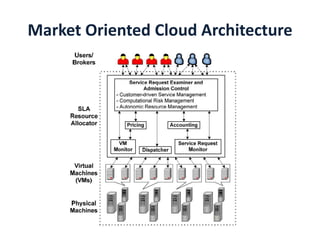
Market Oriented Cloud Architecture
• Users/Brokers :
  – Submit service request from any where in the
    world.
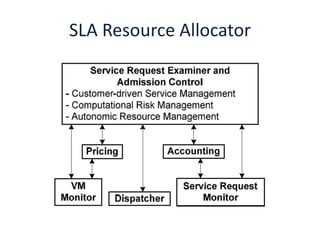
• SLA Resource Allocator :
  – Interface between cloud provider and users.
SLA Resource Allocator
Emerging Cloud Platforms
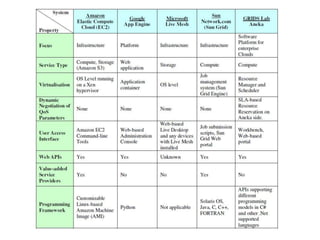
Amazon EC2

•   Elastic Compute Cloud (EC2)
•   Amazon Machine Image (AMI)
•   EC2 Uses XEN Virtual Machine
•   Virtual Os :Linux, Solaris, Windows
•   Simple Storage Service
•   Elastic IP address
•   Amazon Cloud Watch
•   Realiability
Google App Engine

• For developing and hosting web application in
  google managed datacenter
• Automatic scaling*
• Free up to certain level of consumption
• Support for python, java, and Go
• Restrictions
Microsoft Live Mesh
• Access stuffs on your computer from almost
  anywhere
• Free to use internet based file synchronization
  application
• Remote desktop access via internet
Sun Grid
• Now Know as oracle Grid
• Open source batch queuing system
• Used on computer farm or high performance
  computing cluster
Global Cloud Exchange and Markets
Limitations of present service
               providers
• Inflexible pricing
• Consumers are restricted to offering from a
  single provider at a time
• Unable to swap one provider for another
• No standard interface
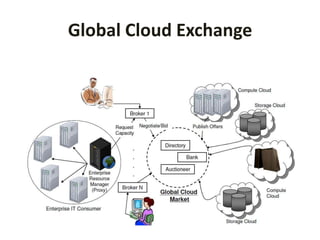
Global Cloud Exchange
•   Market directory
•   Banking system
•   Brokers
•   Price setting mechanism
•   Admission control mechanism
•   Resource management system
•   Consumers utility function
•   Resource management proxy
Challenges
• Unwillingness to shift from traditional
  controlled environment
• Regulatory pressure
• How to obtain restitution in case of SLA
  violation

Market oriented Cloud Computing

  • 1.
    Vision, Hype, andReality for delivering IT Services as Computing Utilities Presented by Jithin P
  • 2.
    Agenda • Introduction • Market Oriented Cloud Architecture • Emerging Cloud Platforms • Global Cloud Exchange and Markets • Summary
  • 3.
    Introduction “As of now,computer networks are still in their infancy, but as they grow up and become sophisticated, we will probably see the spread of ‘computer utilities’ which, like present electric and telephone utilities, will service individual homes and offices across the country.” Leonard Kleinrock
  • 4.
    Introduction • New ComputingParadigms – Cluster Computing – Grid Computing – P2P Computing – Service Computing – Cloud Computing
  • 5.
    Cloud "A Cloud isa type of parallel and distributed system consisting of a collection of interconnected and virtualised computers that are dynamically provisioned and presented as one or more unified computing resources based on service-level agreements established through negotiation between the service provider and consumers.”
  • 6.
    Market Oriented CloudArchitecture • Need – Consumers will require different QoS to be maintained by their providers. – Providers will need to consider and meet different QoS parameter of each individual consumer – So market oriented resource management is necessary to regulate the supply and demand cloud resources at market equilibrium.
  • 7.
  • 8.
    Market Oriented CloudArchitecture • Users/Brokers : – Submit service request from any where in the world. • SLA Resource Allocator : – Interface between cloud provider and users.
  • 9.
  • 10.
  • 11.
    Amazon EC2 • Elastic Compute Cloud (EC2) • Amazon Machine Image (AMI) • EC2 Uses XEN Virtual Machine • Virtual Os :Linux, Solaris, Windows • Simple Storage Service • Elastic IP address • Amazon Cloud Watch • Realiability
  • 12.
    Google App Engine •For developing and hosting web application in google managed datacenter • Automatic scaling* • Free up to certain level of consumption • Support for python, java, and Go • Restrictions
  • 13.
    Microsoft Live Mesh •Access stuffs on your computer from almost anywhere • Free to use internet based file synchronization application • Remote desktop access via internet
  • 14.
    Sun Grid • NowKnow as oracle Grid • Open source batch queuing system • Used on computer farm or high performance computing cluster
  • 16.
  • 17.
    Limitations of presentservice providers • Inflexible pricing • Consumers are restricted to offering from a single provider at a time • Unable to swap one provider for another • No standard interface
  • 18.
  • 19.
    Global Cloud Exchange • Market directory • Banking system • Brokers • Price setting mechanism • Admission control mechanism • Resource management system • Consumers utility function • Resource management proxy
  • 20.
    Challenges • Unwillingness toshift from traditional controlled environment • Regulatory pressure • How to obtain restitution in case of SLA violation

Editor's Notes

  • #4 Explane to get electrical power in home ………………………….
  • #5 Explane notes
  • #7 As consumers rely on Cloud providers to supply alltheir computing needs, they will require specific QoSto be maintained by their providers in order to meettheir objectives and sustain their operations. Cloudproviders will need to consider and meet different QoSparameters of each individual consumer as negotiatedin specific SLAs. To achieve this, Cloud providers canno longer continue to deploy traditional system-centricresource management architecture that do not provideincentives for them to share their resources and stillregard all service requests to be of equal importance.Instead, market-oriented resource management [7] isnecessary to regulate the supply and demand of Cloudresources at market equilibrium, provide feedback interms of economic incentives for both Cloudconsumers and providers, and promote QoS-basedresource allocation mechanisms that differentiateservice requests based on their utility.
  • #9 Service level agreement
  • #10 ExplaneQoS requirements cannot be static andneed to be dynamically updated over time due tocontinuing changes in business operations andoperating environments. In short, there should begreater importance on customers since they pay foraccessing services in Clouds. In addition, the state-ofthe-art in Cloud computing has no or limited supportfor dynamic negotiation of SLAs between participantsand mechanisms for automatic allocation of resourcesto multiple competing requests.
  • #12 Focus on platfrom