An Introduction of Simple Network Management Protocol www.sriinduit.blogspot.com
Introduction SNMP Architecture Goals of Architecture Motivation Five basic messages Message Information Base Transport Protocol Tools use SNMP SNMP advantages/disadvantages Summary Outline:
Introduction: The Internet is : -  a world-wide network of networks Basically use Transmission Control Protocol/Internet Protocol (TCP/IP). However, bad things always come alone with positive aspects:
Introduction (cont’d): As an enterprise networks grow in scale, two facts will become painfully evident: •  The network and its associated resources become crucial to the organization; and •  Many things can go wrong, thereby disabling the network or a portion of it, or degrading performance to an unacceptable level . SNMP is a key Internet Standard
Introduction (cont’d): Internet Activities Board (IAB) recommends: SNMP is used to manage nodes Part of the Transmission Control Protocol/Internet Protocol (TCP/IP) Enables administrators to manage network performance, find and solve network problems, and plan for growth
Wondering: How does SNMP work in networks? Why IAB recommends SNMP?  Are there any SNMP disadvantages?
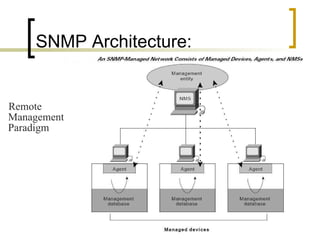
SNMP Architecture:  Remote Management Paradigm
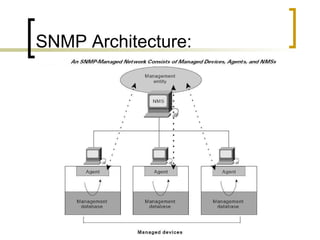
SNMP Architecture: A  managed device   (network elements): A network node ---   contains an SNMP agent; resides on a managed network . Purpose: Collect and store management information and make it available to NMSs using SNMP.  E.g: routers and access servers, switches and bridges, hubs, computer hosts, or printers.
SNMP Architecture: An  agent: A network-management software module that resides in a managed device.  Has local knowledge of management information  Translates that information into a form compatible with SNMP
SNMP Architecture: An  NMS  (Network management station): Executes applications that monitor and control managed devices.  Provides the bulk of the processing and memory resources required for network management.
SNMP Architecture:
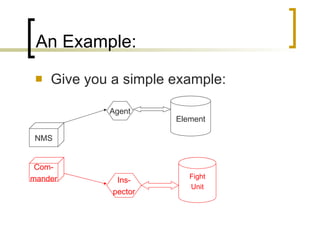
An Example: Give you a simple example: Com- mander NMS Agent Ins- pector Element Fight Unit
Goals of the Architecture: The development cost for  management agent software necessary to support the protocol is reduced; Increasing the degree of management function; E.g: supply additional aspects of network operation and management. Simplified sets of management functions are easily understood.
Motivation: No details about interaction between the management application and managed element It’s impossible to create a list of element management operation that remain new technologies. Two basic commands and allow parameters to specify all the details: Read / Write
In summary,  Management information  NMS  Agents (In the network elements) How can a Message be exchanged? Motivation:
Five basic messages: Get, GetNext, GetResponse, Set, and Trap; (Next slide) Communicate between the manager and the agent.
Five basic messages: Get and GetNext messages : Manager to request information for a specific variable. Agent issue a GetResponse message Set message: Manager request a change be made to the value of a specific variable Trap message: Agent to spontaneously inform the manager of an ‘important’ event. (Report alarm)
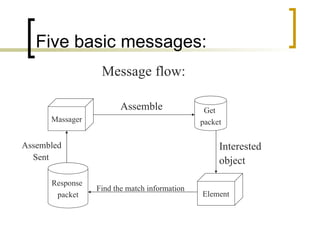
Five basic messages: Message flow: Massager Element Get  packet Response  packet Assemble Interested object Find the match information Assembled Sent
Five basic messages: Most of messages (Get, GetNext and Set) are only issued by manager; Only “Trap” initiated by an agent; Agent software generates traps Traps are asynchronous A manager configures a network element to generate SNMP Trap message by specifying a set of conditions Trap massages provide the basis for automated event monitoring
Introduction Motivation SNMP Architecture SNMP Message Exchanges Five basic messages Message Information Base Transport Protocol Tools use SNMP SNMP advantages/disadvantages Summary Outline:
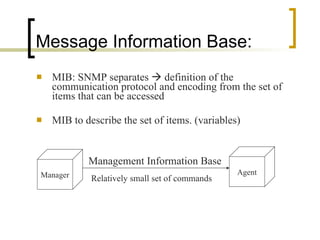
Message Information Base: MIB: SNMP separates    definition of the communication protocol and encoding from the set of items that can be accessed MIB to describe the set of items. (variables) Manager Agent Management Information Base Relatively small set of commands
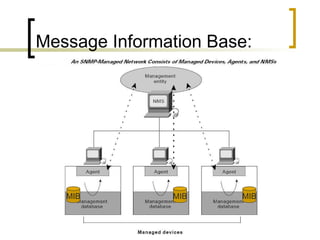
Message Information Base: MIB MIB MIB
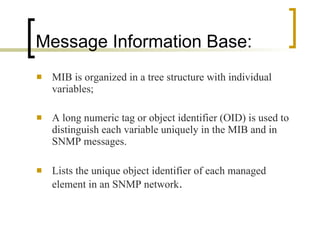
Message Information Base: MIB is organized in a tree structure with individual variables; A long numeric tag or object identifier (OID) is used to distinguish each variable uniquely in the MIB and in SNMP messages. Lists the unique object identifier of each managed element in an SNMP network .
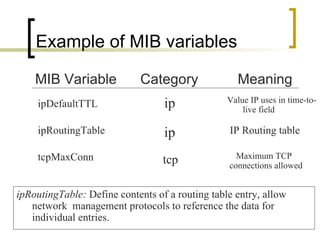
Example of MIB variables MIB Variable  Category  Meaning ipDefaultTTL tcpMaxConn IP Routing table ip ip Value IP uses in time-to-live field ipRoutingTable tcp Maximum TCP connections allowed ipRoutingTable:  Define contents of a routing table entry, allow  network  management protocols to reference the data for individual entries.
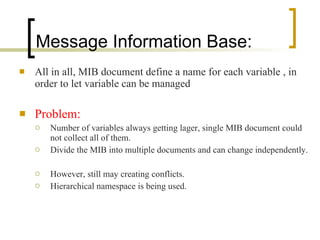
Message Information Base: All in all, MIB document define a name for each variable , in order to let variable can be managed Problem: Number of variables always getting lager, single MIB document could not collect all of them.  Divide the MIB into multiple documents and can change independently. However, still may creating conflicts.  Hierarchical namespace is being used.
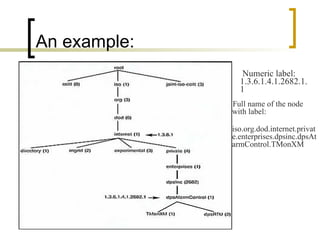
An example: Numeric label: 1.3.6.1.4.1.2682.1.1 Full name of the node with label:  iso.org.dod.internet.private.enterprises.dpsinc.dpsAtarmControl.TMonXM
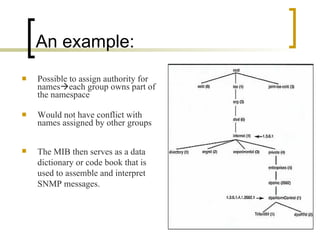
An example: Possible to assign authority for names  each group owns part of the namespace Would not have conflict with names assigned by other groups The MIB then serves as a data dictionary or code book that is used to assemble and interpret SNMP messages.
Message Information Base: Good thing: Guarantee MIB variable names would not conflict with other identifiers Bad things: Naming scheme arises from the length of variables names
Message Information Base: Many items must be managed consist of complex data aggregate that contain multiple values Solution for complex data aggregate:   MIB naming scheme includes a  table construct , data aggregate in which all items are the same or an aggregate in items differ. E.g: A table corresponds to the physical interfaces in a network element
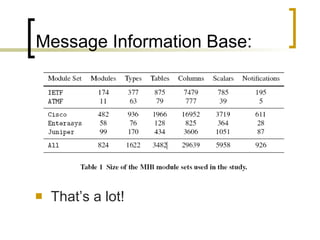
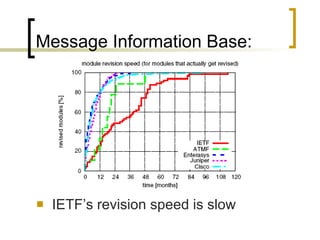
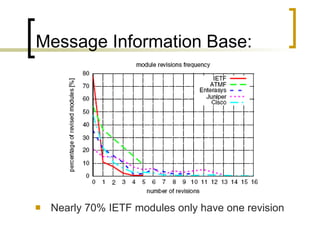
Message Information Base: Reality, what is real situation of MIB module is being used: Here is an example:  Five MIB module sets developed and  maintained by five different organizations
Message Information Base: That’s a lot!
Message Information Base: IETF’s revision speed is slow
Message Information Base: Nearly 70% IETF modules only have one revision
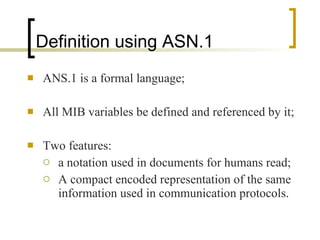
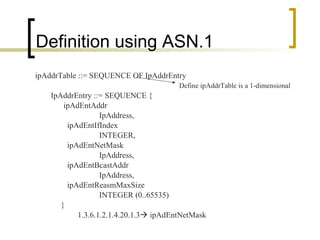
Definition using ASN.1 ANS.1 is a formal language; All MIB variables be defined and referenced by it; Two features:  a notation used in documents for humans read; A compact encoded representation of the same information used in communication protocols.
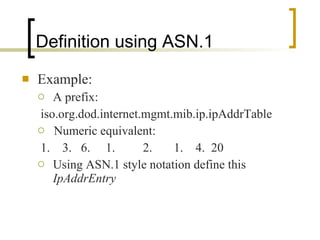
Definition using ASN.1 Example: A prefix: iso.org.dod.internet.mgmt.mib.ip.ipAddrTable Numeric equivalent: 1.  3.  6.  1.  2.  1.  4.  20 Using ASN.1 style notation define this  IpAddrEntry
Definition using ASN.1 ipAddrTable ::= SEQUENCE OF IpAddrEntry IpAddrEntry ::= SEQUENCE { ipAdEntAddr IpAddress, ipAdEntIfIndex INTEGER, ipAdEntNetMask IpAddress, ipAdEntBcastAddr IpAddress, ipAdEntReasmMaxSize INTEGER (0..65535)   } 1.3.6.1.2.1.4.20.1.3   ipAdEntNetMask Define ipAddrTable is a 1-dimensional
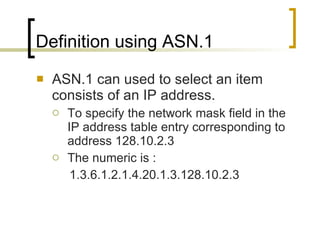
Definition using ASN.1 ASN.1 can used to select an item consists of an IP address. To specify the network mask field in the IP address table entry corresponding to address 128.10.2.3 The numeric is : 1.3.6.1.2.1.4.20.1.3.128.10.2.3
Introduction Motivation SNMP Architecture SNMP Message Exchanges Five basic messages Message Information Base Transport Protocol Tools use SNMP SNMP advantages/disadvantages Summary Outline:
Transport Protocol: SNMP allows the use of either UDP or TCP Management software can either send message in a separate UDP packet or open a TCP connection. The software can handles each message independently.
Tools use SNMP: Provide a high-level interface  Hide the details of MIB variables SNMP massages Easy to understand, manager prefer Provide a low-level interface Manager can form and send a message (commands) Add a new device in network before HL management tools are installed.
SNMP advantages:  Simple design & implementation  users to easily program variables that they want to monitor  Expansibility Protocol can be updated to meet future needs.
SNMP Disadvantages:  Security gaps Intruders access to the information carried along the network  SNMP version 2 has fixed some security issues Not a particularly efficient protocol Bandwidth is wasted with needless information   E.g:SNMP version multiple length
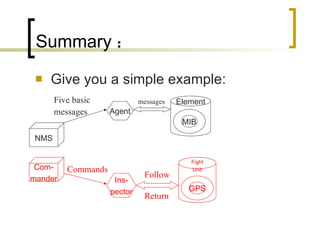
Summary : Give you a simple example: Com- mander NMS Agent Ins- pector Element Fight Unit GPS MIB Five basic  messages Commands Follow messages Return
Summary: SNMP is the most popular network management protocol in the TCP/IP protocol suite .  SNMP is a simple request/response protocol that communicates management information between  managers  and  agents . MIB is used to define the set of variables. Variables are described using ASN.1
References: [1]  J.Case, M.Fedor,  “ A Simple Network Management Protocol (SNMP)”, RFC 1157, May 1990. [2] “ Simple Network Management Protocol ”,  Internetworking Technologies Handbook, Chapter 56. [3]  J. Schonwalder,   “Characterization of SNMP MIB Modules”, International   University Bremen [4]  Comer, D., “Automated Network Management Systems”, Prentice Hall, 2006 [5]  “http://nislab.bu.edu/sc546/sc441Spring2003/snmp/howSNMPworks.html”  [6] “ http://www.wtcs.org/snmp4tpc/snmp.htm ”
Thank you ! Any Comments? The End
Update, Messages, Atomicity SNMP guarantees that either all Set commands in a given message must succeed or none of them should be performed. E.g: Management software sends Set requests to multiple elements: succeed or fail
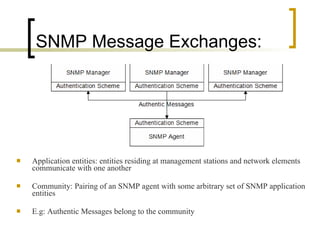
SNMP Message Exchanges: Application entities: entities residing at management stations and network elements communicate with one another Community: Pairing of an SNMP agent with some arbitrary set of SNMP application entities E.g: Authentic Messages belong to the community
Elements of the Architecture: The scope and representation of the management information communicated by the protocol; Operations on management information supported by the protocol; The form and meaning of exchanges among management entities; The definition of administrative relationships among management entities,  The form and meaning of references to management information
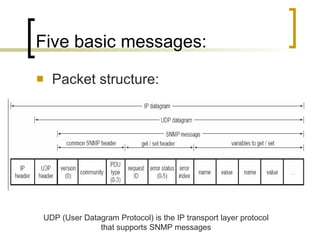
Five basic messages: Packet structure:  UDP (User Datagram Protocol) is the IP transport layer protocol that supports SNMP messages

Snmpv3

  • 1.
    An Introduction ofSimple Network Management Protocol www.sriinduit.blogspot.com
  • 2.
    Introduction SNMP ArchitectureGoals of Architecture Motivation Five basic messages Message Information Base Transport Protocol Tools use SNMP SNMP advantages/disadvantages Summary Outline:
  • 3.
    Introduction: The Internetis : - a world-wide network of networks Basically use Transmission Control Protocol/Internet Protocol (TCP/IP). However, bad things always come alone with positive aspects:
  • 4.
    Introduction (cont’d): Asan enterprise networks grow in scale, two facts will become painfully evident: • The network and its associated resources become crucial to the organization; and • Many things can go wrong, thereby disabling the network or a portion of it, or degrading performance to an unacceptable level . SNMP is a key Internet Standard
  • 5.
    Introduction (cont’d): InternetActivities Board (IAB) recommends: SNMP is used to manage nodes Part of the Transmission Control Protocol/Internet Protocol (TCP/IP) Enables administrators to manage network performance, find and solve network problems, and plan for growth
  • 6.
    Wondering: How doesSNMP work in networks? Why IAB recommends SNMP? Are there any SNMP disadvantages?
  • 7.
    SNMP Architecture: Remote Management Paradigm
  • 8.
    SNMP Architecture: A managed device (network elements): A network node ---  contains an SNMP agent; resides on a managed network . Purpose: Collect and store management information and make it available to NMSs using SNMP. E.g: routers and access servers, switches and bridges, hubs, computer hosts, or printers.
  • 9.
    SNMP Architecture: An agent: A network-management software module that resides in a managed device. Has local knowledge of management information Translates that information into a form compatible with SNMP
  • 10.
    SNMP Architecture: An NMS (Network management station): Executes applications that monitor and control managed devices. Provides the bulk of the processing and memory resources required for network management.
  • 11.
  • 12.
    An Example: Giveyou a simple example: Com- mander NMS Agent Ins- pector Element Fight Unit
  • 13.
    Goals of theArchitecture: The development cost for management agent software necessary to support the protocol is reduced; Increasing the degree of management function; E.g: supply additional aspects of network operation and management. Simplified sets of management functions are easily understood.
  • 14.
    Motivation: No detailsabout interaction between the management application and managed element It’s impossible to create a list of element management operation that remain new technologies. Two basic commands and allow parameters to specify all the details: Read / Write
  • 15.
    In summary, Management information NMS Agents (In the network elements) How can a Message be exchanged? Motivation:
  • 16.
    Five basic messages:Get, GetNext, GetResponse, Set, and Trap; (Next slide) Communicate between the manager and the agent.
  • 17.
    Five basic messages:Get and GetNext messages : Manager to request information for a specific variable. Agent issue a GetResponse message Set message: Manager request a change be made to the value of a specific variable Trap message: Agent to spontaneously inform the manager of an ‘important’ event. (Report alarm)
  • 18.
    Five basic messages:Message flow: Massager Element Get packet Response packet Assemble Interested object Find the match information Assembled Sent
  • 19.
    Five basic messages:Most of messages (Get, GetNext and Set) are only issued by manager; Only “Trap” initiated by an agent; Agent software generates traps Traps are asynchronous A manager configures a network element to generate SNMP Trap message by specifying a set of conditions Trap massages provide the basis for automated event monitoring
  • 20.
    Introduction Motivation SNMPArchitecture SNMP Message Exchanges Five basic messages Message Information Base Transport Protocol Tools use SNMP SNMP advantages/disadvantages Summary Outline:
  • 21.
    Message Information Base:MIB: SNMP separates  definition of the communication protocol and encoding from the set of items that can be accessed MIB to describe the set of items. (variables) Manager Agent Management Information Base Relatively small set of commands
  • 22.
  • 23.
    Message Information Base:MIB is organized in a tree structure with individual variables; A long numeric tag or object identifier (OID) is used to distinguish each variable uniquely in the MIB and in SNMP messages. Lists the unique object identifier of each managed element in an SNMP network .
  • 24.
    Example of MIBvariables MIB Variable Category Meaning ipDefaultTTL tcpMaxConn IP Routing table ip ip Value IP uses in time-to-live field ipRoutingTable tcp Maximum TCP connections allowed ipRoutingTable: Define contents of a routing table entry, allow network management protocols to reference the data for individual entries.
  • 25.
    Message Information Base:All in all, MIB document define a name for each variable , in order to let variable can be managed Problem: Number of variables always getting lager, single MIB document could not collect all of them. Divide the MIB into multiple documents and can change independently. However, still may creating conflicts. Hierarchical namespace is being used.
  • 26.
    An example: Numericlabel: 1.3.6.1.4.1.2682.1.1 Full name of the node with label: iso.org.dod.internet.private.enterprises.dpsinc.dpsAtarmControl.TMonXM
  • 27.
    An example: Possibleto assign authority for names  each group owns part of the namespace Would not have conflict with names assigned by other groups The MIB then serves as a data dictionary or code book that is used to assemble and interpret SNMP messages.
  • 28.
    Message Information Base:Good thing: Guarantee MIB variable names would not conflict with other identifiers Bad things: Naming scheme arises from the length of variables names
  • 29.
    Message Information Base:Many items must be managed consist of complex data aggregate that contain multiple values Solution for complex data aggregate: MIB naming scheme includes a table construct , data aggregate in which all items are the same or an aggregate in items differ. E.g: A table corresponds to the physical interfaces in a network element
  • 30.
    Message Information Base:Reality, what is real situation of MIB module is being used: Here is an example: Five MIB module sets developed and maintained by five different organizations
  • 31.
  • 32.
    Message Information Base:IETF’s revision speed is slow
  • 33.
    Message Information Base:Nearly 70% IETF modules only have one revision
  • 34.
    Definition using ASN.1ANS.1 is a formal language; All MIB variables be defined and referenced by it; Two features: a notation used in documents for humans read; A compact encoded representation of the same information used in communication protocols.
  • 35.
    Definition using ASN.1Example: A prefix: iso.org.dod.internet.mgmt.mib.ip.ipAddrTable Numeric equivalent: 1. 3. 6. 1. 2. 1. 4. 20 Using ASN.1 style notation define this IpAddrEntry
  • 36.
    Definition using ASN.1ipAddrTable ::= SEQUENCE OF IpAddrEntry IpAddrEntry ::= SEQUENCE { ipAdEntAddr IpAddress, ipAdEntIfIndex INTEGER, ipAdEntNetMask IpAddress, ipAdEntBcastAddr IpAddress, ipAdEntReasmMaxSize INTEGER (0..65535) } 1.3.6.1.2.1.4.20.1.3  ipAdEntNetMask Define ipAddrTable is a 1-dimensional
  • 37.
    Definition using ASN.1ASN.1 can used to select an item consists of an IP address. To specify the network mask field in the IP address table entry corresponding to address 128.10.2.3 The numeric is : 1.3.6.1.2.1.4.20.1.3.128.10.2.3
  • 38.
    Introduction Motivation SNMPArchitecture SNMP Message Exchanges Five basic messages Message Information Base Transport Protocol Tools use SNMP SNMP advantages/disadvantages Summary Outline:
  • 39.
    Transport Protocol: SNMPallows the use of either UDP or TCP Management software can either send message in a separate UDP packet or open a TCP connection. The software can handles each message independently.
  • 40.
    Tools use SNMP:Provide a high-level interface Hide the details of MIB variables SNMP massages Easy to understand, manager prefer Provide a low-level interface Manager can form and send a message (commands) Add a new device in network before HL management tools are installed.
  • 41.
    SNMP advantages: Simple design & implementation users to easily program variables that they want to monitor Expansibility Protocol can be updated to meet future needs.
  • 42.
    SNMP Disadvantages: Security gaps Intruders access to the information carried along the network SNMP version 2 has fixed some security issues Not a particularly efficient protocol Bandwidth is wasted with needless information E.g:SNMP version multiple length
  • 43.
    Summary : Giveyou a simple example: Com- mander NMS Agent Ins- pector Element Fight Unit GPS MIB Five basic messages Commands Follow messages Return
  • 44.
    Summary: SNMP isthe most popular network management protocol in the TCP/IP protocol suite . SNMP is a simple request/response protocol that communicates management information between managers and agents . MIB is used to define the set of variables. Variables are described using ASN.1
  • 45.
    References: [1] J.Case, M.Fedor, “ A Simple Network Management Protocol (SNMP)”, RFC 1157, May 1990. [2] “ Simple Network Management Protocol ”, Internetworking Technologies Handbook, Chapter 56. [3] J. Schonwalder, “Characterization of SNMP MIB Modules”, International University Bremen [4] Comer, D., “Automated Network Management Systems”, Prentice Hall, 2006 [5] “http://nislab.bu.edu/sc546/sc441Spring2003/snmp/howSNMPworks.html” [6] “ http://www.wtcs.org/snmp4tpc/snmp.htm ”
  • 46.
    Thank you !Any Comments? The End
  • 47.
    Update, Messages, AtomicitySNMP guarantees that either all Set commands in a given message must succeed or none of them should be performed. E.g: Management software sends Set requests to multiple elements: succeed or fail
  • 48.
    SNMP Message Exchanges:Application entities: entities residing at management stations and network elements communicate with one another Community: Pairing of an SNMP agent with some arbitrary set of SNMP application entities E.g: Authentic Messages belong to the community
  • 49.
    Elements of theArchitecture: The scope and representation of the management information communicated by the protocol; Operations on management information supported by the protocol; The form and meaning of exchanges among management entities; The definition of administrative relationships among management entities, The form and meaning of references to management information
  • 50.
    Five basic messages:Packet structure: UDP (User Datagram Protocol) is the IP transport layer protocol that supports SNMP messages