Cloud
computing
DIVYA MAURYA
CSE 2ND YEAR
INTRODUCTION
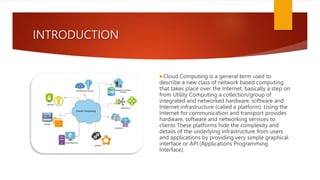
Cloud Computing is a general term used to
describe a new class of network based computing
that takes place over the Internet, basically a step on
from Utility Computing a collection/group of
integrated and networked hardware, software and
Internet infrastructure (called a platform). Using the
Internet for communication and transport provides
hardware, software and networking services to
clients These platforms hide the complexity and
details of the underlying infrastructure from users
and applications by providing very simple graphical
interface or API (Applications Programming
Interface).
What is Cloud
Computing?
 In addition, the platform provides on demand services,
that are always on, anywhere, anytime and any place.
Pay for use and as needed, elastic scale up and down in
capacity and functionalities The hardware and software
services are available to general public, enterprises,
corporations and businesses markets
 Cloud computing is an umbrella term used to refer to
Internet based development and services A number of
characteristics define cloud data, applications services
and infrastructure: Remotely hosted: Services or data
are hosted on remote infrastructure. Ubiquitous:
Services or data are available from anywhere.
Commodified: The result is a utility computing model
similar to traditional that of traditional utilities, like gas
and electricity - you pay for what you would want!
What is Cloud
Computing?
 Many companies are delivering services from the cloud. Some
notable examples include the following: ' Google — Has a
private cloud that it uses for delivering Google Docs and many
other services to its users, including email access, document
applications, text translations, maps, web analytics, and much
more. ' Microsoft — Has Microsoft@ Office 3650 online service
that allows for content and business intelligence tools to be
moved into the cloud, and Microsoft currently makes its office
applications available in a cloud. ' Salesforce.com — Runs its
application set for its customers in a cloud, and its Force.com
and Vmforce.com products provide developers with platforms to
build customized cloud services.
Basic Concepts
There are certain services and models working behind the
scene making the cloud computing feasible and accessible to
end users. Following are the working models for cloud
computing:
• Deployment Models
• Service Models
Deployment Models
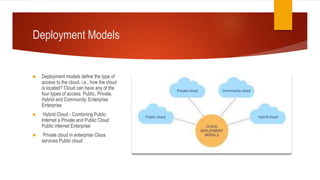
 Deployment models define the type of
access to the cloud, i.e., how the cloud
is located? Cloud can have any of the
four types of access: Public, Private,
Hybrid and Community. Enterprise
Enterprise
 Hybrid Cloud - Combining Public
Internet a Private and Public Cloud
Public internet Enterprise
 Private cloud in enterprise Clous
services Public cloud
Deployment Models
• PUBLIC CLOUD : The Public Cloud allows systems and services to be easily
accessible to the general public. Public cloud may be less secure because of its
openness, e.g., e-mail.
• PRIVATE CLOUD : The Private Cloud allows systems and services to be accessible
within an organization. It offers increased security because of its private nature.
• COMMUNITY CLOUD : The Community Cloud allows systems and services to be
accessible by group of organizations.
• HYBRID CLOUD : The Hybrid Cloud is mixture of public and private cloud.
However, the critical activities are performed using private cloud while the non-
critical activities are performed using public cloud.
Service models
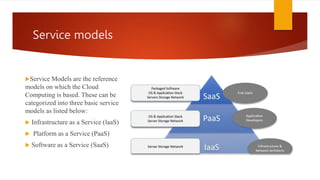
Service Models are the reference
models on which the Cloud
Computing is based. These can be
categorized into three basic service
models as listed below:
 Infrastructure as a Service (laaS)
 Platform as a Service (PaaS)
 Software as a Service (SaaS)
Infrastructure as a
Service (laaS)
 laaS is the delivery of
technology infrastructure as an
on demand scalable service.
laaS provides access to
fundamental resources such as
physical machines, virtual
machines, virtual storage, etc. ‘
 Usually billed based on usage
 Usually multi tenant
virtualized environment
 Can be coupled with Managed
Services for OS and
application support
Platform as a Service
 Platform as a Service (PaaS) the
runtime environment for applications,
PaaS provides development &
deployment tools, etc. PaaS provides
all of the facilities required to support
the complete life cycle of building and
delivering web applications and
services entirely from the Internet.
 Typically applications must be
developed with a particular platform in
mind. ‘
 Multi tenant environments ‘
 Highly scalable multi tier architecture
Software as a Service (SaaS)
Software as a Service (SaaS) SaaS model allows to
use software applications as a service to end users.
SaaS is a software delivery methodology that
provides licensed multi-tenant access to software
and its functions remotely as a
 Web-based service. ‘
 Usually billed based on usage Usually multi
tenant environment
 Highly scalable architecture
 Cloud computing enables companies and applications,
which are system infrastructure dependent, to be
infrastructure-less.
 By using the Cloud infrastructure on
 "pay as used and on demand", all of us can save in
capital and operational investment!
 Clients can:
 Put their data on the platform instead of on their own
desktop PCs and/or on their own servers.
 They can put their applications on the cloud and use the
servers within the cloud to do processing and data
manipulations etc.
purpose
And
benefits?
Opportunities and Challenges
There are also issues relating to policy and access:
If your data is stored abroad whose policy do you adhere to?
What happens if the remote server goes down?
How will you then access files?
There have been cases of users being locked out of accounts and losing access to
data
The Future
•27
•Many of the activities loosely grouped together under cloud computing have already been
happening and centralised computing activity is not a new phenomena Grid Computing was
the last research-led centralised approach However there are concerns that the mainstream
adoption of cloud computing could cause many problems for users Many new open source
systems appearing that you can install and run on your local cluster should be able to run a
variety of applications on these systems
Thanks

cloud.pptx

  • 1.
  • 2.
    INTRODUCTION Cloud Computing isa general term used to describe a new class of network based computing that takes place over the Internet, basically a step on from Utility Computing a collection/group of integrated and networked hardware, software and Internet infrastructure (called a platform). Using the Internet for communication and transport provides hardware, software and networking services to clients These platforms hide the complexity and details of the underlying infrastructure from users and applications by providing very simple graphical interface or API (Applications Programming Interface).
  • 3.
    What is Cloud Computing? In addition, the platform provides on demand services, that are always on, anywhere, anytime and any place. Pay for use and as needed, elastic scale up and down in capacity and functionalities The hardware and software services are available to general public, enterprises, corporations and businesses markets  Cloud computing is an umbrella term used to refer to Internet based development and services A number of characteristics define cloud data, applications services and infrastructure: Remotely hosted: Services or data are hosted on remote infrastructure. Ubiquitous: Services or data are available from anywhere. Commodified: The result is a utility computing model similar to traditional that of traditional utilities, like gas and electricity - you pay for what you would want!
  • 4.
    What is Cloud Computing? Many companies are delivering services from the cloud. Some notable examples include the following: ' Google — Has a private cloud that it uses for delivering Google Docs and many other services to its users, including email access, document applications, text translations, maps, web analytics, and much more. ' Microsoft — Has Microsoft@ Office 3650 online service that allows for content and business intelligence tools to be moved into the cloud, and Microsoft currently makes its office applications available in a cloud. ' Salesforce.com — Runs its application set for its customers in a cloud, and its Force.com and Vmforce.com products provide developers with platforms to build customized cloud services.
  • 5.
    Basic Concepts There arecertain services and models working behind the scene making the cloud computing feasible and accessible to end users. Following are the working models for cloud computing: • Deployment Models • Service Models
  • 6.
    Deployment Models  Deploymentmodels define the type of access to the cloud, i.e., how the cloud is located? Cloud can have any of the four types of access: Public, Private, Hybrid and Community. Enterprise Enterprise  Hybrid Cloud - Combining Public Internet a Private and Public Cloud Public internet Enterprise  Private cloud in enterprise Clous services Public cloud
  • 7.
    Deployment Models • PUBLICCLOUD : The Public Cloud allows systems and services to be easily accessible to the general public. Public cloud may be less secure because of its openness, e.g., e-mail. • PRIVATE CLOUD : The Private Cloud allows systems and services to be accessible within an organization. It offers increased security because of its private nature. • COMMUNITY CLOUD : The Community Cloud allows systems and services to be accessible by group of organizations. • HYBRID CLOUD : The Hybrid Cloud is mixture of public and private cloud. However, the critical activities are performed using private cloud while the non- critical activities are performed using public cloud.
  • 8.
    Service models Service Modelsare the reference models on which the Cloud Computing is based. These can be categorized into three basic service models as listed below:  Infrastructure as a Service (laaS)  Platform as a Service (PaaS)  Software as a Service (SaaS)
  • 9.
    Infrastructure as a Service(laaS)  laaS is the delivery of technology infrastructure as an on demand scalable service. laaS provides access to fundamental resources such as physical machines, virtual machines, virtual storage, etc. ‘  Usually billed based on usage  Usually multi tenant virtualized environment  Can be coupled with Managed Services for OS and application support
  • 10.
    Platform as aService  Platform as a Service (PaaS) the runtime environment for applications, PaaS provides development & deployment tools, etc. PaaS provides all of the facilities required to support the complete life cycle of building and delivering web applications and services entirely from the Internet.  Typically applications must be developed with a particular platform in mind. ‘  Multi tenant environments ‘  Highly scalable multi tier architecture
  • 11.
    Software as aService (SaaS) Software as a Service (SaaS) SaaS model allows to use software applications as a service to end users. SaaS is a software delivery methodology that provides licensed multi-tenant access to software and its functions remotely as a  Web-based service. ‘  Usually billed based on usage Usually multi tenant environment  Highly scalable architecture
  • 12.
     Cloud computingenables companies and applications, which are system infrastructure dependent, to be infrastructure-less.  By using the Cloud infrastructure on  "pay as used and on demand", all of us can save in capital and operational investment!  Clients can:  Put their data on the platform instead of on their own desktop PCs and/or on their own servers.  They can put their applications on the cloud and use the servers within the cloud to do processing and data manipulations etc. purpose And benefits?
  • 13.
    Opportunities and Challenges Thereare also issues relating to policy and access: If your data is stored abroad whose policy do you adhere to? What happens if the remote server goes down? How will you then access files? There have been cases of users being locked out of accounts and losing access to data
  • 14.
    The Future •27 •Many ofthe activities loosely grouped together under cloud computing have already been happening and centralised computing activity is not a new phenomena Grid Computing was the last research-led centralised approach However there are concerns that the mainstream adoption of cloud computing could cause many problems for users Many new open source systems appearing that you can install and run on your local cluster should be able to run a variety of applications on these systems
  • 15.