ACUTE RESPIRATORY ILLNESS      DR.PARTH GURAGAIN
ACUTE RESPIRATORY ILLNESS(ARI)Most commonMajor cause of mortality and morbidity.Can affect anywhere from nose to alveoli.Can be classified intoALRI(Epiglottitis, laryngitis, laryngotrachietis, LTB, bronchitis, bronchiolitis, pneumonia)AURI(Common cold, pharyngitis,otitis media)In less developed countries measles and whooping cough are major cause of Respiratory tract infection.
PROBLEM STATEMENTARI in young children is responsible for 3.9 million death world-wide.Bangladesh,India,Indonesia and Nepal together account for 40% of global mortality.90% of ARI death is due to pneumonia.Most is bacterial in origin.Incidence of pneumonia in developed countries 3-4%, in developing countries 20-30%
ARI in below 5yrs child is responsible for 30-50% of hospital visit..20-40% of hospital admission.It is leading cause of deafness as result of otitis media.
EPIDEMIOLOGICAL DETERMINANTSAgent factorsBacteria   -   Bordetella pertusis   -   Coryneabacterium diptheriae   -   Haemophilus influenzae   -   Klebsiella pneumonia   -   Staphylococcus pyogenes.
Virus- Adenoviruses-endemic types(1,2,5),epidemic type (3,4,7)   - Enterovirus (ECHO and Coxsackie)   - Influenza A,B,C- Measles - RSVOthers- Chlamydia type B-  Coxiella burnetti- Mycoplasma pneumoniae
HOST FACTORSSmall children are most vulnerableFatality more common in young infants, malnourished children, elderly.In developing countries fatality more due to malnutrition and LBW.URTI is more common in children than adults.Illness rate more common in younger children and decreases with increasing age.
At third decade of life there is surge in infection due to cross infection from their children.Women are more affected due to their exposure to small children.
RISK FACTORSClimatic conditionHousingLevel of industrializationOvercrowdingPoor-nutritionLBWIndoor smoke pollutionMaternal smoking
Mode of transmissionAir borne routePerson to Person
CONTROL OF ARIBy improving primary medical care serviceDeveloping better method for:  Early detection
  Treatment
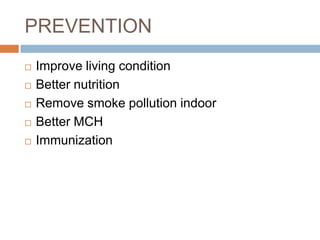
  If possible preventionEducation of mother can be effective tool in reducing mortality and morbidity from ARI.
CLINICAL ASSESMENT  - Access the child condition  - Ask for:AgeDuration of coughIs child able to drink (2mth-5yrs)Has child stopped feeding (<2mths)Had child suffered from any illness (e.g.: measles)Does child have feverIs child excessively drowsyDid child have convulsionIs there irregular breathingShort period of not breathing(apnea)Has child turned blueAny H/O  T/t
PHYSICAL EXAMINATIONCount the breathing in 1 min.Fast breathing present if:RR 60b/min or more for <2mths.
RR 50b/min or more for 2mths to 12mths.
RR 40b/min or more for 12mths to 5yrs.Phy. Exam: contd…..Look for chest indrawingLook and listen for Stridor (is the sound produced while breathing in aka croup)Look for Wheeze (sound produced when breathing out is difficult)Abnormally sleepy and difficult to wake.Feel for fever or low temperature.Check for severe malnutritionLook for cyanosis.
CLASSIFICATION OF ILLNESSA. Child aged 2mths -5yrs 1. Very severe disease 2. Severe Pneumonia 3. Pneumonia 4. No Pneumonia- cough, cold
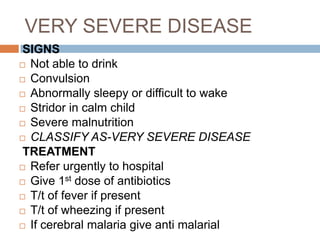
VERY SEVERE DISEASESIGNSNot able to drinkConvulsionAbnormally sleepy or difficult to wakeStridor in calm child Severe malnutritionCLASSIFY AS-VERY SEVERE DISEASE TREATMENTRefer urgently to hospitalGive 1st dose of antibioticsT/t of fever if presentT/t of wheezing if presentIf cerebral malaria give anti malarial
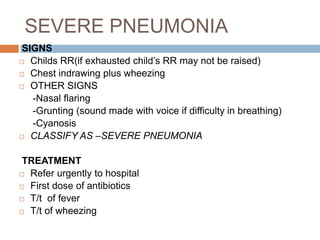
SEVERE PNEUMONIA SIGNSChilds RR(if exhausted child’s RR may not be raised)Chest indrawing plus wheezingOTHER SIGNS     -Nasal flaring     -Grunting (sound made with voice if difficulty in breathing)     -CyanosisCLASSIFY AS –SEVERE PNEUMONIA TREATMENTRefer urgently to hospitalFirst dose of antibioticsT/t  of feverT/t of wheezing
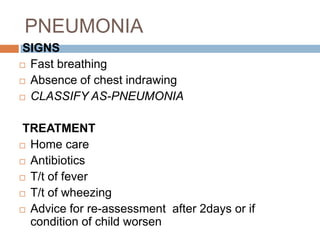
PNEUMONIA SIGNSFast breathingAbsence of chest indrawingCLASSIFY AS-PNEUMONIA TREATMENTHome careAntibioticsT/t of feverT/t of wheezingAdvice for re-assessment  after 2days or if condition of child worsen
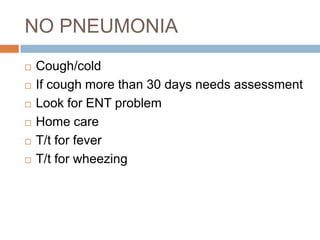
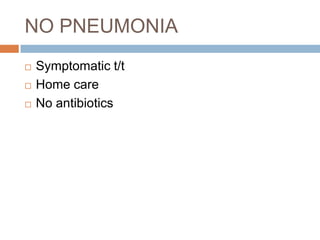
NO PNEUMONIACough/coldIf cough more than 30 days needs assessmentLook for ENT problemHome care T/t for feverT/t for wheezing
B.CLASSIFYING THE ILLNESS IN YOUNG INFANTS(<2MTHS)Signs may be difficult to find in young childrenNon-specific signs as poor feeding, fever,low body temperature,further mild chest indrawing may be present in young infants.CLASSIFIED ASVery severe disease
Severe pneumonia
No pneumoniaVERY SEVERE DISEASE SIGNSStopped feeding wellConvulsionAbnormally sleepy or difficult to wakeStridor in calm childWheezingFever or low body temperatureTREATMENTRefer urgently to hospitalKeep warm Antibiotics
SEVERE PNEUMONIASevere chest indrawingRR 60 OR more TREATMENTRefer urgently Keep warmAntibiotics
NO PNEUMONIA  SIGNSNo severe chest indrawingNo fast breathing TREATMENTKeep warmBreast feedReturn if sick , ↑RR, Difficulty in feeding
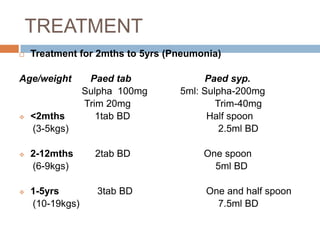
TREATMENTTreatment for 2mths to 5yrs (Pneumonia)Age/weight       Paed tab                           Paed syp.Sulpha  100mg            5ml: Sulpha-200mg                       Trim 20mg                               Trim-40mg<2mths           1tab BD                            Half spoon     (3-5kgs)                                                       2.5ml BD2-12mths        2tab BD                           One spoon     (6-9kgs)                                                      5ml BD1-5yrs              3tab BD                           One and half spoon     (10-19kgs)                                                   7.5ml BD
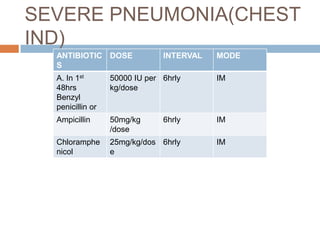
SEVERE PNEUMONIA(CHEST IND)
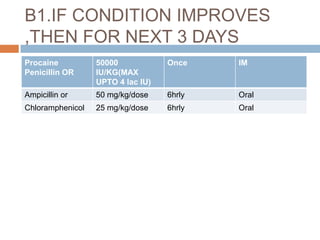
B1.IF CONDITION IMPROVES ,THEN FOR NEXT 3 DAYS
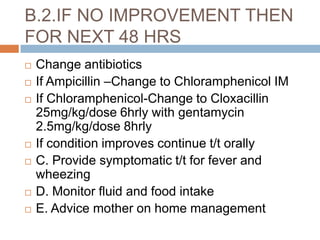
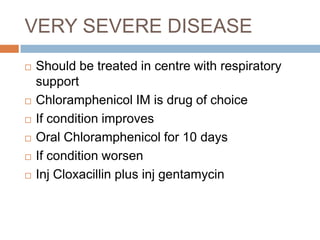
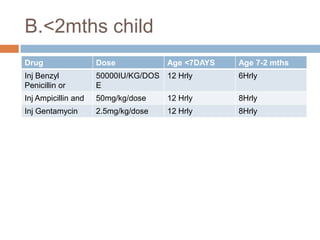
B.2.IF NO IMPROVEMENT THEN FOR NEXT 48 HRSChange antibioticsIf Ampicillin –Change to Chloramphenicol IMIf Chloramphenicol-Change to Cloxacillin 25mg/kg/dose 6hrly with gentamycin 2.5mg/kg/dose 8hrlyIf condition improves continue t/t orallyC. Provide symptomatic t/t for fever and wheezingD. Monitor fluid and food intakeE. Advice mother on home management

Acute Respiratory Illness(Ari)

  • 1.
    ACUTE RESPIRATORY ILLNESS DR.PARTH GURAGAIN
  • 2.
    ACUTE RESPIRATORY ILLNESS(ARI)MostcommonMajor cause of mortality and morbidity.Can affect anywhere from nose to alveoli.Can be classified intoALRI(Epiglottitis, laryngitis, laryngotrachietis, LTB, bronchitis, bronchiolitis, pneumonia)AURI(Common cold, pharyngitis,otitis media)In less developed countries measles and whooping cough are major cause of Respiratory tract infection.
  • 3.
    PROBLEM STATEMENTARI inyoung children is responsible for 3.9 million death world-wide.Bangladesh,India,Indonesia and Nepal together account for 40% of global mortality.90% of ARI death is due to pneumonia.Most is bacterial in origin.Incidence of pneumonia in developed countries 3-4%, in developing countries 20-30%
  • 4.
    ARI in below5yrs child is responsible for 30-50% of hospital visit..20-40% of hospital admission.It is leading cause of deafness as result of otitis media.
  • 5.
    EPIDEMIOLOGICAL DETERMINANTSAgent factorsBacteria - Bordetella pertusis - Coryneabacterium diptheriae - Haemophilus influenzae - Klebsiella pneumonia - Staphylococcus pyogenes.
  • 6.
    Virus- Adenoviruses-endemic types(1,2,5),epidemictype (3,4,7) - Enterovirus (ECHO and Coxsackie) - Influenza A,B,C- Measles - RSVOthers- Chlamydia type B- Coxiella burnetti- Mycoplasma pneumoniae
  • 7.
    HOST FACTORSSmall childrenare most vulnerableFatality more common in young infants, malnourished children, elderly.In developing countries fatality more due to malnutrition and LBW.URTI is more common in children than adults.Illness rate more common in younger children and decreases with increasing age.
  • 8.
    At third decadeof life there is surge in infection due to cross infection from their children.Women are more affected due to their exposure to small children.
  • 9.
    RISK FACTORSClimatic conditionHousingLevelof industrializationOvercrowdingPoor-nutritionLBWIndoor smoke pollutionMaternal smoking
  • 10.
    Mode of transmissionAirborne routePerson to Person
  • 11.
    CONTROL OF ARIByimproving primary medical care serviceDeveloping better method for: Early detection
  • 12.
  • 13.
    Ifpossible preventionEducation of mother can be effective tool in reducing mortality and morbidity from ARI.
  • 14.
    CLINICAL ASSESMENT - Access the child condition - Ask for:AgeDuration of coughIs child able to drink (2mth-5yrs)Has child stopped feeding (<2mths)Had child suffered from any illness (e.g.: measles)Does child have feverIs child excessively drowsyDid child have convulsionIs there irregular breathingShort period of not breathing(apnea)Has child turned blueAny H/O T/t
  • 15.
    PHYSICAL EXAMINATIONCount thebreathing in 1 min.Fast breathing present if:RR 60b/min or more for <2mths.
  • 16.
    RR 50b/min ormore for 2mths to 12mths.
  • 17.
    RR 40b/min ormore for 12mths to 5yrs.Phy. Exam: contd…..Look for chest indrawingLook and listen for Stridor (is the sound produced while breathing in aka croup)Look for Wheeze (sound produced when breathing out is difficult)Abnormally sleepy and difficult to wake.Feel for fever or low temperature.Check for severe malnutritionLook for cyanosis.
  • 18.
    CLASSIFICATION OF ILLNESSA.Child aged 2mths -5yrs 1. Very severe disease 2. Severe Pneumonia 3. Pneumonia 4. No Pneumonia- cough, cold
  • 19.
    VERY SEVERE DISEASESIGNSNotable to drinkConvulsionAbnormally sleepy or difficult to wakeStridor in calm child Severe malnutritionCLASSIFY AS-VERY SEVERE DISEASE TREATMENTRefer urgently to hospitalGive 1st dose of antibioticsT/t of fever if presentT/t of wheezing if presentIf cerebral malaria give anti malarial
  • 20.
    SEVERE PNEUMONIA SIGNSChildsRR(if exhausted child’s RR may not be raised)Chest indrawing plus wheezingOTHER SIGNS -Nasal flaring -Grunting (sound made with voice if difficulty in breathing) -CyanosisCLASSIFY AS –SEVERE PNEUMONIA TREATMENTRefer urgently to hospitalFirst dose of antibioticsT/t of feverT/t of wheezing
  • 21.
    PNEUMONIA SIGNSFast breathingAbsenceof chest indrawingCLASSIFY AS-PNEUMONIA TREATMENTHome careAntibioticsT/t of feverT/t of wheezingAdvice for re-assessment after 2days or if condition of child worsen
  • 22.
    NO PNEUMONIACough/coldIf coughmore than 30 days needs assessmentLook for ENT problemHome care T/t for feverT/t for wheezing
  • 23.
    B.CLASSIFYING THE ILLNESSIN YOUNG INFANTS(<2MTHS)Signs may be difficult to find in young childrenNon-specific signs as poor feeding, fever,low body temperature,further mild chest indrawing may be present in young infants.CLASSIFIED ASVery severe disease
  • 24.
  • 25.
    No pneumoniaVERY SEVEREDISEASE SIGNSStopped feeding wellConvulsionAbnormally sleepy or difficult to wakeStridor in calm childWheezingFever or low body temperatureTREATMENTRefer urgently to hospitalKeep warm Antibiotics
  • 26.
    SEVERE PNEUMONIASevere chestindrawingRR 60 OR more TREATMENTRefer urgently Keep warmAntibiotics
  • 27.
    NO PNEUMONIA SIGNSNo severe chest indrawingNo fast breathing TREATMENTKeep warmBreast feedReturn if sick , ↑RR, Difficulty in feeding
  • 28.
    TREATMENTTreatment for 2mthsto 5yrs (Pneumonia)Age/weight Paed tab Paed syp.Sulpha 100mg 5ml: Sulpha-200mg Trim 20mg Trim-40mg<2mths 1tab BD Half spoon (3-5kgs) 2.5ml BD2-12mths 2tab BD One spoon (6-9kgs) 5ml BD1-5yrs 3tab BD One and half spoon (10-19kgs) 7.5ml BD
  • 29.
  • 30.
    B1.IF CONDITION IMPROVES,THEN FOR NEXT 3 DAYS
  • 31.
    B.2.IF NO IMPROVEMENTTHEN FOR NEXT 48 HRSChange antibioticsIf Ampicillin –Change to Chloramphenicol IMIf Chloramphenicol-Change to Cloxacillin 25mg/kg/dose 6hrly with gentamycin 2.5mg/kg/dose 8hrlyIf condition improves continue t/t orallyC. Provide symptomatic t/t for fever and wheezingD. Monitor fluid and food intakeE. Advice mother on home management