Definition:
• The “unusual” occurrence in a community or
region of disease ,specific health-related
behaviour (smoking) or other health-related
events (traffic accidents) clearly in excess
of “expected occurrence”.
• It implies an imbalance between agent, host &
environment.
Objectives of epidemic
investigation:
• Define magnitude of epidemic outbreak
• Determine particular conditions
responsible for outbreak of epidemic
• Identify cause, source & mode of
transmission to determine measures
necessary for control of epidemic
• Make recommendations for preventing
recurrence
1. Verification of diagnosis:
• First step in epidemic investigation.
• Clinical examination of a sample of cases is useful.
• Laboratory investigation are used for
confirmation of diagnosis.
2. Confirmation of the existence of an
epidemic:
•Compare the disease frequency during the
same period of previous year.
•An epidemic is said to exist when the number
of cases is in excess of the expected frequency
for that population, based on past experience.
3. Defining population at risk:
 Obtaining a map of the area:
Map of the area with natural landmarks, roads
& dwelling units should be prepared.
Area should be divided into segments, using
natural landmarks as boundaries.
 Counting the population:
entire population of the given area according
to age, sex are carried out by house to house
survey.
4. Rapid search for all cases &
their characteristics
• Medical survey should be carried out in the
defined area to identify all cases including
those who have not sought medical care.
• Epidemiological case sheet with data
collected from cases & from persons
apparently exposed but unaffected should be
prepared.
• Searching for more cases by asking patient
if he knew anyone in house or surroundings
with similar symptoms.
5. Data analysis:
• Data collected should be analyzed using
the classical epidemiological parameters
time, place & person.
• Purpose of data analysis is to identify
common event or experience & to delineate
the group involved in the common
experience.
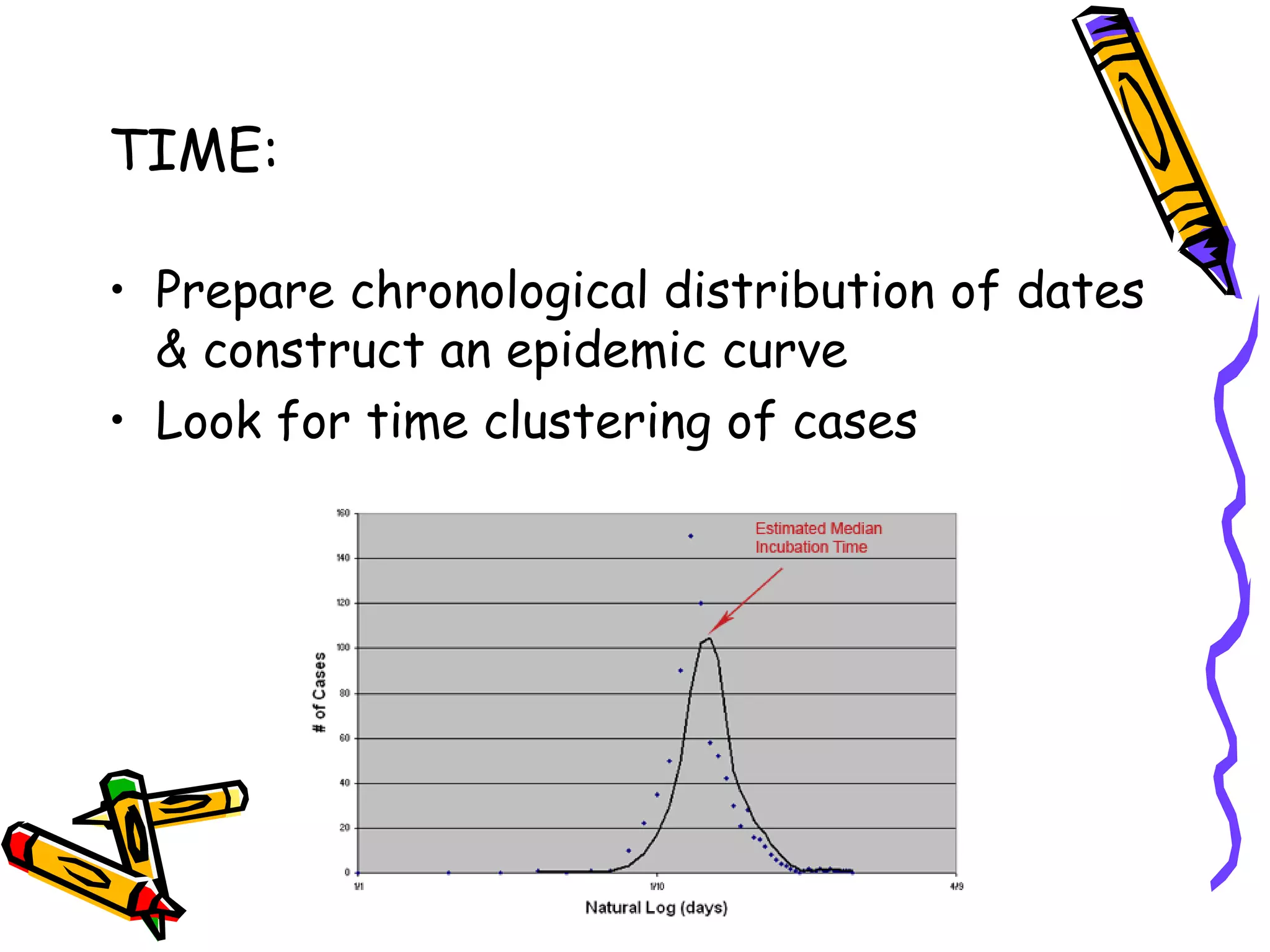
TIME:
• Prepare chronological distribution of dates
& construct an epidemic curve
• Look for time clustering of cases
An epidemic curve suggests
• Time relation with exposure to a
suspected source.
• whether it is a common source or a
propagated epidemic.
• Whether it is a seasonal or cyclic pattern
suggestive of a particular infection.
PLACE:
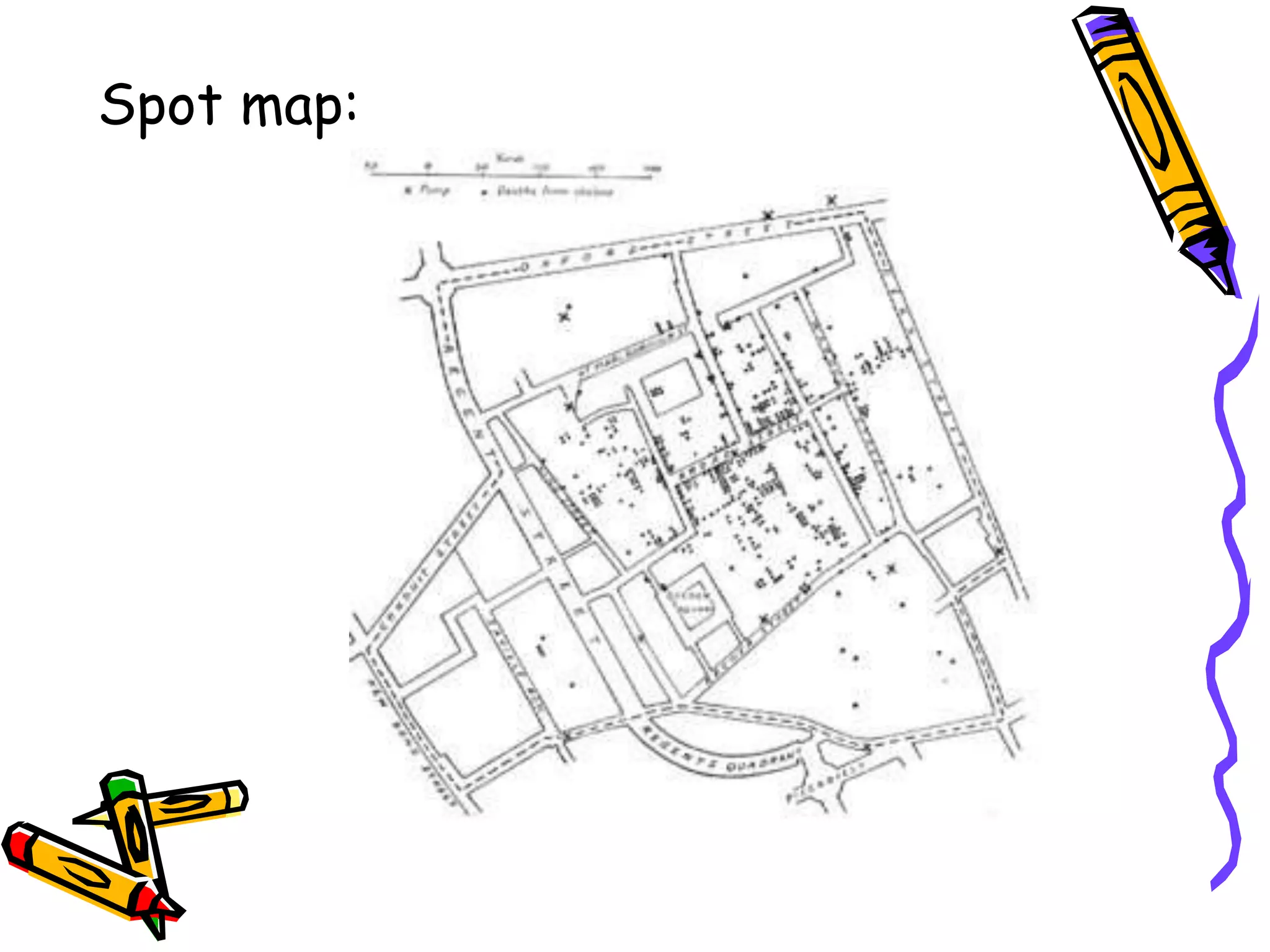
• Prepare a spot map of cases with their
relation to possible source of infection.
Ex: water supply, air pollution, foods eaten,
occupation etc.
• Clustering of cases indicates common
source of infection.
PERSON:
• Analyze the data by age, sex, occupation &
other possible risk factors.
Spot map:
6. Formulation of hypothesis:
• On the basis of time, place & person
distribution or the agent-host-environment
model, formulate hypothesis.
• This explains epidemic in terms of
a) Possible source
b) Causative agent
c) Possible modes of spread
d) Environmental factors which enabled to
occur
7. Testing of hypothesis:
• All reasonable hypotheses need to be
considered & weighed by comparing the
attack rates in various groups for those
exposed & those not exposed ,to each
suspected factor.
This will enable the epidemiologist to
ascertain which hypothesis is consistent
with all the known facts.
8. Evaluation of ecological factors:
• Circumstances involved in transmission of
diseases should be investigated to prevent
further transmission of disease.
• Ecological factors that have made the epidemic
possible should be investigated.
• Primary concern of the epidemiologist is to
relate the disease to environmental factors, to
know the source of infection, reservoirs &
modes of transmission.
9. Further investigation of
population at risk
• Population at risk should be studied to obtain
further information.
• This may involve medical examination, screening
tests, examination of suspected food, faeces,
or blood samples, biochemical studies,
assessment of immunity status, etc.
• This permits classification of all members as to
a) exposure to specific potential vehicle.
b) whether ill or not
10. Writing the report:
1.Background:
geographical location
climatic conditions
demographic status (population
pyramid)
socioeconomic situation
organization of health services
surveillance & early warning systems
normal disease prevalence
2.Historical data:
a) previous occurrence of epidemics
of the same disease
locally or elsewhere
b) occurrence of related disease, if any
in the same area
in other areas
c) discovery of the first case of
present outbreak
3.Methodology of investigation:
case definition
questionnaire used in epidemiological
investigation
survey teams
house hold survey
retrospective survey
prospective surveillance
collection of laboratory specimens
laboratory techniques
4. Analysis of data:
a) clinical data
frequency of signs & symptoms
course of disease
differential diagnosis
death or sequelae rates
b) epidemiological data
mode of occurrence
in time, by place &population groups
c) modes of transmission
source of infection
routes of excretion & portal of entry
factors influencing transmission
d) laboratory data
isolation of agents
serological confirmation
significance of results
e) interpretation of data
comprehensive picture of the out
break.
hypotheses as to cause.
formulation & testing of hypotheses by
statistical analysis.
5. Control measures:
a) definition of strategies & methodology
of implementation
-constrains &
-results
b) evaluation:
-significance of results
-cost / effectiveness
c) preventive measures
investigation of epidemic.ppt

investigation of epidemic.ppt

  • 1.
    Definition: • The “unusual”occurrence in a community or region of disease ,specific health-related behaviour (smoking) or other health-related events (traffic accidents) clearly in excess of “expected occurrence”. • It implies an imbalance between agent, host & environment.
  • 2.
    Objectives of epidemic investigation: •Define magnitude of epidemic outbreak • Determine particular conditions responsible for outbreak of epidemic • Identify cause, source & mode of transmission to determine measures necessary for control of epidemic • Make recommendations for preventing recurrence
  • 3.
    1. Verification ofdiagnosis: • First step in epidemic investigation. • Clinical examination of a sample of cases is useful. • Laboratory investigation are used for confirmation of diagnosis.
  • 4.
    2. Confirmation ofthe existence of an epidemic: •Compare the disease frequency during the same period of previous year. •An epidemic is said to exist when the number of cases is in excess of the expected frequency for that population, based on past experience.
  • 5.
    3. Defining populationat risk:  Obtaining a map of the area: Map of the area with natural landmarks, roads & dwelling units should be prepared. Area should be divided into segments, using natural landmarks as boundaries.  Counting the population: entire population of the given area according to age, sex are carried out by house to house survey.
  • 6.
    4. Rapid searchfor all cases & their characteristics • Medical survey should be carried out in the defined area to identify all cases including those who have not sought medical care. • Epidemiological case sheet with data collected from cases & from persons apparently exposed but unaffected should be prepared. • Searching for more cases by asking patient if he knew anyone in house or surroundings with similar symptoms.
  • 7.
    5. Data analysis: •Data collected should be analyzed using the classical epidemiological parameters time, place & person. • Purpose of data analysis is to identify common event or experience & to delineate the group involved in the common experience.
  • 8.
    TIME: • Prepare chronologicaldistribution of dates & construct an epidemic curve • Look for time clustering of cases
  • 9.
    An epidemic curvesuggests • Time relation with exposure to a suspected source. • whether it is a common source or a propagated epidemic. • Whether it is a seasonal or cyclic pattern suggestive of a particular infection.
  • 10.
    PLACE: • Prepare aspot map of cases with their relation to possible source of infection. Ex: water supply, air pollution, foods eaten, occupation etc. • Clustering of cases indicates common source of infection. PERSON: • Analyze the data by age, sex, occupation & other possible risk factors.
  • 11.
  • 12.
    6. Formulation ofhypothesis: • On the basis of time, place & person distribution or the agent-host-environment model, formulate hypothesis. • This explains epidemic in terms of a) Possible source b) Causative agent c) Possible modes of spread d) Environmental factors which enabled to occur
  • 13.
    7. Testing ofhypothesis: • All reasonable hypotheses need to be considered & weighed by comparing the attack rates in various groups for those exposed & those not exposed ,to each suspected factor. This will enable the epidemiologist to ascertain which hypothesis is consistent with all the known facts.
  • 14.
    8. Evaluation ofecological factors: • Circumstances involved in transmission of diseases should be investigated to prevent further transmission of disease. • Ecological factors that have made the epidemic possible should be investigated. • Primary concern of the epidemiologist is to relate the disease to environmental factors, to know the source of infection, reservoirs & modes of transmission.
  • 15.
    9. Further investigationof population at risk • Population at risk should be studied to obtain further information. • This may involve medical examination, screening tests, examination of suspected food, faeces, or blood samples, biochemical studies, assessment of immunity status, etc. • This permits classification of all members as to a) exposure to specific potential vehicle. b) whether ill or not
  • 16.
    10. Writing thereport: 1.Background: geographical location climatic conditions demographic status (population pyramid) socioeconomic situation organization of health services surveillance & early warning systems normal disease prevalence
  • 17.
    2.Historical data: a) previousoccurrence of epidemics of the same disease locally or elsewhere b) occurrence of related disease, if any in the same area in other areas c) discovery of the first case of present outbreak
  • 18.
    3.Methodology of investigation: casedefinition questionnaire used in epidemiological investigation survey teams house hold survey retrospective survey prospective surveillance collection of laboratory specimens laboratory techniques
  • 19.
    4. Analysis ofdata: a) clinical data frequency of signs & symptoms course of disease differential diagnosis death or sequelae rates b) epidemiological data mode of occurrence in time, by place &population groups
  • 20.
    c) modes oftransmission source of infection routes of excretion & portal of entry factors influencing transmission d) laboratory data isolation of agents serological confirmation significance of results
  • 21.
    e) interpretation ofdata comprehensive picture of the out break. hypotheses as to cause. formulation & testing of hypotheses by statistical analysis.
  • 22.
    5. Control measures: a)definition of strategies & methodology of implementation -constrains & -results b) evaluation: -significance of results -cost / effectiveness c) preventive measures