Ophthalmic Products
Ahmad aljifri
0712797
Anatomy of the Eye
The sclera: The protective outer layer of the eye, referred to as the
“white of the eye” and it maintains the shape of the eye.
The cornea: The front portion of the sclera, is transparent and
allows light to enter the eye. The cornea is a powerful refracting
surface, providing much of the eye's focusing power.
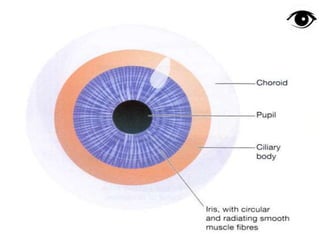
The choroid is the second layer of the eye and lies between the
sclera and the retina. It contains the blood vessels that provide
nourishment to the outer layers of the retina.
The iris is the part of the eye that gives it color. It consists of
muscular tissue that responds to surrounding light, making the
pupil, or circular opening in the center of the iris, larger or smaller
depending on the brightness of the light.
The lens is a transparent, biconvex structure, encased in a thin
transparent covering. The function of the lens is to refract and
focus incoming light onto the retina.
The retina is the innermost layer in the eye. It converts images
into electrical impulses that are sent along the optic nerve to the
brain where the images are interpreted.
The macula is located in the back of the eye, in the center of the
retina. This area produces the sharpest vision.
The inside of the eyeball is divided by the lens into two fluid-filled
sections.
The larger section at the back of the eye is filled with a colorless
gelatinous mass called the vitreous humor.
The smaller section in the front contains a clear, water-like
material called aqueous humor.
The conjunctiva is a mucous membrane that begins at the edge of
the cornea and lines the inside surface of the eyelids and sclera,
which serves to lubricate the eye.
The eye is made of cells that are
called Rods and Cones. Cone cells
are coned shaped and Rod cells
are rod shaped.
Most highly concentrated on the
fovea – an area of the retina that
lacks rods.
Photoreceptors of
the retina:
rod cells - light
sensitive but do
not distinguish
colors.
cone cells - not
as light sensitive
as rods but
provide color
vision
Light energy enters your eye, and the cornea and
lens focus it onto the retina.
b. The light stimulates the rods and cones, two
types of cells found in your retina.
c. The rods and cones send impulses to the optic
nerve, which carries them to the visual area of the
cortex.
d. Your cortex interprets the image and you “see.”
Physiology of Vision
Accommodation is the
focusing of light in the retina.
Mammals focus by changing
the shape of the lens:
-The lens is flattened for
distant objects.
-The lens is rounded for near
objects.
Focusing Light
Accessory organs of Eye
common disorders of the eye can
be self-treated
• Blepharitis: Blepharitis is a common condition
that is caused by inflammation of the eyelid.
• applying hot compresses to the affected eye,
followed by an eyelid scrub.
• Treat with Antibiotic
• Lice: It is common in young school-age
children.
• ointment is applied to the eyelid.
• Contact dermatitis: is an inflammation of
the skin that causes swelling, scaling, or
redness of the eyelid with intense itching.
• triggered by the use of a new product
(soap or makeup) or exposure to a
foreign substance.
• Antihistamines that are taken by mouth.
• Superficial foreign bodies: Lint, dust, an
eyelash, or other foreign matter can
become stuck in the eye. When the
substance cannot easily be removed
either with your finger, water, or an eye
irrigating solution
• Thermal damage: Thermal damage is a burn
injury to the eye itself. Exposure to the sun's
UV radiation during outdoor activities is an
example of minor ocular thermal damage.
• An eye lubricant can be applied to soothe the
eye.
• Conjunctivitis: Bacteria, viruses, fungi, allergic
substances, or inflammation-promoting
agents.
• The inflammation causes enlargement of the
blood vessels in the conjunctiva.
• treated with ocular decongestants.
• Dry eye: Dry eye is characterized by a white or
mildly reddened eye combined with a sandy,
gritty, dry feeling.
• eye drops.
• Hordeolum: Commonly referred to as a sty, is
an inflammation of the glands within the
eyelid, typically with infection.
• Treatment usually is with hot compresses
several times per day.
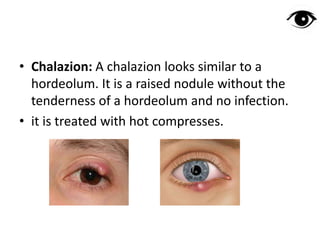
• Chalazion: A chalazion looks similar to a
hordeolum. It is a raised nodule without the
tenderness of a hordeolum and no infection.
• it is treated with hot compresses.
types of OTC eye care products
• Artificial tear drops: Lubricants (also called
artificial tears) ,water-based solutions that are
used to lubricate the eye and thicken tears.
• available in a preservative-free (PF) form.
Artificial tears usually are used two to five
times a day as needed for relief of symptoms.
• Ointments or emollients: useful lubricants.
These products are not water-based and
contain lubricating ingredients similar to
petroleum jelly.
• These ointments cause visual blurring
immediately after their use. Therefore, they
are often used only prior to sleep.
• Eye washes: Eye washes (also known as ocular
irrigants) are used to cleanse and/or rinse
debris from the eye. These products are
balanced to the proper acidity and electrolyte
concentration so as to be non-irritating to the
eye.
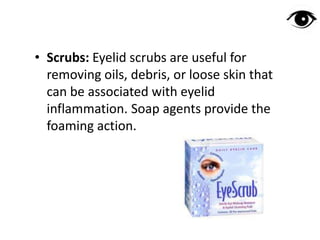
• Scrubs: Eyelid scrubs are useful for
removing oils, debris, or loose skin that
can be associated with eyelid
inflammation. Soap agents provide the
foaming action.
• Decongestants: used to shrink swollen blood
vessels in the congested (red) eye. for example, in
conjunctivitis.
• Patients at risk for angle-closure glaucoma should
cautiously use phenylephrine because it can
cause an attack of the disease
• Phenylephrine has sideeffects with many drugs
• imidazoles: longer acting than phenylephrine and
have fewer side effects
• Antihistamines: Ocular antihistamines are
available OTC. These antihistamines are
combined with ocular decongestants for the
treatment of congestion (conjunctivitis),
particularly when caused by allergy.
• Pheniramine maleate and antazoline both
block histamine receptors in the eye
• Newer allergy eye-drop preparations:
Recently, new classes of eye drops for the
treatment of itching due to allergy have
become available over the counter. Zaditor, a
nonsteroidal anti-inflammatory drop, is an
example of these.
inactive ingredients
• Vehicles: is added to a product to enhance
drug action by increasing the viscosity
(thickness) of the product.
• Examples of ophthalmic vehicles are Dextran
70, gelatin, glycerin, poloxamer 407, and
propylene glycol.
• Preservatives: included to destroy or limit
growth of bacteria that may be introduced
into the product during repeated use.
• Examples of ophthalmic preservatives are
benzalkonium chloride (BAK), cetylpyridinium
chloride, chlorobutanol, methylparaben,
sodium benzoate, and sorbic acid.
• Excipients: substance that is added to provide
physical form to the product, make it less
irritating to the eye, or to preserve the
ingredients within the product.
• Useful ophthalmic excipients are antioxidants,
wetting agents, buffers, and tonicity adjusters.
Contact lens
• Corrective contact lenses
are designed to improve vision, most commonly
by correcting refractive error.
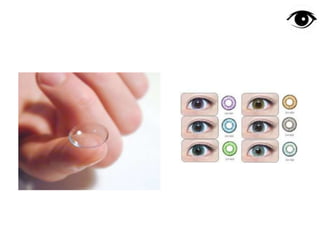
• Cosmetic contact lenses
designed to change the appearance of the eye.
• Therapeutic contact lenses
Soft lenses are often used in the treatment and
management of non-refractive disorders of the
eye. dry eyes, corneal abrasions and erosion,
care
• Saline solution
• Daily cleaner:
Used to clean lenses on a daily basis. A few
drops of cleaner are applied to the lens while
it rests in the palm of the hand.
THANK YOU
Take care of your eyes

OTC Eye Products

  • 1.
  • 2.
  • 4.
    The sclera: Theprotective outer layer of the eye, referred to as the “white of the eye” and it maintains the shape of the eye. The cornea: The front portion of the sclera, is transparent and allows light to enter the eye. The cornea is a powerful refracting surface, providing much of the eye's focusing power. The choroid is the second layer of the eye and lies between the sclera and the retina. It contains the blood vessels that provide nourishment to the outer layers of the retina. The iris is the part of the eye that gives it color. It consists of muscular tissue that responds to surrounding light, making the pupil, or circular opening in the center of the iris, larger or smaller depending on the brightness of the light.
  • 5.
    The lens isa transparent, biconvex structure, encased in a thin transparent covering. The function of the lens is to refract and focus incoming light onto the retina. The retina is the innermost layer in the eye. It converts images into electrical impulses that are sent along the optic nerve to the brain where the images are interpreted. The macula is located in the back of the eye, in the center of the retina. This area produces the sharpest vision.
  • 6.
    The inside ofthe eyeball is divided by the lens into two fluid-filled sections. The larger section at the back of the eye is filled with a colorless gelatinous mass called the vitreous humor. The smaller section in the front contains a clear, water-like material called aqueous humor. The conjunctiva is a mucous membrane that begins at the edge of the cornea and lines the inside surface of the eyelids and sclera, which serves to lubricate the eye.
  • 9.
    The eye ismade of cells that are called Rods and Cones. Cone cells are coned shaped and Rod cells are rod shaped. Most highly concentrated on the fovea – an area of the retina that lacks rods. Photoreceptors of the retina: rod cells - light sensitive but do not distinguish colors. cone cells - not as light sensitive as rods but provide color vision
  • 10.
    Light energy entersyour eye, and the cornea and lens focus it onto the retina. b. The light stimulates the rods and cones, two types of cells found in your retina. c. The rods and cones send impulses to the optic nerve, which carries them to the visual area of the cortex. d. Your cortex interprets the image and you “see.” Physiology of Vision
  • 12.
    Accommodation is the focusingof light in the retina. Mammals focus by changing the shape of the lens: -The lens is flattened for distant objects. -The lens is rounded for near objects. Focusing Light
  • 15.
  • 16.
    common disorders ofthe eye can be self-treated • Blepharitis: Blepharitis is a common condition that is caused by inflammation of the eyelid. • applying hot compresses to the affected eye, followed by an eyelid scrub. • Treat with Antibiotic
  • 17.
    • Lice: Itis common in young school-age children. • ointment is applied to the eyelid.
  • 18.
    • Contact dermatitis:is an inflammation of the skin that causes swelling, scaling, or redness of the eyelid with intense itching. • triggered by the use of a new product (soap or makeup) or exposure to a foreign substance. • Antihistamines that are taken by mouth.
  • 19.
    • Superficial foreignbodies: Lint, dust, an eyelash, or other foreign matter can become stuck in the eye. When the substance cannot easily be removed either with your finger, water, or an eye irrigating solution
  • 20.
    • Thermal damage:Thermal damage is a burn injury to the eye itself. Exposure to the sun's UV radiation during outdoor activities is an example of minor ocular thermal damage. • An eye lubricant can be applied to soothe the eye.
  • 21.
    • Conjunctivitis: Bacteria,viruses, fungi, allergic substances, or inflammation-promoting agents. • The inflammation causes enlargement of the blood vessels in the conjunctiva. • treated with ocular decongestants.
  • 22.
    • Dry eye:Dry eye is characterized by a white or mildly reddened eye combined with a sandy, gritty, dry feeling. • eye drops.
  • 23.
    • Hordeolum: Commonlyreferred to as a sty, is an inflammation of the glands within the eyelid, typically with infection. • Treatment usually is with hot compresses several times per day.
  • 24.
    • Chalazion: Achalazion looks similar to a hordeolum. It is a raised nodule without the tenderness of a hordeolum and no infection. • it is treated with hot compresses.
  • 25.
    types of OTCeye care products • Artificial tear drops: Lubricants (also called artificial tears) ,water-based solutions that are used to lubricate the eye and thicken tears. • available in a preservative-free (PF) form. Artificial tears usually are used two to five times a day as needed for relief of symptoms.
  • 27.
    • Ointments oremollients: useful lubricants. These products are not water-based and contain lubricating ingredients similar to petroleum jelly. • These ointments cause visual blurring immediately after their use. Therefore, they are often used only prior to sleep.
  • 29.
    • Eye washes:Eye washes (also known as ocular irrigants) are used to cleanse and/or rinse debris from the eye. These products are balanced to the proper acidity and electrolyte concentration so as to be non-irritating to the eye.
  • 30.
    • Scrubs: Eyelidscrubs are useful for removing oils, debris, or loose skin that can be associated with eyelid inflammation. Soap agents provide the foaming action.
  • 31.
    • Decongestants: usedto shrink swollen blood vessels in the congested (red) eye. for example, in conjunctivitis. • Patients at risk for angle-closure glaucoma should cautiously use phenylephrine because it can cause an attack of the disease • Phenylephrine has sideeffects with many drugs • imidazoles: longer acting than phenylephrine and have fewer side effects
  • 33.
    • Antihistamines: Ocularantihistamines are available OTC. These antihistamines are combined with ocular decongestants for the treatment of congestion (conjunctivitis), particularly when caused by allergy. • Pheniramine maleate and antazoline both block histamine receptors in the eye
  • 35.
    • Newer allergyeye-drop preparations: Recently, new classes of eye drops for the treatment of itching due to allergy have become available over the counter. Zaditor, a nonsteroidal anti-inflammatory drop, is an example of these.
  • 36.
    inactive ingredients • Vehicles:is added to a product to enhance drug action by increasing the viscosity (thickness) of the product. • Examples of ophthalmic vehicles are Dextran 70, gelatin, glycerin, poloxamer 407, and propylene glycol.
  • 37.
    • Preservatives: includedto destroy or limit growth of bacteria that may be introduced into the product during repeated use. • Examples of ophthalmic preservatives are benzalkonium chloride (BAK), cetylpyridinium chloride, chlorobutanol, methylparaben, sodium benzoate, and sorbic acid.
  • 38.
    • Excipients: substancethat is added to provide physical form to the product, make it less irritating to the eye, or to preserve the ingredients within the product. • Useful ophthalmic excipients are antioxidants, wetting agents, buffers, and tonicity adjusters.
  • 39.
    Contact lens • Correctivecontact lenses are designed to improve vision, most commonly by correcting refractive error. • Cosmetic contact lenses designed to change the appearance of the eye. • Therapeutic contact lenses Soft lenses are often used in the treatment and management of non-refractive disorders of the eye. dry eyes, corneal abrasions and erosion,
  • 41.
    care • Saline solution •Daily cleaner: Used to clean lenses on a daily basis. A few drops of cleaner are applied to the lens while it rests in the palm of the hand.
  • 42.
    THANK YOU Take careof your eyes