Groups & Group Development,
Turning Groups into Effective Teams
Dr. G C Mohanta, BE, MSc(Engg), MBA, PhD(Mgt)
Professor
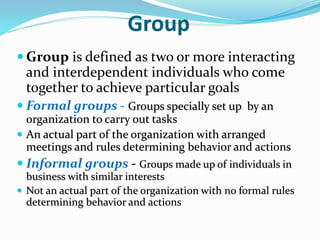
Group
 Group is defined as two or more interacting
and interdependent individuals who come
together to achieve particular goals
 Formal groups - Groups specially set up by an
organization to carry out tasks
 An actual part of the organization with arranged
meetings and rules determining behavior and actions
 Informal groups - Groups made up of individuals in
business with similar interests
 Not an actual part of the organization with no formal rules
determining behavior and actions
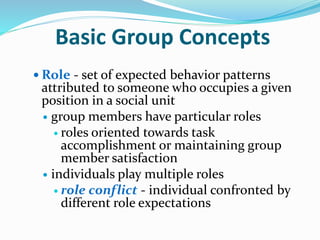
Basic Group Concepts
 Role - set of expected behavior patterns
attributed to someone who occupies a given
position in a social unit
 group members have particular roles
 roles oriented towards task
accomplishment or maintaining group
member satisfaction
 individuals play multiple roles
 role conflict - individual confronted by
different role expectations
Basic Group Concepts (Contd.)
 Norms - acceptable standards or expectations
that are shared by the group’s members
 Each group has:
 its own unique set of norms
 common norms related to levels of effort and
performance
 exert powerful influence on performance
 Conformity - acceptance by group makes some
members susceptible to conformity pressures
 group norms push members toward conformity
 results in alignment of opinions
Basic Group Concepts (Contd.)
 Status - a prestige grading, position, or rank in a
group
 may be conferred informally based on personal
characteristics
 may be formally conferred
 Group Size - effect on behavior of group
depends upon the type of outcome
 large groups - good for getting diverse input
 small groups - good at making use of information
 dispersion of responsibility in large groups leads to
free rider tendency
Basic Group Concepts (Contd.)
 Group Cohesiveness - degree to which
members are attracted to a group and share
the group’s goals
 Relationship between cohesiveness and
group effectiveness depends upon the
alignment of group & organizational goals
Basic Group Concepts (Contd.)
 External Conditions Imposed on the Group
 formal group is a subsystem of a larger system
 group affected by the overall strategy, authority
structures, formal regulations, resources, performance
management system, and organization culture
 Group Member Resources - task-relevant and
intellectual abilities of individual members
 abilities set parameters on effectiveness of performance
in a group
 positive attributes - sociability and self-reliance
 negative attributes - dominance and unconventionality
Basic Group Concepts (Contd.)
 Group Structure - structural variables include
roles, norms, status, and group size
 Group Processes - include communication,
decision making, leadership, and conflict
resolution
 process factors created in the group may have a positive
or negative effect on group performance
 Group Tasks
 Complexity - simple tasks are routine and standardized
 complex tasks are novel and non-routine
 important to have effective communication and controlled
conflict when task is complex
Characteristics of an Effective
Groups
 High commitment to achieving goals
 Clear understanding of the group’s work
 Open communication and trust
 Ideas sharing and generating
 Constructive criticism and suggestions
Factors Affecting Group Decisions
 The size of groups: ideally 5, over 21 ineffective
 Communication ways: centralization or
decentralization
 Leadership styles: automatic, persuasive,
consultative or democratic
 Skills used in groups: contribution skills,
cooperation skills, production skills
Functions of Groups
For the organization
 Accomplish jobs that can not be done by one
individual, especially complex tasks
 Aid decision making
 Help control individual behavior
 Facilitate changes
For the individual
 Help learn about the company and the individuals
themselves
 Help in gaining new skills
 Obtain rewards unable to be achieved alone
 Satisfy personal needs in social acceptance esteem
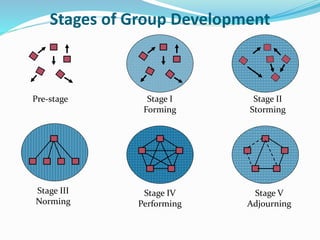
Stages of Group Development
Pre-stage Stage I
Forming
Stage II
Storming
Stage III
Norming
Stage V
Adjourning
Stage IV
Performing
Forming
 Groups members try to set rules for group behaviors
 Individuals start to find out about each other.
 Guidance is needed from the leader.
Characteristics of the Forming Stage:
 Exploration.
 Focus on similarities and differences.
 First impressions are key.
 Confusion/anxiety.
 Lower productivity.
 Issues of inclusion, leadership, developing trust.
 Open communication is a must.
Storming
 A conflict stage where members bargain with each
other.
 Individuals reveal their personal goals and may resist
the control of others.
 Characteristics of the Storming Stage:
 Competition.
 Strained relationships.
 Leader is challenged.
 Tension and disunity.
 Differences are uncomfortable.
 Issues of autonomy vs. control, support vs. competition,
influence, and decision-making.
Norming
 Group members are developing ways of working
together.
 They agree on the shared goals.
 Rules have been developed.
Characteristics of the Norming Stage:
 Increased cohesion.
 More collaboration.
 Emerging trust.
 Appreciation of differences.
 Issues of strengthening relationships, open
communication, positive/constructive feedback.
Performing
 The group has developed unity or cohesion.
 People are getting the job done to realize goals.
Characteristics of the Performing Stage:
 Productivity.
 Problem-solving.
 Shared and participative leadership.
 Full development of potential.
Adjourning
 The group ends.
 The group terminates because the task has been
achieved or when the members have left due to
failure or loss of interest.
 The feelings of members vary at this stage.
 While some may be happy about the group's
accomplishments, others may be depressed that
they would be losing their friends after the group
is disbanded.
Turning Groups Into
Effective Teams
What Is a Team?
 Work team - formal group made up of
interdependent individuals who are
responsible for the attainment of a goal
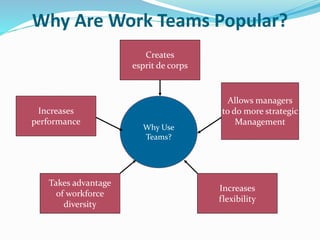
 Work teams are popular in organizations
Why Are Work Teams Popular?
Why Use
Teams?
Creates
esprit de corps
Takes advantage
of workforce
diversity
Increases
flexibility
Increases
performance
Allows managers
to do more strategic
Management
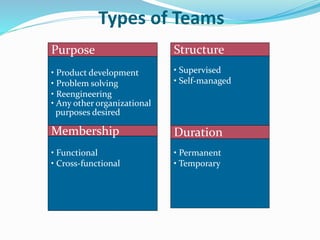
Types of Teams
• Product development
• Problem solving
• Reengineering
• Any other organizational
purposes desired
Purpose
• Functional
• Cross-functional
Membership
• Supervised
• Self-managed
Structure
• Permanent
• Temporary
Duration
Types of Teams (cont.)
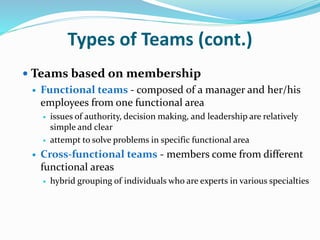
 Teams based on membership
 Functional teams - composed of a manager and her/his
employees from one functional area
 issues of authority, decision making, and leadership are relatively
simple and clear
 attempt to solve problems in specific functional area
 Cross-functional teams - members come from different
functional areas
 hybrid grouping of individuals who are experts in various specialties
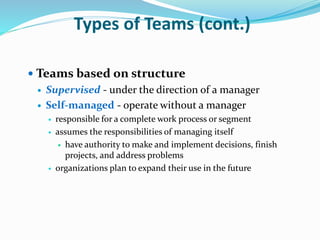
 Teams based on structure
 Supervised - under the direction of a manager
 Self-managed - operate without a manager
 responsible for a complete work process or segment
 assumes the responsibilities of managing itself
 have authority to make and implement decisions, finish
projects, and address problems
 organizations plan to expand their use in the future
Types of Teams (cont.)
 Virtual team - physically dispersed
members are linked by computer
technology
 miss the normal give-and-take or face-to-face
discussions
 tend to be task oriented
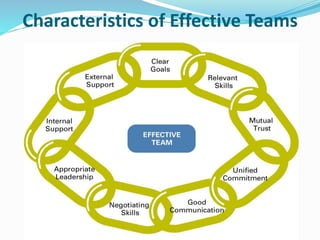
Characteristics of Effective Teams
Characteristics of Effective
Teams (contd.)
 Clear Goals - members understand and support the goals to
be achieved
 Relevant Skills - members have the necessary technical and
interpersonal skills
 Mutual Trust - members are confident in each others’
ability, character, and integrity
 strongly influenced by the organization’s culture
 Unified Commitment - loyalty and dedication to the team
 membership in the team an important aspect of the self
 Good Communication - messages are readily understood
 healthy dose of feedback from team members
Characteristics of Effective Teams
(contd.)
 Negotiating Skills - flexibility requires members to
possess these skills
 must be able to confront and reconcile differences arising
from changing problems
 Appropriate Leadership - provide help in difficult
situations
 plays role of coach or facilitator
 Internal and External Support - team requires a
sound infrastructure
 team should have external resources required to perform its
work
Managing Teams
Planning - goal determination
 members understand and accept the
team’s goals
Organizing - clarify authority and
structural issues
 support in the organization’s culture for
employee involvement and autonomy
 must resolve issues of leadership, tasks to
be performed, and assignment of tasks
Managing Teams (contd.)
 Leading - determine the role that leader will
play
 deal with human dynamics of the team
 Controlling - performance criteria must reflect
teamwork behaviors
 reward system must reflect team efforts and
performance
 Gainsharing - incentive program that shares the gains of the
efforts of employees with those of employers
 rewards directly related to performance

Group development and turning groups into effective teams

  • 1.
    Groups & GroupDevelopment, Turning Groups into Effective Teams Dr. G C Mohanta, BE, MSc(Engg), MBA, PhD(Mgt) Professor
  • 2.
    Group  Group isdefined as two or more interacting and interdependent individuals who come together to achieve particular goals  Formal groups - Groups specially set up by an organization to carry out tasks  An actual part of the organization with arranged meetings and rules determining behavior and actions  Informal groups - Groups made up of individuals in business with similar interests  Not an actual part of the organization with no formal rules determining behavior and actions
  • 3.
    Basic Group Concepts Role - set of expected behavior patterns attributed to someone who occupies a given position in a social unit  group members have particular roles  roles oriented towards task accomplishment or maintaining group member satisfaction  individuals play multiple roles  role conflict - individual confronted by different role expectations
  • 4.
    Basic Group Concepts(Contd.)  Norms - acceptable standards or expectations that are shared by the group’s members  Each group has:  its own unique set of norms  common norms related to levels of effort and performance  exert powerful influence on performance  Conformity - acceptance by group makes some members susceptible to conformity pressures  group norms push members toward conformity  results in alignment of opinions
  • 5.
    Basic Group Concepts(Contd.)  Status - a prestige grading, position, or rank in a group  may be conferred informally based on personal characteristics  may be formally conferred  Group Size - effect on behavior of group depends upon the type of outcome  large groups - good for getting diverse input  small groups - good at making use of information  dispersion of responsibility in large groups leads to free rider tendency
  • 6.
    Basic Group Concepts(Contd.)  Group Cohesiveness - degree to which members are attracted to a group and share the group’s goals  Relationship between cohesiveness and group effectiveness depends upon the alignment of group & organizational goals
  • 7.
    Basic Group Concepts(Contd.)  External Conditions Imposed on the Group  formal group is a subsystem of a larger system  group affected by the overall strategy, authority structures, formal regulations, resources, performance management system, and organization culture  Group Member Resources - task-relevant and intellectual abilities of individual members  abilities set parameters on effectiveness of performance in a group  positive attributes - sociability and self-reliance  negative attributes - dominance and unconventionality
  • 8.
    Basic Group Concepts(Contd.)  Group Structure - structural variables include roles, norms, status, and group size  Group Processes - include communication, decision making, leadership, and conflict resolution  process factors created in the group may have a positive or negative effect on group performance  Group Tasks  Complexity - simple tasks are routine and standardized  complex tasks are novel and non-routine  important to have effective communication and controlled conflict when task is complex
  • 9.
    Characteristics of anEffective Groups  High commitment to achieving goals  Clear understanding of the group’s work  Open communication and trust  Ideas sharing and generating  Constructive criticism and suggestions
  • 10.
    Factors Affecting GroupDecisions  The size of groups: ideally 5, over 21 ineffective  Communication ways: centralization or decentralization  Leadership styles: automatic, persuasive, consultative or democratic  Skills used in groups: contribution skills, cooperation skills, production skills
  • 11.
    Functions of Groups Forthe organization  Accomplish jobs that can not be done by one individual, especially complex tasks  Aid decision making  Help control individual behavior  Facilitate changes For the individual  Help learn about the company and the individuals themselves  Help in gaining new skills  Obtain rewards unable to be achieved alone  Satisfy personal needs in social acceptance esteem
  • 12.
    Stages of GroupDevelopment Pre-stage Stage I Forming Stage II Storming Stage III Norming Stage V Adjourning Stage IV Performing
  • 13.
    Forming  Groups memberstry to set rules for group behaviors  Individuals start to find out about each other.  Guidance is needed from the leader. Characteristics of the Forming Stage:  Exploration.  Focus on similarities and differences.  First impressions are key.  Confusion/anxiety.  Lower productivity.  Issues of inclusion, leadership, developing trust.  Open communication is a must.
  • 14.
    Storming  A conflictstage where members bargain with each other.  Individuals reveal their personal goals and may resist the control of others.  Characteristics of the Storming Stage:  Competition.  Strained relationships.  Leader is challenged.  Tension and disunity.  Differences are uncomfortable.  Issues of autonomy vs. control, support vs. competition, influence, and decision-making.
  • 15.
    Norming  Group membersare developing ways of working together.  They agree on the shared goals.  Rules have been developed. Characteristics of the Norming Stage:  Increased cohesion.  More collaboration.  Emerging trust.  Appreciation of differences.  Issues of strengthening relationships, open communication, positive/constructive feedback.
  • 16.
    Performing  The grouphas developed unity or cohesion.  People are getting the job done to realize goals. Characteristics of the Performing Stage:  Productivity.  Problem-solving.  Shared and participative leadership.  Full development of potential.
  • 17.
    Adjourning  The groupends.  The group terminates because the task has been achieved or when the members have left due to failure or loss of interest.  The feelings of members vary at this stage.  While some may be happy about the group's accomplishments, others may be depressed that they would be losing their friends after the group is disbanded.
  • 18.
  • 19.
    What Is aTeam?  Work team - formal group made up of interdependent individuals who are responsible for the attainment of a goal  Work teams are popular in organizations
  • 20.
    Why Are WorkTeams Popular? Why Use Teams? Creates esprit de corps Takes advantage of workforce diversity Increases flexibility Increases performance Allows managers to do more strategic Management
  • 21.
    Types of Teams •Product development • Problem solving • Reengineering • Any other organizational purposes desired Purpose • Functional • Cross-functional Membership • Supervised • Self-managed Structure • Permanent • Temporary Duration
  • 22.
    Types of Teams(cont.)  Teams based on membership  Functional teams - composed of a manager and her/his employees from one functional area  issues of authority, decision making, and leadership are relatively simple and clear  attempt to solve problems in specific functional area  Cross-functional teams - members come from different functional areas  hybrid grouping of individuals who are experts in various specialties
  • 23.
     Teams basedon structure  Supervised - under the direction of a manager  Self-managed - operate without a manager  responsible for a complete work process or segment  assumes the responsibilities of managing itself  have authority to make and implement decisions, finish projects, and address problems  organizations plan to expand their use in the future Types of Teams (cont.)
  • 24.
    Types of Teams(cont.)  Virtual team - physically dispersed members are linked by computer technology  miss the normal give-and-take or face-to-face discussions  tend to be task oriented
  • 25.
  • 26.
    Characteristics of Effective Teams(contd.)  Clear Goals - members understand and support the goals to be achieved  Relevant Skills - members have the necessary technical and interpersonal skills  Mutual Trust - members are confident in each others’ ability, character, and integrity  strongly influenced by the organization’s culture  Unified Commitment - loyalty and dedication to the team  membership in the team an important aspect of the self  Good Communication - messages are readily understood  healthy dose of feedback from team members
  • 27.
    Characteristics of EffectiveTeams (contd.)  Negotiating Skills - flexibility requires members to possess these skills  must be able to confront and reconcile differences arising from changing problems  Appropriate Leadership - provide help in difficult situations  plays role of coach or facilitator  Internal and External Support - team requires a sound infrastructure  team should have external resources required to perform its work
  • 28.
    Managing Teams Planning -goal determination  members understand and accept the team’s goals Organizing - clarify authority and structural issues  support in the organization’s culture for employee involvement and autonomy  must resolve issues of leadership, tasks to be performed, and assignment of tasks
  • 29.
    Managing Teams (contd.) Leading - determine the role that leader will play  deal with human dynamics of the team  Controlling - performance criteria must reflect teamwork behaviors  reward system must reflect team efforts and performance  Gainsharing - incentive program that shares the gains of the efforts of employees with those of employers  rewards directly related to performance