The Human Eye
Khadijah McGee
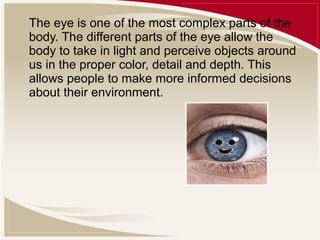
The eye is one of the most complex parts of the
body. The different parts of the eye allow the
body to take in light and perceive objects around
us in the proper color, detail and depth. This
allows people to make more informed decisions
about their environment.
The eye is a big part of the nervous system
and is very involved in it's processes.
But if the nerves in the eye are not in prime
condition, your vision will not be at it's
best.
Your eyesight will malfunction, you may see
false images or even, go blind completely.
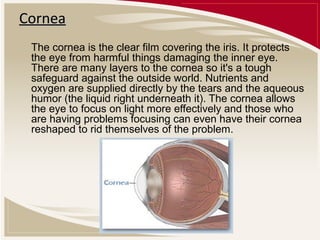
Cornea
The cornea is the clear film covering the iris. It protects
the eye from harmful things damaging the inner eye.
There are many layers to the cornea so it's a tough
safeguard against the outside world. Nutrients and
oxygen are supplied directly by the tears and the aqueous
humor (the liquid right underneath it). The cornea allows
the eye to focus on light more effectively and those who
are having problems focusing can even have their cornea
reshaped to rid themselves of the problem.
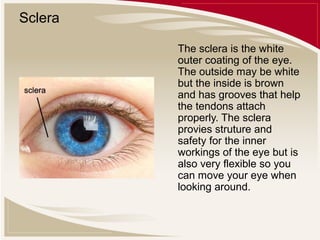
Sclera
The sclera is the white
outer coating of the eye.
The outside may be white
but the inside is brown
and has grooves that help
the tendons attach
properly. The sclera
provies struture and
safety for the inner
workings of the eye but is
also very flexible so you
can move your eye when
looking around.
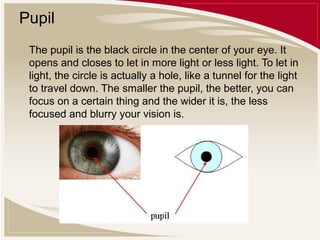
Pupil
The pupil is the black circle in the center of your eye. It
opens and closes to let in more light or less light. To let in
light, the circle is actually a hole, like a tunnel for the light
to travel down. The smaller the pupil, the better, you can
focus on a certain thing and the wider it is, the less
focused and blurry your vision is.
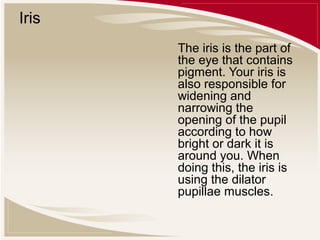
Iris
The iris is the part of
the eye that contains
pigment. Your iris is
also responsible for
widening and
narrowing the
opening of the pupil
according to how
bright or dark it is
around you. When
doing this, the iris is
using the dilator
pupillae muscles.
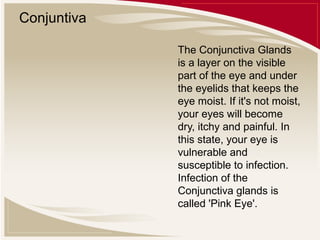
Conjuntiva
The Conjunctiva Glands
is a layer on the visible
part of the eye and under
the eyelids that keeps the
eye moist. If it's not moist,
your eyes will become
dry, itchy and painful. In
this state, your eye is
vulnerable and
susceptible to infection.
Infection of the
Conjunctiva glands is
called 'Pink Eye'.
Lacrimal Glands
These glands are
loacated in the upper
corner of your eye.
They produce tears to
moisten the eye and
to also flush out any
irritants that find their
way into the eye.
Lens
The lens sits directly behind
the pupil. It focuses the light
that the pupil takes in. It can
change shape depending on
the amount of light is coming in
so it can be focused properly.
The Ciliary Body is good to
mention, too, as it aids in the
movement of the lens and also
helps to control the shape of
the lens in a sense that it
flattens out the lens to see
further and squishes it to see
nearer.
Ciliary Body
The Ciliary Body is good to
mention, too, as it aids in
the movement of the lens
and also helps to control the
shape of the lens in a sense
that it flattens out the lens to
see further and squishes it
to see nearer. The Ciliary
Body also produces liquid
called the aqueous humor.
The aqueous humor is also
what causes the cornea to
bulge.
Retina
The retina is located at
the back of the eye,
taking up 65% of it. It is
red in color because it's
rich with blood. The light
that is taken in by the
pupil and focused by the
lens will be then
transmitted onto the
retina. The retina will turn
that light into electrical
pulses and signals using
it's rods and cones. The
signals are sent to the
optic nerve then to the
brain from there.
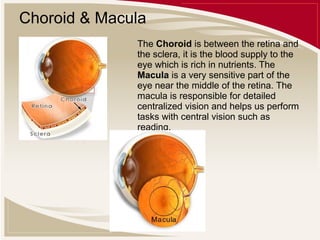
Choroid & Macula
The Choroid is between the retina and
the sclera, it is the blood supply to the
eye which is rich in nutrients. The
Macula is a very sensitive part of the
eye near the middle of the retina. The
macula is responsible for detailed
centralized vision and helps us perform
tasks with central vision such as
reading.
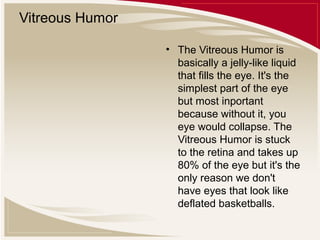
Vitreous Humor
• The Vitreous Humor is
basically a jelly-like liquid
that fills the eye. It's the
simplest part of the eye
but most inportant
because without it, you
eye would collapse. The
Vitreous Humor is stuck
to the retina and takes up
80% of the eye but it's the
only reason we don't
have eyes that look like
deflated basketballs.
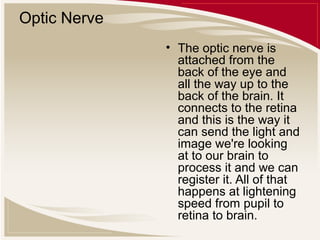
Optic Nerve
• The optic nerve is
attached from the
back of the eye and
all the way up to the
back of the brain. It
connects to the retina
and this is the way it
can send the light and
image we're looking
at to our brain to
process it and we can
register it. All of that
happens at lightening
speed from pupil to
retina to brain.
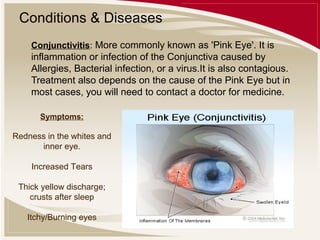
Conditions & Diseases
Conjunctivitis: More commonly known as 'Pink Eye'. It is

inflammation or infection of the Conjunctiva caused by
Allergies, Bacterial infection, or a virus.It is also contagious.
Treatment also depends on the cause of the Pink Eye but in
most cases, you will need to contact a doctor for medicine.
Symptoms:

Redness in the whites and
inner eye.
Increased Tears
Thick yellow discharge;
crusts after sleep
Itchy/Burning eyes
Conditions & Diseases Conti.
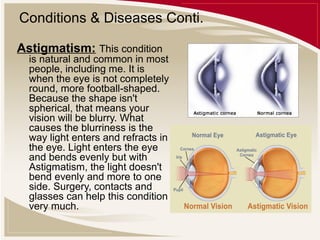
Astigmatism: This condition

is natural and common in most
people, including me. It is
when the eye is not completely
round, more football-shaped.
Because the shape isn't
spherical, that means your
vision will be blurry. What
causes the blurriness is the
way light enters and refracts in
the eye. Light enters the eye
and bends evenly but with
Astigmatism, the light doesn't
bend evenly and more to one
side. Surgery, contacts and
glasses can help this condition
very much.
Conditions & Diseases Conti.
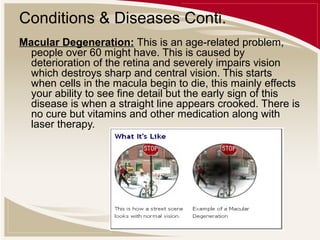
Macular Degeneration: This is an age-related problem,
people over 60 might have. This is caused by
deterioration of the retina and severely impairs vision
which destroys sharp and central vision. This starts
when cells in the macula begin to die, this mainly effects
your ability to see fine detail but the early sign of this
disease is when a straight line appears crooked. There is
no cure but vitamins and other medication along with
laser therapy.
Fun Facts
• The cornea also does not have any blood vessels. You
know what this means? If you ever get any cuts on your
cornea, they will heal up in a jiffy. This is also the reason
that Laser eye surgery is so successful.
• Babies are born with their Ciliary Body almost all round.
This means that babies don't have clear vision and
actually have to learn how to focus their sight just like
they have to learn to do other things such as walking.
• Scientists believe that it is because of a Neural
Mechanism ppreventing the brain from becoming aware
of us blinking so it doesn't think the world has gone dark
when our eyes close.
Fun Facts Contin.
• All images we see are upside down. Ever look at your reflection
in a spoon? You see how it's upside-down no matter how you
turn it? Well, take that and apply it to how our eye works. Before
the image we see gets transmitted to the brain, everything we
see is upside-down, first. The brain just flips it the other way
around afterwards.
• There is a condition called Heterochromia that means a person is
born with two different colored eyes. I think this is pretty cool and
alot of examples of where you can see this is in cat's, look really
close, even the subtle changes in colors is still heterochromia.
Mila Kunis, the famous actress, has this condition.
• If you have blue eyes, you share a common ancestor with every
person who has blue eyes.
The Cool Part!
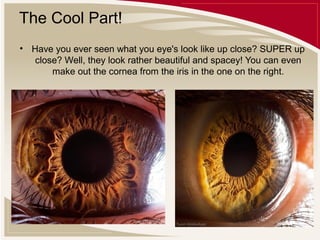
• Have you ever seen what you eye's look like up close? SUPER up
close? Well, they look rather beautiful and spacey! You can even
make out the cornea from the iris in the one on the right.
More Pictures!

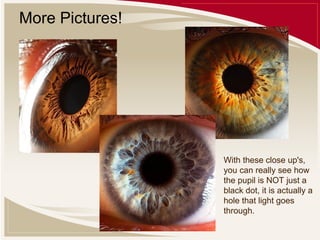
With these close up's,
you can really see how
the pupil is NOT just a
black dot, it is actually a
hole that light goes
through.
And That's It!
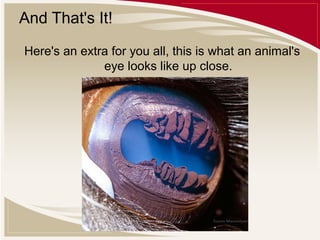
Here's an extra for you all, this is what an animal's
eye looks like up close.
Works Cited
•

•

•

•

•

"Astigmatism: Causes, Symptoms, Diagnosis, and Treatment."
WebMD. WebMD, 9 Sept. 2012. Web. 30 Nov. 2013.
<http://www.webmd.com/eye-health/astigmatism-eyes>.
"Choroid - Eye Anatomy." Http://www.stlukeseye.com/. St. Lukes
Cataract Laser Eye Institute, n.d. Web. 30 Nov. 2013.
<http://www.stlukeseye.com/anatomy/choroid.html>.
"Conjunctivitis (Pinkeye) Causes, Symptoms, and Treatments of
Conjunctivitis." WebMD. WebMD, 30 Oct. 2011. Web. 29 Nov. 2013.
<http://www.webmd.com/eye-health/eye-health-conjunctivitis>.
"Eye Anatomy: Lens and Ciliary Body." ThinkQuest. Oracle
Foundation, n.d. Web. 30 Nov. 2013.
<http://library.thinkquest.org/C005949/anatomy/lensciliary.htm>.
"Eye Anatomy: Optic Cord." ThinkQuest. Oracle Foundation, n.d.
Web. 30 Nov. 2013.
<http://library.thinkquest.org/C005949/anatomy/opticcord.htm>.
Works Cited Conti.
• "Macula - Eye Anatomy." Http://www.stlukeseye.com/. St. Lukes
Cataract Laser Eye Institute, n.d. Web. 30 Nov. 2013.
<http://www.stlukeseye.com/anatomy/macula.html>.
• "Macular Degeneration: MedlinePlus." U.S National Library of
Medicine. U.S. National Library of Medicine, n.d. Web. 30 Nov.
2013.
<http://www.nlm.nih.gov/medlineplus/maculardegeneration.html>.
• Nave, Carl. "The Retina." Http://hyperphysics.phy-astr.gsu.edu/.
Hyper Phsyics, n.d. Web. 30 Nov. 2013.
<http://hyperphysics.phy-astr.gsu.edu/hbase/vision/retina.html>.
• "Parts of the Eye and Their Functions | MD-Health.com." Parts of
the Eye and Their Functions | MD-Health.com. MD Health, n.d.
Web. 28 Nov. 2013. <http://www.md-health.com/Parts-Of-TheEye-And-Its-Function.html>.
Works Cited Conti.
• Segre, Liz, and Stephen Bagi. "Human Eye Anatomy:
Parts of the Eye." All About Vision. N.p., Feb. 2013. Web.
27 Nov. 2013.
<http://www.allaboutvision.com/resources/anatomy.htm>.
• "Why We Blink Without Noticing." LiveScience.com. Live
Science, 25 July 2005. Web. 30 Nov. 2013.
<http://www.livescience.com/335-blink-noticing.html>.

The Human Eye

  • 1.
  • 2.
    The eye isone of the most complex parts of the body. The different parts of the eye allow the body to take in light and perceive objects around us in the proper color, detail and depth. This allows people to make more informed decisions about their environment.
  • 3.
    The eye isa big part of the nervous system and is very involved in it's processes. But if the nerves in the eye are not in prime condition, your vision will not be at it's best. Your eyesight will malfunction, you may see false images or even, go blind completely.
  • 4.
    Cornea The cornea isthe clear film covering the iris. It protects the eye from harmful things damaging the inner eye. There are many layers to the cornea so it's a tough safeguard against the outside world. Nutrients and oxygen are supplied directly by the tears and the aqueous humor (the liquid right underneath it). The cornea allows the eye to focus on light more effectively and those who are having problems focusing can even have their cornea reshaped to rid themselves of the problem.
  • 5.
    Sclera The sclera isthe white outer coating of the eye. The outside may be white but the inside is brown and has grooves that help the tendons attach properly. The sclera provies struture and safety for the inner workings of the eye but is also very flexible so you can move your eye when looking around.
  • 6.
    Pupil The pupil isthe black circle in the center of your eye. It opens and closes to let in more light or less light. To let in light, the circle is actually a hole, like a tunnel for the light to travel down. The smaller the pupil, the better, you can focus on a certain thing and the wider it is, the less focused and blurry your vision is.
  • 7.
    Iris The iris isthe part of the eye that contains pigment. Your iris is also responsible for widening and narrowing the opening of the pupil according to how bright or dark it is around you. When doing this, the iris is using the dilator pupillae muscles.
  • 8.
    Conjuntiva The Conjunctiva Glands isa layer on the visible part of the eye and under the eyelids that keeps the eye moist. If it's not moist, your eyes will become dry, itchy and painful. In this state, your eye is vulnerable and susceptible to infection. Infection of the Conjunctiva glands is called 'Pink Eye'.
  • 9.
    Lacrimal Glands These glandsare loacated in the upper corner of your eye. They produce tears to moisten the eye and to also flush out any irritants that find their way into the eye.
  • 10.
    Lens The lens sitsdirectly behind the pupil. It focuses the light that the pupil takes in. It can change shape depending on the amount of light is coming in so it can be focused properly. The Ciliary Body is good to mention, too, as it aids in the movement of the lens and also helps to control the shape of the lens in a sense that it flattens out the lens to see further and squishes it to see nearer.
  • 11.
    Ciliary Body The CiliaryBody is good to mention, too, as it aids in the movement of the lens and also helps to control the shape of the lens in a sense that it flattens out the lens to see further and squishes it to see nearer. The Ciliary Body also produces liquid called the aqueous humor. The aqueous humor is also what causes the cornea to bulge.
  • 12.
    Retina The retina islocated at the back of the eye, taking up 65% of it. It is red in color because it's rich with blood. The light that is taken in by the pupil and focused by the lens will be then transmitted onto the retina. The retina will turn that light into electrical pulses and signals using it's rods and cones. The signals are sent to the optic nerve then to the brain from there.
  • 13.
    Choroid & Macula TheChoroid is between the retina and the sclera, it is the blood supply to the eye which is rich in nutrients. The Macula is a very sensitive part of the eye near the middle of the retina. The macula is responsible for detailed centralized vision and helps us perform tasks with central vision such as reading.
  • 14.
    Vitreous Humor • TheVitreous Humor is basically a jelly-like liquid that fills the eye. It's the simplest part of the eye but most inportant because without it, you eye would collapse. The Vitreous Humor is stuck to the retina and takes up 80% of the eye but it's the only reason we don't have eyes that look like deflated basketballs.
  • 15.
    Optic Nerve • Theoptic nerve is attached from the back of the eye and all the way up to the back of the brain. It connects to the retina and this is the way it can send the light and image we're looking at to our brain to process it and we can register it. All of that happens at lightening speed from pupil to retina to brain.
  • 16.
    Conditions & Diseases Conjunctivitis:More commonly known as 'Pink Eye'. It is inflammation or infection of the Conjunctiva caused by Allergies, Bacterial infection, or a virus.It is also contagious. Treatment also depends on the cause of the Pink Eye but in most cases, you will need to contact a doctor for medicine. Symptoms: Redness in the whites and inner eye. Increased Tears Thick yellow discharge; crusts after sleep Itchy/Burning eyes
  • 17.
    Conditions & DiseasesConti. Astigmatism: This condition is natural and common in most people, including me. It is when the eye is not completely round, more football-shaped. Because the shape isn't spherical, that means your vision will be blurry. What causes the blurriness is the way light enters and refracts in the eye. Light enters the eye and bends evenly but with Astigmatism, the light doesn't bend evenly and more to one side. Surgery, contacts and glasses can help this condition very much.
  • 18.
    Conditions & DiseasesConti. Macular Degeneration: This is an age-related problem, people over 60 might have. This is caused by deterioration of the retina and severely impairs vision which destroys sharp and central vision. This starts when cells in the macula begin to die, this mainly effects your ability to see fine detail but the early sign of this disease is when a straight line appears crooked. There is no cure but vitamins and other medication along with laser therapy.
  • 19.
    Fun Facts • Thecornea also does not have any blood vessels. You know what this means? If you ever get any cuts on your cornea, they will heal up in a jiffy. This is also the reason that Laser eye surgery is so successful. • Babies are born with their Ciliary Body almost all round. This means that babies don't have clear vision and actually have to learn how to focus their sight just like they have to learn to do other things such as walking. • Scientists believe that it is because of a Neural Mechanism ppreventing the brain from becoming aware of us blinking so it doesn't think the world has gone dark when our eyes close.
  • 20.
    Fun Facts Contin. •All images we see are upside down. Ever look at your reflection in a spoon? You see how it's upside-down no matter how you turn it? Well, take that and apply it to how our eye works. Before the image we see gets transmitted to the brain, everything we see is upside-down, first. The brain just flips it the other way around afterwards. • There is a condition called Heterochromia that means a person is born with two different colored eyes. I think this is pretty cool and alot of examples of where you can see this is in cat's, look really close, even the subtle changes in colors is still heterochromia. Mila Kunis, the famous actress, has this condition. • If you have blue eyes, you share a common ancestor with every person who has blue eyes.
  • 21.
    The Cool Part! •Have you ever seen what you eye's look like up close? SUPER up close? Well, they look rather beautiful and spacey! You can even make out the cornea from the iris in the one on the right.
  • 22.
    More Pictures! With theseclose up's, you can really see how the pupil is NOT just a black dot, it is actually a hole that light goes through.
  • 23.
    And That's It! Here'san extra for you all, this is what an animal's eye looks like up close.
  • 24.
    Works Cited • • • • • "Astigmatism: Causes,Symptoms, Diagnosis, and Treatment." WebMD. WebMD, 9 Sept. 2012. Web. 30 Nov. 2013. <http://www.webmd.com/eye-health/astigmatism-eyes>. "Choroid - Eye Anatomy." Http://www.stlukeseye.com/. St. Lukes Cataract Laser Eye Institute, n.d. Web. 30 Nov. 2013. <http://www.stlukeseye.com/anatomy/choroid.html>. "Conjunctivitis (Pinkeye) Causes, Symptoms, and Treatments of Conjunctivitis." WebMD. WebMD, 30 Oct. 2011. Web. 29 Nov. 2013. <http://www.webmd.com/eye-health/eye-health-conjunctivitis>. "Eye Anatomy: Lens and Ciliary Body." ThinkQuest. Oracle Foundation, n.d. Web. 30 Nov. 2013. <http://library.thinkquest.org/C005949/anatomy/lensciliary.htm>. "Eye Anatomy: Optic Cord." ThinkQuest. Oracle Foundation, n.d. Web. 30 Nov. 2013. <http://library.thinkquest.org/C005949/anatomy/opticcord.htm>.
  • 25.
    Works Cited Conti. •"Macula - Eye Anatomy." Http://www.stlukeseye.com/. St. Lukes Cataract Laser Eye Institute, n.d. Web. 30 Nov. 2013. <http://www.stlukeseye.com/anatomy/macula.html>. • "Macular Degeneration: MedlinePlus." U.S National Library of Medicine. U.S. National Library of Medicine, n.d. Web. 30 Nov. 2013. <http://www.nlm.nih.gov/medlineplus/maculardegeneration.html>. • Nave, Carl. "The Retina." Http://hyperphysics.phy-astr.gsu.edu/. Hyper Phsyics, n.d. Web. 30 Nov. 2013. <http://hyperphysics.phy-astr.gsu.edu/hbase/vision/retina.html>. • "Parts of the Eye and Their Functions | MD-Health.com." Parts of the Eye and Their Functions | MD-Health.com. MD Health, n.d. Web. 28 Nov. 2013. <http://www.md-health.com/Parts-Of-TheEye-And-Its-Function.html>.
  • 26.
    Works Cited Conti. •Segre, Liz, and Stephen Bagi. "Human Eye Anatomy: Parts of the Eye." All About Vision. N.p., Feb. 2013. Web. 27 Nov. 2013. <http://www.allaboutvision.com/resources/anatomy.htm>. • "Why We Blink Without Noticing." LiveScience.com. Live Science, 25 July 2005. Web. 30 Nov. 2013. <http://www.livescience.com/335-blink-noticing.html>.