MODULE ON MEDIA
PLANNING
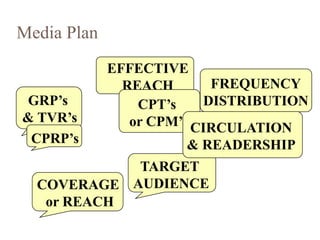
Media Plan
             EFFECTIVE
               REACH       FREQUENCY
GRP’s            CPT’s    DISTRIBUTION
& TVR’s         or CPM’s CIRCULATION
 CPRP’s               & READERSHIP
            TARGET
  COVERAGE AUDIENCE
   or REACH
So much jargon…
     what does it all mean ?
BASIC
MEDIA
TERMINOLOGIES
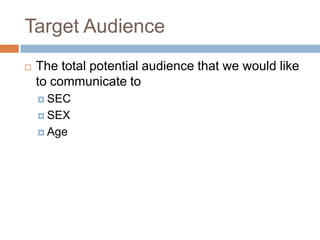
Target Audience
   The total potential audience that we would like
    to communicate to
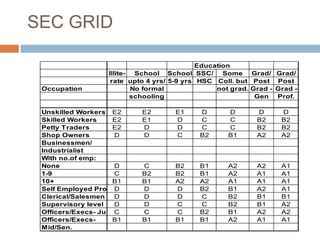
     SEC

     SEX

     Age
SEC GRID

                                           Education
                  Illite- School School SSC/ Some Grad/ Grad/
                   rate upto 4 yrs/ 5-9 yrs HSC Coll. but Post Post
 Occupation              No formal              not grad. Grad - Grad -
                         schooling                         Gen Prof.

 Unskilled Workers E2      E2       E1     D       D       D      D
 Skilled Workers    E2     E1       D      C       C       B2     B2
 Petty Traders      E2     D        D      C       C       B2     B2
 Shop Owners         D     D        C      B2      B1      A2     A2
 Businessmen/
 Industrialist
 With no.of emp:
 None                D     C        B2     B1      A2      A2     A1
 1-9                 C     B2       B2     B1      A2      A1     A1
 10+                B1     B1       A2     A2      A1      A1     A1
 Self Employed Prof. D     D        D      B2      B1      A2     A1
 Clerical/Salesmen   D     D        D      C       B2      B1     B1
 Supervisory level   D     D        C      C       B2      B1     A2
 Officers/Execs- Jun C     C        C      B2      B1      A2     A2
 Officers/Execs-    B1     B1       B1     B1      A2      A1     A1
 Mid/Sen.
Reach of media (Max. Poss)


  Of the total audience the maximum number of
   people that the medium covers.
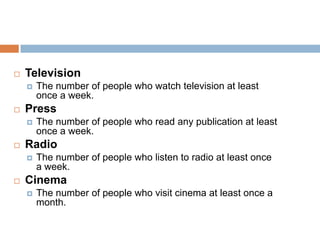
   Television
       The number of people who watch television at least
        once a week.
   Press
       The number of people who read any publication at least
        once a week.
   Radio
       The number of people who listen to radio at least once
        a week.
   Cinema
       The number of people who visit cinema at least once a
        month.
Media Penetration
   It is the percentage of homes in a specified
    area and TA that own at least one TV or
    radio set or have a TV with a C&S
    connection.
   Different from Reach
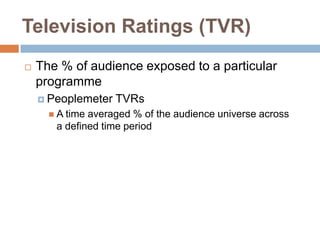
Television Ratings (TVR)
   The % of audience exposed to a particular
    programme
     Peoplemeter   TVRs
       A timeaveraged % of the audience universe across
       a defined time period
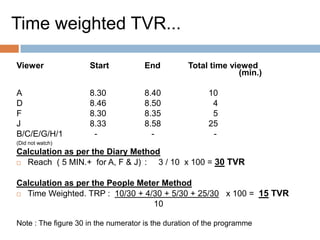
Time weighted TVR...

Viewer               Start            End          Total time viewed
                                                                (min.)

A                    8.30             8.40               10
D                    8.46             8.50                4
F                    8.30             8.35                5
J                    8.33             8.58               25
B/C/E/G/H/1           -                 -                 -
(Did not watch)
Calculation as per the Diary Method
 Reach ( 5 MIN.+ for A, F & J) :  3 / 10 x 100 = 30 TVR

Calculation as per the People Meter Method
 Time Weighted. TRP : 10/30 + 4/30 + 5/30 + 25/30 x 100 = 15 TVR

                                  10

Note : The figure 30 in the numerator is the duration of the programme
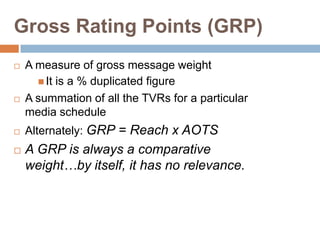
Gross Rating Points (GRP)
   A measure of gross message weight
       It is a % duplicated figure
   A summation of all the TVRs for a particular
    media schedule
   Alternately: GRP = Reach x AOTS
   A GRP is always a comparative
    weight…by itself, it has no relevance.
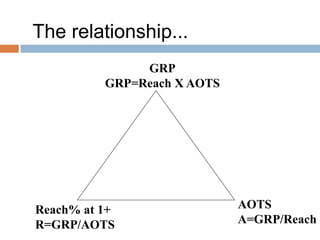
The relationship...
               GRP
          GRP=Reach X AOTS


Reach% at 1+                 AOTS
R=GRP/AOTS                   A=GRP/Reach
Reach (%)


   The net unduplicated number of people that
    the plan covers at least once in the defined
    period
Reach
   Definition :  The percentage of the target
    audience who saw the commercial at least
    once during a given campaign period
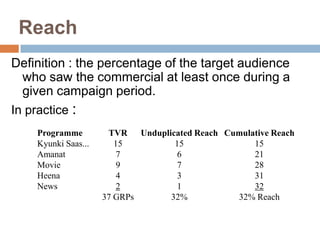
Reach
Definition : the percentage of the target audience
  who saw the commercial at least once during a
  given campaign period.
In practice :
    Programme         TVR Unduplicated Reach Cumulative Reach
    Kyunki Saas...      15        15               15
    Amanat              7          6               21
    Movie               9          7               28
    Heena               4          3               31
    News                2          1               32
                     37 GRPs     32%           32% Reach
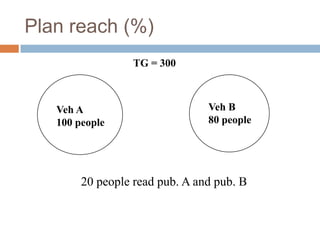
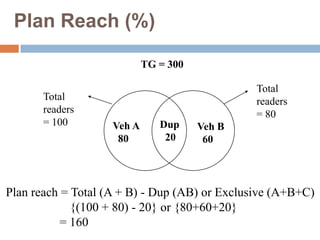
Plan reach (%)
                  TG = 300


   Veh A                        Veh B
   100 people                   80 people


        20 people read pub. A and pub. B
Plan Reach (%)

                            TG = 300

                                               Total
       Total                                   readers
       readers                                 = 80
       = 100        Veh A      Dup     Veh B
                     80         20      60


Plan reach = Total (A + B) - Dup (AB) or Exclusive (A+B+C)
             {(100 + 80) - 20} or {80+60+20}
           = 160
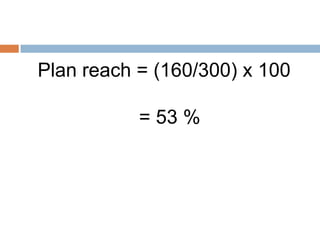
Plan reach = (160/300) x 100

           = 53 %
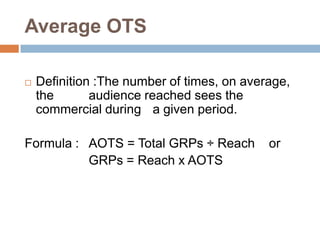
Average OTS

   Definition :The number of times, on average,
    the       audience reached sees the
    commercial during a given period.

Formula : AOTS = Total GRPs ÷ Reach         or
          GRPs = Reach x AOTS
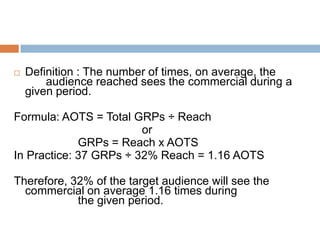
   Definition : The number of times, on average, the
        audience reached sees the commercial during a
    given period.

Formula: AOTS = Total GRPs ÷ Reach
                        or
             GRPs = Reach x AOTS
In Practice: 37 GRPs ÷ 32% Reach = 1.16 AOTS

Therefore, 32% of the target audience will see the
  commercial on average 1.16 times during
            the given period.
The relation between Reach &
            AOTS ...
Inversely proportional
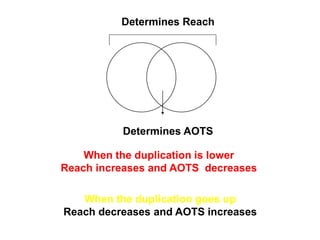
Determines Reach


          Determines AOTS

    When the duplication is lower
Reach increases and AOTS decreases

   When the duplication goes up
Reach decreases and AOTS increases
Effective Frequency
   The number of times a message needs to be
    exposed to the TG to make it relevant
   The OTS that works :
       The optimal OTS to be achieved within a time frame to
        accomplish a specified objective
       The frequency estimator one such tool.
Effective Reach


The reach at effective frequency that is needed
 to accomplish the specified objective
CPT

   Cost Per Thousand :
    A  measure of cost effectiveness.
     The cost of a unit (10 secs) of a vehicle/ the
      total number of target audience reached by the
      vehicle in thousands.
Cost Per GRP
Definition : The cost of buying one rating point.

Formula :   Cost ÷ GRPs = Cost per GRP
Cost Per GRP


Definition :   The cost of buying one rating point.

Formula :      Cost ÷ GRPs = Cost per GRP

In Practice : Rs .250,000 ÷ 15 GRPs =
              Rs. 2174 cost per GRP
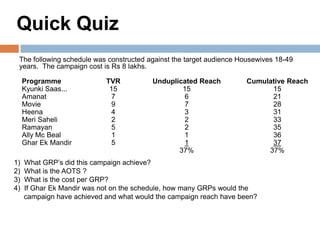
Quick Quiz
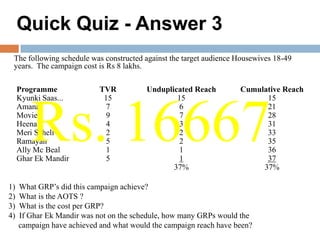
 The following schedule was constructed against the target audience Housewives 18-49
 years. The campaign cost is Rs 8 lakhs.

     Programme              TVR          Unduplicated Reach          Cumulative Reach
     Kyunki Saas...          15                  15                        15
     Amanat                   7                   6                        21
     Movie                    9                   7                        28
     Heena                    4                   3                        31
     Meri Saheli              2                   2                        33
     Ramayan                  5                   2                        35
     Ally Mc Beal             1                   1                        36
     Ghar Ek Mandir           5                   1                        37
                                                37%                       37%
1)   What GRP‟s did this campaign achieve?
2)   What is the AOTS ?
3)   What is the cost per GRP?
4)   If Ghar Ek Mandir was not on the schedule, how many GRPs would the
     campaign have achieved and what would the campaign reach have been?
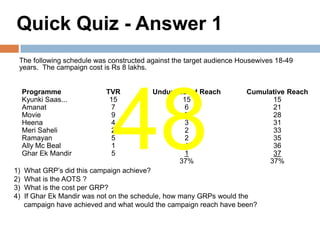
Quick Quiz - Answer 1
 The following schedule was constructed against the target audience Housewives 18-49
 years. The campaign cost is Rs 8 lakhs.


                              48
     Programme              TVR          Unduplicated Reach          Cumulative Reach
     Kyunki Saas...          15                  15                        15
     Amanat                  7                   6                         21
     Movie                   9                   7                         28
     Heena                   4                   3                         31
     Meri Saheli             2                   2                         33
     Ramayan                 5                   2                         35
     Ally Mc Beal            1                   1                         36
     Ghar Ek Mandir          5                   1                         37
                                                37%                       37%
1)   What GRP‟s did this campaign achieve?
2)   What is the AOTS ?
3)   What is the cost per GRP?
4)   If Ghar Ek Mandir was not on the schedule, how many GRPs would the
     campaign have achieved and what would the campaign reach have been?
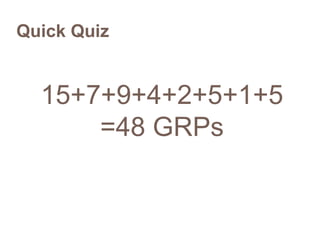
Quick Quiz


  15+7+9+4+2+5+1+5
      =48 GRPs
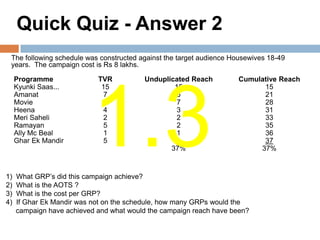
Quick Quiz - Answer 2
 The following schedule was constructed against the target audience Housewives 18-49
 years. The campaign cost is Rs 8 lakhs.


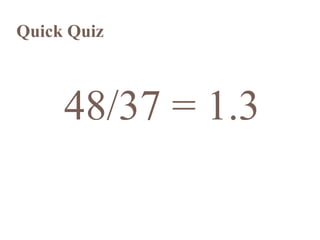
                           1.3
     Programme              TVR          Unduplicated Reach          Cumulative Reach
     Kyunki Saas...          15                  15                        15
     Amanat                   7                   6                        21
     Movie                    9                   7                        28
     Heena                    4                   3                        31
     Meri Saheli              2                   2                        33
     Ramayan                  5                   2                        35
     Ally Mc Beal             1                   1                        36
     Ghar Ek Mandir           5                   1                        37
                                                37%                       37%


1)   What GRP‟s did this campaign achieve?
2)   What is the AOTS ?
3)   What is the cost per GRP?
4)   If Ghar Ek Mandir was not on the schedule, how many GRPs would the
     campaign have achieved and what would the campaign reach have been?
Quick Quiz


     48/37 = 1.3
Quick Quiz - Answer 3
 The following schedule was constructed against the target audience Housewives 18-49
 years. The campaign cost is Rs 8 lakhs.

     Programme              TVR          Unduplicated Reach         Cumulative Reach


        Rs. 16667
     Kyunki Saas...          15                  15                       15
     Amanat                   7                   6                       21
     Movie                    9                   7                       28
     Heena                    4                   3                       31
     Meri Saheli              2                   2                       33
     Ramayan                  5                   2                       35
     Ally Mc Beal             1                   1                       36
     Ghar Ek Mandir           5                   1                       37
                                                37%                      37%

1)   What GRP’s did this campaign achieve?
2)   What is the AOTS ?
3)   What is the cost per GRP?
4)   If Ghar Ek Mandir was not on the schedule, how many GRPs would the
     campaign have achieved and what would the campaign reach have been?
Quick Quiz


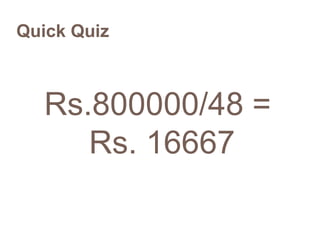
   Rs.800000/48 =
      Rs. 16667
Quick Quiz - Answer 4
 The following schedule was constructed against the target audience
 Housewives 18-49 years. The campaign cost is Rs 8 lakhs.


GRPs- 43
 Programme
 Kyunki Saas...
 Amanat
 Movie
 Heena
 Meri Saheli
                      TVR
                       15
                        7
                        9
                        4
                        2
                                Unduplicated Reach Cumulative Reach
                                         15
                                          6
                                          7
                                          3
                                          2
                                                             15
                                                             21
                                                             28
                                                             31
                                                             33


Reach-36%
 Ramayan                5                 2                  35
 Ally Mc Beal           1                 1                  36
 Ghar Ek Mandir         5                 1                  37
                                        37%                 37%
1) What GRP‟s did this campaign achieve?
2) What is the AOTS ?
3) What is the cost per GRP?
4) If Ghar Ek Mandir was not on the schedule, how many GRPs would the
   campaign have achieved and what would the campaign reach have
been?
Quick Quiz


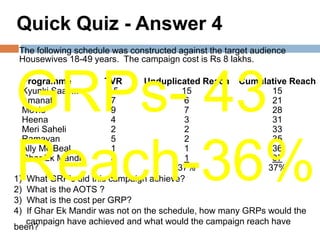
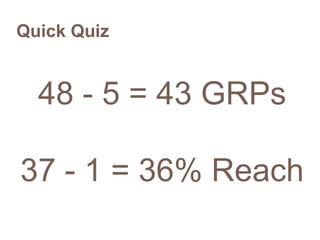
  48 - 5 = 43 GRPs

37 - 1 = 36% Reach
Channel Shares

   Out of the total TV viewing universe in the
    specified time period what proportion of the
    audience has viewed the channel.
Cumulative Reach


   The net unduplicated number of people that
    have viewed a channel for at least a period
    of 1 min within the specified time period.
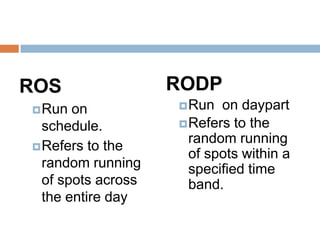
ROS                 RODP
 Run  on            Run  on daypart
  schedule.          Refers to the
                      random running
 Refers to the
                      of spots within a
  random running      specified time
  of spots across     band.
  the entire day
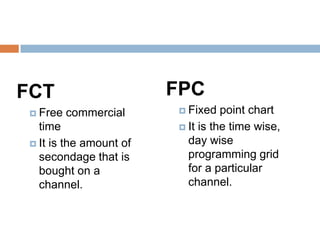
FCT                      FPC
  Free   commercial      Fixed   point chart
   time                   It is the time wise,

  It is the amount of     day wise
   secondage that is       programming grid
   bought on a             for a particular
   channel.                channel.
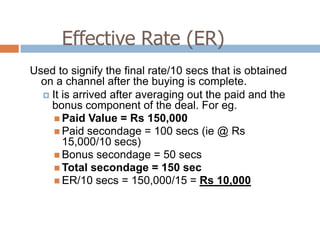
Effective Rate (ER)
Used to signify the final rate/10 secs that is obtained
  on a channel after the buying is complete.
   It is arrived after averaging out the paid and the
    bonus component of the deal. For eg.
      Paid Value = Rs 150,000
      Paid secondage = 100 secs (ie @ Rs
       15,000/10 secs)
      Bonus secondage = 50 secs
      Total secondage = 150 sec
      ER/10 secs = 150,000/15 = Rs 10,000
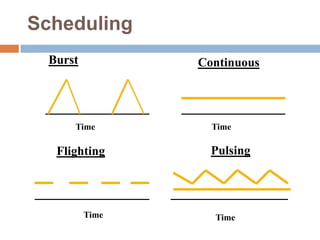
Scheduling
  Burst          Continuous


      Time         Time

   Flighting       Pulsing


          Time     Time
TERMINOLOGIES IN A
COMPETITIVE
FRAMEWORK
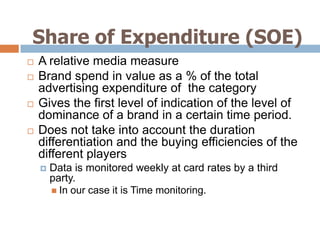
Share of Expenditure (SOE)
   A relative media measure
   Brand spend in value as a % of the total
    advertising expenditure of the category
   Gives the first level of indication of the level of
    dominance of a brand in a certain time period.
   Does not take into account the duration
    differentiation and the buying efficiencies of the
    different players
       Data is monitored weekly at card rates by a third
        party.
         In our case it is Time monitoring.
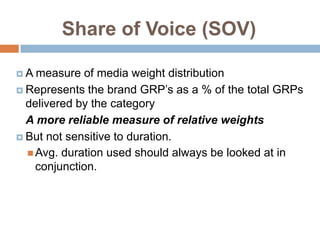
Share of Voice (SOV)

A  measure of media weight distribution
 Represents the brand GRP‟s as a % of the total GRPs
  delivered by the category
  A more reliable measure of relative weights
 But not sensitive to duration.
   Avg. duration used should always be looked at in
    conjunction.
TERMINOLOGIES IN
MARKET
PRIORITISATION
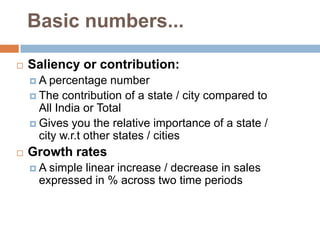
Basic numbers...

   Saliency or contribution:
    A   percentage number
     The contribution of a state / city compared to
      All India or Total
     Gives you the relative importance of a state /
      city w.r.t other states / cities
   Growth rates
    A simple linear increase / decrease in sales
     expressed in % across two time periods
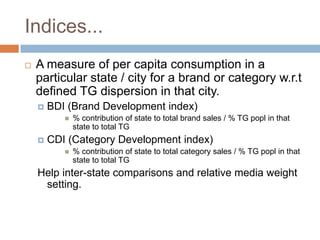
Indices...
   A measure of per capita consumption in a
    particular state / city for a brand or category w.r.t
    defined TG dispersion in that city.
       BDI (Brand Development index)
              % contribution of state to total brand sales / % TG popl in that
               state to total TG
       CDI (Category Development index)
              % contribution of state to total category sales / % TG popl in that
               state to total TG
    Help inter-state comparisons and relative media weight
     setting.
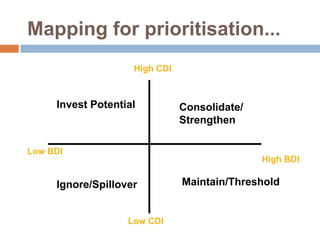
Mapping for prioritisation...
                    High CDI


     Invest Potential          Consolidate/
                               Strengthen

Low BDI
                                              High BDI

     Ignore/Spillover          Maintain/Threshold


                   Low CDI
ZOOMING IN ON
PRINT...
Press terminologies & concepts
Readership
   Average Issue readership
    A  percentage / portion of the audience who read
      the vehicle within the periodicity of it being
      published
     Also referred to as reach of vehicle

   Sole Readers
    A percentage / portion of the audience who
     reads only a particular vehicle and nothing else
Cost efficiency

     CPT (Cost per thousand)
       Cost of a defined creative unit say 100 cc or
       Full Page/ the readership in thousands.

     CPC (Cost per copy)
       Cost of a defined creative unit say 100 cc or
       Full Page/ the circulation in thousands.
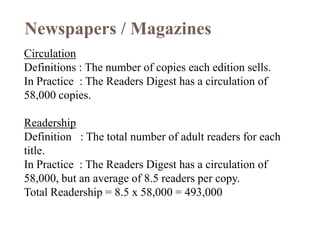
Newspapers / Magazines
Circulation
Definitions : The number of copies each edition sells.
In Practice : The Readers Digest has a circulation of
58,000 copies.

Readership
Definition : The total number of adult readers for each
title.
In Practice : The Readers Digest has a circulation of
58,000, but an average of 8.5 readers per copy.
Total Readership = 8.5 x 58,000 = 493,000
NET TERMINOLOGY
Terminology…
   Uniform Resource Locator (URL)
     An  Internet address
     A means of identifying an exact location on the
      Internet
     http://www.rediff.com

   HTML (HyperText Mark-up Language)
     The set of codes that tells the web browser how
     to display the page
Terminology…
   Rich Media
     Ads with Rich Media use Java, Flash, Shockwave to
      generate banners with animations, form submissions
      etc.
     Interaction with the user

   Cookie
       A packet of data stored on your computer‟s hard drive by a
        Web site
       The code reveals info about you (pages you‟ve
        visited, utilities used, etc.) that can be used for
        targeting of ads
Terminology…
   Hit
     A hit is generated by every request made to a web
      server.
     Eg. The Inbox, Compose etc. on Hotmail are treated
      as different hits
   Impression
       One display of a banner to a single viewer
   Page View
       One download of a complete page
Terminology…


   Unique visitors
       The number of unique individuals who visit a site
        within a specific period of time
WHILE PLANNING
QUESTION
YOURSELF….
1.What is the marketing/sales
objective?
   hold current users
   change user profile
   grab users from competition
   expand category ie.new users
   get current users to use more
2.What is the objective behind the current
burst ?
Specific sales objectives (if measurable)


       Brand task - Introduce, Maintain, Stimulate,
        Reposition, Re-launch
3.What is the role of advertising ?
Increase awareness (measurable), generate trials etc.


       Will impact coverage, continuity, dominance,
        frequency objectives in the plan
4.Which are the focus markets?
Mkt. wise sales salience over at least 4 data points (by quarter)


   Helps in market prioritisation and relative
    media weight allocation
5.What is the competitive set ?
What are their regional pockets of strength ?


   Helps us look at the media in the context of
    the overall marketing plan to counter
    competition
   How is the category moving - growths, rural
    vs urban etc. ?
6.What is the brand's distribution status by
geography, compared to the competition &
category ?


     Can lead to a decision to delay media break
      in a mkt due to below -threshold distribution
7.Who are we talking to ?

    Demographics
    Psychographics
8.Where are current users coming from
?
(if not a new brand) TG definition & geography


          Can help identify the strong pockets
          Can impact the relative media weights for
           each market.
            (Reach      for width & frequency for depth)
9.Where has been the maximum lapsing and why
?
(if applicable)


       Can link this to media weights given.
        Redefine threshold if there is a only media
        solution
10.How much are the resources ?

   Budget determined by client, allocated by
    agency
11.Are there any special
considerations that we need to bear in
mind ?


    Any market/category peculiarity that could
     impact the planning process
      Client
           deals, below the line activities,
      seasonality, purchase cycle etc.
12.Are there any creative size
mandatories ?

     Existing creatives
     New creatives with size restrictions
THE MEDIA PLANNING
PROCESS
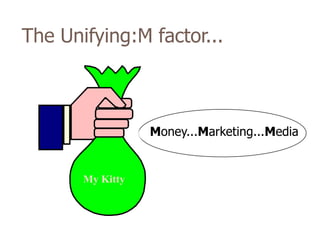
The Unifying:M factor...


                  Money...Marketing...Media


       My Kitty
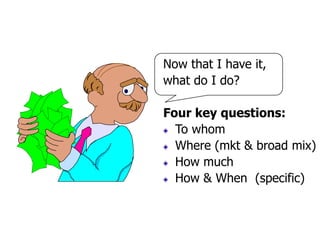
Now that I have it,
what do I do?

Four key questions:
  To whom
  Where (mkt & broad mix)
  How much
  How & When (specific)
To Whom...
To whom...
             Demographics
                Primary vs secondary
             Psychographics
             Mediagraphics
                C&S vs NC&S
Where - Markets...
              Market Prioritisation
                  Salience (% contribution)
                  Growths
                  Mkt wise share
                   movements - competitive
                   factors
                  Distribution
How does our audience relate
to his/her media environment


   Where ...
   Context of media
The juggle...


                Arriving at the right
                media mix
Why a medium...
   Each medium has some inherent capabilities
     TV - a-v/active - emotional/demo
     Press - high involvement - information detail

     Radio - audio/passive - imagination/intimate

     Cinema - audio visual/unadulterated attention

     Outdoor - transient - announcement/localised

     Internet- interactive – one on one
Why a mix...

   Extend the reach beyond a single medium
   Highly fragmented mkts
   If the brand is targeting two different TG
       different strokes for different folks
   Different stimuli aid in making the
    communication more memorable
     Media multiplier
     Launch impact
Quantitative...
   Maximum possible reach of a medium
    (Max Pos):
     How does a medium fare in numeric terms
     within our defined audience
      Eg:FM for teenagers, Women focus mags for
       women etc.
Qualitative...
   Involvement
     This  adds the qualitative layer and gauges not
      just the numbers but also the quality of the
      interaction with a medium.
     Average time spent ( Heavy/ medium /light.)

     Context of use.
Planning in a competitive
  Not always actionable insights but a
context backdrop.
   critical
    MAP- Press (monthly)
    Medialogist - TV (weekly)
Competitive Tracking - Press
   Spends across brands on a regular basis
   Spot key trends
     Type of publications used
     Periodicity (Dailies v/s Magazines)
     Colour v/s B&W
     Seasonality
     Specific positions
     English v/s language press
Competitive Tracking - TV
   Spends across brands on a regular basis
   Spot key trends
     Channel   mix
     Terrestrial vs satellite focus

     Regional vs national focus

     Average duration of spot

     Scheduling pattern
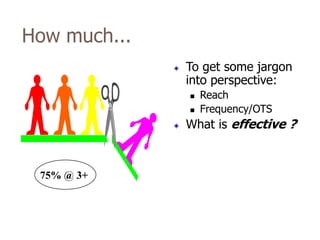
How much...
              To get some jargon
              into perspective:
                 Reach
                 Frequency/OTS
              What is effective ?


 75% @ 3+
Frequency based weight setting
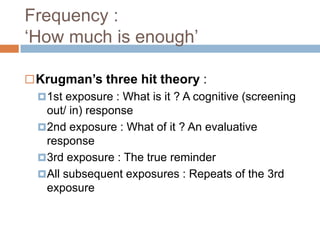
Frequency :
„How much is enough‟

 Krugman’s three hit theory :
   1st exposure : What is it ? A cognitive (screening
    out/ in) response
   2nd exposure : What of it ? An evaluative
    response
   3rd exposure : The true reminder
   All subsequent exposures : Repeats of the 3rd
    exposure
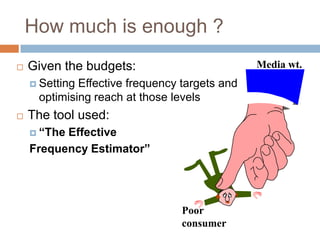
How much is enough ?
   Given the budgets:                         Media wt.
     SettingEffective frequency targets and
     optimising reach at those levels
   The tool used:
     “TheEffective
    Frequency Estimator”


                                 Poor
                                 consumer
About the estimator...
   A model for arriving at an optimal
    frequency level for a brand in a particular
    market.
   Parameters used
     Brand(Awareness) related
     The media/market environment
     Communication factors
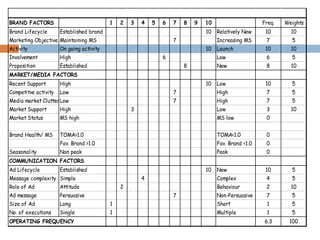
BRAND FACTORS                             1   2   3   4   5   6   7   8   9   10                     Freq.   Weights
Brand Lifecycle       Established brand                                       10 Relatively New       10       10
Marketing Objective Maintaining MS                                7                Increasing MS      7        5
Activity              On going activity                                       10 Launch               10       10
Involvement           High                                    6                    Low                6        5
Proposition           Established                                     8            New                8        10
MARKET/MEDIA FACTORS
Recent Support        High                                                    10 Low                  10       5
Competitve activity   Low                                         7                High               7        5
Media market ClutterLow                                           7                High               7        5
Market Support        High                        3                                Low                3        10
Market Status         MS high                                                      MS low             0


Brand Health/ MS      TOMA>1.0                                                     TOMA<1.0           0
                      Fav. Brand >1.0                                              Fav. Brand <1.0    0
Seasonality           Non peak                                                     Peak               0
COMMUNICATION FACTORS
Ad Lifecycle          Established                                             10 New                  10       5
Message complexity Simple                             4                            Complex            4        5
Role of Ad            Attitude                2                                    Behaviour          2        10
Ad message            Persuasive                                  7                Non-Persuasive     7        5
Size of Ad            Long                1                                        Short              1        5
No. of executions     Single              1                                        Multiple           1        5
OPERATING FREQUENCY                                                                                  6.3      100
Reach based weight setting
Setting reach objectives
Goal Orientation
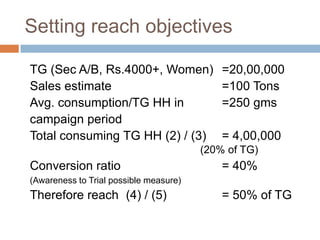
 This approach is a bottom-up approach, which
  flows from expected sales. An illustration :
Setting reach objectives

TG (Sec A/B, Rs.4000+, Women)               =20,00,000
Sales estimate                              =100 Tons
Avg. consumption/TG HH in                   =250 gms
campaign period
Total consuming TG HH (2) / (3)             = 4,00,000
                                        (20% of TG)
Conversion ratio                            = 40%
(Awareness to Trial possible measure)
Therefore reach (4) / (5)                   = 50% of TG
Setting reach objectives
Maximising Efficiency

   This approach is strictly quantitative in nature,
    with the primary objective of maximising
    efficiency. It can be applied only when effective
    frequency objectives have been set.
Setting reach objectives
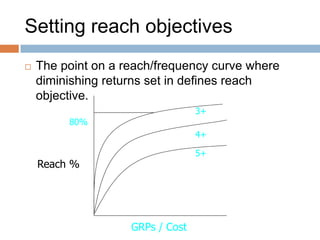
   The point on a reach/frequency curve where
    diminishing returns set in defines reach
    objective.
                                  3+
         80%
                                  4+

                                  5+
    Reach %


                    GRPs / Cost