OSI Reference Layer
The Reference Model for Network communication
Presented by:
V G. Jyothimani
Assistant Professor
MCA department
VVV college for Women
Virudhunagar- 626001
1.Introduction
• According to ISO standard, The OSI (Open Systems Interconnection) model is
essential for global data communication.
2.Purpose
•Facilitates seamless communication between diverse computer systems worldwide.
3.Structure
•Consists of seven distinct layers, each serving a specific function.
4.Layers Overview
•Layer 1 (Physical): Deals with physical connections and transmission of raw data.
•Layer 2 (Data Link): Manages data packets over the physical layer.
•Layer 3 (Network): Handles routing and forwarding of data.
•Layer 4 (Transport): Ensures reliable data transfer between end systems.
•Layer 5 (Session): Establishes, manages, and terminates connections.
•Layer 6 (Presentation): Translates, encrypts, and formats data for presentation.
•Layer 7 (Application): Provides user interfaces and network services.
Objectives of the OSI Model
• To reduce the design complexity, most of the network are organized as a series
of layers or levels, each one build upon one below it.
• The basic idea of a layered structure is to divide the design into small pieces.
• Each layer adds to the services provided by the lower layer in such a way that
the highest layer is provided has a full set of services.
• Key Elements of Layered Models:
• Services: Actions provided by one layer to another (typically a higher
layer).
• Protocols: Rules governing how information is exchanged within a layer.
• Interfaces: Communication points facilitating interaction between layers.
• A Interface is communication between the layers.
Functions of each Layer
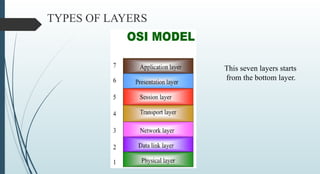
TYPES OF LAYERS
This seven layers starts
from the bottom layer.
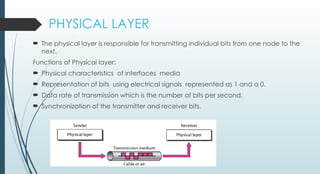
PHYSICAL LAYER
 The physical layer is responsible for transmitting individual bits from one node to the
next.
Functions of Physical layer:
 Physical characteristics of interfaces media
 Representation of bits using electrical signals represented as 1 and a 0.
 Data rate of transmission which is the number of bits per second.
 Synchronization of the transmitter and receiver bits.
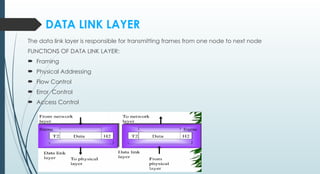
DATA LINK LAYER
The data link layer is responsible for transmitting frames from one node to next node
FUNCTIONS OF DATA LINK LAYER:
 Framing
 Physical Addressing
 Flow Control
 Error Control
 Access Control
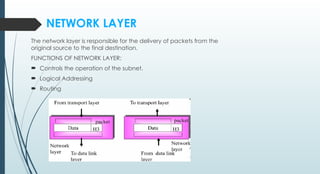
NETWORK LAYER
The network layer is responsible for the delivery of packets from the
original source to the final destination.
FUNCTIONS OF NETWORK LAYER:
 Controls the operation of the subnet.
 Logical Addressing
 Routing
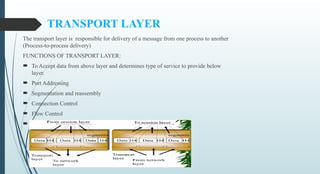
TRANSPORT LAYER
The transport layer is responsible for delivery of a message from one process to another
(Process-to-process delivery)
FUNCTIONS OF TRANSPORT LAYER:
 To Accept data from above layer and determines type of service to provide below
layer.
 Port Addressing
 Segmentation and reassembly
 Connection Control
 Flow Control
 Error Control
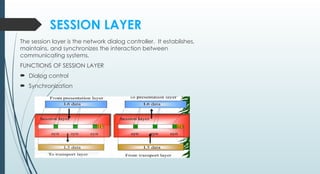
SESSION LAYER
The session layer is the network dialog controller. It establishes,
maintains, and synchronizes the interaction between
communicating systems.
FUNCTIONS OF SESSION LAYER
 Dialog control
 Synchronization
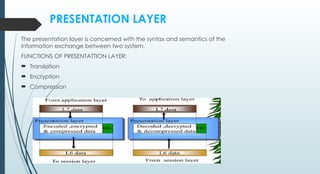
PRESENTATION LAYER
The presentation layer is concerned with the syntax and semantics of the
information exchange between two system.
FUNCTIONS OF PRESENTATTION LAYER:
 Translation
 Encryption
 Compression
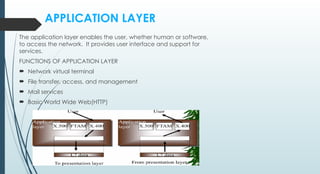
APPLICATION LAYER
The application layer enables the user, whether human or software,
to access the network. It provides user interface and support for
services.
FUNCTIONS OF APPLICATION LAYER
 Network virtual terminal
 File transfer, access, and management
 Mail services
 Basic World Wide Web(HTTP)
OSI reference model and the TCP/IP reference model

OSI reference model and the TCP/IP reference model

  • 1.
    OSI Reference Layer TheReference Model for Network communication Presented by: V G. Jyothimani Assistant Professor MCA department VVV college for Women Virudhunagar- 626001
  • 2.
    1.Introduction • According toISO standard, The OSI (Open Systems Interconnection) model is essential for global data communication. 2.Purpose •Facilitates seamless communication between diverse computer systems worldwide. 3.Structure •Consists of seven distinct layers, each serving a specific function. 4.Layers Overview •Layer 1 (Physical): Deals with physical connections and transmission of raw data. •Layer 2 (Data Link): Manages data packets over the physical layer. •Layer 3 (Network): Handles routing and forwarding of data. •Layer 4 (Transport): Ensures reliable data transfer between end systems. •Layer 5 (Session): Establishes, manages, and terminates connections. •Layer 6 (Presentation): Translates, encrypts, and formats data for presentation. •Layer 7 (Application): Provides user interfaces and network services. Objectives of the OSI Model
  • 3.
    • To reducethe design complexity, most of the network are organized as a series of layers or levels, each one build upon one below it. • The basic idea of a layered structure is to divide the design into small pieces. • Each layer adds to the services provided by the lower layer in such a way that the highest layer is provided has a full set of services. • Key Elements of Layered Models: • Services: Actions provided by one layer to another (typically a higher layer). • Protocols: Rules governing how information is exchanged within a layer. • Interfaces: Communication points facilitating interaction between layers. • A Interface is communication between the layers. Functions of each Layer
  • 4.
    TYPES OF LAYERS Thisseven layers starts from the bottom layer.
  • 5.
    PHYSICAL LAYER  Thephysical layer is responsible for transmitting individual bits from one node to the next. Functions of Physical layer:  Physical characteristics of interfaces media  Representation of bits using electrical signals represented as 1 and a 0.  Data rate of transmission which is the number of bits per second.  Synchronization of the transmitter and receiver bits.
  • 6.
    DATA LINK LAYER Thedata link layer is responsible for transmitting frames from one node to next node FUNCTIONS OF DATA LINK LAYER:  Framing  Physical Addressing  Flow Control  Error Control  Access Control
  • 7.
    NETWORK LAYER The networklayer is responsible for the delivery of packets from the original source to the final destination. FUNCTIONS OF NETWORK LAYER:  Controls the operation of the subnet.  Logical Addressing  Routing
  • 8.
    TRANSPORT LAYER The transportlayer is responsible for delivery of a message from one process to another (Process-to-process delivery) FUNCTIONS OF TRANSPORT LAYER:  To Accept data from above layer and determines type of service to provide below layer.  Port Addressing  Segmentation and reassembly  Connection Control  Flow Control  Error Control
  • 9.
    SESSION LAYER The sessionlayer is the network dialog controller. It establishes, maintains, and synchronizes the interaction between communicating systems. FUNCTIONS OF SESSION LAYER  Dialog control  Synchronization
  • 10.
    PRESENTATION LAYER The presentationlayer is concerned with the syntax and semantics of the information exchange between two system. FUNCTIONS OF PRESENTATTION LAYER:  Translation  Encryption  Compression
  • 11.
    APPLICATION LAYER The applicationlayer enables the user, whether human or software, to access the network. It provides user interface and support for services. FUNCTIONS OF APPLICATION LAYER  Network virtual terminal  File transfer, access, and management  Mail services  Basic World Wide Web(HTTP)