COMPUTER NETWORK
ECS43105
OSI MODEl
(OPEN SYSTSM
INTERCONNECTION
MODEL):
Presented By:
•ANINDYA NAG &
• Rohit Sharma
•Roll No : UG/02/BTCSE/2018/005
•& Roll No: UG/02/BTCSE/2018/009
•B-Tech CSE , Section – “B” [3rd yr , 5th sem]
•There are mainly 2 types of model for data
communication
1. OSI Model
2. TCP/IP Suit
OSI MODEL:
•OSI Model Developed by ISO(
International Standard Organization)
•OSI model is a Seven layer
Architecture.
•OSI Model is the global Accepted
model because Heterogeneous
networks
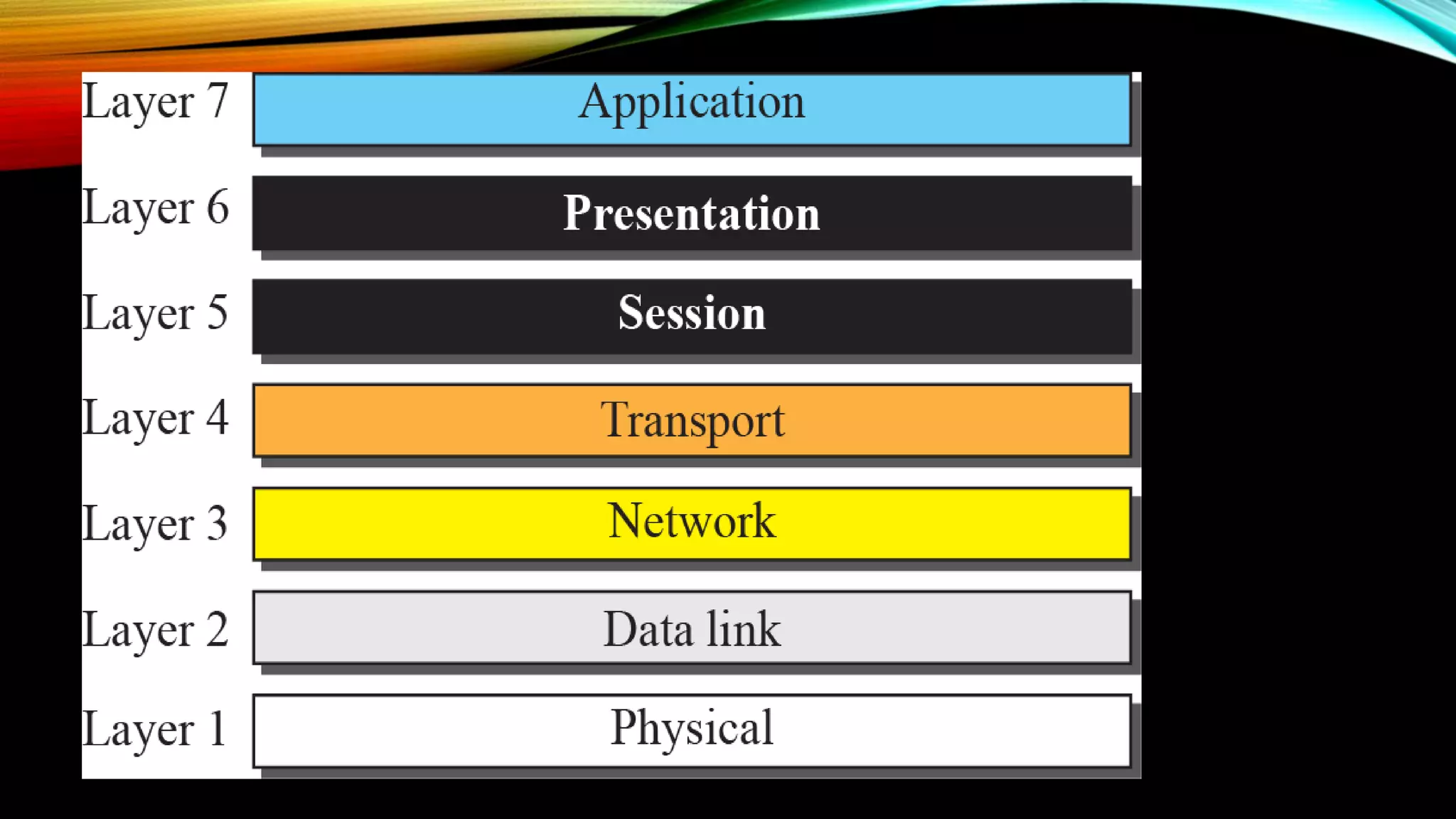
7 LAYERS IN OSI MODEL:
•1.Physical Layer (Layer 1)
•2.Data Link Layer (Layer 2)
•3. Network Layer (Layer 3)
•4.Transport Layer (Layer 4)
•5.Session Layer (Layer 5)
•6.Presentation Layer (Layer 6)
•7.Application Layer (Layer 7)
Application Layer (Layer 7), Presentation Layer (Layer
6), Session Layer (Layer 5)
are software layer..
Transport Layer (Layer 4) is called heart of OSI model
• Network Layer (Layer 3), Data Link Layer (Layer 2),
Physical Layer (Layer 1) are Hardware layer..
OIS mode follows a layered architecture for transmission
of data from sender to receiver through INTERMEDIATE
Devices.
•OIS mode follows a layered
architecture for transmission of data
from sender to receiver through
INTERMEDIATE Devices.
FUNCTION OF PHYSICAL LAYER (LAYER 1)
• Bit Synchronization
• Bit Rate control
• Data transmission as bit over a medium
• It create physical link Between sender and Receiver
FUNCTION OF DATA LINK LAYER (LAYER 2)
•Main function of this layer are flow
control & error control.
•Access Control
•Physical Addressing
•Framing
•It organize bits into frames.
FUNCTION OF NETWORK LAYER (LAYER 3)
• Inter networking
• Packetizing
• Logical Addressing
• Routing
• It is responsible for moving the packet from source to
the destination,
FUNCTION OF TRANSPORT LAYER
• Service point Addressing
• Reliable message deliver from process to process
• reassembly
FUNCTION OF SESSION LAYER
•Synchronization
•Dialog Contriller
•Maintence and
•Termination
FUNCTION OF PRESENTATION LAYER
•Translation
•Compression
•Mainly Encryption
•Dectryption
FUNCTION OF APPLICATION LAYER
•Derectly Connection to sendr and receiver
•Access to network resources
•Provide services to the user
DATA LINK
LAYER:
The data link layer is responsible for moving frames from
one node to the next.
PHYSICAL
LAYER :
THANK YOU

OSI model

  • 1.
  • 2.
  • 3.
    Presented By: •ANINDYA NAG& • Rohit Sharma •Roll No : UG/02/BTCSE/2018/005 •& Roll No: UG/02/BTCSE/2018/009 •B-Tech CSE , Section – “B” [3rd yr , 5th sem]
  • 4.
    •There are mainly2 types of model for data communication 1. OSI Model 2. TCP/IP Suit
  • 5.
    OSI MODEL: •OSI ModelDeveloped by ISO( International Standard Organization) •OSI model is a Seven layer Architecture. •OSI Model is the global Accepted model because Heterogeneous networks
  • 6.
    7 LAYERS INOSI MODEL: •1.Physical Layer (Layer 1) •2.Data Link Layer (Layer 2) •3. Network Layer (Layer 3) •4.Transport Layer (Layer 4) •5.Session Layer (Layer 5) •6.Presentation Layer (Layer 6) •7.Application Layer (Layer 7)
  • 7.
    Application Layer (Layer7), Presentation Layer (Layer 6), Session Layer (Layer 5) are software layer.. Transport Layer (Layer 4) is called heart of OSI model • Network Layer (Layer 3), Data Link Layer (Layer 2), Physical Layer (Layer 1) are Hardware layer.. OIS mode follows a layered architecture for transmission of data from sender to receiver through INTERMEDIATE Devices.
  • 11.
    •OIS mode followsa layered architecture for transmission of data from sender to receiver through INTERMEDIATE Devices.
  • 12.
    FUNCTION OF PHYSICALLAYER (LAYER 1) • Bit Synchronization • Bit Rate control • Data transmission as bit over a medium • It create physical link Between sender and Receiver
  • 13.
    FUNCTION OF DATALINK LAYER (LAYER 2) •Main function of this layer are flow control & error control. •Access Control •Physical Addressing •Framing •It organize bits into frames.
  • 14.
    FUNCTION OF NETWORKLAYER (LAYER 3) • Inter networking • Packetizing • Logical Addressing • Routing • It is responsible for moving the packet from source to the destination,
  • 15.
    FUNCTION OF TRANSPORTLAYER • Service point Addressing • Reliable message deliver from process to process • reassembly
  • 16.
    FUNCTION OF SESSIONLAYER •Synchronization •Dialog Contriller •Maintence and •Termination
  • 17.
    FUNCTION OF PRESENTATIONLAYER •Translation •Compression •Mainly Encryption •Dectryption
  • 18.
    FUNCTION OF APPLICATIONLAYER •Derectly Connection to sendr and receiver •Access to network resources •Provide services to the user
  • 24.
    DATA LINK LAYER: The datalink layer is responsible for moving frames from one node to the next.
  • 25.
  • 26.