Computer Networks
CS-605
BSCS-7th (2018-2022)
Instructor: Talha Tahir Bajwa
TOPICS
• Network Model
• OSI Model
• Physical Layer
• Data Link Layer
• Network Layer
• Transport Layer
• Session Layer
• Presentation Layer
• Application Layer
• Devices used in each layer of OSI model?
Network Model
 A method of describing and analyzing data communication
networks by breaking the entire set of communication process
into a number of layers.
 Each layer has a specific function.
OSI Model
 International standard organization (ISO) established a
committee in 1977 to develop an architecture for systems
communication.
 Open System Interconnection (OSI) reference model is the
result of this effort.
 This model allows any two different systems to communicate.
OSI Model
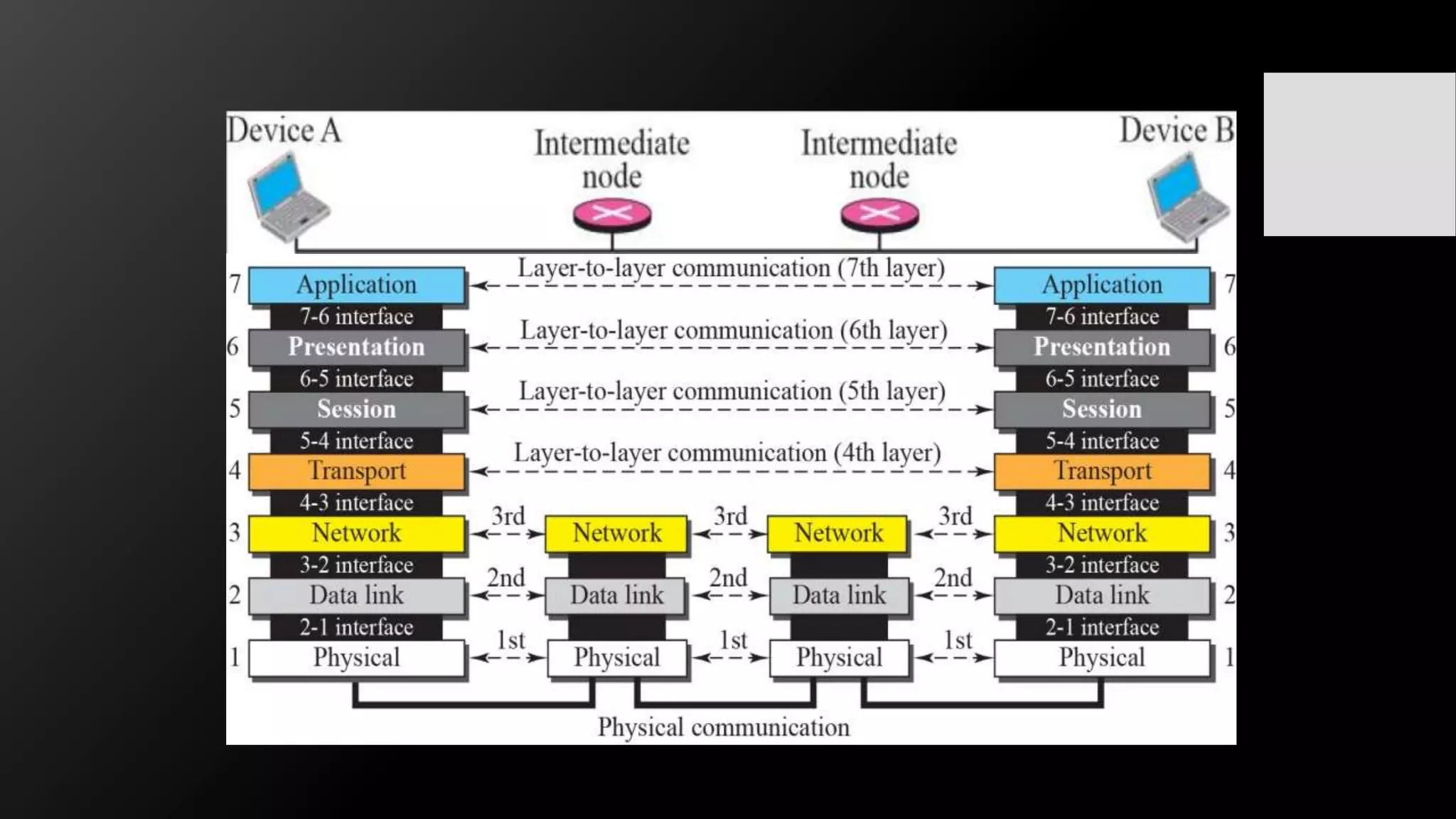
 The OSI model describes how data flows from one computer,
through a network to another computer.
 The OSI model is not a protocol; it is a model for
understanding and designing a network architecture that is
flexible and robust.
It use to transfer data over a network which moves through
different layers.
 It has 7 layer which divided into two level: upper or host
and lower or media level.
 Data moves through different stages like bits, frames,
packets, segments.
OSI Model
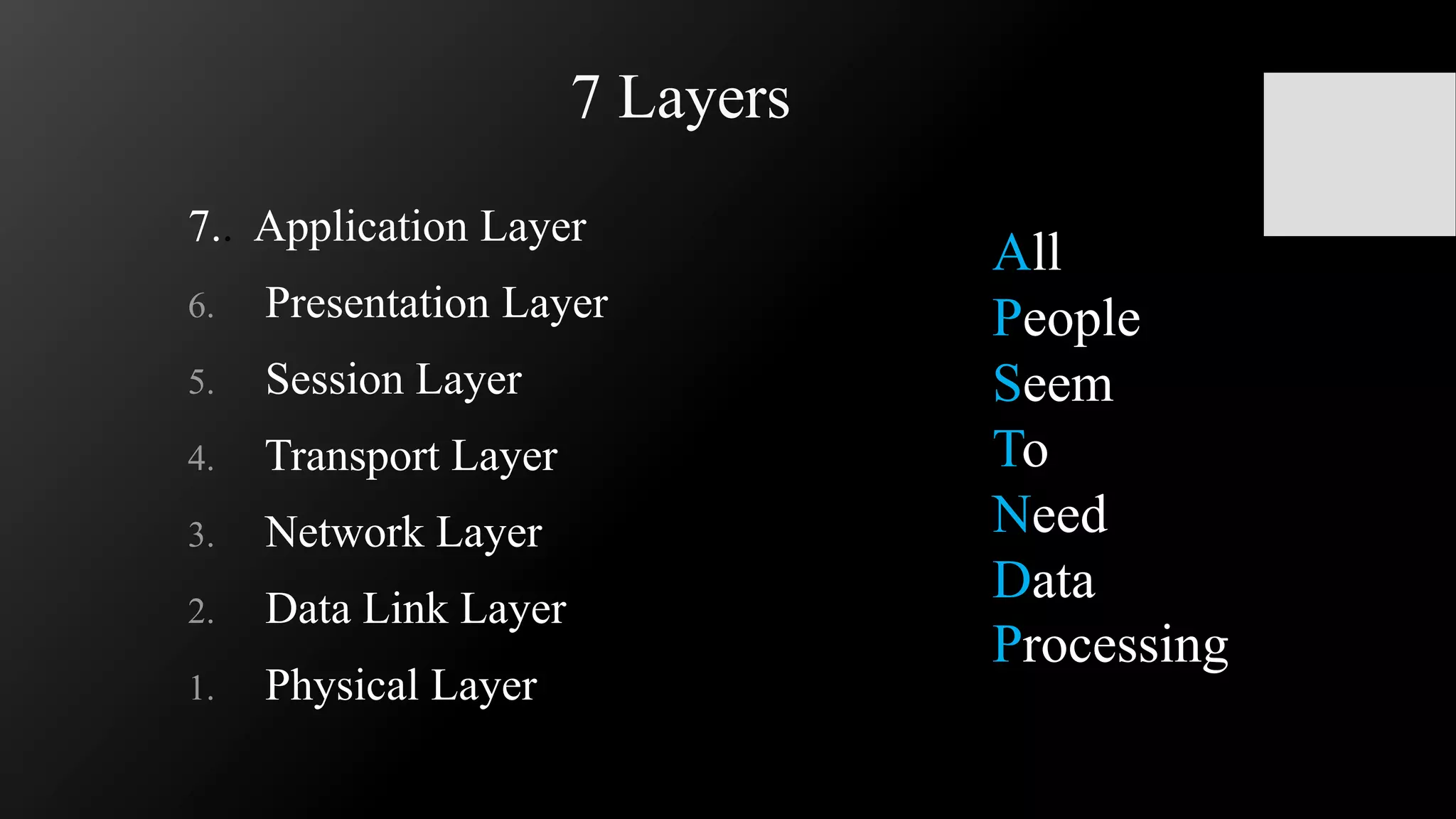
7 Layers
7.. Application Layer
6. Presentation Layer
5. Session Layer
4. Transport Layer
3. Network Layer
2. Data Link Layer
1. Physical Layer
All
People
Seem
To
Need
Data
Processing
Why so many layers
 To reduce the complexity, networks are organized as a stack of
layers, one below the other.
 Each layer performs a specific task.
It provides services to an adjacent layer.
OSI Layers cont.
 Layers 1,2, 3- physical, data link and network are network
support layers.
 Layers 5,6,7- session, presentation, and application are
user support layers.
 Layer 4, the transport layer, links the two subgroups
(network support layers and user support layers).
Physical Layer
 Physical layer is the bottom (Layer 1) of OSI model.
 It is responsible for the actual physical connection between the
devices.
 The physical layer is responsible for movements of individual
bits from one node to next.
Functions of Physical Layer
Representation of Bits: Data in this layer consists of stream of
bits.
Data Rate: This layer defines the rate of transmission which is
the number of bits per second.
Synchronization: It deals with the synchronization of the
transmitter and receiver.
Functions of Physical Layer
Interface: The physical layer defines the transmission interface
between devices and transmission medium.
Line Configuration: This layer connects devices with the
medium: Point to Point configuration and Multipoint
configuration.
Functions of Physical Layer
Transmission Modes: Physical Layer defines the direction of
transmission between two devices: Simplex, Half Duplex, Full
Duplex.
Topologies: Devices must be connected using the following
topologies: Mesh, Star, Ring and Bus.
The physical layer is responsible for movements of
individual bits from one hop (node) to the next.
Data Link Layer
Data link layer is most reliable node to node delivery of data.
It forms frames from the packets that are received from network
layer and gives it to physical layer.
The data link layer is responsible for moving frames from one
node to the next.
Error controlling is easily done.
Error detection bits are used by the data link layer.
It also corrects the errors.
Functions of Data Link Layer
 Framing: Frames are the streams of bits received from the network
layer into manageable data units.
 Physical Addressing: The Data Link layer adds a header to the
frame in order to define physical address of the sender or receiver of
the frame.
 Physical Address identifies a physical location of required data in a
memory.
Functions of Data Link Layer
 Access Control: Protocols of this layer determine which of the
devices has control over the link at any given time.
 Error Control: Duplication of frames are prevented by using
this mechanism.
The data link layer is responsible for moving
frames from one hop (node) to the next.
Network Layer
It is responsible for the source to destination delivery of a
packets across multiple networks.
It routes the signal through different channels from one
node to other.
Functions of Network Layer
 It is responsible for source to destination delivery of a packets
across multiple networks.
 Routing: Provide mechanism to transmit data over
independent networks that are linked together.
 Logical Addressing: Adds logical addresses for sender and
receiver.
The network layer is responsible for the
delivery of individual packets from
the source host to the destination host.
Transport Layer
It is responsible for source process to destination process delivery of
entire message.
Transport layer provides two types of services:
1. Connection Oriented Transmission: In this type of transmission the
receiving device sends an acknowledgment back to the source after
a packet or group of packet is received.
2. Connectionless Transmission: In this type of transmission the
receiver does not acknowledge receipt of a packet.
Functions of Transport Layer
 Flow Control: In this layer, flow control is performed end to
end.
 Error Control: Error Control is performed end to end in this
layer to ensure that the complete message arrives at the
receiving transport layer without any error.
Functions of Transport Layer
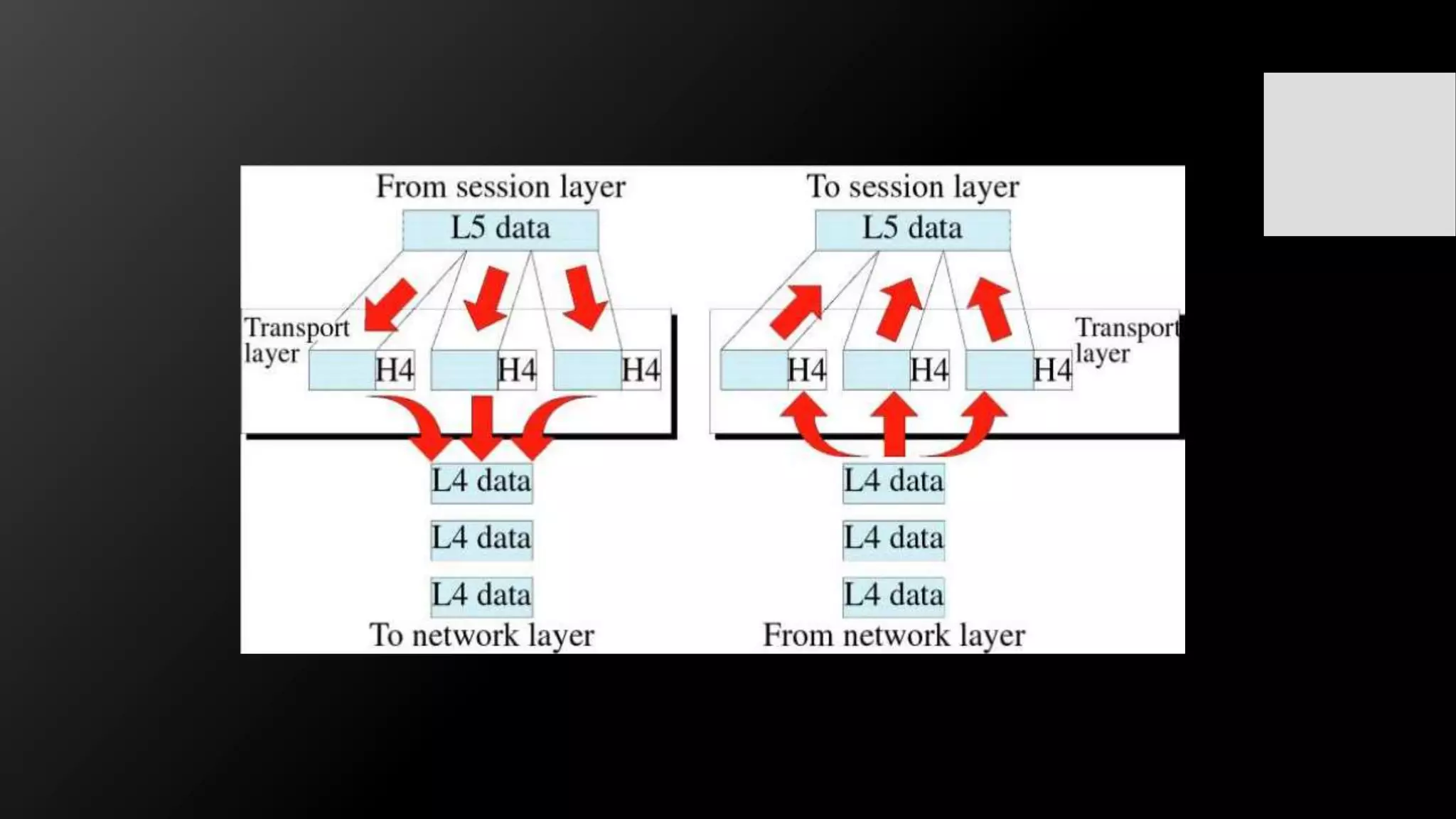
 Segmentation and Reassembly: Divide the message received from
Session layer into Segments and number them to make a sequence
for reassembly at the receiving side.
 Service point addressing: Transport layer makes sure that the
message is delivered to the correct process on destination machine.
The transport layer is responsible for the delivery
of a message from one process to another.
Session Layer
Session layer manages and synchronize the conversation
between two different applications which is called
session.
Transfer of data from source to destination session layer
streams of data are marked and are resynchronized
properly, so that the ends of the messages are not cut
and data loss is avoided.
Functions of Session Layer
Dialog Control: This layer allows two systems to start
communication with each other in half-duplex or full-duplex.
Synchronization This layer allows a process to add
checkpoints which are considered as synchronization points
into stream of data.
Example: If a system is sending a file of 800 pages, adding checkpoints
after every 50 pages is recommended.
This ensures that 50 page unit is successfully received and
acknowledged.
This is beneficial at the time of crash as if a crash happens at page
number 110; there is no need to retransmit 1 to 100 pages.
The session layer is responsible for dialog
control and synchronization.
Presentation Layer
The primary goal of this layer is to take care of the
syntax and semantics of the information exchanged
between two communicating systems.
Presentation layer takes care that the data is sent in
such a way that the receiver will understand the
information (data) and will be able to use the data.
Functions of Presentation Layer
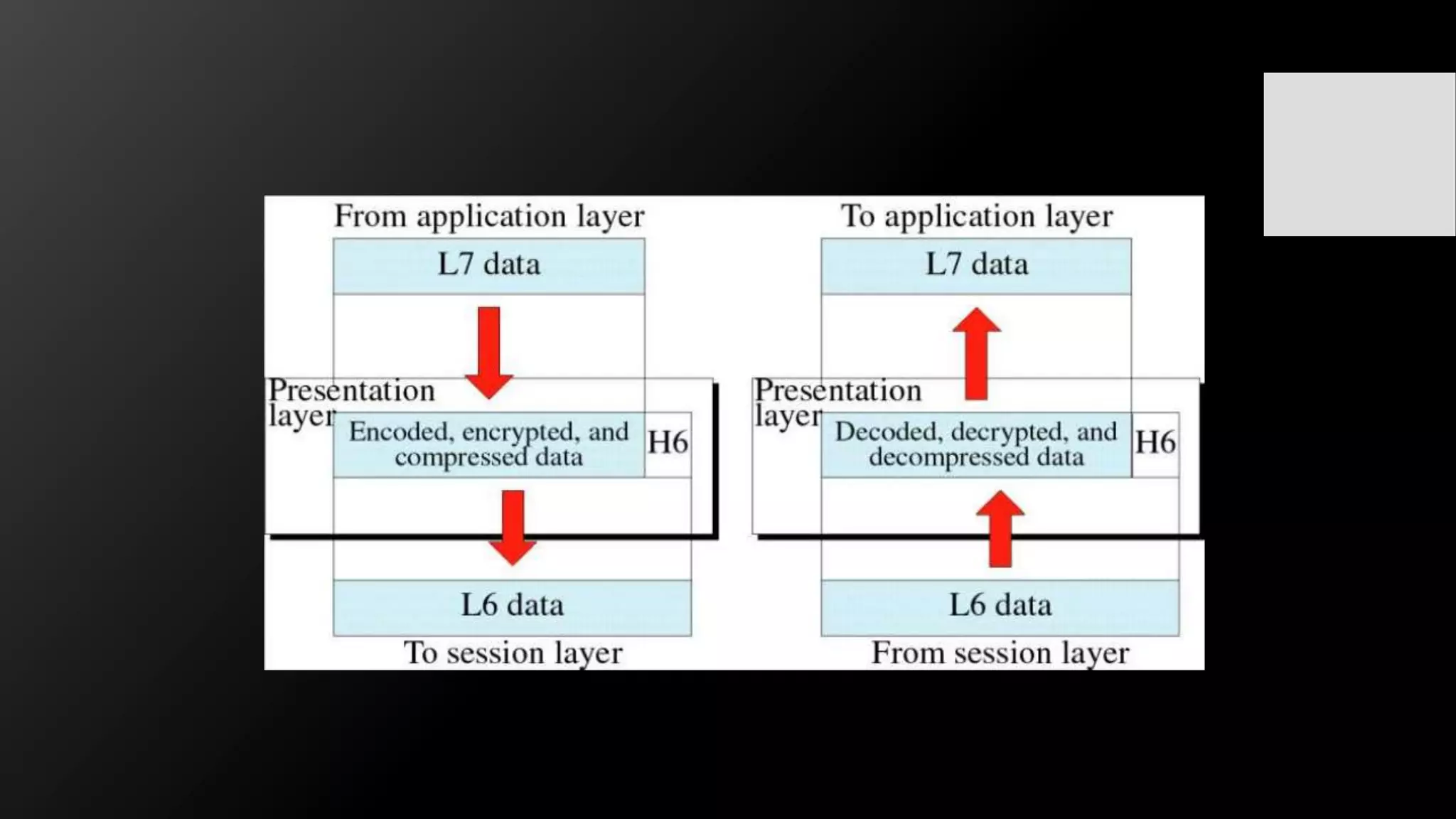
 Data Translation: Encoding and Decoding sender to common
format on sending side common to receiving format on receiver
side.
 Data Encryption: For security and privacy purpose.
 Data Compression: Data compression reduces the number of bits
contained in the information.
The presentation layer is responsible for
translation, compression, and encryption.
Application Layer
 The top layer of the OSI model.
 The application layer is responsible for
providing services to the user like email, file transfer.
 Provides a set of interfaces for sending and receiving
applications to gain access to and use network services, such
as: networked file transfer, message handling and database
query processing.
Functions of Application Layer
Mail Services: This layer provides the basis for E-mail
forwarding and storage.
 Directory Services: This layer provides access for
global information about various services.
 File Transfer, Access and Management (FTAM): It is a
standard mechanism to access files and manages it.
The application layer is responsible for
providing services to the user.
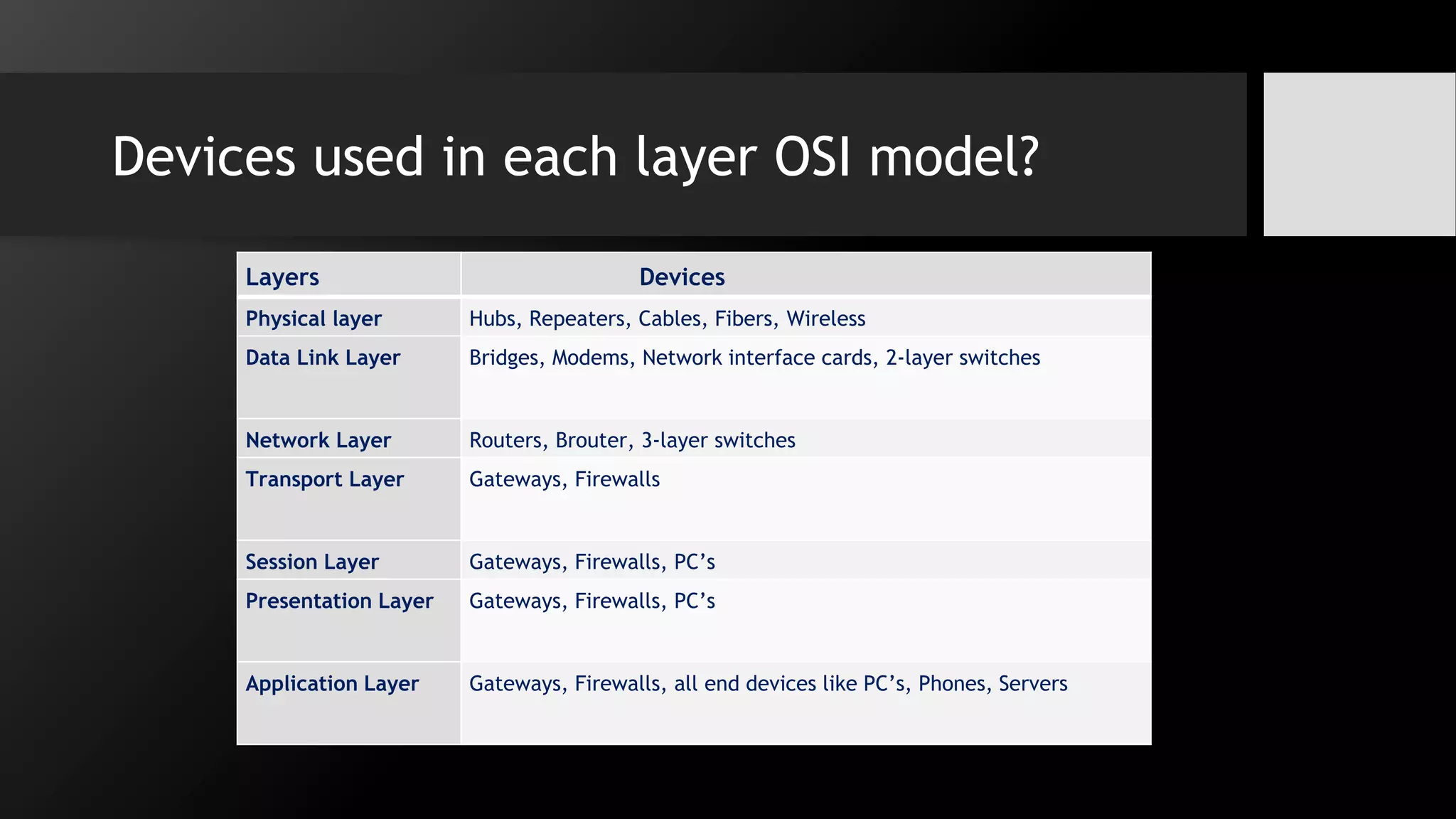
Devices used in each layer OSI model?
Layers Devices
Physical layer Hubs, Repeaters, Cables, Fibers, Wireless
Data Link Layer Bridges, Modems, Network interface cards, 2-layer switches
Network Layer Routers, Brouter, 3-layer switches
Transport Layer Gateways, Firewalls
Session Layer Gateways, Firewalls, PC’s
Presentation Layer Gateways, Firewalls, PC’s
Application Layer Gateways, Firewalls, all end devices like PC’s, Phones, Servers

3. osi model

  • 1.
  • 2.
    TOPICS • Network Model •OSI Model • Physical Layer • Data Link Layer • Network Layer • Transport Layer • Session Layer • Presentation Layer • Application Layer • Devices used in each layer of OSI model?
  • 3.
    Network Model  Amethod of describing and analyzing data communication networks by breaking the entire set of communication process into a number of layers.  Each layer has a specific function.
  • 4.
    OSI Model  Internationalstandard organization (ISO) established a committee in 1977 to develop an architecture for systems communication.  Open System Interconnection (OSI) reference model is the result of this effort.  This model allows any two different systems to communicate.
  • 5.
    OSI Model  TheOSI model describes how data flows from one computer, through a network to another computer.  The OSI model is not a protocol; it is a model for understanding and designing a network architecture that is flexible and robust.
  • 6.
    It use totransfer data over a network which moves through different layers.  It has 7 layer which divided into two level: upper or host and lower or media level.  Data moves through different stages like bits, frames, packets, segments. OSI Model
  • 7.
    7 Layers 7.. ApplicationLayer 6. Presentation Layer 5. Session Layer 4. Transport Layer 3. Network Layer 2. Data Link Layer 1. Physical Layer All People Seem To Need Data Processing
  • 8.
    Why so manylayers  To reduce the complexity, networks are organized as a stack of layers, one below the other.  Each layer performs a specific task. It provides services to an adjacent layer.
  • 10.
    OSI Layers cont. Layers 1,2, 3- physical, data link and network are network support layers.  Layers 5,6,7- session, presentation, and application are user support layers.  Layer 4, the transport layer, links the two subgroups (network support layers and user support layers).
  • 11.
    Physical Layer  Physicallayer is the bottom (Layer 1) of OSI model.  It is responsible for the actual physical connection between the devices.  The physical layer is responsible for movements of individual bits from one node to next.
  • 13.
    Functions of PhysicalLayer Representation of Bits: Data in this layer consists of stream of bits. Data Rate: This layer defines the rate of transmission which is the number of bits per second. Synchronization: It deals with the synchronization of the transmitter and receiver.
  • 14.
    Functions of PhysicalLayer Interface: The physical layer defines the transmission interface between devices and transmission medium. Line Configuration: This layer connects devices with the medium: Point to Point configuration and Multipoint configuration.
  • 15.
    Functions of PhysicalLayer Transmission Modes: Physical Layer defines the direction of transmission between two devices: Simplex, Half Duplex, Full Duplex. Topologies: Devices must be connected using the following topologies: Mesh, Star, Ring and Bus.
  • 16.
    The physical layeris responsible for movements of individual bits from one hop (node) to the next.
  • 17.
    Data Link Layer Datalink layer is most reliable node to node delivery of data. It forms frames from the packets that are received from network layer and gives it to physical layer. The data link layer is responsible for moving frames from one node to the next. Error controlling is easily done. Error detection bits are used by the data link layer. It also corrects the errors.
  • 19.
    Functions of DataLink Layer  Framing: Frames are the streams of bits received from the network layer into manageable data units.  Physical Addressing: The Data Link layer adds a header to the frame in order to define physical address of the sender or receiver of the frame.  Physical Address identifies a physical location of required data in a memory.
  • 20.
    Functions of DataLink Layer  Access Control: Protocols of this layer determine which of the devices has control over the link at any given time.  Error Control: Duplication of frames are prevented by using this mechanism.
  • 21.
    The data linklayer is responsible for moving frames from one hop (node) to the next.
  • 22.
    Network Layer It isresponsible for the source to destination delivery of a packets across multiple networks. It routes the signal through different channels from one node to other.
  • 24.
    Functions of NetworkLayer  It is responsible for source to destination delivery of a packets across multiple networks.  Routing: Provide mechanism to transmit data over independent networks that are linked together.  Logical Addressing: Adds logical addresses for sender and receiver.
  • 25.
    The network layeris responsible for the delivery of individual packets from the source host to the destination host.
  • 26.
    Transport Layer It isresponsible for source process to destination process delivery of entire message. Transport layer provides two types of services: 1. Connection Oriented Transmission: In this type of transmission the receiving device sends an acknowledgment back to the source after a packet or group of packet is received. 2. Connectionless Transmission: In this type of transmission the receiver does not acknowledge receipt of a packet.
  • 28.
    Functions of TransportLayer  Flow Control: In this layer, flow control is performed end to end.  Error Control: Error Control is performed end to end in this layer to ensure that the complete message arrives at the receiving transport layer without any error.
  • 29.
    Functions of TransportLayer  Segmentation and Reassembly: Divide the message received from Session layer into Segments and number them to make a sequence for reassembly at the receiving side.  Service point addressing: Transport layer makes sure that the message is delivered to the correct process on destination machine.
  • 30.
    The transport layeris responsible for the delivery of a message from one process to another.
  • 31.
    Session Layer Session layermanages and synchronize the conversation between two different applications which is called session. Transfer of data from source to destination session layer streams of data are marked and are resynchronized properly, so that the ends of the messages are not cut and data loss is avoided.
  • 33.
    Functions of SessionLayer Dialog Control: This layer allows two systems to start communication with each other in half-duplex or full-duplex. Synchronization This layer allows a process to add checkpoints which are considered as synchronization points into stream of data. Example: If a system is sending a file of 800 pages, adding checkpoints after every 50 pages is recommended. This ensures that 50 page unit is successfully received and acknowledged. This is beneficial at the time of crash as if a crash happens at page number 110; there is no need to retransmit 1 to 100 pages.
  • 34.
    The session layeris responsible for dialog control and synchronization.
  • 35.
    Presentation Layer The primarygoal of this layer is to take care of the syntax and semantics of the information exchanged between two communicating systems. Presentation layer takes care that the data is sent in such a way that the receiver will understand the information (data) and will be able to use the data.
  • 37.
    Functions of PresentationLayer  Data Translation: Encoding and Decoding sender to common format on sending side common to receiving format on receiver side.  Data Encryption: For security and privacy purpose.  Data Compression: Data compression reduces the number of bits contained in the information.
  • 38.
    The presentation layeris responsible for translation, compression, and encryption.
  • 39.
    Application Layer  Thetop layer of the OSI model.  The application layer is responsible for providing services to the user like email, file transfer.  Provides a set of interfaces for sending and receiving applications to gain access to and use network services, such as: networked file transfer, message handling and database query processing.
  • 41.
    Functions of ApplicationLayer Mail Services: This layer provides the basis for E-mail forwarding and storage.  Directory Services: This layer provides access for global information about various services.  File Transfer, Access and Management (FTAM): It is a standard mechanism to access files and manages it.
  • 42.
    The application layeris responsible for providing services to the user.
  • 43.
    Devices used ineach layer OSI model? Layers Devices Physical layer Hubs, Repeaters, Cables, Fibers, Wireless Data Link Layer Bridges, Modems, Network interface cards, 2-layer switches Network Layer Routers, Brouter, 3-layer switches Transport Layer Gateways, Firewalls Session Layer Gateways, Firewalls, PC’s Presentation Layer Gateways, Firewalls, PC’s Application Layer Gateways, Firewalls, all end devices like PC’s, Phones, Servers