
4/21/2022 1
Dr. Md. Shahidul Islam
BDS, MS
Associate Professor & Head
Dental Unit
Khwaja Yunus Ali Medical College
& Hospital
4/21/2022
2
OSCE/ OSPE
4/21/2022 3
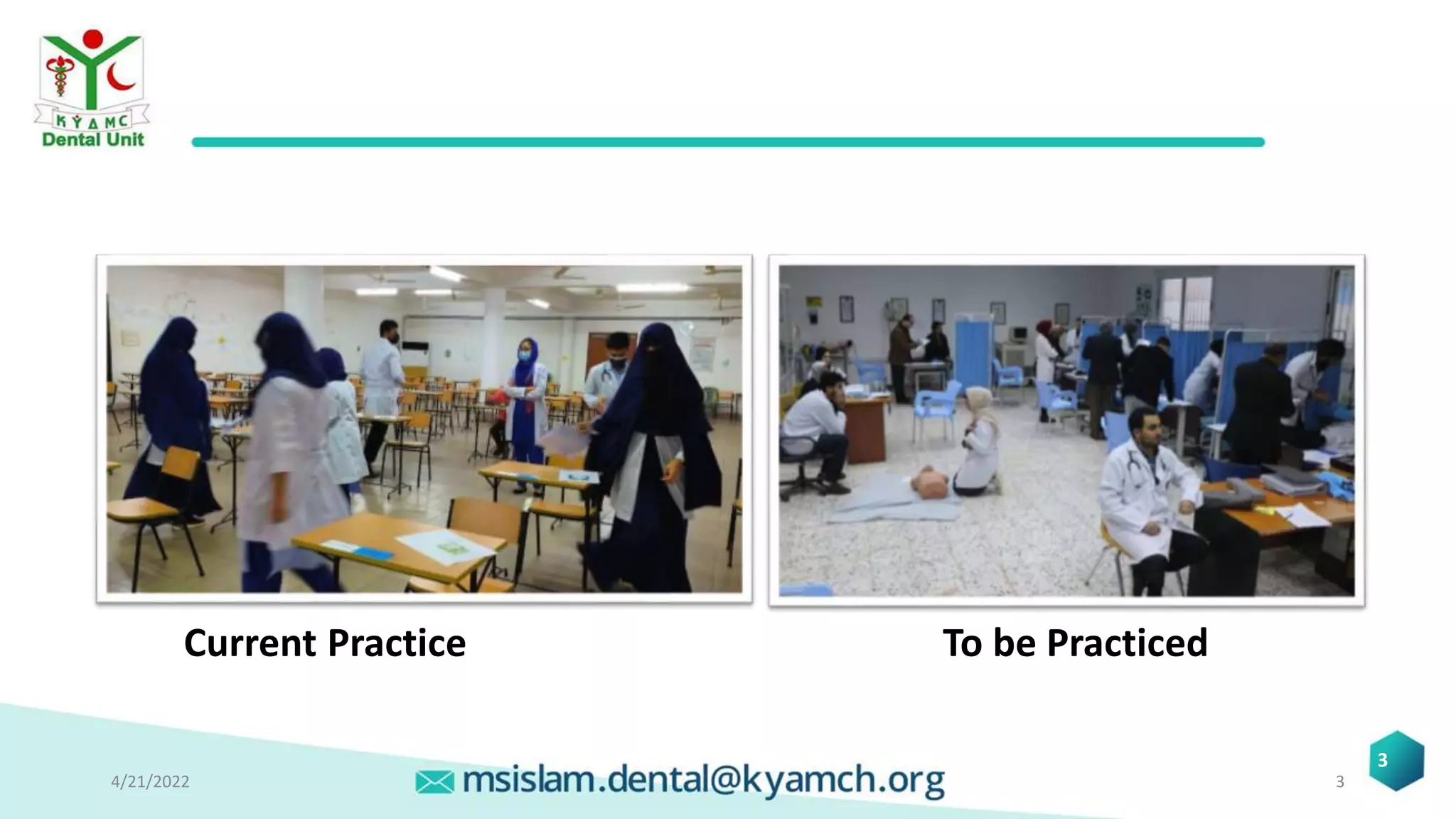
Current Practice To be Practiced
3
Learning Objectives
 Understanding of what is to be assessed in OSPE/OSCE
 Define OSPE/ OSCE
 Outline the characteristics of OSPE/OSCE
 Organizing an OSPE/OSCE
 Preparation of a good OSPE/OSCE station
4/21/2022
4
 To Asses students’-
 Practical skill
 Clinical skill
 Communication skill
 Recall knowledge
 Comprehension
 Application
 Analysis & synthesis
 Performance beyond the scope of oral /written exam.
4/21/2022
5
Purpose of Practical Examination
Traditional Practical/ Clinical Examination
 Limitations-
o Candidates have to face Different patients/ tests/
examiners
o Examiners do not closely observe the candidates
during his performance
o Communication skill, attitude & behavior of
candidates are usually not tested
o Small numbers of tests do not represent the overall
competencies
o Very poor scope of giving feedback after
examination
4/21/2022
6
History
• OSCE was described in 1975, by Harden et al., at the Dundee
University
• For assessment in preclinical and paraclinical subjects, OSPE, a
modified version of the OSCE has been adopted.
4/21/2022 9
4/21/2022 8
7
Definition
These are the assessment tools in
which the components of clinical and
practical competencies are tested in
simulated environment using agreed
check list or rating scale and students
rotate round a number of stations
some of which have observers with
check list.
8
4/21/2022
Characteristics
• Objective: Objective refers to scoring of multiple examiners in
different stations resulting in a more objective score at the end
• Structured: Because every student sees the same problem and
performs the same tasks in the same time frame.
• Clinical/ Practical: Because the tasks are representative of those
found in real situations.
• An Examination
4/21/2022 10
10
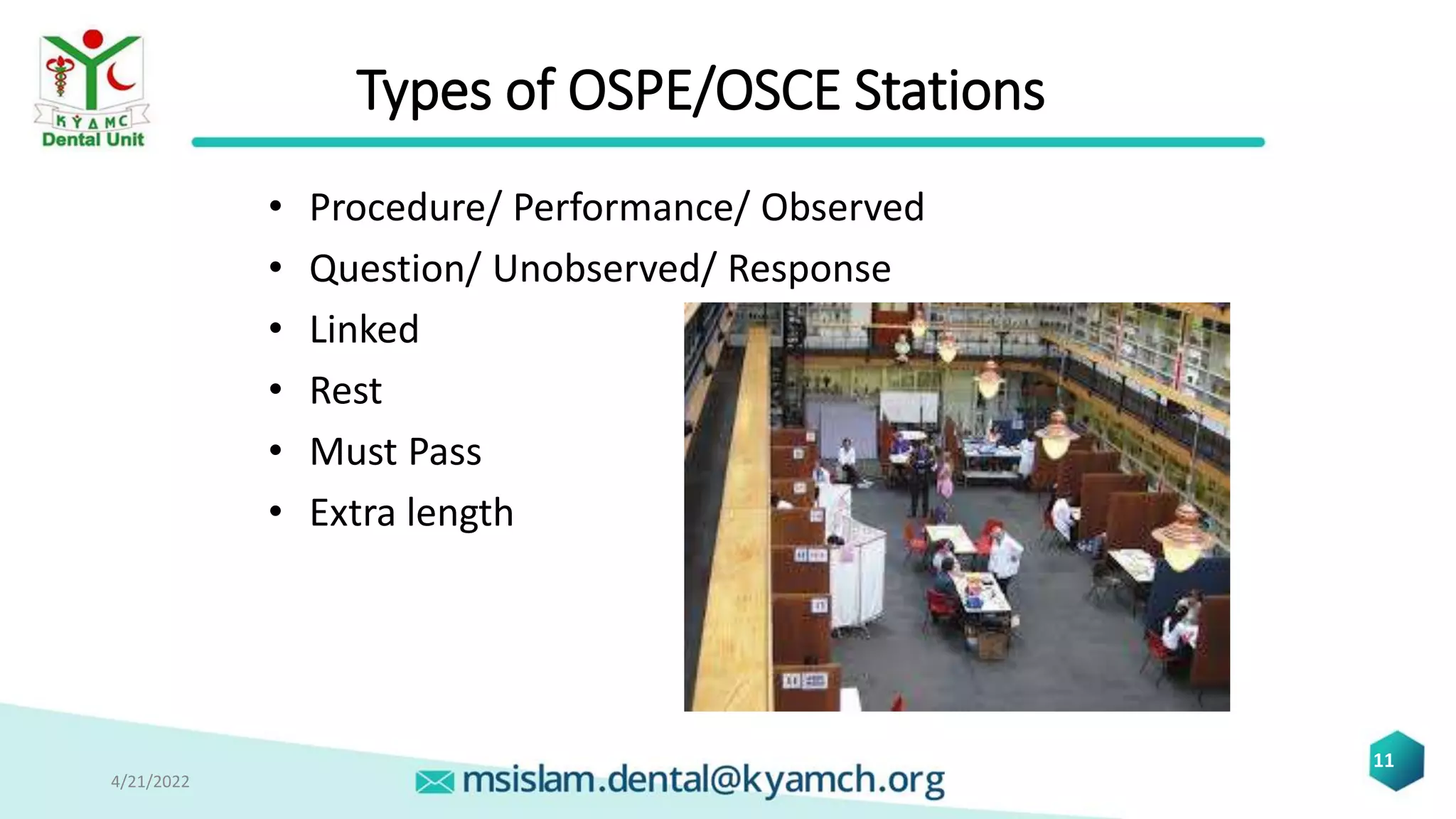
Types of OSPE/OSCE Stations
• Procedure/ Performance/ Observed
• Question/ Unobserved/ Response
• Linked
• Rest
• Must Pass
• Extra length
11
4/21/2022
4/21/2022
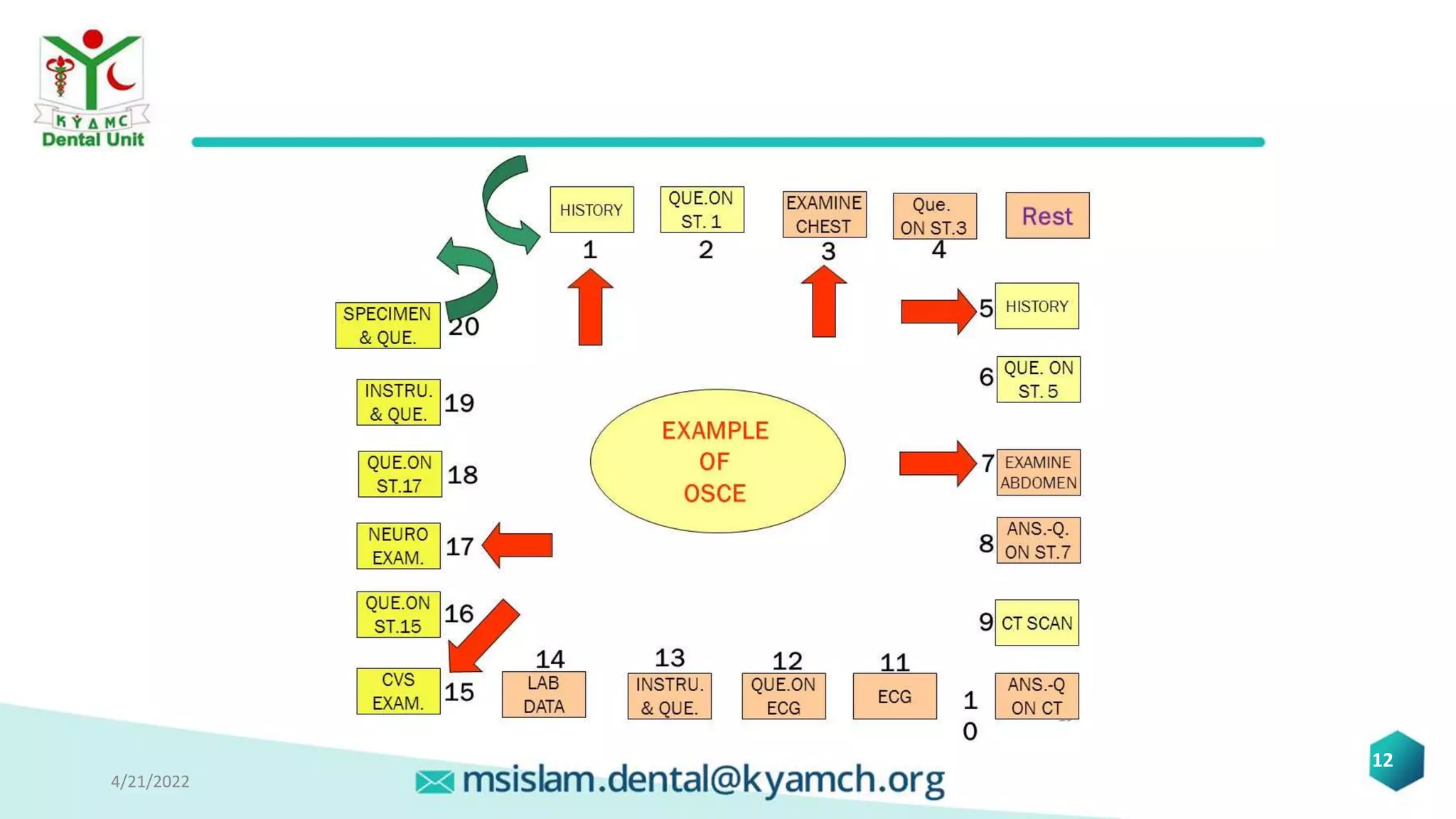
12
Procedure/ Performance/Observed Station
• Candidates perform a procedure
• Candidates Wear a roll number badge
• Observers observes and concurrently
rate
• Stations should be screened
• Station should be kept sufficient
distance
• A separate sheet for each candidate
13
4/21/2022
Question/ Unobserved/Response Station
 Questions to be attached in table
 Separate sheet for each station
 No observer
 No screen
 Drop the answer screen in a box
 Answer script to be counted before next
batch
 The question not to be given alone
4/21/2022
14
Linked Station
• Linked to previous station
• Response of previous procedure
4/21/2022
15
Rest Station
• Not for rest, rather for Adjustment
4/21/2022
16
Must Pass Station
•A student will fail, if s/he fail in this station
4/21/2022
17
Extra Length Station
• A student need double/triple duration to perform a task
4/21/2022
18
OSPE Question- example
1st Professional BDS Examination , May 2022
OSPE Station no.3, Procedural
KYAMC Dental Unit Marks- 5 Time- 5min
Question: Please measure the Blood Pressure of this individual by
Auscultatory method
Instruction: Please memorize your findings for the next station
4/21/2022 19
Check List for Examiner-Example
1st Professional BDS Examination , May 2022
KYAMC Dental Unit OSPE Station 3 Procedural Subject: Physiology
Area of the Performance Roll no.
101 102 103
1. Greetings
2. Introduction
3. Explanation of purpose of examination
4. Permission
5. Exposure
6. Placing the cuff
7. Palpation
8.Placing stethoscope
9. Placing ear piece
10. Measurement
4/21/2022
20
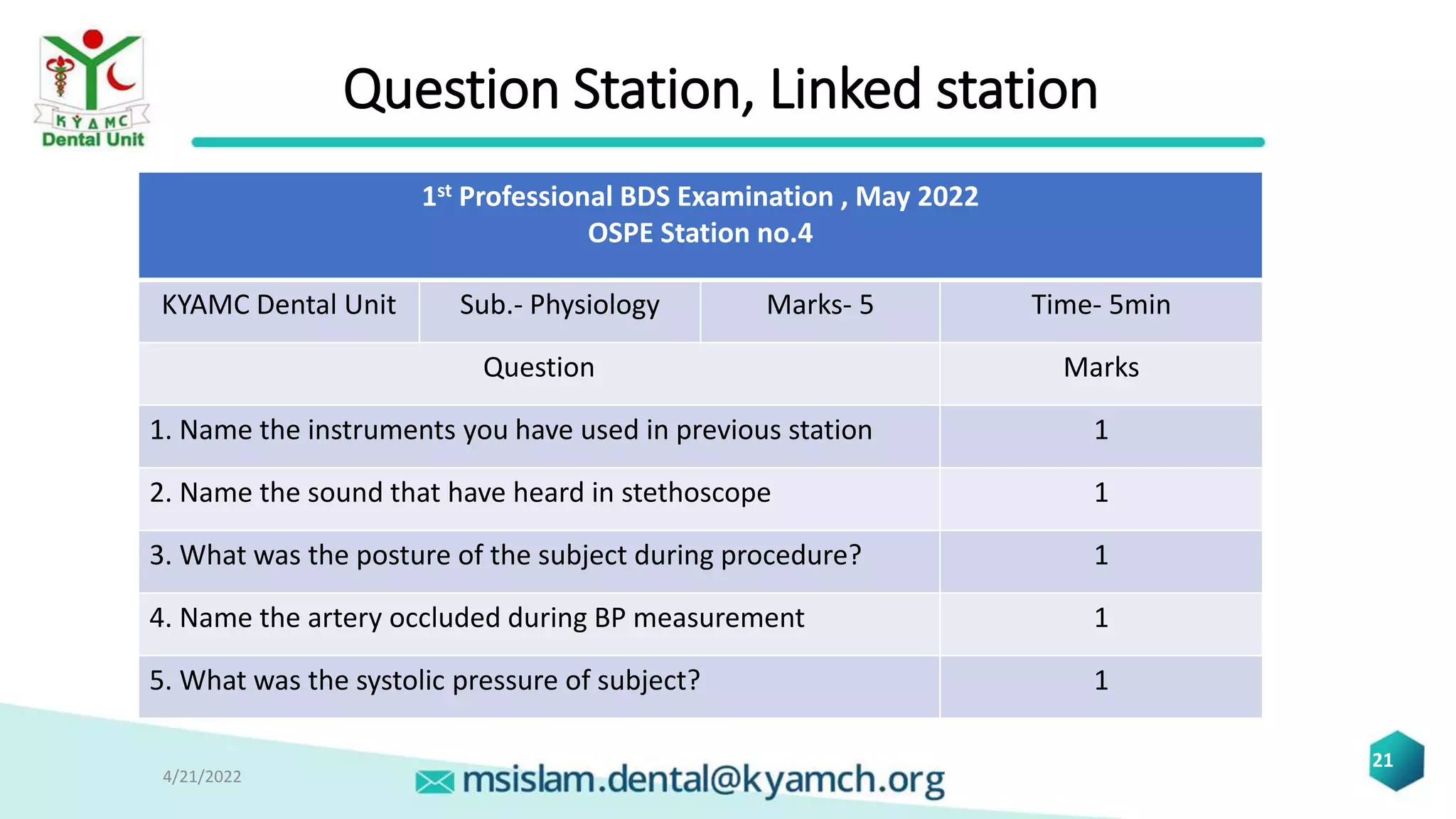
Question Station, Linked station
1st Professional BDS Examination , May 2022
OSPE Station no.4
KYAMC Dental Unit Sub.- Physiology Marks- 5 Time- 5min
Question Marks
1. Name the instruments you have used in previous station 1
2. Name the sound that have heard in stethoscope 1
3. What was the posture of the subject during procedure? 1
4. Name the artery occluded during BP measurement 1
5. What was the systolic pressure of subject? 1
4/21/2022
21
Answer Script
1st Professional BDS Examination , May 2022
OSPE Station no.4, Linked station
KYAMC Dental Unit Sub.- Physiology Roll no.
Answers-
1. Name of the instruments -
2. Name of the sound -
3. Posture of the subject-
4.Name of artery-
5. Systolic BP-
4/21/2022
22
Rating Scale with Standard Answer
1st Professional BDS Examination , May 2022
OSPE Station no.4, Linked station
KYAMC Dental Unit Sub.- Physiology
Standard Answers- Marks
1. Name the instruments -
2. Name the sound -
3. Posture of the subject
4.Name of artery
5. Systolic BP
4/21/2022
23
Organization of OSPE/OSCE
• Advance planning and preparation
• Activities on the day before examination
• Activities on the day of examination
• Activities after examination
4/21/2022
24
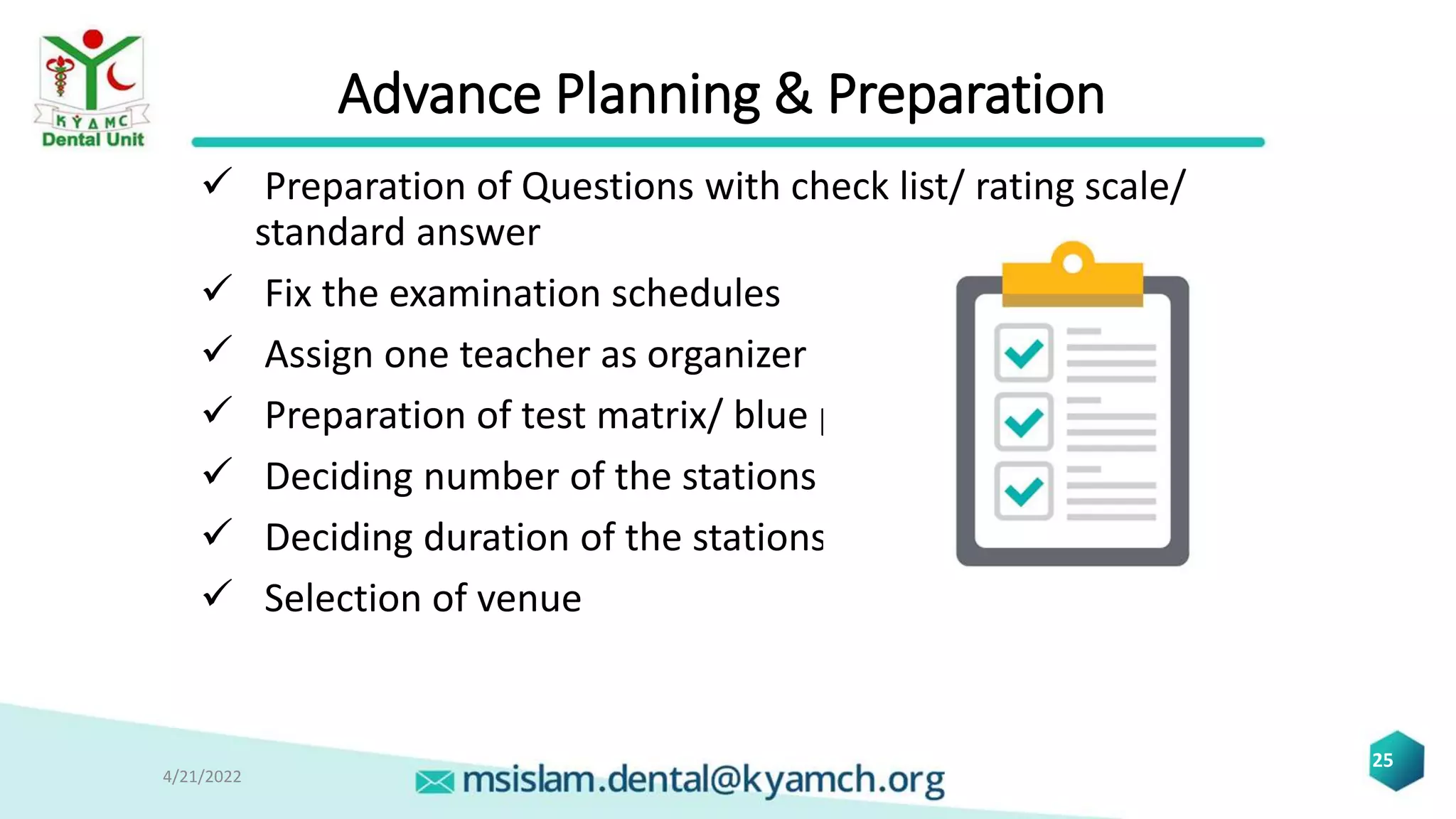
Advance Planning & Preparation
 Preparation of Questions with check list/ rating scale/
standard answer
 Fix the examination schedules
 Assign one teacher as organizer
 Preparation of test matrix/ blue print
 Deciding number of the stations
 Deciding duration of the stations
 Selection of venue
4/21/2022
25
Cont’d…
 Selecting and training of simulated patients
 Preparation of mannequins/model/ simulated
machineries
 Deciding for scoring for each station
 Preparation of examination hall
 Selecting and training/ briefing the observer
 Informing the students about prerequisites
 Arrange budget and refreshment
4/21/2022
26
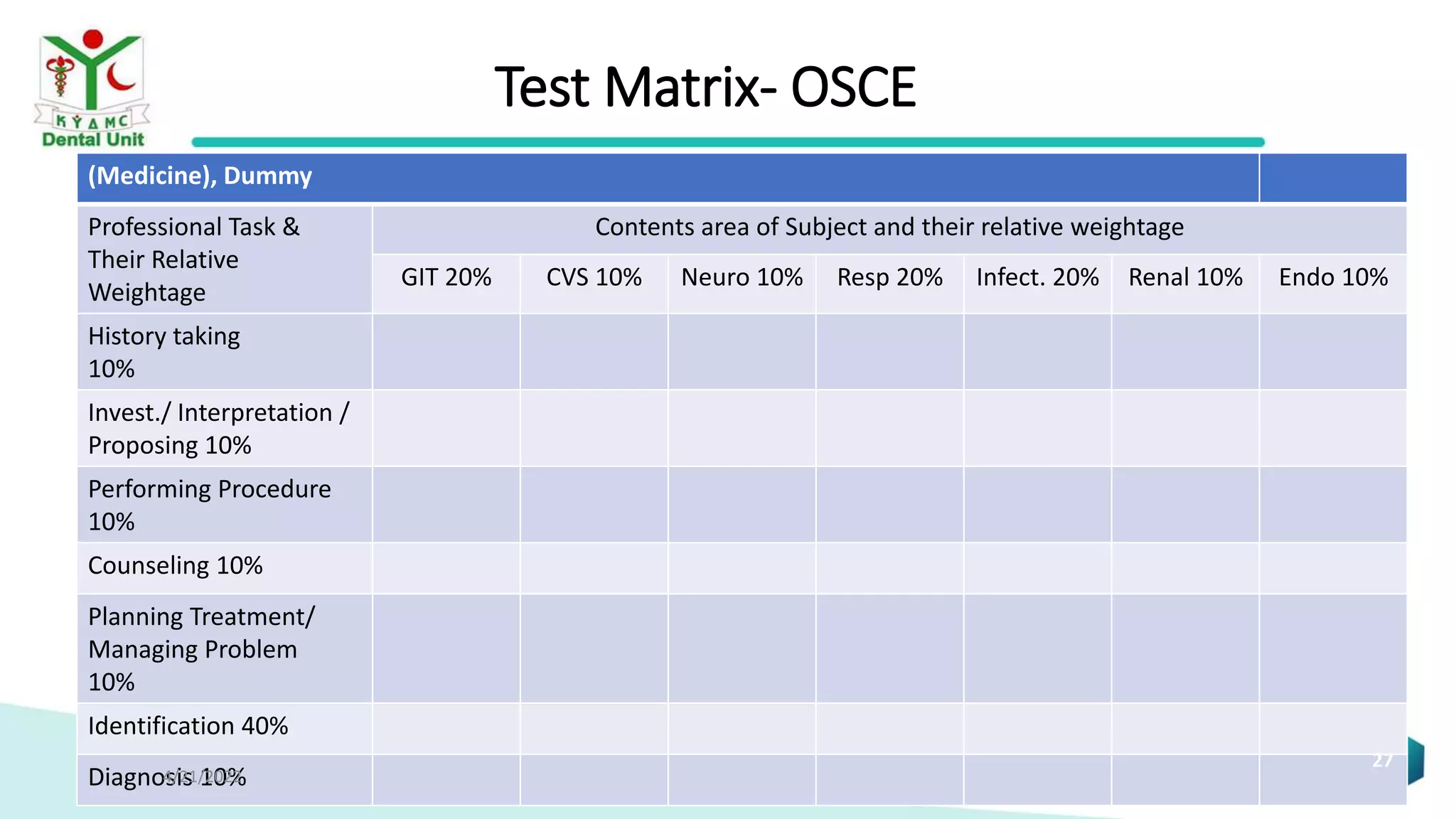
Test Matrix- OSCE
(Medicine), Dummy
Professional Task &
Their Relative
Weightage
Contents area of Subject and their relative weightage
GIT 20% CVS 10% Neuro 10% Resp 20% Infect. 20% Renal 10% Endo 10%
History taking
10%
Invest./ Interpretation /
Proposing 10%
Performing Procedure
10%
Counseling 10%
Planning Treatment/
Managing Problem
10%
Identification 40%
Diagnosis 10%
4/21/2022
27
4/21/2022 28
Activities on the Day before Exam
 Check & Rearrange (if necessary)-
 The exam hall with stations
 The equipment
 The questions
 Instruction to students, patients
and examiners
 Light, electricity, ventilation
 Refreshment
 Toilet, etc
4/21/2022
29
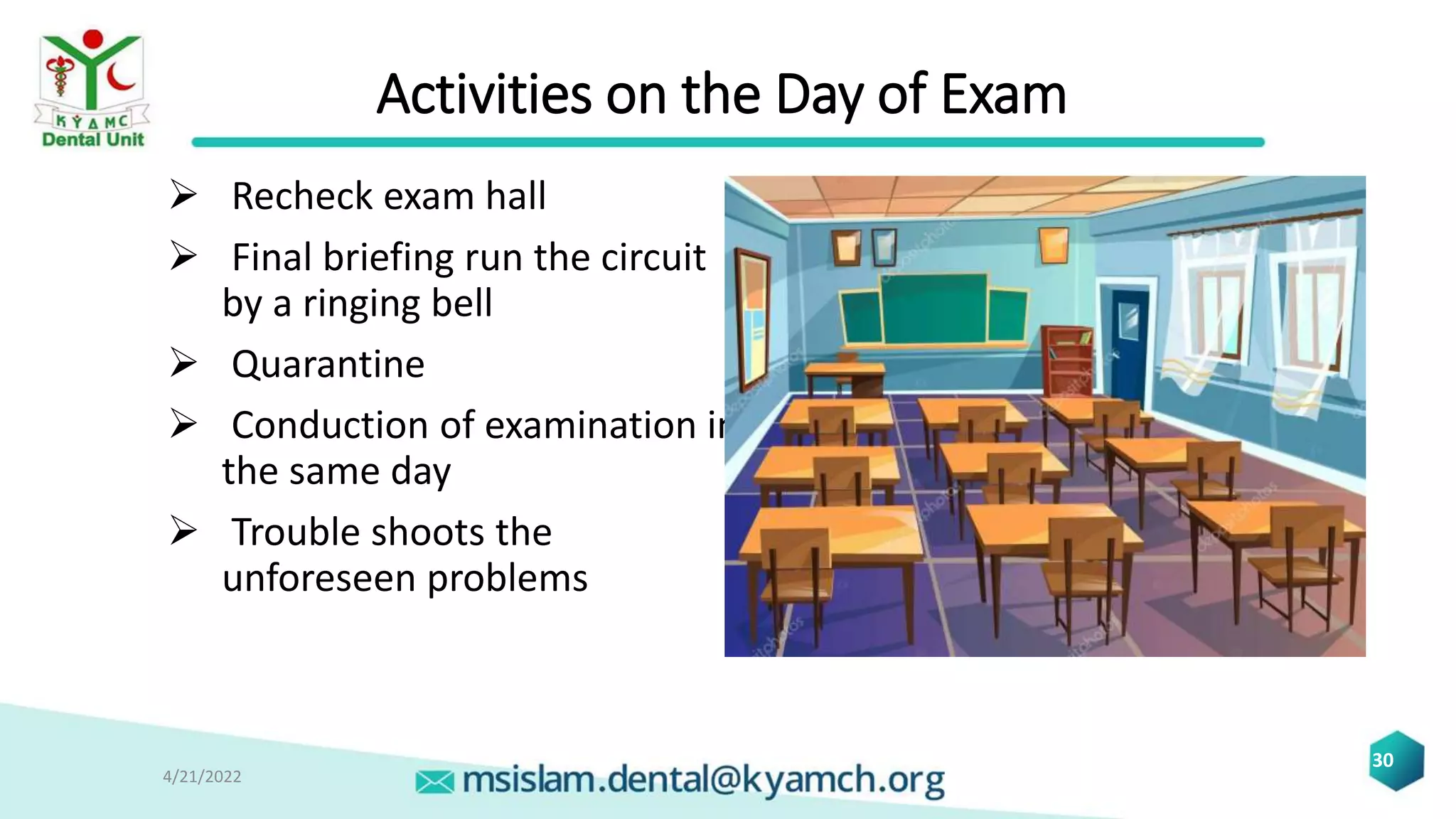
Activities on the Day of Exam
 Recheck exam hall
 Final briefing run the circuit
by a ringing bell
 Quarantine
 Conduction of examination in
the same day
 Trouble shoots the
unforeseen problems
4/21/2022
30
Activities after the Day of Exam
 Collect answer sheet and rating scale
 ± Keep the students in the institute
 Compute the results
 ± Give the feedback to students
 Gathers written comments for improvement from
examiners & observers
 Preserve the question & related docs for future
4/21/2022
31
Advantages of OSPE/OSCE
 These are objective assessment tools as-
 All stations are same for all students
 Patients are usually simulated and trained/
briefed to show same sign and symptoms
 Check list/ rating scale and answer are same for
all
 The examiners are well briefed/ trained
4/21/2022
32
contd.
 It is also reliable assessment tools as-
 The duration and task for all the examiners and
examinees in each station are constant
 Ideally all students appear in examination in
same day
 More valid assessment tools as-
 Covering wider contents area with large number
of stations
 Prepared based on the objectives of the course
4/21/2022
33
Limitations of OSPE/OSCE
 It needs considerable time, efforts, skills &
team work to plan, conduct and evaluate
 These are cumbersome and costly than
traditional practical and clinical
examinations
 OSPE/OSCE assess the students in
simulated environment which may not
represent their future performance in real
life practice
4/21/2022
34
References
• Operational Manual for the Workshop on teaching methodology &
assessment, CME, Dhaka
• Malhotra SD, Shah KN, Patel VJ. Objective structured practical examination
as a tool for the formative assessment of practical skills of undergraduate
students in pharmacology. J Edu Health Promot 2013;2:53.
• Ananthakrishnan N. Objective structured clinical/practical examination
(OSCE/OSPE). J Postgrad Med 1993;39:82
• Nayar U, Malik SL, Bijlani RL. Objective structured practical examination: a
new concept in assessment of laboratory exercises in preclinical sciences.
Med Educ. 1986 May;20(3):204-9. doi: 10.1111/j.1365-
2923.1986.tb01169.x. PMID: 3724576.
4/21/2022
36
Acknowledgement
4/21/2022
37
Thank You
4/21/2022
37
Q & A
Q A
4/21/2022
39

OSCE/ OSPE

  • 1.
  • 2.
    Dr. Md. ShahidulIslam BDS, MS Associate Professor & Head Dental Unit Khwaja Yunus Ali Medical College & Hospital 4/21/2022 2 OSCE/ OSPE
  • 3.
  • 4.
    Learning Objectives  Understandingof what is to be assessed in OSPE/OSCE  Define OSPE/ OSCE  Outline the characteristics of OSPE/OSCE  Organizing an OSPE/OSCE  Preparation of a good OSPE/OSCE station 4/21/2022 4
  • 5.
     To Assesstudents’-  Practical skill  Clinical skill  Communication skill  Recall knowledge  Comprehension  Application  Analysis & synthesis  Performance beyond the scope of oral /written exam. 4/21/2022 5 Purpose of Practical Examination
  • 6.
    Traditional Practical/ ClinicalExamination  Limitations- o Candidates have to face Different patients/ tests/ examiners o Examiners do not closely observe the candidates during his performance o Communication skill, attitude & behavior of candidates are usually not tested o Small numbers of tests do not represent the overall competencies o Very poor scope of giving feedback after examination 4/21/2022 6
  • 7.
    History • OSCE wasdescribed in 1975, by Harden et al., at the Dundee University • For assessment in preclinical and paraclinical subjects, OSPE, a modified version of the OSCE has been adopted. 4/21/2022 9
  • 8.
  • 9.
    Definition These are theassessment tools in which the components of clinical and practical competencies are tested in simulated environment using agreed check list or rating scale and students rotate round a number of stations some of which have observers with check list. 8 4/21/2022
  • 10.
    Characteristics • Objective: Objectiverefers to scoring of multiple examiners in different stations resulting in a more objective score at the end • Structured: Because every student sees the same problem and performs the same tasks in the same time frame. • Clinical/ Practical: Because the tasks are representative of those found in real situations. • An Examination 4/21/2022 10 10
  • 11.
    Types of OSPE/OSCEStations • Procedure/ Performance/ Observed • Question/ Unobserved/ Response • Linked • Rest • Must Pass • Extra length 11 4/21/2022
  • 12.
  • 13.
    Procedure/ Performance/Observed Station •Candidates perform a procedure • Candidates Wear a roll number badge • Observers observes and concurrently rate • Stations should be screened • Station should be kept sufficient distance • A separate sheet for each candidate 13 4/21/2022
  • 14.
    Question/ Unobserved/Response Station Questions to be attached in table  Separate sheet for each station  No observer  No screen  Drop the answer screen in a box  Answer script to be counted before next batch  The question not to be given alone 4/21/2022 14
  • 15.
    Linked Station • Linkedto previous station • Response of previous procedure 4/21/2022 15
  • 16.
    Rest Station • Notfor rest, rather for Adjustment 4/21/2022 16
  • 17.
    Must Pass Station •Astudent will fail, if s/he fail in this station 4/21/2022 17
  • 18.
    Extra Length Station •A student need double/triple duration to perform a task 4/21/2022 18
  • 19.
    OSPE Question- example 1stProfessional BDS Examination , May 2022 OSPE Station no.3, Procedural KYAMC Dental Unit Marks- 5 Time- 5min Question: Please measure the Blood Pressure of this individual by Auscultatory method Instruction: Please memorize your findings for the next station 4/21/2022 19
  • 20.
    Check List forExaminer-Example 1st Professional BDS Examination , May 2022 KYAMC Dental Unit OSPE Station 3 Procedural Subject: Physiology Area of the Performance Roll no. 101 102 103 1. Greetings 2. Introduction 3. Explanation of purpose of examination 4. Permission 5. Exposure 6. Placing the cuff 7. Palpation 8.Placing stethoscope 9. Placing ear piece 10. Measurement 4/21/2022 20
  • 21.
    Question Station, Linkedstation 1st Professional BDS Examination , May 2022 OSPE Station no.4 KYAMC Dental Unit Sub.- Physiology Marks- 5 Time- 5min Question Marks 1. Name the instruments you have used in previous station 1 2. Name the sound that have heard in stethoscope 1 3. What was the posture of the subject during procedure? 1 4. Name the artery occluded during BP measurement 1 5. What was the systolic pressure of subject? 1 4/21/2022 21
  • 22.
    Answer Script 1st ProfessionalBDS Examination , May 2022 OSPE Station no.4, Linked station KYAMC Dental Unit Sub.- Physiology Roll no. Answers- 1. Name of the instruments - 2. Name of the sound - 3. Posture of the subject- 4.Name of artery- 5. Systolic BP- 4/21/2022 22
  • 23.
    Rating Scale withStandard Answer 1st Professional BDS Examination , May 2022 OSPE Station no.4, Linked station KYAMC Dental Unit Sub.- Physiology Standard Answers- Marks 1. Name the instruments - 2. Name the sound - 3. Posture of the subject 4.Name of artery 5. Systolic BP 4/21/2022 23
  • 24.
    Organization of OSPE/OSCE •Advance planning and preparation • Activities on the day before examination • Activities on the day of examination • Activities after examination 4/21/2022 24
  • 25.
    Advance Planning &Preparation  Preparation of Questions with check list/ rating scale/ standard answer  Fix the examination schedules  Assign one teacher as organizer  Preparation of test matrix/ blue print  Deciding number of the stations  Deciding duration of the stations  Selection of venue 4/21/2022 25
  • 26.
    Cont’d…  Selecting andtraining of simulated patients  Preparation of mannequins/model/ simulated machineries  Deciding for scoring for each station  Preparation of examination hall  Selecting and training/ briefing the observer  Informing the students about prerequisites  Arrange budget and refreshment 4/21/2022 26
  • 27.
    Test Matrix- OSCE (Medicine),Dummy Professional Task & Their Relative Weightage Contents area of Subject and their relative weightage GIT 20% CVS 10% Neuro 10% Resp 20% Infect. 20% Renal 10% Endo 10% History taking 10% Invest./ Interpretation / Proposing 10% Performing Procedure 10% Counseling 10% Planning Treatment/ Managing Problem 10% Identification 40% Diagnosis 10% 4/21/2022 27
  • 28.
  • 29.
    Activities on theDay before Exam  Check & Rearrange (if necessary)-  The exam hall with stations  The equipment  The questions  Instruction to students, patients and examiners  Light, electricity, ventilation  Refreshment  Toilet, etc 4/21/2022 29
  • 30.
    Activities on theDay of Exam  Recheck exam hall  Final briefing run the circuit by a ringing bell  Quarantine  Conduction of examination in the same day  Trouble shoots the unforeseen problems 4/21/2022 30
  • 31.
    Activities after theDay of Exam  Collect answer sheet and rating scale  ± Keep the students in the institute  Compute the results  ± Give the feedback to students  Gathers written comments for improvement from examiners & observers  Preserve the question & related docs for future 4/21/2022 31
  • 32.
    Advantages of OSPE/OSCE These are objective assessment tools as-  All stations are same for all students  Patients are usually simulated and trained/ briefed to show same sign and symptoms  Check list/ rating scale and answer are same for all  The examiners are well briefed/ trained 4/21/2022 32
  • 33.
    contd.  It isalso reliable assessment tools as-  The duration and task for all the examiners and examinees in each station are constant  Ideally all students appear in examination in same day  More valid assessment tools as-  Covering wider contents area with large number of stations  Prepared based on the objectives of the course 4/21/2022 33
  • 34.
    Limitations of OSPE/OSCE It needs considerable time, efforts, skills & team work to plan, conduct and evaluate  These are cumbersome and costly than traditional practical and clinical examinations  OSPE/OSCE assess the students in simulated environment which may not represent their future performance in real life practice 4/21/2022 34
  • 35.
    References • Operational Manualfor the Workshop on teaching methodology & assessment, CME, Dhaka • Malhotra SD, Shah KN, Patel VJ. Objective structured practical examination as a tool for the formative assessment of practical skills of undergraduate students in pharmacology. J Edu Health Promot 2013;2:53. • Ananthakrishnan N. Objective structured clinical/practical examination (OSCE/OSPE). J Postgrad Med 1993;39:82 • Nayar U, Malik SL, Bijlani RL. Objective structured practical examination: a new concept in assessment of laboratory exercises in preclinical sciences. Med Educ. 1986 May;20(3):204-9. doi: 10.1111/j.1365- 2923.1986.tb01169.x. PMID: 3724576. 4/21/2022 36
  • 36.
  • 37.
  • 38.
    Q & A QA 4/21/2022 39