OSCE is a modern type of examination often used in health
sciences ( eg. Medicine, dentistry, nursing, pharmacy, and
physiotherapy) to assess clinical skill performance and
competence in skills such as communication, clinical
examination, medical and nursing procedures/ prescription,
exercise prescription, joint mobilization/ manipulation
techniques and interpretation of results.
Objective : Examiners use a checklist for evaluating the
trainees.
Structured : Trainee sees the same problem and perform
the same tasks in the same time frame.
Clinical : The task are representative of those faced in real
clinical situation.
“ The OSCE is an approach to the assessment of clinical
competence in which the components of competence are
assessed in a planned or structured way with attention
being paid to the objectivity of the examination.”
-Harden
According to Boursicot, Ware, and Hazllet(2011):
Measure clinical skills.
Match assessment to intended constructs.
 Promote structured interaction between student and
examiner.
Make structured marking scheme possible.
Present all candidates with the same test.
Promote objectivity.
Generally, the following range of practical skills are
typically assessed in nursing using OSCE:
 Interpersonal and communication skills
 History taking skills
 Physical examination of specific body systems
 Mental Health Assessment.
Clinical problem – solving skills
Interpretation of clinical findings and investigations
Management of a clinical situation, including treatment
and referral
Patient education
Health promotion
Acting safely and appropriately in an urgent clinical
situation
 Basic and advanced nursing care procedure practices.
The examination coordinating committee
 The examination coordinator
Lists of skills, Behaviors and Attitude to be assesses
Criteria for scoring the assessment ( marking scheme of
checklist)
The examinees
The examinersExamination site
Time and time allocation between stations
Anatomic models for repetitive ( Breast, pelvic/ Rectum)
Couplet station
Examination questions
Environment of exam station
Examination station circuit
Patient (real/ stimulated)
Time keeper/ time clock& time signal
Contingency plans
Assessment off the performance of the OSCE
Viva – voce / oral examinations
The OSCE examination consists of about 10-15 stations,
each of which requires about 4-5 minutes.
The number of stations and time spent on each station
may vary based on needs of evaluation.
 all stations should be capable of being completed in the
same time. the students are rotated through all stations
and have to move to the next station at the signal.
As the stations are generally independent, students can
start at any procedure stations and complete the cycle.
Thus, using 15 stations of 4 minutes each, 15 students can
complete the examination within 1 hour.
Each station is designed to test a component of clinical
competence. At some stations, called the procedure
stations, students are given tasks to perform on patients
or simulators.
 At all such stations there are observers with agreed upon
checklists or rating scales to score the student’s
performance. At other stations called response stations,
students respond to questions of the objective type or
interpret data or record their findings of the previous
procedure stations.
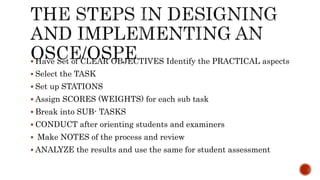
 Have Set of CLEAR OBJECTIVES Identify the PRACTICAL aspects
 Select the TASK
 Set up STATIONS
 Assign SCORES (WEIGHTS) for each sub task
 Break into SUB- TASKS
 CONDUCT after orienting students and examiners
 Make NOTES of the process and review
 ANALYZE the results and use the same for student assessment
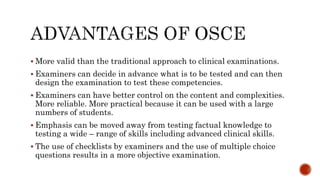
 More valid than the traditional approach to clinical examinations.
 Examiners can decide in advance what is to be tested and can then
design the examination to test these competencies.
 Examiners can have better control on the content and complexities.
More reliable. More practical because it can be used with a large
numbers of students.
 Emphasis can be moved away from testing factual knowledge to
testing a wide – range of skills including advanced clinical skills.
 The use of checklists by examiners and the use of multiple choice
questions results in a more objective examination.
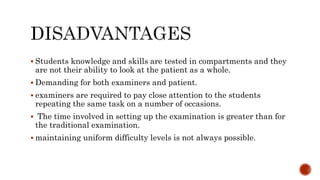
 Students knowledge and skills are tested in compartments and they
are not their ability to look at the patient as a whole.
 Demanding for both examiners and patient.
 examiners are required to pay close attention to the students
repeating the same task on a number of occasions.
 The time involved in setting up the examination is greater than for
the traditional examination.
 maintaining uniform difficulty levels is not always possible.
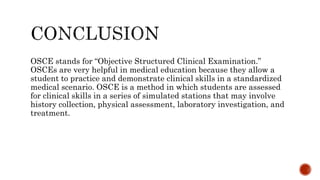
OSCE stands for “Objective Structured Clinical Examination.”
OSCEs are very helpful in medical education because they allow a
student to practice and demonstrate clinical skills in a standardized
medical scenario. OSCE is a method in which students are assessed
for clinical skills in a series of simulated stations that may involve
history collection, physical assessment, laboratory investigation, and
treatment.
osce.pptx
osce.pptx
osce.pptx

osce.pptx

  • 3.
    OSCE is amodern type of examination often used in health sciences ( eg. Medicine, dentistry, nursing, pharmacy, and physiotherapy) to assess clinical skill performance and competence in skills such as communication, clinical examination, medical and nursing procedures/ prescription, exercise prescription, joint mobilization/ manipulation techniques and interpretation of results.
  • 4.
    Objective : Examinersuse a checklist for evaluating the trainees. Structured : Trainee sees the same problem and perform the same tasks in the same time frame. Clinical : The task are representative of those faced in real clinical situation.
  • 5.
    “ The OSCEis an approach to the assessment of clinical competence in which the components of competence are assessed in a planned or structured way with attention being paid to the objectivity of the examination.” -Harden
  • 6.
    According to Boursicot,Ware, and Hazllet(2011): Measure clinical skills. Match assessment to intended constructs.  Promote structured interaction between student and examiner. Make structured marking scheme possible. Present all candidates with the same test. Promote objectivity.
  • 7.
    Generally, the followingrange of practical skills are typically assessed in nursing using OSCE:  Interpersonal and communication skills  History taking skills  Physical examination of specific body systems  Mental Health Assessment. Clinical problem – solving skills Interpretation of clinical findings and investigations
  • 8.
    Management of aclinical situation, including treatment and referral Patient education Health promotion Acting safely and appropriately in an urgent clinical situation  Basic and advanced nursing care procedure practices.
  • 9.
    The examination coordinatingcommittee  The examination coordinator Lists of skills, Behaviors and Attitude to be assesses Criteria for scoring the assessment ( marking scheme of checklist) The examinees The examinersExamination site
  • 10.
    Time and timeallocation between stations Anatomic models for repetitive ( Breast, pelvic/ Rectum) Couplet station Examination questions Environment of exam station Examination station circuit
  • 11.
    Patient (real/ stimulated) Timekeeper/ time clock& time signal Contingency plans Assessment off the performance of the OSCE Viva – voce / oral examinations
  • 12.
    The OSCE examinationconsists of about 10-15 stations, each of which requires about 4-5 minutes. The number of stations and time spent on each station may vary based on needs of evaluation.  all stations should be capable of being completed in the same time. the students are rotated through all stations and have to move to the next station at the signal. As the stations are generally independent, students can start at any procedure stations and complete the cycle.
  • 13.
    Thus, using 15stations of 4 minutes each, 15 students can complete the examination within 1 hour. Each station is designed to test a component of clinical competence. At some stations, called the procedure stations, students are given tasks to perform on patients or simulators.  At all such stations there are observers with agreed upon checklists or rating scales to score the student’s performance. At other stations called response stations, students respond to questions of the objective type or interpret data or record their findings of the previous procedure stations.
  • 14.
     Have Setof CLEAR OBJECTIVES Identify the PRACTICAL aspects  Select the TASK  Set up STATIONS  Assign SCORES (WEIGHTS) for each sub task  Break into SUB- TASKS  CONDUCT after orienting students and examiners  Make NOTES of the process and review  ANALYZE the results and use the same for student assessment
  • 15.
     More validthan the traditional approach to clinical examinations.  Examiners can decide in advance what is to be tested and can then design the examination to test these competencies.  Examiners can have better control on the content and complexities. More reliable. More practical because it can be used with a large numbers of students.  Emphasis can be moved away from testing factual knowledge to testing a wide – range of skills including advanced clinical skills.  The use of checklists by examiners and the use of multiple choice questions results in a more objective examination.
  • 16.
     Students knowledgeand skills are tested in compartments and they are not their ability to look at the patient as a whole.  Demanding for both examiners and patient.  examiners are required to pay close attention to the students repeating the same task on a number of occasions.  The time involved in setting up the examination is greater than for the traditional examination.  maintaining uniform difficulty levels is not always possible.
  • 17.
    OSCE stands for“Objective Structured Clinical Examination.” OSCEs are very helpful in medical education because they allow a student to practice and demonstrate clinical skills in a standardized medical scenario. OSCE is a method in which students are assessed for clinical skills in a series of simulated stations that may involve history collection, physical assessment, laboratory investigation, and treatment.