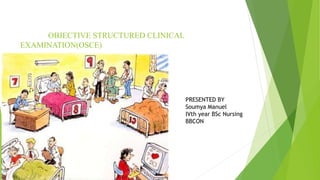
OBJECTIVE STRUCTURED CLINICAL
EXAMINATION(OSCE)
PRESENTED BY
Soumya Manuel
IVth year BSc Nursing
BBCON
COMPONENTS OF AN OSCE
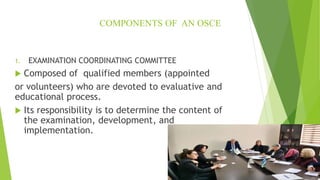
1. EXAMINATION COORDINATING COMMITTEE
 Composed of qualified members (appointed
or volunteers) who are devoted to evaluative and
educational process.
 Its responsibility is to determine the content of
the examination, development, and
implementation.
2. EXAMINATION COORDINATOR
 Facilitates the smooth working of the committee
in developing, implementing, and assessing the
performance of the OSCE.
3. LISTS OF SKILLS, BEHAVIOR AND ATTITUDE TO BE
ASSESSED
It should be able to assess clinical competence, in history
taking, physical examination, laboratory, radiographic, and other data
interpretation, technical and procedural skills, as well as, counseling
and attitudinal behavior.
4. CRITERIA FOR SCORING THE ASSESSMENT
 Checklist should be concise, unambiguous, and written to contribute for the
reliability of the station.
 All stations there are observers with agreed upon checklists or rating scales to
score the student’s performance
5.EXAMINEES
 Could be: student, resident, or fellow in training
or at the end of training of a prescribed course.
 Could be: undergraduate, graduate, or enrolled in
continuing medical education program.
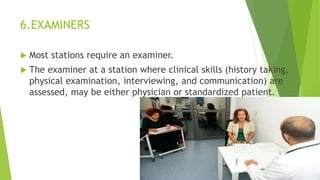
6.EXAMINERS
 Most stations require an examiner.
 The examiner at a station where clinical skills (history taking,
physical examination, interviewing, and communication) are
assessed, may be either physician or standardized patient.
7.EXAMINATION SITE
 Could be special part of the teaching institution.
 The examination could be conducted in an out-
patient clinic where offices are available in close
proximity to each other.
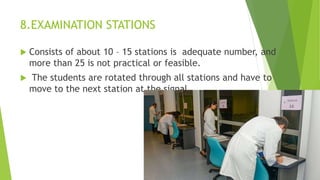
8.EXAMINATION STATIONS
 Consists of about 10 – 15 stations is adequate number, and
more than 25 is not practical or feasible.
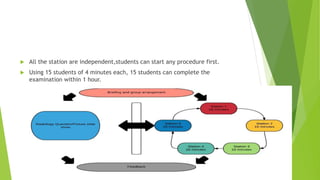
 The students are rotated through all stations and have to
move to the next station at the signal
 All the station are independent,students can start any procedure first.
 Using 15 students of 4 minutes each, 15 students can complete the
examination within 1 hour.
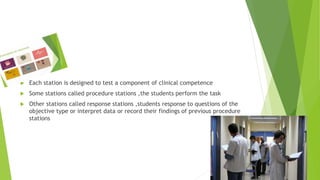
 Each station is designed to test a component of clinical competence
 Some stations called procedure stations ,the students perform the task
 Other stations called response stations ,students response to questions of the
objective type or interpret data or record their findings of previous procedure
stations
PATIENT STANDARDIZED OR SIMULATED
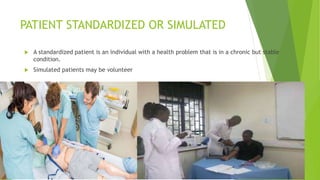
 A standardized patient is an individual with a health problem that is in a chronic but stable
condition.
 Simulated patients may be volunteer
TIME KEEPER,TIME CLOCK AND TIME
SIGNAL
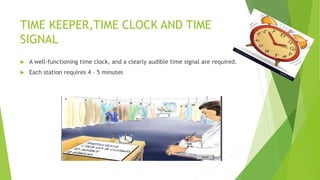
 A well-functioning time clock, and a clearly audible time signal are required.
 Each station requires 4 – 5 minutes
Objective structured clinical examination(osce)

Objective structured clinical examination(osce)

  • 1.
    OBJECTIVE STRUCTURED CLINICAL EXAMINATION(OSCE) PRESENTEDBY Soumya Manuel IVth year BSc Nursing BBCON
  • 2.
    COMPONENTS OF ANOSCE 1. EXAMINATION COORDINATING COMMITTEE  Composed of qualified members (appointed or volunteers) who are devoted to evaluative and educational process.  Its responsibility is to determine the content of the examination, development, and implementation.
  • 3.
    2. EXAMINATION COORDINATOR Facilitates the smooth working of the committee in developing, implementing, and assessing the performance of the OSCE.
  • 4.
    3. LISTS OFSKILLS, BEHAVIOR AND ATTITUDE TO BE ASSESSED It should be able to assess clinical competence, in history taking, physical examination, laboratory, radiographic, and other data interpretation, technical and procedural skills, as well as, counseling and attitudinal behavior.
  • 5.
    4. CRITERIA FORSCORING THE ASSESSMENT  Checklist should be concise, unambiguous, and written to contribute for the reliability of the station.  All stations there are observers with agreed upon checklists or rating scales to score the student’s performance
  • 6.
    5.EXAMINEES  Could be:student, resident, or fellow in training or at the end of training of a prescribed course.  Could be: undergraduate, graduate, or enrolled in continuing medical education program.
  • 7.
    6.EXAMINERS  Most stationsrequire an examiner.  The examiner at a station where clinical skills (history taking, physical examination, interviewing, and communication) are assessed, may be either physician or standardized patient.
  • 8.
    7.EXAMINATION SITE  Couldbe special part of the teaching institution.  The examination could be conducted in an out- patient clinic where offices are available in close proximity to each other.
  • 9.
    8.EXAMINATION STATIONS  Consistsof about 10 – 15 stations is adequate number, and more than 25 is not practical or feasible.  The students are rotated through all stations and have to move to the next station at the signal
  • 10.
     All thestation are independent,students can start any procedure first.  Using 15 students of 4 minutes each, 15 students can complete the examination within 1 hour.
  • 11.
     Each stationis designed to test a component of clinical competence  Some stations called procedure stations ,the students perform the task  Other stations called response stations ,students response to questions of the objective type or interpret data or record their findings of previous procedure stations
  • 12.
    PATIENT STANDARDIZED ORSIMULATED  A standardized patient is an individual with a health problem that is in a chronic but stable condition.  Simulated patients may be volunteer
  • 13.
    TIME KEEPER,TIME CLOCKAND TIME SIGNAL  A well-functioning time clock, and a clearly audible time signal are required.  Each station requires 4 – 5 minutes