SBE and OSCE
Mrs. Nilofar Loladiya
SBE and OSCE
OBJECTIVES:
• Learn about OSCE and its components
• Differentiate between OSCE and SBE
• Discuss regarding SBE
• Evaluate utilization of SBE in our setting
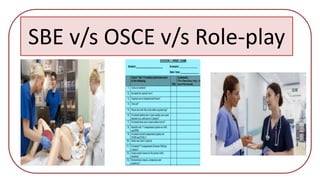
SBE v/s OSCE v/s Role-play
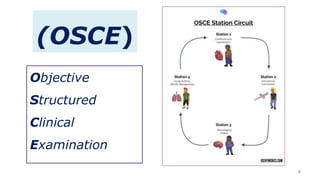
Objective
Structured
Clinical
Examination
4
(OSCE)
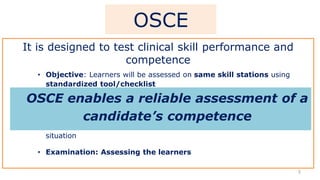
OSCE
It is designed to test clinical skill performance and
competence
• Objective: Learners will be assessed on same skill stations using
standardized tool/checklist
• Structured: Learners sees the same problem and perform the same
tasks in the same timeframe
• Clinical : Task are representative of those faced in real-life clinical
situation
• Examination: Assessing the learners
5
OSCE enables a reliable assessment of a
candidate’s competence
OSCE Process
• Learners rotate through a series of stations where
they answer questions (orally or in writing), or
perform tasks while being observed
• Typically 5-10 stations with equal time in all the
stations
• All learners receive identical assessments
• Learners may demonstrate a skill, interpret diagnostic
materials, or respond to short questions or case
scenario
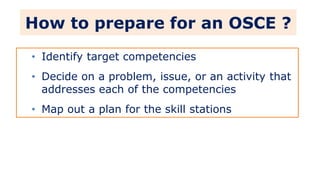
• Identify target competencies
• Decide on a problem, issue, or an activity that
addresses each of the competencies
• Map out a plan for the skill stations
How to prepare for an OSCE ?
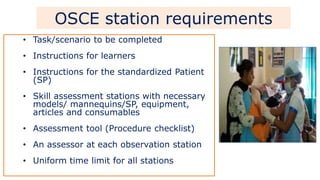
OSCE station requirements
• Task/scenario to be completed
• Instructions for learners
• Instructions for the standardized Patient
(SP)
• Skill assessment stations with necessary
models/ mannequins/SP, equipment,
articles and consumables
• Assessment tool (Procedure checklist)
• An assessor at each observation station
• Uniform time limit for all stations
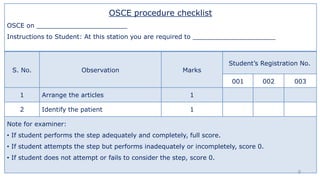
OSCE procedure checklist
OSCE on _______________________
Instructions to Student: At this station you are required to _____________________
S. No. Observation Marks
Student’s Registration No.
001 002 003
1 Arrange the articles 1
2 Identify the patient 1
Note for examiner:
• If student performs the step adequately and completely, full score.
• If student attempts the step but performs inadequately or incompletely, score 0.
• If student does not attempt or fails to consider the step, score 0.
9
Why Procedure Checklist?
A procedure checklist is a list of steps, given in correct sequence, that are
needed to perform a skill correctly. It helps to;
• ensure consistency of the procedure
• ensure that no step is skipped in the procedure
• ensure completeness in carrying out a task
• learners can practice skills independently
• ensure that clinical practice guidelines are followed
• improve clinical outcomes and reduce medical errors
10
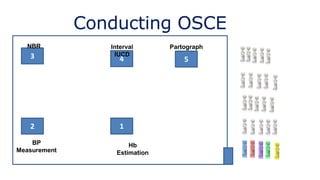
3 5
4
1
2
Hb
Estimation
BP
Measurement
NBR Interval
IUCD
Partograph
Conducting OSCE
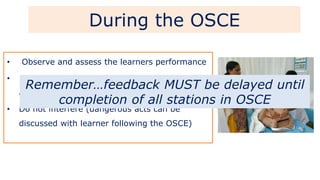
During the OSCE
• Observe and assess the learners performance
• Stand where you can see without interrupting
and let the learner perform the skill
• Do not interfere (dangerous acts can be
discussed with learner following the OSCE)
Remember…feedback MUST be delayed until
completion of all stations in OSCE
After the OSCE
In summative assessments:
• Enter the OSCE scores in the summary sheet and send to the
examination department on the same day
– In formative assessments:
• Review the performance of the learner
• Provide positive feedback and offer suggestions for improvement
• Determine if the learner is competent or needs additional practice
To be declared as pass on an OSCE station, one would need to
achieve at least 80% score in that particular station
• Medical errors happen in 1 out of 10 patients every year globally
•(JCAHO and WHO)
5.2 million errors occur annually in India (Harvard study by Prof. Jha)
Limited learning exposure:
Student-Patient ratio
Decreased LOS
Limited clinical sites
Faculty shortage
Patient safety initiatives
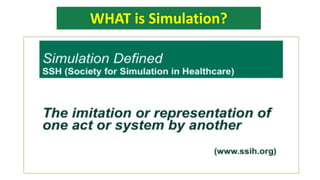
WHAT is Simulation?
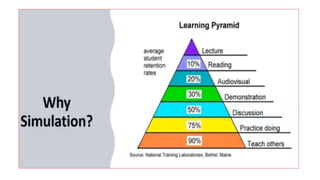
WHY Simulation is used?
See One, Do One,
Teach One
See One, Practice Many,
Do One
Teaching Methodologies
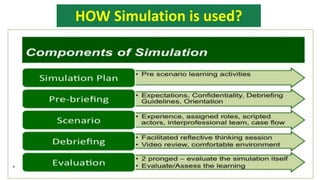
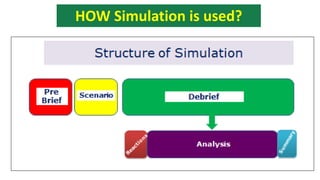
HOW Simulation is used?
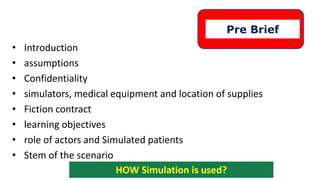
• Introduction
• assumptions
• Confidentiality
• simulators, medical equipment and location of supplies
• Fiction contract
• learning objectives
• role of actors and Simulated patients
• Stem of the scenario
Pre Brief
HOW Simulation is used?
1. Set the scene
Timing , phases, learning objectives, tension off-How are you?
2. Safety
3. Equipment Check
4. DO NOT JUMP IN
5. Conclude when objectives are achieved
Scenario
HOW Simulation is used?
1. Reaction
- A chronological description of action, - does everyone agree?
2. Analysis, reflection- self analysis
(what was good? How can you do this well again?)
Areas for improvement: what would you do different next time?
3. Summarization
what did you learn? How are you going to apply it in clinical practice?
Debrief
HOW Simulation is used?
NEGATIVE Screams, POSITIVE Whispers….
Pull the ideas, Don’t Push The Facts…
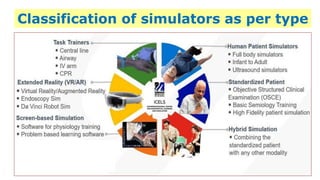
Classification of simulators as per type
Fidelity
26
LOW MEDIUM HIGH
history
Evidence supports best practices for SBE
Best practice is characterized by :
1. Facilitated Reflective Debriefing
2. Repetitive Practice
3. Distributed Practice
4. Curriculum Integration
5. Clinical variation
6. Range of difficulty
7. Individualized learning
8. Multiple learning strategies
9. Defined Outcomes
10.Valid simulator
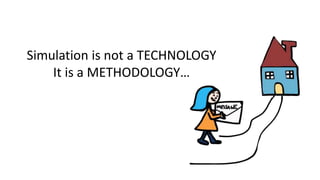
Simulation is not a TECHNOLOGY
It is a METHODOLOGY…

Simulation Based Education and OSCE

  • 1.
    SBE and OSCE Mrs.Nilofar Loladiya
  • 2.
    SBE and OSCE OBJECTIVES: •Learn about OSCE and its components • Differentiate between OSCE and SBE • Discuss regarding SBE • Evaluate utilization of SBE in our setting
  • 3.
    SBE v/s OSCEv/s Role-play
  • 4.
  • 5.
    OSCE It is designedto test clinical skill performance and competence • Objective: Learners will be assessed on same skill stations using standardized tool/checklist • Structured: Learners sees the same problem and perform the same tasks in the same timeframe • Clinical : Task are representative of those faced in real-life clinical situation • Examination: Assessing the learners 5 OSCE enables a reliable assessment of a candidate’s competence
  • 6.
    OSCE Process • Learnersrotate through a series of stations where they answer questions (orally or in writing), or perform tasks while being observed • Typically 5-10 stations with equal time in all the stations • All learners receive identical assessments • Learners may demonstrate a skill, interpret diagnostic materials, or respond to short questions or case scenario
  • 7.
    • Identify targetcompetencies • Decide on a problem, issue, or an activity that addresses each of the competencies • Map out a plan for the skill stations How to prepare for an OSCE ?
  • 8.
    OSCE station requirements •Task/scenario to be completed • Instructions for learners • Instructions for the standardized Patient (SP) • Skill assessment stations with necessary models/ mannequins/SP, equipment, articles and consumables • Assessment tool (Procedure checklist) • An assessor at each observation station • Uniform time limit for all stations
  • 9.
    OSCE procedure checklist OSCEon _______________________ Instructions to Student: At this station you are required to _____________________ S. No. Observation Marks Student’s Registration No. 001 002 003 1 Arrange the articles 1 2 Identify the patient 1 Note for examiner: • If student performs the step adequately and completely, full score. • If student attempts the step but performs inadequately or incompletely, score 0. • If student does not attempt or fails to consider the step, score 0. 9
  • 10.
    Why Procedure Checklist? Aprocedure checklist is a list of steps, given in correct sequence, that are needed to perform a skill correctly. It helps to; • ensure consistency of the procedure • ensure that no step is skipped in the procedure • ensure completeness in carrying out a task • learners can practice skills independently • ensure that clinical practice guidelines are followed • improve clinical outcomes and reduce medical errors 10
  • 11.
  • 12.
    During the OSCE •Observe and assess the learners performance • Stand where you can see without interrupting and let the learner perform the skill • Do not interfere (dangerous acts can be discussed with learner following the OSCE) Remember…feedback MUST be delayed until completion of all stations in OSCE
  • 13.
    After the OSCE Insummative assessments: • Enter the OSCE scores in the summary sheet and send to the examination department on the same day – In formative assessments: • Review the performance of the learner • Provide positive feedback and offer suggestions for improvement • Determine if the learner is competent or needs additional practice To be declared as pass on an OSCE station, one would need to achieve at least 80% score in that particular station
  • 14.
    • Medical errorshappen in 1 out of 10 patients every year globally •(JCAHO and WHO) 5.2 million errors occur annually in India (Harvard study by Prof. Jha) Limited learning exposure: Student-Patient ratio Decreased LOS Limited clinical sites Faculty shortage Patient safety initiatives
  • 15.
  • 18.
  • 19.
    See One, DoOne, Teach One See One, Practice Many, Do One Teaching Methodologies
  • 20.
  • 21.
  • 22.
    • Introduction • assumptions •Confidentiality • simulators, medical equipment and location of supplies • Fiction contract • learning objectives • role of actors and Simulated patients • Stem of the scenario Pre Brief HOW Simulation is used?
  • 23.
    1. Set thescene Timing , phases, learning objectives, tension off-How are you? 2. Safety 3. Equipment Check 4. DO NOT JUMP IN 5. Conclude when objectives are achieved Scenario HOW Simulation is used?
  • 24.
    1. Reaction - Achronological description of action, - does everyone agree? 2. Analysis, reflection- self analysis (what was good? How can you do this well again?) Areas for improvement: what would you do different next time? 3. Summarization what did you learn? How are you going to apply it in clinical practice? Debrief HOW Simulation is used? NEGATIVE Screams, POSITIVE Whispers…. Pull the ideas, Don’t Push The Facts…
  • 25.
  • 26.
  • 27.
    Evidence supports bestpractices for SBE Best practice is characterized by : 1. Facilitated Reflective Debriefing 2. Repetitive Practice 3. Distributed Practice 4. Curriculum Integration 5. Clinical variation 6. Range of difficulty 7. Individualized learning 8. Multiple learning strategies 9. Defined Outcomes 10.Valid simulator
  • 28.
    Simulation is nota TECHNOLOGY It is a METHODOLOGY…