Radiographs
(Part 2)
Presented by
Dr. Neha Sharma
PG II YR
CONTENTS
3
 PANORAMIC IMAGING
 EXTRAORAL RADIOGRAPHS
CEPHALOMETRIC LANDMARKS
LATERAL SKULL PROJECTION
SUBMENTOVERTEX PROJECTION
PA WATERS PROJECTION
REVERSE TOWNES PROJECTION
TMJ IMAGING
 CONCLUSION
HISTORY OF -
EXTRAORAL RADIOGRAPHIC TECHNIQUES
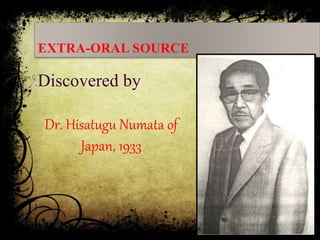
EXTRA-ORAL SOURCE
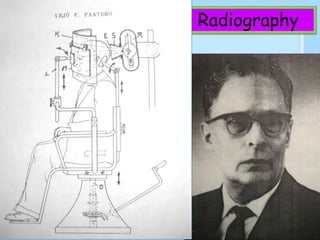
Discovered by
Dr. Hisatugu Numata of
Japan, 1933
Father of Panoramic Radiography
•1949, extra-oral films
•X-ray source - stationary
Dr Yrjo Veli Paatero
What is panoramic imaging
/pantomography???
A technique for producing a single tomographic
image of the facial structures that includes both
the maxillary and mandibular dental arches and
their supporting structures.
‘Panorama’ ‘Tomography’
An
unobstructed
view of a
region in
every
direction
An X-ray technique
for making
radiographs of
layers of tissue in
depth without the
interference of
tissues above and
below the level
PANTOMOGRAPHY
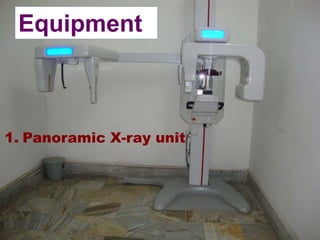
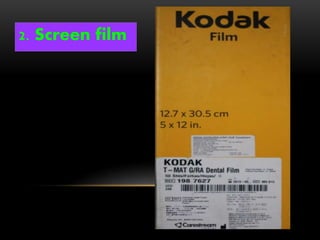
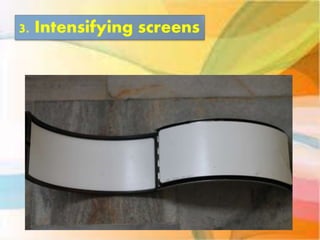
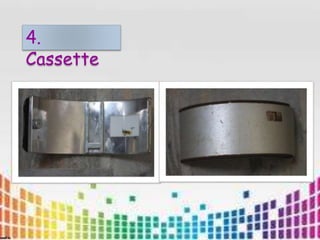
Equipment
1. Panoramic X-ray unit
2. Screen film
3. Intensifying screens
4.
Cassette
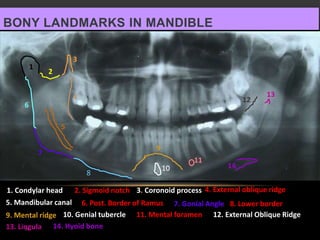
BONY LANDMARKS IN MANDIBLE
14
1
1. Condylar head 2. Sigmoid notch 3. Coronoid process 4. External oblique ridge
5. Mandibular canal
2
3
4
5
6. Post. Border of Ramus 8. Lower border7. Gonial Angle
6
7
9. Mental ridge 11. Mental foramen10. Genial tubercle
13. Lingula
12. External Oblique Ridge
14. Hyoid bone
8
9
10
11
12
13
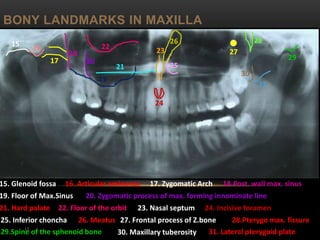
BONY LANDMARKS IN MAXILLA
15
15
15. Glenoid fossa
19. Floor of Max.Sinus
17. Zygomatic Arch16. Articular eminence 18.Post. wall max. sinus
20. Zygomatic process of max. forming innominate line
21. Hard palate 22. Floor of the orbit 23. Nasal septum 24. Incisive foramen
25. Inferior choncha 26. Meatus 27. Frontal process of Z.bone
16
17
18
19
20
21
22
23
29
25
24
26
28.Pterygo max. fissure
30. Maxillary tuberosity29.Spine of the sphenoid bone 31. Lateral pterygoid plate
31
30
28
27
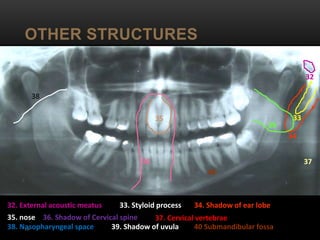
OTHER STRUCTURES
16
32
32. External acoustic meatus 34. Shadow of ear lobe33. Styloid process
35. nose 36. Shadow of Cervical spine
33
34
35
36 37
37. Cervical vertebrae
38
38. Nasopharyngeal space 39. Shadow of uvula
40
39
40 Submandibular fossa
A panoramic film is not
as useful as periapical
radiography for
detecting small carious
lesions, periodontal
diseases, or periapical
lesions.
It should not be used as a
substitute for intraoral
films.
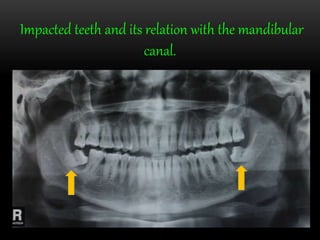
Impacted teeth and its relation with the mandibular
canal.
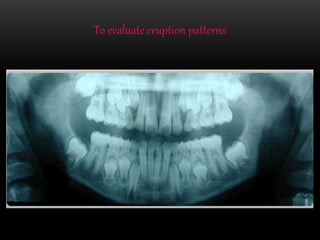
To evaluate eruption patterns
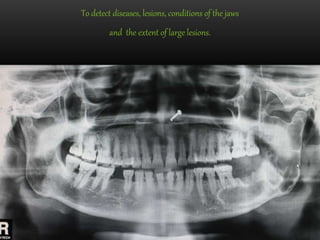
To detect diseases, lesions, conditions of the jaws
and the extent of large lesions.
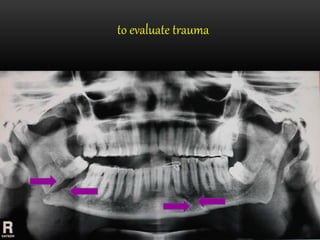
to evaluate trauma
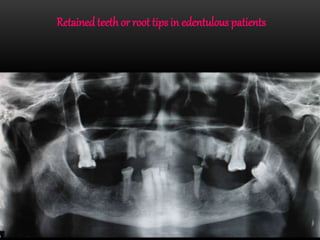
Retainedteethor root tips in edentulous patients
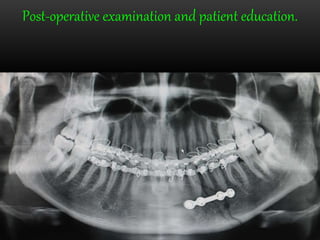
Post-operative examination and patient education.
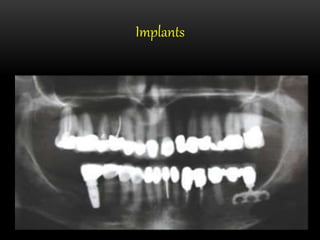
Implants
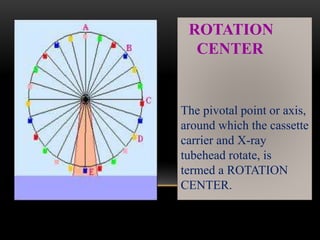
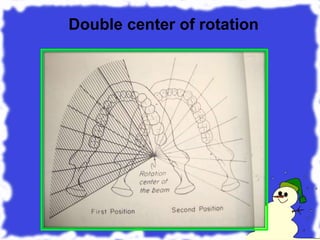
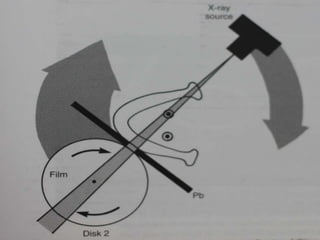
ROTATION
CENTER
The pivotal point or axis,
around which the cassette
carrier and X-ray
tubehead rotate, is
termed a ROTATION
CENTER.
Double center of rotation
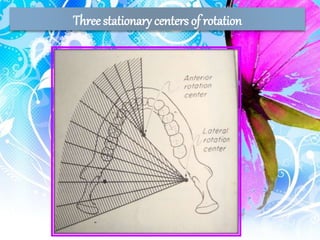
Three stationary centers of rotation
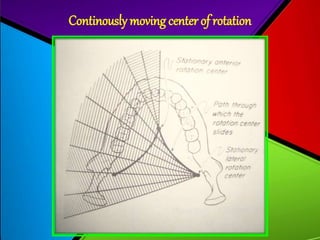
Continously moving center of rotation
During the exposure cycle, the machine shiftsto one or
more additional rotation centers.
This rotational change allowsthe image layer to
conformto the shape of the dental arches.
The location and no. of rotational centers influence the
size and shape of the focal trough.
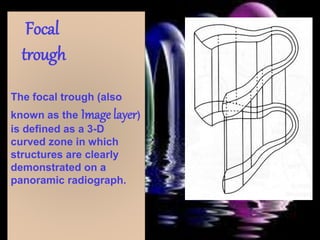
Focal
trough
The focal trough (also
known as the Image layer)
is defined as a 3-D
curved zone in which
structures are clearly
demonstrated on a
panoramic radiograph.
Advantages
1. Fieldsize
2. Minimal exposure
3. Simplicity
4. Patient cooperation
5. Useful in patients with trismus & gagging
6. Valuable visual aid for patient education
Disadvantages
1. Cannot be usedin detection of caries and periodontal disease.
2. Overlapping of teethin premolar region
3. Focal trough limitations
4. Shadowof cervical spine in the lower anterior region.
5. Ghost images
6. Equipment cost
34
COMMON ERRORS
PATIENT POSITIONING ERRORS
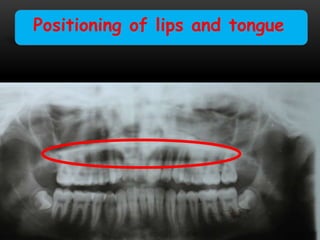
Positioning of lips and tongue
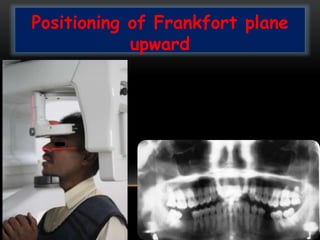
Positioning of Frankfort plane
upward
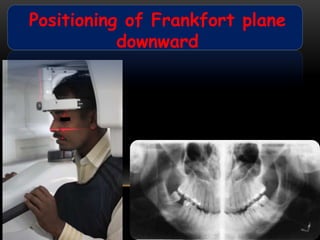
Positioning of Frankfort plane
downward
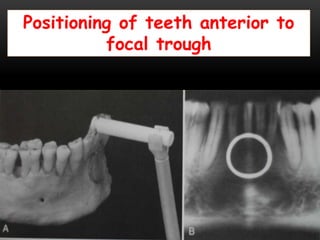
Positioning of teeth anterior to
focal trough
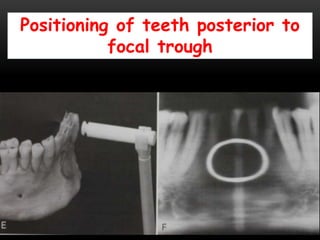
Positioning of teeth posterior to
focal trough
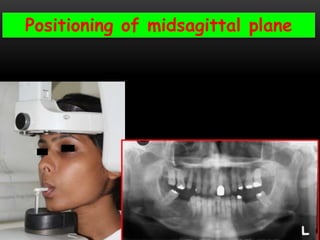
Positioning of midsagittal plane
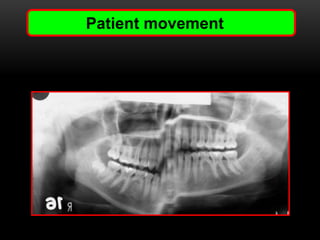
Patient movement
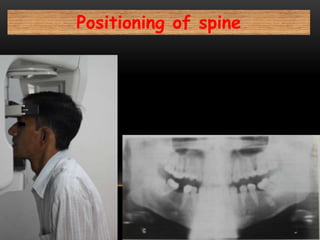
Positioning of spine
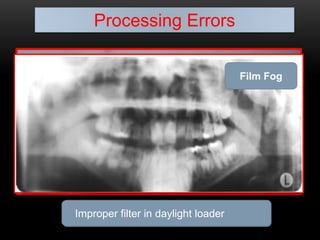
Processing Errors
Underexposed, light, washed out
image
Very dark film, Overexposed
Film Fog
Improper filter in daylight loader
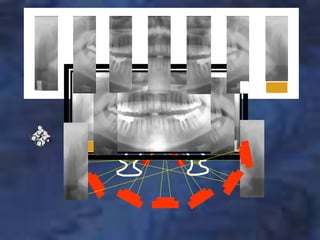
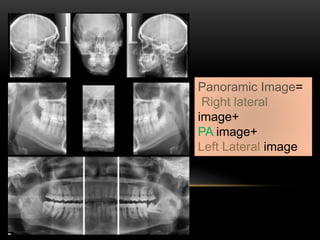
Panoramic Image=
Right lateral
image+
PA image+
Left Lateral image
EXTRAORA
L
RADIOGRA
PHIC
TECHNIQUE
S
7/29/2014 46
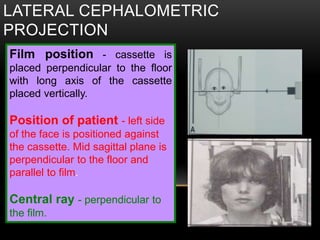
LATERAL CEPHALOMETRIC
PROJECTION
Film position - cassette is
placed perpendicular to the floor
with long axis of the cassette
placed vertically.
Position of patient - left side
of the face is positioned against
the cassette. Mid sagittal plane is
perpendicular to the floor and
parallel to film.
Central ray - perpendicular to
the film.
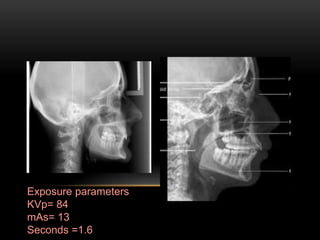
Exposure parameters
KVp= 84
mAs= 13
Seconds =1.6
INDICATIONS
• To evaluate facial growth and
development, trauma, disease and
developmental anomalies.
• Demonstrates the bones of the face,
skull as well as the soft tissue profile
of the face.
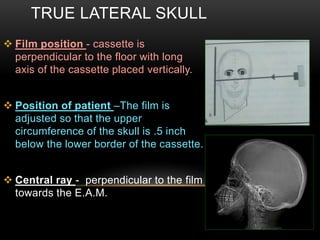
 Film position - cassette is
perpendicular to the floor with long
axis of the cassette placed vertically.
 Position of patient –The film is
adjusted so that the upper
circumference of the skull is .5 inch
below the lower border of the cassette.
 Central ray - perpendicular to the film
towards the E.A.M.
TRUE LATERAL SKULL
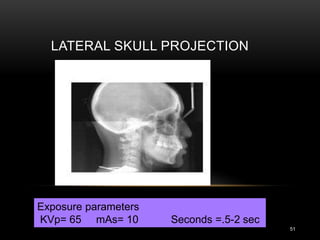
LATERAL SKULL PROJECTION
51
Exposure parameters
KVp= 65 mAs= 10 Seconds =.5-2 sec
To survey skull and facial bone for trauma or pathology.
Nasopharangeal soft tissue, paranasal sinus and hard
palate.
Condition affecting sella turcica, such as tumour of pitutary
gland in acromegaly.
Indications
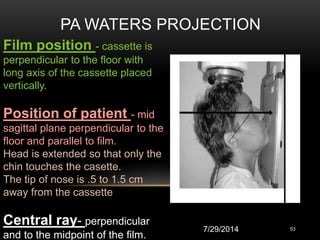
7/29/2014 53
PA WATERS PROJECTION
Film position - cassette is
perpendicular to the floor with
long axis of the cassette placed
vertically.
Position of patient - mid
sagittal plane perpendicular to the
floor and parallel to film.
Head is extended so that only the
chin touches the casette.
The tip of nose is .5 to 1.5 cm
away from the cassette
Central ray- perpendicular
and to the midpoint of the film.
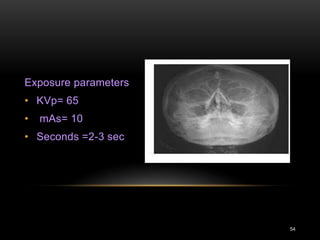
54
Exposure parameters
• KVp= 65
• mAs= 10
• Seconds =2-3 sec
INDICATIONS
55
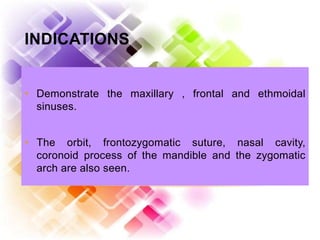
• Demonstrate the maxillary , frontal and ethmoidal
sinuses.
• The orbit, frontozygomatic suture, nasal cavity,
coronoid process of the mandible and the zygomatic
arch are also seen.
56
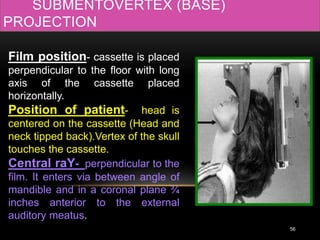
Film position- cassette is placed
perpendicular to the floor with long
axis of the cassette placed
horizontally.
Position of patient- head is
centered on the cassette (Head and
neck tipped back).Vertex of the skull
touches the cassette.
Central raY- perpendicular to the
film. It enters via between angle of
mandible and in a coronal plane ¾
inches anterior to the external
auditory meatus.
SUBMENTOVERTEX (BASE)
PROJECTION
SUBMENTOVERTEX (BASE) PROJECTION
57
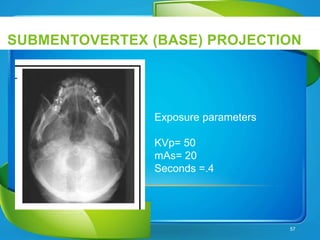
Exposure parameters
KVp= 50
mAs= 20
Seconds =.4
INDICATIONS
58
 Help to study destructive lesion affecting
the palate, pterygoid region or base of the
skull, sphenoidal sinus.
 Fractures of zygomatic arches (JUG
HANDLE).
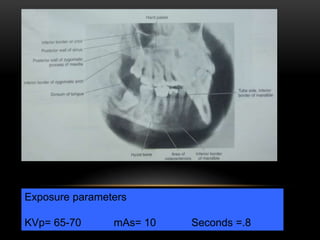
LATERAL OBLIQUE
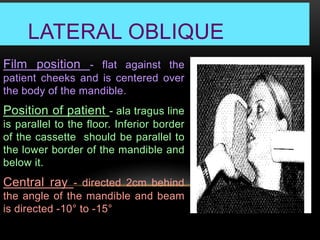
Film position - flat against the
patient cheeks and is centered over
the body of the mandible.
Position of patient - ala tragus line
is parallel to the floor. Inferior border
of the cassette should be parallel to
the lower border of the mandible and
below it.
Central ray - directed 2cm behind
the angle of the mandible and beam
is directed -10° to -15°
Exposure parameters
KVp= 65-70 mAs= 10 Seconds =.8
Lateral Oblique Views - Largely
replaced by panoramic views
Indications:
• Impacted third molars
• fractures of the ramus, condyle or body of
the mandible.
61
62
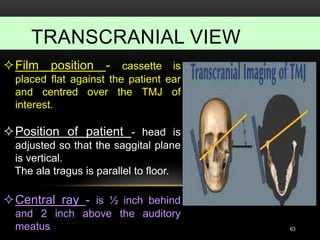
TRANSCRANIAL VIEW
63
Film position - cassette is
placed flat against the patient ear
and centred over the TMJ of
interest.
Position of patient - head is
adjusted so that the saggital plane
is vertical.
The ala tragus is parallel to floor.
Central ray - is ½ inch behind
and 2 inch above the auditory
meatus
64
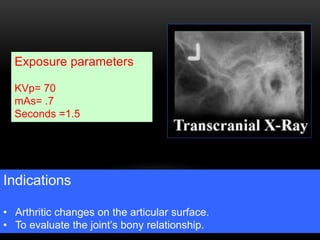
Exposure parameters
KVp= 70
mAs= .7
Seconds =1.5
Indications
• Arthritic changes on the articular surface.
• To evaluate the joint’s bony relationship.
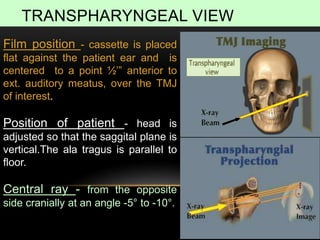
TRANSPHARYNGEAL VIEW
65
Film position - cassette is placed
flat against the patient ear and is
centered to a point ½’” anterior to
ext. auditory meatus, over the TMJ
of interest.
Position of patient - head is
adjusted so that the saggital plane is
vertical.The ala tragus is parallel to
floor.
Central ray - from the opposite
side cranially at an angle -5° to -10°.
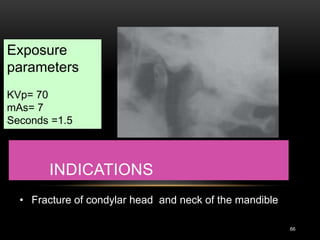
INDICATIONS
66
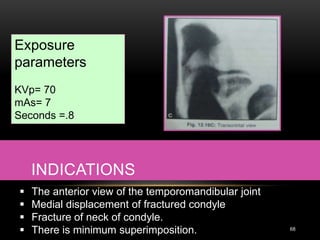
• Fracture of condylar head and neck of the mandible
Exposure
parameters
KVp= 70
mAs= 7
Seconds =1.5
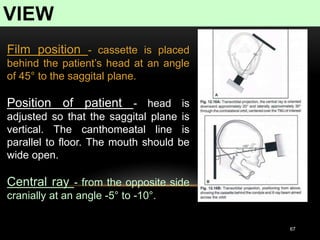
VIEW
67
Film position - cassette is placed
behind the patient’s head at an angle
of 45° to the saggital plane.
Position of patient - head is
adjusted so that the saggital plane is
vertical. The canthomeatal line is
parallel to floor. The mouth should be
wide open.
Central ray - from the opposite side
cranially at an angle -5° to -10°.
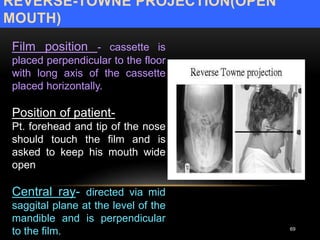
INDICATIONS
68
 The anterior view of the temporomandibular joint
 Medial displacement of fractured condyle
 Fracture of neck of condyle.
 There is minimum superimposition.
Exposure
parameters
KVp= 70
mAs= 7
Seconds =.8
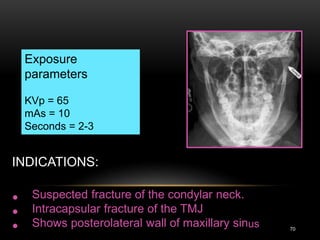
REVERSE-TOWNE PROJECTION(OPEN
MOUTH)
69
Film position - cassette is
placed perpendicular to the floor
with long axis of the cassette
placed horizontally.
Position of patient-
Pt. forehead and tip of the nose
should touch the film and is
asked to keep his mouth wide
open
Central ray- directed via mid
saggital plane at the level of the
mandible and is perpendicular
to the film.
70
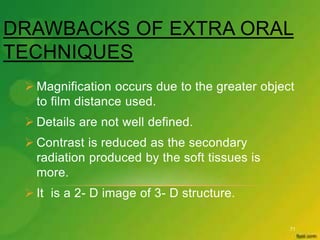
Exposure
parameters
KVp = 65
mAs = 10
Seconds = 2-3
INDICATIONS:
• Suspected fracture of the condylar neck.
• Intracapsular fracture of the TMJ
• Shows posterolateral wall of maxillary sinus
DRAWBACKS OF EXTRA ORAL
TECHNIQUES
71
 Magnification occurs due to the greater object
to film distance used.
 Details are not well defined.
 Contrast is reduced as the secondary
radiation produced by the soft tissues is
more.
 It is a 2- D image of 3- D structure.
CONCLUSION
Thorough knowledge of the indications of
various extra oral techniques allows accurate
and timely diagnosis of various maxillofacial
pathologies. Further, we can arrive at a
diagnosis with minimum number of x-rays
there by reducing patient exposure to
radiation.
• White SC, Pharoah MJ.Oral Radiology
Principles And Interpretations.6thelsevier::
Missouri; 2009
• Mac Donald,Avery.Dentistry For The Child
And Adolscent.9th.elsevier: Missouri; 2011
• Langland and Langlais.. Principles Of Dental
Imaging.7thed.elsevier: Muir; 2005
• Freny R,Karjodkar.Textbook Of Dental And
Maxillofacial Radiology.6thed.elsevier: Reed;
2000
• Dental radiography, Principles and
Techniques; Haring, Howerton;Third
edition.
DR ANKIT GOEL, SUBHARTI.

OPG and Extraoral radiography

  • 2.
  • 3.
    CONTENTS 3  PANORAMIC IMAGING EXTRAORAL RADIOGRAPHS CEPHALOMETRIC LANDMARKS LATERAL SKULL PROJECTION SUBMENTOVERTEX PROJECTION PA WATERS PROJECTION REVERSE TOWNES PROJECTION TMJ IMAGING  CONCLUSION
  • 4.
    HISTORY OF - EXTRAORALRADIOGRAPHIC TECHNIQUES
  • 5.
    EXTRA-ORAL SOURCE Discovered by Dr.Hisatugu Numata of Japan, 1933
  • 6.
    Father of PanoramicRadiography •1949, extra-oral films •X-ray source - stationary Dr Yrjo Veli Paatero
  • 7.
    What is panoramicimaging /pantomography??? A technique for producing a single tomographic image of the facial structures that includes both the maxillary and mandibular dental arches and their supporting structures.
  • 8.
    ‘Panorama’ ‘Tomography’ An unobstructed view ofa region in every direction An X-ray technique for making radiographs of layers of tissue in depth without the interference of tissues above and below the level PANTOMOGRAPHY
  • 9.
  • 10.
  • 11.
  • 12.
  • 14.
    BONY LANDMARKS INMANDIBLE 14 1 1. Condylar head 2. Sigmoid notch 3. Coronoid process 4. External oblique ridge 5. Mandibular canal 2 3 4 5 6. Post. Border of Ramus 8. Lower border7. Gonial Angle 6 7 9. Mental ridge 11. Mental foramen10. Genial tubercle 13. Lingula 12. External Oblique Ridge 14. Hyoid bone 8 9 10 11 12 13
  • 15.
    BONY LANDMARKS INMAXILLA 15 15 15. Glenoid fossa 19. Floor of Max.Sinus 17. Zygomatic Arch16. Articular eminence 18.Post. wall max. sinus 20. Zygomatic process of max. forming innominate line 21. Hard palate 22. Floor of the orbit 23. Nasal septum 24. Incisive foramen 25. Inferior choncha 26. Meatus 27. Frontal process of Z.bone 16 17 18 19 20 21 22 23 29 25 24 26 28.Pterygo max. fissure 30. Maxillary tuberosity29.Spine of the sphenoid bone 31. Lateral pterygoid plate 31 30 28 27
  • 16.
    OTHER STRUCTURES 16 32 32. Externalacoustic meatus 34. Shadow of ear lobe33. Styloid process 35. nose 36. Shadow of Cervical spine 33 34 35 36 37 37. Cervical vertebrae 38 38. Nasopharyngeal space 39. Shadow of uvula 40 39 40 Submandibular fossa
  • 17.
    A panoramic filmis not as useful as periapical radiography for detecting small carious lesions, periodontal diseases, or periapical lesions. It should not be used as a substitute for intraoral films.
  • 18.
    Impacted teeth andits relation with the mandibular canal.
  • 19.
  • 20.
    To detect diseases,lesions, conditions of the jaws and the extent of large lesions.
  • 21.
  • 22.
    Retainedteethor root tipsin edentulous patients
  • 23.
  • 24.
  • 25.
    ROTATION CENTER The pivotal pointor axis, around which the cassette carrier and X-ray tubehead rotate, is termed a ROTATION CENTER.
  • 26.
  • 27.
  • 28.
  • 30.
    During the exposurecycle, the machine shiftsto one or more additional rotation centers. This rotational change allowsthe image layer to conformto the shape of the dental arches. The location and no. of rotational centers influence the size and shape of the focal trough.
  • 31.
    Focal trough The focal trough(also known as the Image layer) is defined as a 3-D curved zone in which structures are clearly demonstrated on a panoramic radiograph.
  • 32.
    Advantages 1. Fieldsize 2. Minimalexposure 3. Simplicity 4. Patient cooperation 5. Useful in patients with trismus & gagging 6. Valuable visual aid for patient education
  • 33.
    Disadvantages 1. Cannot beusedin detection of caries and periodontal disease. 2. Overlapping of teethin premolar region 3. Focal trough limitations 4. Shadowof cervical spine in the lower anterior region. 5. Ghost images 6. Equipment cost
  • 34.
  • 35.
  • 36.
  • 37.
  • 38.
  • 39.
    Positioning of teethanterior to focal trough
  • 40.
    Positioning of teethposterior to focal trough
  • 41.
  • 42.
  • 43.
  • 44.
    Processing Errors Underexposed, light,washed out image Very dark film, Overexposed Film Fog Improper filter in daylight loader
  • 45.
  • 46.
  • 47.
    LATERAL CEPHALOMETRIC PROJECTION Film position- cassette is placed perpendicular to the floor with long axis of the cassette placed vertically. Position of patient - left side of the face is positioned against the cassette. Mid sagittal plane is perpendicular to the floor and parallel to film. Central ray - perpendicular to the film.
  • 48.
  • 49.
    INDICATIONS • To evaluatefacial growth and development, trauma, disease and developmental anomalies. • Demonstrates the bones of the face, skull as well as the soft tissue profile of the face.
  • 50.
     Film position- cassette is perpendicular to the floor with long axis of the cassette placed vertically.  Position of patient –The film is adjusted so that the upper circumference of the skull is .5 inch below the lower border of the cassette.  Central ray - perpendicular to the film towards the E.A.M. TRUE LATERAL SKULL
  • 51.
    LATERAL SKULL PROJECTION 51 Exposureparameters KVp= 65 mAs= 10 Seconds =.5-2 sec
  • 52.
    To survey skulland facial bone for trauma or pathology. Nasopharangeal soft tissue, paranasal sinus and hard palate. Condition affecting sella turcica, such as tumour of pitutary gland in acromegaly. Indications
  • 53.
    7/29/2014 53 PA WATERSPROJECTION Film position - cassette is perpendicular to the floor with long axis of the cassette placed vertically. Position of patient - mid sagittal plane perpendicular to the floor and parallel to film. Head is extended so that only the chin touches the casette. The tip of nose is .5 to 1.5 cm away from the cassette Central ray- perpendicular and to the midpoint of the film.
  • 54.
    54 Exposure parameters • KVp=65 • mAs= 10 • Seconds =2-3 sec
  • 55.
    INDICATIONS 55 • Demonstrate themaxillary , frontal and ethmoidal sinuses. • The orbit, frontozygomatic suture, nasal cavity, coronoid process of the mandible and the zygomatic arch are also seen.
  • 56.
    56 Film position- cassetteis placed perpendicular to the floor with long axis of the cassette placed horizontally. Position of patient- head is centered on the cassette (Head and neck tipped back).Vertex of the skull touches the cassette. Central raY- perpendicular to the film. It enters via between angle of mandible and in a coronal plane ¾ inches anterior to the external auditory meatus. SUBMENTOVERTEX (BASE) PROJECTION
  • 57.
    SUBMENTOVERTEX (BASE) PROJECTION 57 Exposureparameters KVp= 50 mAs= 20 Seconds =.4
  • 58.
    INDICATIONS 58  Help tostudy destructive lesion affecting the palate, pterygoid region or base of the skull, sphenoidal sinus.  Fractures of zygomatic arches (JUG HANDLE).
  • 59.
    LATERAL OBLIQUE Film position- flat against the patient cheeks and is centered over the body of the mandible. Position of patient - ala tragus line is parallel to the floor. Inferior border of the cassette should be parallel to the lower border of the mandible and below it. Central ray - directed 2cm behind the angle of the mandible and beam is directed -10° to -15°
  • 60.
    Exposure parameters KVp= 65-70mAs= 10 Seconds =.8
  • 61.
    Lateral Oblique Views- Largely replaced by panoramic views Indications: • Impacted third molars • fractures of the ramus, condyle or body of the mandible. 61
  • 62.
  • 63.
    TRANSCRANIAL VIEW 63 Film position- cassette is placed flat against the patient ear and centred over the TMJ of interest. Position of patient - head is adjusted so that the saggital plane is vertical. The ala tragus is parallel to floor. Central ray - is ½ inch behind and 2 inch above the auditory meatus
  • 64.
    64 Exposure parameters KVp= 70 mAs=.7 Seconds =1.5 Indications • Arthritic changes on the articular surface. • To evaluate the joint’s bony relationship.
  • 65.
    TRANSPHARYNGEAL VIEW 65 Film position- cassette is placed flat against the patient ear and is centered to a point ½’” anterior to ext. auditory meatus, over the TMJ of interest. Position of patient - head is adjusted so that the saggital plane is vertical.The ala tragus is parallel to floor. Central ray - from the opposite side cranially at an angle -5° to -10°.
  • 66.
    INDICATIONS 66 • Fracture ofcondylar head and neck of the mandible Exposure parameters KVp= 70 mAs= 7 Seconds =1.5
  • 67.
    VIEW 67 Film position -cassette is placed behind the patient’s head at an angle of 45° to the saggital plane. Position of patient - head is adjusted so that the saggital plane is vertical. The canthomeatal line is parallel to floor. The mouth should be wide open. Central ray - from the opposite side cranially at an angle -5° to -10°.
  • 68.
    INDICATIONS 68  The anteriorview of the temporomandibular joint  Medial displacement of fractured condyle  Fracture of neck of condyle.  There is minimum superimposition. Exposure parameters KVp= 70 mAs= 7 Seconds =.8
  • 69.
    REVERSE-TOWNE PROJECTION(OPEN MOUTH) 69 Film position- cassette is placed perpendicular to the floor with long axis of the cassette placed horizontally. Position of patient- Pt. forehead and tip of the nose should touch the film and is asked to keep his mouth wide open Central ray- directed via mid saggital plane at the level of the mandible and is perpendicular to the film.
  • 70.
    70 Exposure parameters KVp = 65 mAs= 10 Seconds = 2-3 INDICATIONS: • Suspected fracture of the condylar neck. • Intracapsular fracture of the TMJ • Shows posterolateral wall of maxillary sinus
  • 71.
    DRAWBACKS OF EXTRAORAL TECHNIQUES 71  Magnification occurs due to the greater object to film distance used.  Details are not well defined.  Contrast is reduced as the secondary radiation produced by the soft tissues is more.  It is a 2- D image of 3- D structure.
  • 72.
    CONCLUSION Thorough knowledge ofthe indications of various extra oral techniques allows accurate and timely diagnosis of various maxillofacial pathologies. Further, we can arrive at a diagnosis with minimum number of x-rays there by reducing patient exposure to radiation.
  • 73.
    • White SC,Pharoah MJ.Oral Radiology Principles And Interpretations.6thelsevier:: Missouri; 2009 • Mac Donald,Avery.Dentistry For The Child And Adolscent.9th.elsevier: Missouri; 2011 • Langland and Langlais.. Principles Of Dental Imaging.7thed.elsevier: Muir; 2005 • Freny R,Karjodkar.Textbook Of Dental And Maxillofacial Radiology.6thed.elsevier: Reed; 2000 • Dental radiography, Principles and Techniques; Haring, Howerton;Third edition.
  • 74.
    DR ANKIT GOEL,SUBHARTI.

Editor's Notes

  • #5 Starting wid the history of e o tech
  • #7 Dr patero was the first to describe principal of panoramic radiography and extra oral film. He kept the xray source stationary while the pt and film was moving constantly
  • #8 Moving on to the --
  • #9 Tpantomography is derived 4m 2 words – panorama and tomography
  • #10 The main component are
  • #14 Next is the working of panoramic radiography As the tubehead rotates around the patient, the x-ray beam passes through different parts of the jaws, producing multiple images that appear as one continuous image on the film (“panoramic view”). When you click the mouse, the tubehead will rotate around the patient and produce the images. The red dots represent the sliding rotation center. Click the mouse to align and merge these individual images into one continuous image.
  • #25 Implants can be well appreciated in opg
  • #26 In panoramic radiography, the film/ cassette carrier and X-ray tubehead are connected and rotate simultaneously around a patient during exposure.
  • #27 Depending on the manufacturer, the no. and location of the rotational center differ. One of the three basic rotation centers is used in panoramic X-ray machines as follows: DOUBLE- CENTER ROTATION TRIPLE- CENTER ROTATION MOVING- CENTER ROTATION
  • #28 Triple centre of rotation machines have 3 rotation centre and create an uninterrupted radiographic image of the jaws
  • #29 Machine rotates around a contnously moving center that is similar to the arches, and create an uninterrupted image of the jaws
  • #30 FUNDAMENTALS OF PANORAMIC IMAGING Previously xray source wase kept stationary while the Movement of film and object about 2 fixed centre of rotation In panoramic radiography, the film and X-ray tube head move around the patient. The X-ray tube head rotate’]s around the patient’s head in one direction, while the film rotates in the opposite direction. 2.Movement of film and xray about 1 fixed centre of rotation 3.Movement of xray source and film about a shifting centre of rotation
  • #32 The structures located within the focal trough appear reasonably well defined on the resulting panoramic radiograph. The structures positioned inside or outside of the focal trough appear blurred/ indistinct and are not readily visible on the panoramic film.
  • #33 Broad coverage of the facial bone and teeth. The radiation dose is relatively low. It is a simple procedure It is Convienient for the pt. It is Useful in patients with trismus & gagging It is Valuable visual aid for patient education
  • #34 Cannot be used in detection of caries and periodontal disease. Panoramic image shows Overlapping of teeth in premolar region. Focal trough limitations i.e the str outside the image layer cannot be visualised. Shadow of cervical spine in the lower anterior region. Formation of Ghost image.
  • #35 MOVING ON TO
  • #37 If the tongue is not placed on the roof of the mouth, a radioluscent shadow will be superimposed over the apices of the max teeth
  • #38 If the frankfort plane is rotated upward,it results in overlapping of the images of the teeth and an opaque shadow obcuring the root of the max teeth
  • #39 an exaggerated smile seen on the panoramic film If the frankfort plane is rotated downward
  • #40 if the teeth are positioned too far forward on the bite block ,the anterior teet appears skiny and out of focus i.e., blured and narrow
  • #41 if the teeth are positioned too far back on the bite block ,the anterior teeth appears fat and out of focus.
  • #42 If the pt head is not centered , the ramus and post teeth appears unequally magnified
  • #43 If the pt moves while taking an opg it results in distorted image
  • #44 If the pt is not standing erect, supermposition of the cervical spine may be seen on the centre of the film
  • #46 combination
  • #48 Pt is asked to keep the teeth in occlusion
  • #51 Film positioning is similar as that of the true lateral
  • #52 All the 3 exposure parameter are less than that of lateral ceph The main drawback wid this tech is the superimposition occurs
  • #53 To reveal the
  • #55 It has least kvp same as that of reverse towne
  • #58 It has highest tube current among all the e.0 tech
  • #59 The exposur time 4 the zygomatic arch is rduced to approx 1/3 the normal exPosure time 4 SMV. LESS 50kvp
  • #60 Pt must hold the cassette in position with the thumb placed under the edge of the cassttte and palm against the outer surface of the cassette
  • #62 Help to evaluate
  • #69 Same exposure parameter as that of T.CRANIAL
  • #71 Same parameter of exposure as that of pa waters view