UPPER AIRWAY
AND
CRANIAL MORPHOLOGY
BY
SHIFAYA NASRIN.S
CRRI
INTRODUCTION
• Upper and lower airway has always been an
area of interest because the oropharyngeal
and nasopharyngeal structures play important
roles in the growth and development of the
craniofacial complex.
• Airway dimensions change with retrognathic
mandible and prognathic mandible comparing
with normal mandible.
• The airway, mode of breathing, and
craniofacial formation are inter-related during
growth and development that form can follow
function and function can follow form .
• So, it is imperative to normalize form and
function as early as possible, so that function
is optimized for life.
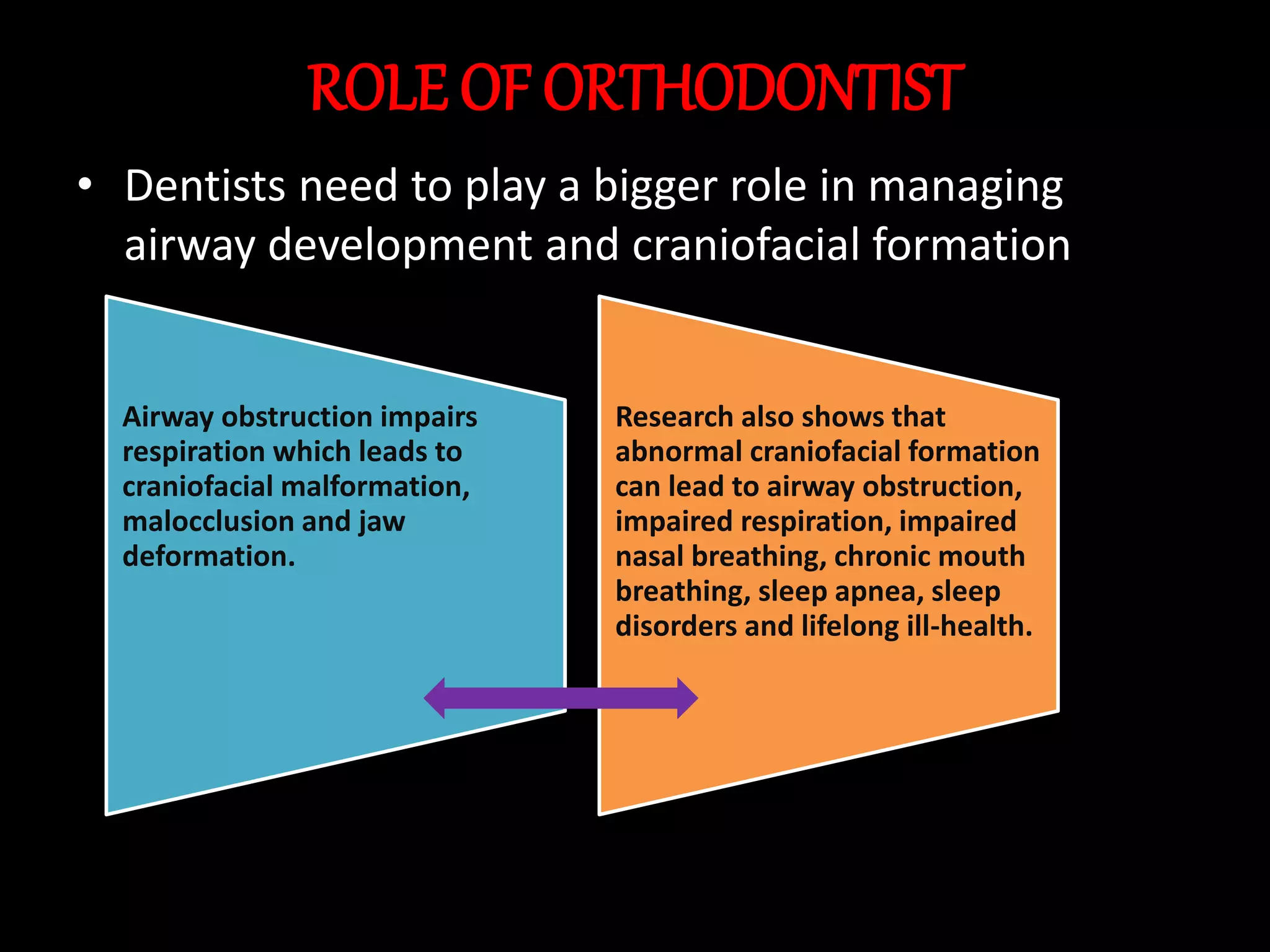
ROLE OF ORTHODONTIST
• Dentists need to play a bigger role in managing
airway development and craniofacial formation
Airway obstruction impairs
respiration which leads to
craniofacial malformation,
malocclusion and jaw
deformation.
Research also shows that
abnormal craniofacial formation
can lead to airway obstruction,
impaired respiration, impaired
nasal breathing, chronic mouth
breathing, sleep apnea, sleep
disorders and lifelong ill-health.
• Therefore, both craniofacial form and function
should be managed closely, particularly during
the early ages of growth and development.
• Early dental diagnosis and treatment of airway
dysfunction and craniofacial malformation
starting at birth is essential
• Current literature shows that early orthodontic
and orthopedic treatment positively impact the
airway and breathing can absolutely lead to a
healthier and longer life.
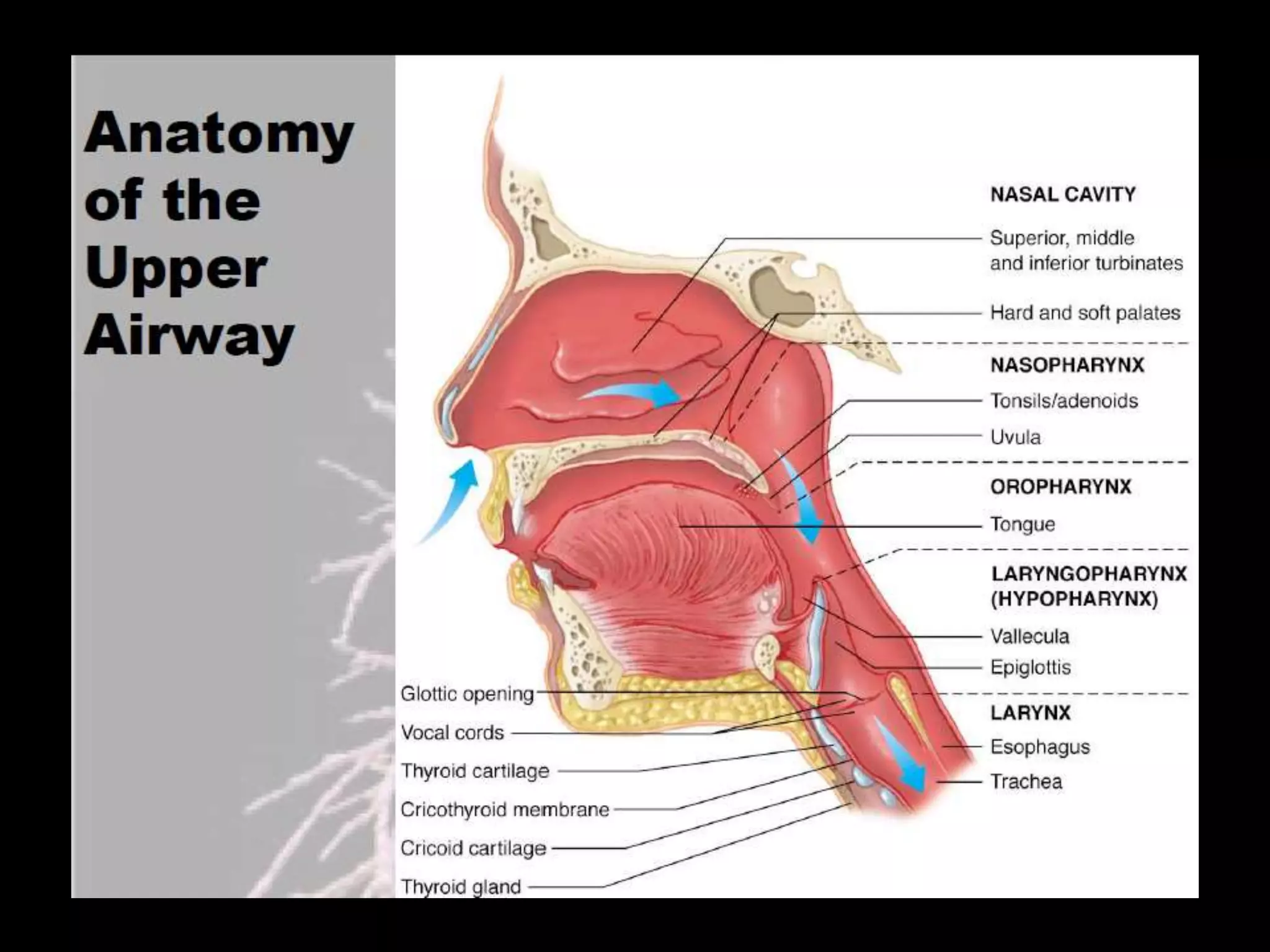
UPPER AIRWAY
• Refers to the parts of respiratory system lying outside of
thorax or above the sternal angle.
• The tract consist of:
- nasal cavity and paranasal sinuses
- pharynx
nasopharynx
oropharynx
laryngopharynx
- larynx
NATURAL HEAD POSTURE
• Boroca defined the position of the head when an
individual stands with the visual axis in the
horizontal plane .
• Natural head posture (NHP) is the upright
position of the head of a standing or sitting
subject, while it is balanced by the post-cervical
and masticatory-suprahyoid-infrahyoid muscle
groups, with the eyes directed forward so that
the visual axis is parallel to the floor
Causes of compensatory adaption of NHP
• Enlarged tonsils and adenoids
• Chronic respiratory problems.
• Obstructive sleep apnea (osa)
NORMAL AIRWAY AND NORMAL
BREATHING
• Normal well-developed airways allow normal breathing
through the nose with the mouth closed.
• Nasal breathing - vital to good health.
• Research has shown that air breathed through the nose is
quite different to the body than air breathed through the
mouth.
THE BENEFITS OF NASAL
BREATHING
• Begin within hours of birth when nasal nitric
oxide gas can first be detected
Nitric oxide:
• produced in the nasal sinuses, secreted into
the nasal passages and inhaled through the
nose
• prevent bacterial growth.
• In the lungs it improves the ability to absorb
oxygen.
• strong vasodilator and brain transmitter.
• increases oxygen transport throughout the
body and is vital to all body organs.
• A good airway and normal nasal breathing is
important because nasal airway obstruction
has profound effects on the whole body
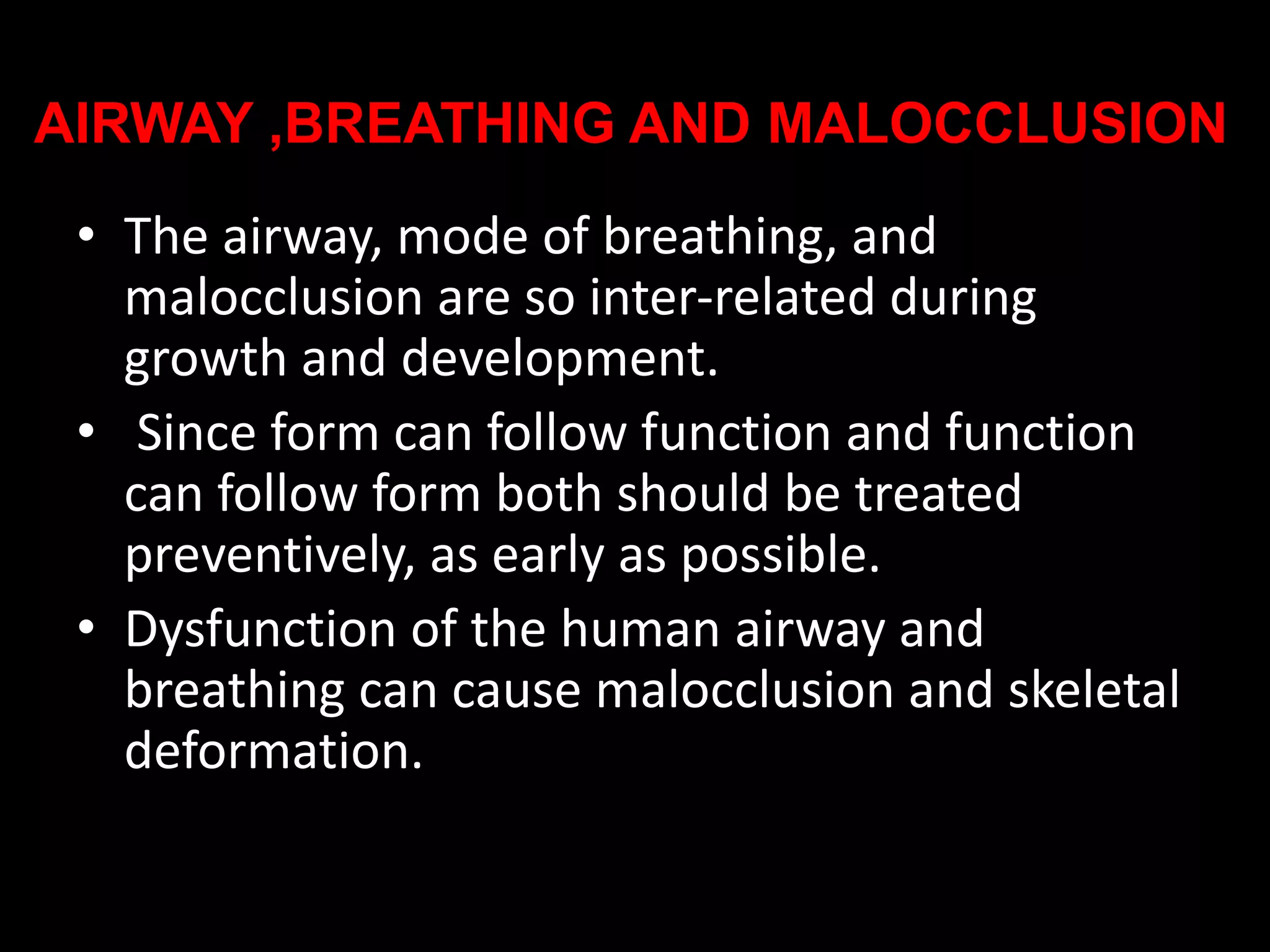
AIRWAY ,BREATHING AND MALOCCLUSION
• The airway, mode of breathing, and
malocclusion are so inter-related during
growth and development.
• Since form can follow function and function
can follow form both should be treated
preventively, as early as possible.
• Dysfunction of the human airway and
breathing can cause malocclusion and skeletal
deformation.
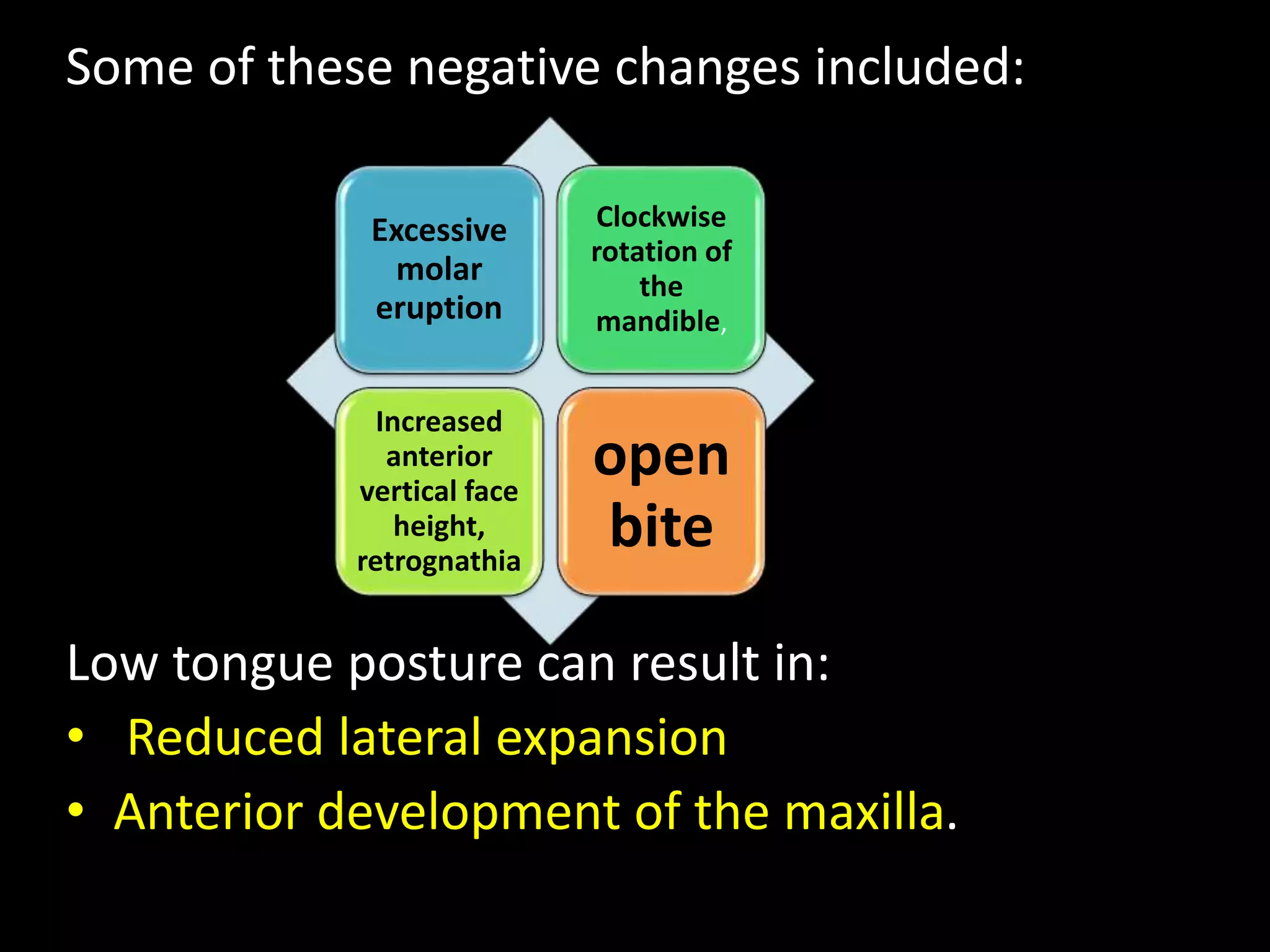
Some of these negative changes included:
Low tongue posture can result in:
• Reduced lateral expansion
• Anterior development of the maxilla.
Excessive
molar
eruption
Clockwise
rotation of
the
mandible,
Increased
anterior
vertical face
height,
retrognathia
open
bite
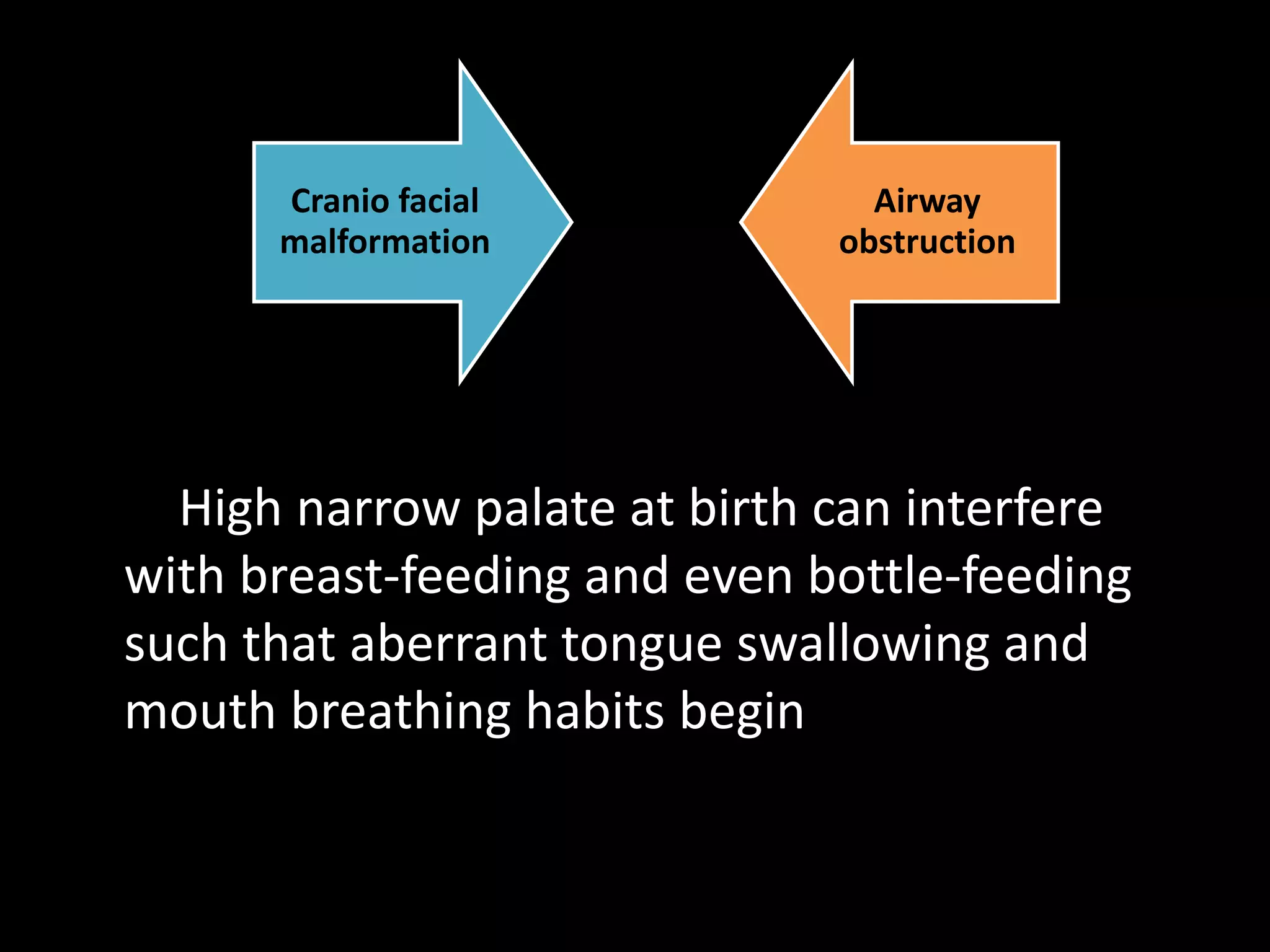
High narrow palate at birth can interfere
with breast-feeding and even bottle-feeding
such that aberrant tongue swallowing and
mouth breathing habits begin
Cranio facial
malformation
Airway
obstruction
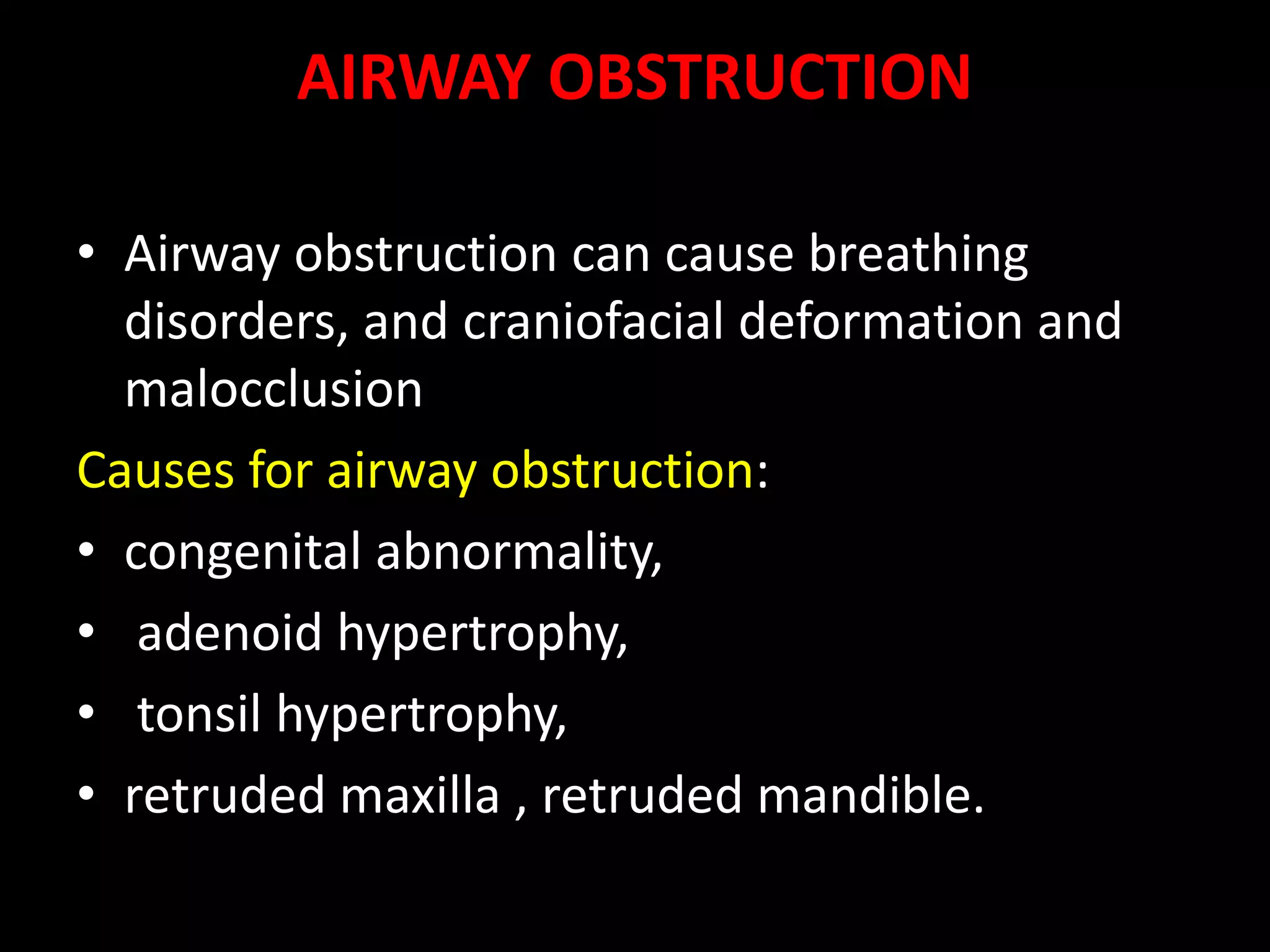
AIRWAY OBSTRUCTION
• Airway obstruction can cause breathing
disorders, and craniofacial deformation and
malocclusion
Causes for airway obstruction:
• congenital abnormality,
• adenoid hypertrophy,
• tonsil hypertrophy,
• retruded maxilla , retruded mandible.
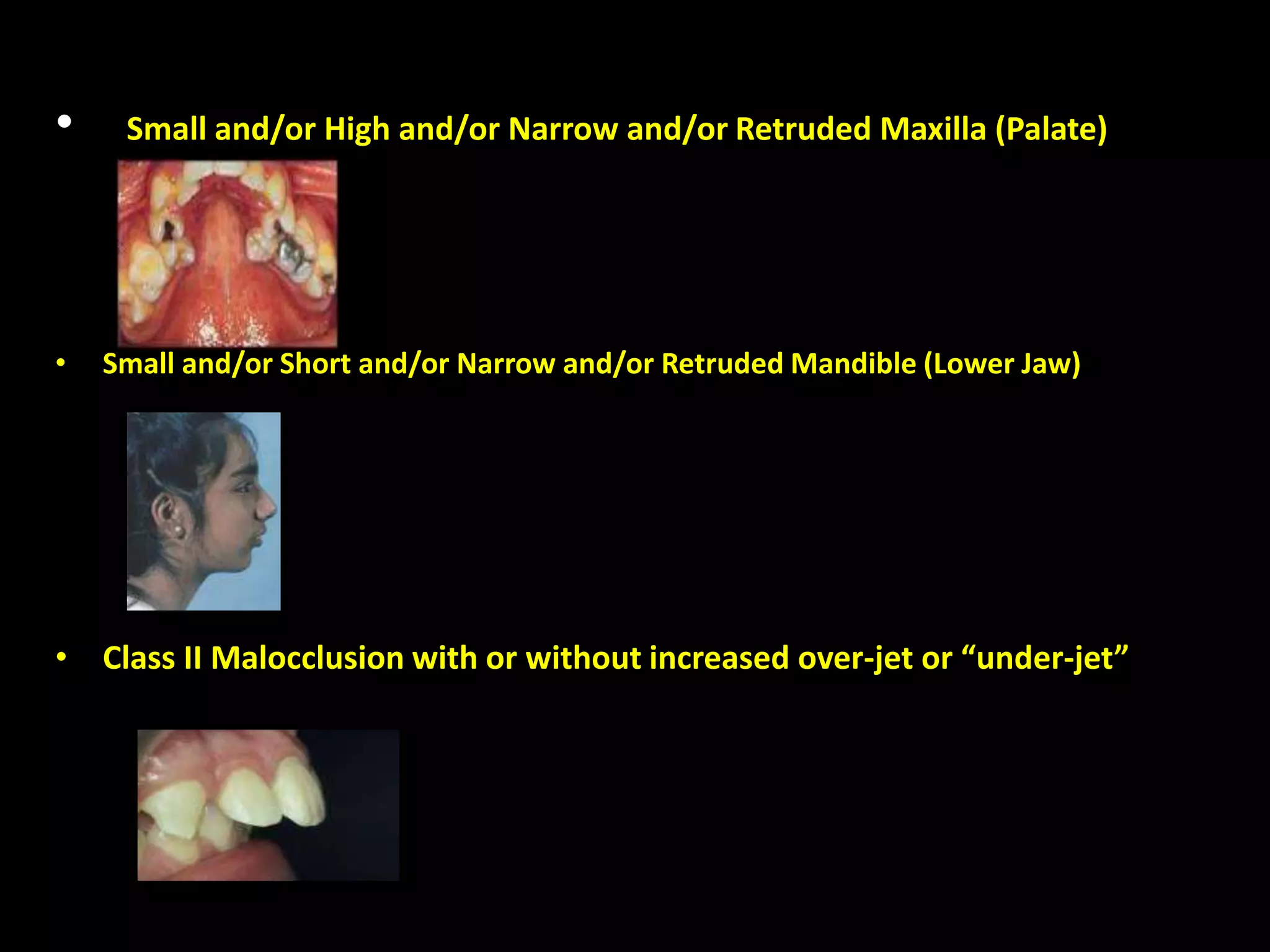
• Small and/or High and/or Narrow and/or Retruded Maxilla (Palate)
• Small and/or Short and/or Narrow and/or Retruded Mandible (Lower Jaw)
• Class II Malocclusion with or without increased over-jet or “under-jet”
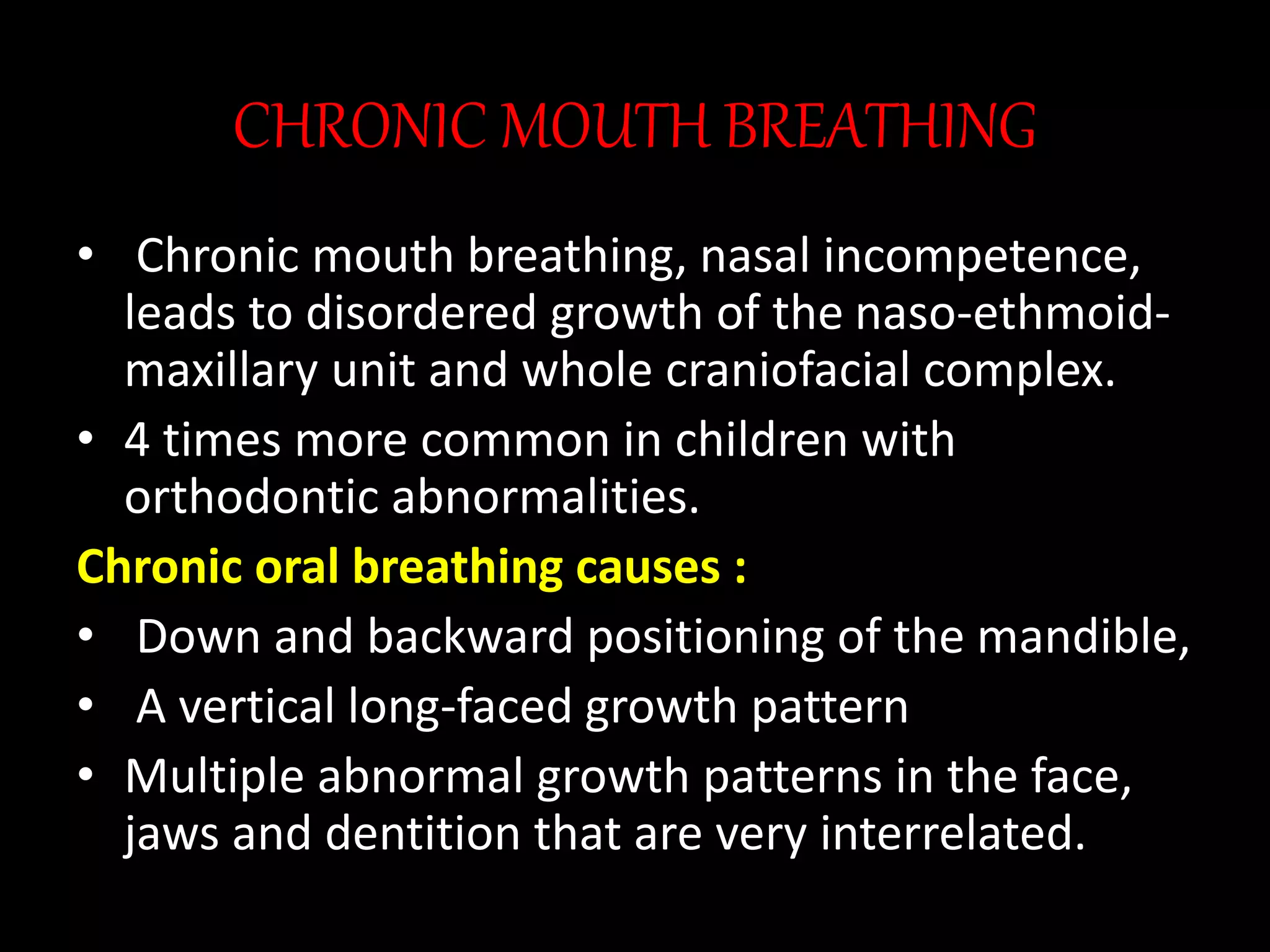
CHRONIC MOUTH BREATHING
• Chronic mouth breathing, nasal incompetence,
leads to disordered growth of the naso-ethmoid-
maxillary unit and whole craniofacial complex.
• 4 times more common in children with
orthodontic abnormalities.
Chronic oral breathing causes :
• Down and backward positioning of the mandible,
• A vertical long-faced growth pattern
• Multiple abnormal growth patterns in the face,
jaws and dentition that are very interrelated.
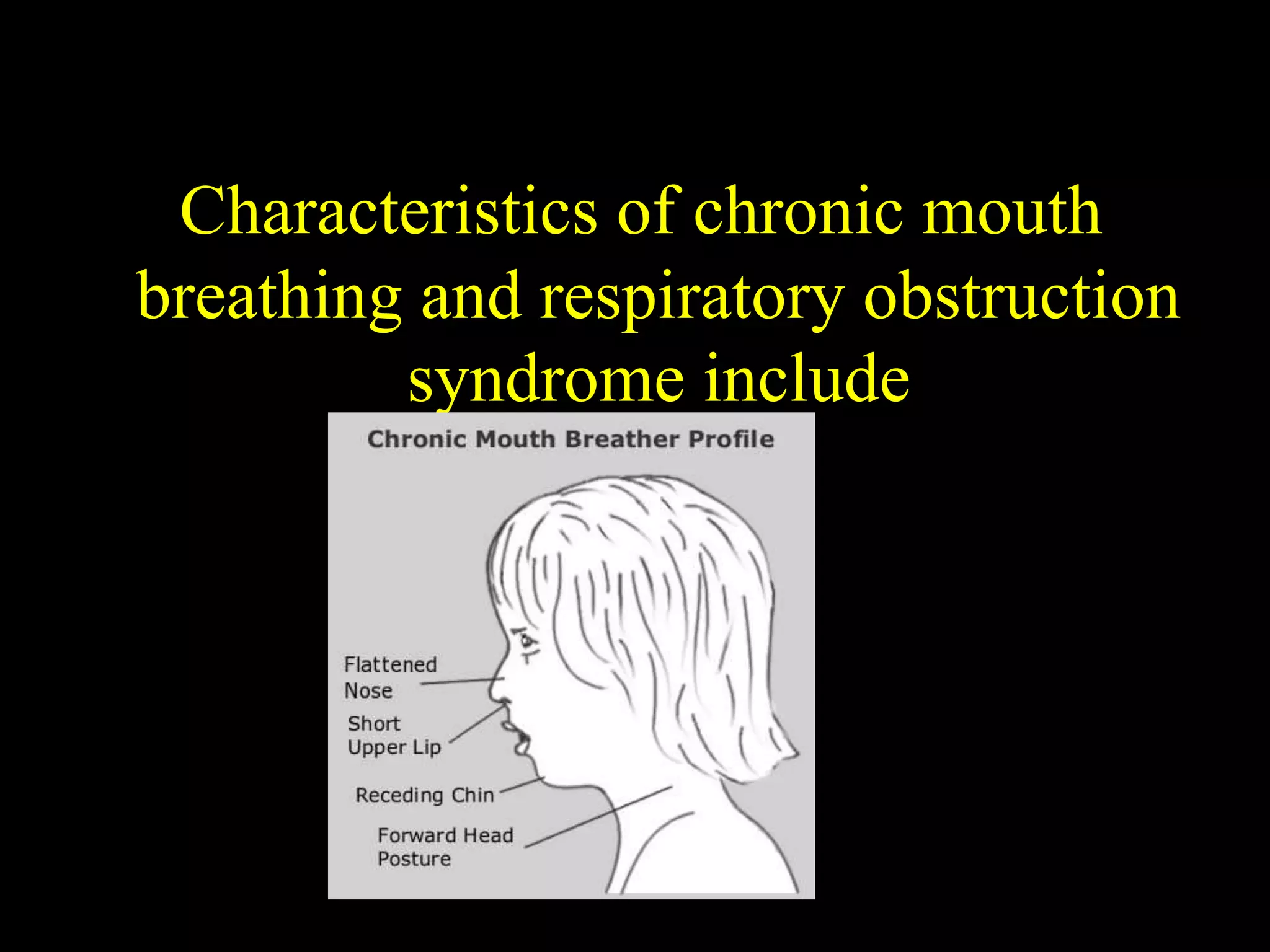
Characteristics of chronic mouth
breathing and respiratory obstruction
syndrome include
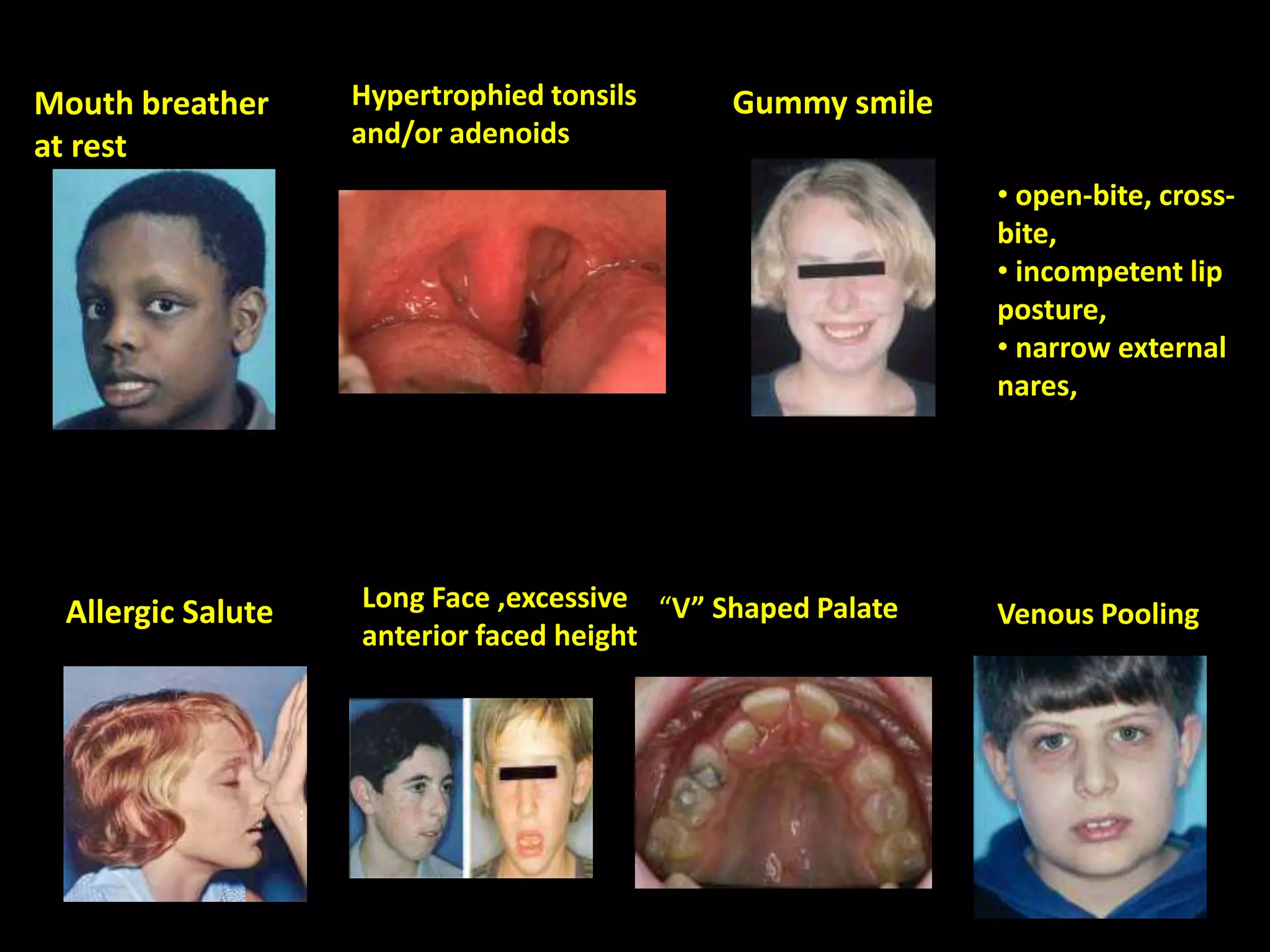
Mouth breather
at rest
:
Gummy smile
Long Face ,excessive
anterior faced height
Hypertrophied tonsils
and/or adenoids
Allergic Salute “V” Shaped Palate Venous Pooling
• open-bite, cross-
bite,
• incompetent lip
posture,
• narrow external
nares,
• Research shows there is a significant
association between nasal resistance and
increased over-jet, open bite, maxillary
crowding, Angle Class II malocclusion and
posterior cross-bite.
• Recognition and prevention of nasal
incompetence in children and its treatment
are needed to ensure proper orthodontic
stability and craniofacial growth
CRANIOFACIAL GROWTH
• Craniofacial growth is eighty to ninety percent
complete by age twelve, so most formation and/
or deformation occurs by that age.
• Unfortunately, age twelve is still the average age
that orthodontic and orthopedic treatment starts
for most children worldwide. This must change.
• The maxilla and mandible are nearly 50% grown
at birth and about 90% grown by age 12.
• 80% of post-birth craniofacial growth occurs
between birth and age 12.
• It is plain to see that earlier treatment, from birth
to age 12, when a majority of post birth growth
potential occurs, can better impact craniofacial
growth and development than after age 12.
• In order to better influence craniofacial growth
and development, disparities must be recognized
and addressed much earlier than at the current
age of twelve.
EARLY DIAGNOSIS
• Early diagnosis is essential to prevent worse
orofacial growth abnormalities.
• Early diagnosis can lead to earlier orthopedic
treatment, which can be more effective, simpler
and less restrictive than later age care.
• Routine early examination and diagnosis should
begin at birth or soon after birth.
• All infants should be screened for craniofacial
deformities that affect airway form and function.
• Breast-feeding - promotes good nasal breathing
• Bottle-fed infants : mouth breathing, tongue
thrusting and palatal arch deformation.
• At the age of 2 and 3 : dental signs of nasal
obstruction and mouth breathing : open bite,
posterior cross-bite and excessive over-jet.
• From ages three to twelve, early airway
obstruction and craniofacial deformations too
often magnify themselves to such an extent that
time inversely relates to the ease and options for
correction.
• cephalometric analysis
EARLY TREATMENT
• Early treatment is essential to normalizing
growth and development.
• Early treatment maximizes the success of
corrective orthodontics and orthopedics .
• Dentists and otolaryngologists provide unique
treatments that can reduce airway obstruction
and craniofacial deformity.
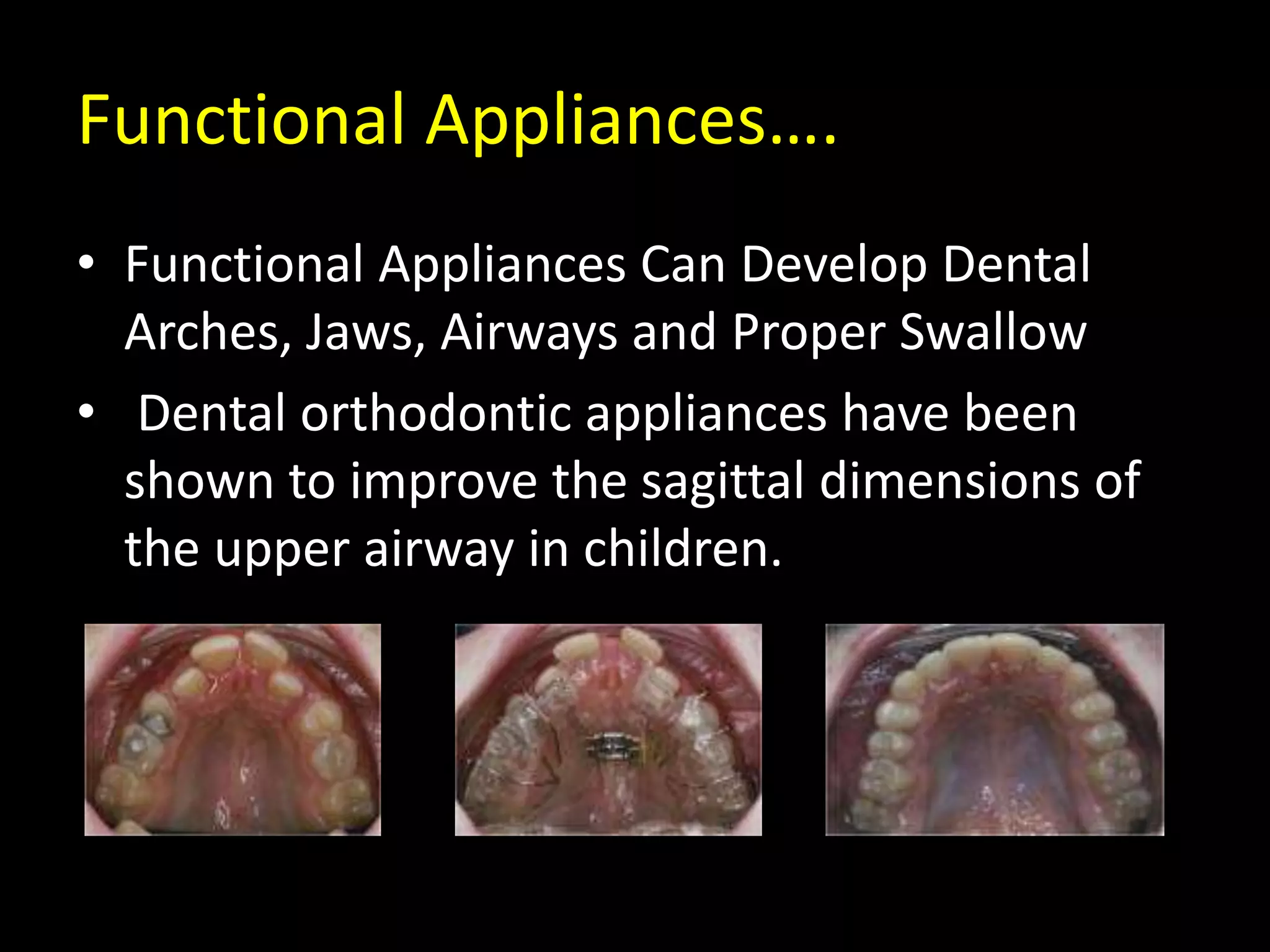
Functional Appliances….
• Functional Appliances Can Develop Dental
Arches, Jaws, Airways and Proper Swallow
• Dental orthodontic appliances have been
shown to improve the sagittal dimensions of
the upper airway in children.
DENTAL RAPID MAXILLARY EXPANSION
• Simple, conservative method of treating
impaired nasal respiration in patients 4 years
to 30 years
• But the younger the patient the better the
long term results.
• It is an effective method for increasing the
width of narrow maxillary arches and it also
reduces nasal resistance from levels seen with
mouth breathing to levels consistent with
normal nasal respiration.
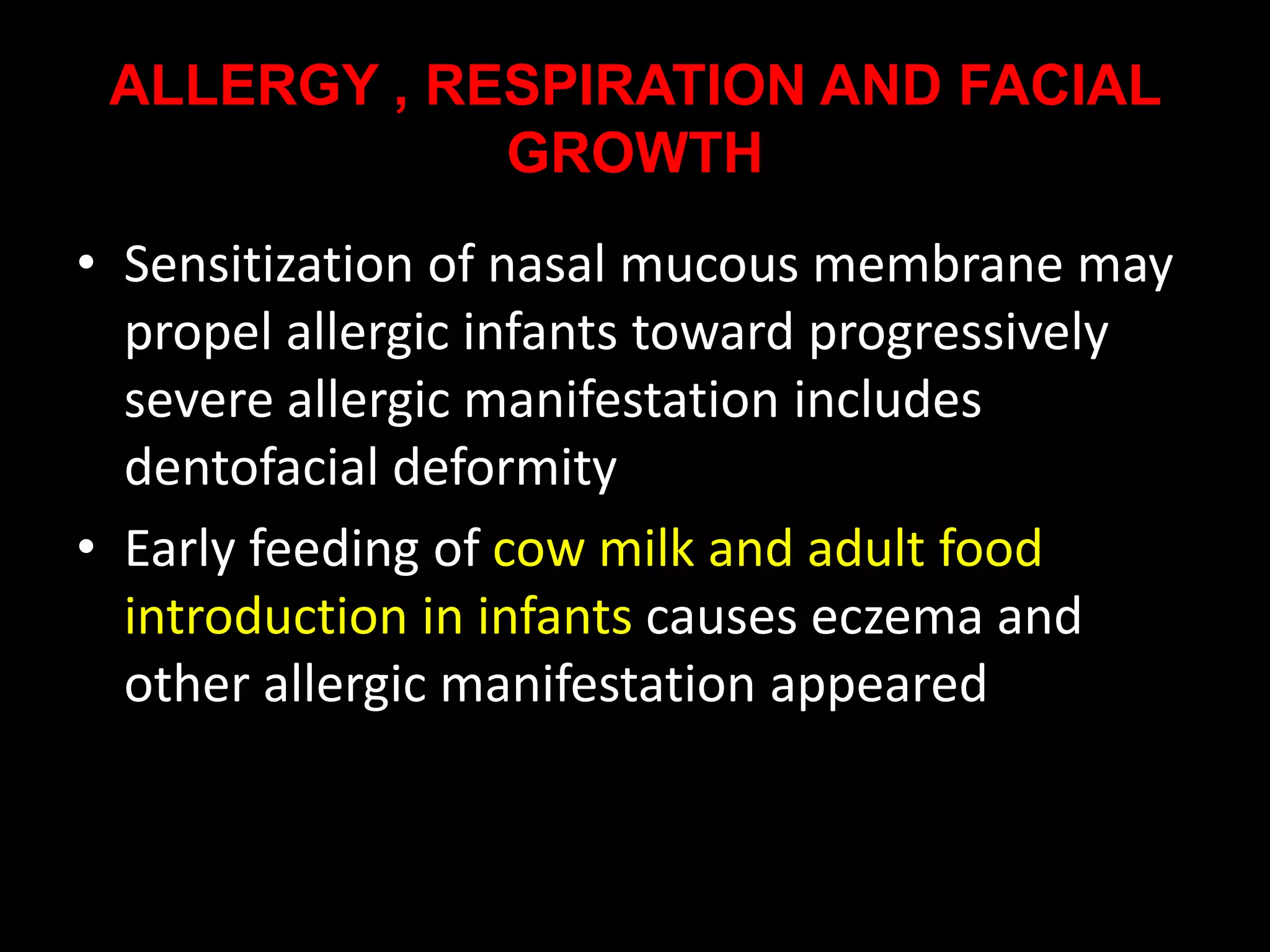
ALLERGY , RESPIRATION AND FACIAL
GROWTH
• Sensitization of nasal mucous membrane may
propel allergic infants toward progressively
severe allergic manifestation includes
dentofacial deformity
• Early feeding of cow milk and adult food
introduction in infants causes eczema and
other allergic manifestation appeared
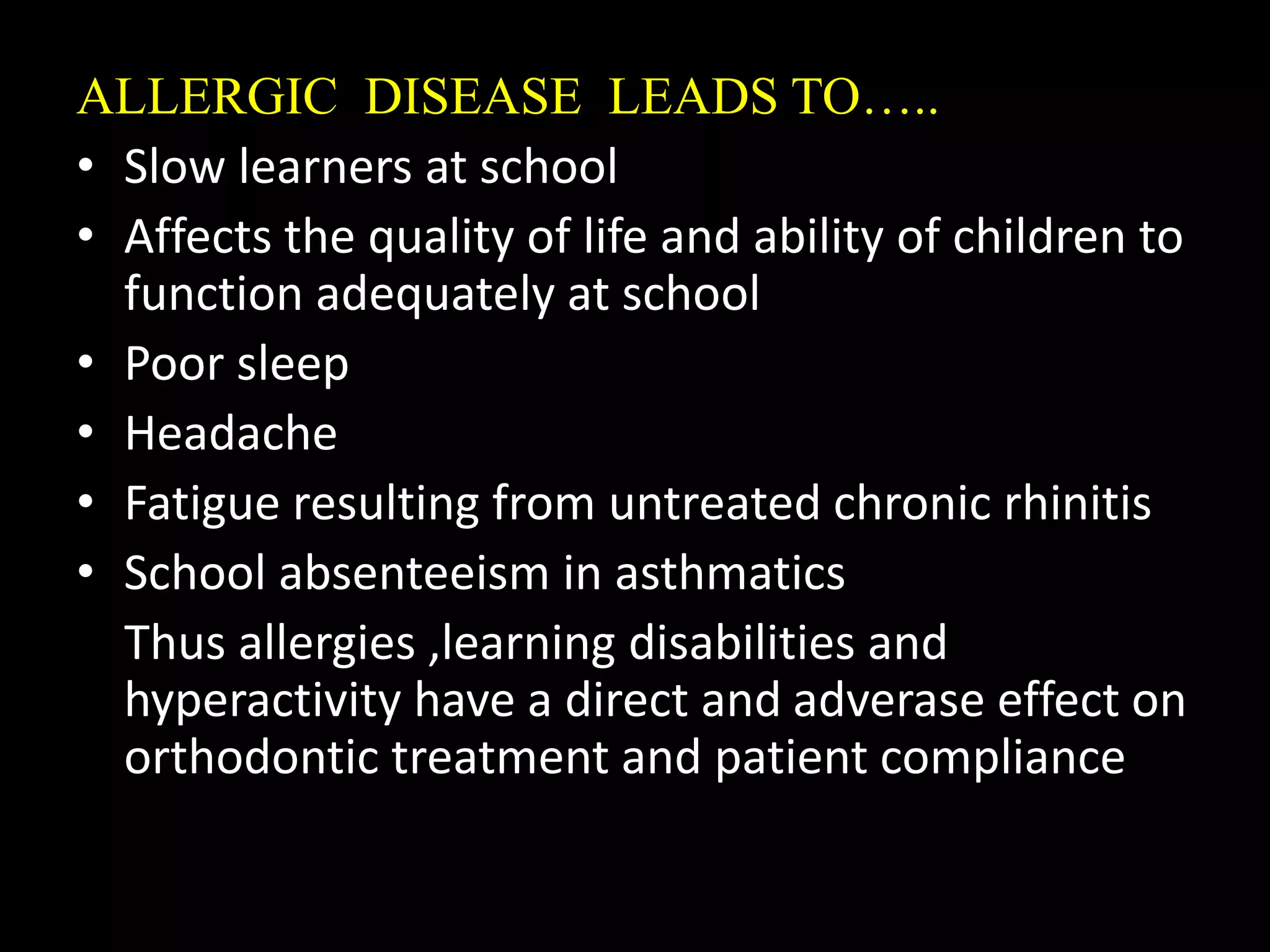
ALLERGIC DISEASE LEADS TO…..
• Slow learners at school
• Affects the quality of life and ability of children to
function adequately at school
• Poor sleep
• Headache
• Fatigue resulting from untreated chronic rhinitis
• School absenteeism in asthmatics
Thus allergies ,learning disabilities and
hyperactivity have a direct and adverase effect on
orthodontic treatment and patient compliance
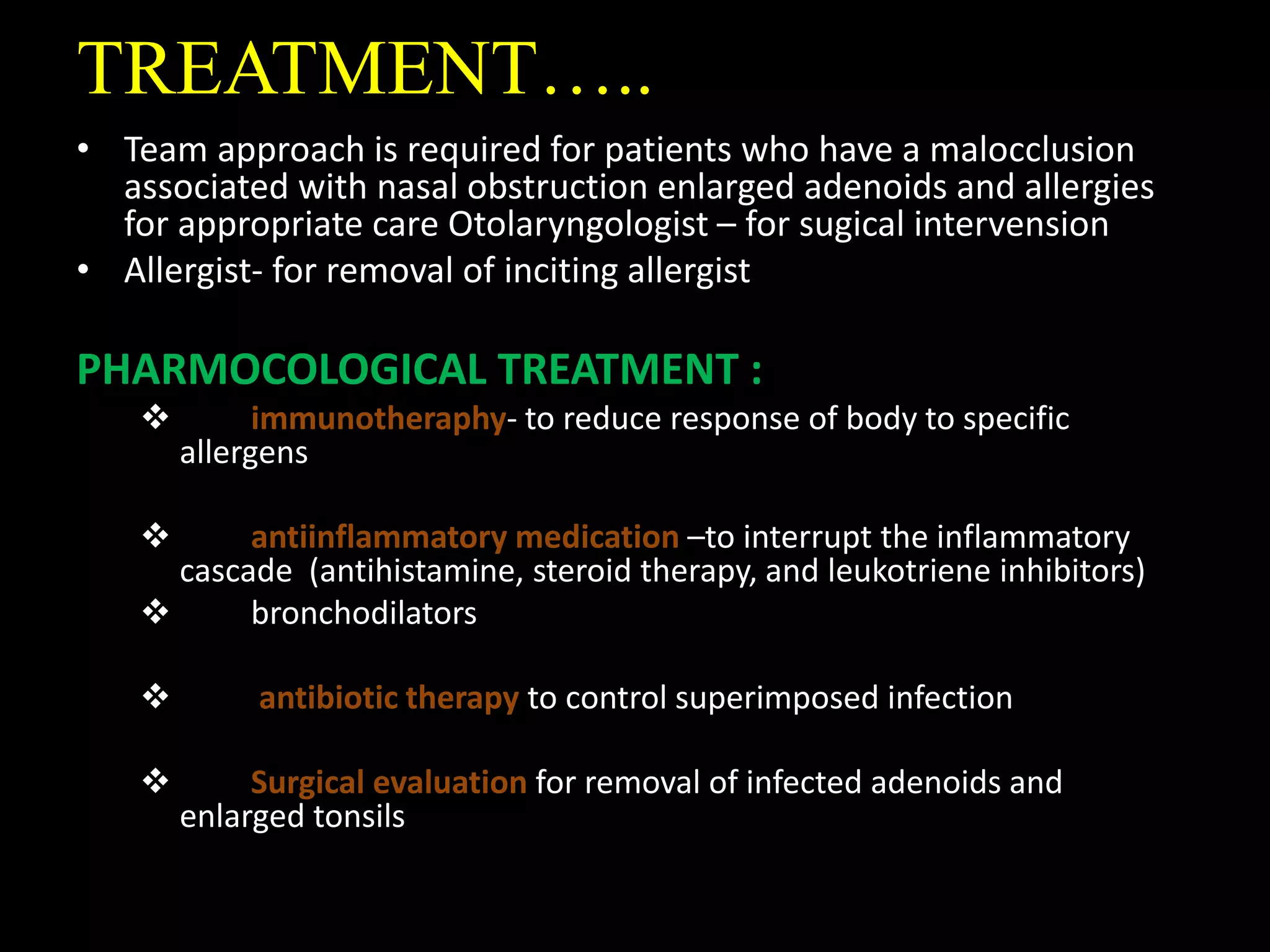
TREATMENT…..
• Team approach is required for patients who have a malocclusion
associated with nasal obstruction enlarged adenoids and allergies
for appropriate care Otolaryngologist – for sugical intervension
• Allergist- for removal of inciting allergist
PHARMOCOLOGICAL TREATMENT :
 immunotheraphy- to reduce response of body to specific
allergens
 antiinflammatory medication –to interrupt the inflammatory
cascade (antihistamine, steroid therapy, and leukotriene inhibitors)
 bronchodilators
 antibiotic therapy to control superimposed infection
 Surgical evaluation for removal of infected adenoids and
enlarged tonsils
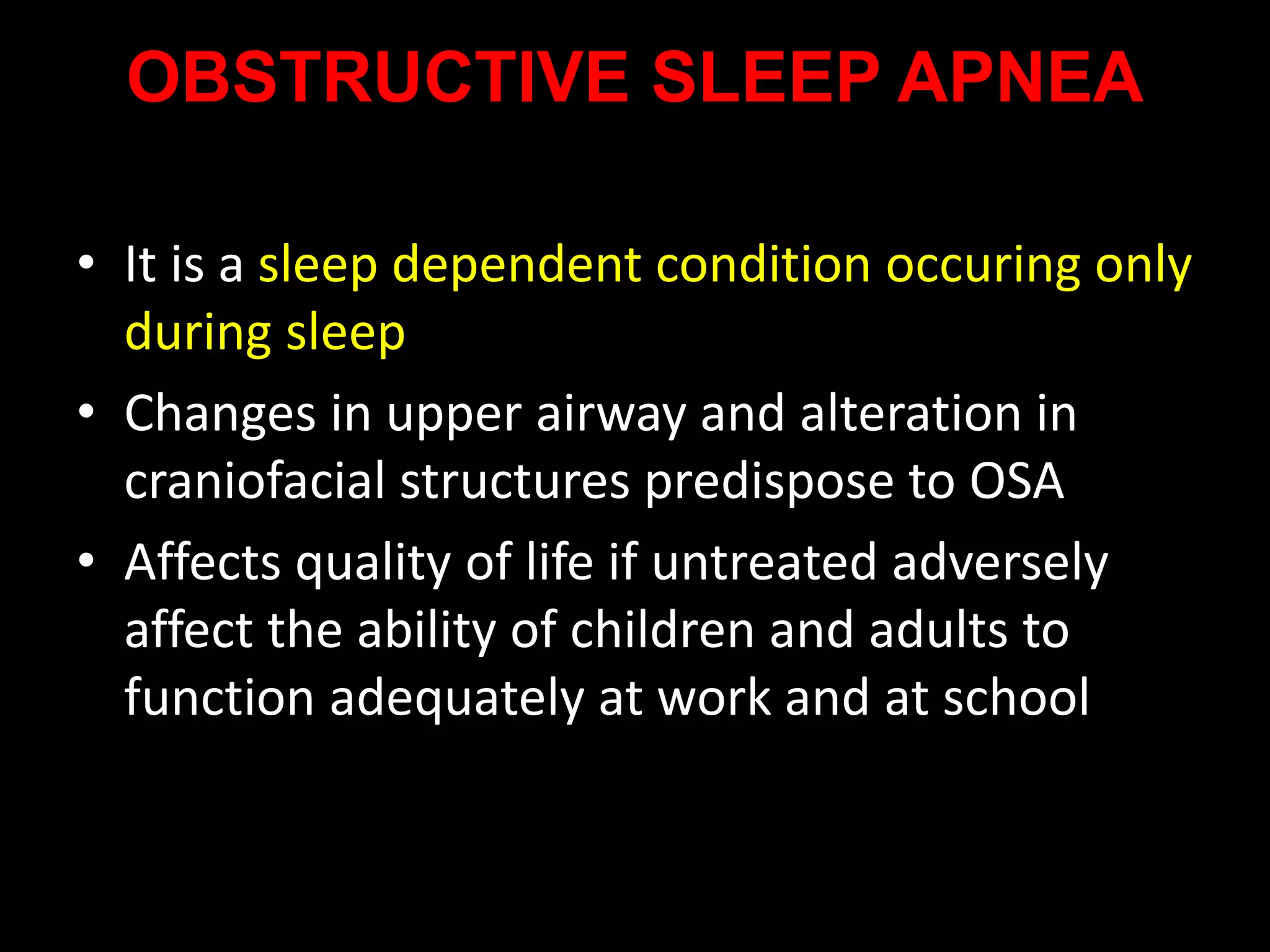
OBSTRUCTIVE SLEEP APNEA
• It is a sleep dependent condition occuring only
during sleep
• Changes in upper airway and alteration in
craniofacial structures predispose to OSA
• Affects quality of life if untreated adversely
affect the ability of children and adults to
function adequately at work and at school
OSA patients presents with……
• Obesity – increases the size of soft tissue in
upper airway which decrease the functional
size of upper airway predispose to sleep
apnea
• Abnormal upper airway anatomy
 retrognathia
 Tonsillar hypertrophy
 Macroglossia
 Enlargement of peritonsillar folds
 Enlargeementt or elongation of soft palate
TREATMENT OPTIONS……….
• Enlarging the upper airway
• Continous positive airway pressure
• Weight loss
• Oral appliances
• Upper airway surgery
Oral appliances in osa
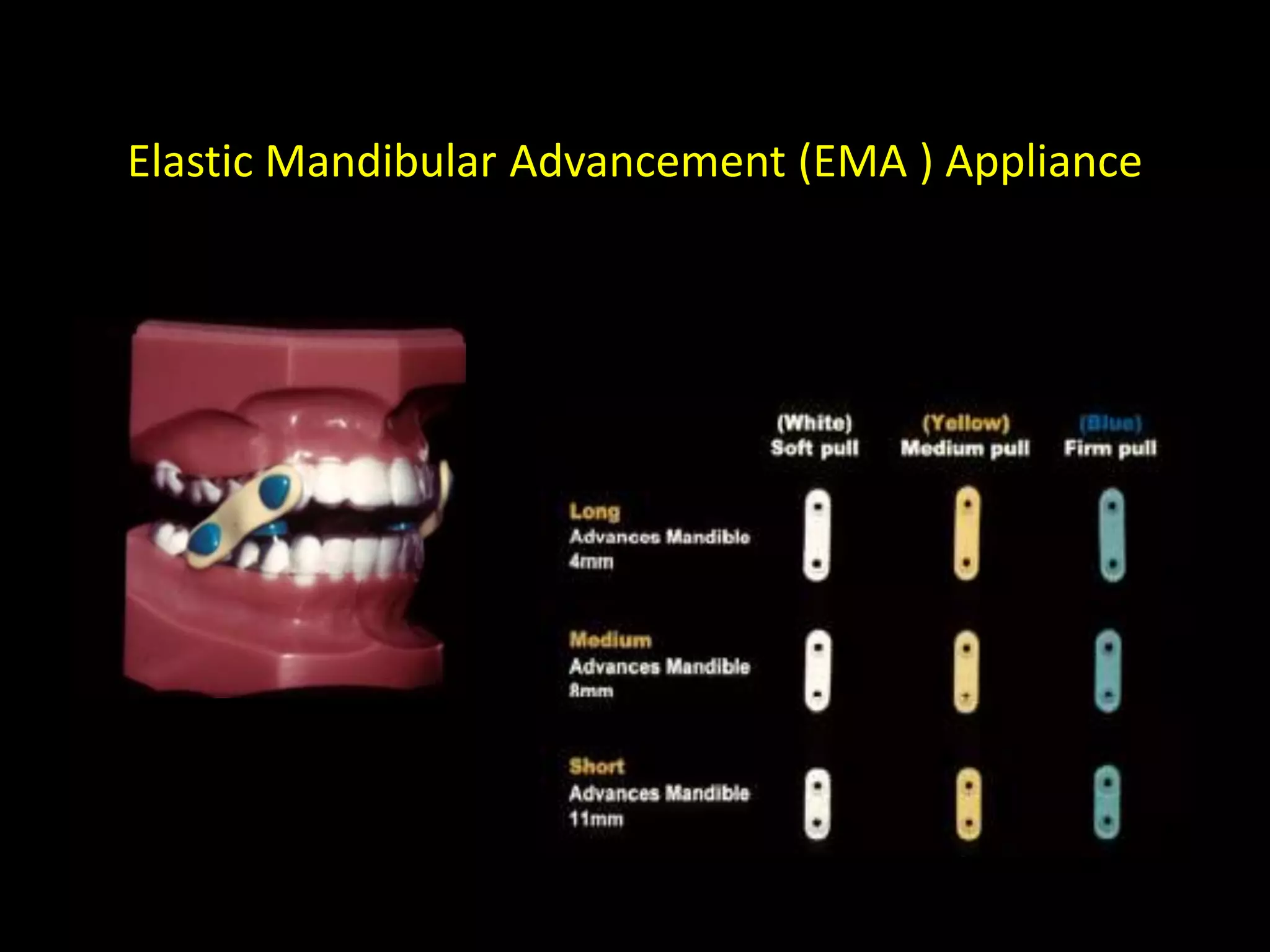
Mandibular advancement devices
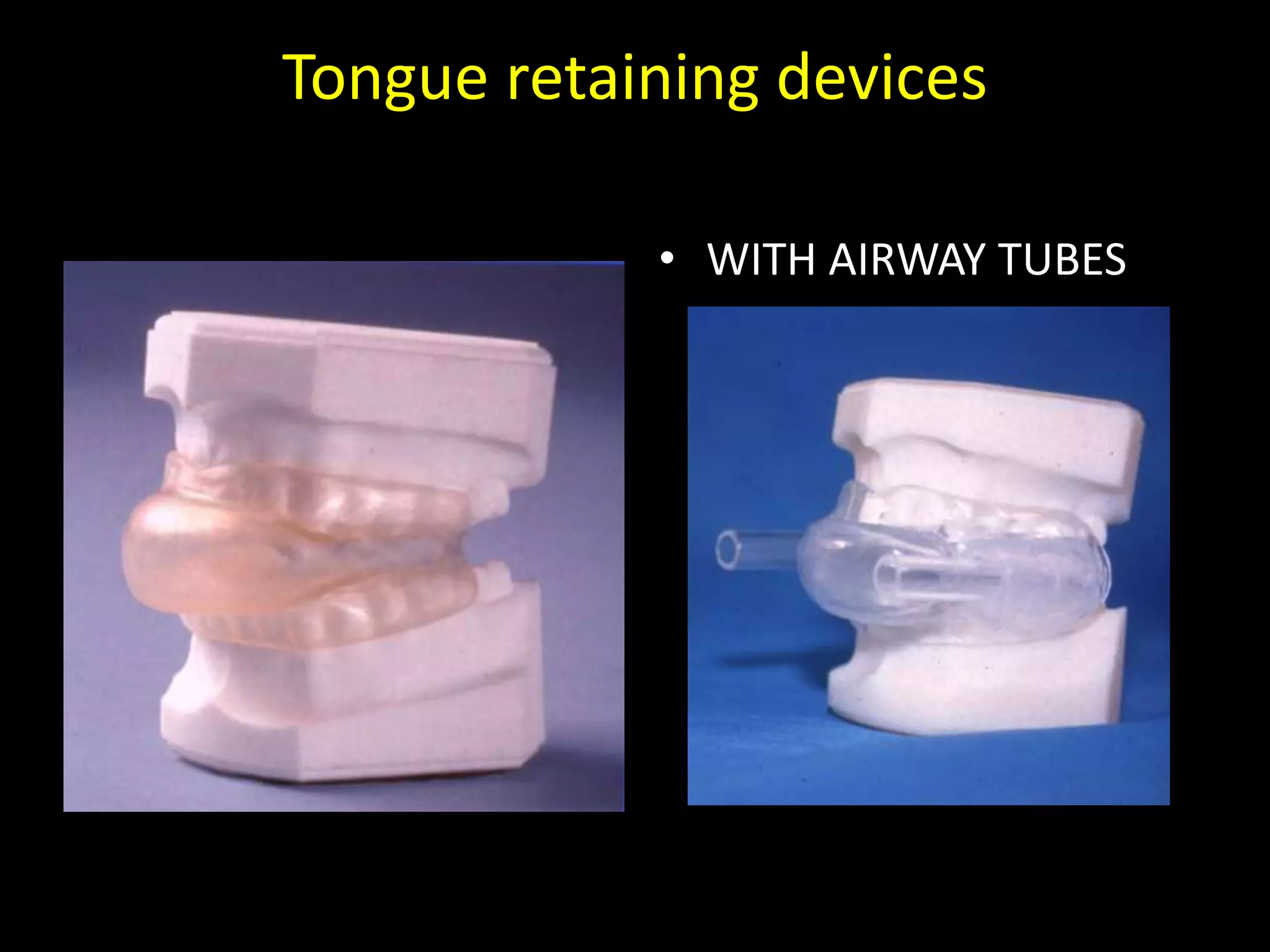
Tongue retaining devices
Combination CPAP/ dental sleep device
therapy
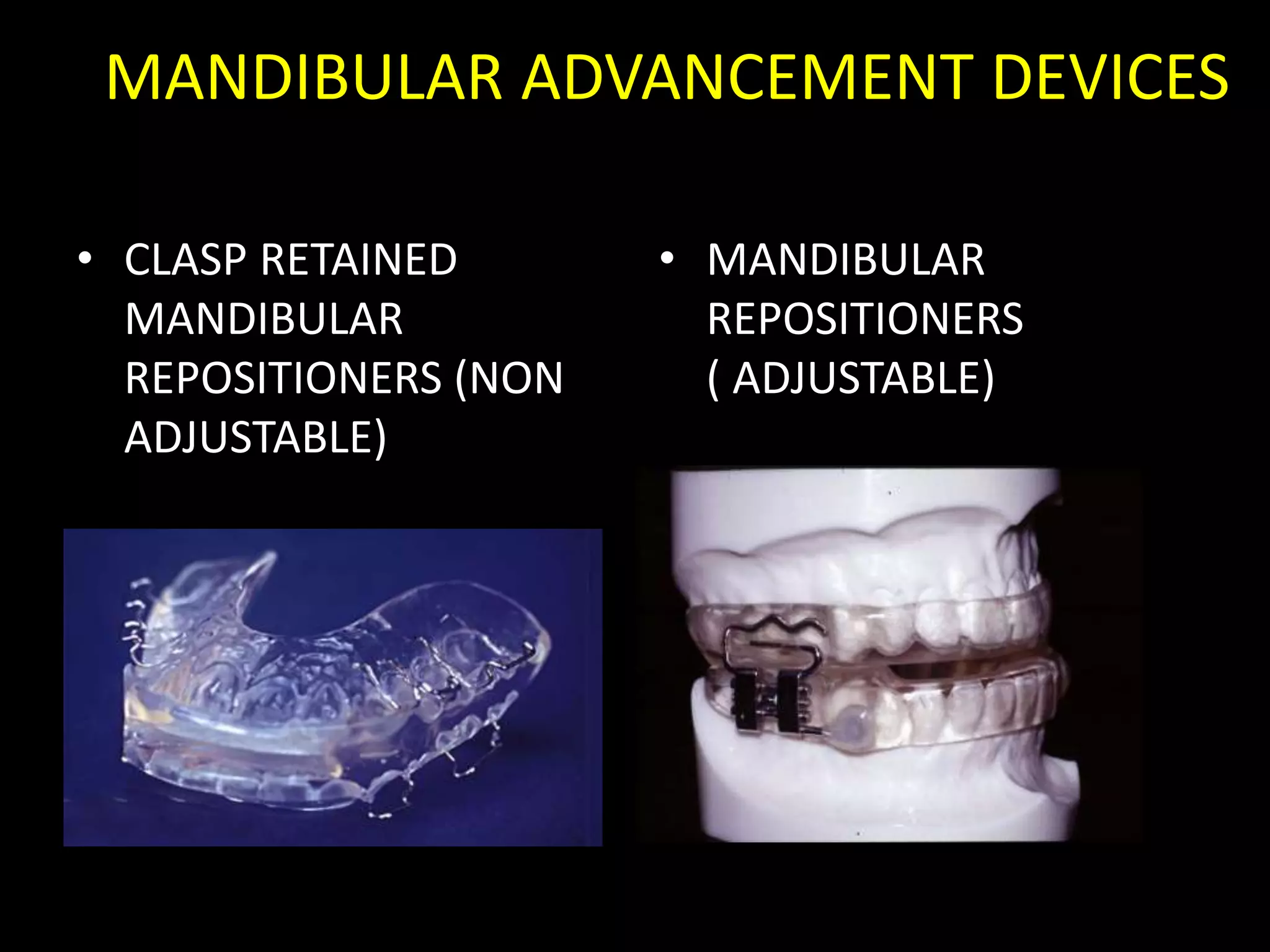
MANDIBULAR ADVANCEMENT DEVICES
• CLASP RETAINED
MANDIBULAR
REPOSITIONERS (NON
ADJUSTABLE)
• MANDIBULAR
REPOSITIONERS
( ADJUSTABLE)
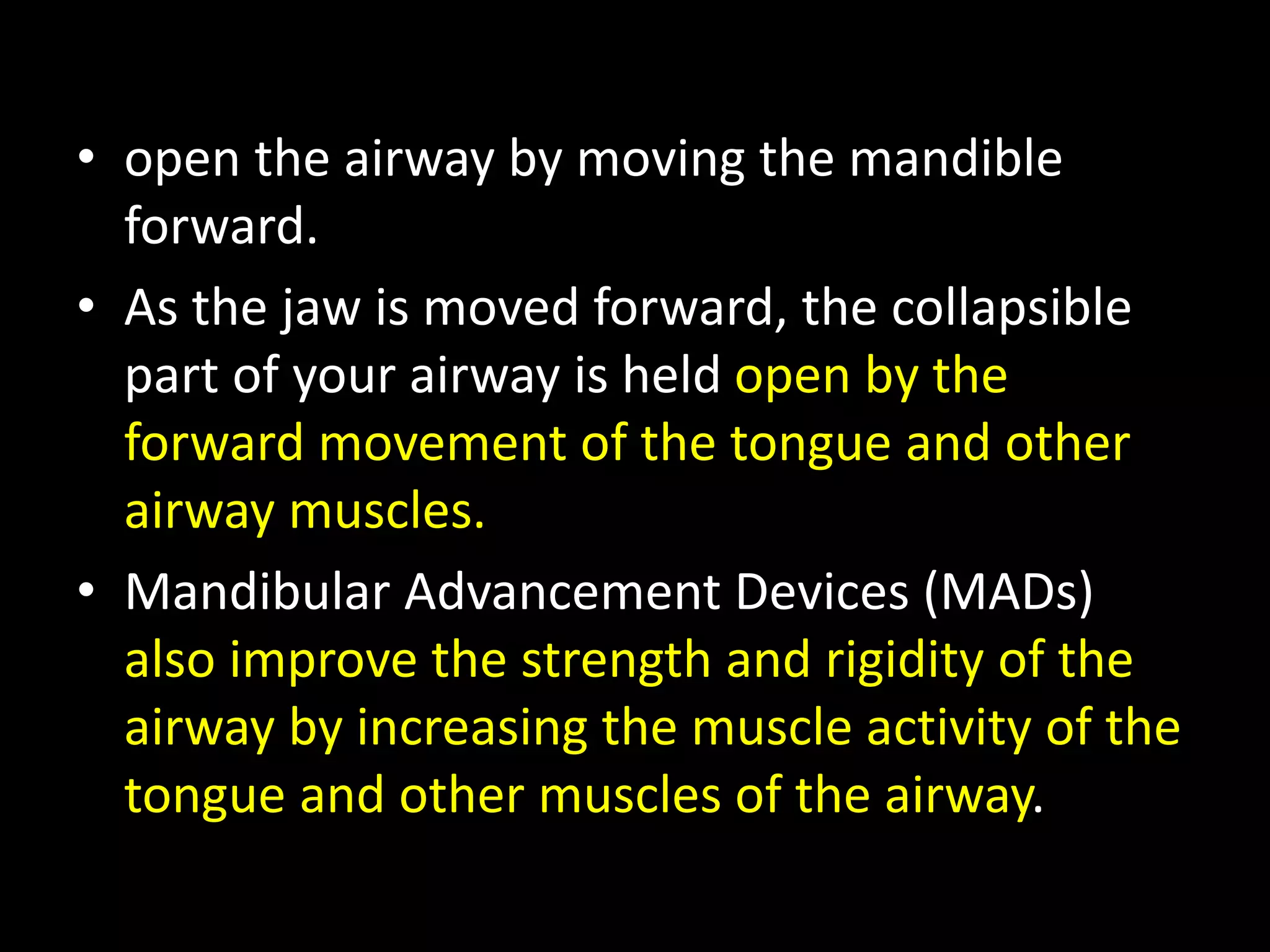
• open the airway by moving the mandible
forward.
• As the jaw is moved forward, the collapsible
part of your airway is held open by the
forward movement of the tongue and other
airway muscles.
• Mandibular Advancement Devices (MADs)
also improve the strength and rigidity of the
airway by increasing the muscle activity of the
tongue and other muscles of the airway.
Elastic Mandibular Advancement (EMA ) Appliance
Tongue retaining devices
• WITH AIRWAY TUBES
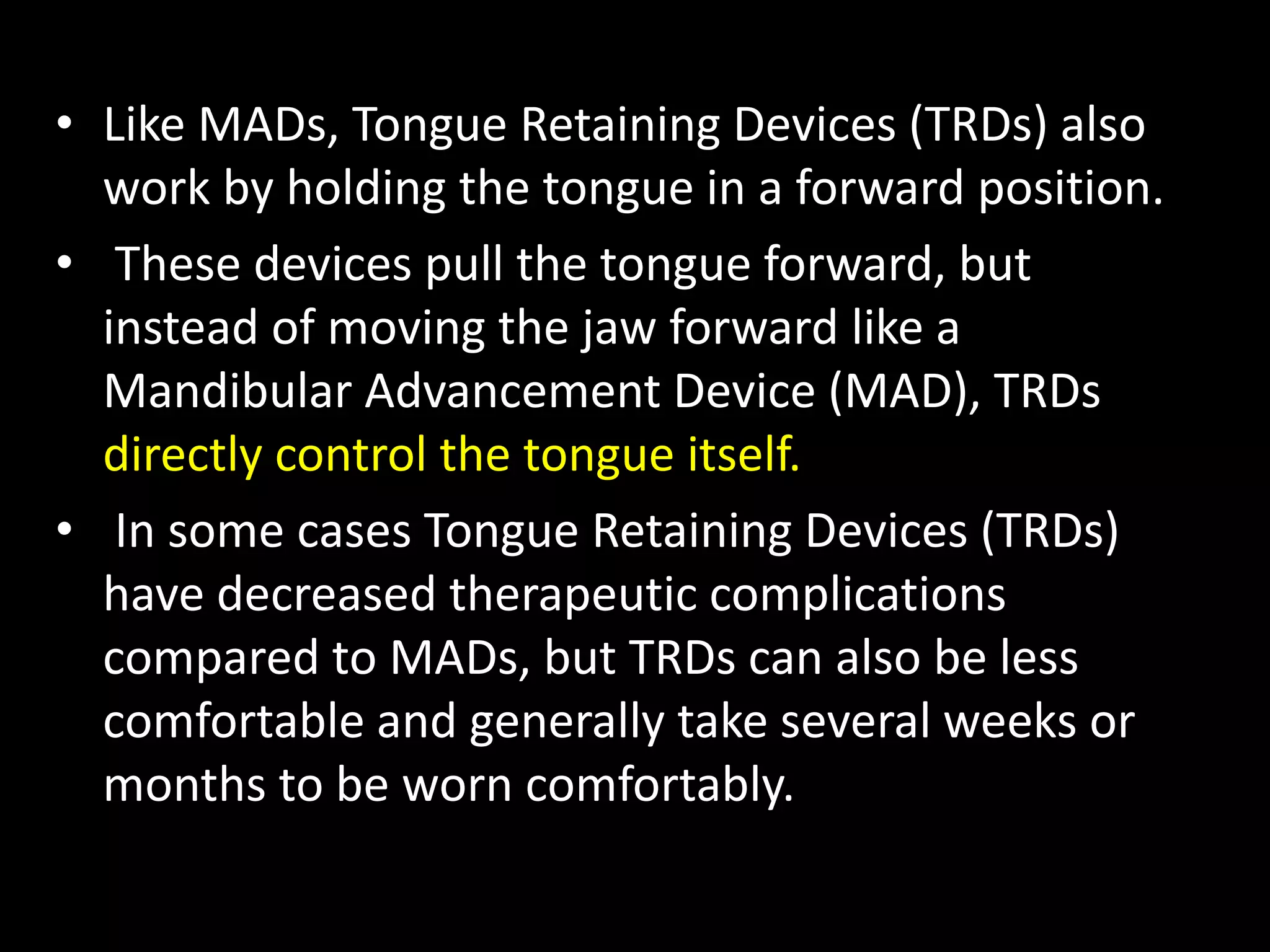
• Like MADs, Tongue Retaining Devices (TRDs) also
work by holding the tongue in a forward position.
• These devices pull the tongue forward, but
instead of moving the jaw forward like a
Mandibular Advancement Device (MAD), TRDs
directly control the tongue itself.
• In some cases Tongue Retaining Devices (TRDs)
have decreased therapeutic complications
compared to MADs, but TRDs can also be less
comfortable and generally take several weeks or
months to be worn comfortably.
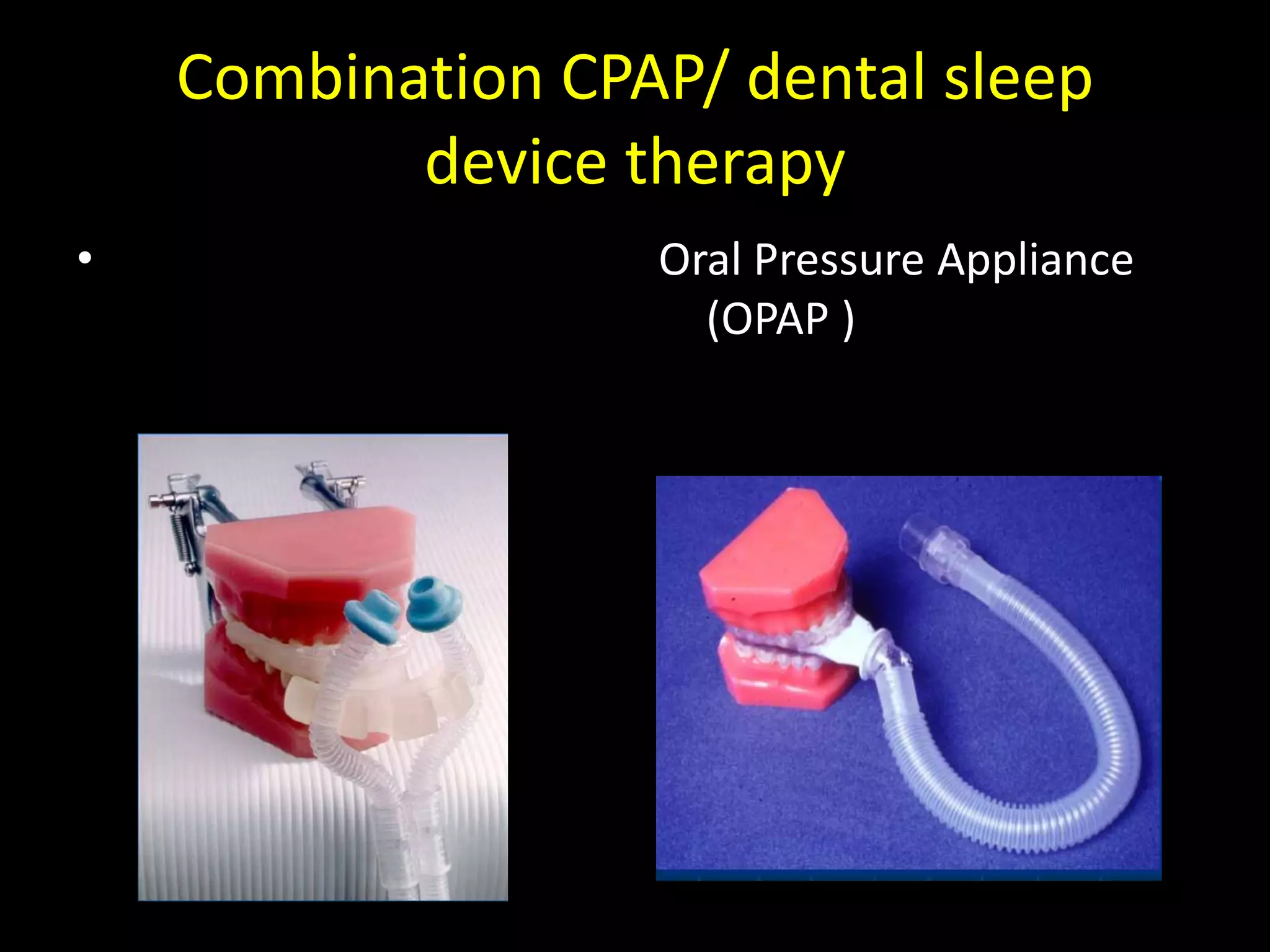
Combination CPAP/ dental sleep
device therapy
• Oral Pressure Appliance
(OPAP )
• problems associated with Continuous Positive
Airway Pressure (CPAP) therapy are due to
high pressures and uncomfortable fit of the
nose or face mask.
• This custom- made dental sleep device or oral
appliance will attach directly to your CPAP
machine.
• When CPAP is combined with jaw
advancement from a mandibular
advancement device, the CPAP can often be
used at a much lower pressure setting.
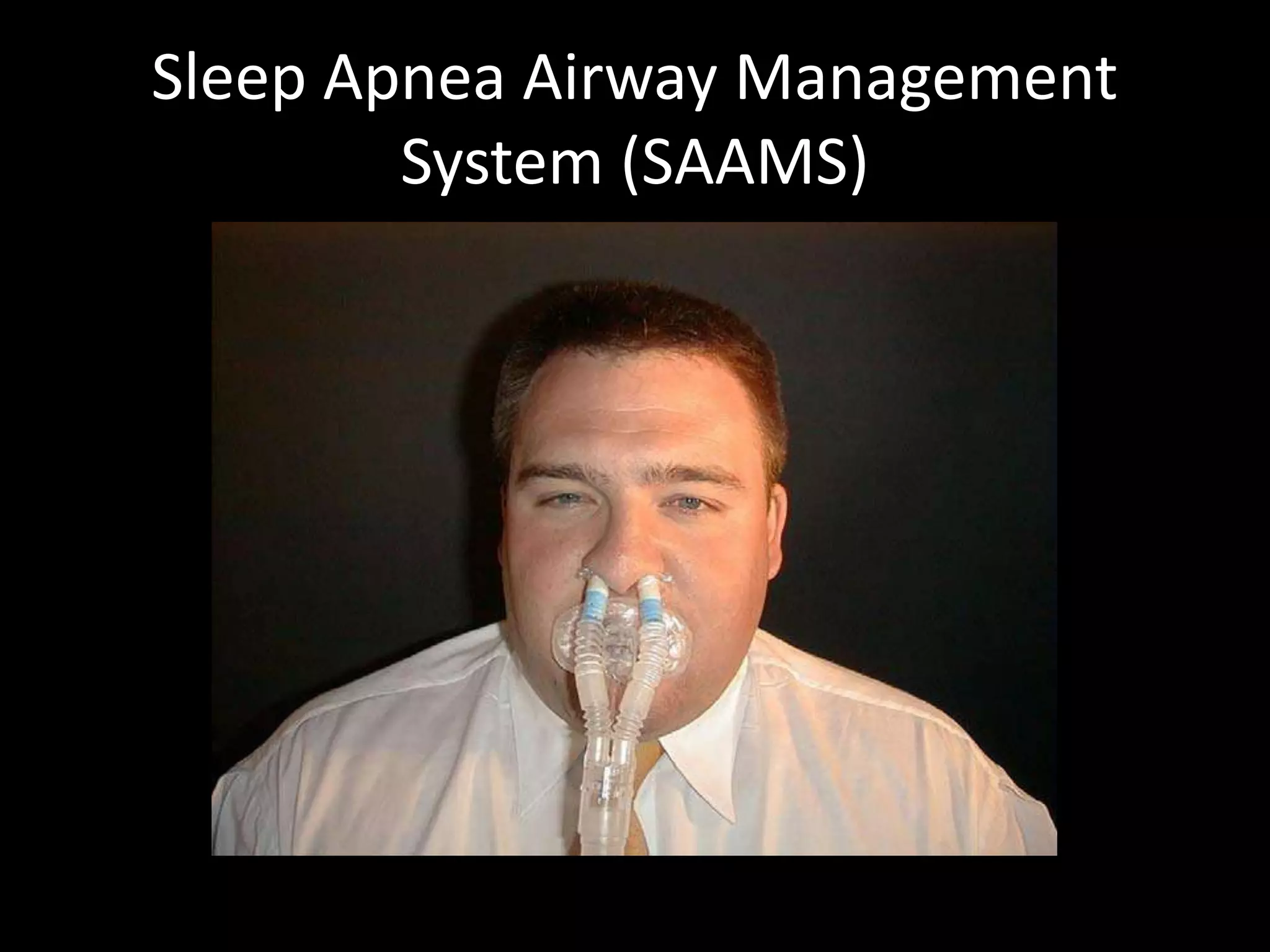
Sleep Apnea Airway Management
System (SAAMS)
SURGERY AND UPPER
AIRWAY
• Adenoidectomy with or without tonsillectomy
DENTISTS AND OTOLARYNGOLOGISTS
• Decades ago, otolaryngologists suggested they should
work together with dentists to benefit patients
(Crawford-1937, Fowler-1947).
• More recently, it was again suggested that better
communication and interchange of ideas between the
various medical and dental practitioners caring for
children with “Stuffy Noses, Long Faces and Dental
Malocclusion” would benefit children.
• It is time for dental doctors and medical doctors to
work together more in the areas of airway, breathing
and orthodontics.
CEPHALOMETRICS OF UPPER AIRWAY
• Linder –aronson and henrikson –determine
definite anteropharyngeal airway in children
from 6-12 years of age
• They measured-
-length of posterior cranial base (ba to s)
-depth of nasopharynx (ba to pns)
-the size of airway
• Determination of the size of the airway-
measuring the distance between the adenoid
and posterior nasal spine
LIMITATION….
• Defining landmarks
• Two dimensionel picture of three dimensional
structure
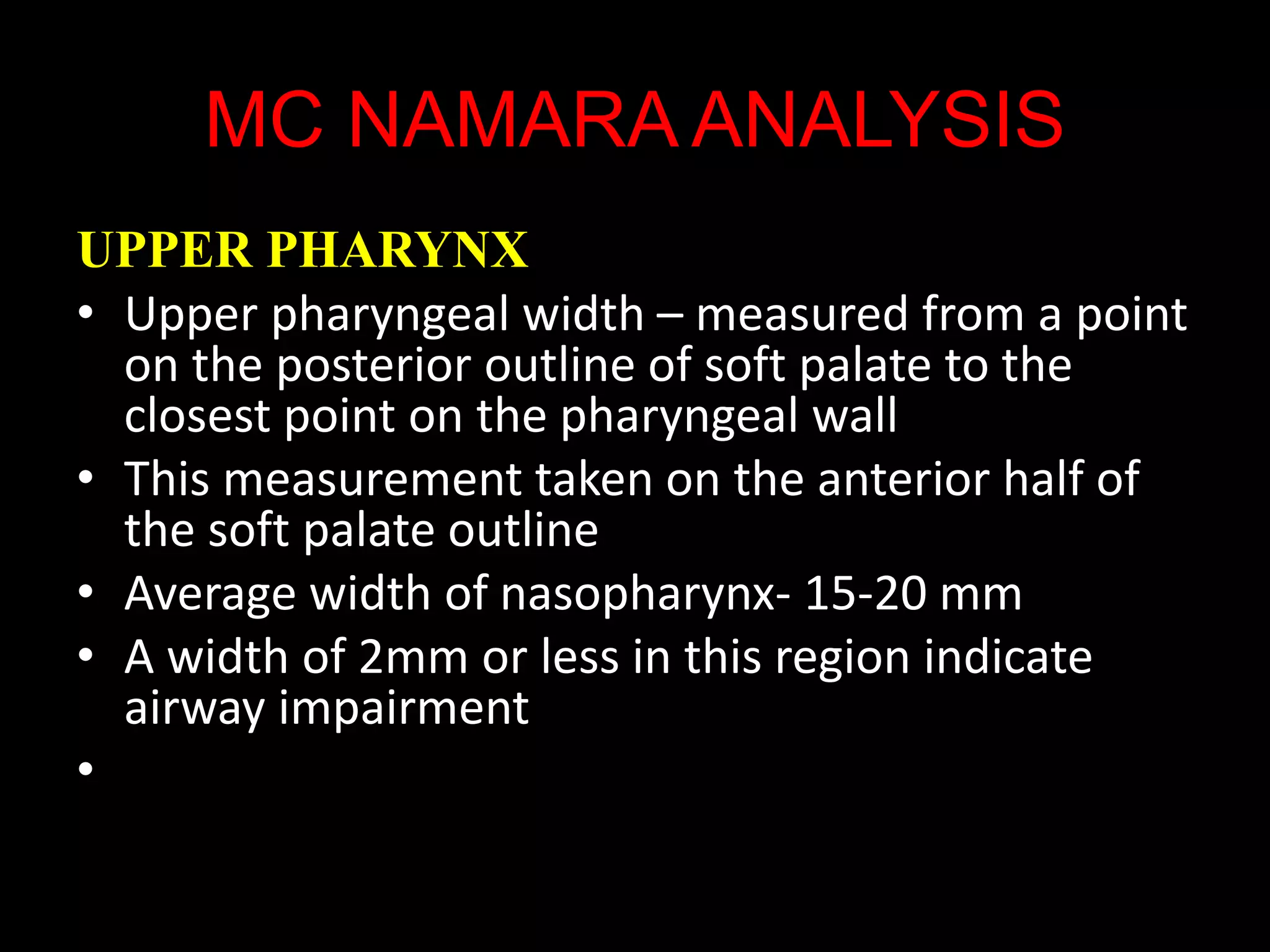
MC NAMARA ANALYSIS
UPPER PHARYNX
• Upper pharyngeal width – measured from a point
on the posterior outline of soft palate to the
closest point on the pharyngeal wall
• This measurement taken on the anterior half of
the soft palate outline
• Average width of nasopharynx- 15-20 mm
• A width of 2mm or less in this region indicate
airway impairment
•
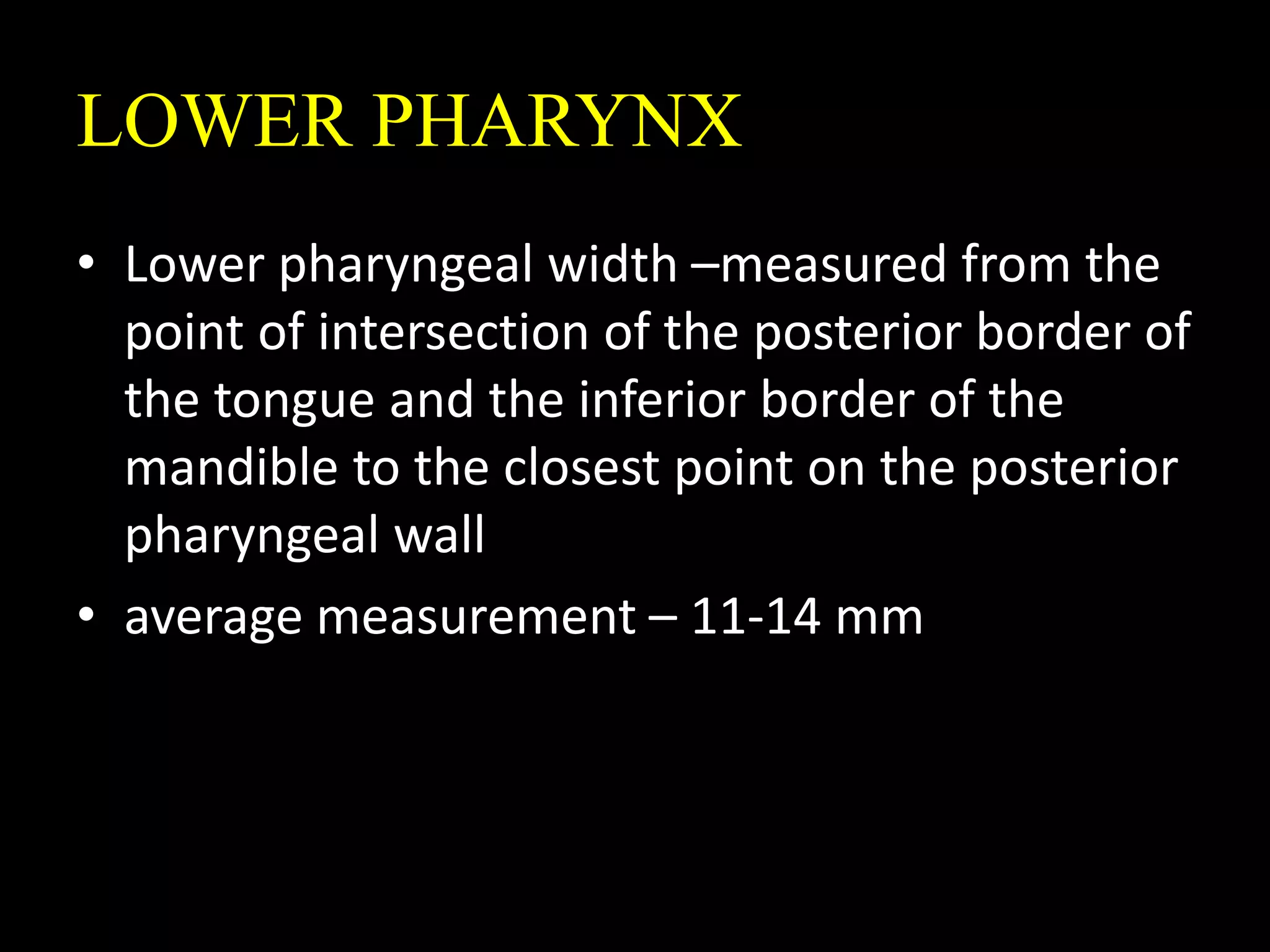
LOWER PHARYNX
• Lower pharyngeal width –measured from the
point of intersection of the posterior border of
the tongue and the inferior border of the
mandible to the closest point on the posterior
pharyngeal wall
• average measurement – 11-14 mm
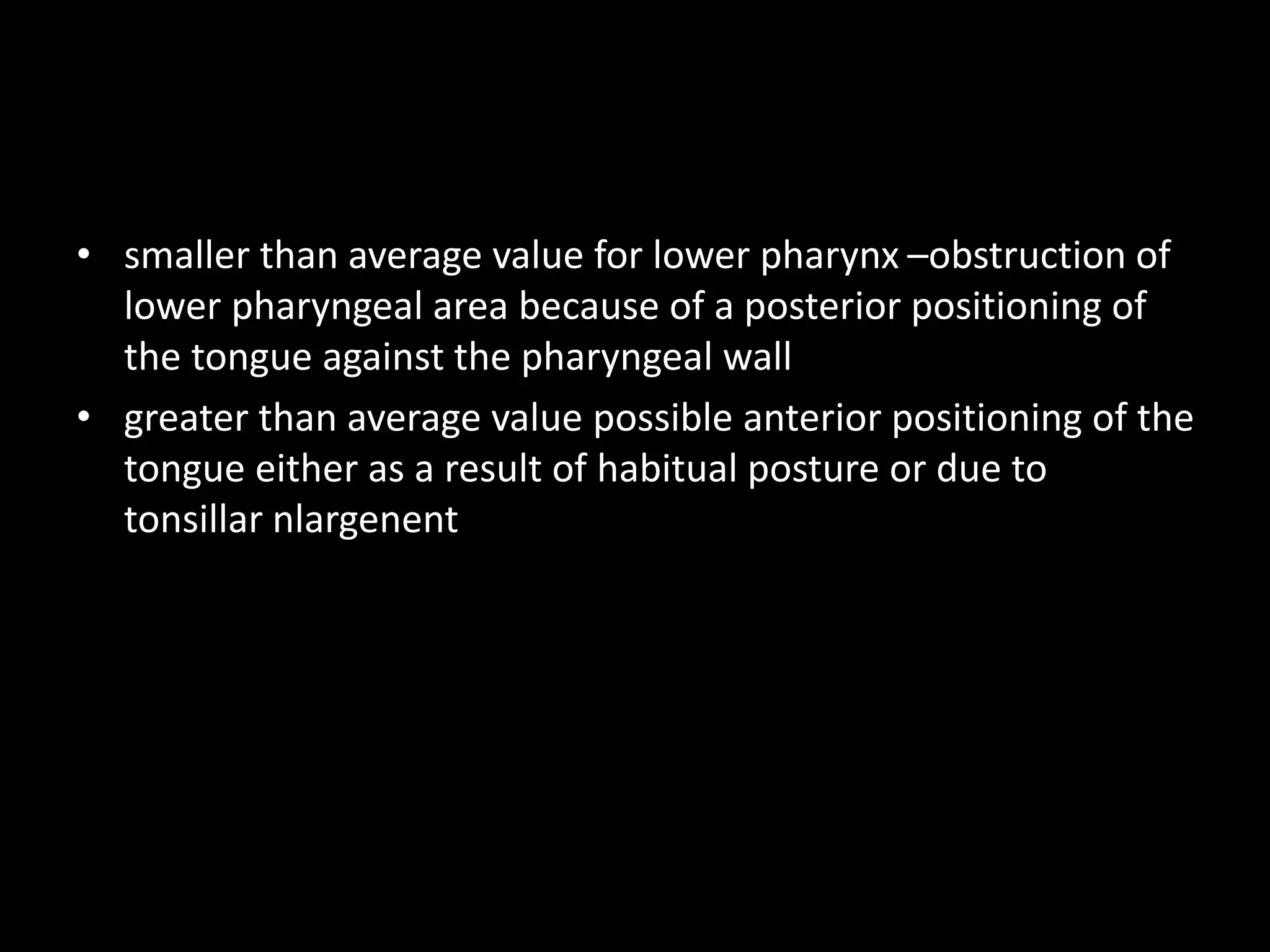
• smaller than average value for lower pharynx –obstruction of
lower pharyngeal area because of a posterior positioning of
the tongue against the pharyngeal wall
• greater than average value possible anterior positioning of the
tongue either as a result of habitual posture or due to
tonsillar nlargenent
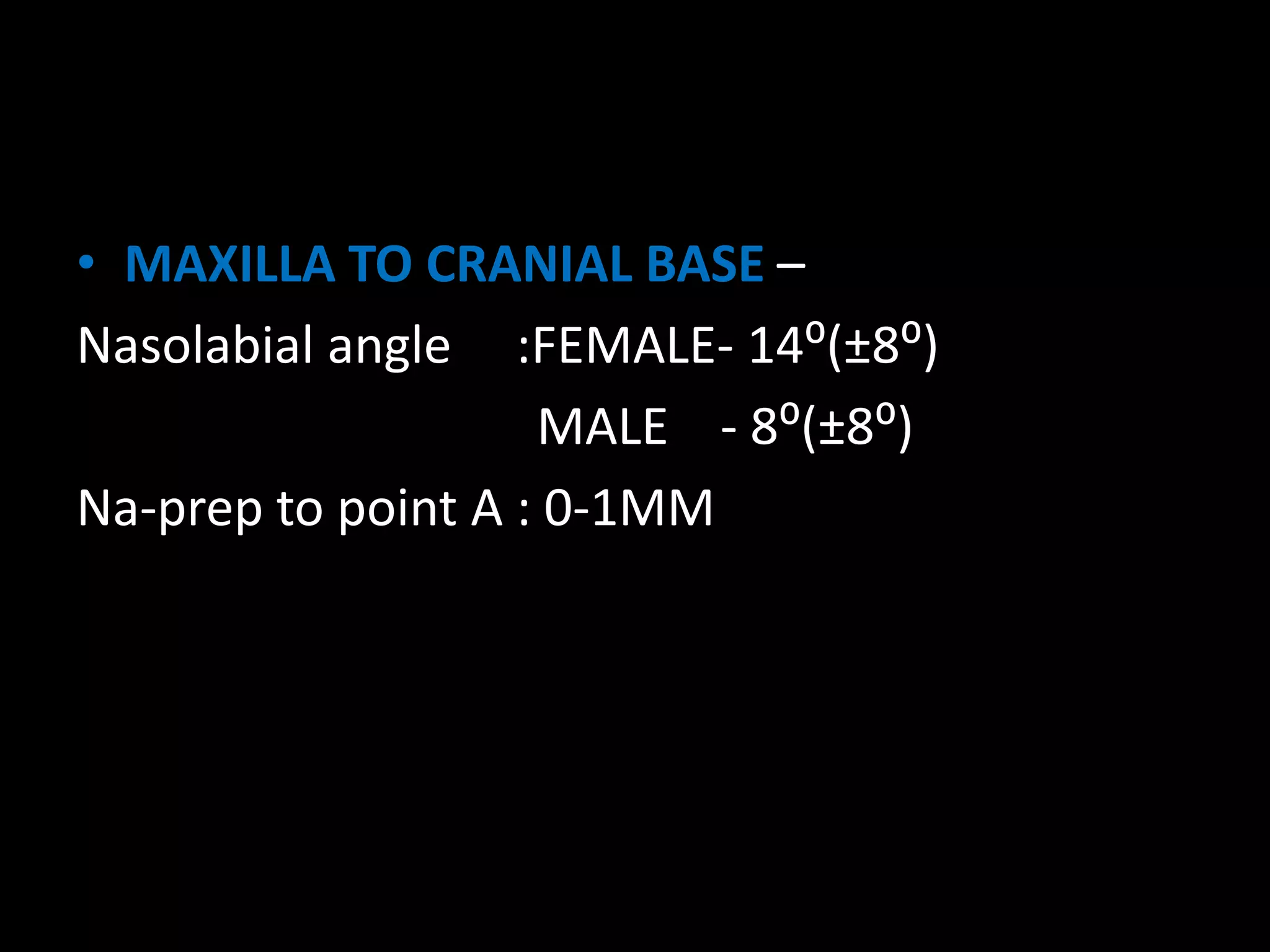
• MAXILLA TO CRANIAL BASE –
Nasolabial angle :FEMALE- 14⁰(±8⁰)
MALE - 8⁰(±8⁰)
Na-prep to point A : 0-1MM
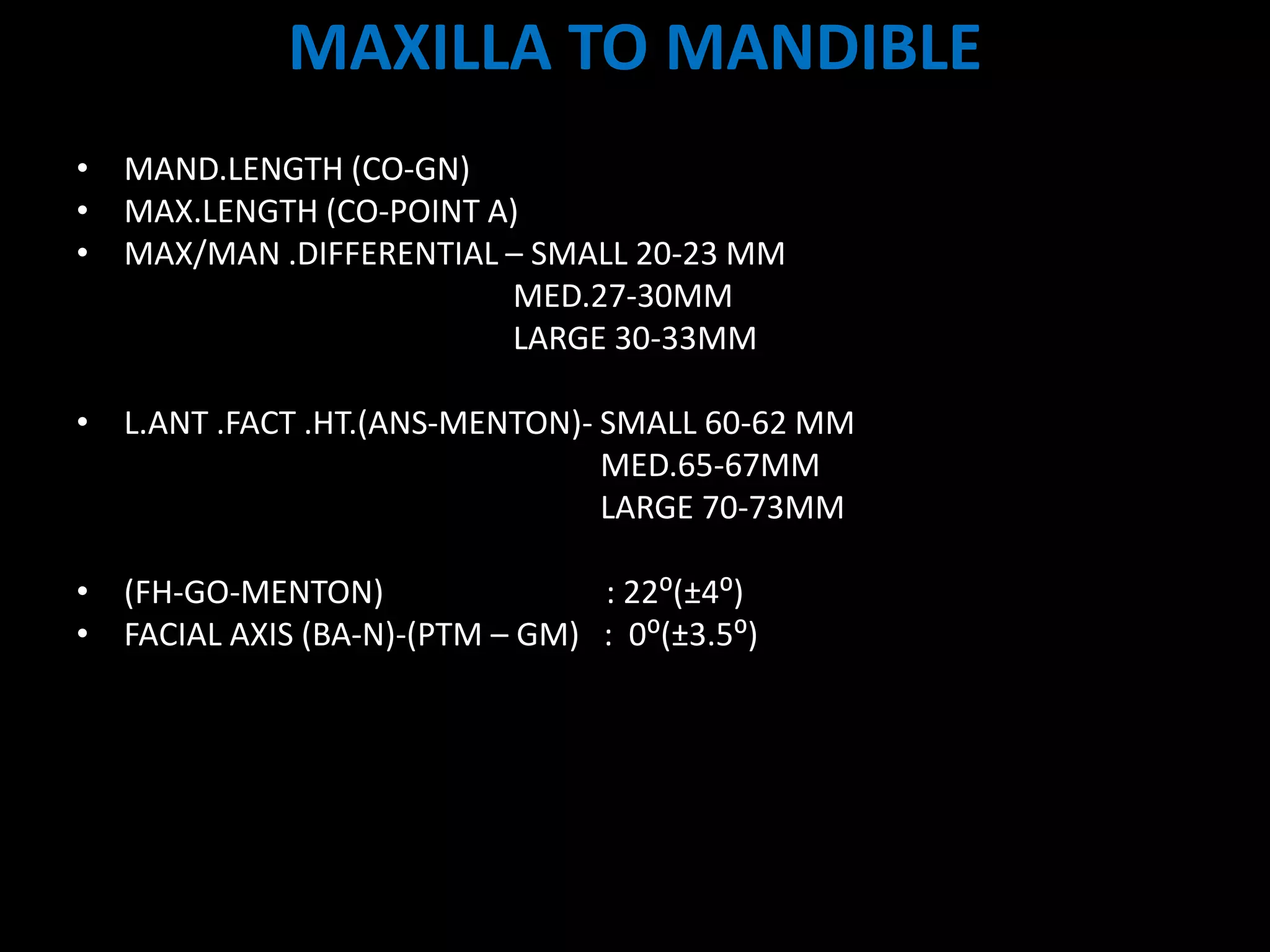
MAXILLA TO MANDIBLE
ANTEROPOSTERIOR
• MAND.LENGTH (CO-GN)
• MAX.LENGTH (CO-POINT A)
• MAX/MAN .DIFFERENTIAL – SMALL 20-23 MM
MED.27-30MM
LARGE 30-33MM
VERTICAL
• L.ANT .FACT .HT.(ANS-MENTON)- SMALL 60-62 MM
MED.65-67MM
LARGE 70-73MM
MAND.PL
• (FH-GO-MENTON) : 22⁰(±4⁰)
• FACIAL AXIS (BA-N)-(PTM – GM) : 0⁰(±3.5⁰)
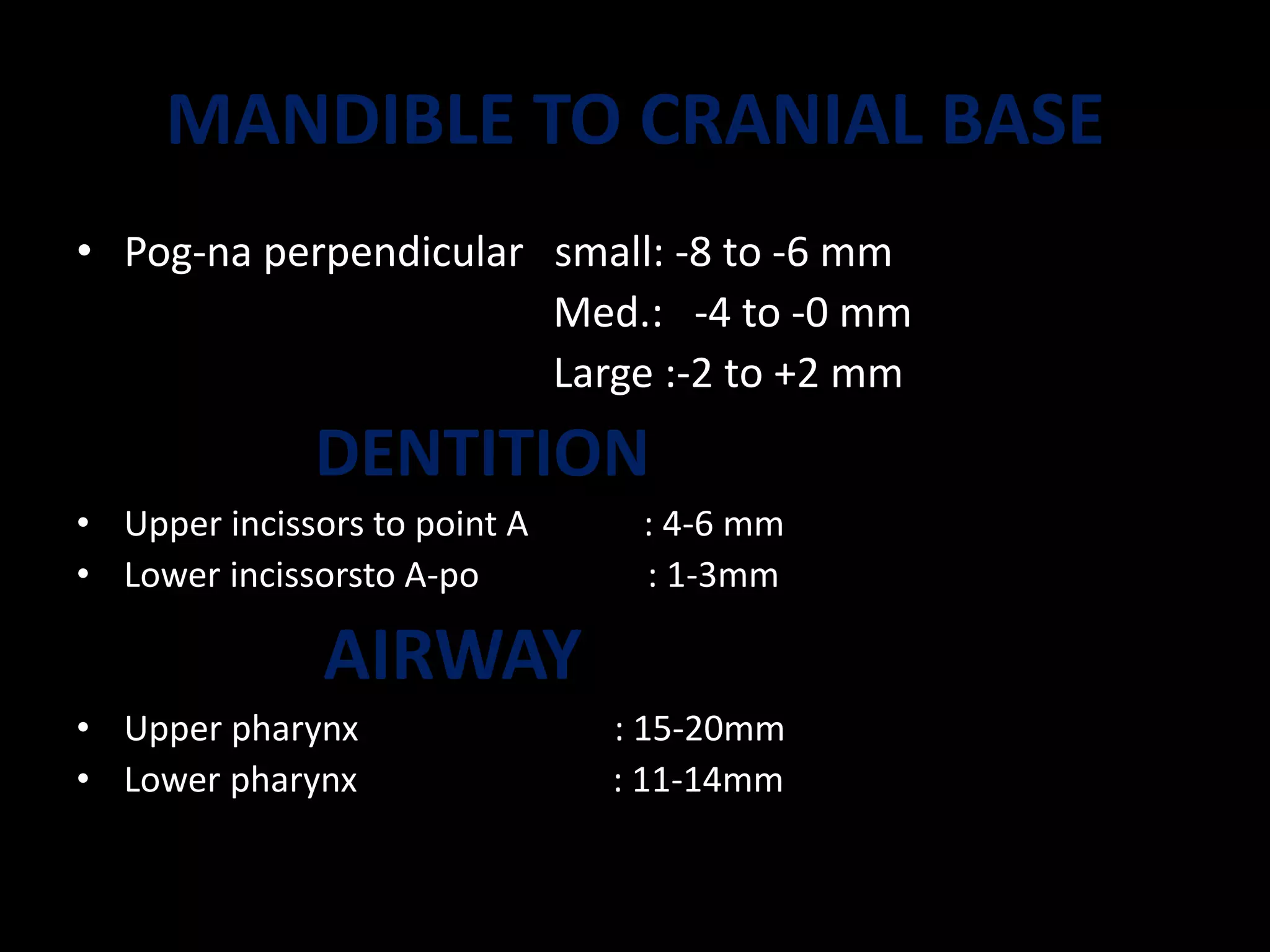
MANDIBLE TO CRANIAL BASE
• Pog-na perpendicular small: -8 to -6 mm
Med.: -4 to -0 mm
Large :-2 to +2 mm
DENTITION
• Upper incissors to point A : 4-6 mm
• Lower incissorsto A-po : 1-3mm
AIRWAY
• Upper pharynx : 15-20mm
• Lower pharynx : 11-14mm
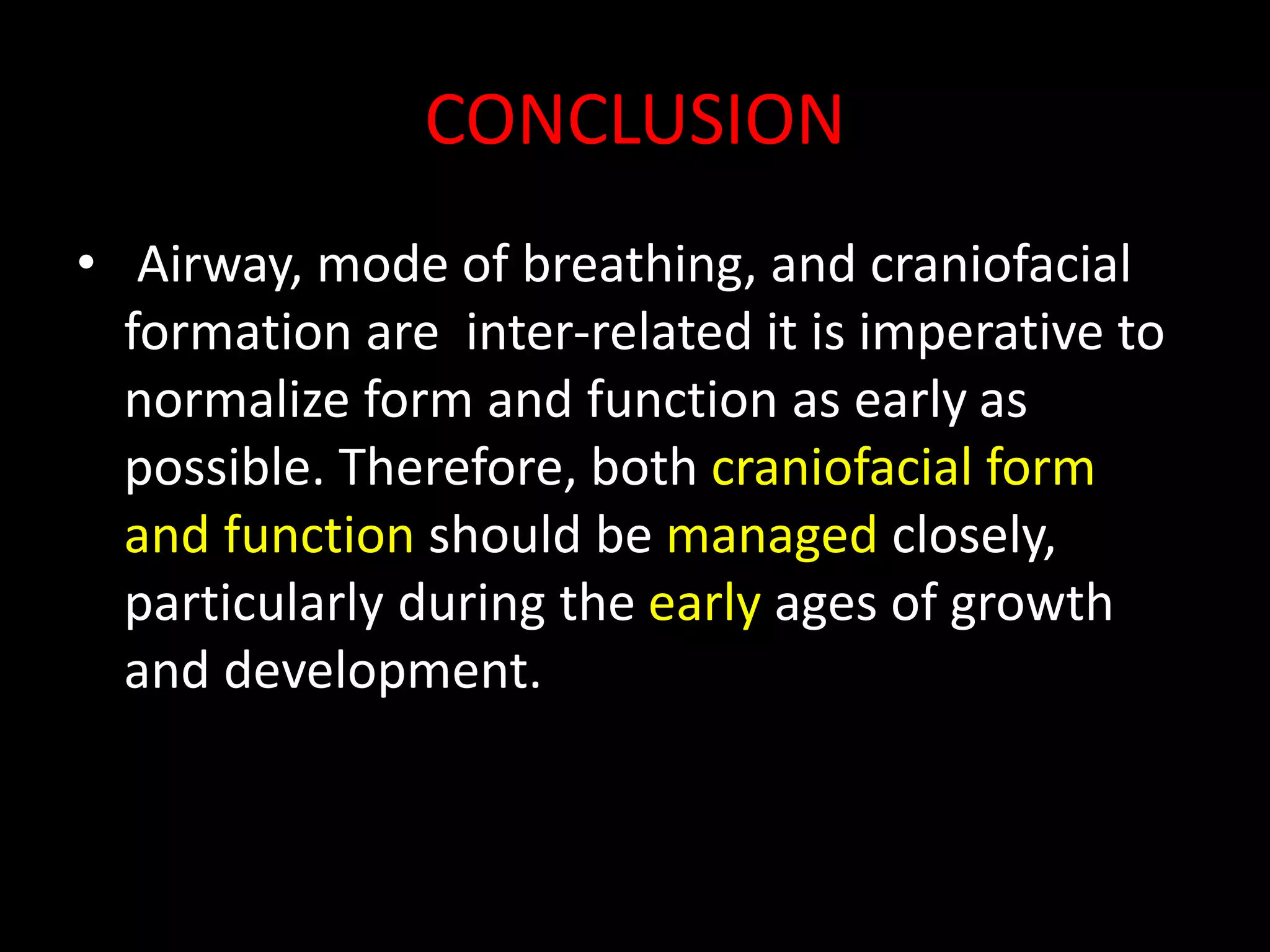
CONCLUSION
• Airway, mode of breathing, and craniofacial
formation are inter-related it is imperative to
normalize form and function as early as
possible. Therefore, both craniofacial form
and function should be managed closely,
particularly during the early ages of growth
and development.

Upper airway and cranial morphology

  • 1.
  • 2.
    INTRODUCTION • Upper andlower airway has always been an area of interest because the oropharyngeal and nasopharyngeal structures play important roles in the growth and development of the craniofacial complex. • Airway dimensions change with retrognathic mandible and prognathic mandible comparing with normal mandible.
  • 3.
    • The airway,mode of breathing, and craniofacial formation are inter-related during growth and development that form can follow function and function can follow form . • So, it is imperative to normalize form and function as early as possible, so that function is optimized for life.
  • 4.
    ROLE OF ORTHODONTIST •Dentists need to play a bigger role in managing airway development and craniofacial formation Airway obstruction impairs respiration which leads to craniofacial malformation, malocclusion and jaw deformation. Research also shows that abnormal craniofacial formation can lead to airway obstruction, impaired respiration, impaired nasal breathing, chronic mouth breathing, sleep apnea, sleep disorders and lifelong ill-health.
  • 5.
    • Therefore, bothcraniofacial form and function should be managed closely, particularly during the early ages of growth and development. • Early dental diagnosis and treatment of airway dysfunction and craniofacial malformation starting at birth is essential • Current literature shows that early orthodontic and orthopedic treatment positively impact the airway and breathing can absolutely lead to a healthier and longer life.
  • 6.
    UPPER AIRWAY • Refersto the parts of respiratory system lying outside of thorax or above the sternal angle. • The tract consist of: - nasal cavity and paranasal sinuses - pharynx nasopharynx oropharynx laryngopharynx - larynx
  • 8.
    NATURAL HEAD POSTURE •Boroca defined the position of the head when an individual stands with the visual axis in the horizontal plane . • Natural head posture (NHP) is the upright position of the head of a standing or sitting subject, while it is balanced by the post-cervical and masticatory-suprahyoid-infrahyoid muscle groups, with the eyes directed forward so that the visual axis is parallel to the floor
  • 9.
    Causes of compensatoryadaption of NHP • Enlarged tonsils and adenoids • Chronic respiratory problems. • Obstructive sleep apnea (osa)
  • 10.
    NORMAL AIRWAY ANDNORMAL BREATHING • Normal well-developed airways allow normal breathing through the nose with the mouth closed. • Nasal breathing - vital to good health. • Research has shown that air breathed through the nose is quite different to the body than air breathed through the mouth.
  • 11.
    THE BENEFITS OFNASAL BREATHING • Begin within hours of birth when nasal nitric oxide gas can first be detected Nitric oxide: • produced in the nasal sinuses, secreted into the nasal passages and inhaled through the nose • prevent bacterial growth. • In the lungs it improves the ability to absorb oxygen.
  • 12.
    • strong vasodilatorand brain transmitter. • increases oxygen transport throughout the body and is vital to all body organs. • A good airway and normal nasal breathing is important because nasal airway obstruction has profound effects on the whole body
  • 13.
    AIRWAY ,BREATHING ANDMALOCCLUSION • The airway, mode of breathing, and malocclusion are so inter-related during growth and development. • Since form can follow function and function can follow form both should be treated preventively, as early as possible. • Dysfunction of the human airway and breathing can cause malocclusion and skeletal deformation.
  • 14.
    Some of thesenegative changes included: Low tongue posture can result in: • Reduced lateral expansion • Anterior development of the maxilla. Excessive molar eruption Clockwise rotation of the mandible, Increased anterior vertical face height, retrognathia open bite
  • 15.
    High narrow palateat birth can interfere with breast-feeding and even bottle-feeding such that aberrant tongue swallowing and mouth breathing habits begin Cranio facial malformation Airway obstruction
  • 16.
    AIRWAY OBSTRUCTION • Airwayobstruction can cause breathing disorders, and craniofacial deformation and malocclusion Causes for airway obstruction: • congenital abnormality, • adenoid hypertrophy, • tonsil hypertrophy, • retruded maxilla , retruded mandible.
  • 17.
    • Small and/orHigh and/or Narrow and/or Retruded Maxilla (Palate) • Small and/or Short and/or Narrow and/or Retruded Mandible (Lower Jaw) • Class II Malocclusion with or without increased over-jet or “under-jet”
  • 18.
    CHRONIC MOUTH BREATHING •Chronic mouth breathing, nasal incompetence, leads to disordered growth of the naso-ethmoid- maxillary unit and whole craniofacial complex. • 4 times more common in children with orthodontic abnormalities. Chronic oral breathing causes : • Down and backward positioning of the mandible, • A vertical long-faced growth pattern • Multiple abnormal growth patterns in the face, jaws and dentition that are very interrelated.
  • 19.
    Characteristics of chronicmouth breathing and respiratory obstruction syndrome include
  • 20.
    Mouth breather at rest : Gummysmile Long Face ,excessive anterior faced height Hypertrophied tonsils and/or adenoids Allergic Salute “V” Shaped Palate Venous Pooling • open-bite, cross- bite, • incompetent lip posture, • narrow external nares,
  • 21.
    • Research showsthere is a significant association between nasal resistance and increased over-jet, open bite, maxillary crowding, Angle Class II malocclusion and posterior cross-bite. • Recognition and prevention of nasal incompetence in children and its treatment are needed to ensure proper orthodontic stability and craniofacial growth
  • 22.
    CRANIOFACIAL GROWTH • Craniofacialgrowth is eighty to ninety percent complete by age twelve, so most formation and/ or deformation occurs by that age. • Unfortunately, age twelve is still the average age that orthodontic and orthopedic treatment starts for most children worldwide. This must change. • The maxilla and mandible are nearly 50% grown at birth and about 90% grown by age 12.
  • 23.
    • 80% ofpost-birth craniofacial growth occurs between birth and age 12. • It is plain to see that earlier treatment, from birth to age 12, when a majority of post birth growth potential occurs, can better impact craniofacial growth and development than after age 12. • In order to better influence craniofacial growth and development, disparities must be recognized and addressed much earlier than at the current age of twelve.
  • 24.
    EARLY DIAGNOSIS • Earlydiagnosis is essential to prevent worse orofacial growth abnormalities. • Early diagnosis can lead to earlier orthopedic treatment, which can be more effective, simpler and less restrictive than later age care. • Routine early examination and diagnosis should begin at birth or soon after birth. • All infants should be screened for craniofacial deformities that affect airway form and function.
  • 25.
    • Breast-feeding -promotes good nasal breathing • Bottle-fed infants : mouth breathing, tongue thrusting and palatal arch deformation. • At the age of 2 and 3 : dental signs of nasal obstruction and mouth breathing : open bite, posterior cross-bite and excessive over-jet. • From ages three to twelve, early airway obstruction and craniofacial deformations too often magnify themselves to such an extent that time inversely relates to the ease and options for correction. • cephalometric analysis
  • 26.
    EARLY TREATMENT • Earlytreatment is essential to normalizing growth and development. • Early treatment maximizes the success of corrective orthodontics and orthopedics . • Dentists and otolaryngologists provide unique treatments that can reduce airway obstruction and craniofacial deformity.
  • 27.
    Functional Appliances…. • FunctionalAppliances Can Develop Dental Arches, Jaws, Airways and Proper Swallow • Dental orthodontic appliances have been shown to improve the sagittal dimensions of the upper airway in children.
  • 28.
    DENTAL RAPID MAXILLARYEXPANSION • Simple, conservative method of treating impaired nasal respiration in patients 4 years to 30 years • But the younger the patient the better the long term results. • It is an effective method for increasing the width of narrow maxillary arches and it also reduces nasal resistance from levels seen with mouth breathing to levels consistent with normal nasal respiration.
  • 29.
    ALLERGY , RESPIRATIONAND FACIAL GROWTH • Sensitization of nasal mucous membrane may propel allergic infants toward progressively severe allergic manifestation includes dentofacial deformity • Early feeding of cow milk and adult food introduction in infants causes eczema and other allergic manifestation appeared
  • 30.
    ALLERGIC DISEASE LEADSTO….. • Slow learners at school • Affects the quality of life and ability of children to function adequately at school • Poor sleep • Headache • Fatigue resulting from untreated chronic rhinitis • School absenteeism in asthmatics Thus allergies ,learning disabilities and hyperactivity have a direct and adverase effect on orthodontic treatment and patient compliance
  • 31.
    TREATMENT….. • Team approachis required for patients who have a malocclusion associated with nasal obstruction enlarged adenoids and allergies for appropriate care Otolaryngologist – for sugical intervension • Allergist- for removal of inciting allergist PHARMOCOLOGICAL TREATMENT :  immunotheraphy- to reduce response of body to specific allergens  antiinflammatory medication –to interrupt the inflammatory cascade (antihistamine, steroid therapy, and leukotriene inhibitors)  bronchodilators  antibiotic therapy to control superimposed infection  Surgical evaluation for removal of infected adenoids and enlarged tonsils
  • 32.
    OBSTRUCTIVE SLEEP APNEA •It is a sleep dependent condition occuring only during sleep • Changes in upper airway and alteration in craniofacial structures predispose to OSA • Affects quality of life if untreated adversely affect the ability of children and adults to function adequately at work and at school
  • 33.
    OSA patients presentswith…… • Obesity – increases the size of soft tissue in upper airway which decrease the functional size of upper airway predispose to sleep apnea • Abnormal upper airway anatomy  retrognathia  Tonsillar hypertrophy  Macroglossia  Enlargement of peritonsillar folds  Enlargeementt or elongation of soft palate
  • 34.
    TREATMENT OPTIONS………. • Enlargingthe upper airway • Continous positive airway pressure • Weight loss • Oral appliances • Upper airway surgery
  • 35.
    Oral appliances inosa Mandibular advancement devices Tongue retaining devices Combination CPAP/ dental sleep device therapy
  • 36.
    MANDIBULAR ADVANCEMENT DEVICES •CLASP RETAINED MANDIBULAR REPOSITIONERS (NON ADJUSTABLE) • MANDIBULAR REPOSITIONERS ( ADJUSTABLE)
  • 37.
    • open theairway by moving the mandible forward. • As the jaw is moved forward, the collapsible part of your airway is held open by the forward movement of the tongue and other airway muscles. • Mandibular Advancement Devices (MADs) also improve the strength and rigidity of the airway by increasing the muscle activity of the tongue and other muscles of the airway.
  • 38.
  • 39.
  • 40.
    • Like MADs,Tongue Retaining Devices (TRDs) also work by holding the tongue in a forward position. • These devices pull the tongue forward, but instead of moving the jaw forward like a Mandibular Advancement Device (MAD), TRDs directly control the tongue itself. • In some cases Tongue Retaining Devices (TRDs) have decreased therapeutic complications compared to MADs, but TRDs can also be less comfortable and generally take several weeks or months to be worn comfortably.
  • 41.
    Combination CPAP/ dentalsleep device therapy • Oral Pressure Appliance (OPAP )
  • 42.
    • problems associatedwith Continuous Positive Airway Pressure (CPAP) therapy are due to high pressures and uncomfortable fit of the nose or face mask. • This custom- made dental sleep device or oral appliance will attach directly to your CPAP machine. • When CPAP is combined with jaw advancement from a mandibular advancement device, the CPAP can often be used at a much lower pressure setting.
  • 43.
    Sleep Apnea AirwayManagement System (SAAMS)
  • 44.
    SURGERY AND UPPER AIRWAY •Adenoidectomy with or without tonsillectomy
  • 45.
    DENTISTS AND OTOLARYNGOLOGISTS •Decades ago, otolaryngologists suggested they should work together with dentists to benefit patients (Crawford-1937, Fowler-1947). • More recently, it was again suggested that better communication and interchange of ideas between the various medical and dental practitioners caring for children with “Stuffy Noses, Long Faces and Dental Malocclusion” would benefit children. • It is time for dental doctors and medical doctors to work together more in the areas of airway, breathing and orthodontics.
  • 46.
    CEPHALOMETRICS OF UPPERAIRWAY • Linder –aronson and henrikson –determine definite anteropharyngeal airway in children from 6-12 years of age • They measured- -length of posterior cranial base (ba to s) -depth of nasopharynx (ba to pns) -the size of airway
  • 47.
    • Determination ofthe size of the airway- measuring the distance between the adenoid and posterior nasal spine
  • 48.
    LIMITATION…. • Defining landmarks •Two dimensionel picture of three dimensional structure
  • 49.
    MC NAMARA ANALYSIS UPPERPHARYNX • Upper pharyngeal width – measured from a point on the posterior outline of soft palate to the closest point on the pharyngeal wall • This measurement taken on the anterior half of the soft palate outline • Average width of nasopharynx- 15-20 mm • A width of 2mm or less in this region indicate airway impairment •
  • 50.
    LOWER PHARYNX • Lowerpharyngeal width –measured from the point of intersection of the posterior border of the tongue and the inferior border of the mandible to the closest point on the posterior pharyngeal wall • average measurement – 11-14 mm
  • 51.
    • smaller thanaverage value for lower pharynx –obstruction of lower pharyngeal area because of a posterior positioning of the tongue against the pharyngeal wall • greater than average value possible anterior positioning of the tongue either as a result of habitual posture or due to tonsillar nlargenent
  • 52.
    • MAXILLA TOCRANIAL BASE – Nasolabial angle :FEMALE- 14⁰(±8⁰) MALE - 8⁰(±8⁰) Na-prep to point A : 0-1MM
  • 53.
    MAXILLA TO MANDIBLE ANTEROPOSTERIOR •MAND.LENGTH (CO-GN) • MAX.LENGTH (CO-POINT A) • MAX/MAN .DIFFERENTIAL – SMALL 20-23 MM MED.27-30MM LARGE 30-33MM VERTICAL • L.ANT .FACT .HT.(ANS-MENTON)- SMALL 60-62 MM MED.65-67MM LARGE 70-73MM MAND.PL • (FH-GO-MENTON) : 22⁰(±4⁰) • FACIAL AXIS (BA-N)-(PTM – GM) : 0⁰(±3.5⁰)
  • 54.
    MANDIBLE TO CRANIALBASE • Pog-na perpendicular small: -8 to -6 mm Med.: -4 to -0 mm Large :-2 to +2 mm DENTITION • Upper incissors to point A : 4-6 mm • Lower incissorsto A-po : 1-3mm AIRWAY • Upper pharynx : 15-20mm • Lower pharynx : 11-14mm
  • 55.
    CONCLUSION • Airway, modeof breathing, and craniofacial formation are inter-related it is imperative to normalize form and function as early as possible. Therefore, both craniofacial form and function should be managed closely, particularly during the early ages of growth and development.