La Salle University-Ozamiz City
EDMNGT 101
Acc. To Chester Barnard
 function
 define the role positions, the jobs related
and the coordination between authority
and responsibility
Acc. To Clayton State University:
School of Business
 process
 creating an organization’s framework
◦ degree of complexity, formalization, and
centralization
Acc. To Medina
 management function
 structuring of resources and activities
 accomplish objectives efficiently and
effectively
Acc. To Attner & Morgan
 management function
 establishes relationships between activity
and authority
 results to an organization
◦ a system acting in harmony to execute whole
tasks to achieve goals effectively and efficiently
Acc. To Champ Academy
Importance of Organizing
 Plan implementation
 Assignment of
authority,
responsibility, and
accountability
 Division of work
 Coordinates diverse
organizational tasks
 Establish
relationship among
individuals, groups
and departments
 Establish formal
lines of authority
 Allocation and
deployment of
organizational
resources
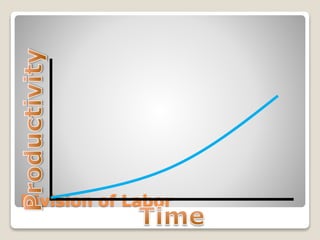
Division of Labor
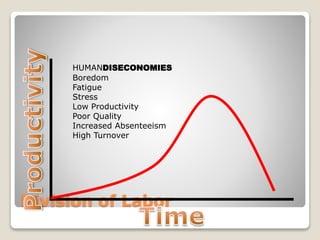
Division of Labor
HUMANDISECONOMIES
Boredom
Fatigue
Stress
Low Productivity
Poor Quality
Increased Absenteeism
High Turnover
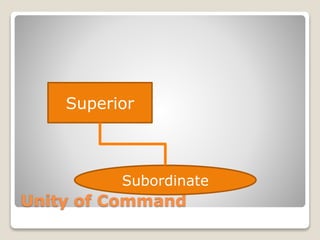
Unity of Command
Superior
Subordinate
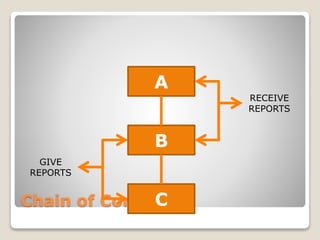
Chain of Command
A
B
C
RECEIVE
REPORTS
GIVE
REPORTS
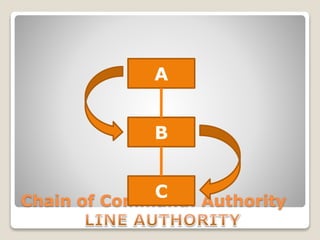
Chain of Command: Authority
A
B
C
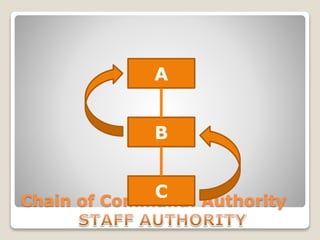
Chain of Command: Authority
A
B
C
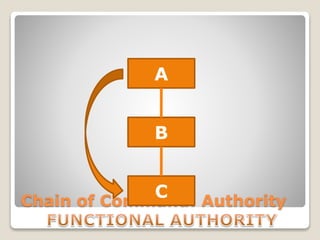
Chain of Command: Authority
A
B
C
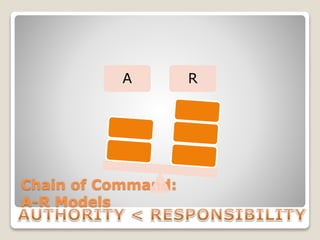
Chain of Command: Responsibility
Chain of Command:
A-R Models
A R
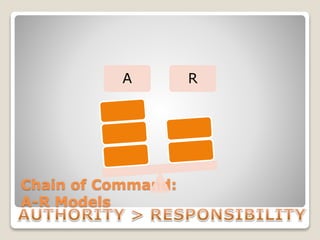
Chain of Command:
A-R Models
A R
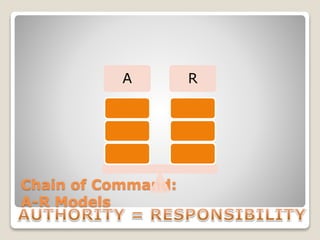
Chain of Command:
A-R Models
A R
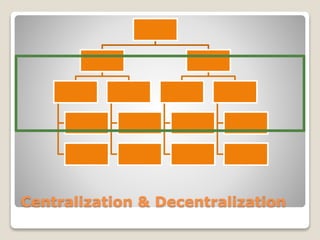
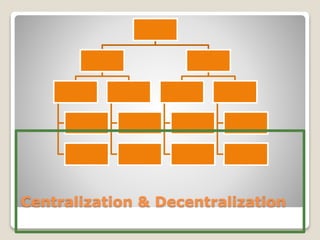
Centralization & Decentralization
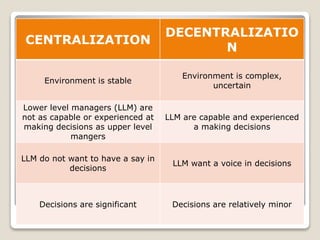
CENTRALIZATION
DECENTRALIZATIO
N
Environment is stable
Environment is complex,
uncertain
Lower level managers (LLM) are
not as capable or experienced at
making decisions as upper level
mangers
LLM are capable and experienced
a making decisions
LLM do not want to have a say in
decisions
LLM want a voice in decisions
Decisions are significant Decisions are relatively minor
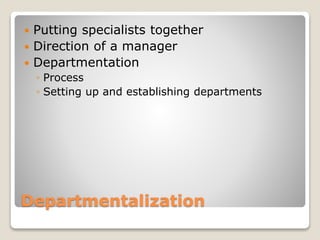
Departmentalization
 Putting specialists together
 Direction of a manager
 Departmentation
◦ Process
◦ Setting up and establishing departments
Common Elements of Organization
C/D/DC/I/T (c) 2010
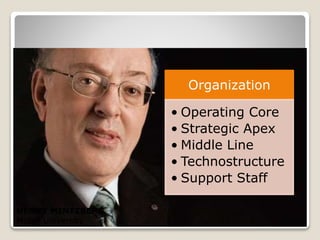
HENRY MINTZBERG
McGill University
Organization
• Operating Core
• Strategic Apex
• Middle Line
• Technostructure
• Support Staff
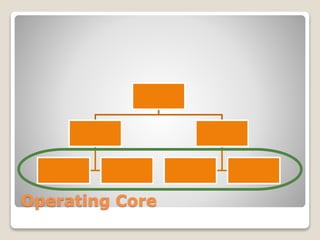
Operating Core
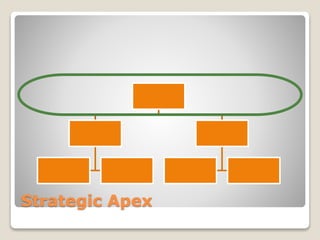
Strategic Apex
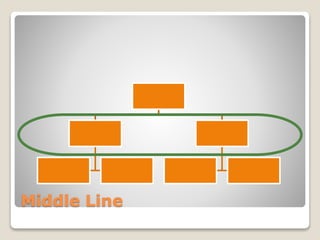
Middle Line
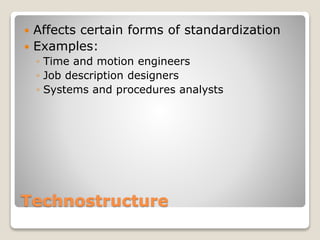
Technostructure
 Affects certain forms of standardization
 Examples:
◦ Time and motion engineers
◦ Job description designers
◦ Systems and procedures analysts
Support Staff
 Fill staff units
 Provides indirect support
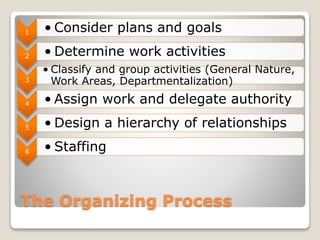
The Organizing Process
1 • Consider plans and goals
2 • Determine work activities
3
• Classify and group activities (General Nature,
Work Areas, Departmentalization)
4 • Assign work and delegate authority
5 • Design a hierarchy of relationships
6 • Staffing
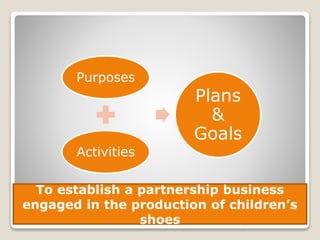
1. Consider Plans & Goals
Purposes
Activities
Plans
&
Goals
C/D/DC/I/T (c) 2010
To establish a partnership business
engaged in the production of children’s
shoes
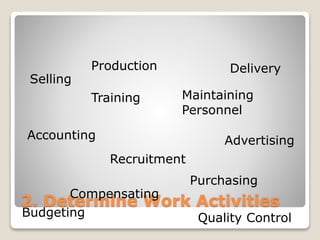
2. Determine Work Activities
Selling
Accounting
Delivery
Quality Control
Advertising
Compensating
Training
Production
Purchasing
Budgeting
Recruitment
Maintaining
Personnel
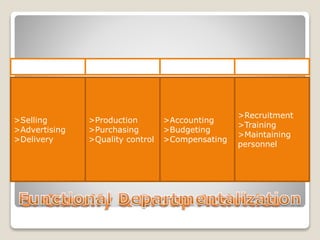
3. Classify & Group Activities
>Selling
>Advertising
>Delivery
>Production
>Purchasing
>Quality control
>Accounting
>Budgeting
>Compensating
>Recruitment
>Training
>Maintaining
personnel
MARKETING OPERATIONS FINANCE
HUMAN
RESOURCES
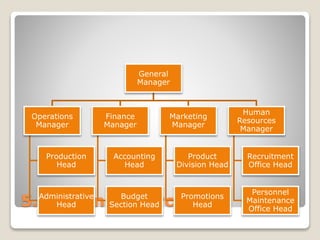
5. Design hierarchy
General
Manager
Operations
Manager
Production
Head
Administrative
Head
Finance
Manager
Accounting
Head
Budget
Section Head
Marketing
Manager
Product
Division Head
Promotions
Head
Human
Resources
Manager
Recruitment
Office Head
Personnel
Maintenance
Office Head
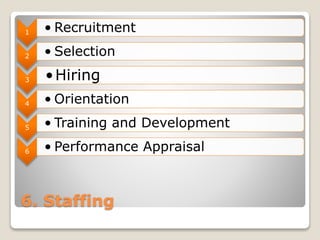
6. Staffing
1 • Recruitment
2 • Selection
3 •Hiring
4 • Orientation
5 • Training and Development
6 • Performance Appraisal
Organizational Structure
 Formal system of tasks, reporting
relationships
 Controls, coordinates, motivates
employees
 Achieve organization’s goals
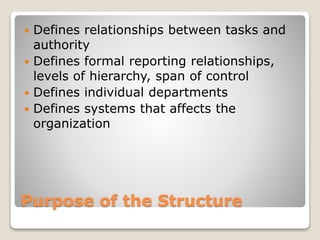
Purpose of the Structure
 Defines relationships between tasks and
authority
 Defines formal reporting relationships,
levels of hierarchy, span of control
 Defines individual departments
 Defines systems that affects the
organization
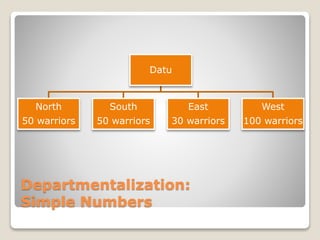
Departmentalization:
Simple Numbers
Datu
North
50 warriors
South
50 warriors
East
30 warriors
West
100 warriors
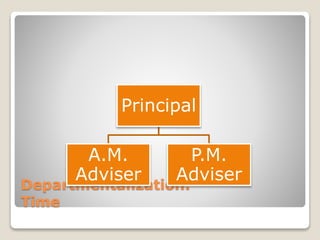
Departmentalization:
Time
Principal
A.M.
Adviser
P.M.
Adviser
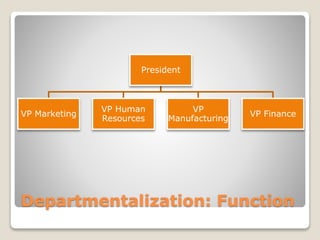
Departmentalization: Function
President
VP Marketing
VP Human
Resources
VP
Manufacturing
VP Finance
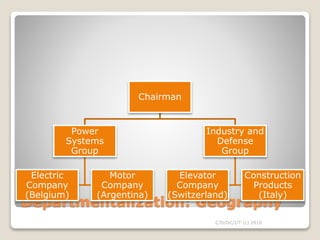
Departmentalization: Geography
C/D/DC/I/T (c) 2010
Chairman
Power
Systems
Group
Electric
Company
(Belgium)
Motor
Company
(Argentina)
Industry and
Defense
Group
Elevator
Company
(Switzerland)
Construction
Products
(Italy)
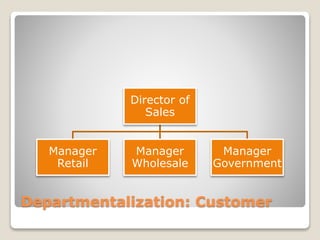
Departmentalization: Customer
Director of
Sales
Manager
Retail
Manager
Wholesale
Manager
Government
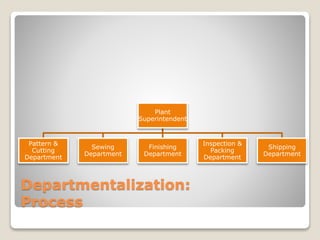
Departmentalization:
Process
Plant
Superintendent
Pattern &
Cutting
Department
Sewing
Department
Finishing
Department
Inspection &
Packing
Department
Shipping
Department
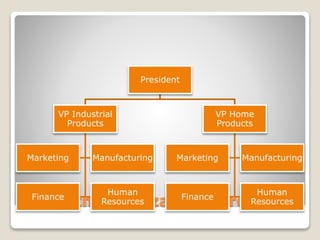
Departmentalization: Product
President
VP Industrial
Products
Marketing Manufacturing
Finance
Human
Resources
VP Home
Products
Marketing Manufacturing
Finance
Human
Resources
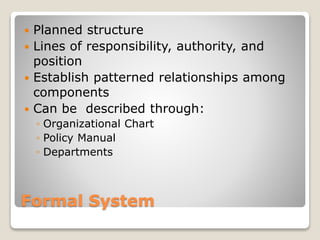
Formal System
 Planned structure
 Lines of responsibility, authority, and
position
 Establish patterned relationships among
components
 Can be described through:
◦ Organizational Chart
◦ Policy Manual
◦ Departments
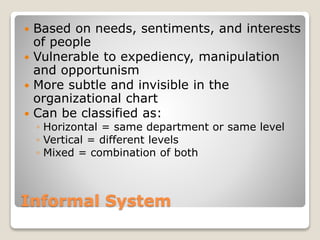
Informal System
 Based on needs, sentiments, and interests
of people
 Vulnerable to expediency, manipulation
and opportunism
 More subtle and invisible in the
organizational chart
 Can be classified as:
◦ Horizontal = same department or same level
◦ Vertical = different levels
◦ Mixed = combination of both
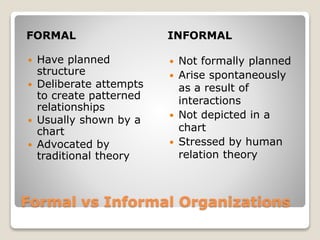
Formal vs Informal Organizations
FORMAL INFORMAL
 Have planned
structure
 Deliberate attempts
to create patterned
relationships
 Usually shown by a
chart
 Advocated by
traditional theory
 Not formally planned
 Arise spontaneously
as a result of
interactions
 Not depicted in a
chart
 Stressed by human
relation theory
C/D/DC/I/T (c) 2010
C/D/DC/I/T (c) 2010
C/D/DC/I/T (c) 2010
C/D/DC/I/T (c) 2010

Organizing edmngt