Performance ManagementPerformance Management
SystemSystem
R. K. PANDEYR. K. PANDEY
Performance Management SystemPerformance Management System
 It is an organization - wide management programIt is an organization - wide management program
that provides a structured approach to:that provides a structured approach to:
 Communicate business strategyCommunicate business strategy
 Establish a shared understanding of what is to beEstablish a shared understanding of what is to be
achieved and how it is to be achievedachieved and how it is to be achieved
 Facilitate management of self and othersFacilitate management of self and others
 Measure and motivate performanceMeasure and motivate performance
(organizational and individual)(organizational and individual)
Contd…Contd…
 Performance ManagementPerformance Management – A management– A management
process for ensuring employees are focusing theirprocess for ensuring employees are focusing their
work efforts in ways that contribute to achievingwork efforts in ways that contribute to achieving
the agency’s mission. It consists of three phases:the agency’s mission. It consists of three phases:
(a) setting expectations for employee performance,(a) setting expectations for employee performance,
(b) maintaining a dialogue between supervisor and(b) maintaining a dialogue between supervisor and
employee to keep performance on track, andemployee to keep performance on track, and
(c) measuring actual performance relative to(c) measuring actual performance relative to
performance expectations.performance expectations.
PMS Consists of…PMS Consists of…
 A process for communicating employee performanceA process for communicating employee performance
expectations, maintaining ongoing performance dialogue,expectations, maintaining ongoing performance dialogue,
and conducting annual performance appraisals;and conducting annual performance appraisals;
 A procedure for addressing employee performance thatA procedure for addressing employee performance that
falls below expectations;falls below expectations;
 A procedure for encouraging and facilitating employeeA procedure for encouraging and facilitating employee
development;development;
 Training in managing performance and administering theTraining in managing performance and administering the
system; andsystem; and
 A procedure for resolving performance pay disputes.A procedure for resolving performance pay disputes.
WHY MEASURE PERFORMANCE ?WHY MEASURE PERFORMANCE ?
BecauseBecause
 What you cannot measure you cannot improve.What you cannot measure you cannot improve.
 If you cannot improve you cannot grow.If you cannot improve you cannot grow.
 Measurement helps in objectively differentiatingMeasurement helps in objectively differentiating
between performers and non performers.between performers and non performers.
 Pay for performance is possible only throughPay for performance is possible only through
metrics.metrics.
Objective of PMSObjective of PMS
 To confirm the services of probationary employees uponTo confirm the services of probationary employees upon
their completing the probationary period satisfactorilytheir completing the probationary period satisfactorily
 To check the effective & efficiency of individuals, teamsTo check the effective & efficiency of individuals, teams
& organization& organization
 To effect promotions based on competence andTo effect promotions based on competence and
performanceperformance
 To access the training and development needs of theTo access the training and development needs of the
employeesemployees
 To decide upon the pay riseTo decide upon the pay rise
 PM can be used to determine whether HR programmesPM can be used to determine whether HR programmes
such as selection, training, and transfer have been effectivesuch as selection, training, and transfer have been effective
or not.or not.
PAS & PMSPAS & PMS
 PAS:PAS:
 Emphasis is on relativeEmphasis is on relative
evaluation of individualsevaluation of individuals
 Annual exerciseAnnual exercise
 Rewards & recognition ofRewards & recognition of
good performancegood performance
 Designed & monitored byDesigned & monitored by
HR departmentHR department
 Ownership is mostly withOwnership is mostly with
the HR dept.the HR dept.
 PMS:PMS:
 Emphasis is on performanceEmphasis is on performance
of individuals, team & orgn.of individuals, team & orgn.
 Continuous processContinuous process
 Performance rewarding mayPerformance rewarding may
or may not be integral partor may not be integral part
 Designed by HR dept. butDesigned by HR dept. but
monitored by respective dept.monitored by respective dept.
 Ownership is with the lineOwnership is with the line
managers, HR facilitates itsmanagers, HR facilitates its
implementationimplementation
PMS Includes…PMS Includes…
 Work planWork plan – A document that describes the work– A document that describes the work
to be completed by an employee within theto be completed by an employee within the
performance cycle, the performance expected, andperformance cycle, the performance expected, and
how the performance will be measured.how the performance will be measured.
 Corrective action planCorrective action plan – A short-term action plan– A short-term action plan
that is initiated when an employee’s performancethat is initiated when an employee’s performance
fails to meet expectations. Its purpose is to achievefails to meet expectations. Its purpose is to achieve
an improvement in performance.an improvement in performance.
Contd…Contd…
 Individual development planIndividual development plan – An action plan for– An action plan for
enhancing an employee’s level of performance inenhancing an employee’s level of performance in
order to excel in the current job or prepare for neworder to excel in the current job or prepare for new
responsibilities.responsibilities.
 Performance appraisalPerformance appraisal – A confidential document– A confidential document
that includes the employee’s performancethat includes the employee’s performance
expectations, a summary of the employee’s actualexpectations, a summary of the employee’s actual
performance relative to those expectations, an overallperformance relative to those expectations, an overall
rating of the employee’s performance, and therating of the employee’s performance, and the
supervisor’s and employee’s signatures.supervisor’s and employee’s signatures.
Contd…Contd…
 Performance documentationPerformance documentation – A letter, memo,– A letter, memo,
completed form, or note on which the supervisorcompleted form, or note on which the supervisor
indicates the extent to which the employee isindicates the extent to which the employee is
currently meeting expectations and provides evidencecurrently meeting expectations and provides evidence
to support that conclusion.to support that conclusion.
 Fair appraisalFair appraisal – Appraising employees in a manner– Appraising employees in a manner
that accurately reflects how they performed relative tothat accurately reflects how they performed relative to
the expectations defined in their work plan and in athe expectations defined in their work plan and in a
manner that is not influenced by factors irrelevant tomanner that is not influenced by factors irrelevant to
performance.performance.
HIGHLIGHTS OF THE SYSTEMHIGHLIGHTS OF THE SYSTEM
 The appraiser and the appraisee jointly set the KeyThe appraiser and the appraisee jointly set the Key
Result Areas (KRA’s) and assign mutually agreedResult Areas (KRA’s) and assign mutually agreed
weightageweightage expressed as a percentageexpressed as a percentage
 Simple mathematical relationship between setSimple mathematical relationship between set
weightage and accomplishment gives a finalweightage and accomplishment gives a final
numerical score on KRA’snumerical score on KRA’s
 To evaluate all management personnel on companyTo evaluate all management personnel on company
values and leadership attributes a new section hasvalues and leadership attributes a new section has
been added entitled “been added entitled “Values in ActionValues in Action””
WHAT IS A KEY RESULT AREA ?WHAT IS A KEY RESULT AREA ?
 A KRA refers to a target that needs to be achieved byA KRA refers to a target that needs to be achieved by
the appraisee in a given timethe appraisee in a given time
 KRA’s are the set of performance expectations fromKRA’s are the set of performance expectations from
the appraiseethe appraisee
 The focus is on tangible outputs. However this doesThe focus is on tangible outputs. However this does
not mean that tasks that have a qualitative outputnot mean that tasks that have a qualitative output
cannot form a KRAcannot form a KRA
 The focus is on tangible outputs. However this doesThe focus is on tangible outputs. However this does
not mean that tasks that have a qualitative outputnot mean that tasks that have a qualitative output
cannot form a KRAcannot form a KRA
Setting KRA in case of a FunctionalSetting KRA in case of a Functional
Reporting RelationshipReporting Relationship
 Functional reporting cases will require input from theFunctional reporting cases will require input from the
functional superior in setting KRAs for the appraisee.functional superior in setting KRAs for the appraisee.
 The appraiser , the appraisee and the functional superiorThe appraiser , the appraisee and the functional superior
will have to mutually agree upon the KRAs for thewill have to mutually agree upon the KRAs for the
appraisee.appraisee.
 In case of a disagreement , it will be the functionalIn case of a disagreement , it will be the functional
superior’s responsibility to convince the administrativesuperior’s responsibility to convince the administrative
superior to reach an agreement on the KRAs andsuperior to reach an agreement on the KRAs and
communicate the same to the appraisee.communicate the same to the appraisee.
 In some cases, functional goals could be super-ordinateIn some cases, functional goals could be super-ordinate
to business goals.to business goals.
Components of PMSComponents of PMS
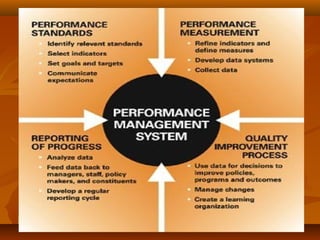
 Performance StandardsPerformance Standards - establishment of- establishment of
organizational or system performance standards,organizational or system performance standards,
targets and goals and relevant indicators to improvetargets and goals and relevant indicators to improve
public health practicepublic health practice
 Performance MeasuresPerformance Measures - application and use of- application and use of
performance indicators and measuresperformance indicators and measures
Contd…Contd…
 Reporting of ProgressReporting of Progress - documentation and- documentation and
reporting of progress in meeting standards andreporting of progress in meeting standards and
targets and sharing of such information throughtargets and sharing of such information through
feedbackfeedback
 Quality ImprovementQuality Improvement - establishment of a program- establishment of a program
or process to manage change and achieve qualityor process to manage change and achieve quality
improvement in public health policies, programs orimprovement in public health policies, programs or
infrastructure based on performance standards,infrastructure based on performance standards,
measurements and reports.measurements and reports.
Importance of PMSImportance of PMS
 A Performance Management System enables aA Performance Management System enables a
business to sustain profitability and performancebusiness to sustain profitability and performance
by linking the employees' pay to competency andby linking the employees' pay to competency and
contribution .contribution .
 It provides opportunities for concerted personalIt provides opportunities for concerted personal
development and career growth .development and career growth .
 It brings all the employees under a single strategicIt brings all the employees under a single strategic
umbrella .umbrella .
Contd…Contd…
 Most importantly, it gives supervisors andMost importantly, it gives supervisors and
subordinates an equal opportunity to expresssubordinates an equal opportunity to express
themselves under structured conditionsthemselves under structured conditions
 Organizations can effectively manage theOrganizations can effectively manage the
performance appraisal process with our onlineperformance appraisal process with our online
performance management systemperformance management system
 It calls for a high level of co-ordination, channeledIt calls for a high level of co-ordination, channeled
information flow, and timely reviewinformation flow, and timely review
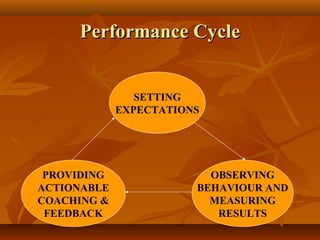
Performance CyclePerformance Cycle
SETTING
EXPECTATIONS
PROVIDING
ACTIONABLE
COACHING &
FEEDBACK
OBSERVING
BEHAVIOUR AND
MEASURING
RESULTS
Appraise Need For FurtherAppraise Need For Further
DiscussionDiscussion
 The reviewer meets the appraiser to investigate theThe reviewer meets the appraiser to investigate the
point of disagreement.point of disagreement.
 The reviewer decides to meet the appraisee to hearThe reviewer decides to meet the appraisee to hear
his / her views.his / her views.
 The reviewer examines the case and communicatesThe reviewer examines the case and communicates
his / her decision to the appraiser.his / her decision to the appraiser.
 The appraiser communicates the decision of theThe appraiser communicates the decision of the
reviewer to the appraisee.reviewer to the appraisee.
FURTHER LINKS EMERGINGFURTHER LINKS EMERGING
FROM THE PMSFROM THE PMS
 Rewards and RecognitionRewards and Recognition
 Training and DevelopmentTraining and Development
 Potential AppraisalPotential Appraisal
 Career and Succession PlanningCareer and Succession Planning
THANK YOUTHANK YOU

PERFORMANCE MANAGEMENT SYSTEM

  • 1.
  • 2.
    Performance Management SystemPerformanceManagement System  It is an organization - wide management programIt is an organization - wide management program that provides a structured approach to:that provides a structured approach to:  Communicate business strategyCommunicate business strategy  Establish a shared understanding of what is to beEstablish a shared understanding of what is to be achieved and how it is to be achievedachieved and how it is to be achieved  Facilitate management of self and othersFacilitate management of self and others  Measure and motivate performanceMeasure and motivate performance (organizational and individual)(organizational and individual)
  • 3.
    Contd…Contd…  Performance ManagementPerformanceManagement – A management– A management process for ensuring employees are focusing theirprocess for ensuring employees are focusing their work efforts in ways that contribute to achievingwork efforts in ways that contribute to achieving the agency’s mission. It consists of three phases:the agency’s mission. It consists of three phases: (a) setting expectations for employee performance,(a) setting expectations for employee performance, (b) maintaining a dialogue between supervisor and(b) maintaining a dialogue between supervisor and employee to keep performance on track, andemployee to keep performance on track, and (c) measuring actual performance relative to(c) measuring actual performance relative to performance expectations.performance expectations.
  • 4.
    PMS Consists of…PMSConsists of…  A process for communicating employee performanceA process for communicating employee performance expectations, maintaining ongoing performance dialogue,expectations, maintaining ongoing performance dialogue, and conducting annual performance appraisals;and conducting annual performance appraisals;  A procedure for addressing employee performance thatA procedure for addressing employee performance that falls below expectations;falls below expectations;  A procedure for encouraging and facilitating employeeA procedure for encouraging and facilitating employee development;development;  Training in managing performance and administering theTraining in managing performance and administering the system; andsystem; and  A procedure for resolving performance pay disputes.A procedure for resolving performance pay disputes.
  • 5.
    WHY MEASURE PERFORMANCE?WHY MEASURE PERFORMANCE ? BecauseBecause  What you cannot measure you cannot improve.What you cannot measure you cannot improve.  If you cannot improve you cannot grow.If you cannot improve you cannot grow.  Measurement helps in objectively differentiatingMeasurement helps in objectively differentiating between performers and non performers.between performers and non performers.  Pay for performance is possible only throughPay for performance is possible only through metrics.metrics.
  • 6.
    Objective of PMSObjectiveof PMS  To confirm the services of probationary employees uponTo confirm the services of probationary employees upon their completing the probationary period satisfactorilytheir completing the probationary period satisfactorily  To check the effective & efficiency of individuals, teamsTo check the effective & efficiency of individuals, teams & organization& organization  To effect promotions based on competence andTo effect promotions based on competence and performanceperformance  To access the training and development needs of theTo access the training and development needs of the employeesemployees  To decide upon the pay riseTo decide upon the pay rise  PM can be used to determine whether HR programmesPM can be used to determine whether HR programmes such as selection, training, and transfer have been effectivesuch as selection, training, and transfer have been effective or not.or not.
  • 7.
    PAS & PMSPAS& PMS  PAS:PAS:  Emphasis is on relativeEmphasis is on relative evaluation of individualsevaluation of individuals  Annual exerciseAnnual exercise  Rewards & recognition ofRewards & recognition of good performancegood performance  Designed & monitored byDesigned & monitored by HR departmentHR department  Ownership is mostly withOwnership is mostly with the HR dept.the HR dept.  PMS:PMS:  Emphasis is on performanceEmphasis is on performance of individuals, team & orgn.of individuals, team & orgn.  Continuous processContinuous process  Performance rewarding mayPerformance rewarding may or may not be integral partor may not be integral part  Designed by HR dept. butDesigned by HR dept. but monitored by respective dept.monitored by respective dept.  Ownership is with the lineOwnership is with the line managers, HR facilitates itsmanagers, HR facilitates its implementationimplementation
  • 8.
    PMS Includes…PMS Includes… Work planWork plan – A document that describes the work– A document that describes the work to be completed by an employee within theto be completed by an employee within the performance cycle, the performance expected, andperformance cycle, the performance expected, and how the performance will be measured.how the performance will be measured.  Corrective action planCorrective action plan – A short-term action plan– A short-term action plan that is initiated when an employee’s performancethat is initiated when an employee’s performance fails to meet expectations. Its purpose is to achievefails to meet expectations. Its purpose is to achieve an improvement in performance.an improvement in performance.
  • 9.
    Contd…Contd…  Individual developmentplanIndividual development plan – An action plan for– An action plan for enhancing an employee’s level of performance inenhancing an employee’s level of performance in order to excel in the current job or prepare for neworder to excel in the current job or prepare for new responsibilities.responsibilities.  Performance appraisalPerformance appraisal – A confidential document– A confidential document that includes the employee’s performancethat includes the employee’s performance expectations, a summary of the employee’s actualexpectations, a summary of the employee’s actual performance relative to those expectations, an overallperformance relative to those expectations, an overall rating of the employee’s performance, and therating of the employee’s performance, and the supervisor’s and employee’s signatures.supervisor’s and employee’s signatures.
  • 10.
    Contd…Contd…  Performance documentationPerformancedocumentation – A letter, memo,– A letter, memo, completed form, or note on which the supervisorcompleted form, or note on which the supervisor indicates the extent to which the employee isindicates the extent to which the employee is currently meeting expectations and provides evidencecurrently meeting expectations and provides evidence to support that conclusion.to support that conclusion.  Fair appraisalFair appraisal – Appraising employees in a manner– Appraising employees in a manner that accurately reflects how they performed relative tothat accurately reflects how they performed relative to the expectations defined in their work plan and in athe expectations defined in their work plan and in a manner that is not influenced by factors irrelevant tomanner that is not influenced by factors irrelevant to performance.performance.
  • 11.
    HIGHLIGHTS OF THESYSTEMHIGHLIGHTS OF THE SYSTEM  The appraiser and the appraisee jointly set the KeyThe appraiser and the appraisee jointly set the Key Result Areas (KRA’s) and assign mutually agreedResult Areas (KRA’s) and assign mutually agreed weightageweightage expressed as a percentageexpressed as a percentage  Simple mathematical relationship between setSimple mathematical relationship between set weightage and accomplishment gives a finalweightage and accomplishment gives a final numerical score on KRA’snumerical score on KRA’s  To evaluate all management personnel on companyTo evaluate all management personnel on company values and leadership attributes a new section hasvalues and leadership attributes a new section has been added entitled “been added entitled “Values in ActionValues in Action””
  • 12.
    WHAT IS AKEY RESULT AREA ?WHAT IS A KEY RESULT AREA ?  A KRA refers to a target that needs to be achieved byA KRA refers to a target that needs to be achieved by the appraisee in a given timethe appraisee in a given time  KRA’s are the set of performance expectations fromKRA’s are the set of performance expectations from the appraiseethe appraisee  The focus is on tangible outputs. However this doesThe focus is on tangible outputs. However this does not mean that tasks that have a qualitative outputnot mean that tasks that have a qualitative output cannot form a KRAcannot form a KRA  The focus is on tangible outputs. However this doesThe focus is on tangible outputs. However this does not mean that tasks that have a qualitative outputnot mean that tasks that have a qualitative output cannot form a KRAcannot form a KRA
  • 13.
    Setting KRA incase of a FunctionalSetting KRA in case of a Functional Reporting RelationshipReporting Relationship  Functional reporting cases will require input from theFunctional reporting cases will require input from the functional superior in setting KRAs for the appraisee.functional superior in setting KRAs for the appraisee.  The appraiser , the appraisee and the functional superiorThe appraiser , the appraisee and the functional superior will have to mutually agree upon the KRAs for thewill have to mutually agree upon the KRAs for the appraisee.appraisee.  In case of a disagreement , it will be the functionalIn case of a disagreement , it will be the functional superior’s responsibility to convince the administrativesuperior’s responsibility to convince the administrative superior to reach an agreement on the KRAs andsuperior to reach an agreement on the KRAs and communicate the same to the appraisee.communicate the same to the appraisee.  In some cases, functional goals could be super-ordinateIn some cases, functional goals could be super-ordinate to business goals.to business goals.
  • 14.
    Components of PMSComponentsof PMS  Performance StandardsPerformance Standards - establishment of- establishment of organizational or system performance standards,organizational or system performance standards, targets and goals and relevant indicators to improvetargets and goals and relevant indicators to improve public health practicepublic health practice  Performance MeasuresPerformance Measures - application and use of- application and use of performance indicators and measuresperformance indicators and measures
  • 15.
    Contd…Contd…  Reporting ofProgressReporting of Progress - documentation and- documentation and reporting of progress in meeting standards andreporting of progress in meeting standards and targets and sharing of such information throughtargets and sharing of such information through feedbackfeedback  Quality ImprovementQuality Improvement - establishment of a program- establishment of a program or process to manage change and achieve qualityor process to manage change and achieve quality improvement in public health policies, programs orimprovement in public health policies, programs or infrastructure based on performance standards,infrastructure based on performance standards, measurements and reports.measurements and reports.
  • 17.
    Importance of PMSImportanceof PMS  A Performance Management System enables aA Performance Management System enables a business to sustain profitability and performancebusiness to sustain profitability and performance by linking the employees' pay to competency andby linking the employees' pay to competency and contribution .contribution .  It provides opportunities for concerted personalIt provides opportunities for concerted personal development and career growth .development and career growth .  It brings all the employees under a single strategicIt brings all the employees under a single strategic umbrella .umbrella .
  • 18.
    Contd…Contd…  Most importantly,it gives supervisors andMost importantly, it gives supervisors and subordinates an equal opportunity to expresssubordinates an equal opportunity to express themselves under structured conditionsthemselves under structured conditions  Organizations can effectively manage theOrganizations can effectively manage the performance appraisal process with our onlineperformance appraisal process with our online performance management systemperformance management system  It calls for a high level of co-ordination, channeledIt calls for a high level of co-ordination, channeled information flow, and timely reviewinformation flow, and timely review
  • 19.
  • 20.
    Appraise Need ForFurtherAppraise Need For Further DiscussionDiscussion  The reviewer meets the appraiser to investigate theThe reviewer meets the appraiser to investigate the point of disagreement.point of disagreement.  The reviewer decides to meet the appraisee to hearThe reviewer decides to meet the appraisee to hear his / her views.his / her views.  The reviewer examines the case and communicatesThe reviewer examines the case and communicates his / her decision to the appraiser.his / her decision to the appraiser.  The appraiser communicates the decision of theThe appraiser communicates the decision of the reviewer to the appraisee.reviewer to the appraisee.
  • 21.
    FURTHER LINKS EMERGINGFURTHERLINKS EMERGING FROM THE PMSFROM THE PMS  Rewards and RecognitionRewards and Recognition  Training and DevelopmentTraining and Development  Potential AppraisalPotential Appraisal  Career and Succession PlanningCareer and Succession Planning
  • 22.