
ChapterChapter
FUNCTIONS OF MANAGEMENTFUNCTIONS OF MANAGEMENT
Presented By :-Ramkrishna RajputPresented By :-Ramkrishna Rajput
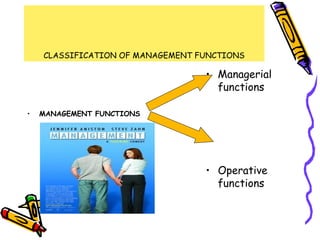
CLASSIFICATION OF MANAGEMENT FUNCTIONS
• MANAGEMENT FUNCTIONS
• Managerial
functions
• Operative
functions
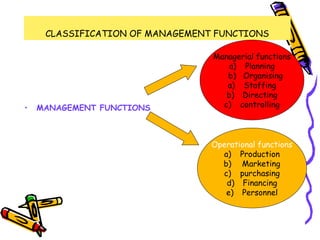
CLASSIFICATION OF MANAGEMENT FUNCTIONS
• MANAGEMENT FUNCTIONS
Managerial functions
a) Planning
b) Organising
a) Staffing
b) Directing
c) controlling
Operational functions
a) Production
b) Marketing
c) purchasing
d) Financing
e) Personnel
CLASSIFICATION OF MANAGEMENT FUNCTIONS
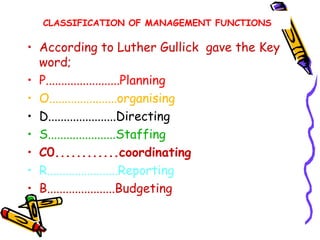
• According to Luther Gullick gave the Key
word;
• P........................Planning
• O......................organising
• D......................Directing
• S......................Staffing
• C0............coordinating
• R.......................Reporting
• B......................Budgeting
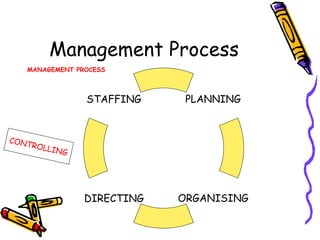
Management Process
MANAGEMENT PROCESS
DIRECTING
STAFFING
ORGANISING
PLANNING
CONTROLLING
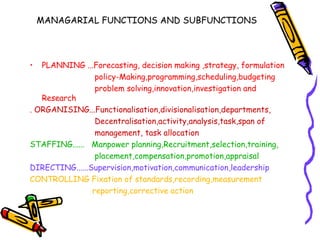
MANAGARIAL FUNCTIONS AND SUBFUNCTIONS
• PLANNING ...Forecasting, decision making ,strategy, formulation
policy-Making,programming,scheduling,budgeting
problem solving,innovation,investigation and
Research
. ORGANISING...Functionalisation,divisionalisation,departments,
Decentralisation,activity,analysis,task,span of
management, task allocation
STAFFING...... Manpower planning,Recruitment,selection,training,
placement,compensation,promotion,appraisal
DIRECTING......Supervision,motivation,communication,leadership
CONTROLLING Fixation of standards,recording,measurement
reporting,corrective action
Planning
• Planning is deciding in advance what is to
be done in the future
• “According to koontz and O ‘Donnell
defines planning is deciding in advance
what to do, how to do it, when to do it and
who is to do it. Planning bridges the gap
from where we are to where we want to
go. It makes it possible for things to occur
which would not otherwise happen”
Features of planning
• Planning seeks to achieve certain objectives.
• Planning is oriented towards the future.
• Planning is a mental exercise
• Planning involves choices from alternatives
• Planning is the basics for all other functions.
• It is a continuous function
• It is pervading.
• Planning is directed towards efficiency.
Steps in planning
• Collecting information about past
• Defining objectives
• Developing planning premises
• Discovering alternative cources of action.
• Evaluating alternatives.
• Choosing the best alternatives
• Defining subsidiary plans
• Periodic revision and review of plans.
Advantages of planning
• It focuses attention on desired
objectives
• It helps to minimise risk
• It improve efficiency
• It avoid confusions
• It encourage innovation and creativity
• It enables co operation and group work
• It serves as the basis of control.
Limitations of planning
• Lack of accurate information
• Time consuming
• Expensive
• Rigidity due to strict compliance with
plans
• Unwillingness to people change
• External limitations (political )
How we overcome the limitations?
• Top management support
• Better forecasting
• Developing clear-cut objectives
• Participation of employees in planning
• Sound communication
• Overcoming resistance to change
• Scientific planning
• Well balanced keeping plans.
Organising
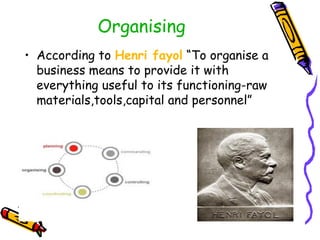
• According to Henri fayol “To organise a
business means to provide it with
everything useful to its functioning-raw
materials,tools,capital and personnel”
Steps in organising
• Identifying the activities required for
achieving objectives.
• Classifying these activities in to convenient
groups
• Assigning the group of activities to
appropriate persons.
• Delegating authority and fixing
responsibilities.
• Coordinating Authority Responsibility
relationship throughout the enterprise.
Importance of organising
• Sound organisation facilitate growth and
diversification
• Optimum use of human resources by matching
work with talent
• Maintain good harmonious structure in the office
• Group activity is equivalent to social structure of
organisation
• It is a mechanism of management to direct
,controls and coordinates the activities of
enterprise.
Staffing
• It is concerned with the Human
resources of the enterprise.
• It is concerned with
acquiring,developing,utilising,and
maintaining human resources.
• It is a process of matching jobs with
individuals to ensure right man for
the right job.
Definition of staffing
• According to koontz and O Donnel
“The managerial functions of staffing
involves manning the organisational
structure through proper and
effective selection, appraisal and
development of personnel to fill the
roles designed in to the structure.
Importance of staffing
• It helps in discovering and obtaining
competent employees for various job.
• It improve the quantity and quality of
output by putting right man for right job.
• It improves job satisfaction of employees
• It reduces cost of personnel by avoiding
wastage of human resource.
• It facilitates the growth and
diversification.
Features of staffing
• It is a function of management
• It is an integral part of the process of
management.
• It is concerned with the human resources
• It is a pervasive function
• Aims at optimum utilisation of human
resources.
Steps in staffing
• Manpower planning
• Recruitment,selection,placement
• Training and development
• Appraisal ,promotion and transfer
• Employee remuneration
Directing
• It is concerned with the execution of
plans through organised action.
• It is also known as commanding or
actuating
DEFINITION
• “Direction consist of the process and
techniques utilised in using
instructions and making certain that
operations are carried out as
planned”
Importance
• Mere planning, organizing, and staffing are
not sufficient to set the tasks in motion.
Management has well-coordinated plans,
properly established duty- authority
relations, and able personnel, yet it is
through the function of direction that the
manager is able to make the employees
accomplish their tasks by making them
integrate their individual efforts with the
interest and objectives of the enterprise.
Importance
• It calls for properly motivating,
communicating with, and leading the
subordinates. Motivation induces and
inspires the employees to perform
better, while through good leadership, a
manager is able to make his
subordinates work with zeal and
confidence.
Directing the subordinates embraces three
essential activities:
1. Issuing orders and instructions
2. Guiding and counselling the subordinates in
their work with a view to improve their
performance
3. Supervising the work of subordinates to
ensure that it conforms to orders and
instructions issued
•
COORDINATING
• Co-ordination must be sought from
the very first step, namely, planning,
so that plans of all departments are
integrated into a master plan, issuing
the adequate co-ordination.
• Similarly organizing of people into
groups and work into activities
involves adequate co-ordination.
COORDINATING
• It can also be secured through proper
motivation of the workers towards
organized efforts in terms of
organizational objectives and personal
objectives of the employees through an
integration of such objectives.
• Finally the controlling aspect also
indicates further co-ordination is required
resulting in improvements and fresh plans.
CONTROLLING
• Controlling involves several tasks,
including monitoring customer
satisfaction.
• controlling
• keeping the company on track and
making sure goals are met
CONTROLLING
The important steps to be initiated in this direction
are as follows:
• 1. Measurement of accomplishments against pre-
determined standards and recording of deviations
• 2. Analysing and probing the reasons for such
deviations
• 3. Fixing of responsibility in terms of persons
responsible for negative deviations
• 4. Correction of employee performance so that group
goals are achieved through effective implementation
of plans devised to attain them.
CONTROLLING
• Control is thus closely related to the
planning aspect of the job of a manager. But
it should not be viewed merely as a post-
mortem of past achievements and
performances. In fact, a good control
system should suggest corrective measures
so that negative deviations may not recur in
the future. The principle of feedback when
incorporated in the control system can be of
great use in this direction.
Monitoring or Evaluation
• Monitoring is the collection and analysis of
information about a project or programme,
undertaken while the project/programme is
ongoing.
• Evaluation is the periodic, retrospective
assessment of an organisation, project or
programme that might be conducted
internally or by external independent
evaluators.
Monitoring or Evaluation
• Good planning, monitoring and evaluation enhance
the contribution of establishing clear links
between past, present and future initiatives and
development results.
• Monitoring and evaluation can help an organization
extract relevant information from past and ongoing
activities that can be used as the basis for
programmatic fine-tuning, reorientation and future
planning. Without effective planning, monitoring
and evaluation, it would be impossible to judge if
work is going in the right direction, whether
progress and success can be claimed, and how
future efforts might be improved.
Thank You

Functions of managment

  • 1.
    ChapterChapter FUNCTIONS OF MANAGEMENTFUNCTIONSOF MANAGEMENT Presented By :-Ramkrishna RajputPresented By :-Ramkrishna Rajput
  • 2.
    CLASSIFICATION OF MANAGEMENTFUNCTIONS • MANAGEMENT FUNCTIONS • Managerial functions • Operative functions
  • 3.
    CLASSIFICATION OF MANAGEMENTFUNCTIONS • MANAGEMENT FUNCTIONS Managerial functions a) Planning b) Organising a) Staffing b) Directing c) controlling Operational functions a) Production b) Marketing c) purchasing d) Financing e) Personnel
  • 4.
    CLASSIFICATION OF MANAGEMENTFUNCTIONS • According to Luther Gullick gave the Key word; • P........................Planning • O......................organising • D......................Directing • S......................Staffing • C0............coordinating • R.......................Reporting • B......................Budgeting
  • 5.
  • 6.
    MANAGARIAL FUNCTIONS ANDSUBFUNCTIONS • PLANNING ...Forecasting, decision making ,strategy, formulation policy-Making,programming,scheduling,budgeting problem solving,innovation,investigation and Research . ORGANISING...Functionalisation,divisionalisation,departments, Decentralisation,activity,analysis,task,span of management, task allocation STAFFING...... Manpower planning,Recruitment,selection,training, placement,compensation,promotion,appraisal DIRECTING......Supervision,motivation,communication,leadership CONTROLLING Fixation of standards,recording,measurement reporting,corrective action
  • 7.
    Planning • Planning isdeciding in advance what is to be done in the future • “According to koontz and O ‘Donnell defines planning is deciding in advance what to do, how to do it, when to do it and who is to do it. Planning bridges the gap from where we are to where we want to go. It makes it possible for things to occur which would not otherwise happen”
  • 8.
    Features of planning •Planning seeks to achieve certain objectives. • Planning is oriented towards the future. • Planning is a mental exercise • Planning involves choices from alternatives • Planning is the basics for all other functions. • It is a continuous function • It is pervading. • Planning is directed towards efficiency.
  • 9.
    Steps in planning •Collecting information about past • Defining objectives • Developing planning premises • Discovering alternative cources of action. • Evaluating alternatives. • Choosing the best alternatives • Defining subsidiary plans • Periodic revision and review of plans.
  • 10.
    Advantages of planning •It focuses attention on desired objectives • It helps to minimise risk • It improve efficiency • It avoid confusions • It encourage innovation and creativity • It enables co operation and group work • It serves as the basis of control.
  • 11.
    Limitations of planning •Lack of accurate information • Time consuming • Expensive • Rigidity due to strict compliance with plans • Unwillingness to people change • External limitations (political )
  • 12.
    How we overcomethe limitations? • Top management support • Better forecasting • Developing clear-cut objectives • Participation of employees in planning • Sound communication • Overcoming resistance to change • Scientific planning • Well balanced keeping plans.
  • 13.
    Organising • According toHenri fayol “To organise a business means to provide it with everything useful to its functioning-raw materials,tools,capital and personnel”
  • 14.
    Steps in organising •Identifying the activities required for achieving objectives. • Classifying these activities in to convenient groups • Assigning the group of activities to appropriate persons. • Delegating authority and fixing responsibilities. • Coordinating Authority Responsibility relationship throughout the enterprise.
  • 15.
    Importance of organising •Sound organisation facilitate growth and diversification • Optimum use of human resources by matching work with talent • Maintain good harmonious structure in the office • Group activity is equivalent to social structure of organisation • It is a mechanism of management to direct ,controls and coordinates the activities of enterprise.
  • 21.
    Staffing • It isconcerned with the Human resources of the enterprise. • It is concerned with acquiring,developing,utilising,and maintaining human resources. • It is a process of matching jobs with individuals to ensure right man for the right job.
  • 22.
    Definition of staffing •According to koontz and O Donnel “The managerial functions of staffing involves manning the organisational structure through proper and effective selection, appraisal and development of personnel to fill the roles designed in to the structure.
  • 23.
    Importance of staffing •It helps in discovering and obtaining competent employees for various job. • It improve the quantity and quality of output by putting right man for right job. • It improves job satisfaction of employees • It reduces cost of personnel by avoiding wastage of human resource. • It facilitates the growth and diversification.
  • 24.
    Features of staffing •It is a function of management • It is an integral part of the process of management. • It is concerned with the human resources • It is a pervasive function • Aims at optimum utilisation of human resources.
  • 25.
    Steps in staffing •Manpower planning • Recruitment,selection,placement • Training and development • Appraisal ,promotion and transfer • Employee remuneration
  • 26.
    Directing • It isconcerned with the execution of plans through organised action. • It is also known as commanding or actuating
  • 27.
    DEFINITION • “Direction consistof the process and techniques utilised in using instructions and making certain that operations are carried out as planned”
  • 28.
    Importance • Mere planning,organizing, and staffing are not sufficient to set the tasks in motion. Management has well-coordinated plans, properly established duty- authority relations, and able personnel, yet it is through the function of direction that the manager is able to make the employees accomplish their tasks by making them integrate their individual efforts with the interest and objectives of the enterprise.
  • 29.
    Importance • It callsfor properly motivating, communicating with, and leading the subordinates. Motivation induces and inspires the employees to perform better, while through good leadership, a manager is able to make his subordinates work with zeal and confidence.
  • 30.
    Directing the subordinatesembraces three essential activities: 1. Issuing orders and instructions 2. Guiding and counselling the subordinates in their work with a view to improve their performance 3. Supervising the work of subordinates to ensure that it conforms to orders and instructions issued •
  • 31.
    COORDINATING • Co-ordination mustbe sought from the very first step, namely, planning, so that plans of all departments are integrated into a master plan, issuing the adequate co-ordination. • Similarly organizing of people into groups and work into activities involves adequate co-ordination.
  • 32.
    COORDINATING • It canalso be secured through proper motivation of the workers towards organized efforts in terms of organizational objectives and personal objectives of the employees through an integration of such objectives. • Finally the controlling aspect also indicates further co-ordination is required resulting in improvements and fresh plans.
  • 33.
    CONTROLLING • Controlling involvesseveral tasks, including monitoring customer satisfaction. • controlling • keeping the company on track and making sure goals are met
  • 34.
    CONTROLLING The important stepsto be initiated in this direction are as follows: • 1. Measurement of accomplishments against pre- determined standards and recording of deviations • 2. Analysing and probing the reasons for such deviations • 3. Fixing of responsibility in terms of persons responsible for negative deviations • 4. Correction of employee performance so that group goals are achieved through effective implementation of plans devised to attain them.
  • 35.
    CONTROLLING • Control isthus closely related to the planning aspect of the job of a manager. But it should not be viewed merely as a post- mortem of past achievements and performances. In fact, a good control system should suggest corrective measures so that negative deviations may not recur in the future. The principle of feedback when incorporated in the control system can be of great use in this direction.
  • 36.
    Monitoring or Evaluation •Monitoring is the collection and analysis of information about a project or programme, undertaken while the project/programme is ongoing. • Evaluation is the periodic, retrospective assessment of an organisation, project or programme that might be conducted internally or by external independent evaluators.
  • 37.
    Monitoring or Evaluation •Good planning, monitoring and evaluation enhance the contribution of establishing clear links between past, present and future initiatives and development results. • Monitoring and evaluation can help an organization extract relevant information from past and ongoing activities that can be used as the basis for programmatic fine-tuning, reorientation and future planning. Without effective planning, monitoring and evaluation, it would be impossible to judge if work is going in the right direction, whether progress and success can be claimed, and how future efforts might be improved.
  • 38.