

Organizing
Course: BBA
Subject: Principles of Management
Unit: II
Topics
• Organizing: Nature, importance, process, formal &
informal organizations, Organizational Charts
• Departmentaion: Definition, Bases of
departmentation, Types of organization structure-
functional, divisional, project, matrix organization.
Authority: definition, types, responsibility &
accountability, delegation; definition, steps in
delegation, obstacles to delegation and their
elimination, what is decentralization and
centralization. (Ch.11 to 15 – Principles and
Practice of Management by L.M.Prasad)
What is organizing
• Planning focuses on deciding what to do -
Organizing focuses on how to do it
• Planning- obj/goal
• Organizing- organizing people and allocate
resources to carry out the plan
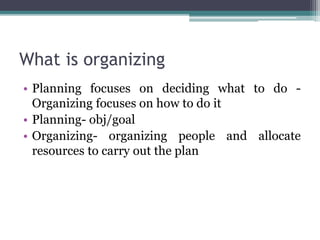
Definition
• When 2 or more persons work together towards
a common goal, authority & responsibilities are
allocated among them so that their efforts may
become effective.
Authority and
Responsibility
1 2
Definition
• It’s a mgt. function involves assigning duties, grouping
tasks, delegating authority and responsibility and
allocating resources to carry out a specific plan
• System of cooperative activities of two or more persons
• Urwick: ‘org. is the process of dividing up of the
activities which are necessary to any purpose and
arranging them in groups which are assigned to
individual’
A. & R.
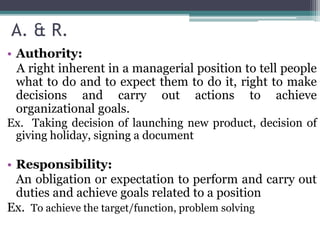
• Authority:
A right inherent in a managerial position to tell people
what to do and to expect them to do it, right to make
decisions and carry out actions to achieve
organizational goals.
Ex. Taking decision of launching new product, decision of
giving holiday, signing a document
• Responsibility:
An obligation or expectation to perform and carry out
duties and achieve goals related to a position
Ex. To achieve the target/function, problem solving
Importance
• Helps individual about the tasks he or she is
expected to accomplish.
• creates channels of communication and thus
supports decision-making and control.
• Smooth flow of work activities
• efficient use of its resources and avoid conflict and
duplication of effort.
• harmonious relationships
• supports planning and control activities by
establishing accountability and an appropriate line
of authority.
Formal and informal organization
• Formal:
- For specific goal
- Definite authority, responsibility
- Ex. Marketing department, HR department
• Informal:
- Natural grouping of people on basis of similarity
in thoughts/beliefs, habits
- Ex. Lunch group, sports group, festival/events,
south Indian employees, smoke/music
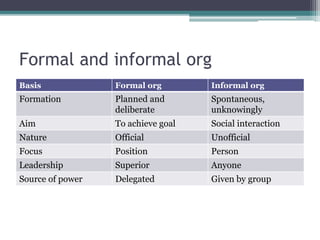
Formal and informal org
Basis Formal org Informal org
Formation Planned and
deliberate
Spontaneous,
unknowingly
Aim To achieve goal Social interaction
Nature Official Unofficial
Focus Position Person
Leadership Superior Anyone
Source of power Delegated Given by group
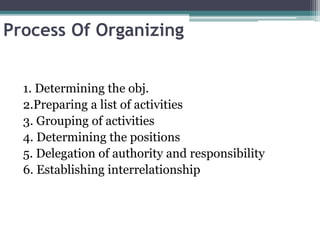
Process Of Organizing
1. Determining the obj.
2.Preparing a list of activities
3. Grouping of activities
4. Determining the positions
5. Delegation of authority and responsibility
6. Establishing interrelationship
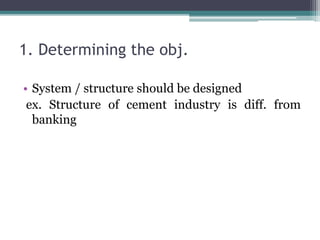
1. Determining the obj.
• System / structure should be designed
ex. Structure of cement industry is diff. from
banking
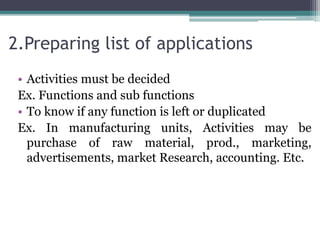
2.Preparing list of applications
• Activities must be decided
Ex. Functions and sub functions
• To know if any function is left or duplicated
Ex. In manufacturing units, Activities may be
purchase of raw material, prod., marketing,
advertisements, market Research, accounting. Etc.
3. Grouping of activities
• Similar activity should be in a same group
Ex. Selling, advertising, distribution, m.r.
• Departmentation: Various activities are
classified in various groups to form departments
Departmentation:
• Based on function: production, marketing,
finance, acc.
• Based on geographical areas: govt org. i.e., post,
railways, telephone
- requirement of local people can be fulfilled
• Based on products:
• Based on customers:
4. Determining the positions
• One official as in charge of each department
-Ex. Purchase officer for purchase section
• Departmental head
5. Delegation of authority and
responsibility
• One person can not perform all function so its
divided to other persons(subordinates)
• To perform the task certain authority and
responsibility must be given
• Officer must be responsible for the performance
of his subordinates
• Decentralization: required if the size of the
business is greater
6. Establishing interrelationship
• Interrelationship between various departments for
perfect coordination
• Manager must be informed about duties, authority
and inter-relationship with other departments
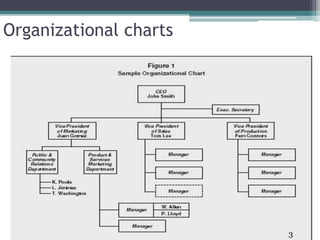
• Org chart can be prepared
Organizational charts
• Providing information about organizational
relationship
• It’s a diagrammatic representation of the major
functions and their relationship, channel of
authority
Organizational charts
3
References:
1. http://www.h-lapoal.co.il/wp-content/uploads/2014/07/9088529.jpg
2. https://lh5.ggpht.com/alEdnVq8WwbEN2PiJgT0sd2RY2hJ2L5CaOUxwSYIlL4Lr
g_-O9SKWzRehEAF3AuF_9ROxw=s85
3. https://lh4.ggpht.com/N0nt8asFlBNVM2_LF92wpQg_g-
I5ICGHVTqGkjUWXDQj5UhVft8PWOGgp6xATVvD6I9RPQ=s108

Bba i pom u 2.1 organising

  • 1.
  • 2.
    Topics • Organizing: Nature,importance, process, formal & informal organizations, Organizational Charts • Departmentaion: Definition, Bases of departmentation, Types of organization structure- functional, divisional, project, matrix organization. Authority: definition, types, responsibility & accountability, delegation; definition, steps in delegation, obstacles to delegation and their elimination, what is decentralization and centralization. (Ch.11 to 15 – Principles and Practice of Management by L.M.Prasad)
  • 3.
    What is organizing •Planning focuses on deciding what to do - Organizing focuses on how to do it • Planning- obj/goal • Organizing- organizing people and allocate resources to carry out the plan
  • 4.
    Definition • When 2or more persons work together towards a common goal, authority & responsibilities are allocated among them so that their efforts may become effective. Authority and Responsibility 1 2
  • 5.
    Definition • It’s amgt. function involves assigning duties, grouping tasks, delegating authority and responsibility and allocating resources to carry out a specific plan • System of cooperative activities of two or more persons • Urwick: ‘org. is the process of dividing up of the activities which are necessary to any purpose and arranging them in groups which are assigned to individual’
  • 6.
    A. & R. •Authority: A right inherent in a managerial position to tell people what to do and to expect them to do it, right to make decisions and carry out actions to achieve organizational goals. Ex. Taking decision of launching new product, decision of giving holiday, signing a document • Responsibility: An obligation or expectation to perform and carry out duties and achieve goals related to a position Ex. To achieve the target/function, problem solving
  • 7.
    Importance • Helps individualabout the tasks he or she is expected to accomplish. • creates channels of communication and thus supports decision-making and control. • Smooth flow of work activities • efficient use of its resources and avoid conflict and duplication of effort. • harmonious relationships • supports planning and control activities by establishing accountability and an appropriate line of authority.
  • 8.
    Formal and informalorganization • Formal: - For specific goal - Definite authority, responsibility - Ex. Marketing department, HR department • Informal: - Natural grouping of people on basis of similarity in thoughts/beliefs, habits - Ex. Lunch group, sports group, festival/events, south Indian employees, smoke/music
  • 9.
    Formal and informalorg Basis Formal org Informal org Formation Planned and deliberate Spontaneous, unknowingly Aim To achieve goal Social interaction Nature Official Unofficial Focus Position Person Leadership Superior Anyone Source of power Delegated Given by group
  • 10.
    Process Of Organizing 1.Determining the obj. 2.Preparing a list of activities 3. Grouping of activities 4. Determining the positions 5. Delegation of authority and responsibility 6. Establishing interrelationship
  • 11.
    1. Determining theobj. • System / structure should be designed ex. Structure of cement industry is diff. from banking
  • 12.
    2.Preparing list ofapplications • Activities must be decided Ex. Functions and sub functions • To know if any function is left or duplicated Ex. In manufacturing units, Activities may be purchase of raw material, prod., marketing, advertisements, market Research, accounting. Etc.
  • 13.
    3. Grouping ofactivities • Similar activity should be in a same group Ex. Selling, advertising, distribution, m.r. • Departmentation: Various activities are classified in various groups to form departments
  • 14.
    Departmentation: • Based onfunction: production, marketing, finance, acc. • Based on geographical areas: govt org. i.e., post, railways, telephone - requirement of local people can be fulfilled • Based on products: • Based on customers:
  • 15.
    4. Determining thepositions • One official as in charge of each department -Ex. Purchase officer for purchase section • Departmental head
  • 16.
    5. Delegation ofauthority and responsibility • One person can not perform all function so its divided to other persons(subordinates) • To perform the task certain authority and responsibility must be given • Officer must be responsible for the performance of his subordinates • Decentralization: required if the size of the business is greater
  • 17.
    6. Establishing interrelationship •Interrelationship between various departments for perfect coordination • Manager must be informed about duties, authority and inter-relationship with other departments • Org chart can be prepared
  • 18.
    Organizational charts • Providinginformation about organizational relationship • It’s a diagrammatic representation of the major functions and their relationship, channel of authority
  • 19.
  • 21.