MODULE 3:
ORGANIZING
Dr.A.Poomagal
Assistant Professor
SRFMS
DEFINITION OF ORGANIZING
• “The process of determining the tasks to be
done, who will do them, and how those
tasks will be managed and coordinated”
• To structure or arrange the relationship
between people, the work to be done, &
the facilities so that goals are achieved.
Why Organize?
• Managers have to organize the activities they
want to perform for the following reasons:
☺ So that they can divide the work according
to the nature & similarity of tasks.
☺ So that they can pool resources & increase
the efforts which lead to efficiency.
☺ So that they can build continuity & synergy.
continue…
• A manager who wants to organize his/her
department must address these issues:
 Determine what is to be done
 Assigning tasks
 Decide how to achieve coordination
 Decide on a span of management
 Decide how much authority you should
designate
 Draw an organizational chart
What is organizational
structure?
 Shows the flow of interactions within the
organization
 Specifies its division of work activities and
shows how different functions of activities are
linked
 Shows level of specialization of work activities
 Indicates the organization’s hierarchy and
authority structure
 Shows organization’s reporting structure
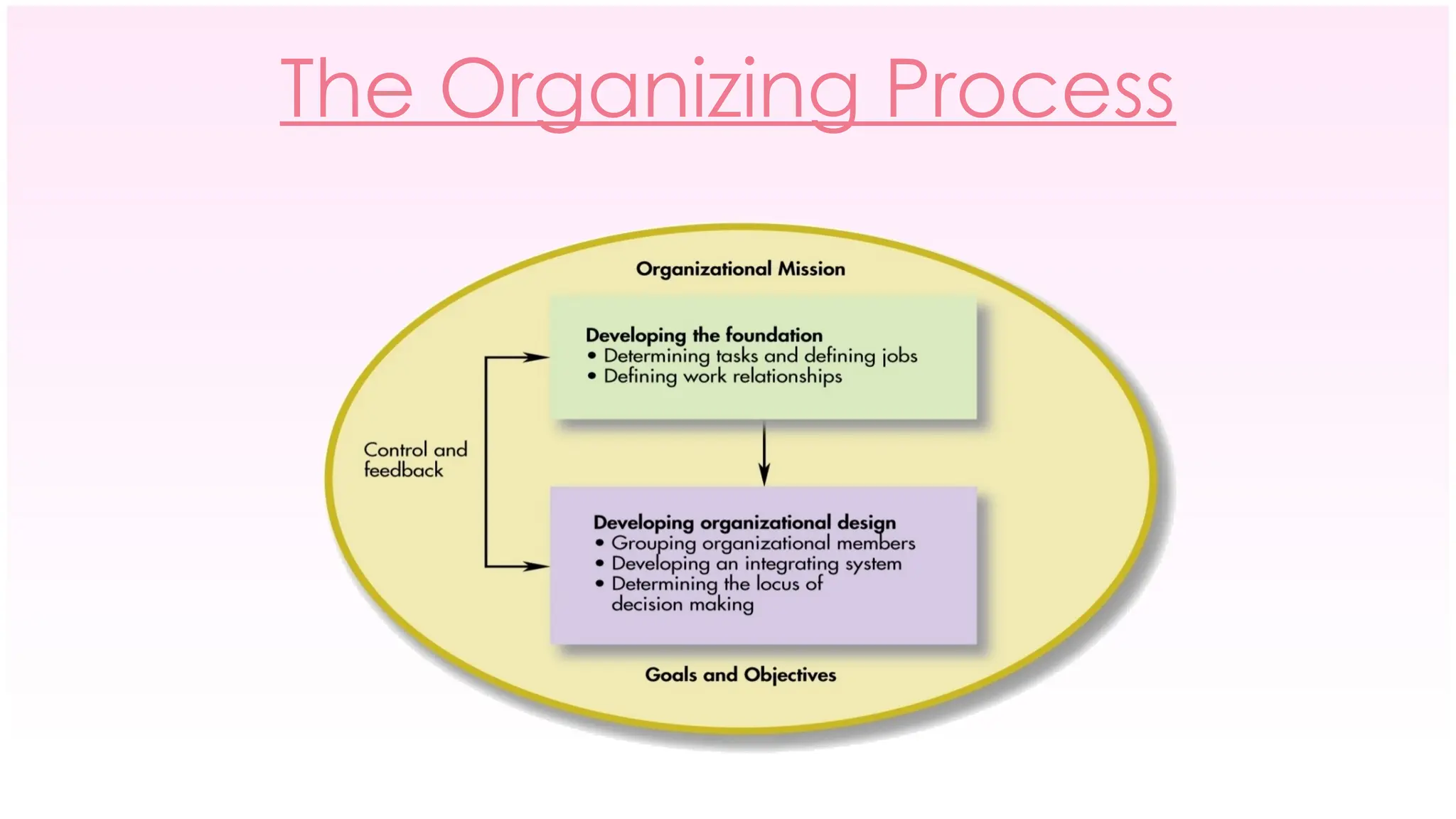
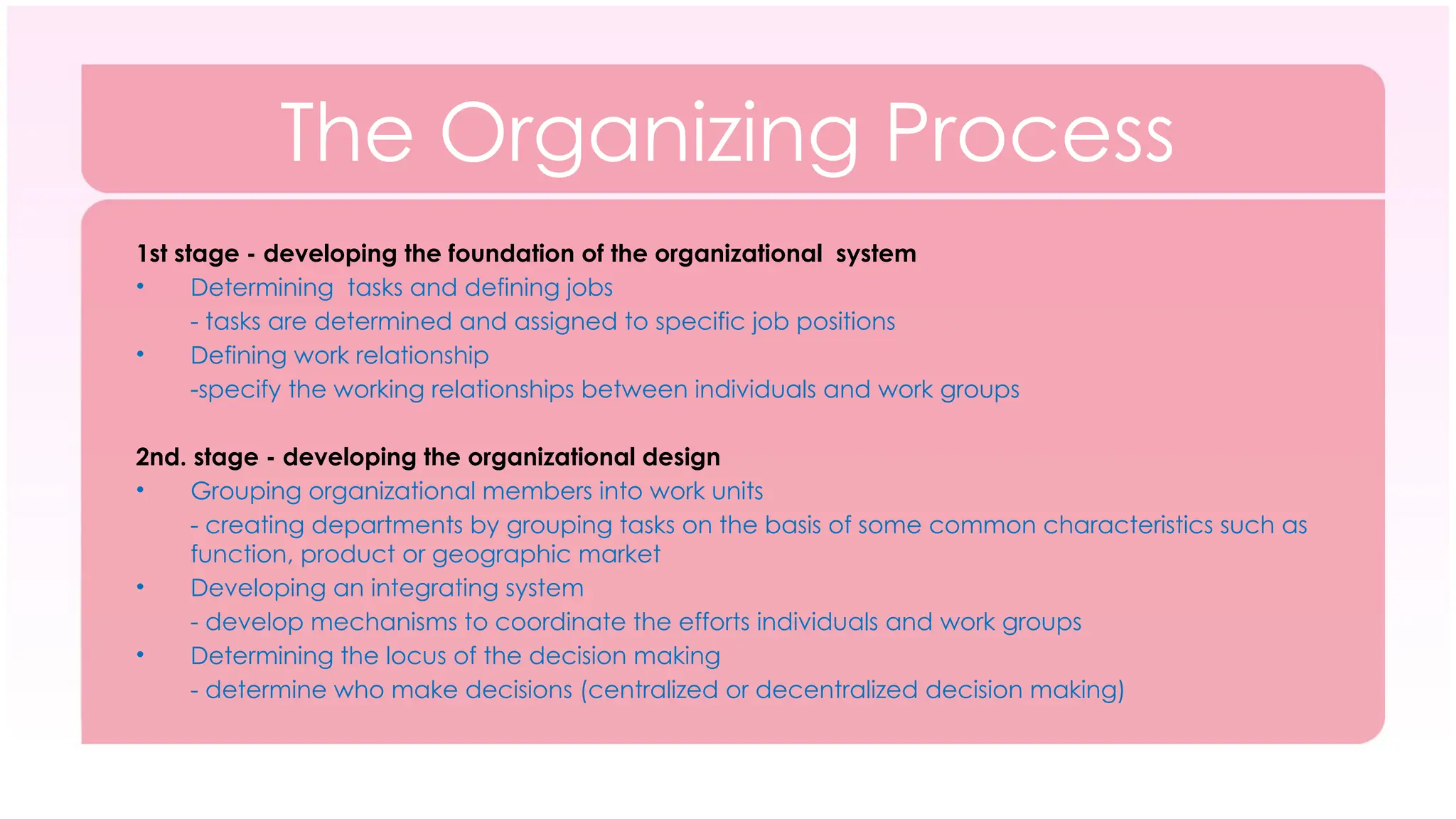
The Organizing Process
1st stage - developing the foundation of the organizational system
• Determining tasks and defining jobs
- tasks are determined and assigned to specific job positions
• Defining work relationship
-specify the working relationships between individuals and work groups
2nd. stage - developing the organizational design
• Grouping organizational members into work units
- creating departments by grouping tasks on the basis of some common characteristics such as
function, product or geographic market
• Developing an integrating system
- develop mechanisms to coordinate the efforts individuals and work groups
• Determining the locus of the decision making
- determine who make decisions (centralized or decentralized decision making)
DIVISION OF WORK/LABOUR
• The work has to be divided
among the members so that
individuals are responsible for a
limited set of jobs instead doing
the task as a whole.
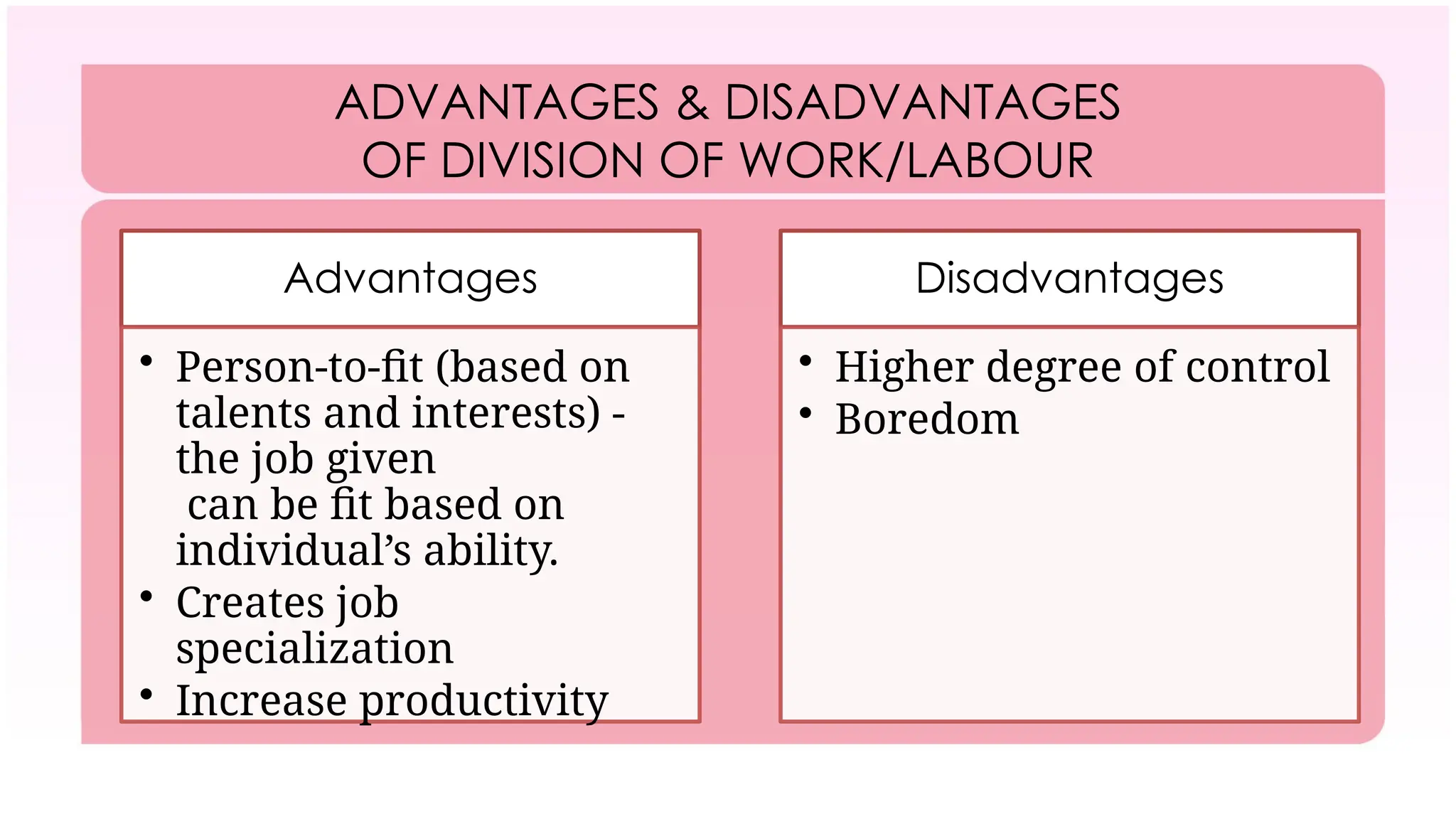
ADVANTAGES & DISADVANTAGES
OF DIVISION OF WORK/LABOUR
Advantages
• Person-to-fit (based on
talents and interests) -
the job given
can be fit based on
individual’s ability.
• Creates job
specialization
• Increase productivity
Disadvantages
• Higher degree of control
• Boredom
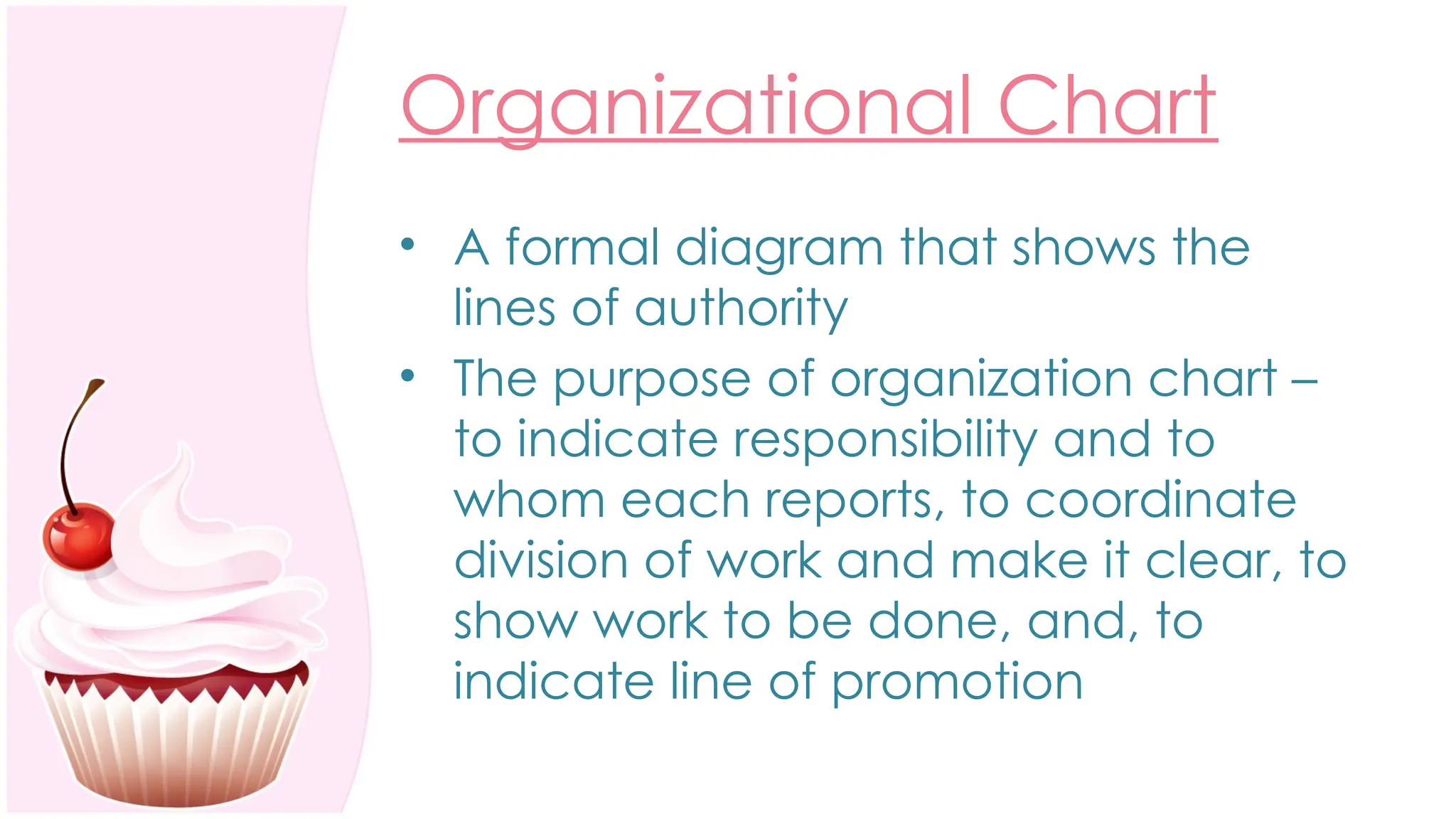
Organizational Chart
• A formal diagram that shows the
lines of authority
• The purpose of organization chart –
to indicate responsibility and to
whom each reports, to coordinate
division of work and make it clear, to
show work to be done, and, to
indicate line of promotion
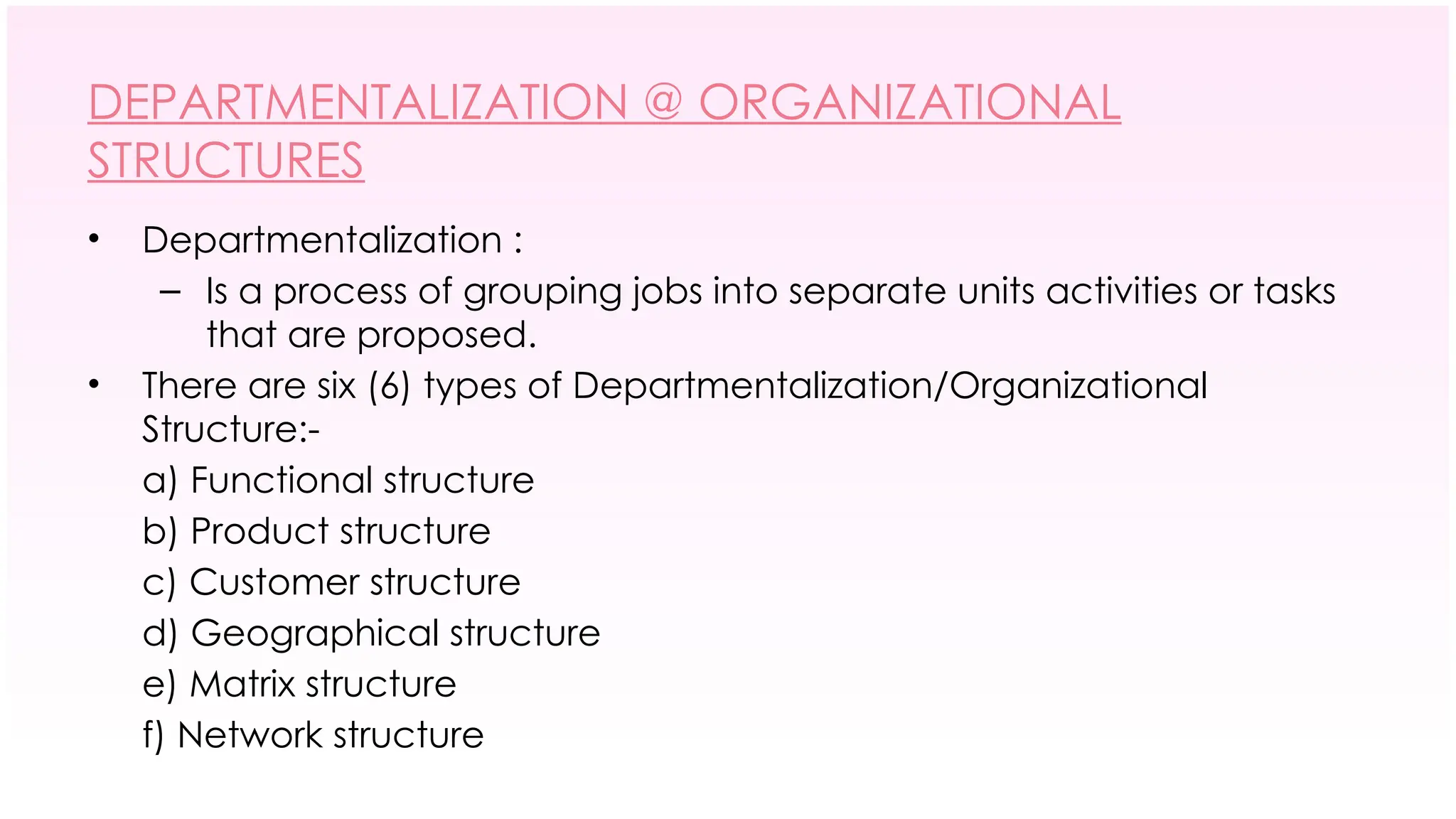
DEPARTMENTALIZATION @ ORGANIZATIONAL
STRUCTURES
• Departmentalization :
– Is a process of grouping jobs into separate units activities or tasks
that are proposed.
• There are six (6) types of Departmentalization/Organizational
Structure:-
a) Functional structure
b) Product structure
c) Customer structure
d) Geographical structure
e) Matrix structure
f) Network structure
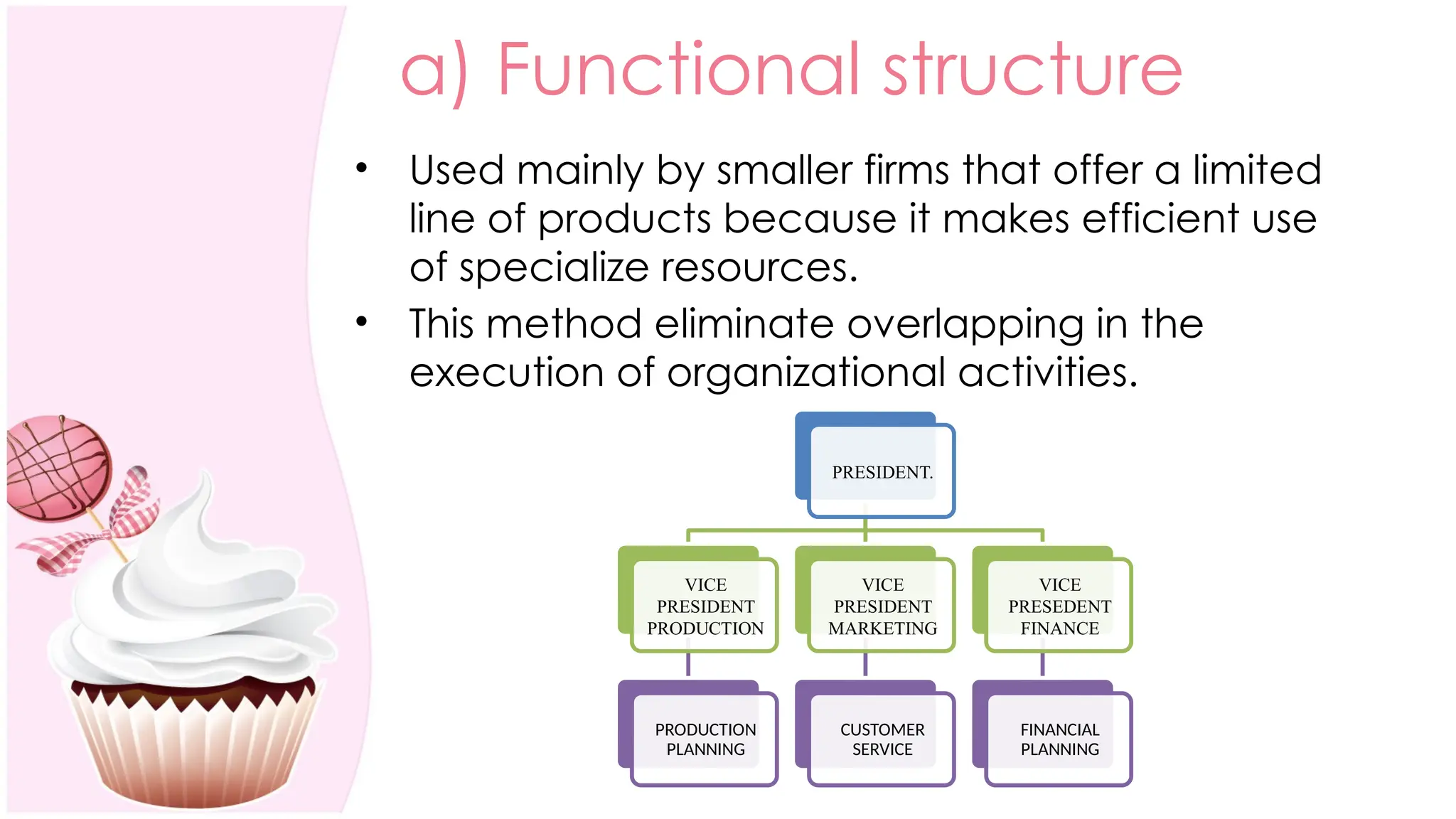
a) Functional structure
• Used mainly by smaller firms that offer a limited
line of products because it makes efficient use
of specialize resources.
• This method eliminate overlapping in the
execution of organizational activities.
PRESIDENT.
VICE
PRESIDENT
PRODUCTION
PRODUCTION
PLANNING
VICE
PRESIDENT
MARKETING
CUSTOMER
SERVICE
VICE
PRESEDENT
FINANCE
FINANCIAL
PLANNING
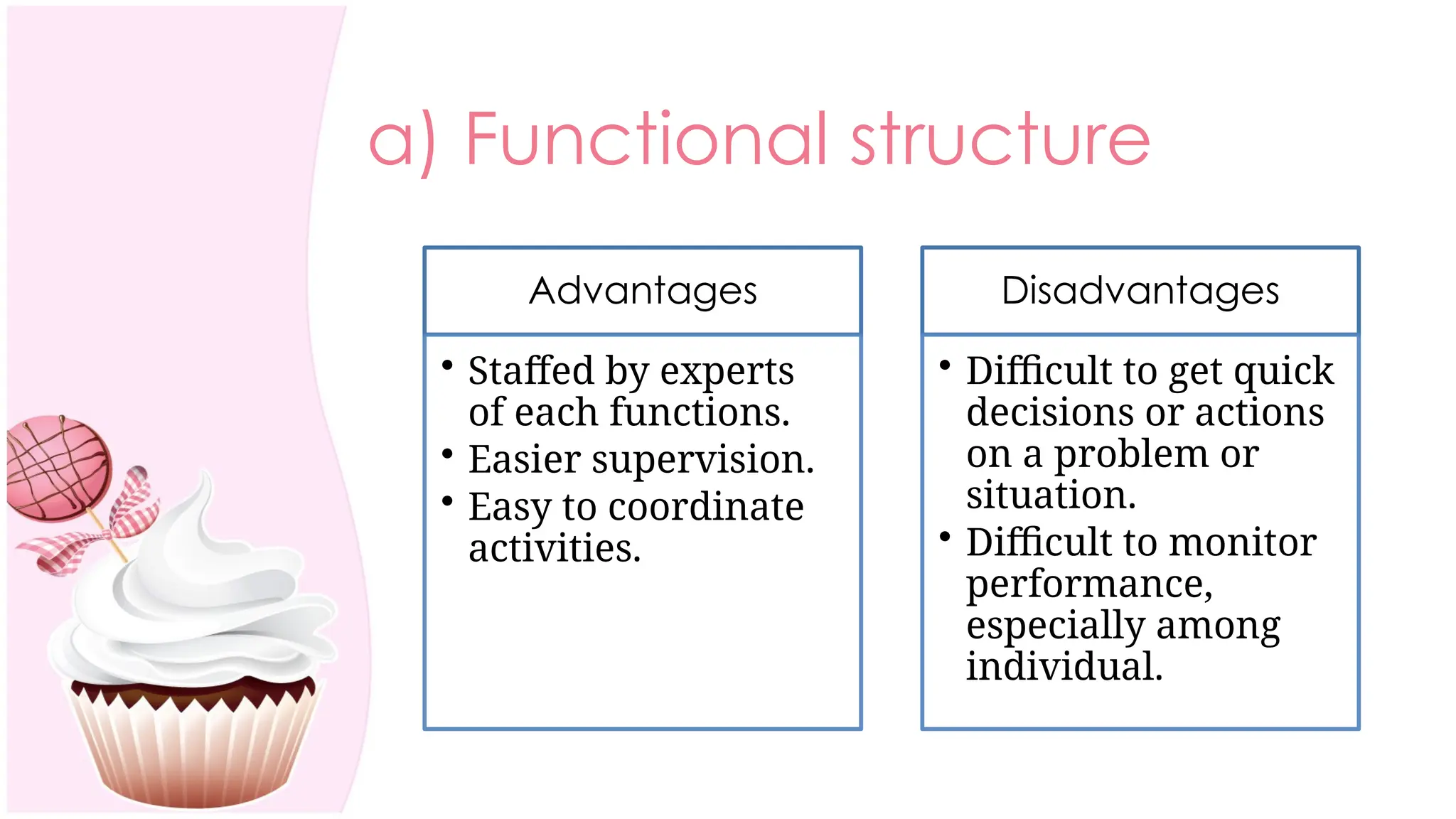
a) Functional structure
Advantages
• Staffed by experts
of each functions.
• Easier supervision.
• Easy to coordinate
activities.
Disadvantages
• Difficult to get quick
decisions or actions
on a problem or
situation.
• Difficult to monitor
performance,
especially among
individual.
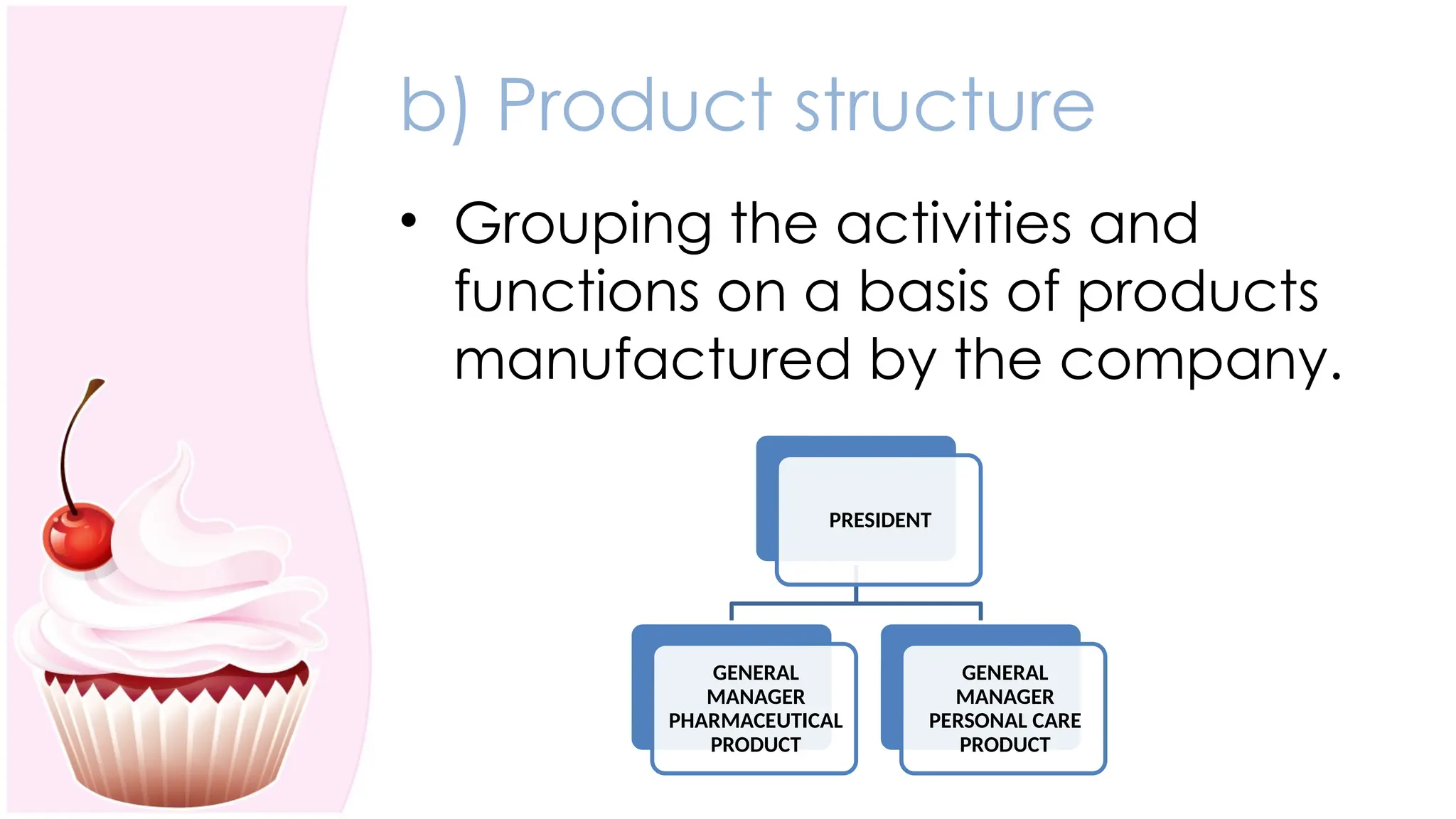
b) Product structure
• Grouping the activities and
functions on a basis of products
manufactured by the company.
PRESIDENT
GENERAL
MANAGER
PHARMACEUTICAL
PRODUCT
GENERAL
MANAGER
PERSONAL CARE
PRODUCT
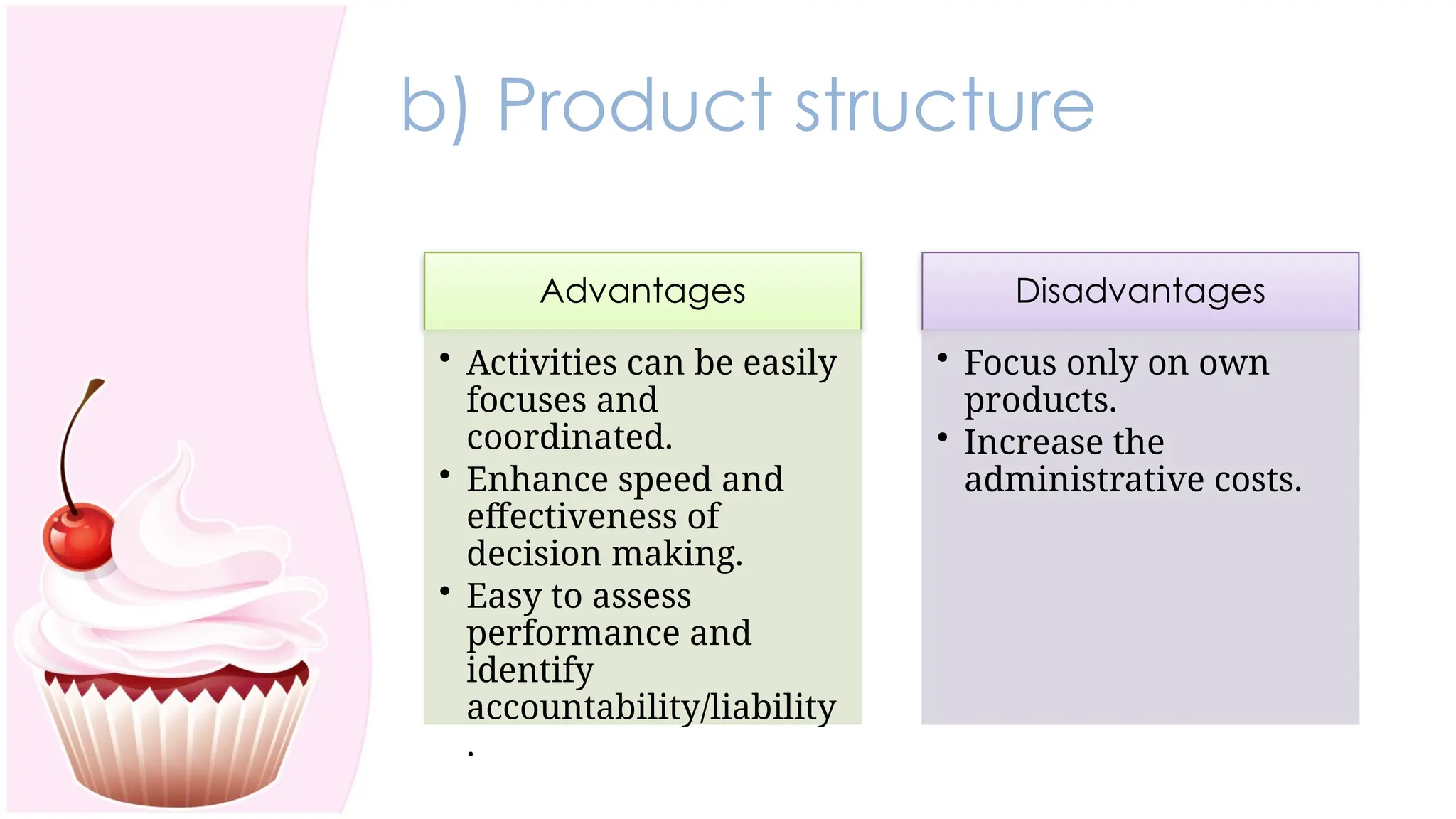
b) Product structure
Advantages
• Activities can be easily
focuses and
coordinated.
• Enhance speed and
effectiveness of
decision making.
• Easy to assess
performance and
identify
accountability/liability
.
Disadvantages
• Focus only on own
products.
• Increase the
administrative costs.
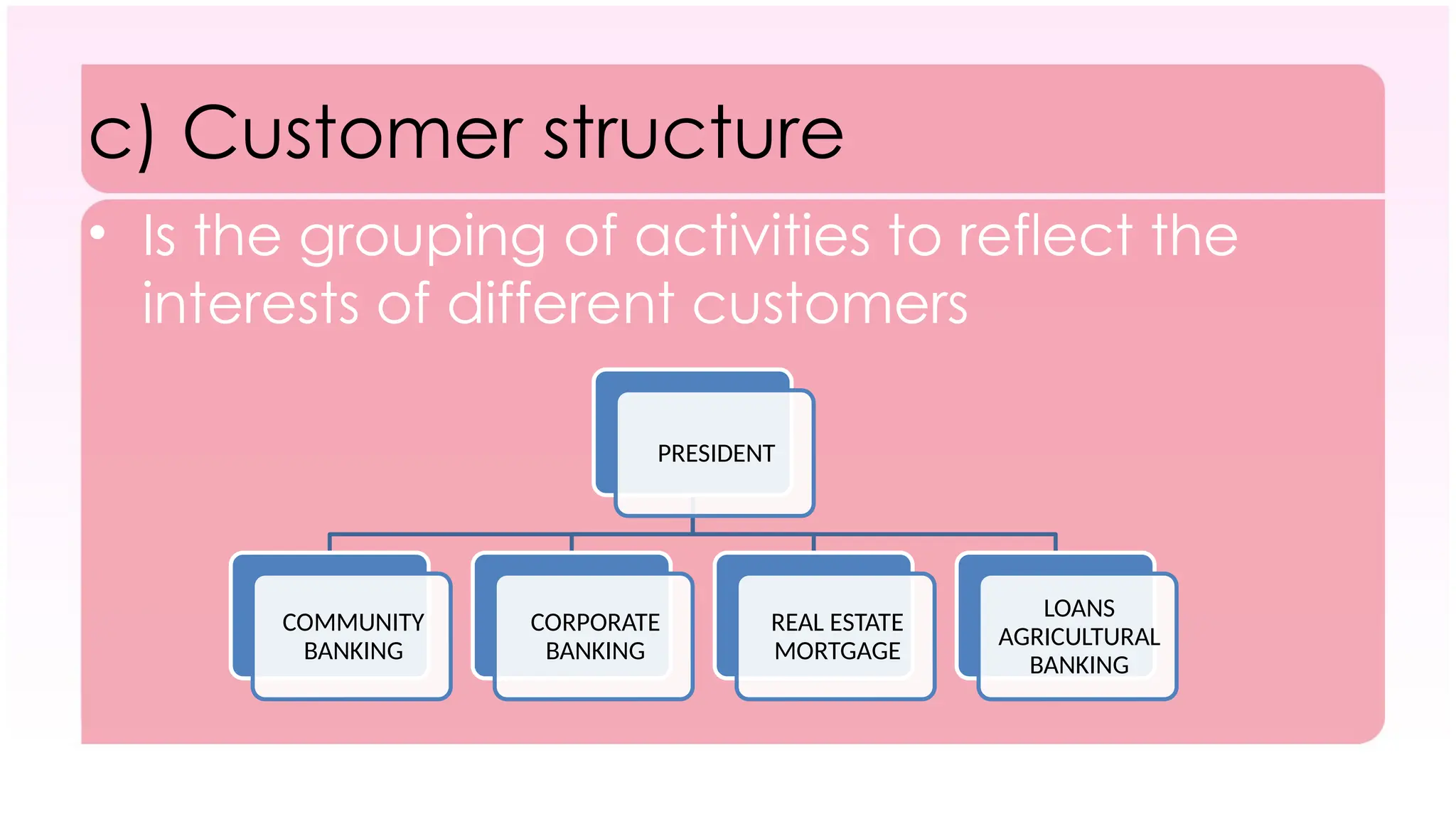
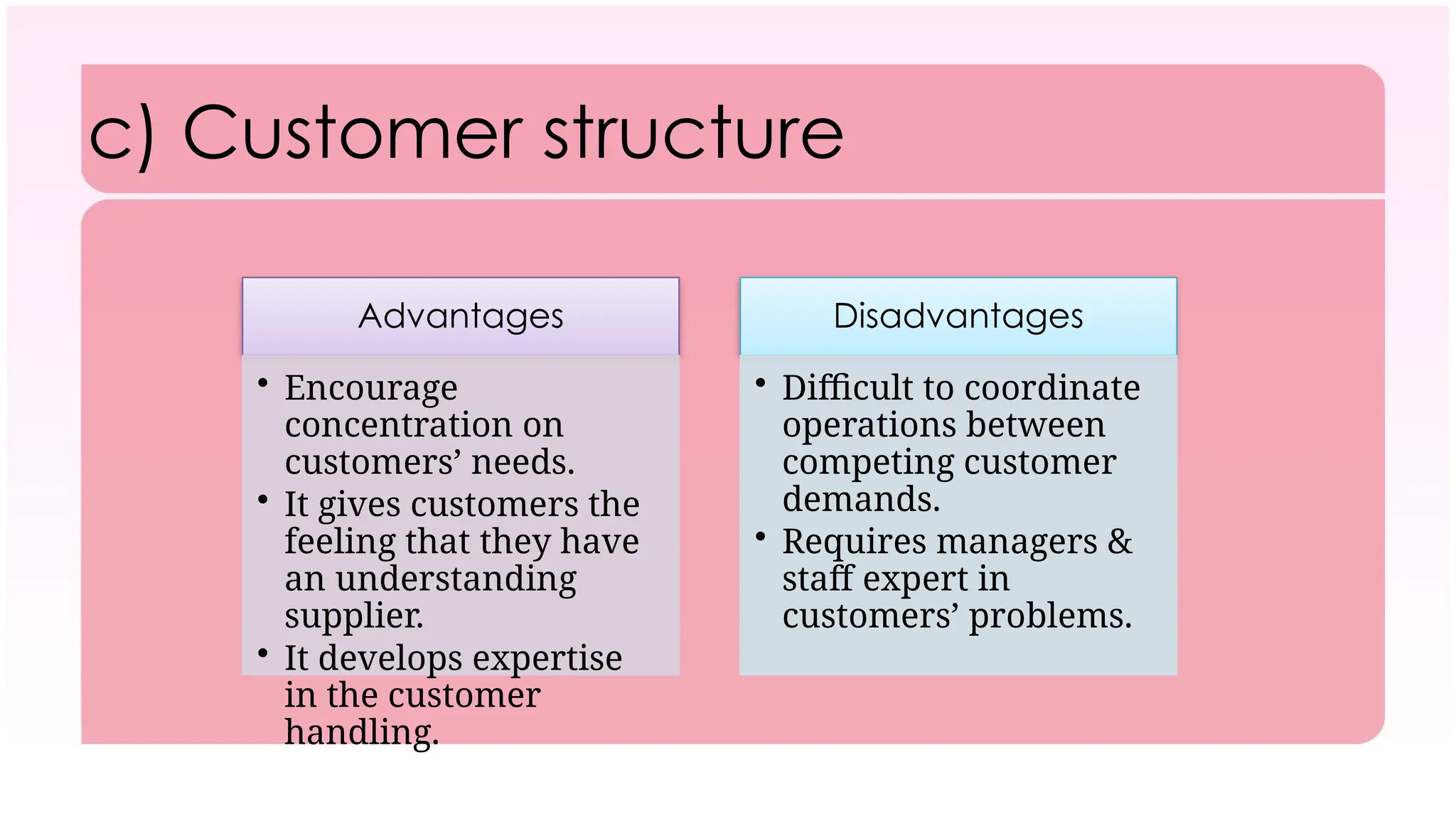
c) Customer structure
• Is the grouping of activities to reflect the
interests of different customers
PRESIDENT
COMMUNITY
BANKING
CORPORATE
BANKING
REAL ESTATE
MORTGAGE
LOANS
AGRICULTURAL
BANKING
c) Customer structure
Advantages
• Encourage
concentration on
customers’ needs.
• It gives customers the
feeling that they have
an understanding
supplier.
• It develops expertise
in the customer
handling.
Disadvantages
• Difficult to coordinate
operations between
competing customer
demands.
• Requires managers &
staff expert in
customers’ problems.
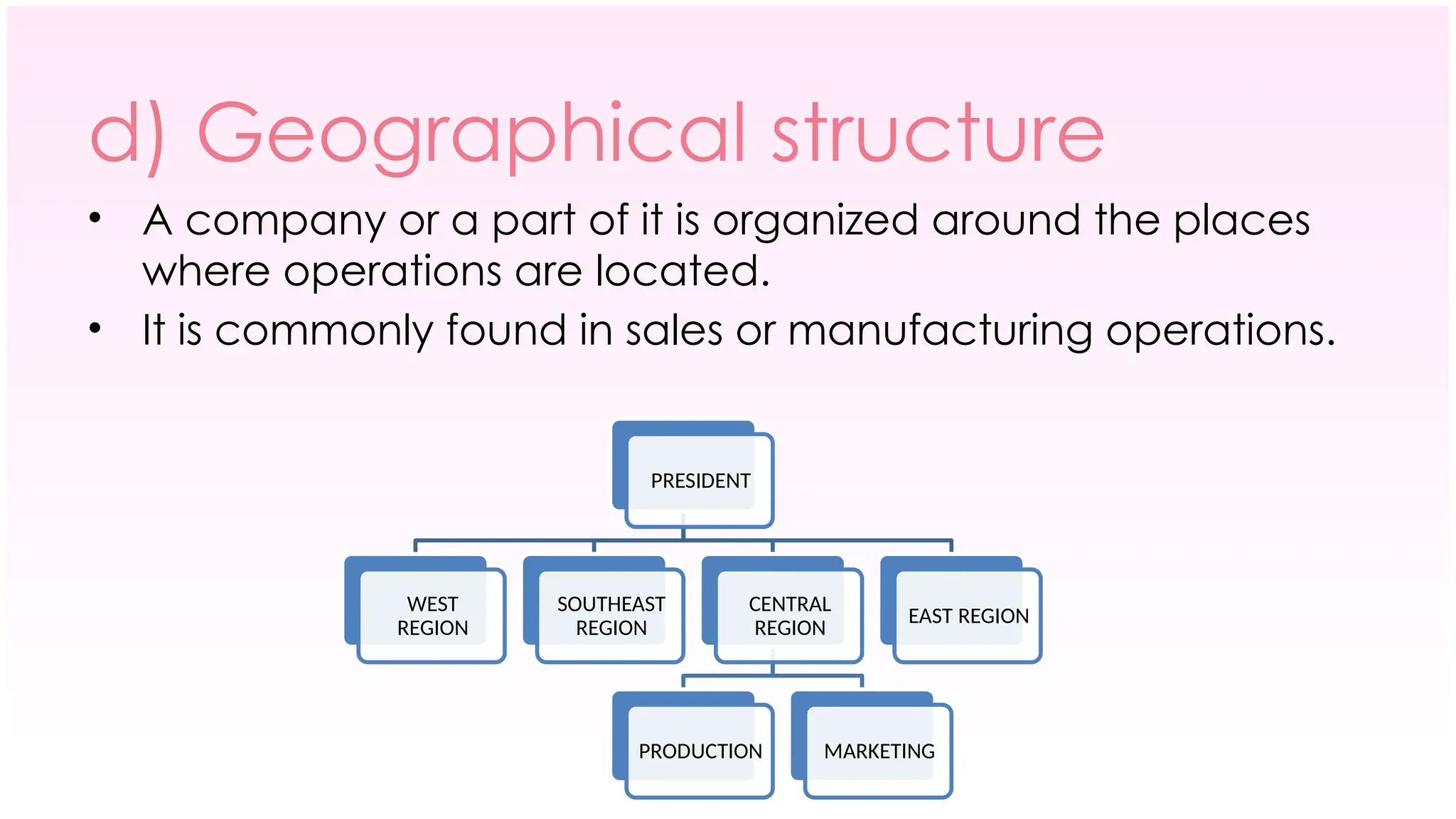
d) Geographical structure
• A company or a part of it is organized around the places
where operations are located.
• It is commonly found in sales or manufacturing operations.
PRESIDENT
WEST
REGION
SOUTHEAST
REGION
CENTRAL
REGION
PRODUCTION MARKETING
EAST REGION
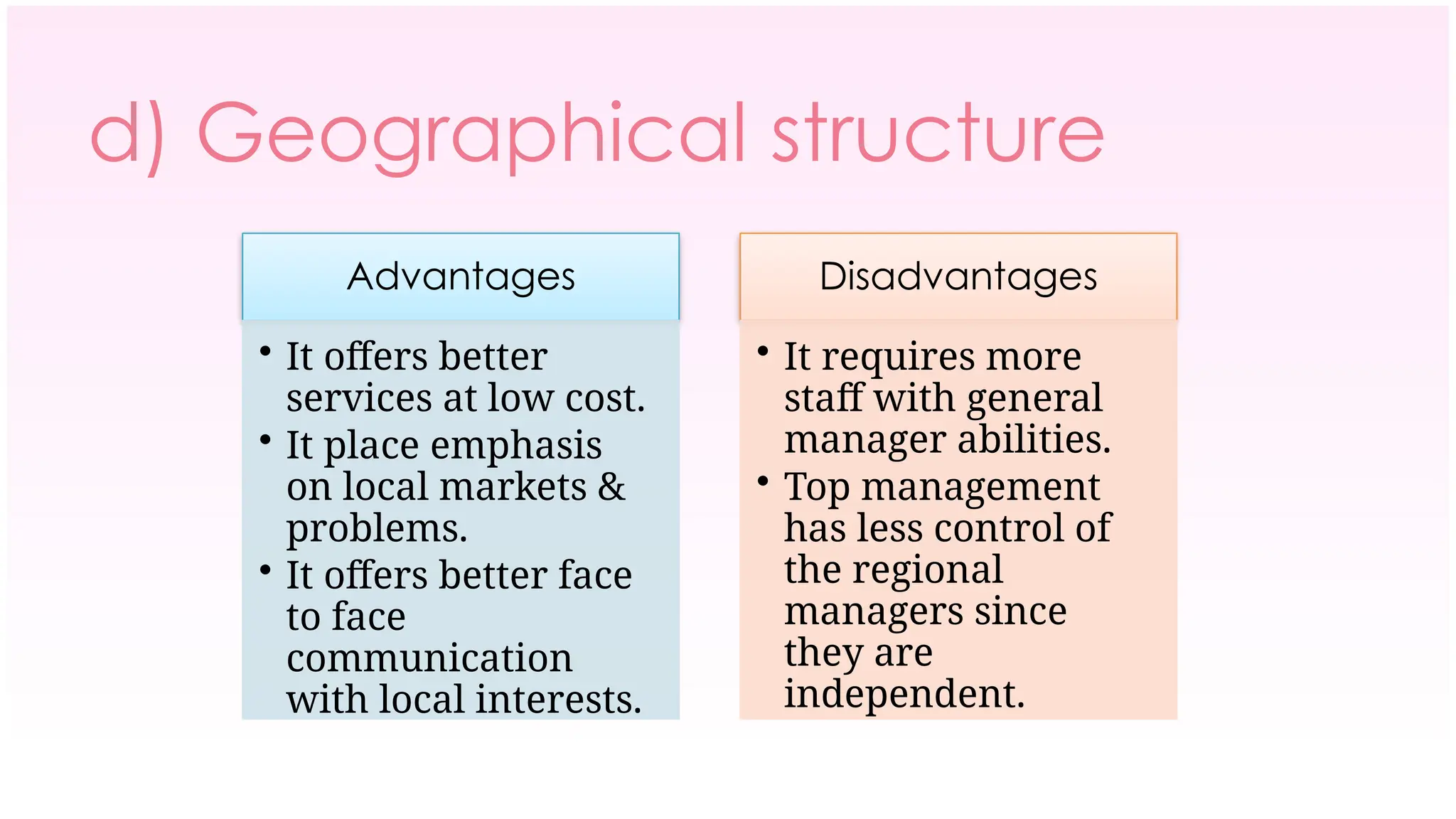
d) Geographical structure
Advantages
• It offers better
services at low cost.
• It place emphasis
on local markets &
problems.
• It offers better face
to face
communication
with local interests.
Disadvantages
• It requires more
staff with general
manager abilities.
• Top management
has less control of
the regional
managers since
they are
independent.
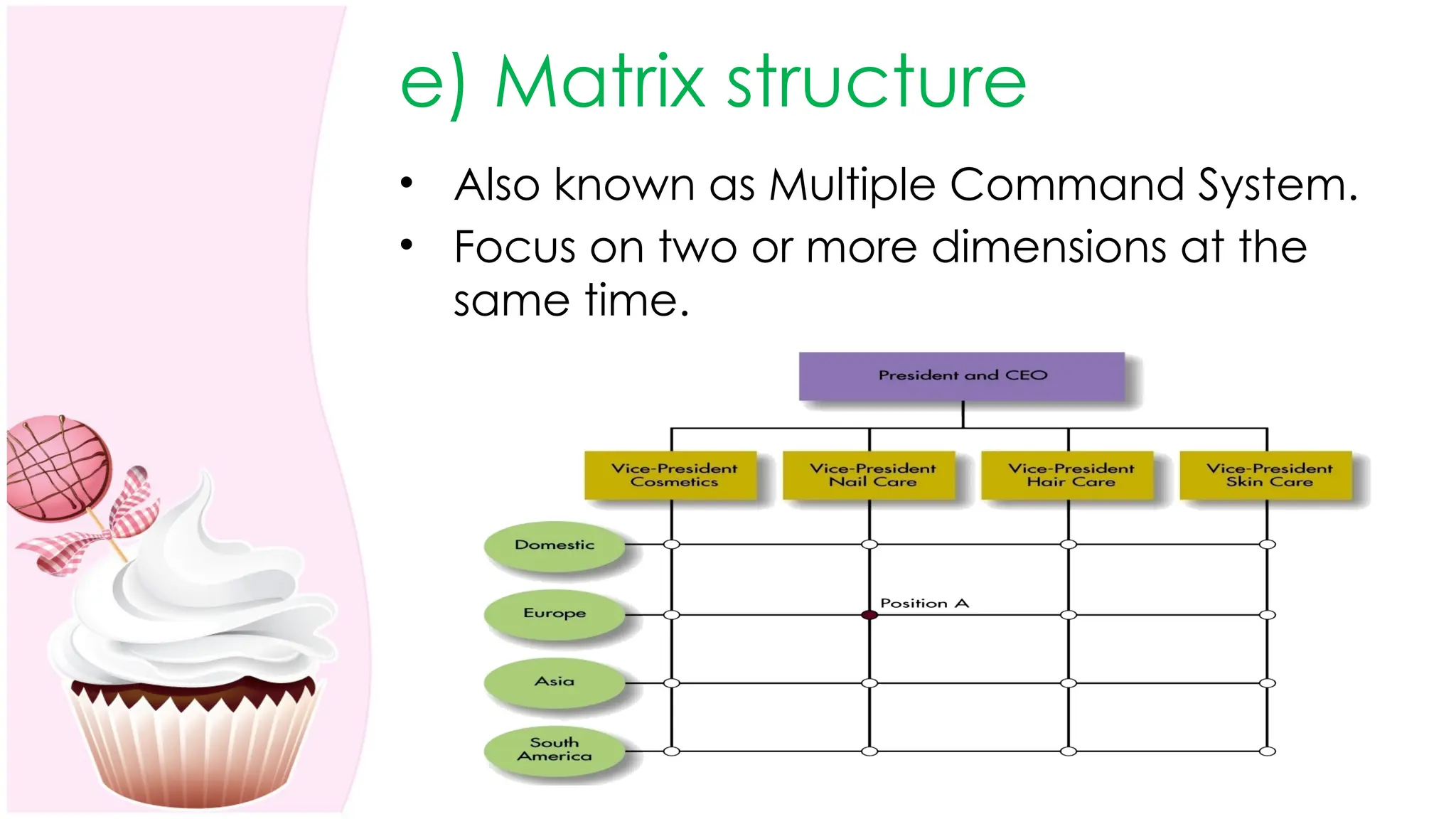
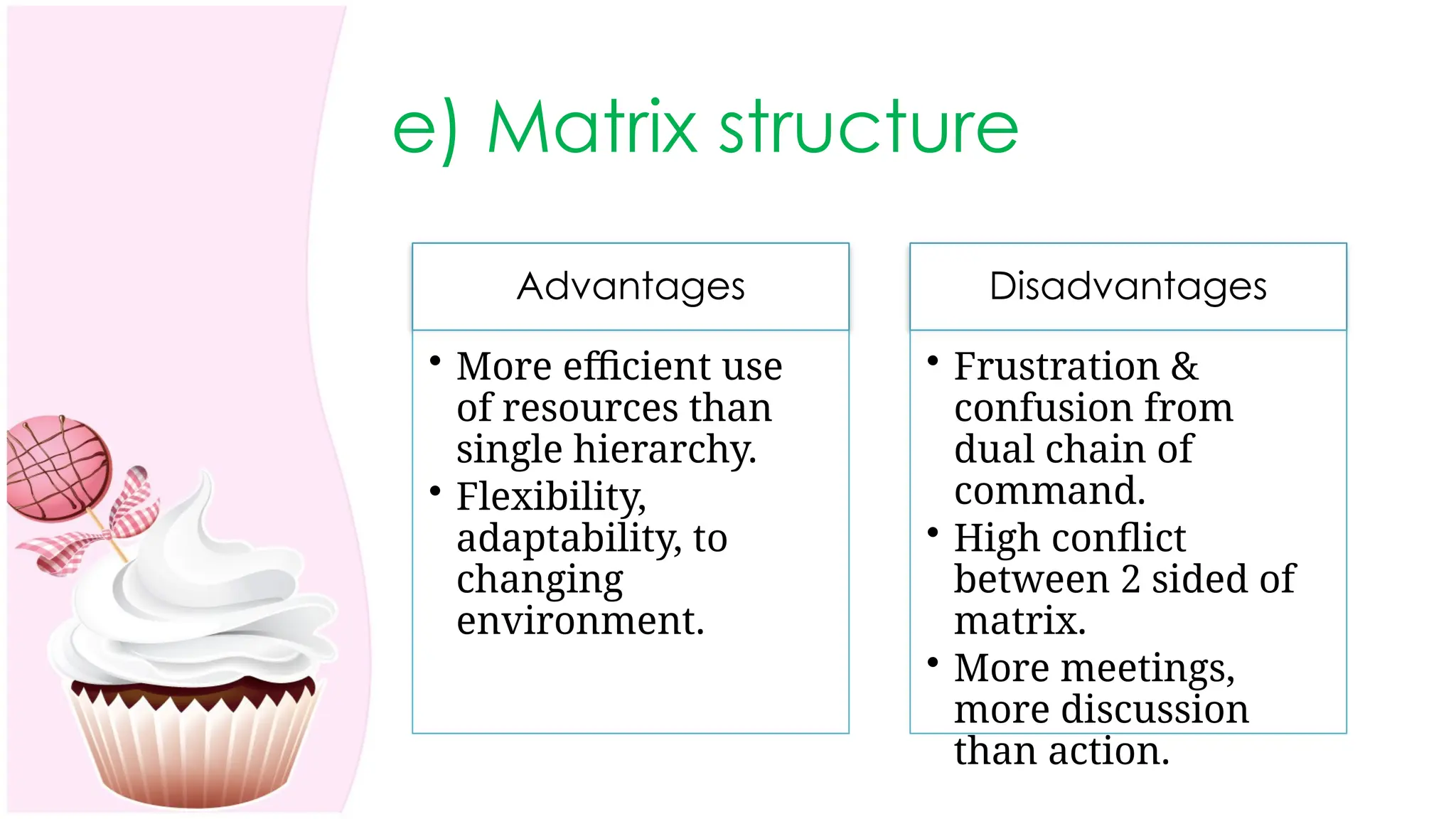
e) Matrix structure
• Also known as Multiple Command System.
• Focus on two or more dimensions at the
same time.
e) Matrix structure
Advantages
• More efficient use
of resources than
single hierarchy.
• Flexibility,
adaptability, to
changing
environment.
Disadvantages
• Frustration &
confusion from
dual chain of
command.
• High conflict
between 2 sided of
matrix.
• More meetings,
more discussion
than action.
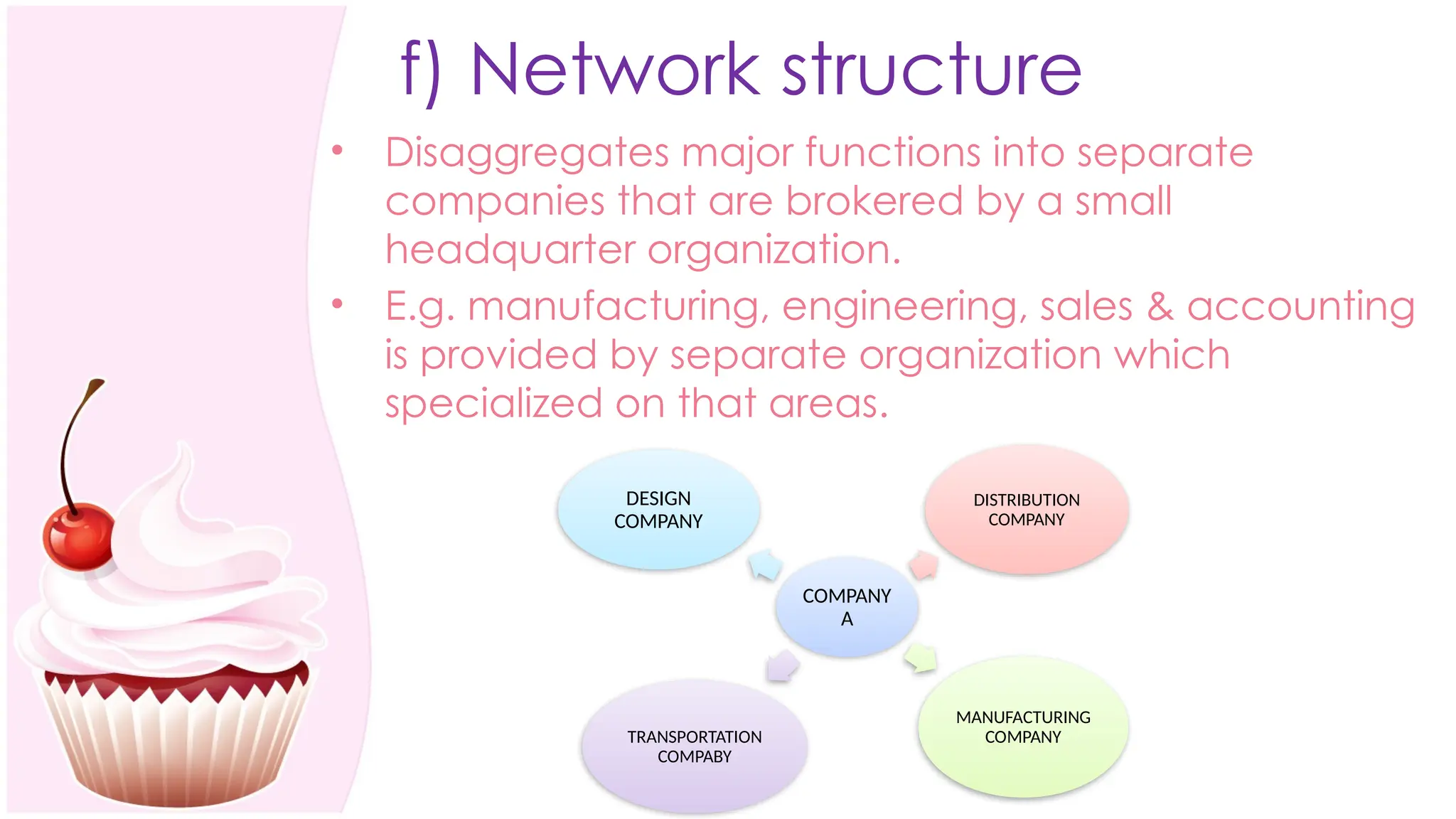
f) Network structure
• Disaggregates major functions into separate
companies that are brokered by a small
headquarter organization.
• E.g. manufacturing, engineering, sales & accounting
is provided by separate organization which
specialized on that areas.
COMPANY
A
DISTRIBUTION
COMPANY
MANUFACTURING
COMPANY
TRANSPORTATION
COMPABY
DESIGN
COMPANY
f) Network structure
Advantages
• Global
competitiveness.
• Workforce
challenge.
• Reduce
administrative
cost.
Disadvantages
• No hands-on
control.
• Can lose
organization
part.
• Employee loyalty
weakened.
SPAN OF MANAGEMENT
 Definition : A number of subordinates who report directly to a given
manager of supervision
 Also called ‘span of control’
◦ In theory, when tasks are very complex, span of control should be
relatively narrow.
◦ In contrast, where jobs are highly standardized and routine (low
complexity), a manager will not need to spend as much time
supporting individual subordinates, and the span of control may be
larger.
MAJOR FACTORS THAT INFLUENCE
THE SPAN OF MANAGEMENT
• The type of work
• The strength of the organization
structure
• The ability of the manager
• The amount & type of
communication required among
the members
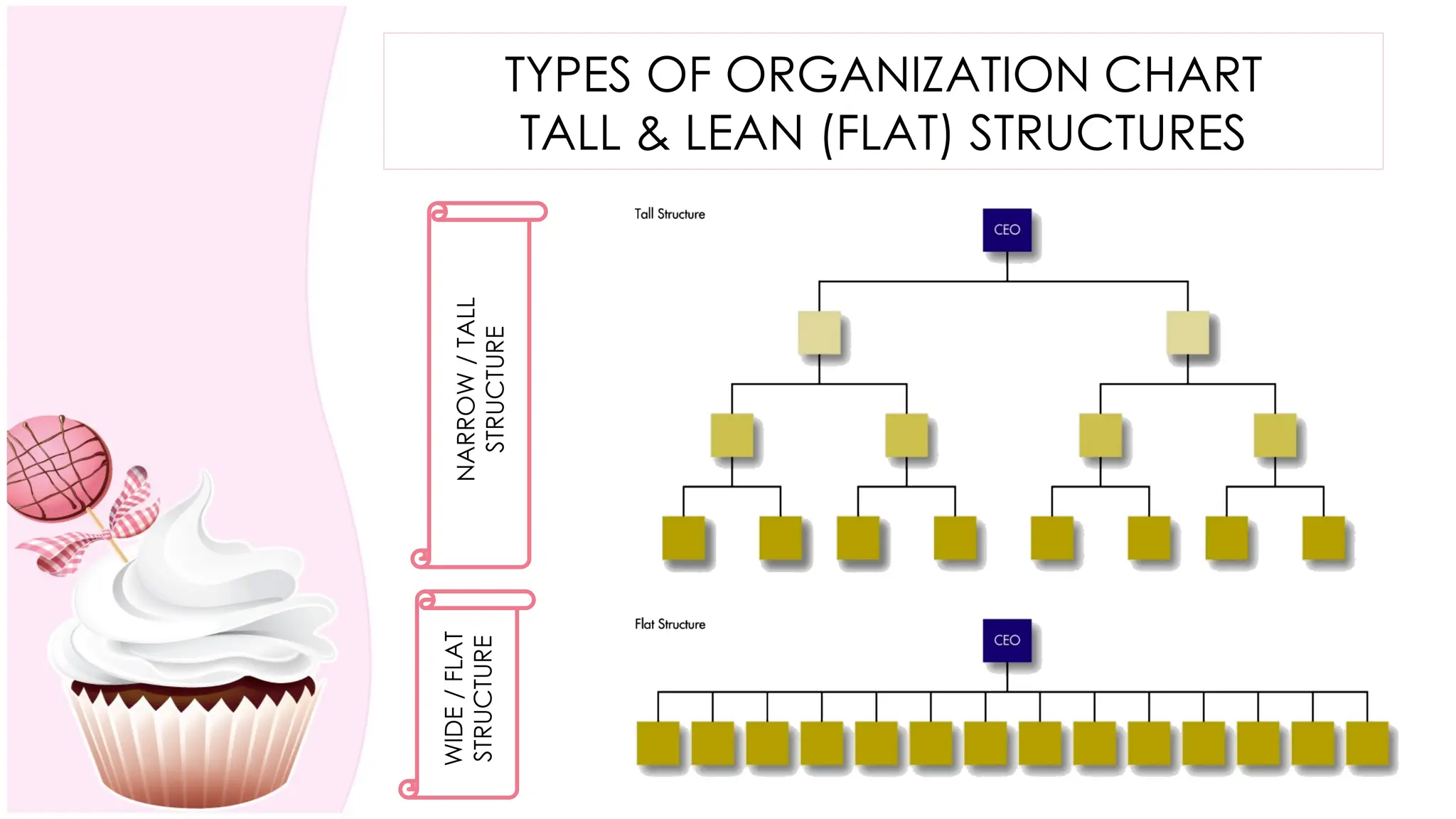
TYPES OF ORGANIZATION CHART
TALL & LEAN (FLAT) STRUCTURES
NARROW
/
TALL
STRUCTURE
WIDE
/
FLAT
STRUCTURE
Narrow/tall
span management
• Have short span of authority with
many organization levels
• Advantages – close supervision, close
control, and rapid communication
between subordinates and superiors
• Disadvantage – superiors tend to get
involved with subordinates work, high
cost, excessive distance between the
lowest level and the highest level.
Wide/flat span of management
• Have few organization levels with wide span of
authority
• Advantages – superiors are forced to delegate,
clear policies must be made and subordinates must
be carefully selected
• Disadvantages – decisions made by managers tend
to be bottleneck, superior’s loss of control, and
requires exceptional quality manager.
CHAIN OF COMMAND
• Definition : Separate lines of authority/power among all position in an
organization.
• It has 2 components:-
(i) UNITY OF COMMAND
- Suggests that each person within an organization must have a
clear reporting relationship to only one superior.
(ii) SCALAR RELATIONSHIP
- Suggests that there must be a clear and unbroken line of
authority that extends from the lowest to the highest position in
the organization.
AUTHORITY
• Definition : “The right to
make decisions with respect
to work assignments & to
require subordinates to
perform assigned tasks in
accordance with the
decision made”.
Line & Staff Authority
 Line Authority
◦ Those organizational members that are directly
involved in delivering the products and services of
the organization.
 Staff Authority
◦ Those organizational members that are not
directly involved in delivering the products and
services to the organization, but provide support
for line personnel.
DELEGATION
• Definition: “The process of transferring the authority for a
specific activity or task to another member of the
organization and empowering that individual to
accomplish the task effectively”.
• Transforming the responsibility for a specific activity or
task to another member of the organization.
• Empowering that individual to accomplish the task
effectively.
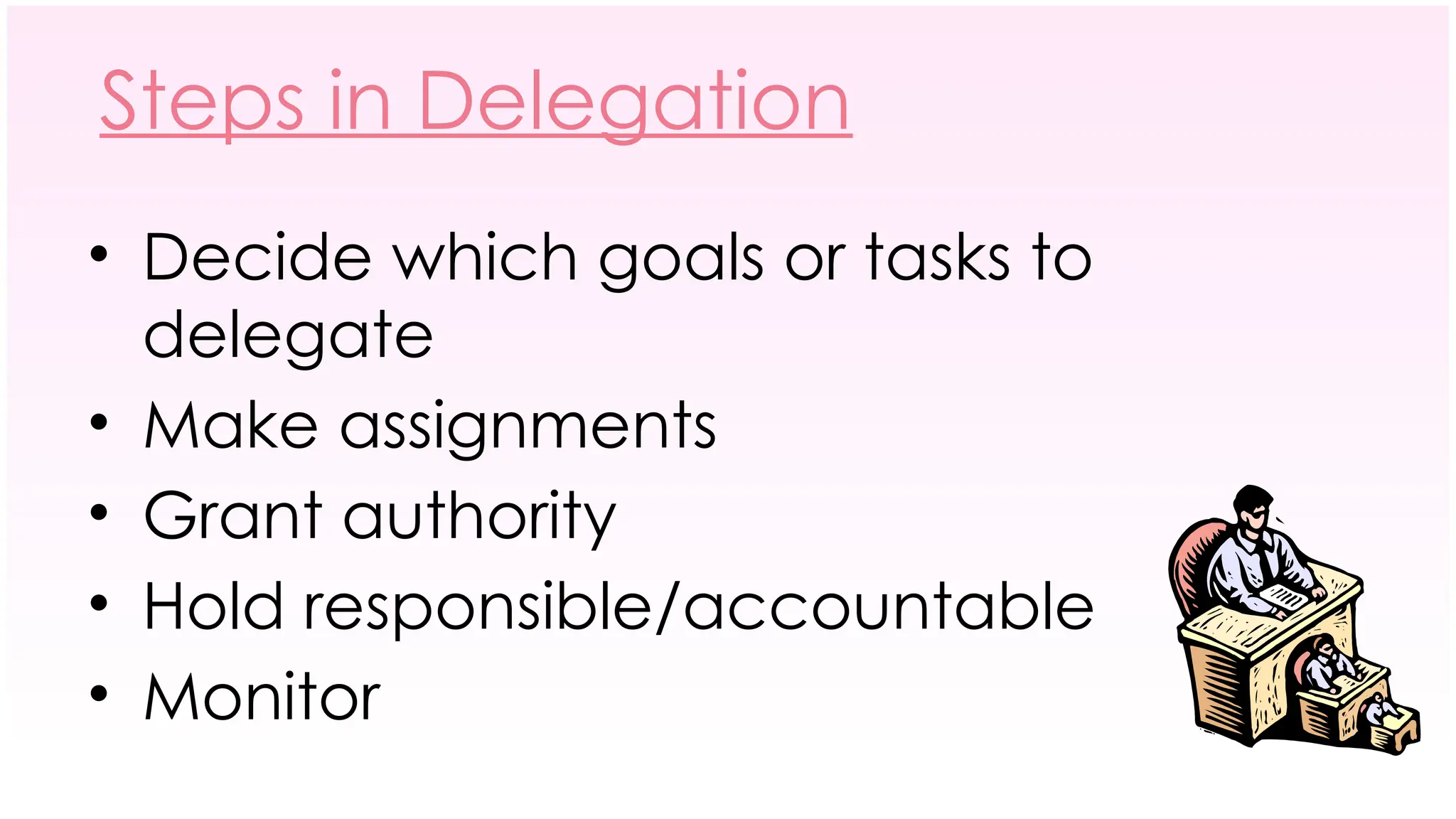
Steps in Delegation
• Decide which goals or tasks to
delegate
• Make assignments
• Grant authority
• Hold responsible/accountable
• Monitor
Benefits of Delegation
1. Empowerment
2. Better decision-making
3. Provide an opportunity for the
development of analytical and
problem-solving skills
4. Managers magnify their
accomplishments
Barriers of Delegation
1. Manager may refrain to delegate
because they are insecure about
their value to the organization.
2. Managers simply lack confidence in
the abilities of their subordinates.
3. Manager experience dual
accountability.
4. Subordinate are reluctant to accept
delegation.
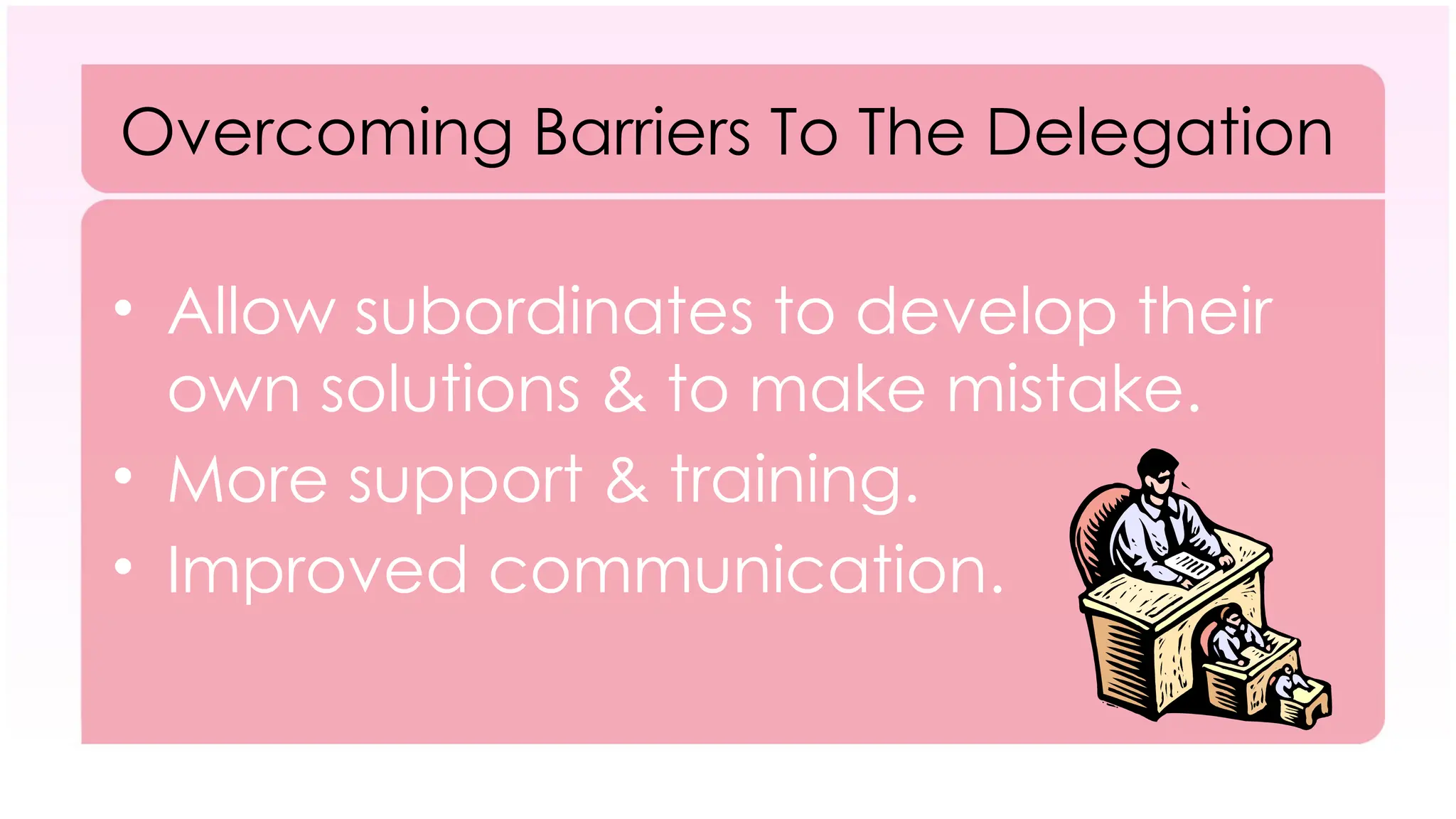
Overcoming Barriers To The Delegation
• Allow subordinates to develop their
own solutions & to make mistake.
• More support & training.
• Improved communication.
Centralization & Decentralization
☺ Centralization is the process of
systematically maintain the
power and authority in the
hands of higher-level managers.
☺ Decentralization is the process of
systematically hand over/assign
power and authority throughout
to middle and lower manager.
COORDINATION
• Keeping organization units
that interact with or
influence each other in
contact with each to share
information & other things in
a way that enhances
accomplishment of tasks.
Module 3 Organising staffing directing h

Module 3 Organising staffing directing h

  • 1.
  • 2.
    DEFINITION OF ORGANIZING •“The process of determining the tasks to be done, who will do them, and how those tasks will be managed and coordinated” • To structure or arrange the relationship between people, the work to be done, & the facilities so that goals are achieved.
  • 3.
    Why Organize? • Managershave to organize the activities they want to perform for the following reasons: ☺ So that they can divide the work according to the nature & similarity of tasks. ☺ So that they can pool resources & increase the efforts which lead to efficiency. ☺ So that they can build continuity & synergy.
  • 4.
    continue… • A managerwho wants to organize his/her department must address these issues:  Determine what is to be done  Assigning tasks  Decide how to achieve coordination  Decide on a span of management  Decide how much authority you should designate  Draw an organizational chart
  • 5.
    What is organizational structure? Shows the flow of interactions within the organization  Specifies its division of work activities and shows how different functions of activities are linked  Shows level of specialization of work activities  Indicates the organization’s hierarchy and authority structure  Shows organization’s reporting structure
  • 6.
  • 7.
    The Organizing Process 1ststage - developing the foundation of the organizational system • Determining tasks and defining jobs - tasks are determined and assigned to specific job positions • Defining work relationship -specify the working relationships between individuals and work groups 2nd. stage - developing the organizational design • Grouping organizational members into work units - creating departments by grouping tasks on the basis of some common characteristics such as function, product or geographic market • Developing an integrating system - develop mechanisms to coordinate the efforts individuals and work groups • Determining the locus of the decision making - determine who make decisions (centralized or decentralized decision making)
  • 8.
    DIVISION OF WORK/LABOUR •The work has to be divided among the members so that individuals are responsible for a limited set of jobs instead doing the task as a whole.
  • 9.
    ADVANTAGES & DISADVANTAGES OFDIVISION OF WORK/LABOUR Advantages • Person-to-fit (based on talents and interests) - the job given can be fit based on individual’s ability. • Creates job specialization • Increase productivity Disadvantages • Higher degree of control • Boredom
  • 10.
    Organizational Chart • Aformal diagram that shows the lines of authority • The purpose of organization chart – to indicate responsibility and to whom each reports, to coordinate division of work and make it clear, to show work to be done, and, to indicate line of promotion
  • 11.
    DEPARTMENTALIZATION @ ORGANIZATIONAL STRUCTURES •Departmentalization : – Is a process of grouping jobs into separate units activities or tasks that are proposed. • There are six (6) types of Departmentalization/Organizational Structure:- a) Functional structure b) Product structure c) Customer structure d) Geographical structure e) Matrix structure f) Network structure
  • 12.
    a) Functional structure •Used mainly by smaller firms that offer a limited line of products because it makes efficient use of specialize resources. • This method eliminate overlapping in the execution of organizational activities. PRESIDENT. VICE PRESIDENT PRODUCTION PRODUCTION PLANNING VICE PRESIDENT MARKETING CUSTOMER SERVICE VICE PRESEDENT FINANCE FINANCIAL PLANNING
  • 13.
    a) Functional structure Advantages •Staffed by experts of each functions. • Easier supervision. • Easy to coordinate activities. Disadvantages • Difficult to get quick decisions or actions on a problem or situation. • Difficult to monitor performance, especially among individual.
  • 14.
    b) Product structure •Grouping the activities and functions on a basis of products manufactured by the company. PRESIDENT GENERAL MANAGER PHARMACEUTICAL PRODUCT GENERAL MANAGER PERSONAL CARE PRODUCT
  • 15.
    b) Product structure Advantages •Activities can be easily focuses and coordinated. • Enhance speed and effectiveness of decision making. • Easy to assess performance and identify accountability/liability . Disadvantages • Focus only on own products. • Increase the administrative costs.
  • 16.
    c) Customer structure •Is the grouping of activities to reflect the interests of different customers PRESIDENT COMMUNITY BANKING CORPORATE BANKING REAL ESTATE MORTGAGE LOANS AGRICULTURAL BANKING
  • 17.
    c) Customer structure Advantages •Encourage concentration on customers’ needs. • It gives customers the feeling that they have an understanding supplier. • It develops expertise in the customer handling. Disadvantages • Difficult to coordinate operations between competing customer demands. • Requires managers & staff expert in customers’ problems.
  • 18.
    d) Geographical structure •A company or a part of it is organized around the places where operations are located. • It is commonly found in sales or manufacturing operations. PRESIDENT WEST REGION SOUTHEAST REGION CENTRAL REGION PRODUCTION MARKETING EAST REGION
  • 19.
    d) Geographical structure Advantages •It offers better services at low cost. • It place emphasis on local markets & problems. • It offers better face to face communication with local interests. Disadvantages • It requires more staff with general manager abilities. • Top management has less control of the regional managers since they are independent.
  • 20.
    e) Matrix structure •Also known as Multiple Command System. • Focus on two or more dimensions at the same time.
  • 21.
    e) Matrix structure Advantages •More efficient use of resources than single hierarchy. • Flexibility, adaptability, to changing environment. Disadvantages • Frustration & confusion from dual chain of command. • High conflict between 2 sided of matrix. • More meetings, more discussion than action.
  • 22.
    f) Network structure •Disaggregates major functions into separate companies that are brokered by a small headquarter organization. • E.g. manufacturing, engineering, sales & accounting is provided by separate organization which specialized on that areas. COMPANY A DISTRIBUTION COMPANY MANUFACTURING COMPANY TRANSPORTATION COMPABY DESIGN COMPANY
  • 23.
    f) Network structure Advantages •Global competitiveness. • Workforce challenge. • Reduce administrative cost. Disadvantages • No hands-on control. • Can lose organization part. • Employee loyalty weakened.

  • 24.
    SPAN OF MANAGEMENT Definition : A number of subordinates who report directly to a given manager of supervision  Also called ‘span of control’ ◦ In theory, when tasks are very complex, span of control should be relatively narrow. ◦ In contrast, where jobs are highly standardized and routine (low complexity), a manager will not need to spend as much time supporting individual subordinates, and the span of control may be larger.
  • 25.
    MAJOR FACTORS THATINFLUENCE THE SPAN OF MANAGEMENT • The type of work • The strength of the organization structure • The ability of the manager • The amount & type of communication required among the members
  • 26.
    TYPES OF ORGANIZATIONCHART TALL & LEAN (FLAT) STRUCTURES NARROW / TALL STRUCTURE WIDE / FLAT STRUCTURE
  • 27.
    Narrow/tall span management • Haveshort span of authority with many organization levels • Advantages – close supervision, close control, and rapid communication between subordinates and superiors • Disadvantage – superiors tend to get involved with subordinates work, high cost, excessive distance between the lowest level and the highest level.
  • 28.
    Wide/flat span ofmanagement • Have few organization levels with wide span of authority • Advantages – superiors are forced to delegate, clear policies must be made and subordinates must be carefully selected • Disadvantages – decisions made by managers tend to be bottleneck, superior’s loss of control, and requires exceptional quality manager.
  • 29.
    CHAIN OF COMMAND •Definition : Separate lines of authority/power among all position in an organization. • It has 2 components:- (i) UNITY OF COMMAND - Suggests that each person within an organization must have a clear reporting relationship to only one superior. (ii) SCALAR RELATIONSHIP - Suggests that there must be a clear and unbroken line of authority that extends from the lowest to the highest position in the organization.
  • 30.
    AUTHORITY • Definition :“The right to make decisions with respect to work assignments & to require subordinates to perform assigned tasks in accordance with the decision made”.
  • 31.
    Line & StaffAuthority  Line Authority ◦ Those organizational members that are directly involved in delivering the products and services of the organization.  Staff Authority ◦ Those organizational members that are not directly involved in delivering the products and services to the organization, but provide support for line personnel.
  • 32.
    DELEGATION • Definition: “Theprocess of transferring the authority for a specific activity or task to another member of the organization and empowering that individual to accomplish the task effectively”. • Transforming the responsibility for a specific activity or task to another member of the organization. • Empowering that individual to accomplish the task effectively.
  • 33.
    Steps in Delegation •Decide which goals or tasks to delegate • Make assignments • Grant authority • Hold responsible/accountable • Monitor
  • 34.
    Benefits of Delegation 1.Empowerment 2. Better decision-making 3. Provide an opportunity for the development of analytical and problem-solving skills 4. Managers magnify their accomplishments
  • 35.
    Barriers of Delegation 1.Manager may refrain to delegate because they are insecure about their value to the organization. 2. Managers simply lack confidence in the abilities of their subordinates. 3. Manager experience dual accountability. 4. Subordinate are reluctant to accept delegation.
  • 36.
    Overcoming Barriers ToThe Delegation • Allow subordinates to develop their own solutions & to make mistake. • More support & training. • Improved communication.
  • 37.
    Centralization & Decentralization ☺Centralization is the process of systematically maintain the power and authority in the hands of higher-level managers. ☺ Decentralization is the process of systematically hand over/assign power and authority throughout to middle and lower manager.
  • 38.
    COORDINATION • Keeping organizationunits that interact with or influence each other in contact with each to share information & other things in a way that enhances accomplishment of tasks.