
What Is Organizing?
Organizing:
Arranging the
activities of the
enterprise in such a
way that they
systematically
contribute to the
enterprise’s goals.
Organization designOrganization design –– management decisions andmanagement decisions and
actions that result in a specific organization structure.actions that result in a specific organization structure.
Organization structure –Organization structure – the pattern of jobs and groupsthe pattern of jobs and groups
of jobs in an organization. It is an important cause ofof jobs in an organization. It is an important cause of
individual and group behavior.individual and group behavior.
Organization Structure & Design
4
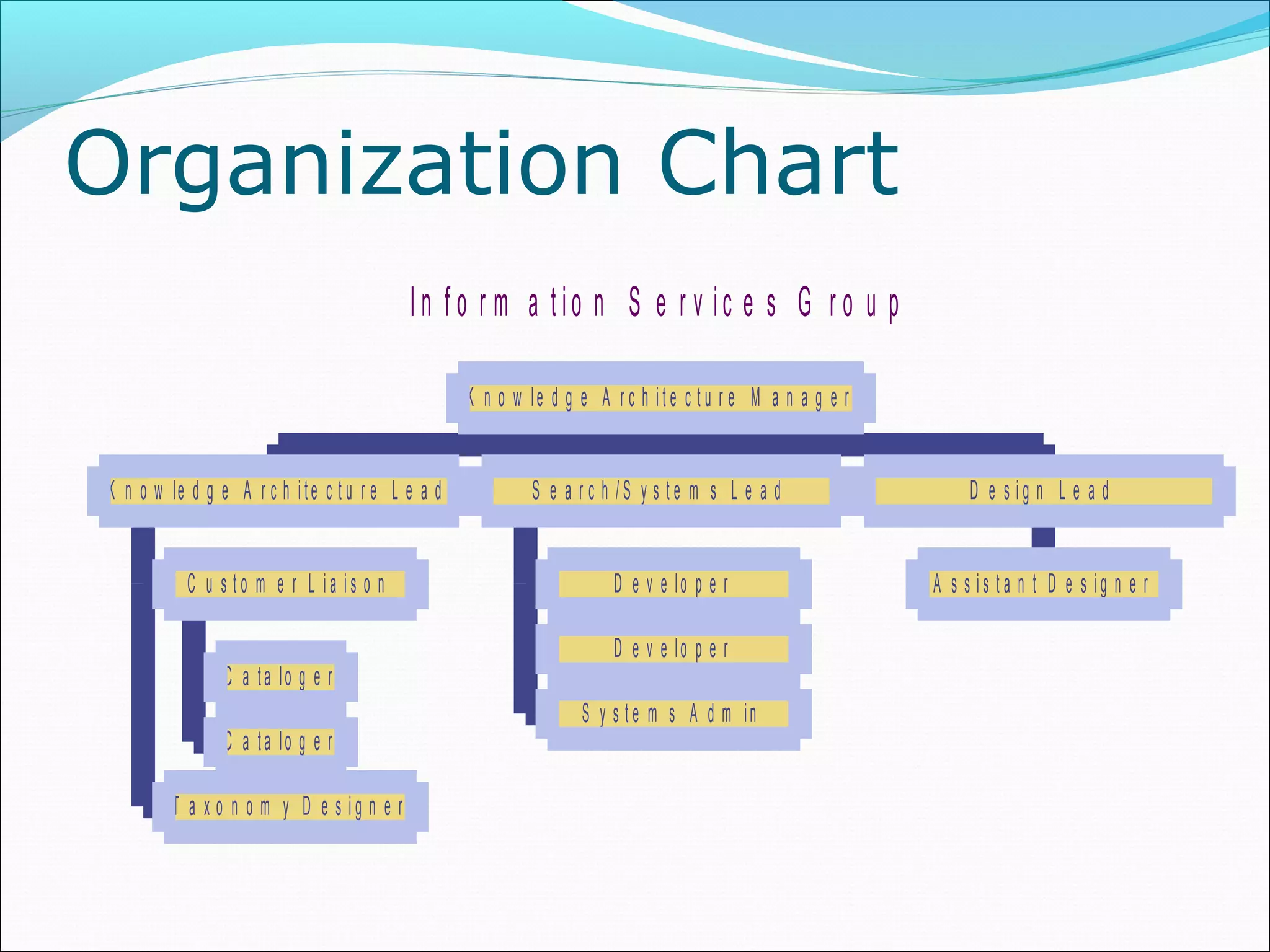
Organization Chart
Organization Chart: A
chart that shows the
structure of the
organization including
the title of each
manager’s position and,
by means of connecting
lines, who is accountable
to whom and who has
authority for each area.
Organization Chart
I n f o r m a t io n S e r v ic e s G r o u p
C a ta lo g e r
C a ta lo g e r
C u s t o m e r L i a i s o n
T a x o n o m y D e s i g n e r
K n o w le d g e A r c h i te c t u r e L e a d
D e v e lo p e r
D e v e lo p e r
S y s t e m s A d m in
S e a r c h / S y s t e m s L e a d
A s s i s t a n t D e s i g n e r
D e s i g n L e a d
K n o w le d g e A r c h i t e c t u r e M a n a g e r
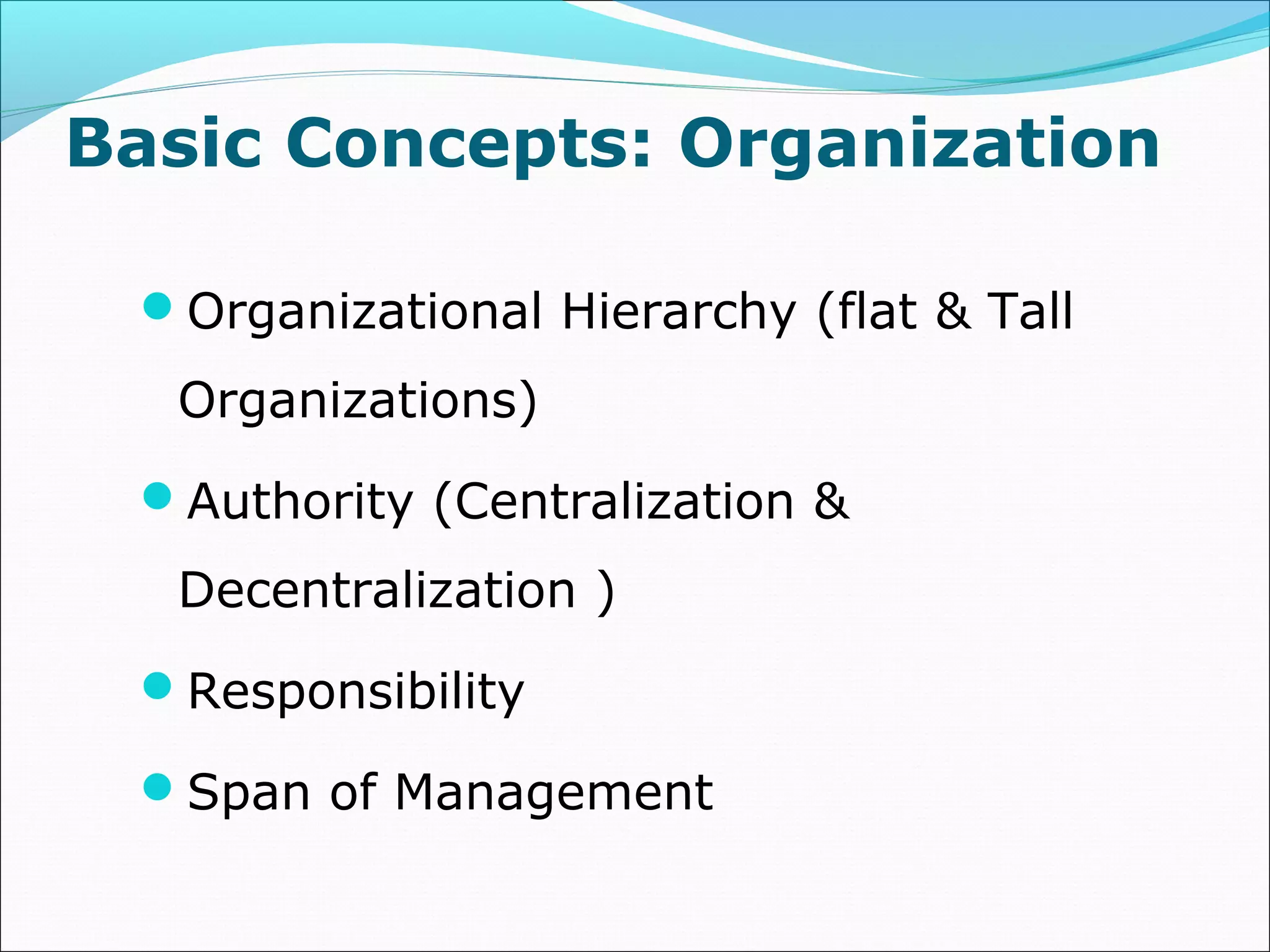
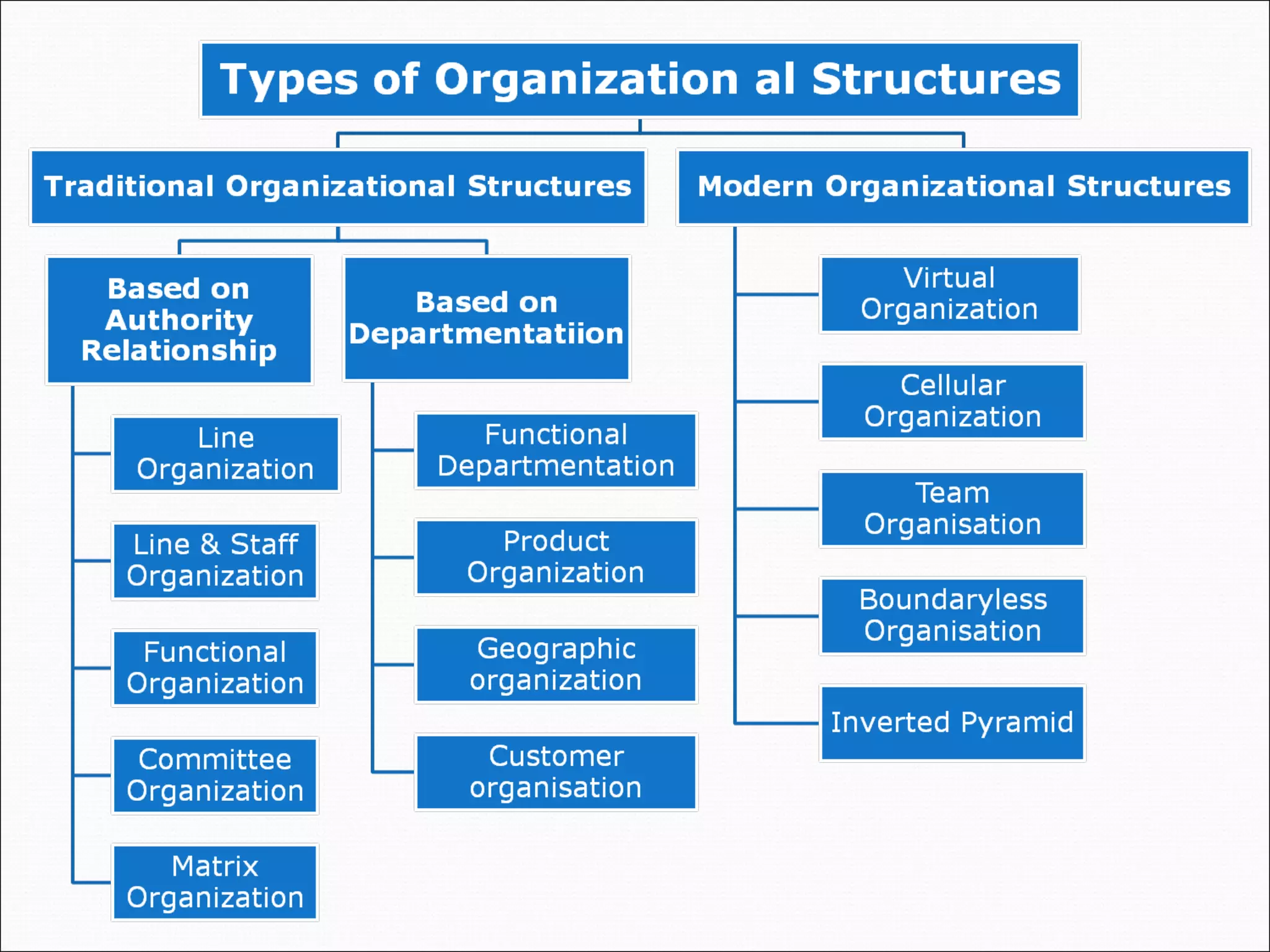
Basic Concepts: Organization
Organizational Hierarchy (flat & Tall
Organizations)
Authority (Centralization &
Decentralization )
Responsibility
Span of Management
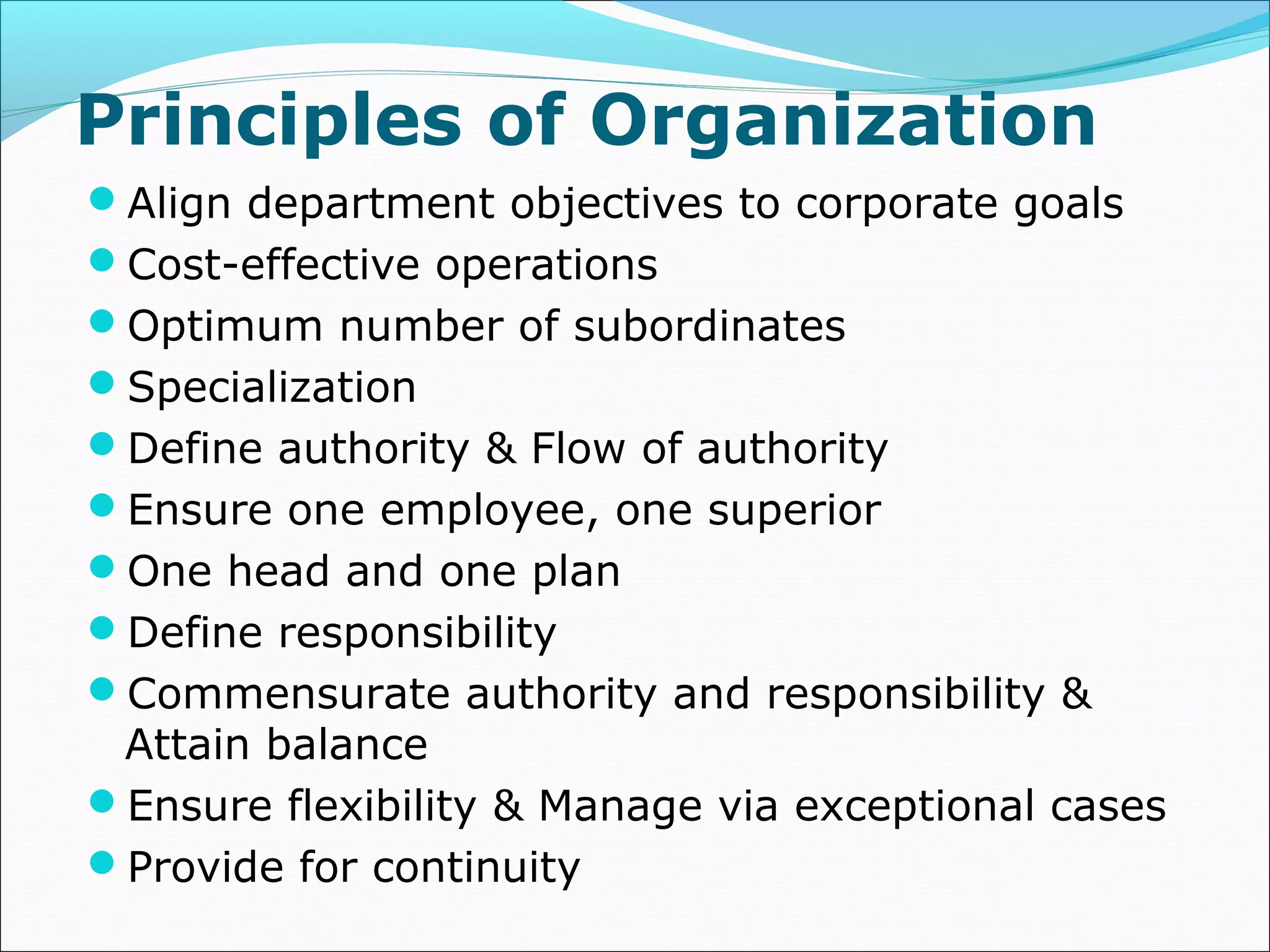
Principles of Organization
Align department objectives to corporate goals
Cost-effective operations
Optimum number of subordinates
Specialization
Define authority & Flow of authority
Ensure one employee, one superior
One head and one plan
Define responsibility
Commensurate authority and responsibility &
Attain balance
Ensure flexibility & Manage via exceptional cases
Provide for continuity
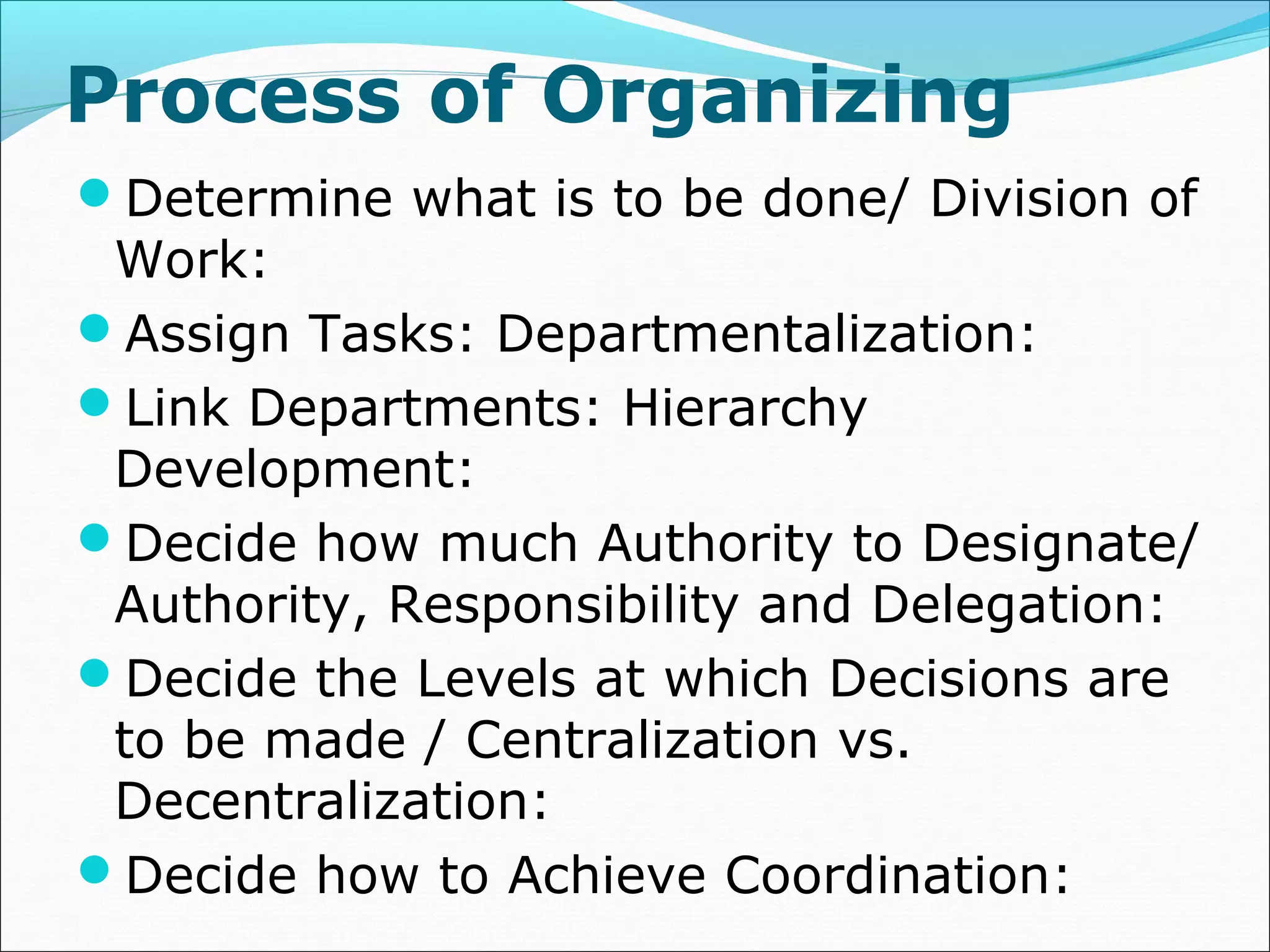
Determine what is to be done/ Division of
Work:
Assign Tasks: Departmentalization:
Link Departments: Hierarchy
Development:
Decide how much Authority to Designate/
Authority, Responsibility and Delegation:
Decide the Levels at which Decisions are
to be made / Centralization vs.
Decentralization:
Decide how to Achieve Coordination:
Process of Organizing
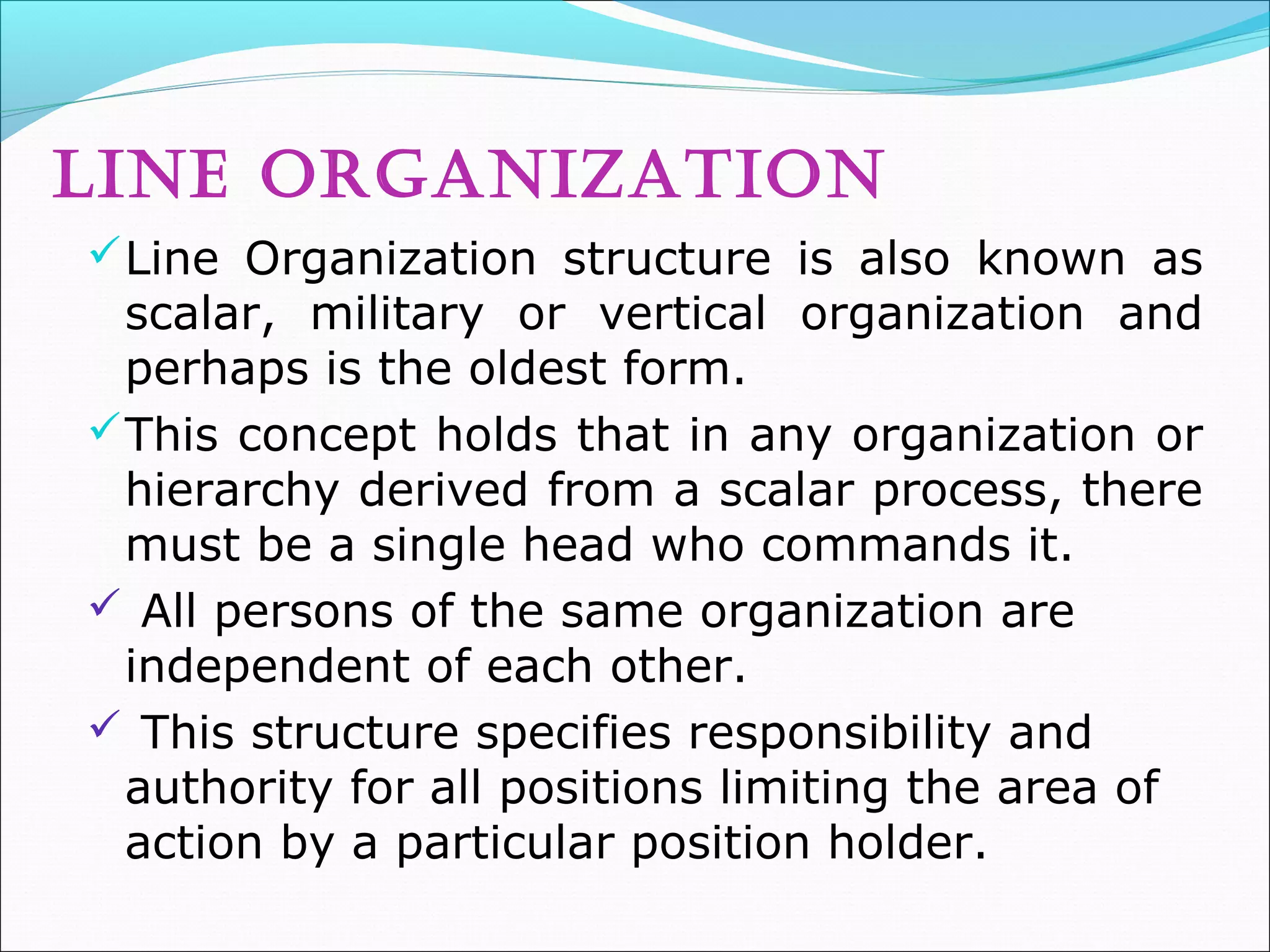
LINE ORGANIZATION
Line Organization structure is also known as
scalar, military or vertical organization and
perhaps is the oldest form.
This concept holds that in any organization or
hierarchy derived from a scalar process, there
must be a single head who commands it.
 All persons of the same organization are
independent of each other.
 This structure specifies responsibility and
authority for all positions limiting the area of
action by a particular position holder.
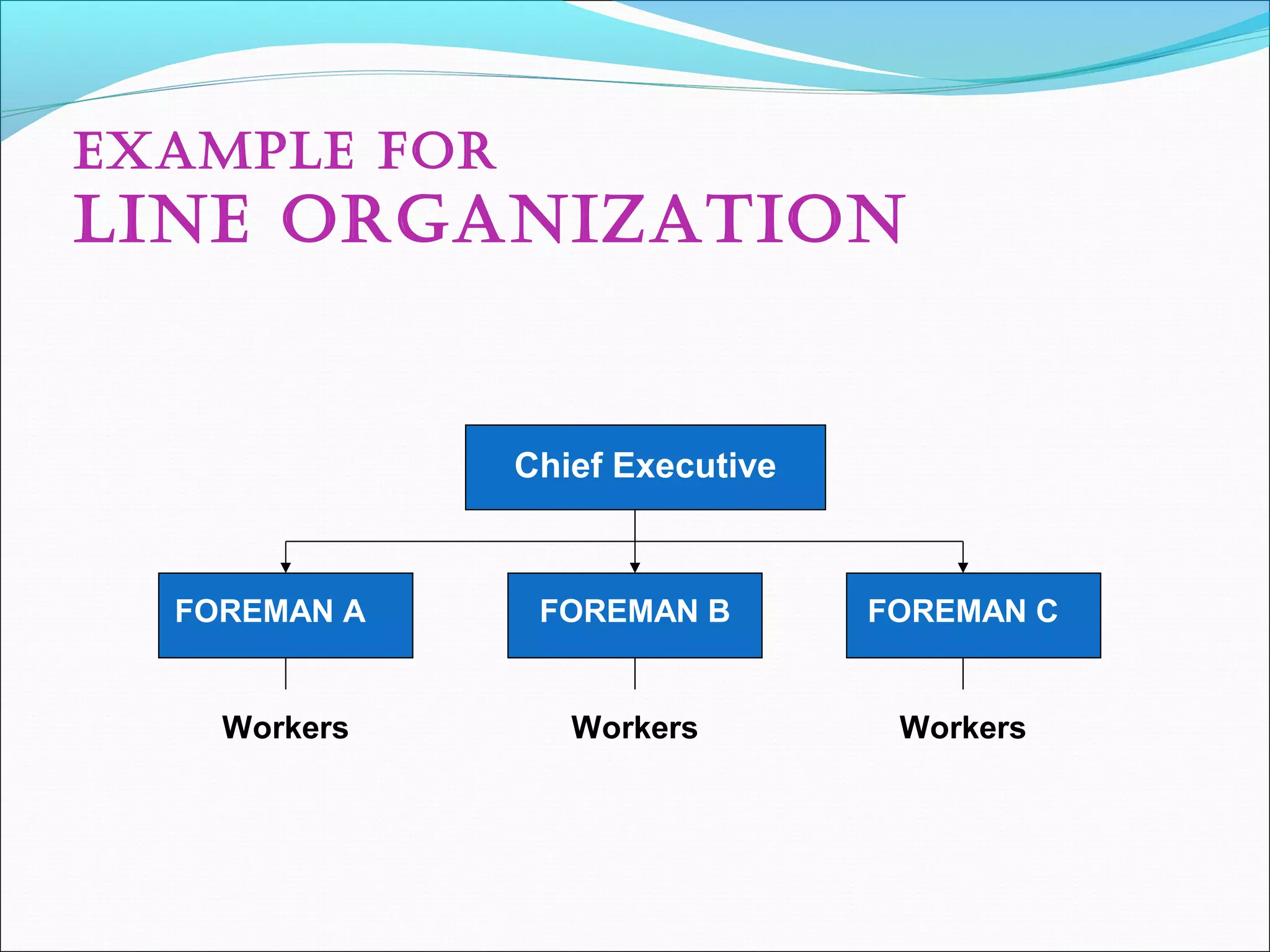
ExamplE for
lINE orGaNIZaTIoN
Chief ExecutiveChief Executive
FOREMAN A FOREMAN B FOREMAN C
Workers Workers Workers
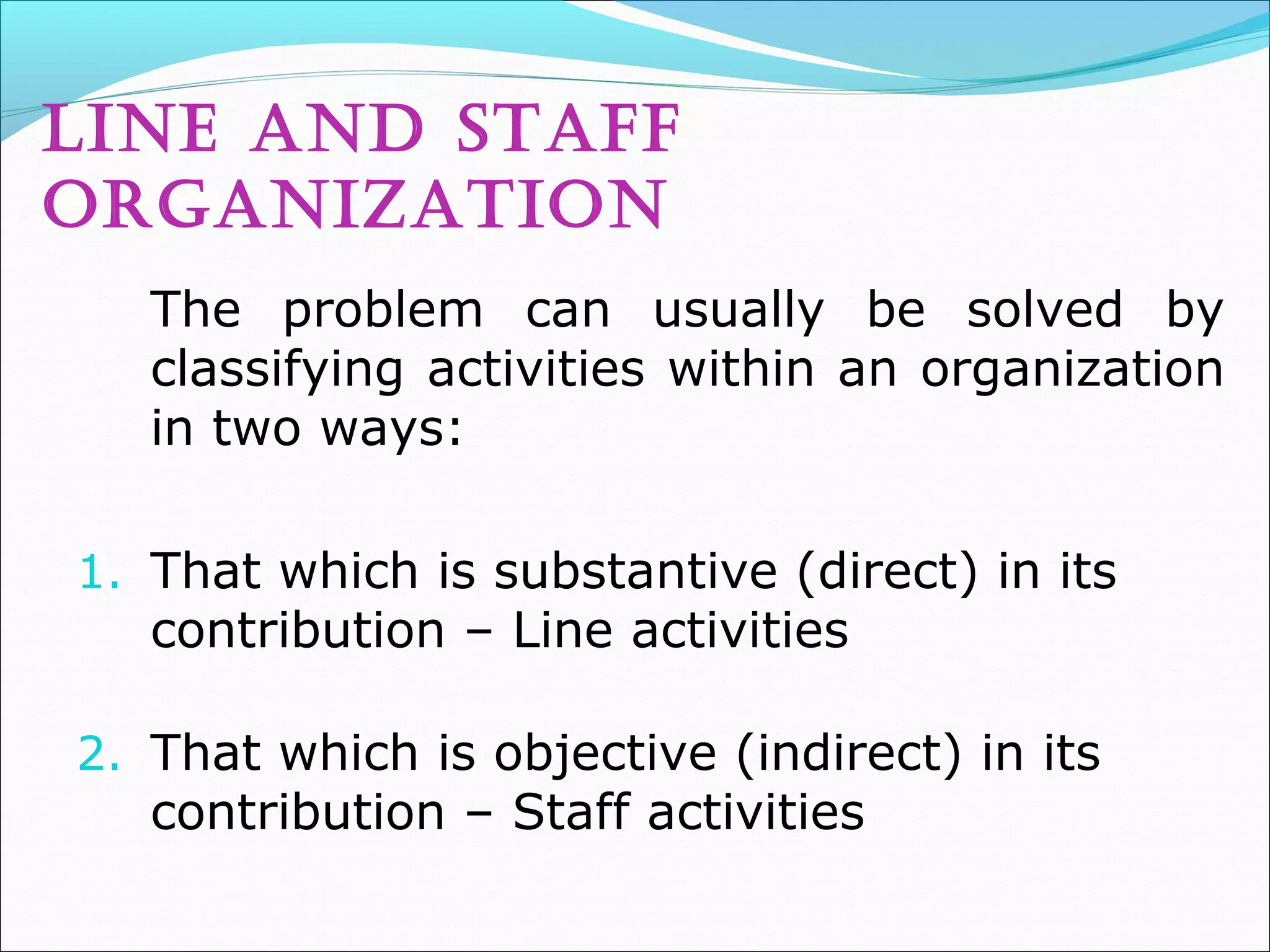
lINE aND STaff
orGaNIZaTIoN
The problem can usually be solved by
classifying activities within an organization
in two ways:
1. That which is substantive (direct) in its
contribution – Line activities
2. That which is objective (indirect) in its
contribution – Staff activities
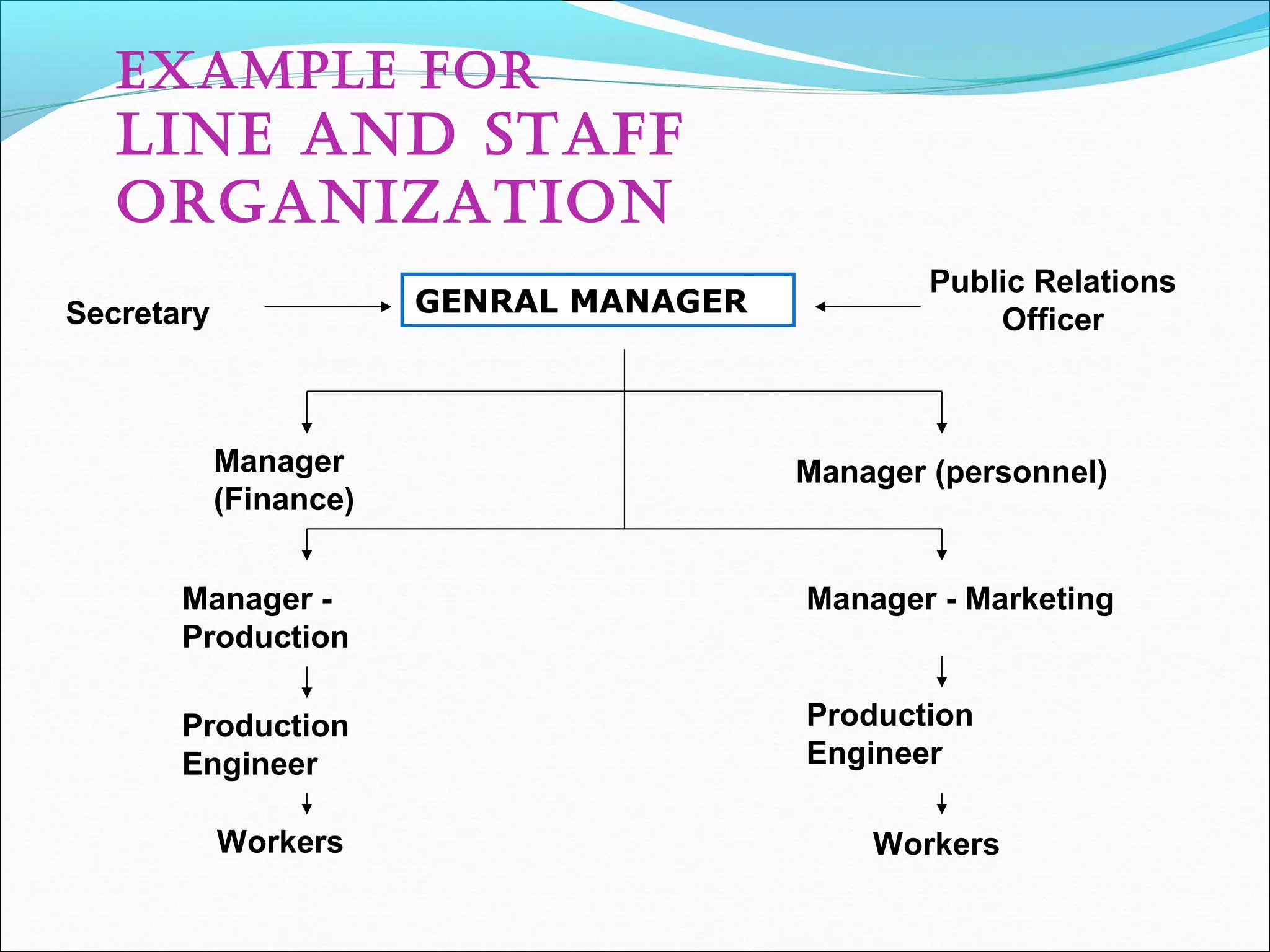
ExamplE for
lINE aND STaff
orGaNIZaTIoN
GENRAL MANAGER
Public Relations
OfficerSecretary
Manager
(Finance)
Manager (personnel)
Manager -
Production
Manager - Marketing
Production
Engineer
Production
Engineer
Workers Workers
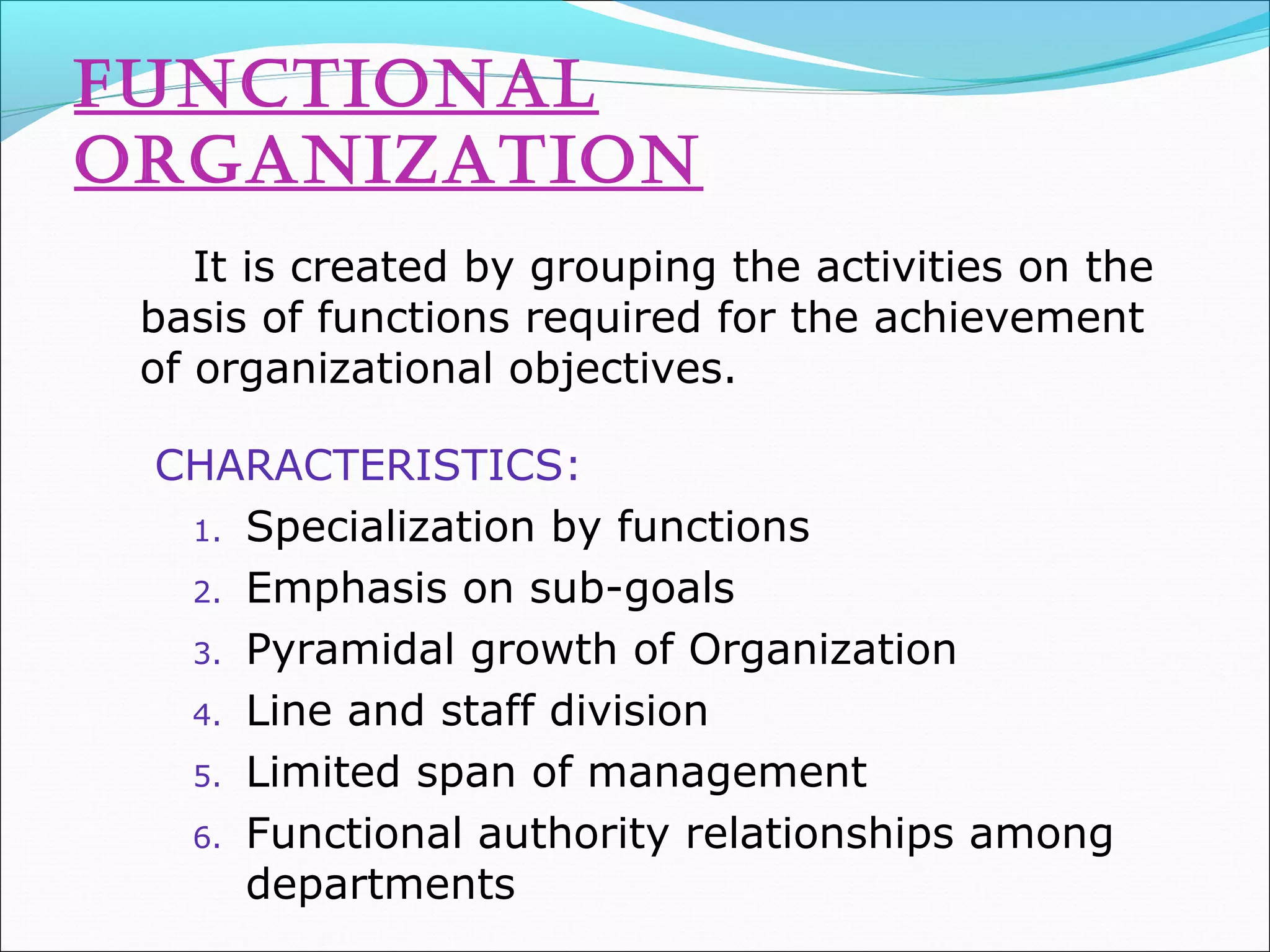
fUNCTIoNal
orGaNIZaTIoN
It is created by grouping the activities on the
basis of functions required for the achievement
of organizational objectives.
CHARACTERISTICS:
1. Specialization by functions
2. Emphasis on sub-goals
3. Pyramidal growth of Organization
4. Line and staff division
5. Limited span of management
6. Functional authority relationships among
departments
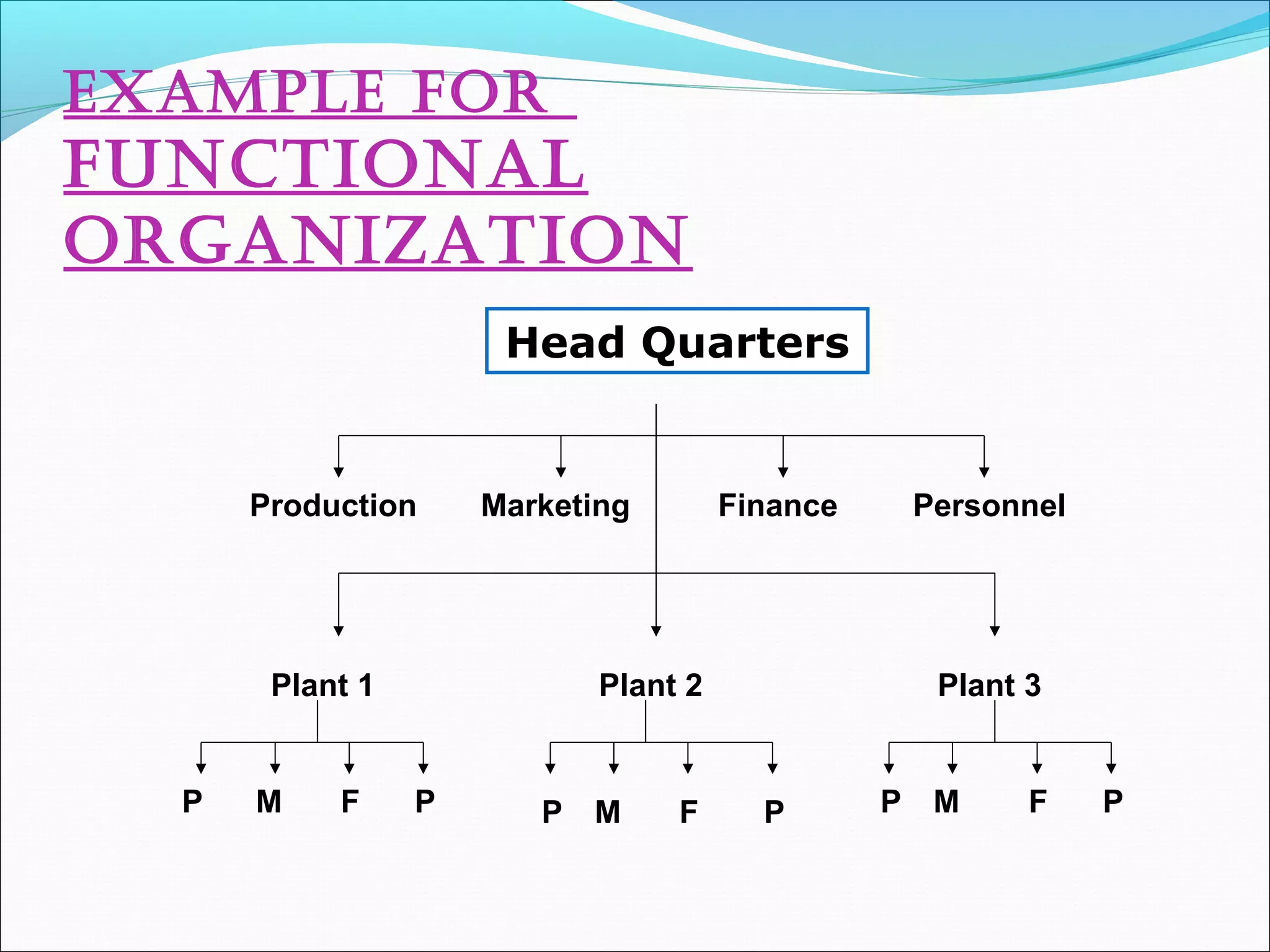
ExamplE for
fUNCTIoNal
orGaNIZaTIoN
Head Quarters
Production Marketing Finance Personnel
Plant 1 Plant 2 Plant 3
P M F P P PM MF FP P
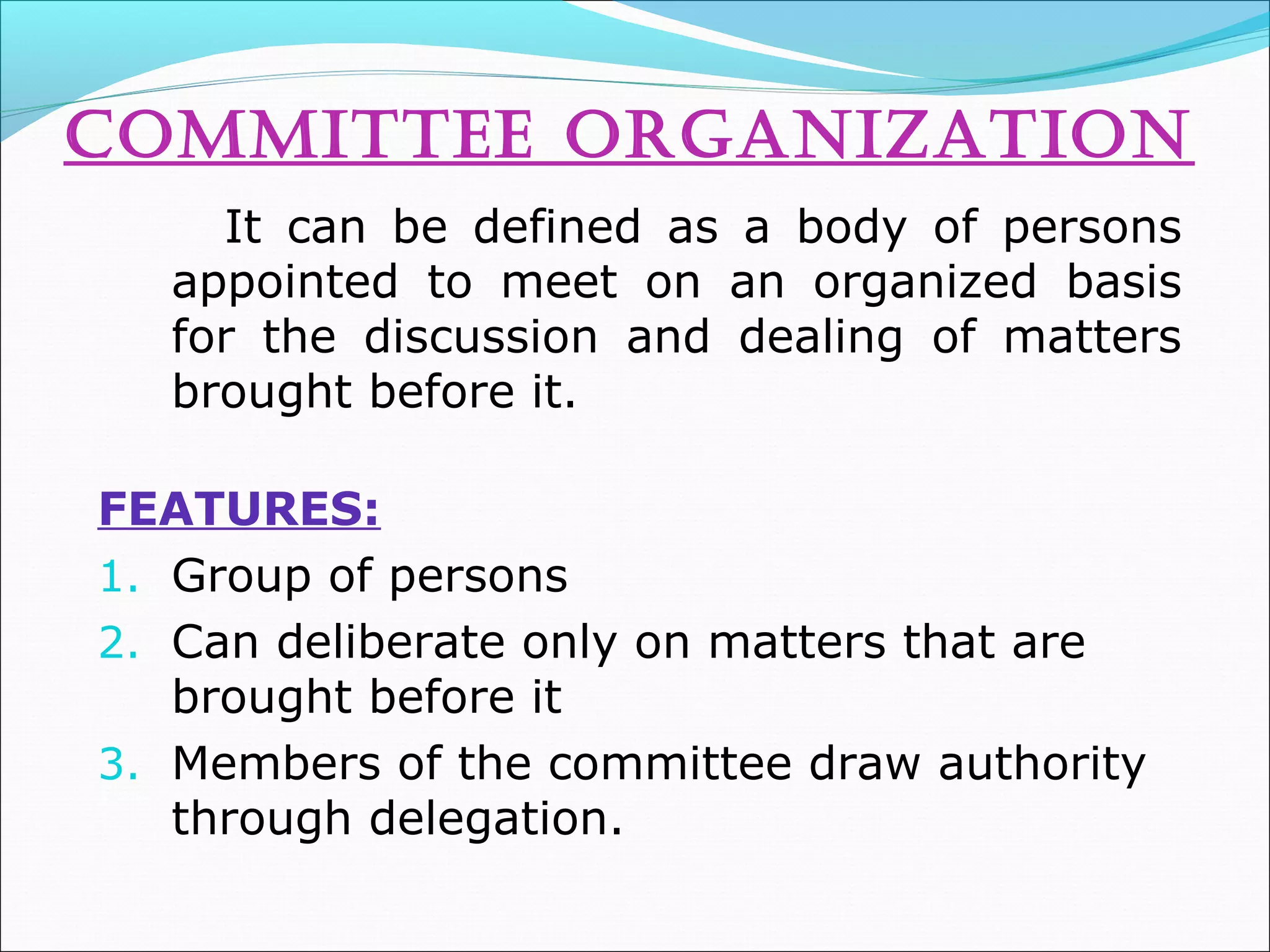
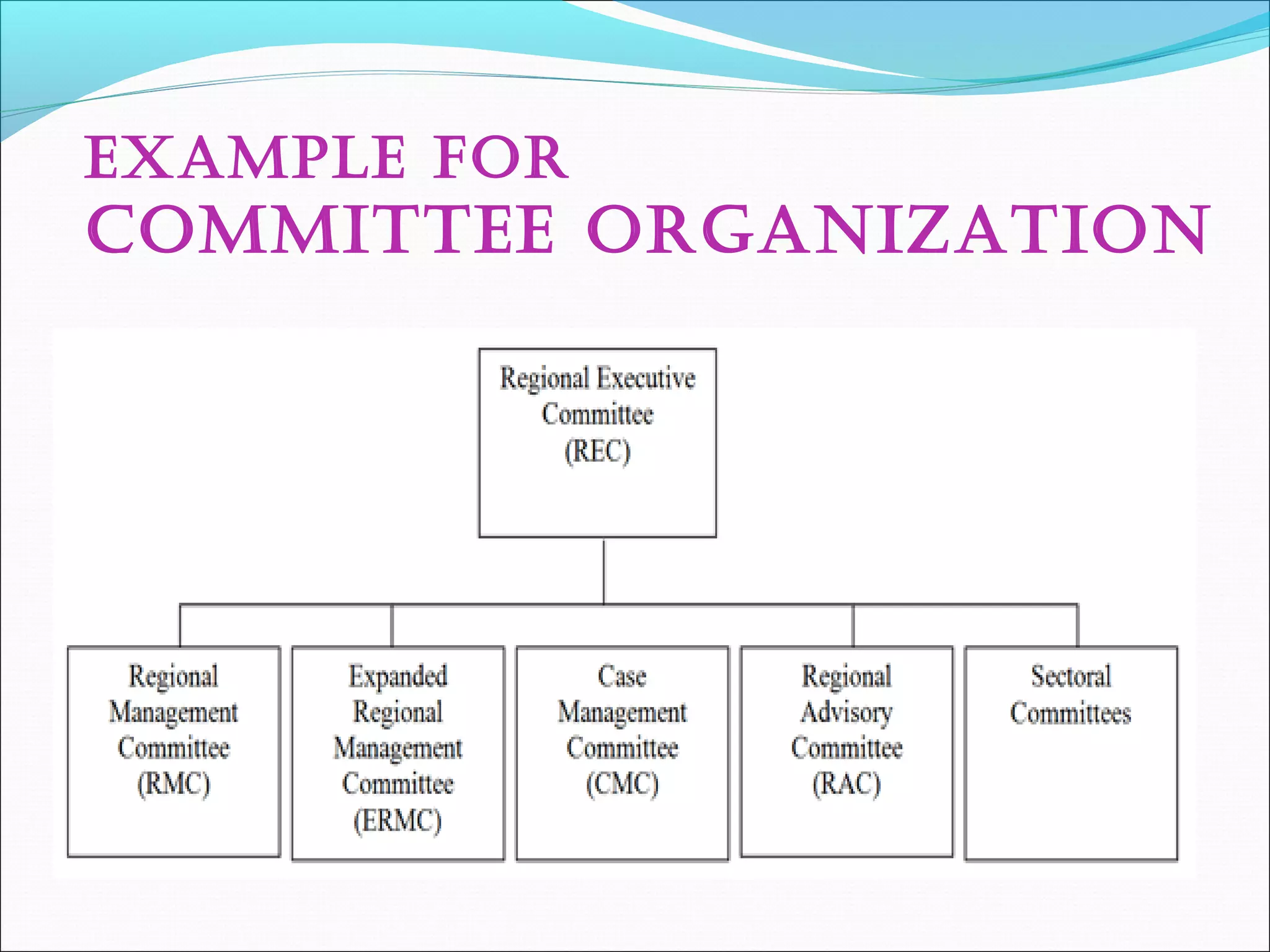
CommITTEE orGaNIZaTIoN
It can be defined as a body of persons
appointed to meet on an organized basis
for the discussion and dealing of matters
brought before it.
FEATURES:
1. Group of persons
2. Can deliberate only on matters that are
brought before it
3. Members of the committee draw authority
through delegation.
ExamplE for
CommITTEE orGaNIZaTIoN
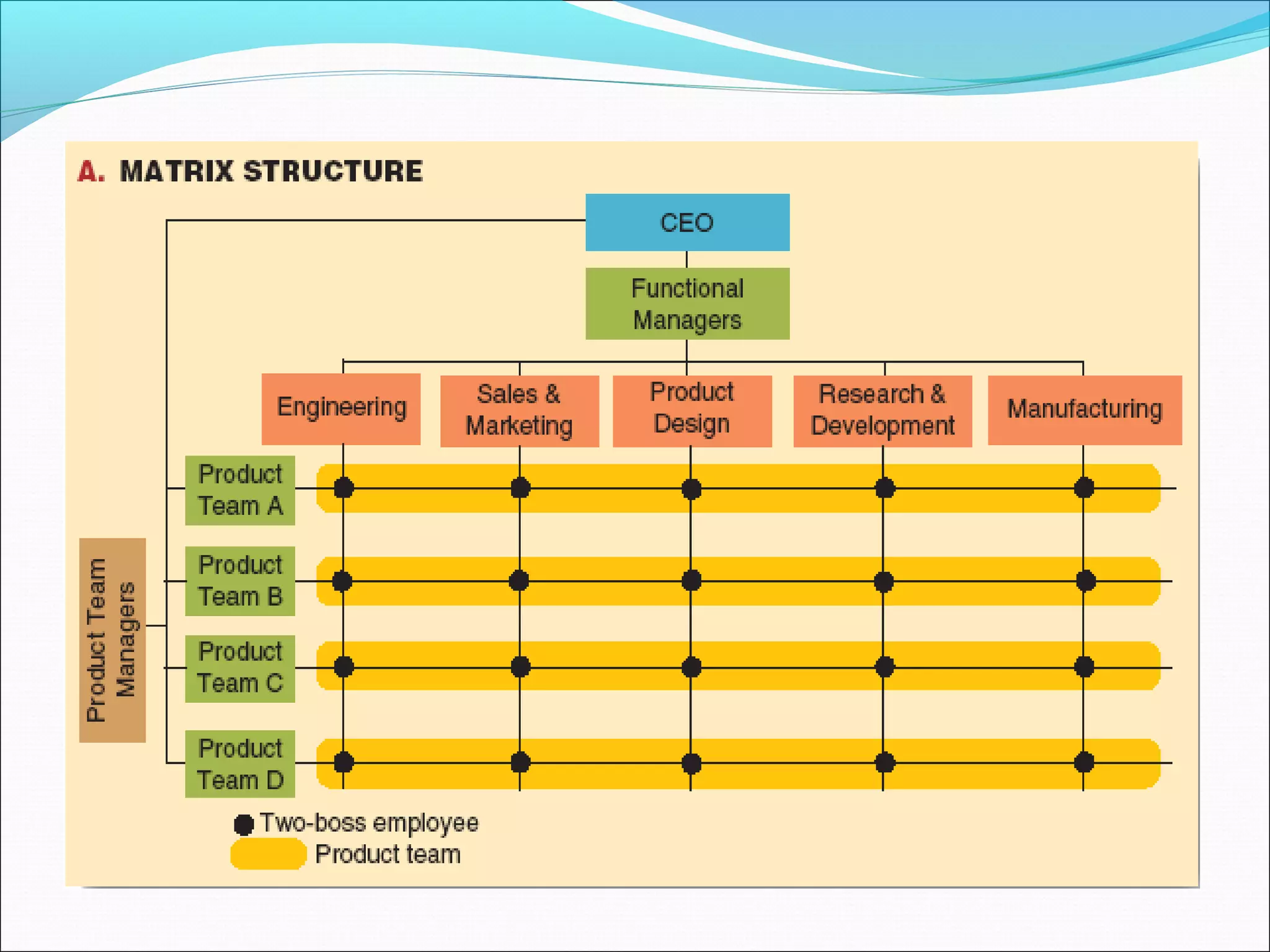
MATRIX
ORGANIZATION
Matrix Organization is the realization of two
dimensional structure which emanates
directly from two dimensions of authority.
1. Pure project structure
2. Functional structure
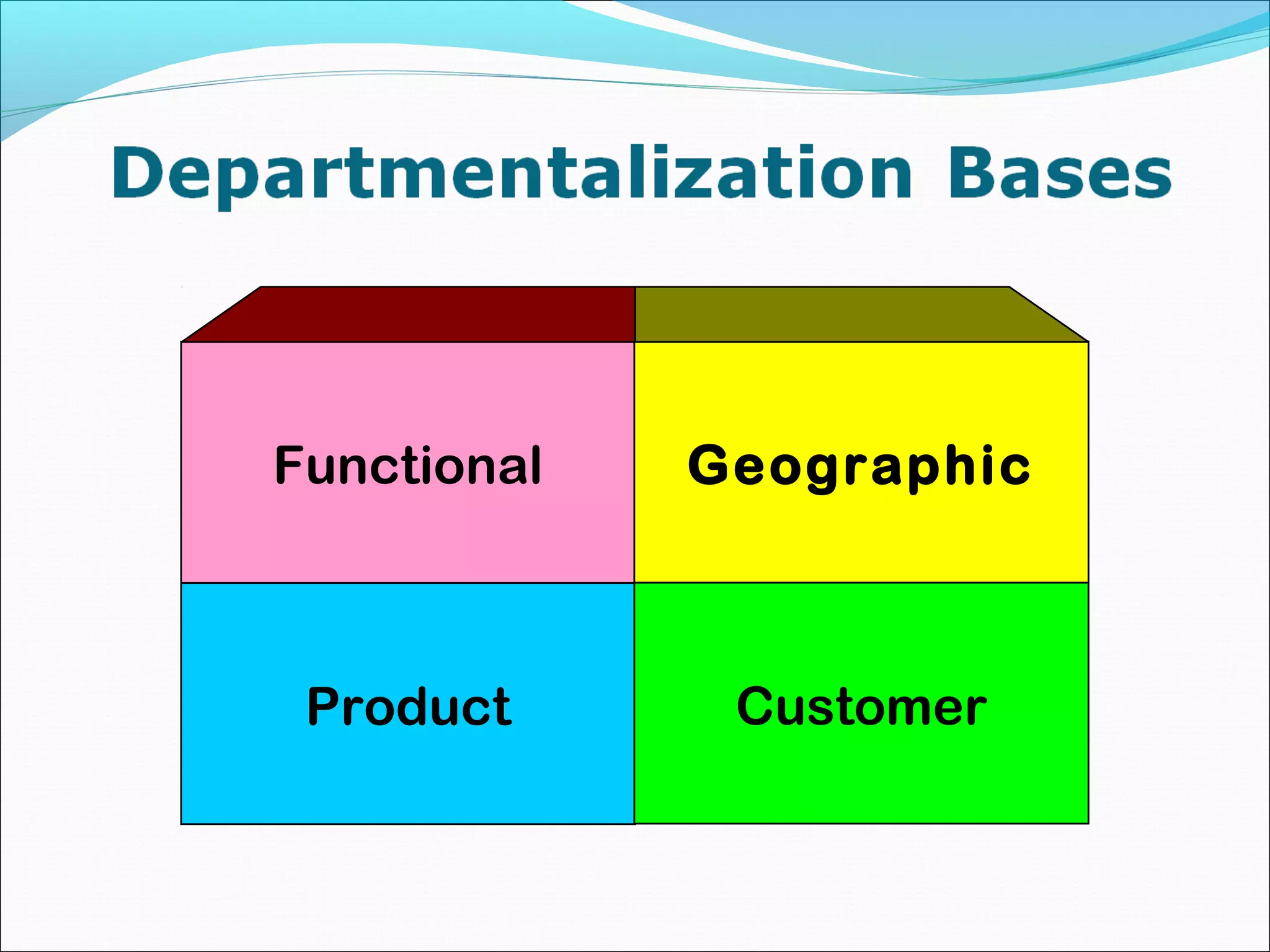
Functional Geographic
Product Customer
Departmental Bases:
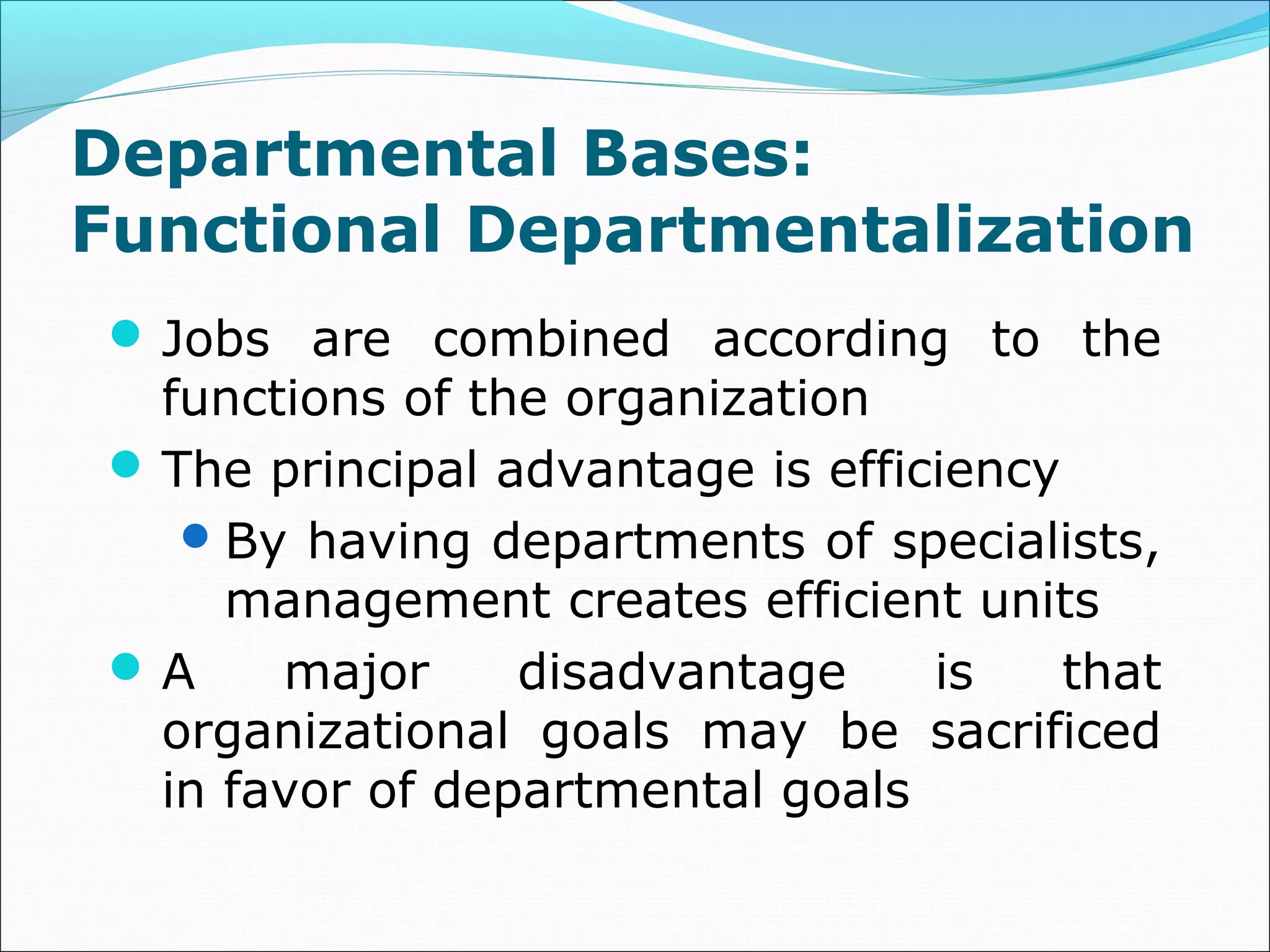
Functional Departmentalization
Jobs are combined according to the
functions of the organization
The principal advantage is efficiency
By having departments of specialists,
management creates efficient units
A major disadvantage is that
organizational goals may be sacrificed
in favor of departmental goals
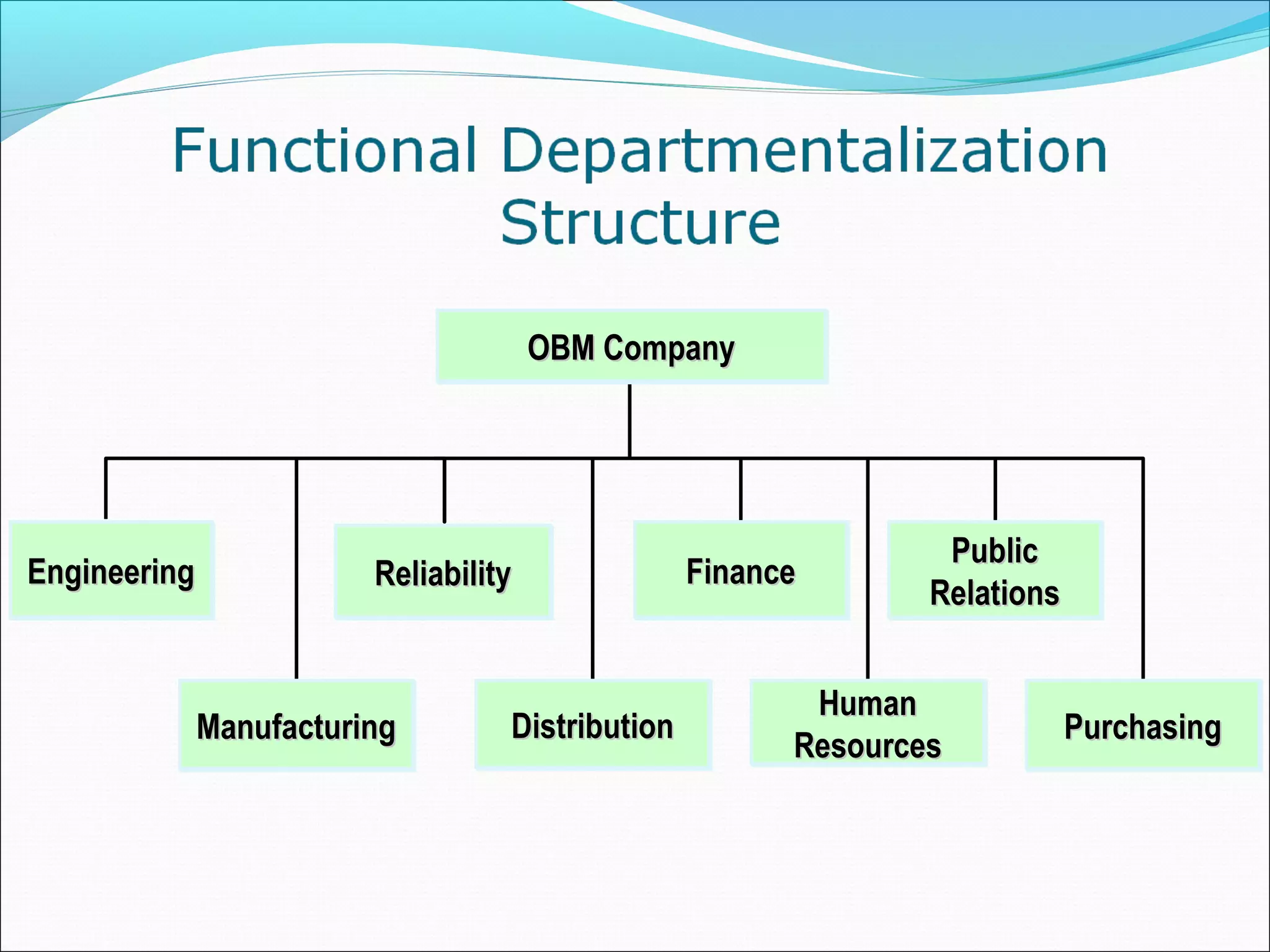
EngineeringEngineeringEngineeringEngineering ReliabilityReliabilityReliabilityReliability FinanceFinanceFinanceFinance
ManufacturingManufacturingManufacturingManufacturing DistributionDistributionDistributionDistribution
HumanHuman
ResourcesResources
HumanHuman
ResourcesResources
PublicPublic
RelationsRelations
PublicPublic
RelationsRelations
PurchasingPurchasingPurchasingPurchasing
OBM CompanyOBM CompanyOBM CompanyOBM Company
Departmental Bases:
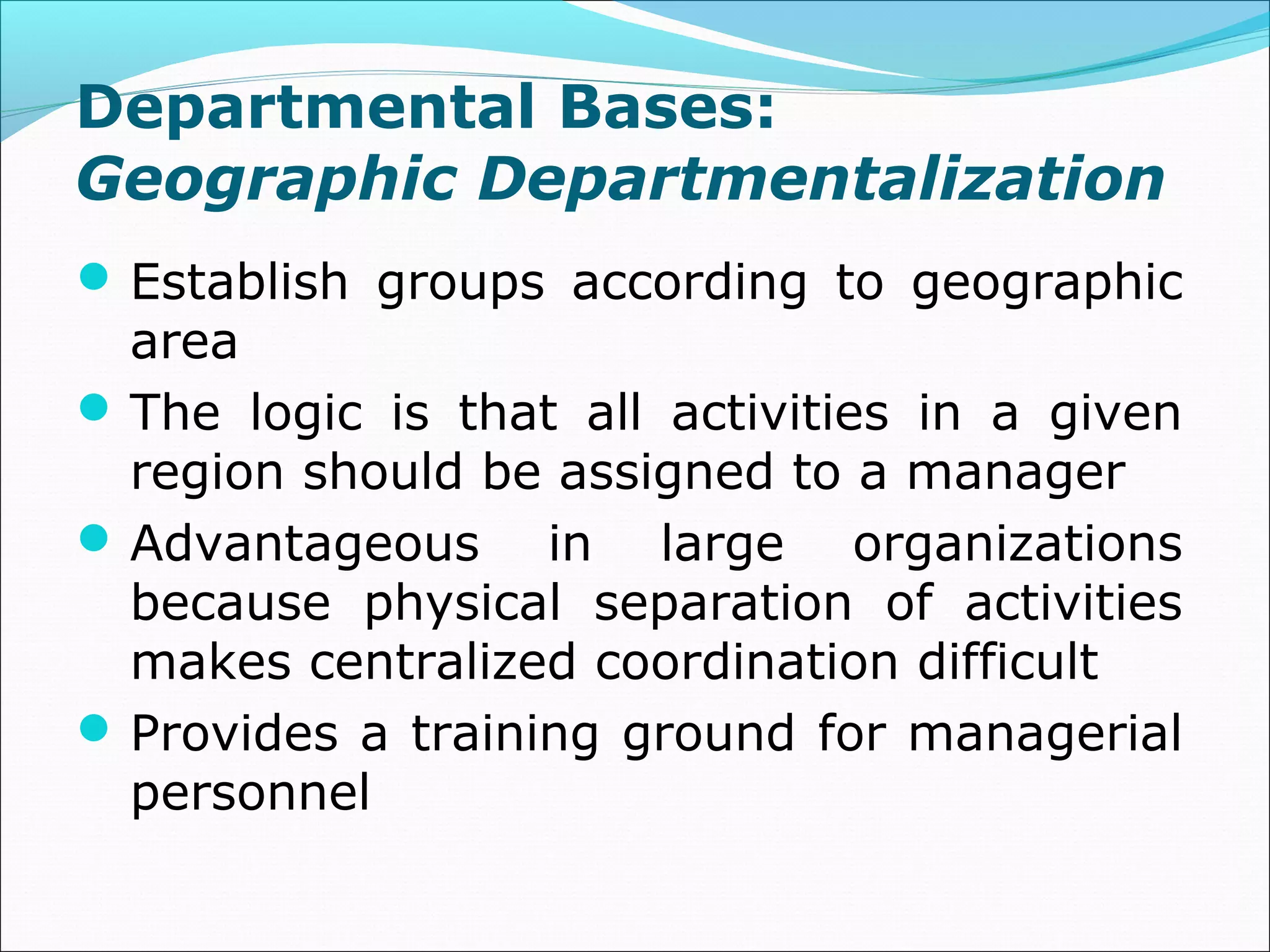
Geographic Departmentalization
Establish groups according to geographic
area
The logic is that all activities in a given
region should be assigned to a manager
Advantageous in large organizations
because physical separation of activities
makes centralized coordination difficult
Provides a training ground for managerial
personnel
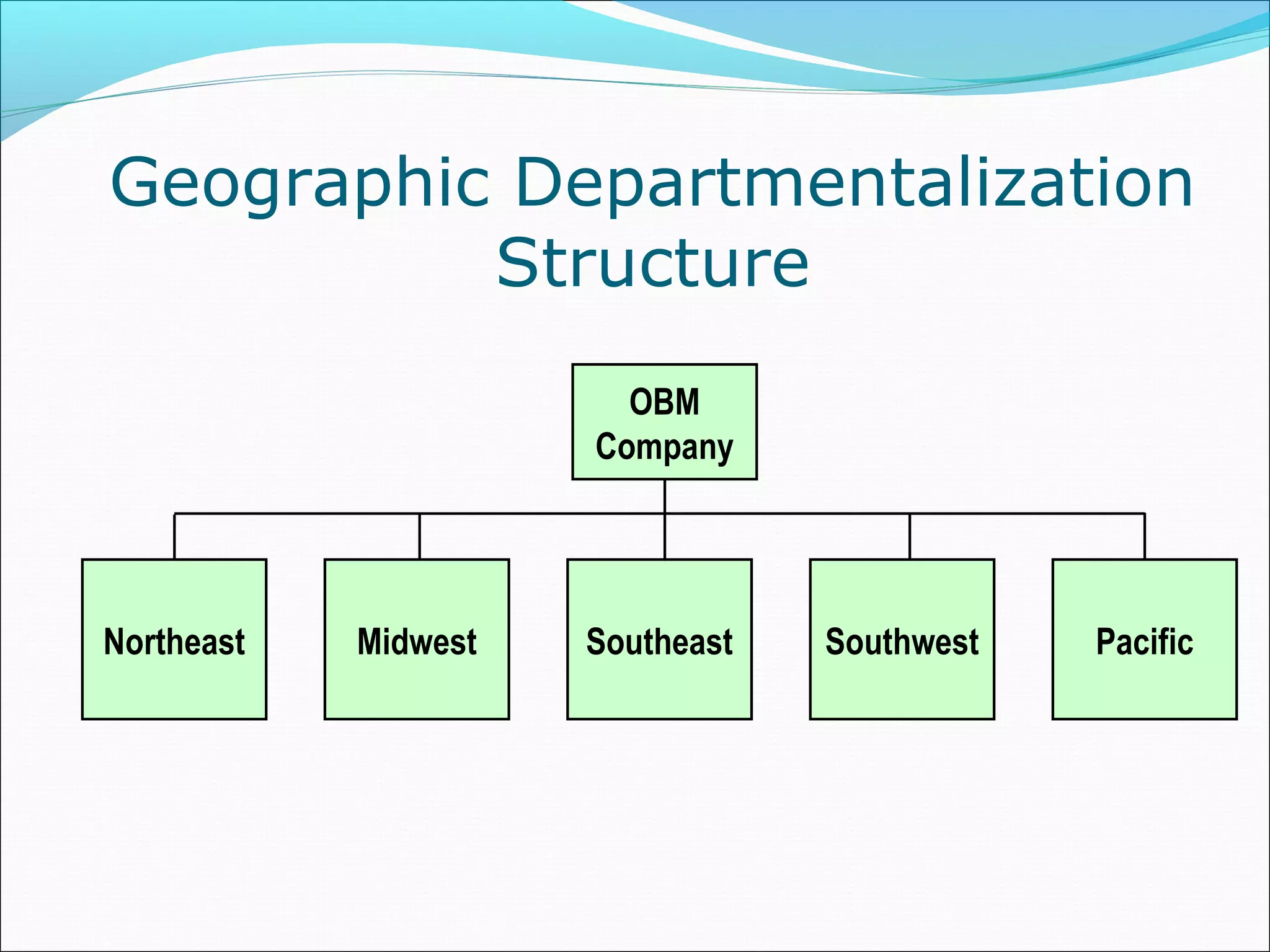
Northeast Midwest Southeast Pacific
OBM
Company
Southwest
Geographic Departmentalization
Structure
Departmental Bases:
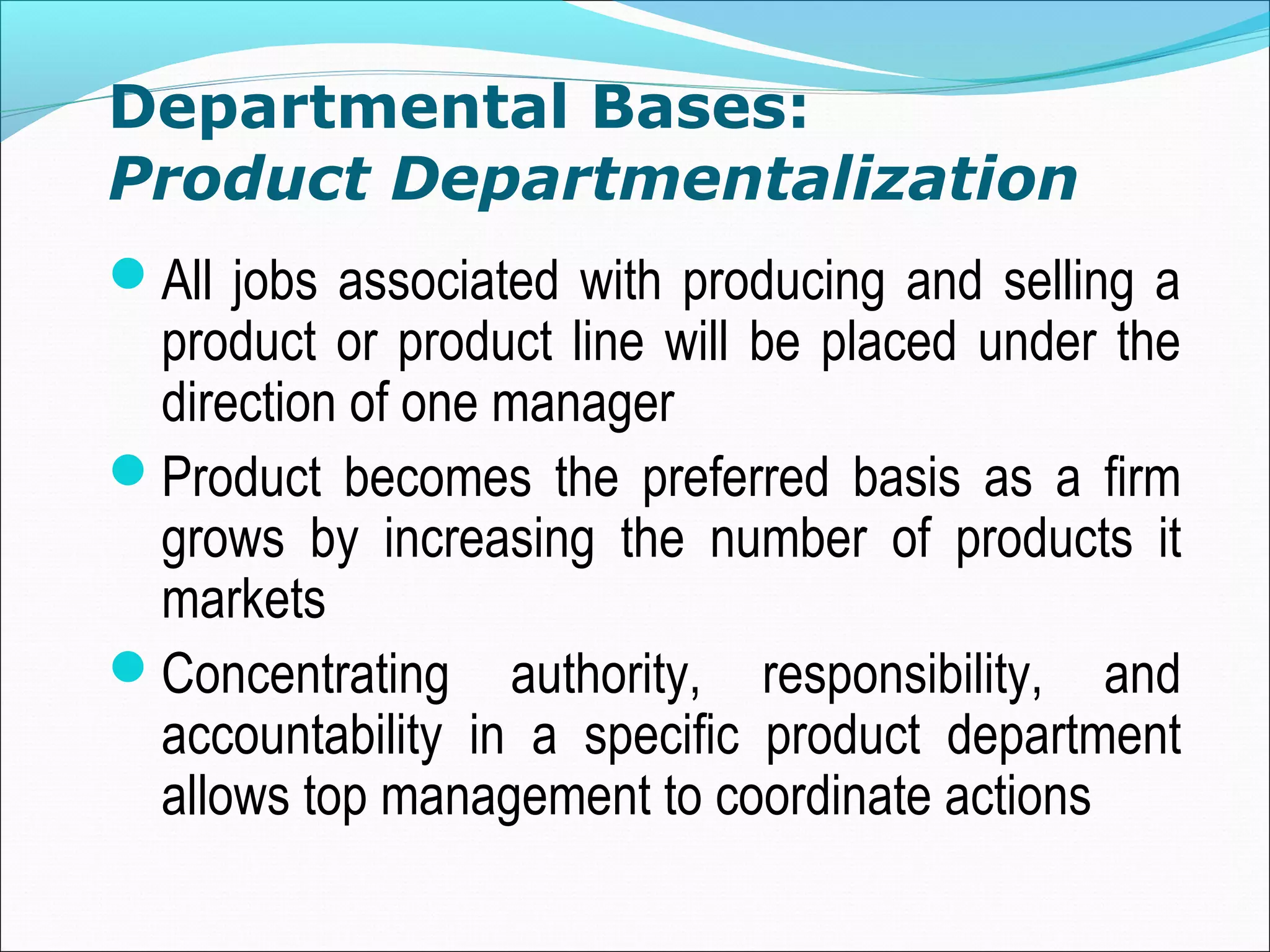
Product Departmentalization
All jobs associated with producing and selling a
product or product line will be placed under the
direction of one manager
Product becomes the preferred basis as a firm
grows by increasing the number of products it
markets
Concentrating authority, responsibility, and
accountability in a specific product department
allows top management to coordinate actions
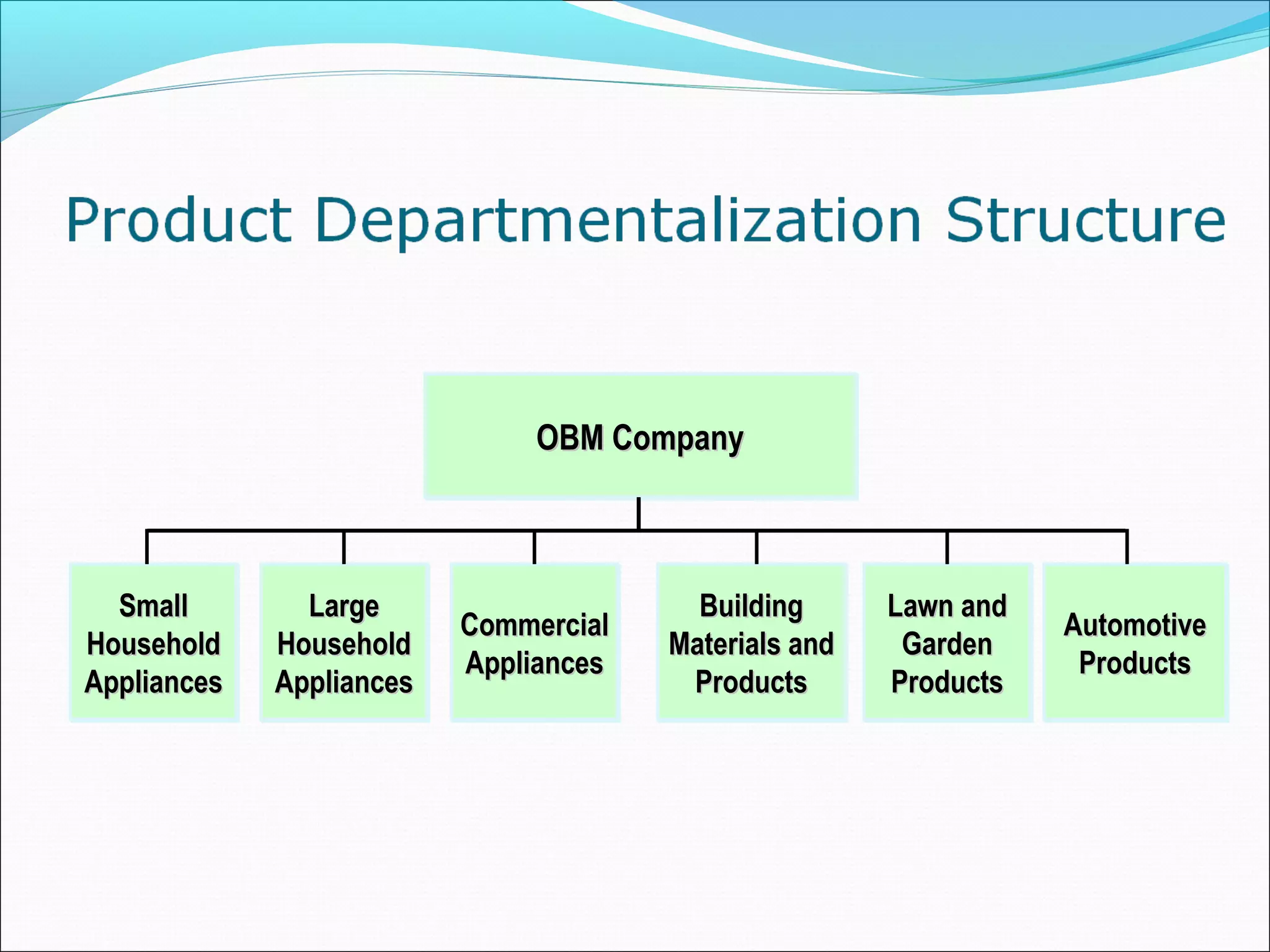
OBM CompanyOBM CompanyOBM CompanyOBM Company
SmallSmall
HouseholdHousehold
AppliancesAppliances
SmallSmall
HouseholdHousehold
AppliancesAppliances
LargeLarge
HouseholdHousehold
AppliancesAppliances
LargeLarge
HouseholdHousehold
AppliancesAppliances
CommercialCommercial
AppliancesAppliances
CommercialCommercial
AppliancesAppliances
BuildingBuilding
Materials andMaterials and
ProductsProducts
BuildingBuilding
Materials andMaterials and
ProductsProducts
Lawn andLawn and
GardenGarden
ProductsProducts
Lawn andLawn and
GardenGarden
ProductsProducts
AutomotiveAutomotive
ProductsProducts
AutomotiveAutomotive
ProductsProducts
Departmental Bases:
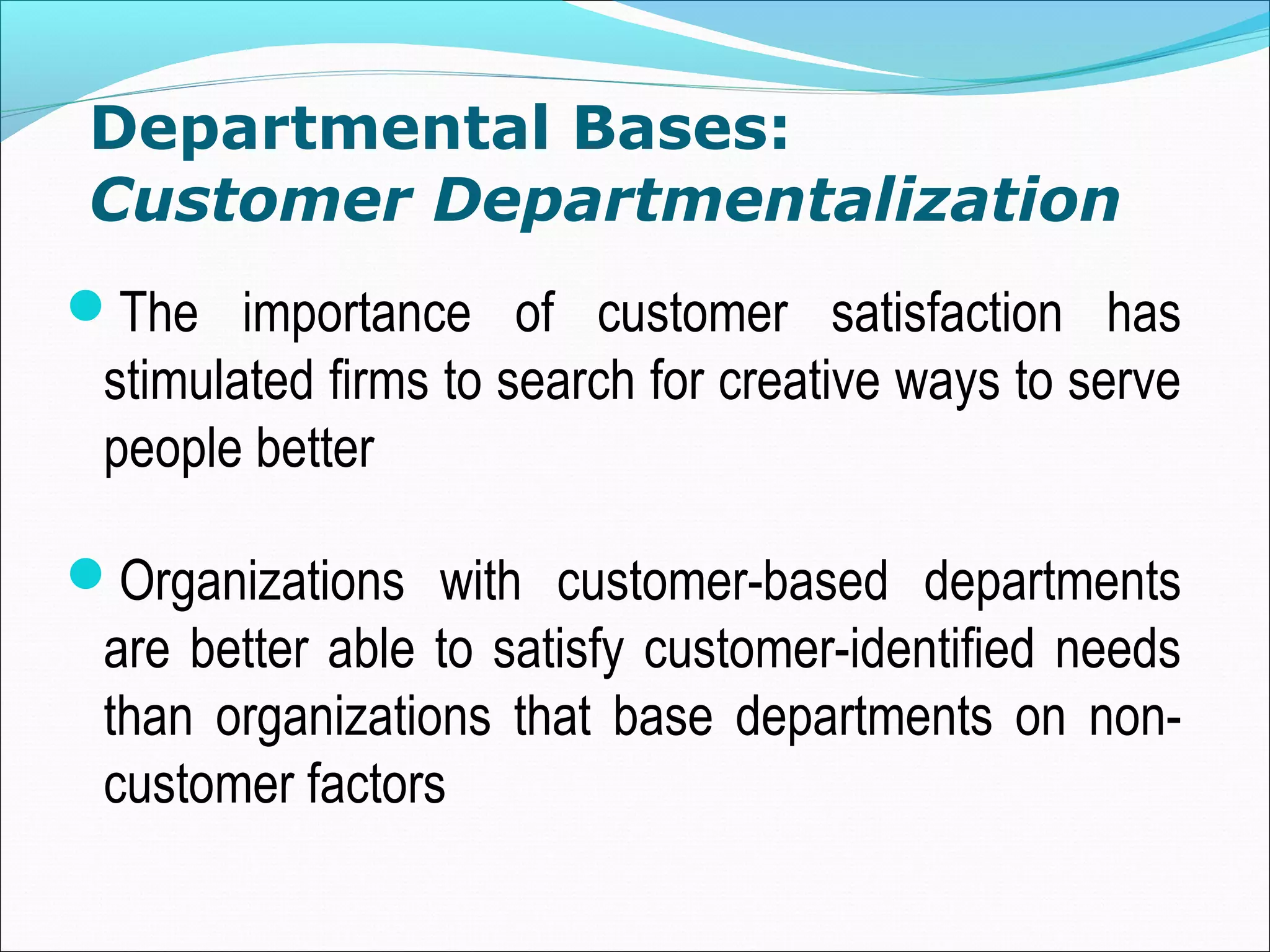
Customer Departmentalization
The importance of customer satisfaction has
stimulated firms to search for creative ways to serve
people better
Organizations with customer-based departments
are better able to satisfy customer-identified needs
than organizations that base departments on non-
customer factors
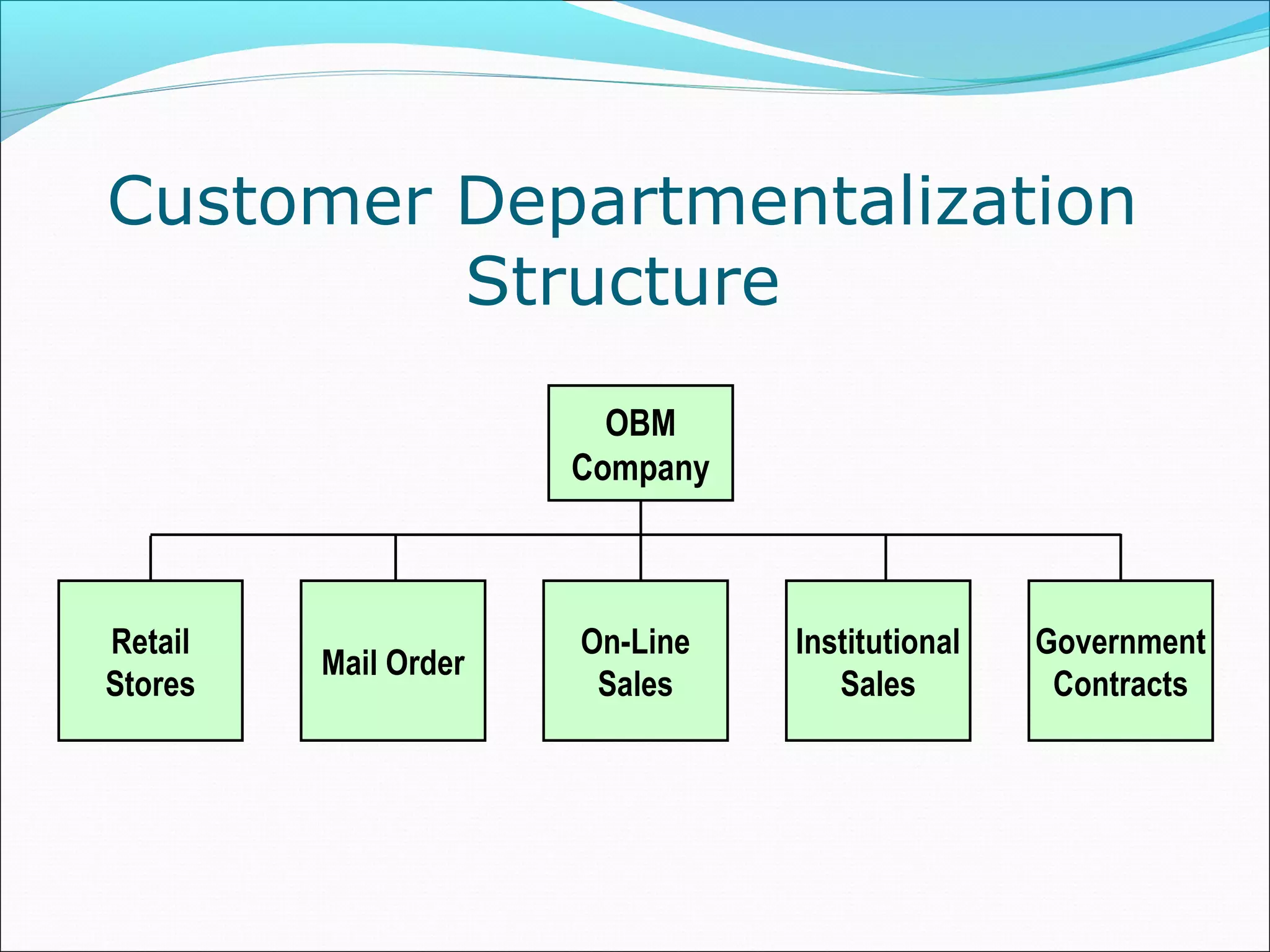
Retail
Stores
Mail Order
On-Line
Sales
Government
Contracts
OBM
Company
Institutional
Sales
Customer Departmentalization
Structure
MODERN ORGANISATION
STRUCTURES
Virtual Organizations
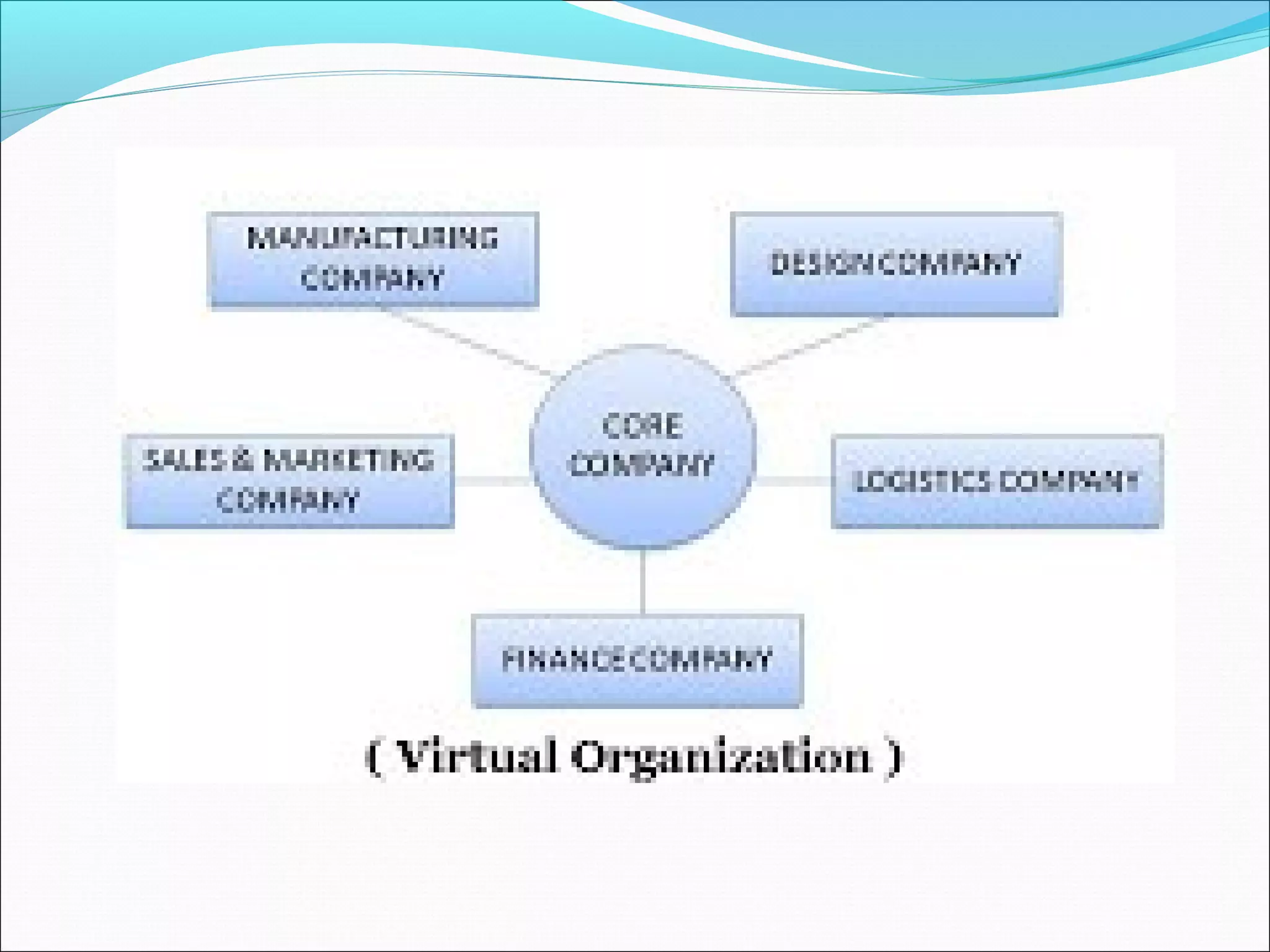
Virtual organization – a collection of
geographically distributed, functionally and/or
culturally diverse aggregations of individuals
that is linked by electronic forms of
communication
Assembled and disassembled according to
needs
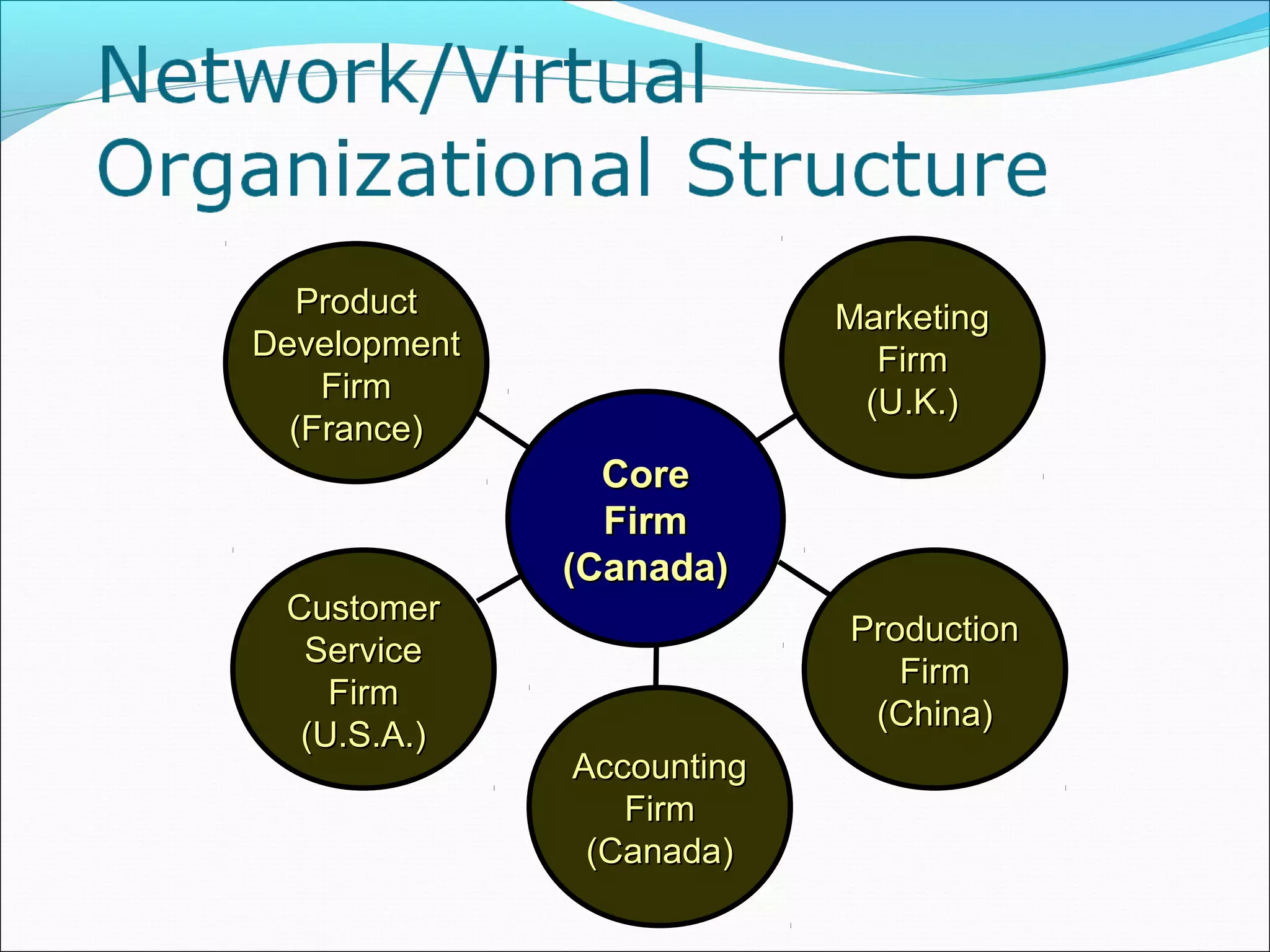
CoreCore
FirmFirm
(Canada)(Canada)
ProductProduct
DevelopmentDevelopment
FirmFirm
(France)(France)
MarketingMarketing
FirmFirm
(U.K.)(U.K.)
CustomerCustomer
ServiceService
FirmFirm
(U.S.A.)(U.S.A.)
ProductionProduction
FirmFirm
(China)(China)
AccountingAccounting
FirmFirm
(Canada)(Canada)
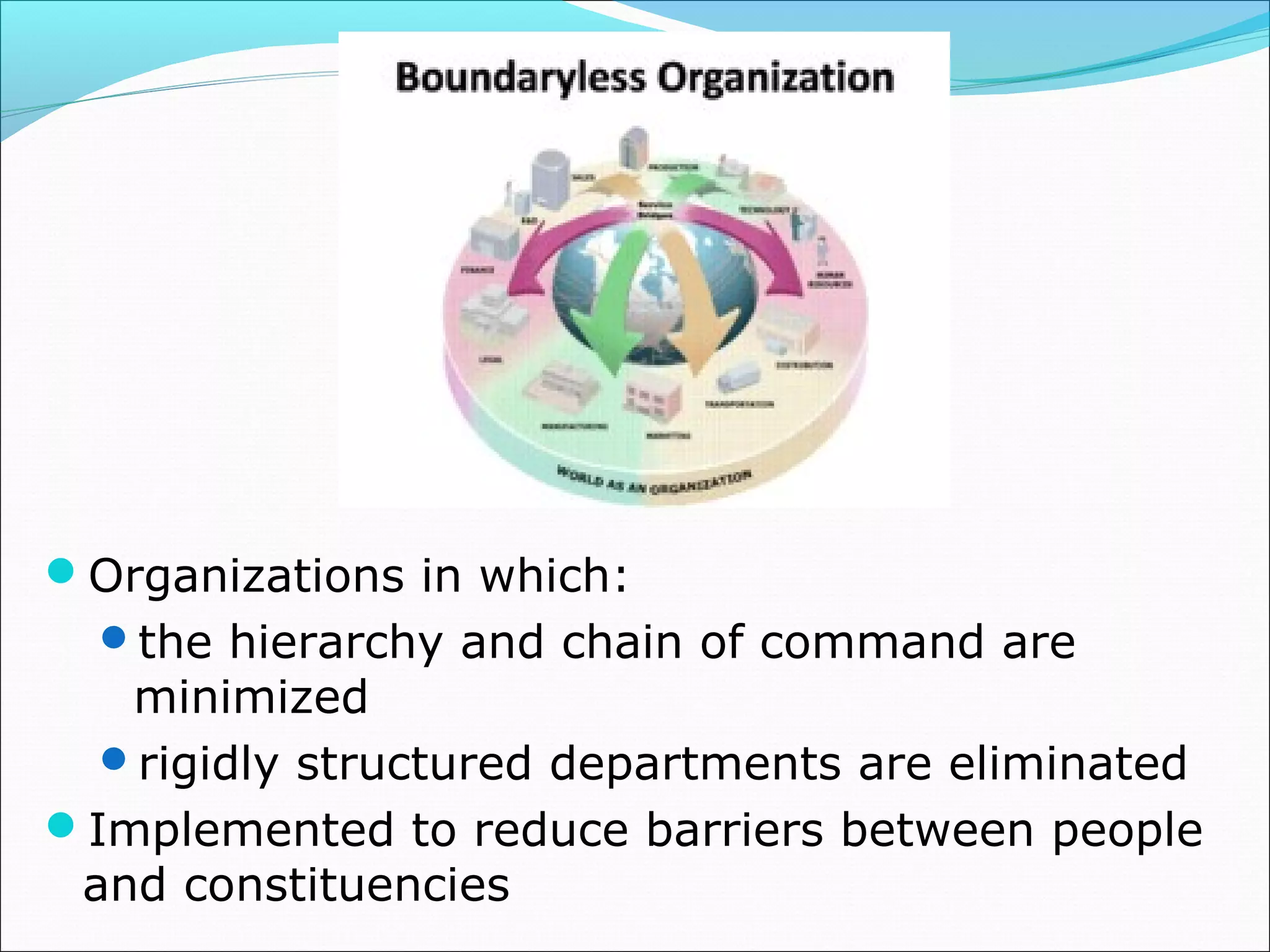
Organizations in which:
the hierarchy and chain of command are
minimized
rigidly structured departments are eliminated
Implemented to reduce barriers between people
and constituencies
VIRTUAL ORGANIZATION
Virtual Organization is a temporary
network of independent companies –
suppliers, customers, even erstwhile
rivals – linked by information
technology to share skills, costs and
access to one another’s markets.
It will have neither central office nor
organization chart. It will have no
hierarchy, no vertical integration.
CELLULAR ORGANIZATION
It is a form of organization consisting of a
collection of self-managing firms or cells held
together by mutual interest. A cellular
organization is built on the principles of self-
organization, member ownership, and
entrepreneurship.
Each cell within the organization shares
common features and purposes with its sister
cells but is also able to function independently.
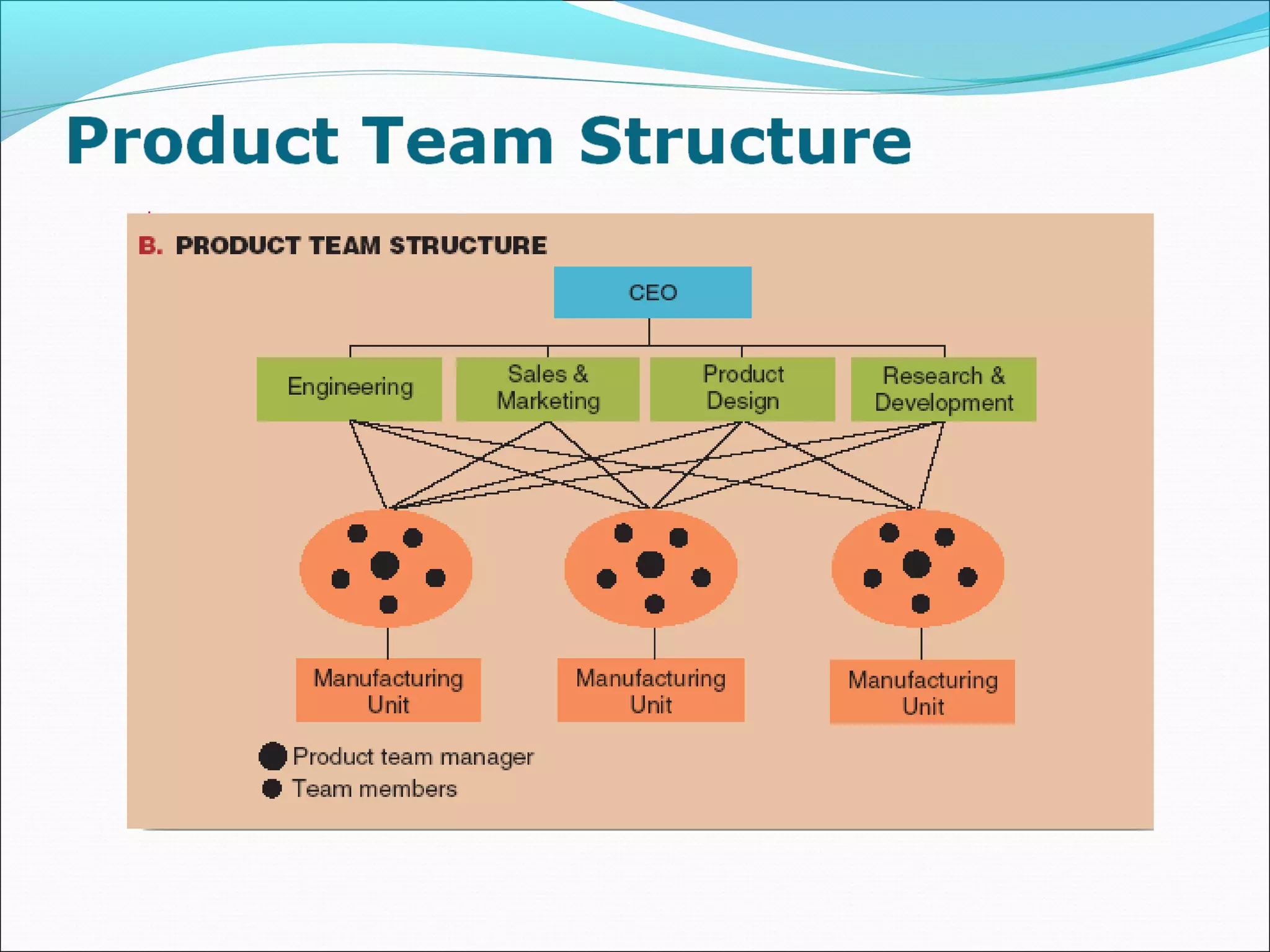
TEAM
STRUCTURE
A Team is a group of people in the
organization constituted for
completing certain assignments.
TYPES:
1. Lead Team
2. Cross-functional Team
3. Problem-solving Team
4. Self-managing Team
Features of Team-Based Structures
Structure is built around Self-directed work
teams rather than individuals
Teams organized around work processes
Very flat span of control
Very little formalization
Most supervisory activities are delegated to the
team
Usually found within divisionalized structure
Very responsive and flexible; empowerment is
high; reduced need for managers; time
consuming; ambiquity
BOUNDARYLESS
ORGANIZATION
It is a model that views organizations as
having permeable boundaries. An organization
has external boundaries that separate it from its
suppliers and customers, and internal boundaries
that provide demarcation to departments.
This rigidity is removed in boundaryless
organizations, where the goal is to develop
greater flexibility and responsiveness to change
and to facilitate the free exchange of information
and ideas.
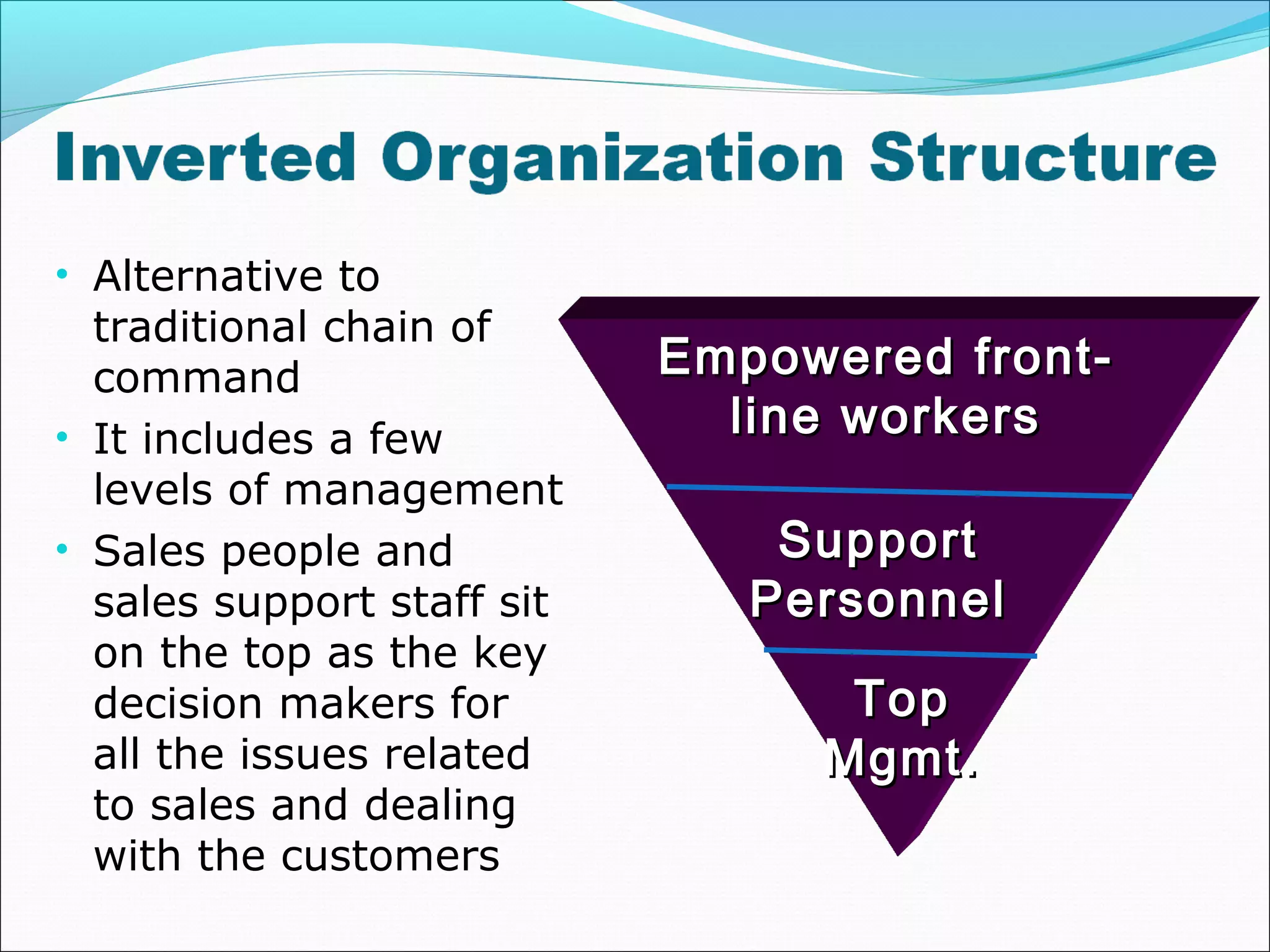
Empowered front-Empowered front-
line workersline workers
SupportSupport
PersonnelPersonnel
TopTop
Mgmt.Mgmt.
• Alternative to
traditional chain of
command
• It includes a few
levels of management
• Sales people and
sales support staff sit
on the top as the key
decision makers for
all the issues related
to sales and dealing
with the customers
Oganisational design & structure

Oganisational design & structure

  • 2.
    What Is Organizing? Organizing: Arrangingthe activities of the enterprise in such a way that they systematically contribute to the enterprise’s goals.
  • 3.
    Organization designOrganization design–– management decisions andmanagement decisions and actions that result in a specific organization structure.actions that result in a specific organization structure. Organization structure –Organization structure – the pattern of jobs and groupsthe pattern of jobs and groups of jobs in an organization. It is an important cause ofof jobs in an organization. It is an important cause of individual and group behavior.individual and group behavior. Organization Structure & Design
  • 4.
    4 Organization Chart Organization Chart:A chart that shows the structure of the organization including the title of each manager’s position and, by means of connecting lines, who is accountable to whom and who has authority for each area.
  • 5.
    Organization Chart I nf o r m a t io n S e r v ic e s G r o u p C a ta lo g e r C a ta lo g e r C u s t o m e r L i a i s o n T a x o n o m y D e s i g n e r K n o w le d g e A r c h i te c t u r e L e a d D e v e lo p e r D e v e lo p e r S y s t e m s A d m in S e a r c h / S y s t e m s L e a d A s s i s t a n t D e s i g n e r D e s i g n L e a d K n o w le d g e A r c h i t e c t u r e M a n a g e r
  • 6.
    Basic Concepts: Organization OrganizationalHierarchy (flat & Tall Organizations) Authority (Centralization & Decentralization ) Responsibility Span of Management
  • 7.
    Principles of Organization Aligndepartment objectives to corporate goals Cost-effective operations Optimum number of subordinates Specialization Define authority & Flow of authority Ensure one employee, one superior One head and one plan Define responsibility Commensurate authority and responsibility & Attain balance Ensure flexibility & Manage via exceptional cases Provide for continuity
  • 8.
    Determine what isto be done/ Division of Work: Assign Tasks: Departmentalization: Link Departments: Hierarchy Development: Decide how much Authority to Designate/ Authority, Responsibility and Delegation: Decide the Levels at which Decisions are to be made / Centralization vs. Decentralization: Decide how to Achieve Coordination: Process of Organizing
  • 10.
    LINE ORGANIZATION Line Organizationstructure is also known as scalar, military or vertical organization and perhaps is the oldest form. This concept holds that in any organization or hierarchy derived from a scalar process, there must be a single head who commands it.  All persons of the same organization are independent of each other.  This structure specifies responsibility and authority for all positions limiting the area of action by a particular position holder.
  • 11.
    ExamplE for lINE orGaNIZaTIoN ChiefExecutiveChief Executive FOREMAN A FOREMAN B FOREMAN C Workers Workers Workers
  • 12.
    lINE aND STaff orGaNIZaTIoN Theproblem can usually be solved by classifying activities within an organization in two ways: 1. That which is substantive (direct) in its contribution – Line activities 2. That which is objective (indirect) in its contribution – Staff activities
  • 13.
    ExamplE for lINE aNDSTaff orGaNIZaTIoN GENRAL MANAGER Public Relations OfficerSecretary Manager (Finance) Manager (personnel) Manager - Production Manager - Marketing Production Engineer Production Engineer Workers Workers
  • 14.
    fUNCTIoNal orGaNIZaTIoN It is createdby grouping the activities on the basis of functions required for the achievement of organizational objectives. CHARACTERISTICS: 1. Specialization by functions 2. Emphasis on sub-goals 3. Pyramidal growth of Organization 4. Line and staff division 5. Limited span of management 6. Functional authority relationships among departments
  • 15.
    ExamplE for fUNCTIoNal orGaNIZaTIoN Head Quarters ProductionMarketing Finance Personnel Plant 1 Plant 2 Plant 3 P M F P P PM MF FP P
  • 16.
    CommITTEE orGaNIZaTIoN It canbe defined as a body of persons appointed to meet on an organized basis for the discussion and dealing of matters brought before it. FEATURES: 1. Group of persons 2. Can deliberate only on matters that are brought before it 3. Members of the committee draw authority through delegation.
  • 17.
  • 18.
    MATRIX ORGANIZATION Matrix Organization isthe realization of two dimensional structure which emanates directly from two dimensions of authority. 1. Pure project structure 2. Functional structure
  • 20.
  • 21.
    Departmental Bases: Functional Departmentalization Jobsare combined according to the functions of the organization The principal advantage is efficiency By having departments of specialists, management creates efficient units A major disadvantage is that organizational goals may be sacrificed in favor of departmental goals
  • 22.
    EngineeringEngineeringEngineeringEngineering ReliabilityReliabilityReliabilityReliability FinanceFinanceFinanceFinance ManufacturingManufacturingManufacturingManufacturingDistributionDistributionDistributionDistribution HumanHuman ResourcesResources HumanHuman ResourcesResources PublicPublic RelationsRelations PublicPublic RelationsRelations PurchasingPurchasingPurchasingPurchasing OBM CompanyOBM CompanyOBM CompanyOBM Company
  • 23.
    Departmental Bases: Geographic Departmentalization Establishgroups according to geographic area The logic is that all activities in a given region should be assigned to a manager Advantageous in large organizations because physical separation of activities makes centralized coordination difficult Provides a training ground for managerial personnel
  • 24.
    Northeast Midwest SoutheastPacific OBM Company Southwest Geographic Departmentalization Structure
  • 25.
    Departmental Bases: Product Departmentalization Alljobs associated with producing and selling a product or product line will be placed under the direction of one manager Product becomes the preferred basis as a firm grows by increasing the number of products it markets Concentrating authority, responsibility, and accountability in a specific product department allows top management to coordinate actions
  • 26.
    OBM CompanyOBM CompanyOBMCompanyOBM Company SmallSmall HouseholdHousehold AppliancesAppliances SmallSmall HouseholdHousehold AppliancesAppliances LargeLarge HouseholdHousehold AppliancesAppliances LargeLarge HouseholdHousehold AppliancesAppliances CommercialCommercial AppliancesAppliances CommercialCommercial AppliancesAppliances BuildingBuilding Materials andMaterials and ProductsProducts BuildingBuilding Materials andMaterials and ProductsProducts Lawn andLawn and GardenGarden ProductsProducts Lawn andLawn and GardenGarden ProductsProducts AutomotiveAutomotive ProductsProducts AutomotiveAutomotive ProductsProducts
  • 27.
    Departmental Bases: Customer Departmentalization Theimportance of customer satisfaction has stimulated firms to search for creative ways to serve people better Organizations with customer-based departments are better able to satisfy customer-identified needs than organizations that base departments on non- customer factors
  • 28.
  • 29.
    MODERN ORGANISATION STRUCTURES Virtual Organizations Virtualorganization – a collection of geographically distributed, functionally and/or culturally diverse aggregations of individuals that is linked by electronic forms of communication Assembled and disassembled according to needs
  • 30.
  • 31.
    Organizations in which: thehierarchy and chain of command are minimized rigidly structured departments are eliminated Implemented to reduce barriers between people and constituencies
  • 32.
    VIRTUAL ORGANIZATION Virtual Organizationis a temporary network of independent companies – suppliers, customers, even erstwhile rivals – linked by information technology to share skills, costs and access to one another’s markets. It will have neither central office nor organization chart. It will have no hierarchy, no vertical integration.
  • 34.
    CELLULAR ORGANIZATION It isa form of organization consisting of a collection of self-managing firms or cells held together by mutual interest. A cellular organization is built on the principles of self- organization, member ownership, and entrepreneurship. Each cell within the organization shares common features and purposes with its sister cells but is also able to function independently.
  • 35.
    TEAM STRUCTURE A Team isa group of people in the organization constituted for completing certain assignments. TYPES: 1. Lead Team 2. Cross-functional Team 3. Problem-solving Team 4. Self-managing Team
  • 36.
    Features of Team-BasedStructures Structure is built around Self-directed work teams rather than individuals Teams organized around work processes Very flat span of control Very little formalization Most supervisory activities are delegated to the team Usually found within divisionalized structure Very responsive and flexible; empowerment is high; reduced need for managers; time consuming; ambiquity
  • 38.
    BOUNDARYLESS ORGANIZATION It is amodel that views organizations as having permeable boundaries. An organization has external boundaries that separate it from its suppliers and customers, and internal boundaries that provide demarcation to departments. This rigidity is removed in boundaryless organizations, where the goal is to develop greater flexibility and responsiveness to change and to facilitate the free exchange of information and ideas.
  • 39.
    Empowered front-Empowered front- lineworkersline workers SupportSupport PersonnelPersonnel TopTop Mgmt.Mgmt. • Alternative to traditional chain of command • It includes a few levels of management • Sales people and sales support staff sit on the top as the key decision makers for all the issues related to sales and dealing with the customers

Editor's Notes