Group Properties
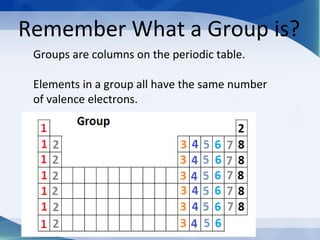
Remember What a Group is?
Groups are columns on the periodic table.
Elements in a group all have the same number
of valence electrons.
Hydrogen
• Hydrogen belongs to a
family of its own.
• Hydrogen is a diatomic,
reactive gas.
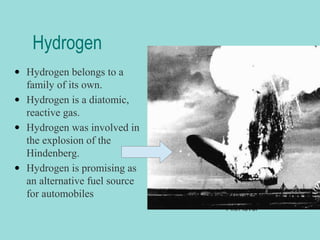
• Hydrogen was involved in
the explosion of the
Hindenberg.
• Hydrogen is promising as
an alternative fuel source
for automobiles

 Click to edit the outline text format
−

Second Outline Level
 Third Outline Level
− Fourth Outline Level
 Fifth Outline Level
 Sixth Outline Level

•

Seventh Outline LevelClick to edit Master
text styles

− Second level
− Third level

• Fourth level
− Fifth level
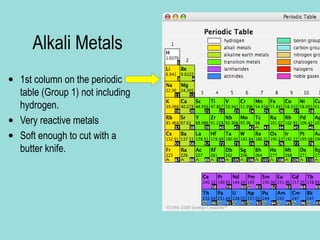
Alkali Metals
• 1st column on the periodic
table (Group 1) not including
hydrogen.
• Very reactive metals
• Soft enough to cut with a
butter knife.

Click to edit the outline text format
− Second Outline Level
 Third Outline Level
− Fourth Outline Level
 Fifth Outline Level
 Sixth Outline Level
 Seventh Outline
Level
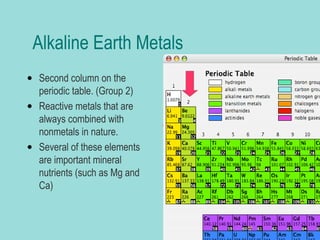
Alkaline Earth Metals
• Second column on the
periodic table. (Group 2)
• Reactive metals that are
always combined with
nonmetals in nature.
• Several of these elements
are important mineral
nutrients (such as Mg and
Ca)

Click to edit the outline text format
− Second Outline Level
 Third Outline Level
− Fourth Outline Level
 Fifth Outline Level
 Sixth Outline Level
 Seventh Outline
Level
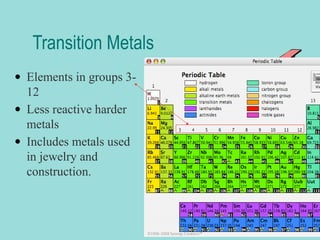
Transition Metals
• Elements in groups 312
• Less reactive harder
metals
• Includes metals used
in jewelry and
construction.

 Click to edit the outline text format
−

Second Outline Level
 Third Outline Level
− Fourth Outline Level
 Fifth Outline Level
 Sixth Outline Level

•

Seventh Outline LevelClick to edit Master
text styles

− Second level
− Third level

• Fourth level
− Fifth level
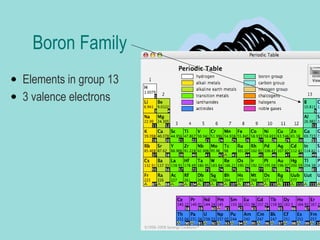
Boron Family
• Elements in group 13
• 3 valence electrons

Click to edit the outline text format
− Second Outline Level
 Third Outline Level
− Fourth Outline Level
 Fifth Outline Level
 Sixth Outline Level
 Seventh Outline
Level
Carbon Family
• Elements in group 14
• Contains elements
important to life and
computers.
• Silicon and Germanium
are important
semiconductors.

 Click to edit the outline text format
−

Second Outline Level
 Third Outline Level
− Fourth Outline Level
 Fifth Outline Level
 Sixth Outline Level

•

Seventh Outline LevelClick to edit Master
text styles

− Second level
− Third level

• Fourth level
− Fifth level
Nitrogen Family
• Elements in group 15
• Nitrogen makes up over
¾ of the atmosphere.
• The red stuff on the tip of
matches is phosphorus.

 Click to edit the outline text format
−

Second Outline Level
 Third Outline Level
− Fourth Outline Level
 Fifth Outline Level
 Sixth Outline Level

•

Seventh Outline LevelClick to edit Master
text styles

− Second level
− Third level

• Fourth level
− Fifth level
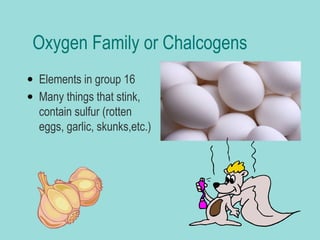
Oxygen Family or Chalcogens
• Elements in group 16
• Many things that stink,
contain sulfur (rotten
eggs, garlic, skunks,etc.)

Click to edit the outline text format
− Second Outline Level
 Third Outline Level
− Fourth Outline Level
 Fifth Outline Level
 Sixth Outline Level
 Seventh Outline
Level
Halogens
• Elements in group 17
• Very reactive, volatile,
diatomic, nonmetals
• Used as disinfectants
and to strengthen teeth.

Click to edit the outline text format
− Second Outline Level
 Third Outline Level
− Fourth Outline Level
 Fifth Outline Level
 Sixth Outline Level
 Seventh Outline
Level
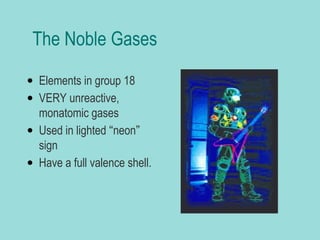
The Noble Gases
• Elements in group 18
• VERY unreactive,
monatomic gases
• Used in lighted “neon”
sign
• Have a full valence shell.
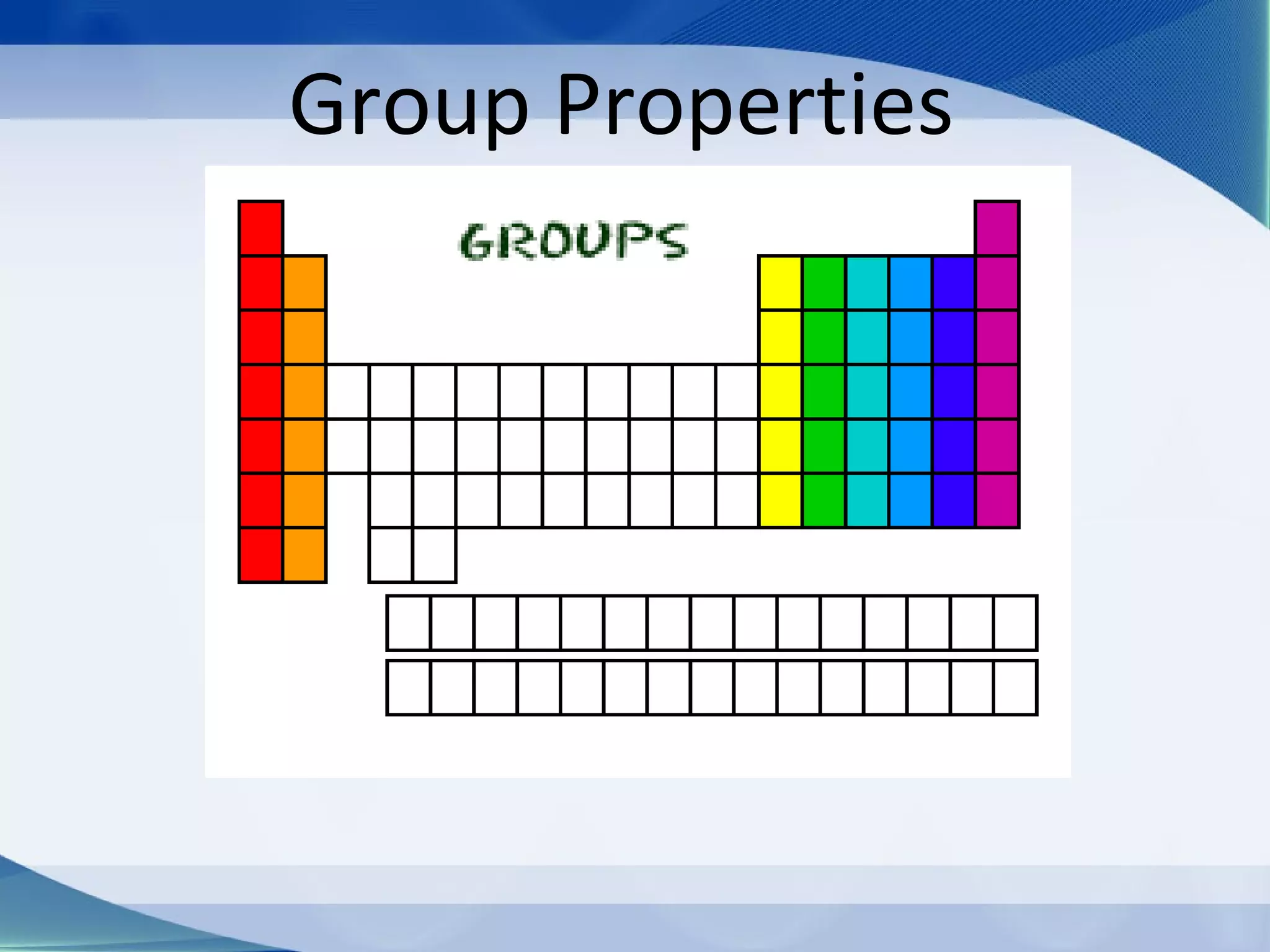
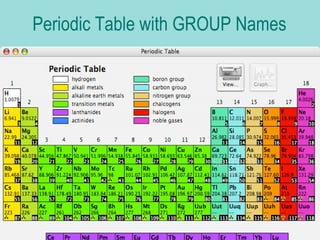
Periodic Table with GROUP Names
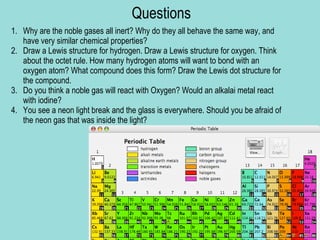
Questions
1. Why are the noble gases all inert? Why do they all behave the same way, and
have very similar chemical properties?
2. Draw a Lewis structure for hydrogen. Draw a Lewis structure for oxygen. Think
about the octet rule. How many hydrogen atoms will want to bond with an
oxygen atom? What compound does this form? Draw the Lewis dot structure for
the compound.
3. Do you think a noble gas will react with Oxygen? Would an alkalai metal react
with iodine?
4. You see a neon light break and the glass is everywhere. Should you be afraid of
the neon gas that was inside the light?

Group Names and Properties

  • 1.
  • 2.
    Remember What aGroup is? Groups are columns on the periodic table. Elements in a group all have the same number of valence electrons.
  • 3.
    Hydrogen • Hydrogen belongsto a family of its own. • Hydrogen is a diatomic, reactive gas. • Hydrogen was involved in the explosion of the Hindenberg. • Hydrogen is promising as an alternative fuel source for automobiles  Click to edit the outline text format − Second Outline Level  Third Outline Level − Fourth Outline Level  Fifth Outline Level  Sixth Outline Level • Seventh Outline LevelClick to edit Master text styles − Second level − Third level • Fourth level − Fifth level
  • 4.
    Alkali Metals • 1stcolumn on the periodic table (Group 1) not including hydrogen. • Very reactive metals • Soft enough to cut with a butter knife. Click to edit the outline text format − Second Outline Level  Third Outline Level − Fourth Outline Level  Fifth Outline Level  Sixth Outline Level  Seventh Outline Level
  • 5.
    Alkaline Earth Metals •Second column on the periodic table. (Group 2) • Reactive metals that are always combined with nonmetals in nature. • Several of these elements are important mineral nutrients (such as Mg and Ca) Click to edit the outline text format − Second Outline Level  Third Outline Level − Fourth Outline Level  Fifth Outline Level  Sixth Outline Level  Seventh Outline Level
  • 6.
    Transition Metals • Elementsin groups 312 • Less reactive harder metals • Includes metals used in jewelry and construction.  Click to edit the outline text format − Second Outline Level  Third Outline Level − Fourth Outline Level  Fifth Outline Level  Sixth Outline Level • Seventh Outline LevelClick to edit Master text styles − Second level − Third level • Fourth level − Fifth level
  • 7.
    Boron Family • Elementsin group 13 • 3 valence electrons Click to edit the outline text format − Second Outline Level  Third Outline Level − Fourth Outline Level  Fifth Outline Level  Sixth Outline Level  Seventh Outline Level
  • 8.
    Carbon Family • Elementsin group 14 • Contains elements important to life and computers. • Silicon and Germanium are important semiconductors.  Click to edit the outline text format − Second Outline Level  Third Outline Level − Fourth Outline Level  Fifth Outline Level  Sixth Outline Level • Seventh Outline LevelClick to edit Master text styles − Second level − Third level • Fourth level − Fifth level
  • 9.
    Nitrogen Family • Elementsin group 15 • Nitrogen makes up over ¾ of the atmosphere. • The red stuff on the tip of matches is phosphorus.  Click to edit the outline text format − Second Outline Level  Third Outline Level − Fourth Outline Level  Fifth Outline Level  Sixth Outline Level • Seventh Outline LevelClick to edit Master text styles − Second level − Third level • Fourth level − Fifth level
  • 10.
    Oxygen Family orChalcogens • Elements in group 16 • Many things that stink, contain sulfur (rotten eggs, garlic, skunks,etc.) Click to edit the outline text format − Second Outline Level  Third Outline Level − Fourth Outline Level  Fifth Outline Level  Sixth Outline Level  Seventh Outline Level
  • 11.
    Halogens • Elements ingroup 17 • Very reactive, volatile, diatomic, nonmetals • Used as disinfectants and to strengthen teeth. Click to edit the outline text format − Second Outline Level  Third Outline Level − Fourth Outline Level  Fifth Outline Level  Sixth Outline Level  Seventh Outline Level
  • 12.
    The Noble Gases •Elements in group 18 • VERY unreactive, monatomic gases • Used in lighted “neon” sign • Have a full valence shell.
  • 13.
  • 14.
    Questions 1. Why arethe noble gases all inert? Why do they all behave the same way, and have very similar chemical properties? 2. Draw a Lewis structure for hydrogen. Draw a Lewis structure for oxygen. Think about the octet rule. How many hydrogen atoms will want to bond with an oxygen atom? What compound does this form? Draw the Lewis dot structure for the compound. 3. Do you think a noble gas will react with Oxygen? Would an alkalai metal react with iodine? 4. You see a neon light break and the glass is everywhere. Should you be afraid of the neon gas that was inside the light?