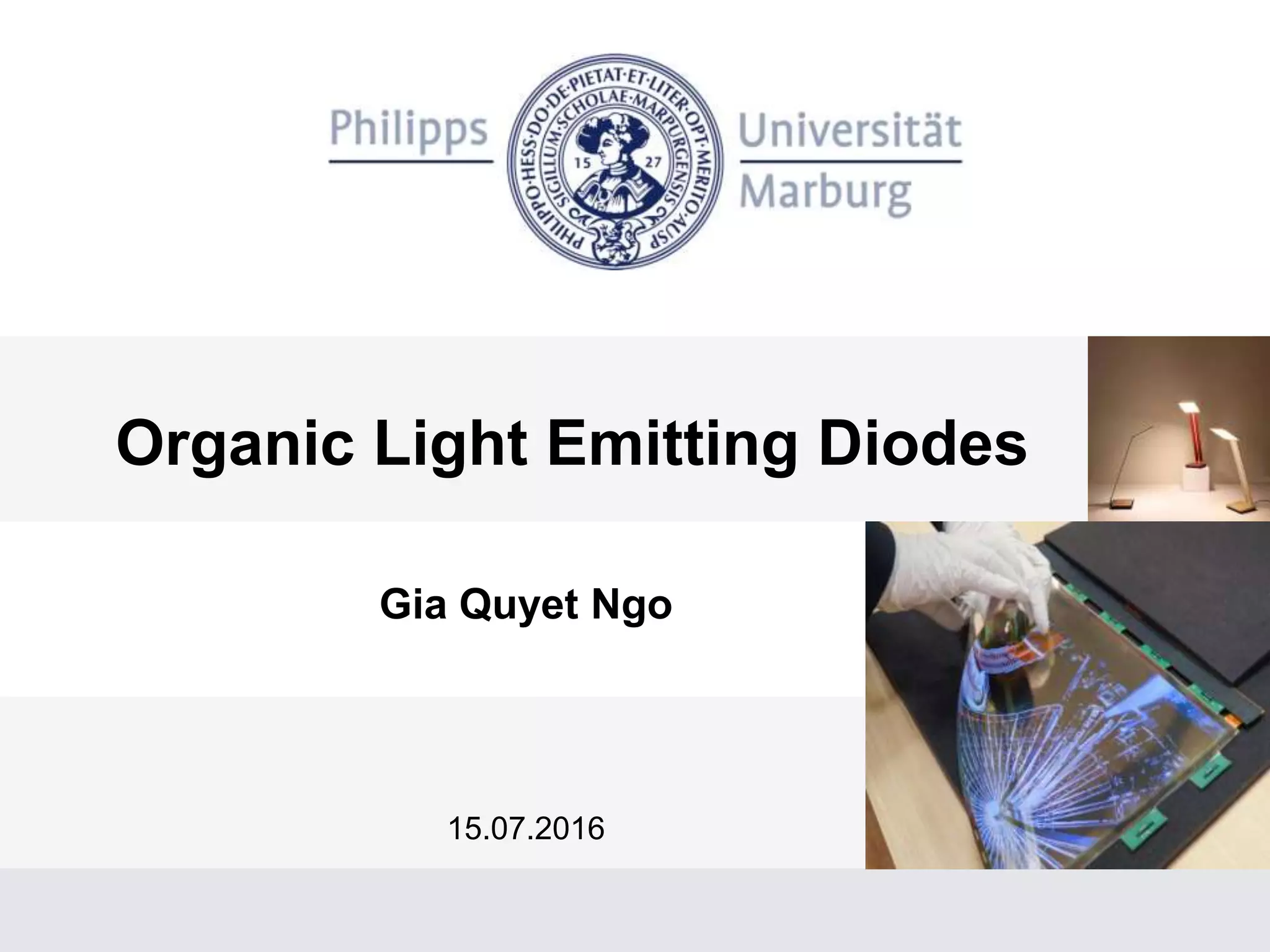
Organic Light Emitting Diodes
Gia Quyet Ngo
15.07.2016
Outline
2
• Introduction
• Structure
• Characteristics
• Principle
• Applications
• Limitations
• Conclusion
Introduction
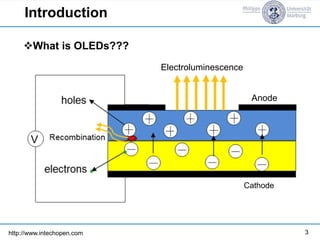
What is OLEDs???
3http://www.intechopen.com
Cathode
Anode
Electroluminescence
Motivation
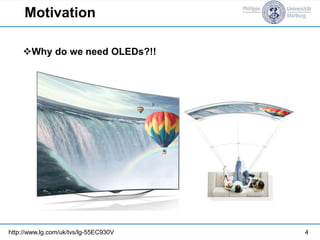
Why do we need OLEDs?!!
4http://www.lg.com/uk/tvs/lg-55EC930V
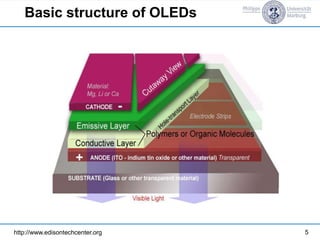
5http://www.edisontechcenter.org
Basic structure of OLEDs
Characteristics of OLEDs
6Bernard Geffroy et al., “Review Organic light-emitting diode (OLED) technology: materials, devices and
display technologies”, Polymer International 55:572-582 (2006)
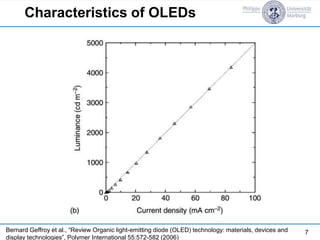
Characteristics of OLEDs
7Bernard Geffroy et al., “Review Organic light-emitting diode (OLED) technology: materials, devices and
display technologies”, Polymer International 55:572-582 (2006)
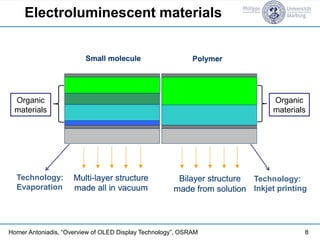
Electroluminescent materials
8Homer Antoniadis, “Overview of OLED Display Technology”, OSRAM
Technology:
Inkjet printing
Technology:
Evaporation
Organic
materials
Organic
materials
9
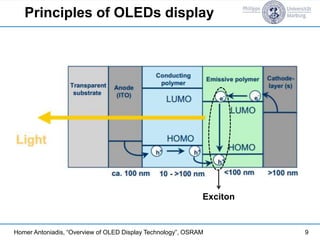
Principles of OLEDs display
Exciton
Homer Antoniadis, “Overview of OLED Display Technology”, OSRAM
10http://electronics.howstuffworks.com
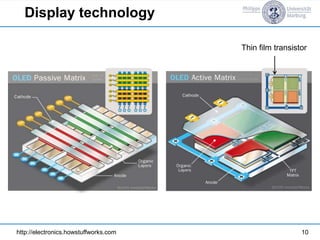
Display technology
Thin film transistor
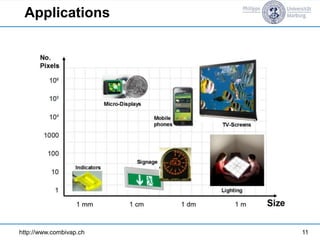
Applications
11http://www.combivap.ch
Limitations
12
• Low operating lifetime.
• Expensive.
• Damageable with water.
• Hard to see in direct sunlight.
• Color balance issues.
Conclusions
• A breakthrough of next generation displays
and lighting.
• Challenges to overcome.
What is the next steps???
• Better materials.
• New manufacturing processes.
• QLED (Quantum dots-LED)!!!
13
Any Questions?
14

Organic light emitting diodes (oled)

Editor's Notes

  • #4 Electroluminescence is the phenomenon of a material emitting light when electric current or an electric field is passed through it - this happens when electrons are sent through the material and fill electron holes. An electron hole exists where an atom lacks electrons (negatively charged) and therefore has a positive charge. In 1960s, for single crystals of anthracene (C14H10). 1987 by Tang with efficient and low voltage OLEDs from p-n heterostructure.
  • #5 OLED thickness less than 2mm (4-6 mm for LCDs). OLED TV of LG has total thickness is 4.3mm. Brightness of OLEDs up to 10,000 cd/m2. Viewing angle from 160 – 170 degree without degradation of the picture. Response time few tens of microseconds compared with milisecond of LCDs. Highest luminous efficiency (lumen/w) is 70. Power consumption around 60% of LCD display. Lightweight and thin. Bright, wide viewing angle. Fast response time, high contrast. Large area color displays and flexibility. Low power consumption.
  • #6 Organic electroluminescent materials based on pi-conjugated molecules, are almost insulators (Eg = 2.5-4eV). Light is produced by recombination of holes and electrons which have to be injected at the electrodes. Charges move inside the material by hopping processes and recombine to form excitons. The location of recombination zone in the diode is a function of the charge mobility of the organic material as well as electric field distribution.
  • #7 I-V-L show that above threshold voltage, the current increases exponentially and light is emitted. Generally, luminance is proportional to the current density, indicating that the quantum efficiency is constant over a wide range of current.
  • #8 I-V-L show that above threshold voltage, the current increases exponentially and light is emitted. Generally, luminance is proportional to the current density, indicating that the quantum efficiency is constant over a wide range of current.
  • #9 Requirements for OLED materials: Hight luminescence quantum yield, good carrier mobility. Good forming properties, good thermal and oxidative stability. Good color purity. There are two main classes of OLED devices: those made with small organic molecules (dry process) and those made with organic polymers (wet process). Electroluminescence from Polymers is discovered from Cambridge university in 1990.
  • #10 If a drive voltage is applied, electrons and holes are injected from cathode and anode, respectively. The recombination of the injected charge carriers within the EML leads to the generation of excited molecular states (in the following referred to as excitons) which can decay radiatively to create photons. The conduction in organic layer is driven by delocalization of π electrons caused by conjugation over all or part of the organic molecule. Hence, the conducting levels in organic molecules can be varied form that of an insulator to a conductor.
  • #11 The row and column substrate intersect at designated pixel. We cannot activate single pixel due to the mechanism of circuitry. PMOLED:Advantanges: Simplicity. Easy to manufacture. Suitable with small screens. Disadvantages: High power consumption. Slow response time. Imprecise voltage control. Huge resistive looses in the column of pixels. Damageable pixels under high current. AMOLED: Advantanges: Low power consumption Suitable with large screens, more benefit in case of top emission. Faster refresh rates. Disadvantages: Difficulties of fabrication.
  • #13 Blue color has the lower lifespan compared with the other colors.
  • #14 Future of OLEDs Paving New Ways for OLED Technology OLED technology may usher in a new era of large-area, transparent, flexible and low-energy display and lighting products. The flexibility of OLEDs enables manufacturers to produce OLEDs using roll-to-roll manufacturing processes, and allows for the production of flexible display and lighting products. OLEDs are commercially produced on rigid glass substrates mainly. However, first applications like watches or bent displays using flexible OLEDs have entered the market lately. Developing sufficiently durable and flexible OLEDs will require better materials and further development of manufacturing tools and processes. Flexible plastic substrates need improved barrier layers to protect OLEDs from moisture and oxygen. Thin-film encapsulation also is needed to create thin and flexible metal- and glass-based OLEDs. These advances ultimately may lead to very flexible OLED panels for both display and lighting products, ensuring that any surface area – flat or curved – will be able to host a light source. Recent demonstrations by display and lighting companies already have hinted at the potential of flexible OLED technology. Substantial development efforts are being invested in this area and, if successful, flexible OLED panels may become commercially available as early as the last half of this decade.