

OLED
ORGANIC LIGHT EMITTING DIODE.
BY:
DIVYANSHU BHUSHAN
C.S.E. A1,3rd
YR.
1103510019
Outline
 What is OLED
 How OLED works
 Types of OLEDs
 Flexible OLEDs
 How FOLEDs works
 Advantages and Challenges
 Sequitur (Conclusion)
INTRODUCTION
 (An OLED (organic light-emitting diode) is a light-emitting
diodeLED) in which the emissive electroluminescent layer is a film
of organic compound which emits light in response to an electric
current.
 This layer of organic semiconductor is situated between two
electrodes. Generally,at least one of these electrodes is
transparent.
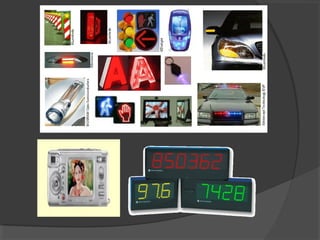
 OLEDs are used to create digital displays in devices such as
television screens, computer monitors,portable systems such as
mobile phones, handheld games consoles and PDAs
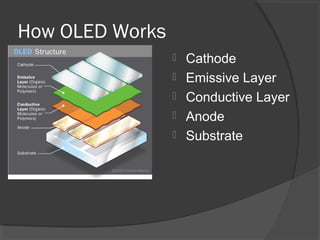
How OLED Works
 Cathode
 Emissive Layer
 Conductive Layer
 Anode
 Substrate
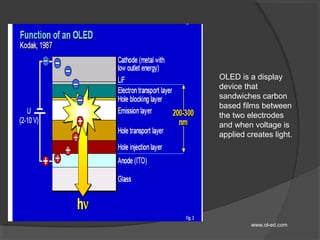
OLED is a display
device that
sandwiches carbon
based films between
the two electrodes
and when voltage is
applied creates light.
www.ol-ed.com
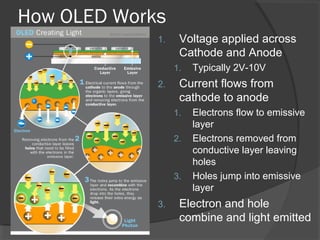
How OLED Works
1. Voltage applied across
Cathode and Anode
1. Typically 2V-10V
2. Current flows from
cathode to anode
1. Electrons flow to emissive
layer
2. Electrons removed from
conductive layer leaving
holes
3. Holes jump into emissive
layer
3. Electron and hole
combine and light emitted
Types of OLEDs
 Passive-matrix OLED
 Active-matrix OLED
 Transparent OLED
 Top-emitting OLED
 Foldable OLED
 White OLED
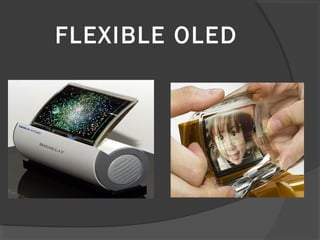
FLEXIBLE OLED
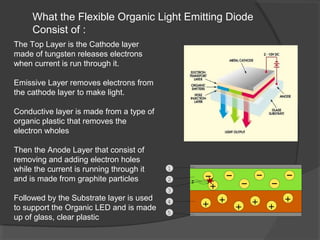
What the Flexible Organic Light Emitting Diode
Consist of :
The Top Layer is the Cathode layer
made of tungsten releases electrons
when current is run through it.
Emissive Layer removes electrons from
the cathode layer to make light.
Conductive layer is made from a type of
organic plastic that removes the
electron wholes
Then the Anode Layer that consist of
removing and adding electron holes
while the current is running through it
and is made from graphite particles
Followed by the Substrate layer is used
to support the Organic LED and is made
up of glass, clear plastic
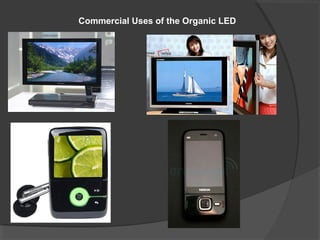
Commercial Uses of the Organic LED
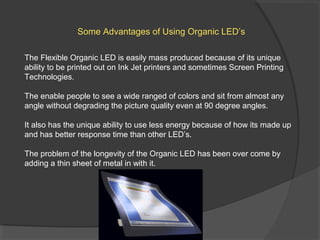
Some Advantages of Using Organic LED’s
The Flexible Organic LED is easily mass produced because of its unique
ability to be printed out on Ink Jet printers and sometimes Screen Printing
Technologies.
The enable people to see a wide ranged of colors and sit from almost any
angle without degrading the picture quality even at 90 degree angles.
It also has the unique ability to use less energy because of how its made up
and has better response time than other LED’s.
The problem of the longevity of the Organic LED has been over come by
adding a thin sheet of metal in with it.
OLED Advantages over LED and
LCD
 Thinner, lighter and more flexible
 Plastic substrates rather then glass
 High resolution (<5um pixel size) and fast
switching (1-10um)
 Do not require backlight, light generated
 Low voltage, low power and emissive source
 Robust Design (Plastic Substrate)
 Larger sized displays
 Brighter- good daylight visibility
 Larger viewing angles -170o
OLED Disadvantages
 Shorter Lifetime (approx 5-10 yrs)
 Expensive
 Susceptible to water
 Overcome multi-billion dollar LCD
market
Corporations in OLED’sCorporations in OLED’s
Small Molecule
Kodak
IBM
UDX
Ritek
Samsung
Polymer
CDT
Dupont
Philips
Dow Chemicals
Market Forecast
SEQUITUR
 OLED is a display device that sandwiches carbon based films
between the two electrodes and when voltage is applied creates
light.
 OLED has many advantages over LCDs.
 In coming future it will acquire the market due to its qualities.
 The dynamic interplay of chemistry with device physics results in
these remarkable displays.
References
 http://www.inhabitat.com/samsungs-super-sleek-
31-oled-tv
 www.universaldisplay.com
 www.google.com/ www.googleimages.com
 www.wikipedia.org
 www.isuppli.org
Oled

Oled

  • 1.
    OLED ORGANIC LIGHT EMITTINGDIODE. BY: DIVYANSHU BHUSHAN C.S.E. A1,3rd YR. 1103510019
  • 3.
    Outline  What isOLED  How OLED works  Types of OLEDs  Flexible OLEDs  How FOLEDs works  Advantages and Challenges  Sequitur (Conclusion)
  • 4.
    INTRODUCTION  (An OLED(organic light-emitting diode) is a light-emitting diodeLED) in which the emissive electroluminescent layer is a film of organic compound which emits light in response to an electric current.  This layer of organic semiconductor is situated between two electrodes. Generally,at least one of these electrodes is transparent.  OLEDs are used to create digital displays in devices such as television screens, computer monitors,portable systems such as mobile phones, handheld games consoles and PDAs
  • 5.
    How OLED Works Cathode  Emissive Layer  Conductive Layer  Anode  Substrate
  • 6.
    OLED is adisplay device that sandwiches carbon based films between the two electrodes and when voltage is applied creates light. www.ol-ed.com
  • 7.
    How OLED Works 1.Voltage applied across Cathode and Anode 1. Typically 2V-10V 2. Current flows from cathode to anode 1. Electrons flow to emissive layer 2. Electrons removed from conductive layer leaving holes 3. Holes jump into emissive layer 3. Electron and hole combine and light emitted
  • 8.
    Types of OLEDs Passive-matrix OLED  Active-matrix OLED  Transparent OLED  Top-emitting OLED  Foldable OLED  White OLED
  • 9.
  • 10.
    What the FlexibleOrganic Light Emitting Diode Consist of : The Top Layer is the Cathode layer made of tungsten releases electrons when current is run through it. Emissive Layer removes electrons from the cathode layer to make light. Conductive layer is made from a type of organic plastic that removes the electron wholes Then the Anode Layer that consist of removing and adding electron holes while the current is running through it and is made from graphite particles Followed by the Substrate layer is used to support the Organic LED and is made up of glass, clear plastic
  • 11.
    Commercial Uses ofthe Organic LED
  • 12.
    Some Advantages ofUsing Organic LED’s The Flexible Organic LED is easily mass produced because of its unique ability to be printed out on Ink Jet printers and sometimes Screen Printing Technologies. The enable people to see a wide ranged of colors and sit from almost any angle without degrading the picture quality even at 90 degree angles. It also has the unique ability to use less energy because of how its made up and has better response time than other LED’s. The problem of the longevity of the Organic LED has been over come by adding a thin sheet of metal in with it.
  • 13.
    OLED Advantages overLED and LCD  Thinner, lighter and more flexible  Plastic substrates rather then glass  High resolution (<5um pixel size) and fast switching (1-10um)  Do not require backlight, light generated  Low voltage, low power and emissive source  Robust Design (Plastic Substrate)  Larger sized displays  Brighter- good daylight visibility  Larger viewing angles -170o
  • 14.
    OLED Disadvantages  ShorterLifetime (approx 5-10 yrs)  Expensive  Susceptible to water  Overcome multi-billion dollar LCD market
  • 15.
    Corporations in OLED’sCorporationsin OLED’s Small Molecule Kodak IBM UDX Ritek Samsung Polymer CDT Dupont Philips Dow Chemicals
  • 16.
  • 17.
    SEQUITUR  OLED isa display device that sandwiches carbon based films between the two electrodes and when voltage is applied creates light.  OLED has many advantages over LCDs.  In coming future it will acquire the market due to its qualities.  The dynamic interplay of chemistry with device physics results in these remarkable displays.
  • 18.
    References  http://www.inhabitat.com/samsungs-super-sleek- 31-oled-tv  www.universaldisplay.com www.google.com/ www.googleimages.com  www.wikipedia.org  www.isuppli.org