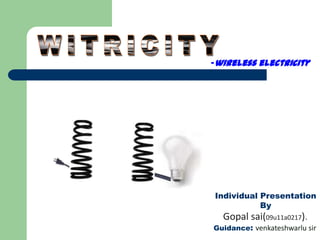

-wireless electricity


Individual Presentation
           By
  Gopal sai(09u11a0217).
Guidance: venkateshwarlu sir
(summarize)

1) History of Wireless power.
2) Need of Witricity.
3) Basic Principle.
4) Range & Rate of Coupling.
5) Design of Parameters
6) advantage and dis adv.
History of Wireless Power:
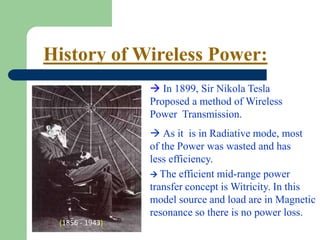
                  In 1899, Sir Nikola Tesla
                 Proposed a method of Wireless
                 Power Transmission.
                  As it is in Radiative mode, most
                 of the Power was wasted and has
                 less efficiency.
                  The efficient mid-range power
                 transfer concept is Witricity. In this
                 model source and load are in Magnetic
                 resonance so there is no power loss.
 (1856 - 1943)
The forgotten invention is reborn in 2007


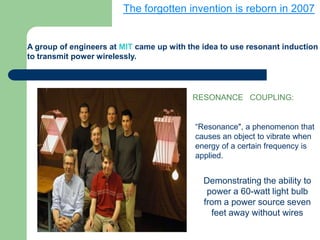
A group of engineers at MIT came up with the idea to use resonant induction
to transmit power wirelessly.


                                          RESONANCE COUPLING:


                                           “Resonance", a phenomenon that
                                           causes an object to vibrate when
                                           energy of a certain frequency is
                                           applied.


                                             Demonstrating the ability to
                                              power a 60-watt light bulb
                                             from a power source seven
                                               feet away without wires
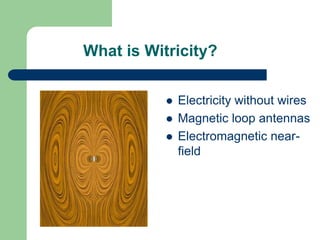
What is Witricity?


              Electricity without wires
              Magnetic loop antennas
              Electromagnetic near-
               field
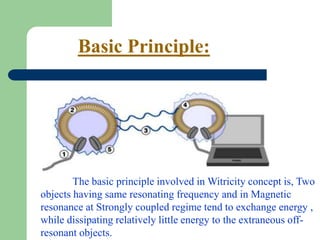
Basic Principle:


        The basic principle involved in Witricity concept is, Two
objects having same resonating frequency and in Magnetic
resonance at Strongly coupled regime tend to exchange energy ,
while dissipating relatively little energy to the extraneous off-
resonant objects.
How does Witricity Work?


   Near-field inductive coupling through magnetic
    fields
   Interact weakly with surrounding objects
    (biological tissue)
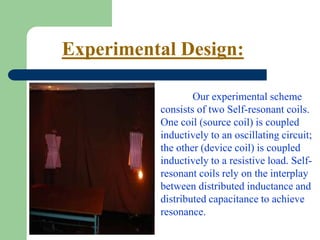
Experimental Design:

                  Our experimental scheme
          consists of two Self-resonant coils.
          One coil (source coil) is coupled
          inductively to an oscillating circuit;
          the other (device coil) is coupled
          inductively to a resistive load. Self-
          resonant coils rely on the interplay
          between distributed inductance and
          distributed capacitance to achieve
          resonance.
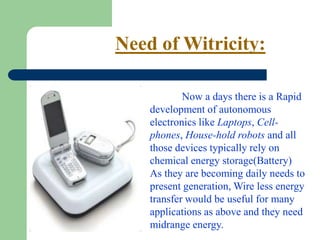
Need of Witricity:

            Now a days there is a Rapid
    development of autonomous
    electronics like Laptops, Cell-
    phones, House-hold robots and all
    those devices typically rely on
    chemical energy storage(Battery)
    As they are becoming daily needs to
    present generation, Wire less energy
    transfer would be useful for many
    applications as above and they need
    midrange energy.
Witricity Today


   MIT powered 60 watt light bulb from 2
    meters (7 ft) at 40% efficiency
   MIT researchers working on improving the
    technology
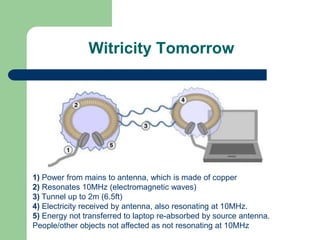
Witricity Tomorrow


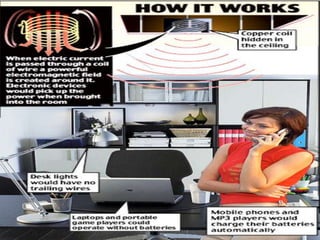
1) Power from mains to antenna, which is made of copper
2) Resonates 10MHz (electromagnetic waves)
3) Tunnel up to 2m (6.5ft)
4) Electricity received by antenna, also resonating at 10MHz.
5) Energy not transferred to laptop re-absorbed by source antenna.
People/other objects not affected as not resonating at 10MHz
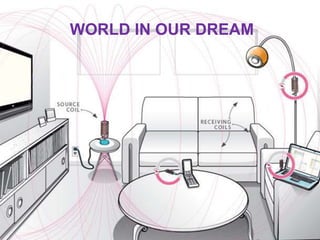
WORLD IN OUR DREAM
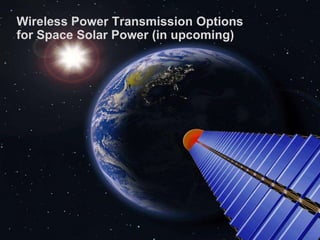
Wireless Power Transmission Options
 Advantages:
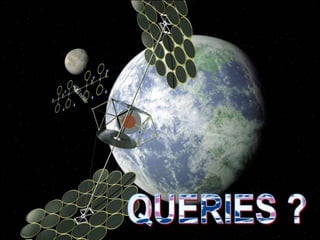
for Space Solar Power (in upcoming)

☼ Unaffected by the day night cycle, weather or seasons.
☼ This is an eco friendly system..
☼ It is boon for the devices which uses midrange power.

Limitations:
☼ The resonance condition should be satisfied and if any error
exists, there is no possibility of power transfer.
☼ If there is any possibility of very strong ferromagnetic material
presence causes low power transfer due to radiation.
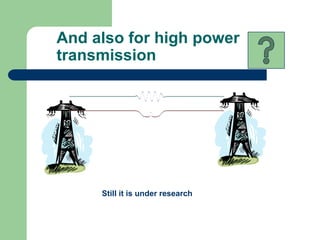
And also for high power
transmission


     Still it is under research
•.
     Advantages


            • Significant declining of office
                         space
          •No need for meter rooms and
                 electrical closets.
             •Reduction of e-waste by
          eliminating the need for power
                        cords
        •Need more light in your office, no
        need for electrician. Simply place
         the lamp where ever you need it
Draw-back

  •Need for standardization and
  adaptation. So no overheating
    occurs because of different
               voltages.
   •Retrofitting old equipment or
 purchasing new equipment could
become a very expensive attempt.
•possibility of “energy theft”. Wi Fi,
    someone can be using your
      internet or your power.
Wireless electricity

Wireless electricity

  • 1.
    -wireless electricity Individual Presentation By Gopal sai(09u11a0217). Guidance: venkateshwarlu sir
  • 2.
    (summarize) 1) History ofWireless power. 2) Need of Witricity. 3) Basic Principle. 4) Range & Rate of Coupling. 5) Design of Parameters 6) advantage and dis adv.
  • 3.
    History of WirelessPower:  In 1899, Sir Nikola Tesla Proposed a method of Wireless Power Transmission.  As it is in Radiative mode, most of the Power was wasted and has less efficiency.  The efficient mid-range power transfer concept is Witricity. In this model source and load are in Magnetic resonance so there is no power loss. (1856 - 1943)
  • 4.
    The forgotten inventionis reborn in 2007 A group of engineers at MIT came up with the idea to use resonant induction to transmit power wirelessly. RESONANCE COUPLING: “Resonance", a phenomenon that causes an object to vibrate when energy of a certain frequency is applied. Demonstrating the ability to power a 60-watt light bulb from a power source seven feet away without wires
  • 5.
    What is Witricity?  Electricity without wires  Magnetic loop antennas  Electromagnetic near- field
  • 6.
    Basic Principle: The basic principle involved in Witricity concept is, Two objects having same resonating frequency and in Magnetic resonance at Strongly coupled regime tend to exchange energy , while dissipating relatively little energy to the extraneous off- resonant objects.
  • 7.
    How does WitricityWork?  Near-field inductive coupling through magnetic fields  Interact weakly with surrounding objects (biological tissue)
  • 8.
    Experimental Design: Our experimental scheme consists of two Self-resonant coils. One coil (source coil) is coupled inductively to an oscillating circuit; the other (device coil) is coupled inductively to a resistive load. Self- resonant coils rely on the interplay between distributed inductance and distributed capacitance to achieve resonance.
  • 9.
    Need of Witricity: Now a days there is a Rapid development of autonomous electronics like Laptops, Cell- phones, House-hold robots and all those devices typically rely on chemical energy storage(Battery) As they are becoming daily needs to present generation, Wire less energy transfer would be useful for many applications as above and they need midrange energy.
  • 10.
    Witricity Today  MIT powered 60 watt light bulb from 2 meters (7 ft) at 40% efficiency  MIT researchers working on improving the technology
  • 11.
    Witricity Tomorrow 1) Powerfrom mains to antenna, which is made of copper 2) Resonates 10MHz (electromagnetic waves) 3) Tunnel up to 2m (6.5ft) 4) Electricity received by antenna, also resonating at 10MHz. 5) Energy not transferred to laptop re-absorbed by source antenna. People/other objects not affected as not resonating at 10MHz
  • 12.
  • 14.
    Wireless Power TransmissionOptions Advantages: for Space Solar Power (in upcoming) ☼ Unaffected by the day night cycle, weather or seasons. ☼ This is an eco friendly system.. ☼ It is boon for the devices which uses midrange power. Limitations: ☼ The resonance condition should be satisfied and if any error exists, there is no possibility of power transfer. ☼ If there is any possibility of very strong ferromagnetic material presence causes low power transfer due to radiation.
  • 15.
    And also forhigh power transmission Still it is under research
  • 16.
    •. Advantages • Significant declining of office space •No need for meter rooms and electrical closets. •Reduction of e-waste by eliminating the need for power cords •Need more light in your office, no need for electrician. Simply place the lamp where ever you need it
  • 17.
    Draw-back •Needfor standardization and adaptation. So no overheating occurs because of different voltages. •Retrofitting old equipment or purchasing new equipment could become a very expensive attempt. •possibility of “energy theft”. Wi Fi, someone can be using your internet or your power.