OLED TECHNOLOGIES
CONTENTS
• Introduction
• What is an OLED?
• History
• Features
• Structure
• Working
• Types
• Advantages
• Disadvantages
• Applications
• Conclusion
INTRODUCTION
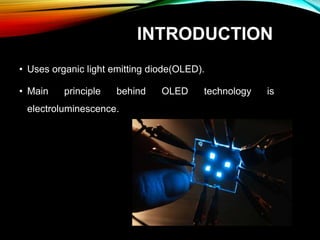
• Uses organic light emitting diode(OLED).
• Main principle behind OLED technology is
electroluminescence.
WHAT IS AN OLED?
• OLEDs are solid state devices composed of thin films of
organic molecules that is 100 to 500 nanometres thick.
• They don’t require any backlight. i.e., they are self emitting.
• They are organic because they are made from compounds
of carbon and hydrogen .
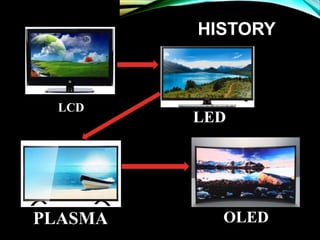
HISTORY
LCD
LED
PLASMA OLED
FEATURES
• Flexibility.
• No backlight
• Light weight and thin.
• Low power consumption.
• Perfect display from all angles.
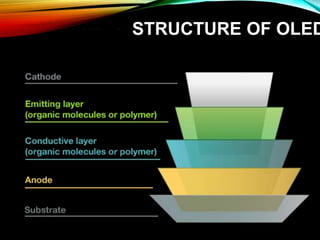
STRUCTURE OF OLED
WORKING PRINCIPLE
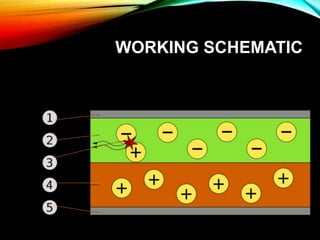
• A voltage is applied across the anode and cathode.
• Current flows from cathode to anode through the organic layers.
• Electrons flow to emissive layer from the cathode.
• Electrons are removed from conductive layer leaving holes.
• Holes jump into emissive layer .
• Electron and hole combine and light emitted.
WORKING SCHEMATIC
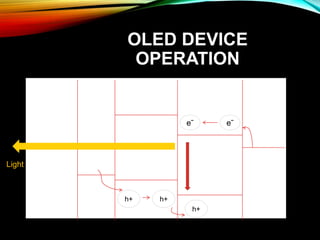
OLED DEVICE
OPERATION
Transparent
substrate
Anode
(ITO)
Conductive
layer
Emissive
layer
Cathode
LUMO
LUMO
HOMO
HOMO
eˉeˉ
h+
h+h+
Light
FABRICATION
• Substrate preparation.
• Device deposition
• Deposit and pattern anode.
• Pattern organic layers.
• Vacuum deposit and pattern cathode.
• Encapsulation.
OLED DEPOSITION
• Organic layers can be applied to the substrate using the
following methods.
- Evaporation and shadow masking.
- Inkjet printing.
- Organic vapor phase deposition.
COLOUR GENERATION
• Different approaches for fabricating red, green and blue
pixels.
- Red, green and blue individual pixels.
- White emitter and colour filters.
- Blue emitter and colour converters.
- Stacked OLED
TYPES OF OLED
Six types of OLEDs
Passive matrix OLED(PMOLED).
Active matrix OLED(AMOLED).
Transparent OLED(TOLED).
Top emitting OLED.
Flexible OLED(FOLED).
White OLED(WOLED).
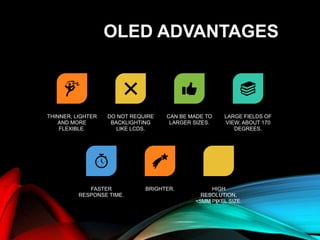
OLED ADVANTAGES
THINNER, LIGHTER
AND MORE
FLEXIBLE.
DO NOT REQUIRE
BACKLIGHTING
LIKE LCDS.
CAN BE MADE TO
LARGER SIZES.
LARGE FIELDS OF
VIEW, ABOUT 170
DEGREES.
FASTER
RESPONSE TIME.
BRIGHTER. HIGH
RESOLUTION,
<5ΜM PIXEL SIZE.
OLED DISADVANTAGES
EXPENSIVE. LIFESPAN. WATER
DAMAGE.
COLOUR
BALANCE
ISSUES .
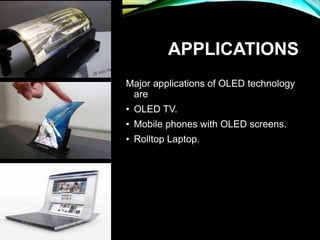
APPLICATIONS
Major applications of OLED technology
are
• OLED TV.
• Mobile phones with OLED screens.
• Rolltop Laptop.
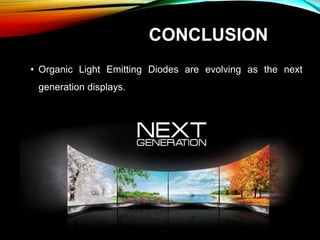
CONCLUSION
• Organic Light Emitting Diodes are evolving as the next
generation displays.
THANK YOU

O led technology