ORGANIC LIGHT EMITTING
DIODES or OLEDs
presented by
S.GAYATHRI(115011013887)
All Rights reserved. Not for distribution. Single user license
B.TECH ECE 2ND YEAR
ORGANIC LIGHT EMITTING DIODES or OLEDs
It differs with low power and
Combination of great colors
1
It principles of electroluminiescence2
OLEDs are used to create digital
Displays in devices such as cameras etc
3
These are diodes are about 100 to 500
Nanometers thick
4
ARCHITECTURE OF OLED TECHNOLOGY
1 Amorphous and
crystalline molecules
2 Arranged in irregular
pattern
3 It has many thin layers
of organic materials
4 There are several thin
and functional layers
It can be achieved by using
multi-layered devices
5
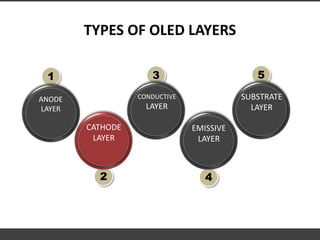
TYPES OF OLED LAYERS
2
CATHODE
LAYER
1
ANODE
LAYER
3
CONDUCTIVE
LAYER
4
EMISSIVE
LAYER
5
SUBSTRATE
LAYER
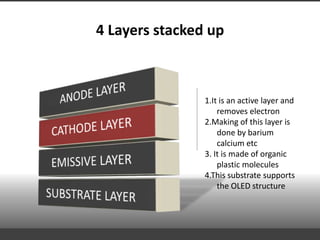
4 Layers stacked up
1.It is an active layer and
removes electron
2.Making of this layer is
done by barium
calcium etc
3. It is made of organic
plastic molecules
4.This substrate supports
the OLED structure
WORKING OF OLED
Anode and
cathode are
used for
OLEDs
Emissive layer
becomes
negative
charger
Conductive
layer become
positive
charger
OLEDs also work
as diodes if
current flows in
correct direction
To creates
radiation that
varies in
frequency
range
This may lead
to change in
electrical levels
Due to
electrostatic
forces applied,
the electrons
move the
Positive
conductive
layer
Negative
emissive layer
They are
helpful in
conducting
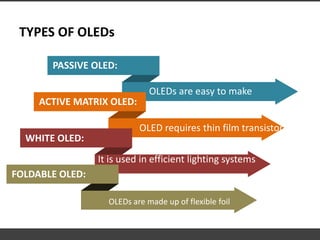
TYPES OF OLEDs
PASSIVE OLED:
OLEDs are easy to make
ACTIVE MATRIX OLED:
OLED requires thin film transistor
It is used in efficient lighting systems
WHITE OLED:
FOLDABLE OLED:
OLEDs are made up of flexible foil
APPLICATIONS OF OLED DISPLAY TECHNOLOGY
1 TVs
2 Cell phone screens
3 Computer screens
4
keyboards
5Lights
6Portable device
7Smart card
8
Light source
OLED
TECHNOLOGY
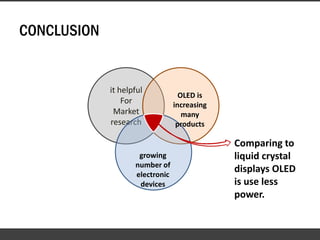
it helpful
For
Market
research
OLED is
increasing
many
products
growing
number of
electronic
devices
Comparing to
liquid crystal
displays OLED
is use less
power.
CONCLUSION

S.Gayathri Lakshitha

  • 1.
    ORGANIC LIGHT EMITTING DIODESor OLEDs presented by S.GAYATHRI(115011013887) All Rights reserved. Not for distribution. Single user license
  • 2.
  • 3.
    ORGANIC LIGHT EMITTINGDIODES or OLEDs It differs with low power and Combination of great colors 1 It principles of electroluminiescence2 OLEDs are used to create digital Displays in devices such as cameras etc 3 These are diodes are about 100 to 500 Nanometers thick 4
  • 4.
    ARCHITECTURE OF OLEDTECHNOLOGY 1 Amorphous and crystalline molecules 2 Arranged in irregular pattern 3 It has many thin layers of organic materials 4 There are several thin and functional layers It can be achieved by using multi-layered devices 5
  • 5.
    TYPES OF OLEDLAYERS 2 CATHODE LAYER 1 ANODE LAYER 3 CONDUCTIVE LAYER 4 EMISSIVE LAYER 5 SUBSTRATE LAYER
  • 6.
    4 Layers stackedup 1.It is an active layer and removes electron 2.Making of this layer is done by barium calcium etc 3. It is made of organic plastic molecules 4.This substrate supports the OLED structure
  • 7.
    WORKING OF OLED Anodeand cathode are used for OLEDs Emissive layer becomes negative charger Conductive layer become positive charger OLEDs also work as diodes if current flows in correct direction To creates radiation that varies in frequency range This may lead to change in electrical levels Due to electrostatic forces applied, the electrons move the Positive conductive layer Negative emissive layer They are helpful in conducting
  • 8.
    TYPES OF OLEDs PASSIVEOLED: OLEDs are easy to make ACTIVE MATRIX OLED: OLED requires thin film transistor It is used in efficient lighting systems WHITE OLED: FOLDABLE OLED: OLEDs are made up of flexible foil
  • 9.
    APPLICATIONS OF OLEDDISPLAY TECHNOLOGY 1 TVs 2 Cell phone screens 3 Computer screens 4 keyboards 5Lights 6Portable device 7Smart card 8 Light source OLED TECHNOLOGY
  • 10.
    it helpful For Market research OLED is increasing many products growing numberof electronic devices Comparing to liquid crystal displays OLED is use less power. CONCLUSION