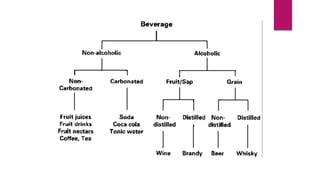


Production of alcoholic
beverage
S.SABARINATHAN
MSC.BIOTECHNOLOGY
MANORMANIAM SUNDARNAR UNIVERSITY
Introduction
 An alcoholic drink (alcoholic beverage) is a drink that contains ethanol, a type of
alcohol produced by fermentation of grain , fruits, or other sources of sugar.
 Alcoholic beverages are produced throughout the world.
 The type of the beverages and the substrate used for its production mostly
depends on the crops grown in the region.
 Poland and Russia beers manufactured from barely are consumed while in france
, Italy and Greece wine mostly consumed.
Saccharomyces cerevisiae the key
organism for the production of alcoholic
beverages
 The most common used organisms for the production of beverages is the yeast ,
saccharomyces cerevisiae.
 This organisms is capable utilizing simple sugar(glucose , fructose) and
converting them to ethanol.
 It is fortunate that cerevisiae is a unique organism that can tolerate and grow even
at a high concentration of alcohol.
 This is advantageous for good production yield of alcoholic beverages.
 There are two types of S.cerevisiae strains bottom yeast and top yeast.
 The bottom yeast settles to the bottom whereas the top yeast raises to the top
while carrying out fermentation.
 Top yeast are frequently used for the production of beer while bottom yeast are
employed for wine production.
 However, both strains can be used for beverage production.
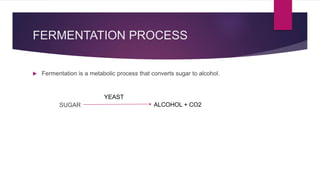
FERMENTATION PROCESS
 Fermentation is a metabolic process that converts sugar to alcohol.
SUGAR
YEAST
ALCOHOL + CO2
wine
WINE
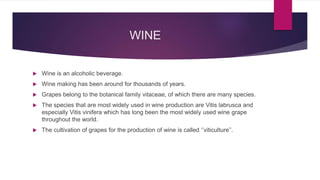
 Wine is an alcoholic beverage.
 Wine making has been around for thousands of years.
 Grapes belong to the botanical family vitaceae, of which there are many species.
 The species that are most widely used in wine production are Vitis labrusca and
especially Vitis vinifera which has long been the most widely used wine grape
throughout the world.
 The cultivation of grapes for the production of wine is called ‘’viticulture’’.
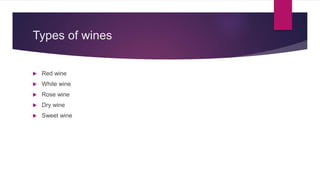
Types of wines
 Red wine
 White wine
 Rose wine
 Dry wine
 Sweet wine
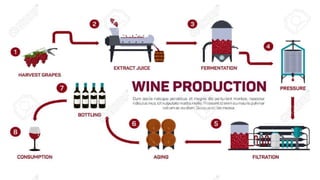
 In general there are five basic components of the wine making process:
1. Harvesting
2. Crushing and pressing
3. Fermentation
4. Clarification
5. Aging and bottling
Harvesting
 Harvesting is the first step in the wine making process and an important part of
ensuring delicious wine.
 Grapes are the only fruit that have the necessary acids , ester to consistently
make nature wine.
 Quality of the grapes is very important for the production of wines.
 Harvesting can be done by hand or mechanically.
 Many wine makers prefer to harvest by hand because mechanical harvesting can
be tough on the grapes.
 Once the grapes are taken to the winery , they are sorted into bunches , and
rotten or under ripe grapes are removed.
Crushing and pressing
 After the grapes are sorted , they are ready to be crushed.
 For many years , men and women did this manually by stomping the grapes with
their feet.
 Nowadays, most wine makers perform this mechanically.
 Mechanical pressing has brought tremendous sanitary gain as well as increased
the longevity and quality of the wine.
 For white wine, the wine makers will quickly crush and press the grapes in order
to separate the juice from the skins and seeds.
 Red wine , on the other hand, is left in contact with the skins to acquire flavour
and colour.
Fermentation
 After crushing and pressing the grape juice ready for fermentation process.
 This grape juice ready for fermentation process is technically referred to as must.
 During fermentation add sulfur dioxide is added.
 Sulfur dioxide to must to inhibit the growth of non wine yeast and contamination
bacteria.
 Sulfur dioxide which can kill other organisms.
 It is used as a preservative because of its anti-oxidative and anti-microbial
properties in wine , but also as a cleaning agent for barrels.
 Initially, oxygen is bubbled through the fermentation medium to promote good
growth of yeast cell and gradually anaerobic conditions are established.
 The wine production normally takes a 2 to 5 days.
 The fermentation conditions ( temperature and time etc…) are actually dependent
on type of wine produced.
Clarification
 Once fermentation is complete, clarification begins.
 Clarification is the process in which unwanted solid particles are removed.
 Wine can then be clarified through fining or filtration.
Aging and Bottling
 Aging and bottling is the final stage of the wine making process.
 Wine are transfer to storage tanks and allowed to age, which may take some month or
years.
 Ageing of wine is very important for the development of characteristic flavour and
aroma.
 The alcohol content of wines is in the range of 10-15 %.
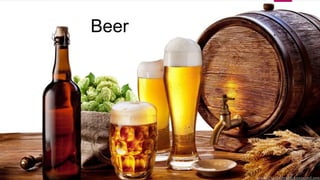
Beer
BEER
 Beer is an undistilled alcoholic berverge.
 Alcohol content in the range of 4-8%.
 It is produced by fermentation of barley or other cereals, by employing the yeast
(most frequently) S.cerevisiae or sometimes S.carlbergensis.
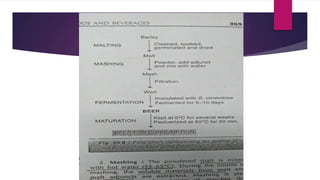
 There are four major steps involved in the production of beer.
1. Malting
2. Mashing
3. Fermentation
4. Maturation
Malting
 Dried barely are cleaned and soaked in water for a period of two days.
 The excess water is drained and the soaked barely are incubated for 4-6 days to
germinate.
 Germination process is associated with the formation of enzymes amylase (starch
hydrolysing ).
 The germinated seeds are slowly subjected to increased temperature up to 80˚C.
 Malt is prepared by powdering the seeds.
Mashing
 The powdered malt is mixed with hot water 55-65˚C.
 During the course of mashing, the soluble materials from malt are extracted.
 Mashing is also associated with degradation of starches (amylases) to produced
glucose.
 The temperature and pH influence the activities of enzymes.
 At the end of mashing, the medium for fermentation which is referred to as beer wort.
 This is rich in sugar , amino acid , minerals and vitamins.
 Hops are the dried flower obtained from hop plant.
 Addition of hops to wort is often done to provide characteristic flavour and aroma.
Fermentation
 The beer wort kept in open and closed bioreactors, is inoculated with pure strains
of yeast S.cerevisiae (top fermenting strains).
 The fermentation carried out at temperature 20-28˚C for 5-10 days.
 In some countries, the bottom fermentation strains are used . The bottom
fermentation yeast ideal temperature for fermentation 10-15˚C.
Maturation
 Maturation ,the phase after fermentation, is the period in which the beer is allowed
to rest at suitable temperature.
 Clarification is the operation that gives the beer its clear quality. It consists of
pumping the liquid through a suitable filter.
 The filtered beer is then stored in tanks ,now ready to be bottled.
Industrial production Alcoholic beverages

Industrial production Alcoholic beverages

  • 1.
  • 2.
    Introduction  An alcoholicdrink (alcoholic beverage) is a drink that contains ethanol, a type of alcohol produced by fermentation of grain , fruits, or other sources of sugar.  Alcoholic beverages are produced throughout the world.  The type of the beverages and the substrate used for its production mostly depends on the crops grown in the region.  Poland and Russia beers manufactured from barely are consumed while in france , Italy and Greece wine mostly consumed.
  • 3.
    Saccharomyces cerevisiae thekey organism for the production of alcoholic beverages  The most common used organisms for the production of beverages is the yeast , saccharomyces cerevisiae.  This organisms is capable utilizing simple sugar(glucose , fructose) and converting them to ethanol.  It is fortunate that cerevisiae is a unique organism that can tolerate and grow even at a high concentration of alcohol.  This is advantageous for good production yield of alcoholic beverages.
  • 4.
     There aretwo types of S.cerevisiae strains bottom yeast and top yeast.  The bottom yeast settles to the bottom whereas the top yeast raises to the top while carrying out fermentation.  Top yeast are frequently used for the production of beer while bottom yeast are employed for wine production.  However, both strains can be used for beverage production.
  • 5.
    FERMENTATION PROCESS  Fermentationis a metabolic process that converts sugar to alcohol. SUGAR YEAST ALCOHOL + CO2
  • 7.
  • 8.
    WINE  Wine isan alcoholic beverage.  Wine making has been around for thousands of years.  Grapes belong to the botanical family vitaceae, of which there are many species.  The species that are most widely used in wine production are Vitis labrusca and especially Vitis vinifera which has long been the most widely used wine grape throughout the world.  The cultivation of grapes for the production of wine is called ‘’viticulture’’.
  • 9.
    Types of wines Red wine  White wine  Rose wine  Dry wine  Sweet wine
  • 11.
     In generalthere are five basic components of the wine making process: 1. Harvesting 2. Crushing and pressing 3. Fermentation 4. Clarification 5. Aging and bottling
  • 12.
    Harvesting  Harvesting isthe first step in the wine making process and an important part of ensuring delicious wine.  Grapes are the only fruit that have the necessary acids , ester to consistently make nature wine.  Quality of the grapes is very important for the production of wines.  Harvesting can be done by hand or mechanically.  Many wine makers prefer to harvest by hand because mechanical harvesting can be tough on the grapes.  Once the grapes are taken to the winery , they are sorted into bunches , and rotten or under ripe grapes are removed.
  • 13.
    Crushing and pressing After the grapes are sorted , they are ready to be crushed.  For many years , men and women did this manually by stomping the grapes with their feet.  Nowadays, most wine makers perform this mechanically.  Mechanical pressing has brought tremendous sanitary gain as well as increased the longevity and quality of the wine.  For white wine, the wine makers will quickly crush and press the grapes in order to separate the juice from the skins and seeds.  Red wine , on the other hand, is left in contact with the skins to acquire flavour and colour.
  • 14.
    Fermentation  After crushingand pressing the grape juice ready for fermentation process.  This grape juice ready for fermentation process is technically referred to as must.  During fermentation add sulfur dioxide is added.  Sulfur dioxide to must to inhibit the growth of non wine yeast and contamination bacteria.  Sulfur dioxide which can kill other organisms.  It is used as a preservative because of its anti-oxidative and anti-microbial properties in wine , but also as a cleaning agent for barrels.
  • 15.
     Initially, oxygenis bubbled through the fermentation medium to promote good growth of yeast cell and gradually anaerobic conditions are established.  The wine production normally takes a 2 to 5 days.  The fermentation conditions ( temperature and time etc…) are actually dependent on type of wine produced.
  • 16.
    Clarification  Once fermentationis complete, clarification begins.  Clarification is the process in which unwanted solid particles are removed.  Wine can then be clarified through fining or filtration. Aging and Bottling  Aging and bottling is the final stage of the wine making process.  Wine are transfer to storage tanks and allowed to age, which may take some month or years.  Ageing of wine is very important for the development of characteristic flavour and aroma.  The alcohol content of wines is in the range of 10-15 %.
  • 17.
  • 18.
    BEER  Beer isan undistilled alcoholic berverge.  Alcohol content in the range of 4-8%.  It is produced by fermentation of barley or other cereals, by employing the yeast (most frequently) S.cerevisiae or sometimes S.carlbergensis.  There are four major steps involved in the production of beer. 1. Malting 2. Mashing 3. Fermentation 4. Maturation
  • 20.
    Malting  Dried barelyare cleaned and soaked in water for a period of two days.  The excess water is drained and the soaked barely are incubated for 4-6 days to germinate.  Germination process is associated with the formation of enzymes amylase (starch hydrolysing ).  The germinated seeds are slowly subjected to increased temperature up to 80˚C.  Malt is prepared by powdering the seeds.
  • 21.
    Mashing  The powderedmalt is mixed with hot water 55-65˚C.  During the course of mashing, the soluble materials from malt are extracted.  Mashing is also associated with degradation of starches (amylases) to produced glucose.  The temperature and pH influence the activities of enzymes.  At the end of mashing, the medium for fermentation which is referred to as beer wort.  This is rich in sugar , amino acid , minerals and vitamins.  Hops are the dried flower obtained from hop plant.  Addition of hops to wort is often done to provide characteristic flavour and aroma.
  • 22.
    Fermentation  The beerwort kept in open and closed bioreactors, is inoculated with pure strains of yeast S.cerevisiae (top fermenting strains).  The fermentation carried out at temperature 20-28˚C for 5-10 days.  In some countries, the bottom fermentation strains are used . The bottom fermentation yeast ideal temperature for fermentation 10-15˚C.
  • 23.
    Maturation  Maturation ,thephase after fermentation, is the period in which the beer is allowed to rest at suitable temperature.  Clarification is the operation that gives the beer its clear quality. It consists of pumping the liquid through a suitable filter.  The filtered beer is then stored in tanks ,now ready to be bottled.