MIRPUR UNIVERSITY OFSCIENCE & TECHNOLOGY
Presenters
Maryam Iqbal 044 Maheen Zohra 043
Samavia Nisar 029 Samar Fatima 028
Muqadas Noor 046 Maryam Aslam 016
Amina Rustam 037 Tayyba Habib 059
Aleena Noor 002 Emaan Shahzadi 039
Adeeba Ashfaq 060 Arouba Imtiaz 009
Maham Hanif 049
Topic: Industrial production of organic acid by biotechnology prospective
Department of Biotechnology
2.
Introduction
Organic acidsare important compounds widely used in the food, pharmaceutical,
and chemical industries.
Traditionally produced through chemical methods, their industrial production has
shifted toward biotechnological processes due to environmental concerns and the
need for sustainability.
Biotechnology uses microorganisms and fermentation techniques to produce
organic acids in a more eco-friendly and cost-effective way.
This method not only reduces pollution but also utilizes renewable resources,
making it ideal for modern industrial needs
Factors involved inproduction of organic acids
are
The organism
The medium
The product
5.
Citric acid production
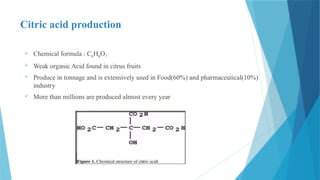
Chemical formula : C6H8O7
Weak organic Acid found in citrus fruits
Produce in tonnage and is extensively used in Food(60%) and pharmaceutical(10%)
industry
More than millions are produced almost every year
6.
Citric acid production
Microorganisms used for production of citric acid are:
Aspergillus niger (used for commercial production)
Aspergillus awamori
Aspergillus foetidus
Candida lipolytica
Candida psedotropicalis etc.
The main advantage of using this microorganism are:(a)its ease of handling, (b)its
ability to ferment a variety of cheap raw materials,and (c)high yields
7.
Citric acid production
Citric acid production is batch and aerobic fermentation process.
Citric acid production can be carried out in two different ways:
1)Solid state fermentation
2)Liquid state fermentation
8.
Citric acid production
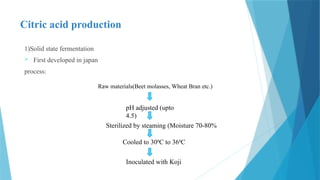
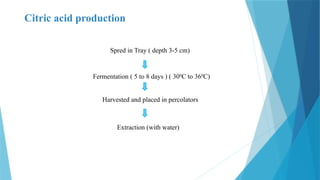
1)Solidstate fermentation
First developed in japan
process:
Raw materials(Beet molasses, Wheat Bran etc.)
pH adjusted (upto
4.5)
Sterilized by steaming (Moisture 70-80%
Cooled to 300
C to 360
C
Inoculated with Koji
9.
Citric acid production
Spredin Tray ( depth 3-5 cm)
Fermentation ( 5 to 8 days ) ( 300
C to 360
C)
Harvested and placed in percolators
Extraction (with water)
10.
Citric acid production
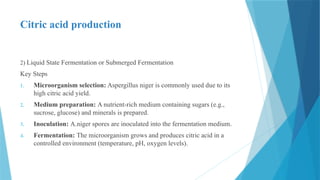
2)Liquid State Fermentation or Submerged Fermentation
Key Steps
1. Microorganism selection: Aspergillus niger is commonly used due to its
high citric acid yield.
2. Medium preparation: A nutrient-rich medium containing sugars (e.g.,
sucrose, glucose) and minerals is prepared.
3. Inoculation: A.niger spores are inoculated into the fermentation medium.
4. Fermentation: The microorganism grows and produces citric acid in a
controlled environment (temperature, pH, oxygen levels).
11.
Citric acid production
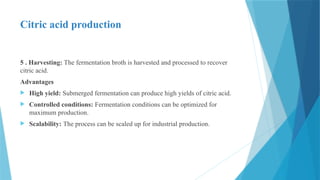
5. Harvesting: The fermentation broth is harvested and processed to recover
citric acid.
Advantages
High yield: Submerged fermentation can produce high yields of citric acid.
Controlled conditions: Fermentation conditions can be optimized for
maximum production.
Scalability: The process can be scaled up for industrial production.
12.
Application of Citricacid
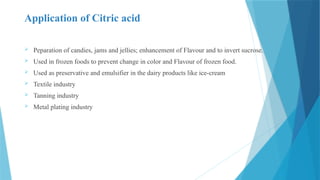
Peparation of candies, jams and jellies; enhancement of Flavour and to invert sucrose.
Used in frozen foods to prevent change in color and Flavour of frozen food.
Used as preservative and emulsifier in the dairy products like ice-cream
Textile industry
Tanning industry
Metal plating industry
13.
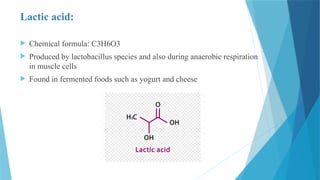
Lactic acid:
Chemicalformula: C3H6O3
Produced by lactobacillus species and also during anaerobic respiration
in muscle cells
Found in fermented foods such as yogurt and cheese
14.
Lactic acid production:
Lacticis produced by following types of lactobacillus
Lactobacillus delbrueckii
Lactobacillus bulgarious
Lactobacillus plantarum
Lactobacillus brevis
Bifidobacterium is also responsible for the production of lactic acid and Rhizpous
is the fungus that produces lactic acid.
15.
Industrial production oflactic acid
Biotechnological methods primarily involves microbial fermentation of renewable
carbohydrate sources. Lactic acid is a valuable chemical used in the food industry,
pharmaceuticals, cosmetics, and especially in the production of polylactic acid (PLA)
a biodegradable plastic.
Microorganisms Used :
Lactic acid can be produced by a variety of lactic acid bacteria (LAB).
and genetically modified organisms (GMOs).
16.
Continue…….
Lactic AcidBacteria (LAB):
Homo fermentative LAB: Convert sugars primarily into lactic acid (90–.
95%)Lactobacillus delbrueckii, L. bulgaricus, L. plantarum.
Heterofermentative LAB: Produce lactic acid plus ethanol/acetic acid and
CO Leuconostoc spp., L. brevis.
₂
Genetically Engineered Microorganisms:
Escherichia coli, Bacillus subtilis, and Corynebacterium glutamicum have been
engineered to Improve yield and productivity Tolerate high lactic acid concentrations Use
diverse feedstocks (e.g., lignocellulose)
Fermentation Process
Lacticacid fermentation :
Lactic acid fermentation is a metabolic process by which glucose or other six-
carbon sugars (also, disaccharides of six-carbon sugars, e.g. sucrose or lactose)
are converted into cellular energy and the metabolite lactate, which is lactic
acid in solution. It is an anaerobic fermentation reaction that occurs in some
bacteria and animal cells, such as muscles cells.
Conditions for LAB:
pH: 5.0–6.5 (controlled using CaCO , NaOH, or NH OH)Temperature: 30–
₃ ₄
42°C (depending on the strain)
19.
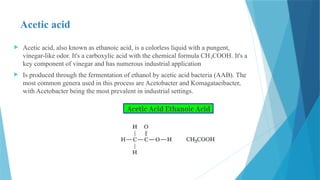
Acetic acid
Aceticacid, also known as ethanoic acid, is a colorless liquid with a pungent,
vinegar-like odor. It's a carboxylic acid with the chemical formula CH COOH. It's a
₃
key component of vinegar and has numerous industrial application
Is produced through the fermentation of ethanol by acetic acid bacteria (AAB). The
most common genera used in this process are Acetobacter and Komagataeibacter,
with Acetobacter being the most prevalent in industrial settings.
20.
Production of AceticAcid
Microbial Fermentation
Produced naturally by Acetobacter and Gluconobacter species through
oxidation of ethanol in aerobic conditions.
Process:
Ethanol + Oxygen → Acetic acid + Water
Carried out by acetic acid bacteria (AAB).
This is the basis of vinegar production.
21.
Industrial Microbial Production(Vinegar Industry)
Raw materials: ethanol from fermentation of sugars (from fruits, grains,
molasses).
Fermentation types:
Orleans method (traditional surface fermentation)
Submerged fermentation (industrial scale, faster production with
aeration and agitation).
Submerged fermentation is preferred industrially for higher productivity and
control.
Applications of Acetic Acid
Food industry:
Vinegar Production: Acetic acid is the main component of vinegar (~4-8%)
used as a preservative, flavoring, and pickling agent.
22.
Applications of AceticAcid
Chemical Industry
Chemical Intermediate:
Production of vinyl acetate monomer (VAM), which is a precursor to
polyvinyl acetate and polyvinyl alcohol (used in adhesives, paints, and
coatings).
Pharmaceuticals
Used in the manufacture of acetylsalicylic acid (aspirin) and other drugs.
As an antiseptic agent in diluted form.
Textile Industry
Used in dyeing and printing processes to control pH.
Production of cellulose acetate fibers (a type of synthetic fiber).
23.
Acetic Acid asa Solvent
In its liquid state, CH3COOH is a hydrophile (readily dissolves in water) and also a
polar, protic solvent.
A mixture of acetic acid and water is, in this manner, similar to a mixture of ethanol
and water.
Acetic acid also forms miscible mixtures with hexane, chloroform, and several oils.
However, it does not form miscible mixtures with long-chain alkanes (such as
octane).
The desirable solvent properties of acetic acid, along with its ability to form
miscible mixtures with both polar and non-polar compounds, make it a very
important industrial solvent.
It is widely used in the industrial preparation of dimethyl terephthalate (DMT).
24.
Gluconic acid
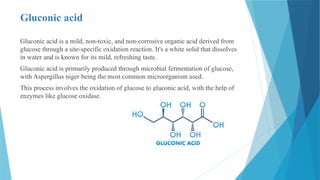
Gluconic acidis a mild, non-toxic, and non-corrosive organic acid derived from
glucose through a site-specific oxidation reaction. It's a white solid that dissolves
in water and is known for its mild, refreshing taste.
Gluconic acid is primarily produced through microbial fermentation of glucose,
with Aspergillus niger being the most common microorganism used.
This process involves the oxidation of glucose to gluconic acid, with the help of
enzymes like glucose oxidase.
25.
Gluconic acid production
Microbial Fermentation:
Enzyme-catalyzed reaction:
Glucose is converted to gluconic acid by enzymes like glucose oxidase, which is
produced by microorganisms such as Aspergillus niger.
Mechanism:
The aldehyde group (-CHO) at the C1 position of glucose is oxidized to a
carboxylic acid group (-COOH), forming glucono-δ-lactone, which then
spontaneously hydrolyzes to gluconic acid.
Microorganism:
Aspergillus niger is the most widely used microorganism for gluconic acid
production due to its high yield and efficiency.
Substrate:
Glucose is the primary carbon source used in this fermentation process.
26.
Chemical Synthesis (LessCommon):
Oxidizing agents:
Chemical synthesis involves using oxidizing agents like bromine water or dilute
nitric acid to oxidize glucose.
Limitations:
Chemical synthesis is generally less economical due to lower selectivity and yield
compared to microbial fermentation.
Downstream Processing:
Recovery: After fermentation, gluconic acid is recovered from the fermentation
broth through various steps, including:
Centrifugation: To remove microbial cells and other solid particles.
Carbon adsorption: To remove impurities.
Evaporation: To concentrate the gluconic acid solution.
27.
Crystallization:
To obtaingluconic acid crystals.
Ion exchange: To further purify the gluconic acid.
Applications:
Gluconic acid and its derivatives (like sodium gluconate) have various applications in:
Food and beverage industry: As a food acidulant, chelating agent, and leavening agent.
Pharmaceutical industry: As a buffering agent, mineral supplement, and in drug
formulations.
Cosmetics and personal care products: As a chelating agent and pH adjuster.
Industrial cleaning and descaling: As a chelating agent.
28.
Environmental & HealthAspects
Biodegradable: Yes
Non-toxic: Generally recognized as safe (GRAS)
Eco-Friendly: Used in green cleaning products
Market and Industry Insight
Growing demand in health supplements and eco-cleaners
Produced at industrial scale using fermentation
Conclusion
The industrial production of organic acids through biotechnology has emerged as a
sustainable and economically viable alternative to traditional chemical synthesis. By
leveraging the metabolic capabilities of microorganisms such as Aspergillus Niger,
Lactobacillus, and genetically engineered strains like E. coli, industries can produce
valuable organic acids like citric acid, lactic acid, gluconic acid, and succinic acid using
renewable and low-cost feedstocks.