HOW TO TEST ORAL PRODUCTION
EVALUATION CRITERIAEvaluation should be conducted when students engage in their prepared conversations.
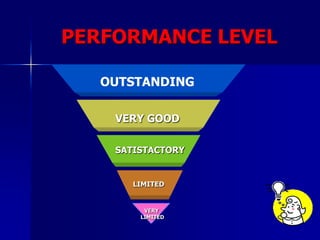
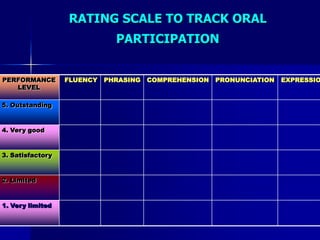
PERFORMANCE LEVELOUTSTANDINGVERY GOODSATISTACTORYLIMITEDVERY LIMITED
FLUENCY OF SPEECH:Based upon the smoothness, not speed, and take into account use of hesitancy in conversation.
PHRASING:The grouping of words in meaningful phrases.
LISTENING COMPREHENSION:This phase of evaluation is initially tested during the prepared conversation section of the exam.
PRONUNCIATION:Where it hinders communicative understanding.
EXPRESSION:Use of tone, inflection, intonation, and volume.
RATING SCALE TO TRACK ORAL PARTICIPATION
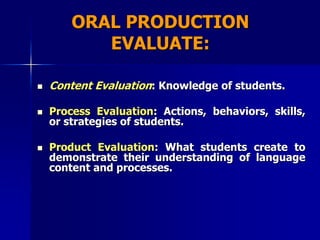
ORAL PRODUCTION EVALUATE:Content Evaluation: Knowledge of students.Process Evaluation: Actions, behaviors, skills, or strategies of students.Product Evaluation: What students create to demonstrate their understanding of language content and processes.
MATCH TESTS TO THE CONTENTTests will measure students' achievement.Test items should be based on the content and skills.To keep track of how well tests reflect results, construct a grid.
TRY TO MAKE TESTS VALID, RELIABLE, AND BALANCEDA test is reliable if it accurately and consistently evaluates student's performance. Ambiguous questions, unclear directions, and vague scoring criteria threaten reliability. Very short tests are also unlikely to be highly reliable. Oral production should be balanced.
“The learning products only become aspects of the intelligence when they are organized, recoverable, generalizable and transferable to new problematic situations.”EYSENCK,H.J.(1983)

How to test oral production