ASSESSING SPEAKING
Let’s talk and share
What’s in it for you?
1. What is Speaking?
2. How speaking be simplified?
3. How to decide activity for speaking assessment?
4. How to make rubric sheets and fill them?
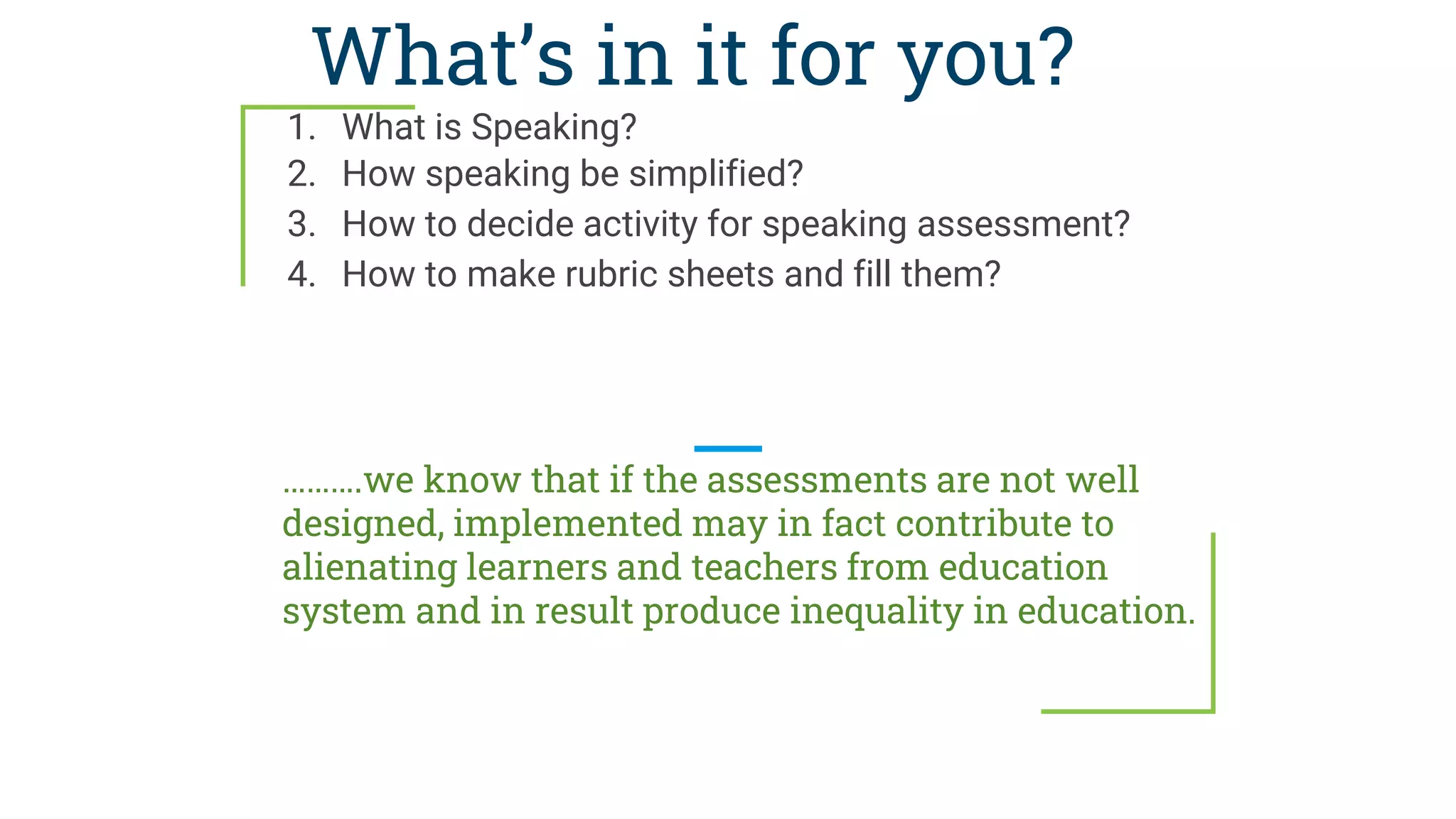
……….we know that if the assessments are not well
designed, implemented may in fact contribute to
alienating learners and teachers from education
system and in result produce inequality in education.
WHAT IS SPEAKING?
Why assess speaking?
For students: to help them know the aims of learning,
The indicators or criterias help them evaluate the progress
For teachers: to understand the student’s strengths and weaknesses,
to improve classroom instructions, to target further teaching
For parents: to make them aware of the learning goals,their ward’s progress, to
decide the priorities for further learning
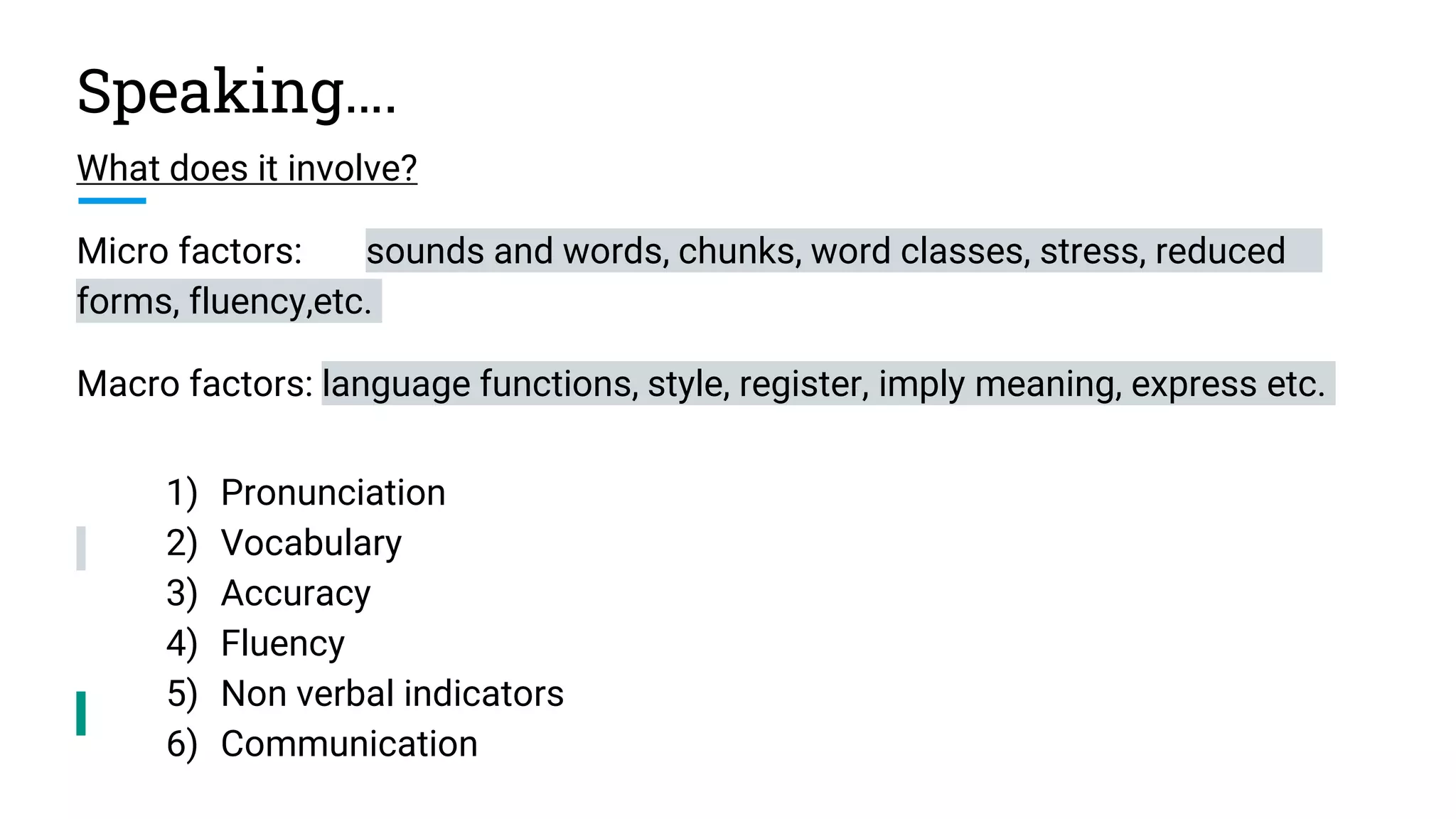
Speaking….
What does it involve?
Micro factors: sounds and words, chunks, word classes, stress, reduced
forms, fluency,etc.
Macro factors: language functions, style, register, imply meaning, express etc.
1) Pronunciation
2) Vocabulary
3) Accuracy
4) Fluency
5) Non verbal indicators
6) Communication
Let’s start with planning …..
Assessing Speaking
1.CHOOSE : Learning outcome/ purpose
2.DESIGN: Test/ activity
3.DESIGN: Rubric sheet
4.ENVIRONMENT
5.NEXT?
And what do you think,
1.The purpose or LOs could be………….
2.The assessment test or activities could be…….
3. Creating a healthy test environment……
4.The rubric sheet looks like….” What will quality work look like?”
PRONUNCIATION
CRITERIA HIGH or 4 LOW or 3 POOR or 2 NOT AT ALLor 1
Clear
Proper intonation
Word stress
Sentence stress
Intelligibility
Assimilation and
contraction in
suitable places
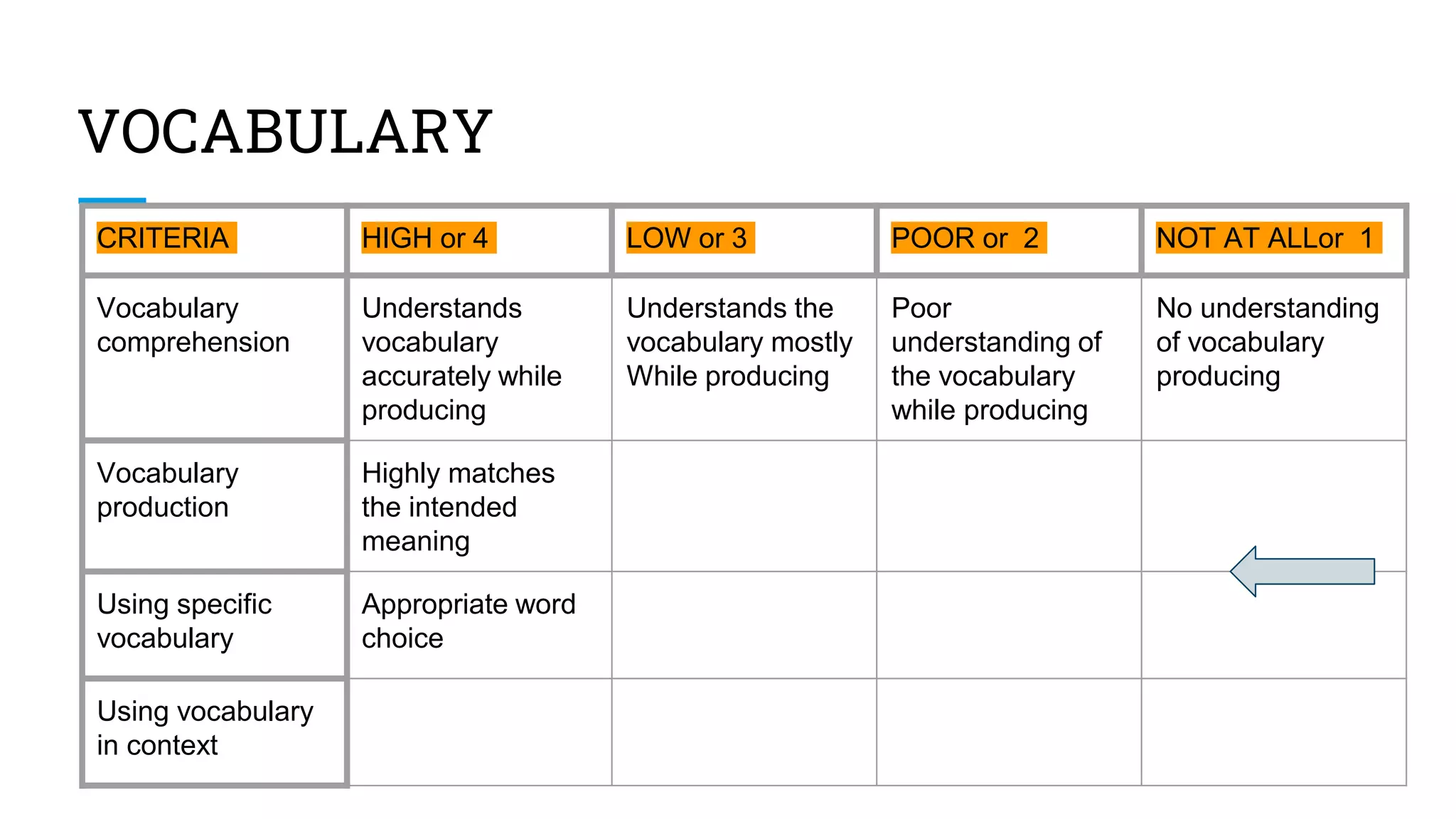
VOCABULARY
CRITERIA HIGH or 4 LOW or 3 POOR or 2 NOT AT ALLor 1
Vocabulary
comprehension
Understands
vocabulary
accurately while
producing
Understands the
vocabulary mostly
While producing
Poor
understanding of
the vocabulary
while producing
No understanding
of vocabulary
producing
Vocabulary
production
Highly matches
the intended
meaning
Using specific
vocabulary
Appropriate word
choice
Using vocabulary
in context
ACCURACY
CRITERIA HIGH or 4 LOW or 3 POOR or 2 NOT AT ALLor 1
Word order All correct
Grammatical
structure
All correct
Range of
grammar used eg
tense, auxiliary
verbs, pronoun
etc
Wide range
FLUENCY
CRITERIA HIGH or 4 LOW or 3 POOR or 2 NOT AT ALLor 1
Level of comfort 3 3
No. of pauses 2
Speed of talking
Hesitation
before/ while
speaking
NON VERBAL INDICATORS
CRITERIA HIGH or 4 LOW or 3 POOR or 2 NOT AT ALLor
1
Eye contact
Body posture
Facial
expressions
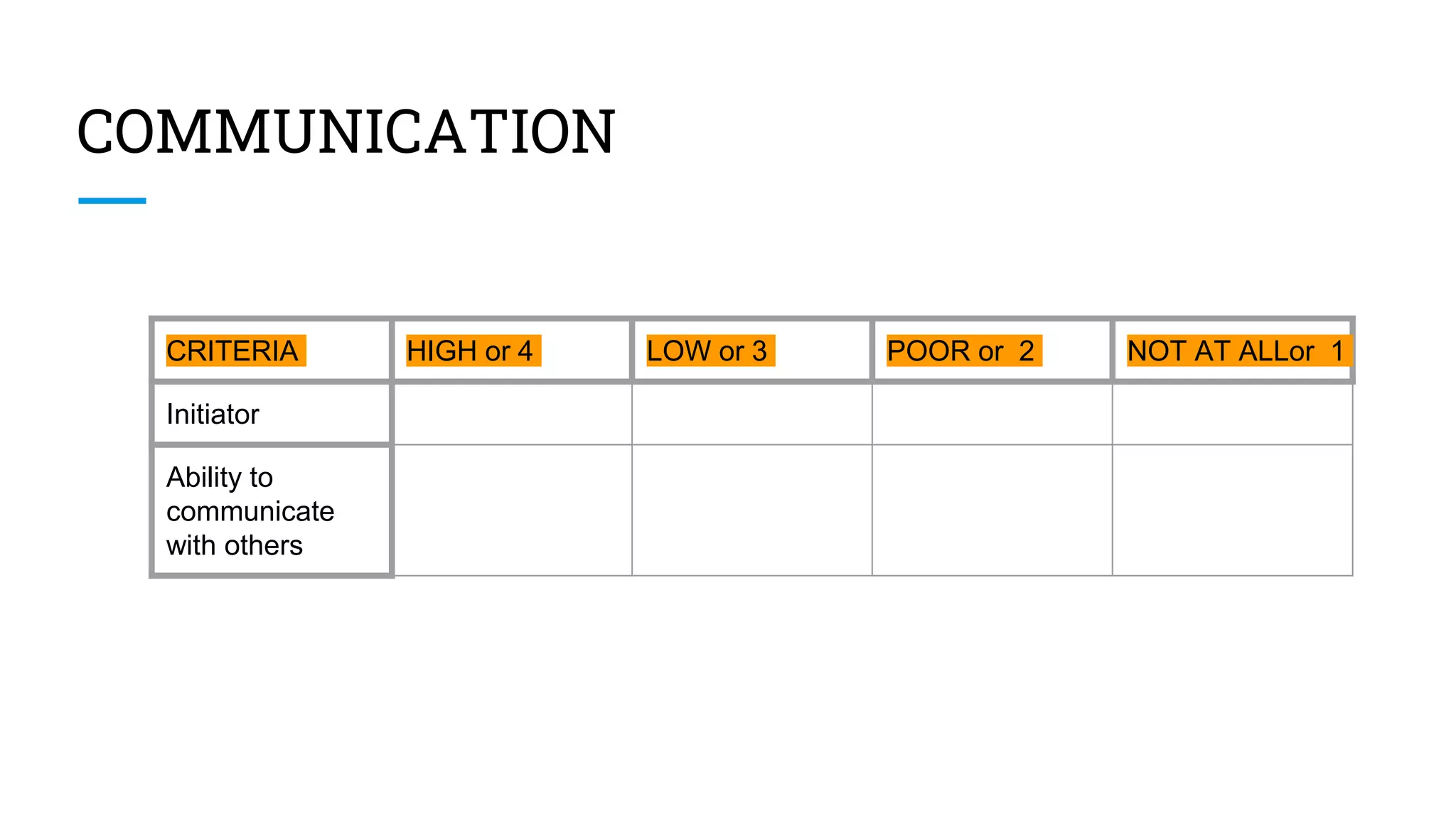
COMMUNICATION
CRITERIA HIGH or 4 LOW or 3 POOR or 2 NOT AT ALLor 1
Initiator
Ability to
communicate
with others
Do it with our previous example
1.LO: Std4: speaks briefly on familiar issues and experiences of day -to -day life
2.Design test / activity: Simple:- Few Personal information/ response question,
3.Think about the test environment
Use an audio for speaking assessment
4.Prepare speaking assessment rubric sheet
1) Pronunciation
2) Vocabulary
3) Accuracy
4) Fluency
5) Non verbal indicators
6) Communication
5.WHAT NEXT………………………………?
Lorem ipsum dolor sit amet at
nec at adipiscing03
● Donec risus dolor porta venenatis
● Pharetra luctus felis
● Proin in tellus felis volutpat
Lorem ipsum dolor sit amet at
nec at adipiscing02
● Donec risus dolor porta venenatis
● Pharetra luctus felis
● Proin in tellus felis volutpat
Lorem ipsum dolor sit amet at
nec at adipiscing01
● Donec risus dolor porta venenatis
● Pharetra luctus felis
● Proin in tellus felis volutpat
REMEDIAL PLANNING
03
FEEDBACK AND REPORTING
02
ANALYSIS OF THE RESULT DATA
01
How many students can/ could
achieve the learning outcome/ purpose
How much is the success rate
Interpret the data
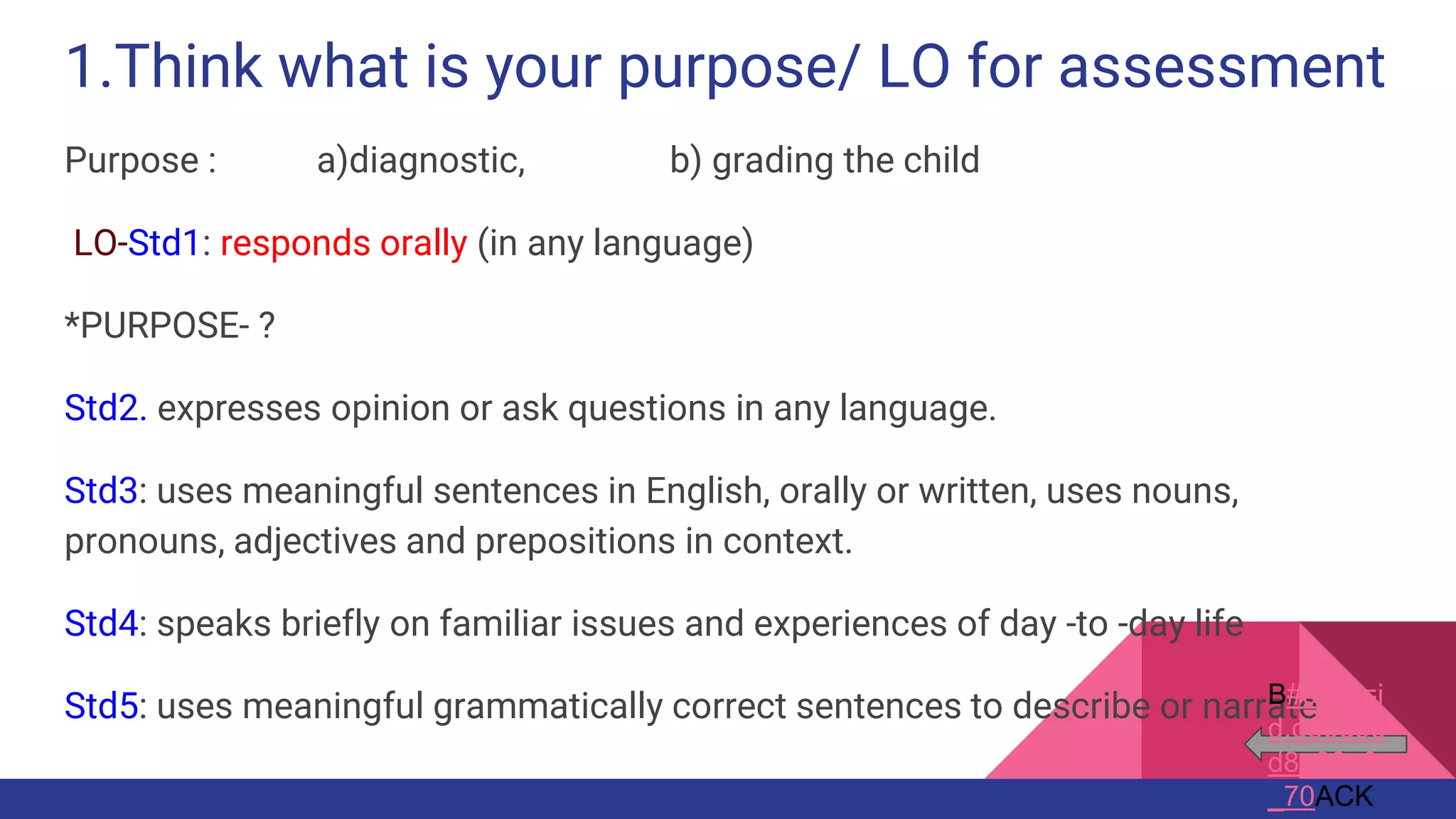
1.Think what is your purpose/ LO for assessment
Purpose : a)diagnostic, b) grading the child
LO-Std1: responds orally (in any language)
*PURPOSE- ?
Std2. expresses opinion or ask questions in any language.
Std3: uses meaningful sentences in English, orally or written, uses nouns,
pronouns, adjectives and prepositions in context.
Std4: speaks briefly on familiar issues and experiences of day -to -day life
Std5: uses meaningful grammatically correct sentences to describe or narrateB#slide=i
d.g80d93
d8e93_0
_70ACK
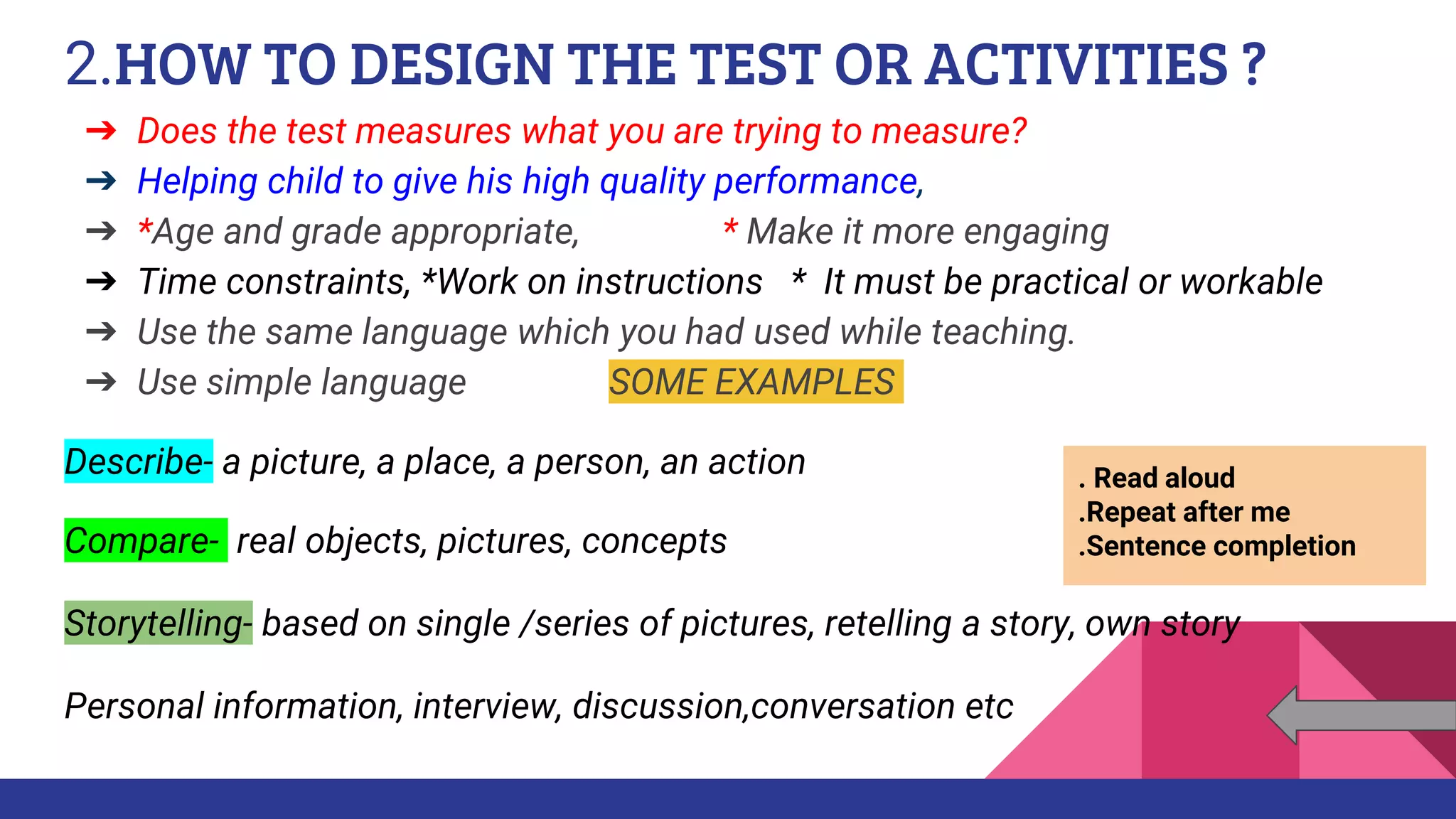
2.HOW TO DESIGN THE TEST OR ACTIVITIES ?
➔ Does the test measures what you are trying to measure?
➔ Helping child to give his high quality performance,
➔ *Age and grade appropriate, * Make it more engaging
➔ Time constraints, *Work on instructions * It must be practical or workable
➔ Use the same language which you had used while teaching.
➔ Use simple language SOME EXAMPLES
Describe- a picture, a place, a person, an action
Compare- real objects, pictures, concepts
Storytelling- based on single /series of pictures, retelling a story, own story
Personal information, interview, discussion,conversation etc
. Read aloud
.Repeat after me
.Sentence completion
3.Some concerns about test environment
One must think about
➔ Space available
➔ Time per student for student as well as observer to
➔ Sitting arrangements
➔ Mode of test:- individual/ group, live/ recorded
➔ Role of observer:- active or silent observer
THANK YOU ALL
UBUNTU
Take care, stay healthy and safe

Assessing speaking

  • 1.
  • 2.
    What’s in itfor you? 1. What is Speaking? 2. How speaking be simplified? 3. How to decide activity for speaking assessment? 4. How to make rubric sheets and fill them? ……….we know that if the assessments are not well designed, implemented may in fact contribute to alienating learners and teachers from education system and in result produce inequality in education.
  • 3.
  • 4.
    Why assess speaking? Forstudents: to help them know the aims of learning, The indicators or criterias help them evaluate the progress For teachers: to understand the student’s strengths and weaknesses, to improve classroom instructions, to target further teaching For parents: to make them aware of the learning goals,their ward’s progress, to decide the priorities for further learning
  • 5.
    Speaking…. What does itinvolve? Micro factors: sounds and words, chunks, word classes, stress, reduced forms, fluency,etc. Macro factors: language functions, style, register, imply meaning, express etc. 1) Pronunciation 2) Vocabulary 3) Accuracy 4) Fluency 5) Non verbal indicators 6) Communication
  • 6.
    Let’s start withplanning ….. Assessing Speaking 1.CHOOSE : Learning outcome/ purpose 2.DESIGN: Test/ activity 3.DESIGN: Rubric sheet 4.ENVIRONMENT 5.NEXT?
  • 7.
    And what doyou think, 1.The purpose or LOs could be…………. 2.The assessment test or activities could be……. 3. Creating a healthy test environment…… 4.The rubric sheet looks like….” What will quality work look like?”
  • 8.
    PRONUNCIATION CRITERIA HIGH or4 LOW or 3 POOR or 2 NOT AT ALLor 1 Clear Proper intonation Word stress Sentence stress Intelligibility Assimilation and contraction in suitable places
  • 9.
    VOCABULARY CRITERIA HIGH or4 LOW or 3 POOR or 2 NOT AT ALLor 1 Vocabulary comprehension Understands vocabulary accurately while producing Understands the vocabulary mostly While producing Poor understanding of the vocabulary while producing No understanding of vocabulary producing Vocabulary production Highly matches the intended meaning Using specific vocabulary Appropriate word choice Using vocabulary in context
  • 10.
    ACCURACY CRITERIA HIGH or4 LOW or 3 POOR or 2 NOT AT ALLor 1 Word order All correct Grammatical structure All correct Range of grammar used eg tense, auxiliary verbs, pronoun etc Wide range
  • 11.
    FLUENCY CRITERIA HIGH or4 LOW or 3 POOR or 2 NOT AT ALLor 1 Level of comfort 3 3 No. of pauses 2 Speed of talking Hesitation before/ while speaking
  • 12.
    NON VERBAL INDICATORS CRITERIAHIGH or 4 LOW or 3 POOR or 2 NOT AT ALLor 1 Eye contact Body posture Facial expressions
  • 13.
    COMMUNICATION CRITERIA HIGH or4 LOW or 3 POOR or 2 NOT AT ALLor 1 Initiator Ability to communicate with others
  • 14.
    Do it withour previous example 1.LO: Std4: speaks briefly on familiar issues and experiences of day -to -day life 2.Design test / activity: Simple:- Few Personal information/ response question, 3.Think about the test environment Use an audio for speaking assessment 4.Prepare speaking assessment rubric sheet 1) Pronunciation 2) Vocabulary 3) Accuracy 4) Fluency 5) Non verbal indicators 6) Communication
  • 15.
    5.WHAT NEXT………………………………? Lorem ipsumdolor sit amet at nec at adipiscing03 ● Donec risus dolor porta venenatis ● Pharetra luctus felis ● Proin in tellus felis volutpat Lorem ipsum dolor sit amet at nec at adipiscing02 ● Donec risus dolor porta venenatis ● Pharetra luctus felis ● Proin in tellus felis volutpat Lorem ipsum dolor sit amet at nec at adipiscing01 ● Donec risus dolor porta venenatis ● Pharetra luctus felis ● Proin in tellus felis volutpat REMEDIAL PLANNING 03 FEEDBACK AND REPORTING 02 ANALYSIS OF THE RESULT DATA 01 How many students can/ could achieve the learning outcome/ purpose How much is the success rate Interpret the data
  • 16.
    1.Think what isyour purpose/ LO for assessment Purpose : a)diagnostic, b) grading the child LO-Std1: responds orally (in any language) *PURPOSE- ? Std2. expresses opinion or ask questions in any language. Std3: uses meaningful sentences in English, orally or written, uses nouns, pronouns, adjectives and prepositions in context. Std4: speaks briefly on familiar issues and experiences of day -to -day life Std5: uses meaningful grammatically correct sentences to describe or narrateB#slide=i d.g80d93 d8e93_0 _70ACK
  • 17.
    2.HOW TO DESIGNTHE TEST OR ACTIVITIES ? ➔ Does the test measures what you are trying to measure? ➔ Helping child to give his high quality performance, ➔ *Age and grade appropriate, * Make it more engaging ➔ Time constraints, *Work on instructions * It must be practical or workable ➔ Use the same language which you had used while teaching. ➔ Use simple language SOME EXAMPLES Describe- a picture, a place, a person, an action Compare- real objects, pictures, concepts Storytelling- based on single /series of pictures, retelling a story, own story Personal information, interview, discussion,conversation etc . Read aloud .Repeat after me .Sentence completion
  • 18.
    3.Some concerns abouttest environment One must think about ➔ Space available ➔ Time per student for student as well as observer to ➔ Sitting arrangements ➔ Mode of test:- individual/ group, live/ recorded ➔ Role of observer:- active or silent observer
  • 19.
    THANK YOU ALL UBUNTU Takecare, stay healthy and safe

Editor's Notes

  • #4 TW: ability to speak in a language so as to be understood by others ( short & simple)
  • #18  Be careful about SVA : Does the test (measure) not measures….
  • #19 TW: What is the task you’re leaving them with? This is a very abrupt ending. Either leave them with a task/ recap a few main salient point on last slide.