Riphah
International
University
Faisalabad
Presentation
WRITING SKILLS
Presenter
• ADIL SHAHBAZ
• MUDASIR MUSTAFA
• MUHAMMAD FASI
• SHAHZAD BATTI
Outline
What is writing
Importance of writing
Principles of writing
Process of writing
Types of writing
 How to improve writing
What is writing
 Writing is a form of communication and a means of
expressing thoughts, ideas, and information through
the use of written language.
 It involves the process of putting words together in a
coherent and meaningful way to convey a message
or convey a story.
 Writing can take various forms, such as essays,
articles, novels, poems, letters, emails, and more.
Quotes
Importance of writing
 Effective communication: Writing skills enable individuals to communicate their
thoughts, ideas, and messages clearly and concisely.
 Academic Success: Writing is a fundamental component of education. From
essays and research papers to exams and dissertations, writing skills play a crucial
role in academic achievement.
Principles of writing
 Purpose
 Use clear language
 Be Objective
 Choice of Words
 Punctuation
 Grammatical correct
 Proofread
Principles of writing
Purpose
 First of all You must know why you are writing.
 The Writing process is like a building. On the
skeleton of purpose The building is constructed.
 There are many purpose of writing
Principles of writing
Language:
 Use simple and concise language.
 Avoid jorgan and technical terms.
 Write short sentences so that your reader get a basic point of your phrases
Be Objective
 Present information objectively.
 Your conclusion should arise logically from the information Presented and based
on The facts evidence you collected.
Principles of writing
Choice of words
 Your writing could be easy and based on simple words So that your reader Get
main points.
 Words can convey positive negative strong or weak message.
Punctuation
.
 Its speaking We don’t need to have any commas fullstop,
Question mark etc.
 A writer Should have Best knowledge to use These things.
Principles of writing
Grammatically Correct
 No grammatical mistake.
 In writing grammer have Large effect..if you Write correct grammar
the reader understand context easily.
Proofread
 After You finish writing,read and re-read and check the types and
Grammar error.
 Check for concise and cut out every single word.
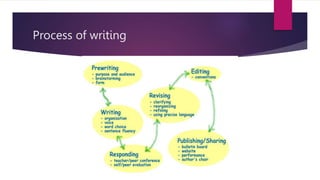
Process of writing
 Prewriting/planning
 Drafting
 Revising
 Editing
 Proofreading
Process of writing
Process of writing
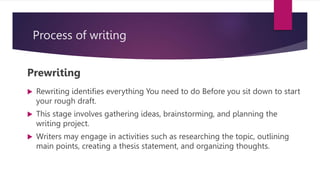
Prewriting
 Rewriting identifies everything You need to do Before you sit down to start
your rough draft.
 This stage involves gathering ideas, brainstorming, and planning the
writing project.
 Writers may engage in activities such as researching the topic, outlining
main points, creating a thesis statement, and organizing thoughts.
Process of writing
Drafting
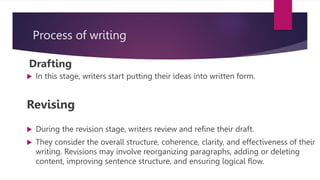
 In this stage, writers start putting their ideas into written form.
Revising
 During the revision stage, writers review and refine their draft.
 They consider the overall structure, coherence, clarity, and effectiveness of their
writing. Revisions may involve reorganizing paragraphs, adding or deleting
content, improving sentence structure, and ensuring logical flow.
Process of writing
Editing
 You have overhoded your story . It’s time to find tone
manuscript line by line.
 Editing involves focusing on language mechanics,
grammar, punctuation, spelling, and sentence-level
issues.
Publishing
 Complete your final copy.
 Share it with other by publishing it or Presented it.
Types of writing
 Narrative writing
 Discriptive Writing
 Expository writing
 Agrumentative Writing
Types of writing
Narrative writing
 Narrative writing tells a story or recounts a series of events.
 It often includes characters, settings, a plot, and a narrative
arc.
 Novels, short stories, autobiographies, and memoirs are
Examples of narrative writing.
Types of writing
Expository writing
 Expository writing provides information, explains concepts, or
presents a viewpoint in an objective and logical manner.
 It seeks to educate or inform the reader.
 Examples include textbooks, academic essays, research
papers, and explanatory articles.
Types of writing
Discriptive writing
 Descriptive writing aims to create a vivid and detailed picture
in the reader’s mind.
 It uses sensory language and imagery to convey the
characteristics, qualities, or features of a person, place, object,
or experience.
 Descriptive writing is commonly found in poetry, travel
writing, and creative nonfiction.
Types of writing
Agrumentative Writing
 Argumentative writing presents a reasoned argument
supported by evidence.
 It involves stating a claim or thesis and providing supporting
evidence and reasoning to convince the reader of its validity.
 Argumentative writing is common in academic essays,
debates, and legal or policy documents.
How to improve your writing
They are many ways to improve your writing Skills.
 Practice writing regularly.
 Chosing very ordinary topics and writing on them May
improve your writing Skills as well as Creative skills.
 Read a passage from book and then try to reproduce it in
your own words.
 Read a good writer Well and note his/her style then try to
copy their style.
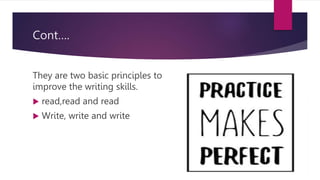
Cont….
They are two basic principles to
improve the writing skills.
 read,read and read
 Write, write and write
writing skills.pptx
writing skills.pptx

writing skills.pptx

  • 1.
  • 2.
  • 3.
    Presenter • ADIL SHAHBAZ •MUDASIR MUSTAFA • MUHAMMAD FASI • SHAHZAD BATTI
  • 4.
    Outline What is writing Importanceof writing Principles of writing Process of writing Types of writing  How to improve writing
  • 5.
    What is writing Writing is a form of communication and a means of expressing thoughts, ideas, and information through the use of written language.  It involves the process of putting words together in a coherent and meaningful way to convey a message or convey a story.  Writing can take various forms, such as essays, articles, novels, poems, letters, emails, and more.
  • 6.
  • 7.
    Importance of writing Effective communication: Writing skills enable individuals to communicate their thoughts, ideas, and messages clearly and concisely.  Academic Success: Writing is a fundamental component of education. From essays and research papers to exams and dissertations, writing skills play a crucial role in academic achievement.
  • 8.
    Principles of writing Purpose  Use clear language  Be Objective  Choice of Words  Punctuation  Grammatical correct  Proofread
  • 9.
    Principles of writing Purpose First of all You must know why you are writing.  The Writing process is like a building. On the skeleton of purpose The building is constructed.  There are many purpose of writing
  • 10.
    Principles of writing Language: Use simple and concise language.  Avoid jorgan and technical terms.  Write short sentences so that your reader get a basic point of your phrases Be Objective  Present information objectively.  Your conclusion should arise logically from the information Presented and based on The facts evidence you collected.
  • 11.
    Principles of writing Choiceof words  Your writing could be easy and based on simple words So that your reader Get main points.  Words can convey positive negative strong or weak message. Punctuation .  Its speaking We don’t need to have any commas fullstop, Question mark etc.  A writer Should have Best knowledge to use These things.
  • 12.
    Principles of writing GrammaticallyCorrect  No grammatical mistake.  In writing grammer have Large effect..if you Write correct grammar the reader understand context easily. Proofread  After You finish writing,read and re-read and check the types and Grammar error.  Check for concise and cut out every single word.
  • 13.
    Process of writing Prewriting/planning  Drafting  Revising  Editing  Proofreading
  • 14.
  • 15.
    Process of writing Prewriting Rewriting identifies everything You need to do Before you sit down to start your rough draft.  This stage involves gathering ideas, brainstorming, and planning the writing project.  Writers may engage in activities such as researching the topic, outlining main points, creating a thesis statement, and organizing thoughts.
  • 16.
    Process of writing Drafting In this stage, writers start putting their ideas into written form. Revising  During the revision stage, writers review and refine their draft.  They consider the overall structure, coherence, clarity, and effectiveness of their writing. Revisions may involve reorganizing paragraphs, adding or deleting content, improving sentence structure, and ensuring logical flow.
  • 17.
    Process of writing Editing You have overhoded your story . It’s time to find tone manuscript line by line.  Editing involves focusing on language mechanics, grammar, punctuation, spelling, and sentence-level issues. Publishing  Complete your final copy.  Share it with other by publishing it or Presented it.
  • 18.
    Types of writing Narrative writing  Discriptive Writing  Expository writing  Agrumentative Writing
  • 19.
    Types of writing Narrativewriting  Narrative writing tells a story or recounts a series of events.  It often includes characters, settings, a plot, and a narrative arc.  Novels, short stories, autobiographies, and memoirs are Examples of narrative writing.
  • 20.
    Types of writing Expositorywriting  Expository writing provides information, explains concepts, or presents a viewpoint in an objective and logical manner.  It seeks to educate or inform the reader.  Examples include textbooks, academic essays, research papers, and explanatory articles.
  • 21.
    Types of writing Discriptivewriting  Descriptive writing aims to create a vivid and detailed picture in the reader’s mind.  It uses sensory language and imagery to convey the characteristics, qualities, or features of a person, place, object, or experience.  Descriptive writing is commonly found in poetry, travel writing, and creative nonfiction.
  • 22.
    Types of writing AgrumentativeWriting  Argumentative writing presents a reasoned argument supported by evidence.  It involves stating a claim or thesis and providing supporting evidence and reasoning to convince the reader of its validity.  Argumentative writing is common in academic essays, debates, and legal or policy documents.
  • 23.
    How to improveyour writing They are many ways to improve your writing Skills.  Practice writing regularly.  Chosing very ordinary topics and writing on them May improve your writing Skills as well as Creative skills.  Read a passage from book and then try to reproduce it in your own words.  Read a good writer Well and note his/her style then try to copy their style.
  • 24.
    Cont…. They are twobasic principles to improve the writing skills.  read,read and read  Write, write and write