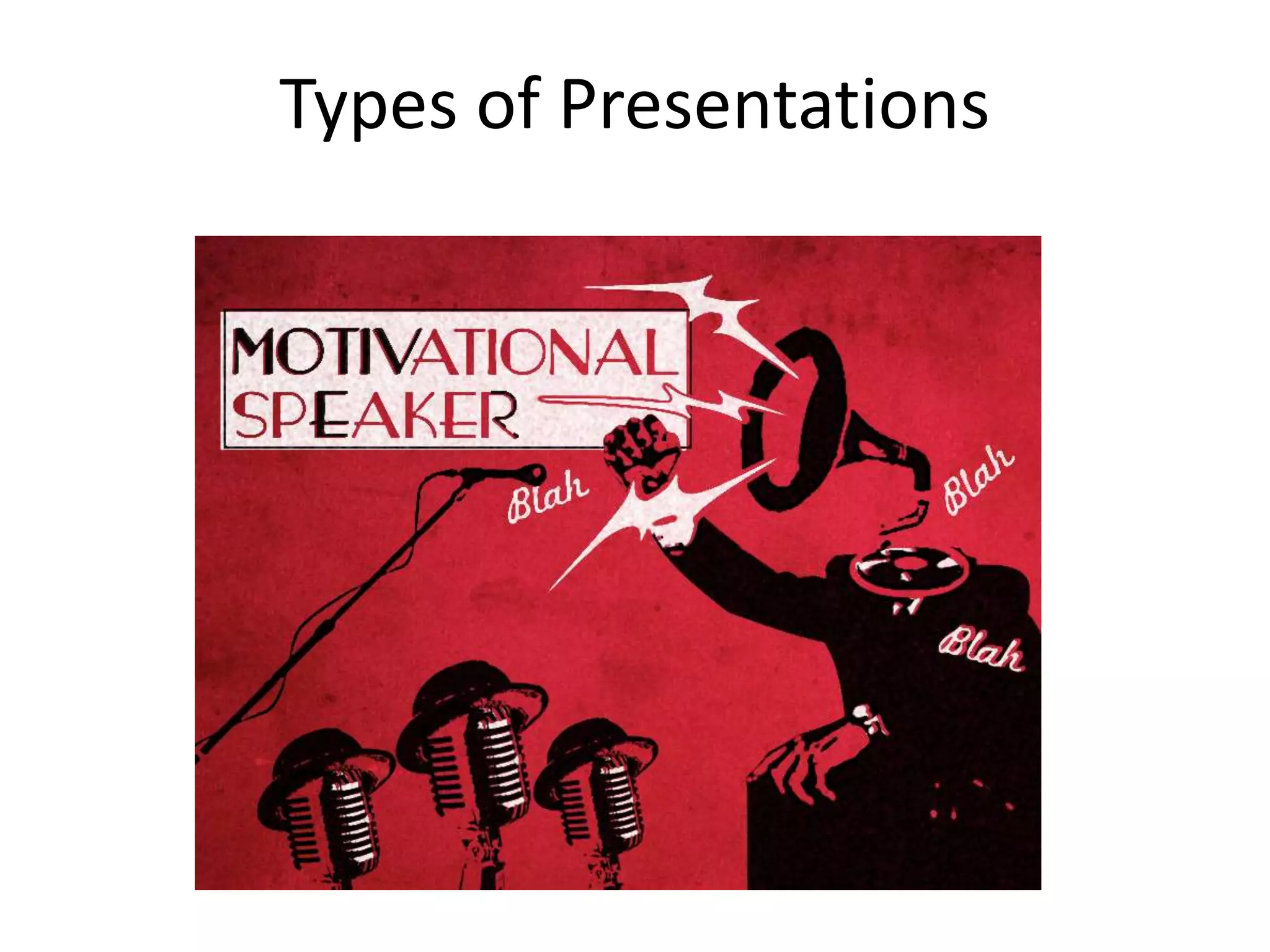
Types of Presentations
1. INFORMATIVE
• These presentations are brief and to the point. They
generally stick to the facts and avoid complicated
information.
• Usually used to describe facts – usually best for other
experts.
• Organized from most important topic to least. Best
for breaking big information down into small.
• Examples include university lectures, school classes,
and research results.
Informative Presentation – Pros and Cons
• Pros –
• Cons –
(5 mins!)
2. INSTRUCTIONAL
• These presentations give specific directions or
orders. It is designed to teach something completely
new to the audience.
• Very thorough, and usually takes a long time.
• All the theory and knowledge from the basic steps to
checking the audience’s understanding.
• Examples include tutorial classes, safety
demonstrations, and instructional videos.
Instructional Presentation – Pros and Cons
• Pros –
• Cons –
(5 mins!)
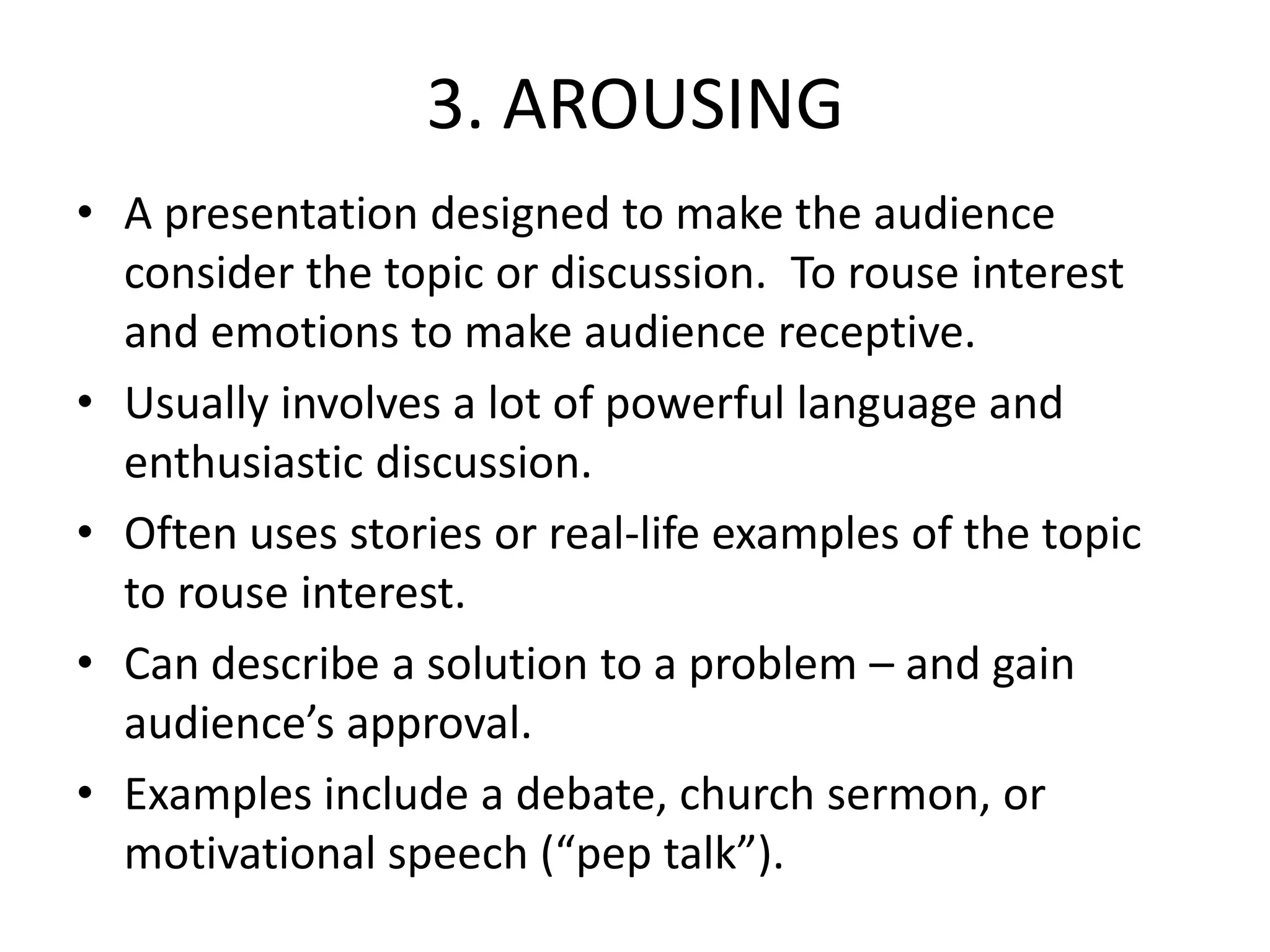
3. AROUSING
• A presentation designed to make the audience
consider the topic or discussion. To rouse interest
and emotions to make audience receptive.
• Usually involves a lot of powerful language and
enthusiastic discussion.
• Often uses stories or real-life examples of the topic
to rouse interest.
• Can describe a solution to a problem – and gain
audience’s approval.
• Examples include a debate, church sermon, or
motivational speech (“pep talk”).
Arousing Presentation – Pros and Cons
• Pros –
• Cons –
(5 mins!)
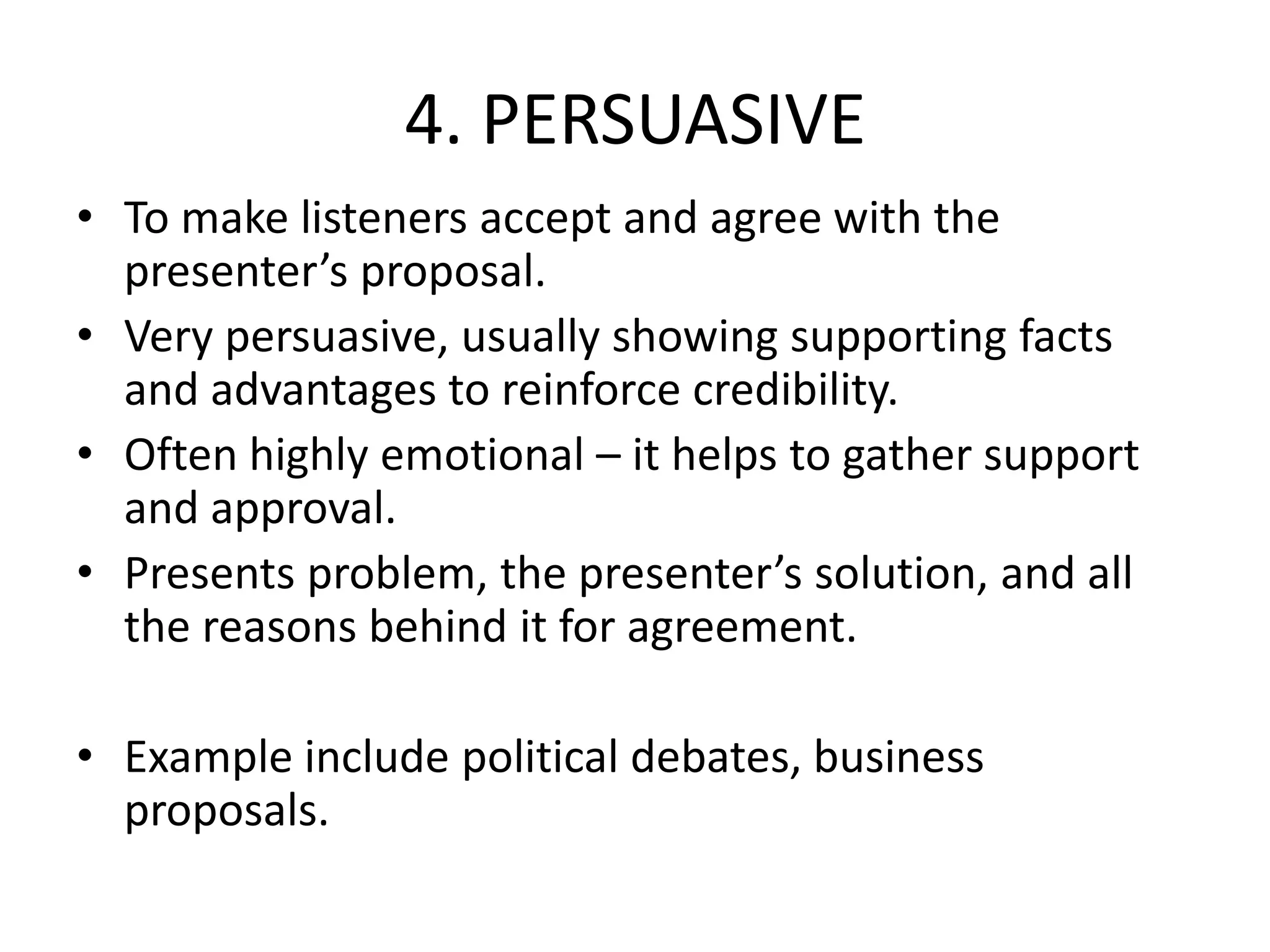
4. PERSUASIVE
• To make listeners accept and agree with the
presenter’s proposal.
• Very persuasive, usually showing supporting facts
and advantages to reinforce credibility.
• Often highly emotional – it helps to gather support
and approval.
• Presents problem, the presenter’s solution, and all
the reasons behind it for agreement.
• Example include political debates, business
proposals.
Persuasive Presentation – Pros and Cons
• Pros –
• Cons –
(5 mins!)
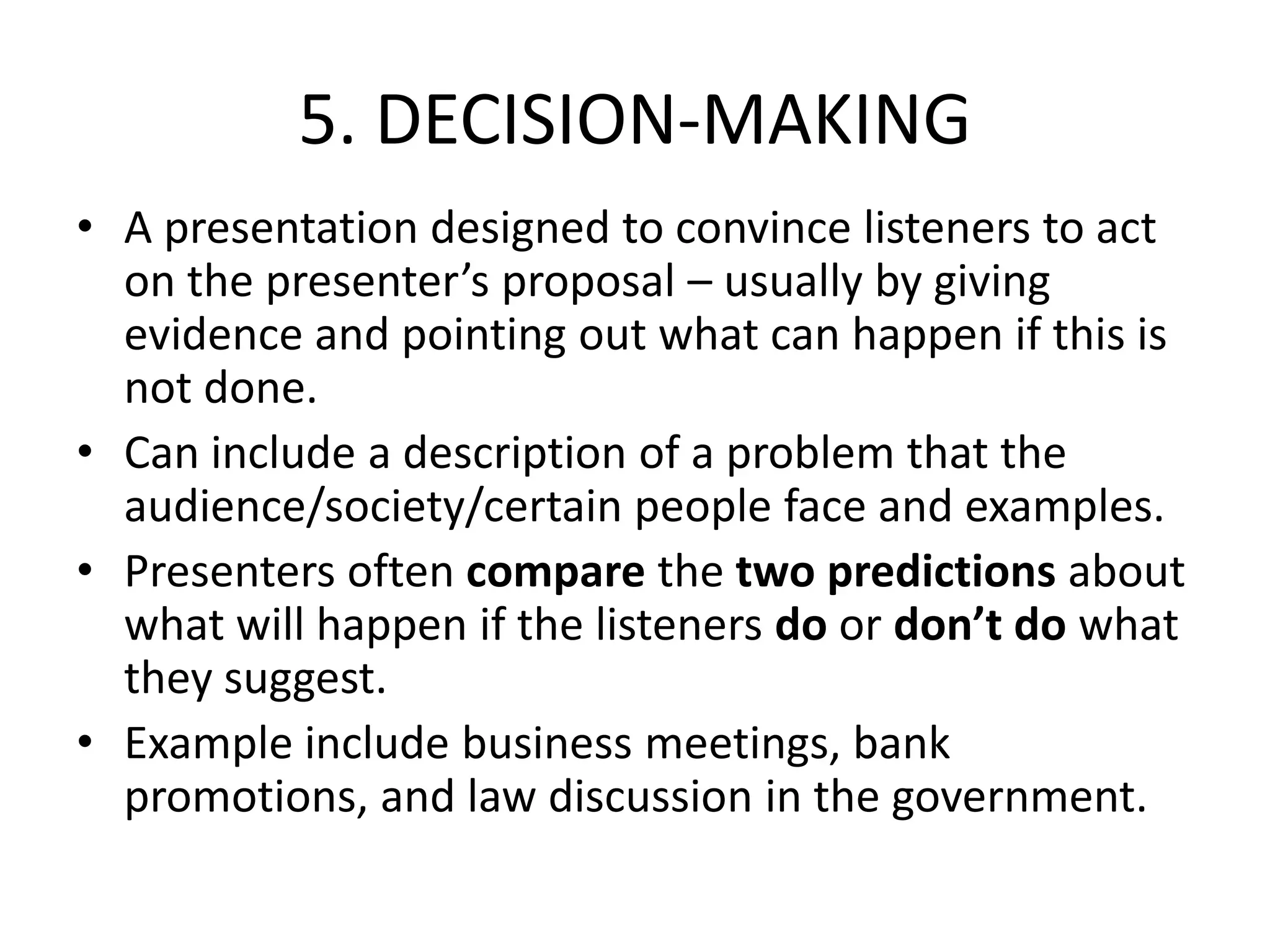
5. DECISION-MAKING
• A presentation designed to convince listeners to act
on the presenter’s proposal – usually by giving
evidence and pointing out what can happen if this is
not done.
• Can include a description of a problem that the
audience/society/certain people face and examples.
• Presenters often compare the two predictions about
what will happen if the listeners do or don’t do what
they suggest.
• Example include business meetings, bank
promotions, and law discussion in the government.
Decision-Making – Pros and Cons
• Pros –
• Cons –
(5 mins!)
So Which One Do You Prefer?

Types of presentations

  • 1.
  • 2.
    1. INFORMATIVE • Thesepresentations are brief and to the point. They generally stick to the facts and avoid complicated information. • Usually used to describe facts – usually best for other experts. • Organized from most important topic to least. Best for breaking big information down into small. • Examples include university lectures, school classes, and research results.
  • 3.
    Informative Presentation –Pros and Cons • Pros – • Cons – (5 mins!)
  • 4.
    2. INSTRUCTIONAL • Thesepresentations give specific directions or orders. It is designed to teach something completely new to the audience. • Very thorough, and usually takes a long time. • All the theory and knowledge from the basic steps to checking the audience’s understanding. • Examples include tutorial classes, safety demonstrations, and instructional videos.
  • 5.
    Instructional Presentation –Pros and Cons • Pros – • Cons – (5 mins!)
  • 6.
    3. AROUSING • Apresentation designed to make the audience consider the topic or discussion. To rouse interest and emotions to make audience receptive. • Usually involves a lot of powerful language and enthusiastic discussion. • Often uses stories or real-life examples of the topic to rouse interest. • Can describe a solution to a problem – and gain audience’s approval. • Examples include a debate, church sermon, or motivational speech (“pep talk”).
  • 7.
    Arousing Presentation –Pros and Cons • Pros – • Cons – (5 mins!)
  • 8.
    4. PERSUASIVE • Tomake listeners accept and agree with the presenter’s proposal. • Very persuasive, usually showing supporting facts and advantages to reinforce credibility. • Often highly emotional – it helps to gather support and approval. • Presents problem, the presenter’s solution, and all the reasons behind it for agreement. • Example include political debates, business proposals.
  • 9.
    Persuasive Presentation –Pros and Cons • Pros – • Cons – (5 mins!)
  • 10.
    5. DECISION-MAKING • Apresentation designed to convince listeners to act on the presenter’s proposal – usually by giving evidence and pointing out what can happen if this is not done. • Can include a description of a problem that the audience/society/certain people face and examples. • Presenters often compare the two predictions about what will happen if the listeners do or don’t do what they suggest. • Example include business meetings, bank promotions, and law discussion in the government.
  • 11.
    Decision-Making – Prosand Cons • Pros – • Cons – (5 mins!)
  • 12.
    So Which OneDo You Prefer?