ANTI-DIABETIC DRUGS
Presented by
Ansari Imtiyaz Ahmed
Assit. Professor
J.E.S’s College of Pharmacy
Nandurbar
Content
Diabetes Mellitus
Types of Diabetes Mellitus
Management of Diabetes Mellitus
References
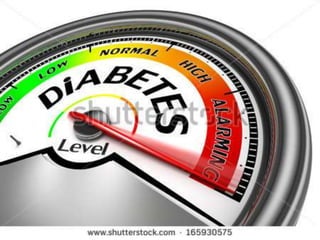
Diabetes Mellitus:
It is metabolic disorder characterized by
Hyperglycaemia
Glucosuria
Negative Nitrogen Balance
Sometime Ketonaemia
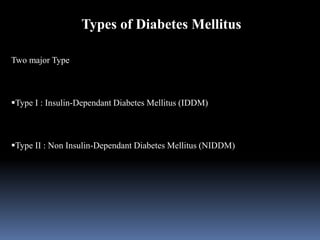
Types of Diabetes Mellitus
Two major Type
Type I : Insulin-Dependant Diabetes Mellitus (IDDM)
Type II : Non Insulin-Dependant Diabetes Mellitus (NIDDM)
Management of DM
 The major components of the treatment of diabetes
are:
• Diet and ExerciseA
• Oral hypoglycaemic
therapyB
• Insulin TherapyC
Diet and Exercise
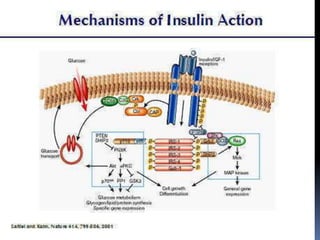
Insulin
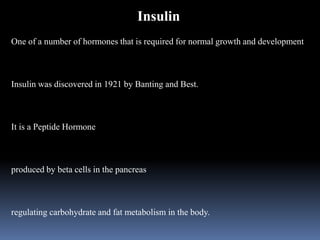
One of a number of hormones that is required for normal growth and development
Insulin was discovered in 1921 by Banting and Best.
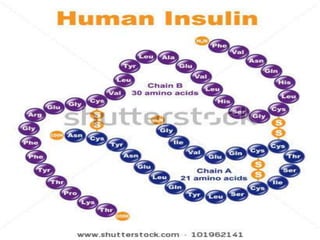
It is a Peptide Hormone
produced by beta cells in the pancreas
regulating carbohydrate and fat metabolism in the body.
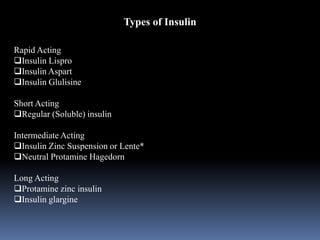
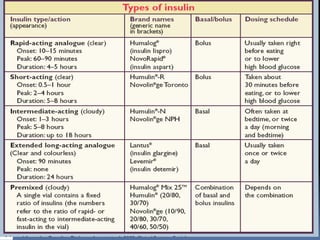
Types of Insulin
Rapid Acting
Insulin Lispro
Insulin Aspart
Insulin Glulisine
Short Acting
Regular (Soluble) insulin
Intermediate Acting
Insulin Zinc Suspension or Lente*
Neutral Protamine Hagedorn
Long Acting
Protamine zinc insulin
Insulin glargine
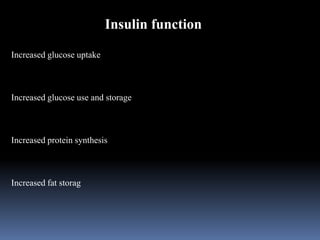
Insulin function
Increased glucose uptake
Increased glucose use and storage
Increased protein synthesis
Increased fat storag
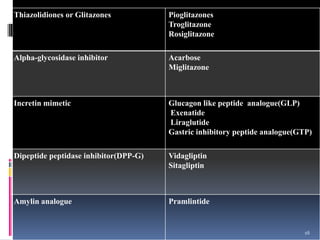
Oral hypoglycaemic therapy
15
Category Examples
Sulfonylurea's 1st generation
Tolbutamide
Tolazamide
Chlorpropamide
Acetohexamide
2nd generation
Glipizide
Glyburide
Glimepride
Gliclazide
Biguanides Metformin
Meglitinides Repaglinde
Nataglinide
Thiazolidiones or Glitazones Pioglitazones
Troglitazone
Rosiglitazone
Alpha-glycosidase inhibitor Acarbose
Miglitazone
Incretin mimetic Glucagon like peptide analogue(GLP)
Exenatide
Liraglutide
Gastric inhibitory peptide analogue(GTP)
Dipeptide peptidase inhibitor(DPP-G) Vidagliptin
Sitagliptin
Amylin analogue Pramlintide
16
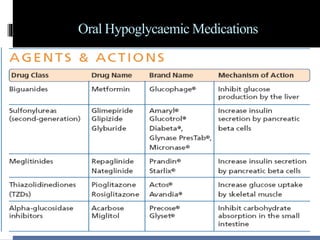
Oral Hypoglycaemic Medications
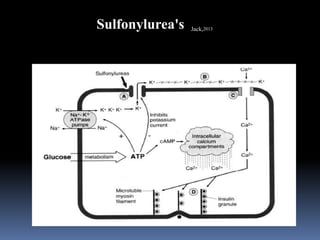
Sulfonylurea's Jack,2013
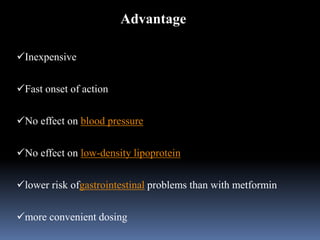
Advantage
Inexpensive
Fast onset of action
No effect on blood pressure
No effect on low-density lipoprotein
lower risk ofgastrointestinal problems than with metformin
more convenient dosing
Disadvantages:
causes an average of 5–10 pounds weight gain
Increased risk of hypoglycemia
Glyburide has increases risk of hypoglycemia slightly more as
compared with glimepiride and glipizide
Absorption, Fate, and Excretion Goodman Gilman’s
Orally Absorbed
90% bound to plasma protien
Excreted through urine
Adverse Effect
Hypoglycemia
Nonspecific Side Effect
Hypersensitivity
Drug Interactions Tripathi, 2008
Inhibit metabolism/excretion:Cimetidine, Sulfonamide, Warfarin,
Chloramphenicol.
Synergise With Drug: Salicylates, Propanolol, Lithium, Theophylline.
Displace from protein binding: Phenylbutazone, Sulfinpyrazone, Sulfonamide.
Induce Metabolism: Phenobarbitone, Phenytion, Rifampicin.
Opposite action/suppress insulin release: Corticosteroids, Diazoxide,
Thaizides, Frusemide,
Biguanides
Lowers blood glucose- increases glucose uptake and utilisation in muscle +
reduces hepatic glucose production (gluconeogenesis)
reduction of intestinal glucose absorption
Adverse effects:
- GIT disturbancies (anorexia + weight loss, diarrhea)
- lactic acidosis rare but potencially fatal
Metformin should be avoided in patients who predispose to lactic acidosis
(renal and hepatic disease, heart failure…)
Vit.B12 Deficiency
Thiazolidinediones
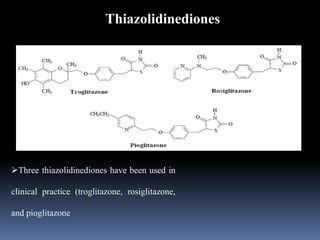
Three thiazolidinediones have been used in
clinical practice (troglitazone, rosiglitazone,
and pioglitazone
troglitazone was withdrawn from use
Thiazolidinediones act on adipose, muscle, and hepatic tissue
Selective agonists for nuclear peroxisome proliferator-activated
receptor-g (PPARΎ).
bind to PPARΎ
Their main action is to diminish insulin resistance by increasing glucose
uptake and metabolism in muscle and adipose tissues
Lower risk of hypoglycemia
Slight increase in high-density lipoprotein
Actos linked to decreased triglycerides
Convenient dosing
Advantages
Alpha-glucosidase inhibitor
Reduces glucose absorbance by acting on small intestineto cause decrease
in production of enzymes needed to digest carbohydrates
Slightly decreased risk of hypoglycemia as compared to sulfonylurea
Not associated with weight gain
Decreases triglycerides
No effect on cholesterol
References
 Rang, P, H., Dale, M, M., Ritter, J, M., Flower, R, J., 2008.
Pharmacology, 402-409.
 Tripathi, K, D., 2008. Essentials of Medical Pharmacology, 254-274.
 Robbins, Kumar, Cotran.,2007.Basic Pathology, 641-654.
 Goodman & Gilman‘s., 2006 .The Pharmacological Basis Of
Therapeutics,
 Jack DeRuiter “OVERVIEW OF THE ANTIDIABETIC AGENTS”
Endocrine Pharmacotherapy Module, Spring, 2003
 Nancy J.V. Bohannon, MD, “Treating dual defects in diabetes: Insulin
resistance and insulin secretion” Am J Health-Syst Pharm. 2002; 59(Suppl
9):S9-13 .
Emily Loghmani, “DIABETES MELLITIS: TYPE 1 AND TYPE 2”,
Guidelines for Adolescent Nutrition Services (2005), 167-181.
NK Agrawal,VS Reddy, RK Sahay, SK Bhadada,JK Agrawal, “Newer Oral
Antidiabetic Agents”, Journal, Indian Academy of Clinical Medicine, 2000,Vol.
1, No. 3, 245-250.
Maureen I. Harris, PhD, MPH, ” Classification, Diagnostic Criteria,
and Screening for Diabetes”, Chapter 2, 16-31.
Thank You