ANTICOAGULANT
NAME- SABITRI PRADHAN
M.PHARM
Dept. of pharmacology
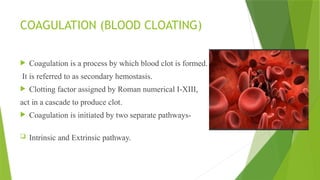
COAGULATION (BLOOD CLOATING)
 Coagulation is a process by which blood clot is formed.
It is referred to as secondary hemostasis.
 Clotting factor assigned by Roman numerical I-XIII,
act in a cascade to produce clot.
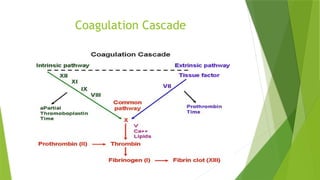
 Coagulation is initiated by two separate pathways-
 Intrinsic and Extrinsic pathway.
Coagulation Cascade
ANTICOAGULANTS
Definition: A substance that prevents coagulation or clotting of blood
but doesn’t dissolve an already formed clot. Therapeutic
interference (‘blood-thinning) with the clotting mechanism of the
blood to prevent or treat thrombosis and embolism.
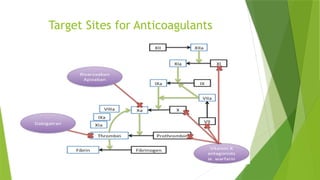
 The anticoagulant drugs inhibit either the action of the coagulation
factors (heparin) or interfere with the synthesis of the coagulation
factors (warfarin).
 Drugs that help prevent the clotting (coagulation) of blood
 Some of them occur naturally in blood-eating animals such as
leeches and mosquitoes, where they help keep the bite area
unclotted long enough for the animal to obtain some blood.
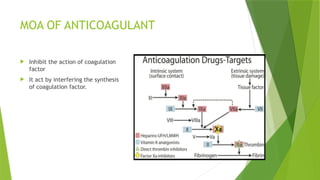
Target Sites for Anticoagulants
MOA OF ANTICOAGULANT
 Inhibit the action of coagulation
factor
 It act by interfering the synthesis
of coagulation factor.
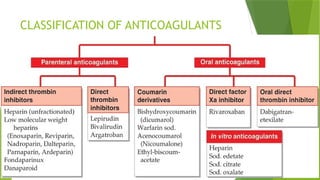
CLASSIFICATION OF ANTICOAGULANTS
HEPARIN
 Heparin was discovered by a medical student, McLean in the year
1916.
 Strong anticoagulant (due to in-vitro and in-vivo).
 It was later isolated and identified by Howell as a sulphated
mucopolysaccaride.
 Because of its high concentration in liver, it was named as heparin.
 Commercially, heparin is obtained from beef lung and pig
intestinal mucosa.
 Metabolized by Heparinase in liver.
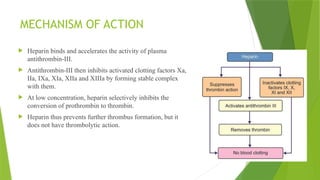
MECHANISM OF ACTION
 Heparin binds and accelerates the activity of plasma
antithrombin-III.
 Antithrombin-III then inhibits activated clotting factors Xa,
IIa, IXa, XIa, XIIa and XIIIa by forming stable complex
with them.
 At low concentration, heparin selectively inhibits the
conversion of prothrombin to thrombin.
 Heparin thus prevents further thrombus formation, but it
does not have thrombolytic action.
PHARMACOKINETIC
 Heparin is not absorbed after oral administration because of its high negative
charge and large molecular size.
 Therefore, it must be given parenterally.
 On I.V. administration, the anticoagulant effect starts immediately, whereas on
subcutaneous route, it takes 1-2 hours.
 Heparin is highly protein bound.
 It does not cross the BPB or placental barrier due to high molecular weight.
ADVERSE EFFECT:
 Bleeding (no clotting)
 Hypoaldosteronism
 Hypersensitivity reactions
 Osteoporosis
 Reversible alopecia
CONTRAINDICATION
 Bleeding disorder
 Haemophilia
 Renal failure
 Neurosurgery
HEPARIN ANTAGONIST:
 Mild overdose-stop heparin uses
 Severe overdose-protamine sulfate (I.V)
 Dose-1mg for 100 unit of heparin
LOW MOLECULAR WEIGHT HEPARINS
 It only inhibit factor X not thrombin
 Given subcutaneously
HEPARINOIDS
used in patients developing thrombocytopenia with heparin.
LEPIRUDIN :
 It directly inhibits thrombin and is used as an anticoagulant in
patients with heparin – induced thrombocytopenia.
 It is administered through I.V
 No antidote is available.
DANAPAROID
 It is isolated from pig intestinal mucosa, and it has mainly antifactor Xa
activity.
 It is administered subcutaneously for prophylaxis and intravenously for
treatment of deep vein thrombosis especially in patients with HIT.
BIVALIRUDIN
 It is a synthetic heparinoid and has a mechanism similar to that of
lepirudin .
 It can be used in coronary angioplasty as an alternative to heparin.
ORALANTICOAGULANTS
 Among oral anticoagulants , coumarin derivatives are commonly used.
 Oral anti coagulants like warfarin act only in vivo.
 They are vitamin K antagonists.
WARFARIN:
 Used in vivo
 1st
anticoagulant discovered in 1951.
 They act by interfering with synthesis of vit K dependent clotting factors in
liver i.e factor-VII,IX,X.
 They block gamma carboxylation of glutamate residue in prothrombin
VII,IX,X.
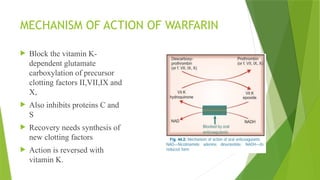
MECHANISM OF ACTION OF WARFARIN
 Block the vitamin K-
dependent glutamate
carboxylation of precursor
clotting factors II,VII,IX and
X,
 Also inhibits proteins C and
S
 Recovery needs synthesis of
new clotting factors
 Action is reversed with
vitamin K.
PHARMACOKINETICS
 Completely absorbed after oral administration.
 It can also be given I.V. or rectal.
 Food interferes with absorption of warfarin.
 Highly bound to plasma proteins, freely crosses the placental barrier.
 Metabolized in liver, inactive metabolites are excreted in urine and stool.
 Half life- 40 hours . Duration of action is 2-5 days.
ADVERSE EFFECT:
 Bleeding (brain and intestine)
 Teratogenic effect
 Skin Necrosis
 Other Rare Side Effects : Diarrhoea , Alopecia , Dermatits, Abdominal
Cramps.
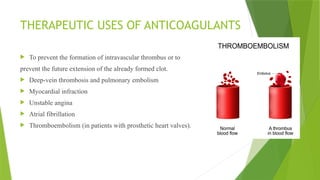
THERAPEUTIC USES OF ANTICOAGULANTS
 To prevent the formation of intravascular thrombus or to
prevent the future extension of the already formed clot.
 Deep-vein thrombosis and pulmonary embolism
 Myocardial infraction
 Unstable angina
 Atrial fibrillation
 Thromboembolism (in patients with prosthetic heart valves).
THANK YOU

Anticoagulants and its classification slideshare

  • 1.
  • 2.
    COAGULATION (BLOOD CLOATING) Coagulation is a process by which blood clot is formed. It is referred to as secondary hemostasis.  Clotting factor assigned by Roman numerical I-XIII, act in a cascade to produce clot.  Coagulation is initiated by two separate pathways-  Intrinsic and Extrinsic pathway.
  • 3.
  • 5.
    ANTICOAGULANTS Definition: A substancethat prevents coagulation or clotting of blood but doesn’t dissolve an already formed clot. Therapeutic interference (‘blood-thinning) with the clotting mechanism of the blood to prevent or treat thrombosis and embolism.  The anticoagulant drugs inhibit either the action of the coagulation factors (heparin) or interfere with the synthesis of the coagulation factors (warfarin).  Drugs that help prevent the clotting (coagulation) of blood  Some of them occur naturally in blood-eating animals such as leeches and mosquitoes, where they help keep the bite area unclotted long enough for the animal to obtain some blood.
  • 6.
    Target Sites forAnticoagulants
  • 7.
    MOA OF ANTICOAGULANT Inhibit the action of coagulation factor  It act by interfering the synthesis of coagulation factor.
  • 8.
  • 9.
    HEPARIN  Heparin wasdiscovered by a medical student, McLean in the year 1916.  Strong anticoagulant (due to in-vitro and in-vivo).  It was later isolated and identified by Howell as a sulphated mucopolysaccaride.  Because of its high concentration in liver, it was named as heparin.  Commercially, heparin is obtained from beef lung and pig intestinal mucosa.  Metabolized by Heparinase in liver.
  • 10.
    MECHANISM OF ACTION Heparin binds and accelerates the activity of plasma antithrombin-III.  Antithrombin-III then inhibits activated clotting factors Xa, IIa, IXa, XIa, XIIa and XIIIa by forming stable complex with them.  At low concentration, heparin selectively inhibits the conversion of prothrombin to thrombin.  Heparin thus prevents further thrombus formation, but it does not have thrombolytic action.
  • 11.
    PHARMACOKINETIC  Heparin isnot absorbed after oral administration because of its high negative charge and large molecular size.  Therefore, it must be given parenterally.  On I.V. administration, the anticoagulant effect starts immediately, whereas on subcutaneous route, it takes 1-2 hours.  Heparin is highly protein bound.  It does not cross the BPB or placental barrier due to high molecular weight. ADVERSE EFFECT:  Bleeding (no clotting)  Hypoaldosteronism  Hypersensitivity reactions  Osteoporosis  Reversible alopecia
  • 12.
    CONTRAINDICATION  Bleeding disorder Haemophilia  Renal failure  Neurosurgery HEPARIN ANTAGONIST:  Mild overdose-stop heparin uses  Severe overdose-protamine sulfate (I.V)  Dose-1mg for 100 unit of heparin LOW MOLECULAR WEIGHT HEPARINS  It only inhibit factor X not thrombin  Given subcutaneously
  • 13.
    HEPARINOIDS used in patientsdeveloping thrombocytopenia with heparin. LEPIRUDIN :  It directly inhibits thrombin and is used as an anticoagulant in patients with heparin – induced thrombocytopenia.  It is administered through I.V  No antidote is available.
  • 14.
    DANAPAROID  It isisolated from pig intestinal mucosa, and it has mainly antifactor Xa activity.  It is administered subcutaneously for prophylaxis and intravenously for treatment of deep vein thrombosis especially in patients with HIT. BIVALIRUDIN  It is a synthetic heparinoid and has a mechanism similar to that of lepirudin .  It can be used in coronary angioplasty as an alternative to heparin.
  • 15.
    ORALANTICOAGULANTS  Among oralanticoagulants , coumarin derivatives are commonly used.  Oral anti coagulants like warfarin act only in vivo.  They are vitamin K antagonists. WARFARIN:  Used in vivo  1st anticoagulant discovered in 1951.  They act by interfering with synthesis of vit K dependent clotting factors in liver i.e factor-VII,IX,X.  They block gamma carboxylation of glutamate residue in prothrombin VII,IX,X.
  • 16.
    MECHANISM OF ACTIONOF WARFARIN  Block the vitamin K- dependent glutamate carboxylation of precursor clotting factors II,VII,IX and X,  Also inhibits proteins C and S  Recovery needs synthesis of new clotting factors  Action is reversed with vitamin K.
  • 17.
    PHARMACOKINETICS  Completely absorbedafter oral administration.  It can also be given I.V. or rectal.  Food interferes with absorption of warfarin.  Highly bound to plasma proteins, freely crosses the placental barrier.  Metabolized in liver, inactive metabolites are excreted in urine and stool.  Half life- 40 hours . Duration of action is 2-5 days. ADVERSE EFFECT:  Bleeding (brain and intestine)  Teratogenic effect  Skin Necrosis  Other Rare Side Effects : Diarrhoea , Alopecia , Dermatits, Abdominal Cramps.
  • 18.
    THERAPEUTIC USES OFANTICOAGULANTS  To prevent the formation of intravascular thrombus or to prevent the future extension of the already formed clot.  Deep-vein thrombosis and pulmonary embolism  Myocardial infraction  Unstable angina  Atrial fibrillation  Thromboembolism (in patients with prosthetic heart valves).
  • 19.