ORAL COMMUNICATION EFFECTIVE IN CLASS KARTHIK INDRAJIT.K
COMMUNICATION Communication : the process of exchanging information Two types of communication Verbal and non verbal communication
Definition of Terms Nonverbal communication:  the process of communication through sending and receiving wordless  messages  Gestures Body language Posture Facial Expressions Eye Contact Appearance Intonations Handwriting Etc.
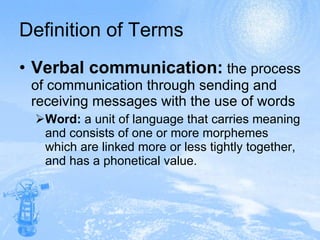
Definition of Terms Verbal communication:   the process of communication through sending and receiving messages with the use of words Word:  a unit of language that carries meaning and consists of one or more morphemes which are linked more or less tightly together, and has a phonetical value.
ORAL COMMUNICATION Oral communication:  the conveyance of ideas and information in forms that can be listened to or spoken
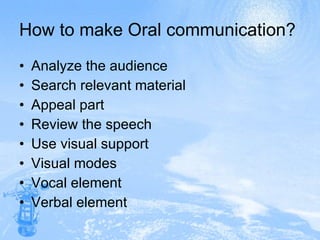
How to make Oral communication? Analyze the audience Search relevant material Appeal part Review the speech Use visual support Visual modes Vocal element Verbal element
Public speaking A good way of getting your views and message across at meetings, special events and other gatherings. It can be difficult to stand up and speak in other language in front of other people.  Complete a pre-test to evaluate your english communication level in your video speech.
INITIAL STEPS: IF YOU ARE GOING TO DELIVER A SPEECH AT AN EVENT OR MEETING, YOU SHOULD HAVE  TIME  TO PREPARE IT WORD BY WORD. MAKE SURE YOU DO THE NECESSARY  RESEARCH , AND KEEP IT FAIRLY BRIEF SO YOU DO NOT BORE YOUR PUBLIC.  Take five minutes to read “preparation” in one of the handouts.
In the introduction: Introduce your team work, names and their study programs; Introduce the issue that you are going to discuss; Try to grab your audience’s attention straight away with a dramatic fact or a real life story; Give a  very brief  outline of what your speech will cover and why the issue is important to the group.
In the main body of the speech: Make your content as concise and lively as you can, including examples involving real people, Always bear your audience in mind, Include vital facts from your research illustrating your main points, Say what you think should be done about the issue and what your group are trying to do,
In the conclusion: Sum up your main points, Explain how members of the audience can get involved, Say you will try to answer questions from members of the audience afterwards. Thank people for listening.
THANK YOU

Oral Communication Effective In Class

  • 1.
    ORAL COMMUNICATION EFFECTIVEIN CLASS KARTHIK INDRAJIT.K
  • 2.
    COMMUNICATION Communication :the process of exchanging information Two types of communication Verbal and non verbal communication
  • 3.
    Definition of TermsNonverbal communication: the process of communication through sending and receiving wordless messages Gestures Body language Posture Facial Expressions Eye Contact Appearance Intonations Handwriting Etc.
  • 4.
    Definition of TermsVerbal communication: the process of communication through sending and receiving messages with the use of words Word: a unit of language that carries meaning and consists of one or more morphemes which are linked more or less tightly together, and has a phonetical value.
  • 5.
    ORAL COMMUNICATION Oralcommunication: the conveyance of ideas and information in forms that can be listened to or spoken
  • 6.
    How to makeOral communication? Analyze the audience Search relevant material Appeal part Review the speech Use visual support Visual modes Vocal element Verbal element
  • 7.
    Public speaking Agood way of getting your views and message across at meetings, special events and other gatherings. It can be difficult to stand up and speak in other language in front of other people. Complete a pre-test to evaluate your english communication level in your video speech.
  • 8.
    INITIAL STEPS: IFYOU ARE GOING TO DELIVER A SPEECH AT AN EVENT OR MEETING, YOU SHOULD HAVE TIME TO PREPARE IT WORD BY WORD. MAKE SURE YOU DO THE NECESSARY RESEARCH , AND KEEP IT FAIRLY BRIEF SO YOU DO NOT BORE YOUR PUBLIC. Take five minutes to read “preparation” in one of the handouts.
  • 9.
    In the introduction:Introduce your team work, names and their study programs; Introduce the issue that you are going to discuss; Try to grab your audience’s attention straight away with a dramatic fact or a real life story; Give a very brief outline of what your speech will cover and why the issue is important to the group.
  • 10.
    In the mainbody of the speech: Make your content as concise and lively as you can, including examples involving real people, Always bear your audience in mind, Include vital facts from your research illustrating your main points, Say what you think should be done about the issue and what your group are trying to do,
  • 11.
    In the conclusion:Sum up your main points, Explain how members of the audience can get involved, Say you will try to answer questions from members of the audience afterwards. Thank people for listening.
  • 12.