I. History of Oral Communication
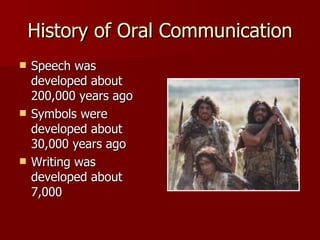
History of Oral Communication Speech was developed about 200,000 years ago Symbols were developed about 30,000 years ago Writing was developed about 7,000
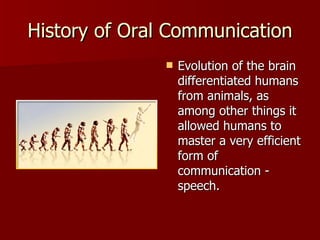
History of Oral Communication Evolution of the brain differentiated humans from animals, as among other things it allowed humans to master a very efficient form of communication - speech.
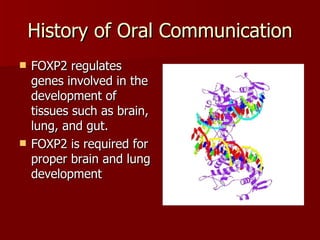
History of Oral Communication FOXP2 regulates genes involved in the development of tissues such as brain, lung, and gut. FOXP2 is required for proper brain and lung development
II. Definition of Terms
Definition of Terms Oral communication:  the conveyance of ideas and information in forms that can be listened to or spoken Verbal Oral communication:  the conveyance of ideas and information in forms that can be listened to or spoken using words Non Verbal Oral communication:  the conveyance of ideas and information in forms that can be listened to or spoken using no words
Definition of Terms  (continued…) Examples of Nonverbal Oral Messages Intonations :  rising intonation for echo or declarative questions ( He found it on the street? ) falling intonation for  wh-  questions ( Where did he find it? ) and statements ( He found it on the street. ).  Grunts:  Sighs:  used to express relief Pitch: Volume: Silence: Others…
Definition of Terms  (continued…) Paralanguage : non-verbal elements of communication used to modify meaning and convey emotion.
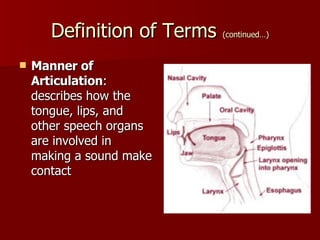
Definition of Terms  (continued…) Manner of Articulation : describes how the tongue, lips, and other speech organs are involved in making a sound make contact
III. Uses / Purpose
Guess the Tagline? Just do it. (1988)
Guess the Tagline? Melts in your mouth, not in your hands. (1954)
Guess the Tagline? When it absolutely, positively has to be there overnight. (1982)
Guess the Tagline? Finger-lickin’ good! (1952)
Guess the Tagline? Let your fingers do the walking. (1964)
Guess the Tagline? The happiest place on earth. (1960s)
Guess the Tagline? Fly the friendly skies. (1966)
Guess the Tagline? Kills bugs dead. (1966)
Guess the Tagline? Share moments. Share life. (1990s)
Guess the Tagline? Think outside the box. (1990s) Think different. (1998)
Guess the Tagline? Reach out and touch someone. (1979)
Guess the Tagline? The mind is a terrible thing to waste. (1972)
Guess the Tagline? Look, Ma, no cavities! (1958)
Guess the Tagline? This is your brain. This is your brain on drugs. Any questions? (1987)
Guess the Tagline? We bring good things to life. (1981)
Guess the Tagline? They’re gr-r-r-eat! (1950s)
“ It's not what he said, it's the way he said it.”
Business Uses of Paralanguage & Oral Communication Used to emphasize other forms of communication Used to express / hide emotions or attitudes Used as a tool to better recall an idea or concept of a product or company
IV. Advantages & Drawbacks
Advantages Able to retransmit information to others thru word of mouth unlike nonverbal visual communication Paralanguage transcends language barriers Does not require visual contact
Disadvantages Paralanguage is mostly limited to face to face contact Except for paralanguage, it is subject to language barriers
-End of Report-

Oral Communication

  • 1.
    I. History ofOral Communication
  • 2.
    History of OralCommunication Speech was developed about 200,000 years ago Symbols were developed about 30,000 years ago Writing was developed about 7,000
  • 3.
    History of OralCommunication Evolution of the brain differentiated humans from animals, as among other things it allowed humans to master a very efficient form of communication - speech.
  • 4.
    History of OralCommunication FOXP2 regulates genes involved in the development of tissues such as brain, lung, and gut. FOXP2 is required for proper brain and lung development
  • 5.
  • 6.
    Definition of TermsOral communication: the conveyance of ideas and information in forms that can be listened to or spoken Verbal Oral communication: the conveyance of ideas and information in forms that can be listened to or spoken using words Non Verbal Oral communication: the conveyance of ideas and information in forms that can be listened to or spoken using no words
  • 7.
    Definition of Terms (continued…) Examples of Nonverbal Oral Messages Intonations : rising intonation for echo or declarative questions ( He found it on the street? ) falling intonation for wh- questions ( Where did he find it? ) and statements ( He found it on the street. ). Grunts: Sighs: used to express relief Pitch: Volume: Silence: Others…
  • 8.
    Definition of Terms (continued…) Paralanguage : non-verbal elements of communication used to modify meaning and convey emotion.
  • 9.
    Definition of Terms (continued…) Manner of Articulation : describes how the tongue, lips, and other speech organs are involved in making a sound make contact
  • 10.
    III. Uses /Purpose
  • 11.
    Guess the Tagline?Just do it. (1988)
  • 12.
    Guess the Tagline?Melts in your mouth, not in your hands. (1954)
  • 13.
    Guess the Tagline?When it absolutely, positively has to be there overnight. (1982)
  • 14.
    Guess the Tagline?Finger-lickin’ good! (1952)
  • 15.
    Guess the Tagline?Let your fingers do the walking. (1964)
  • 16.
    Guess the Tagline?The happiest place on earth. (1960s)
  • 17.
    Guess the Tagline?Fly the friendly skies. (1966)
  • 18.
    Guess the Tagline?Kills bugs dead. (1966)
  • 19.
    Guess the Tagline?Share moments. Share life. (1990s)
  • 20.
    Guess the Tagline?Think outside the box. (1990s) Think different. (1998)
  • 21.
    Guess the Tagline?Reach out and touch someone. (1979)
  • 22.
    Guess the Tagline?The mind is a terrible thing to waste. (1972)
  • 23.
    Guess the Tagline?Look, Ma, no cavities! (1958)
  • 24.
    Guess the Tagline?This is your brain. This is your brain on drugs. Any questions? (1987)
  • 25.
    Guess the Tagline?We bring good things to life. (1981)
  • 26.
    Guess the Tagline?They’re gr-r-r-eat! (1950s)
  • 27.
    “ It's notwhat he said, it's the way he said it.”
  • 28.
    Business Uses ofParalanguage & Oral Communication Used to emphasize other forms of communication Used to express / hide emotions or attitudes Used as a tool to better recall an idea or concept of a product or company
  • 29.
  • 30.
    Advantages Able toretransmit information to others thru word of mouth unlike nonverbal visual communication Paralanguage transcends language barriers Does not require visual contact
  • 31.
    Disadvantages Paralanguage ismostly limited to face to face contact Except for paralanguage, it is subject to language barriers
  • 32.