The document discusses different types of interviews, including:
- Face-to-face interviews, which are traditional and involve the candidate and interviewer meeting in person.
- Panel interviews, which involve multiple interviewers evaluating a candidate's group skills.
- Phone interviews, which are increasingly common and help reduce bias.
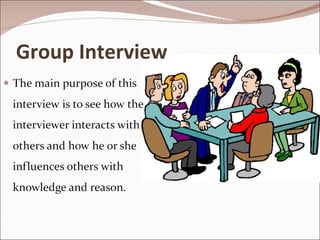
- Group interviews, which evaluate leadership potential by having candidates interview together.
- Stress interviews, which were more common for sales roles and aim to see how candidates handle pressure.
In this document
Powered by AI
Introduction to the topic of interviews and their varying definitions, including media and job contexts.
Interviews involve questions about background and goals. Different styles impact information gathered.
Categorizes interview questions by type: actual, biographical, formal, informal, usual, and traditional.
Discusses diverse interview styles and preparation, emphasizing the need to adapt to different interview formats.
Describes various interview formats including face-to-face, panel, and phone interviews, highlighting their purposes.
Explains group interviews for evaluating leadership and stress interviews for assessing candidate resilience.
Shares tips for conducting interviews as a reporter, including preparation, guiding the conversation, and follow-ups.
Final remarks on the presentation and a thank you for participation.
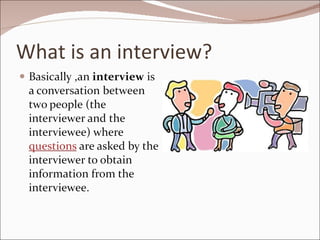
Interview means differentthings The word interview can stand for different things. For example a reporter interviews a celebrity for television. This kind of interviews can be one-on-one but usually when it comes to television there are many reporters from different channels. There are also job interviews where a person has to go through in order to get a job he wants. Job interviews are usually face-to-face interviews and it includes paperwork.
4.
During an interviewyou can expect to be asked questions around your educational background, previous work experiences and questions relating to your personal characteristics and goals. But what happens after that? It depends on what interview style your interviewer prefers. Below are some of the more common interview styles used.
5.
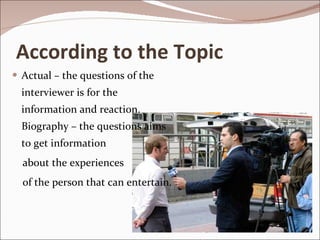
According to theTopic Actual – the questions of the interviewer is for the information and reaction. Biography – the questions aims to get information about the experiences of the person that can entertain.
6.
According to MethodsFormal – the time is scheduled for the sake of the interviewee. Informal – no specific schedule.
7.
According to GoalsUsual – the good example is the search for the evidences about the witness of the scene. Traditional – aims to get accurate information needed for the entertainment of the people and avoid judgment to the person. Groupings – this is about the numbers of the interviewer and interviewee
8.
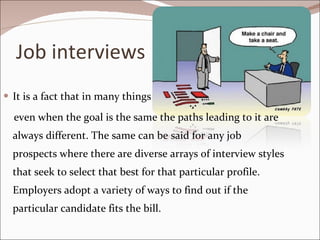
Job interviews Itis a fact that in many things even when the goal is the same the paths leading to it are always different. The same can be said for any job prospects where there are diverse arrays of interview styles that seek to select that best for that particular profile. Employers adopt a variety of ways to find out if the particular candidate fits the bill.
9.
Must know… Thatis why a person coming to the interview shouldn’t expect just to impress the interviewer with his or her professional successes but must be prepared to face all the hurdles that the interviewer places before them. Since, the job profile is very diverse so it makes little sense if there is only one type of interview structure.
10.
For example, aninterview structure that is appropriate for a sales representative will be of little help when the interviewer wants to select, say, a person in the management role. With increasing competition in the job market, different types of interviews have become very necessary to recruit talents. Read below to know more on what these different types of interviews are.
11.
Different Kinds OfInterview Face-To-Face Interview This is a traditional interview and the most common type. In this interview the candidate and the interviewer meets face-to-face. The main concept of the interview is to build rapport with the interviewer and show how the qualifications will benefit their organization. The interviewee should maintain eye contact, and respond to all the questions of the interviewer.
12.
Panel Interview Apanel interview comprises more than two members interviewing a person for the hiring. It is most common mode of interview when hiring at the senior level. The interviewee should try to connect with each interviewer and the best way to do this is to read the personality of each interviewer. …
13.
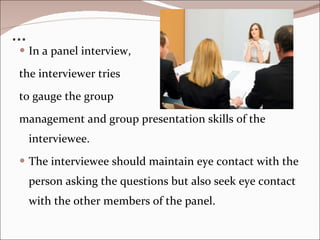
… In apanel interview, the interviewer tries to gauge the group management and group presentation skills of the interviewee. The interviewee should maintain eye contact with the person asking the questions but also seek eye contact with the other members of the panel.
14.
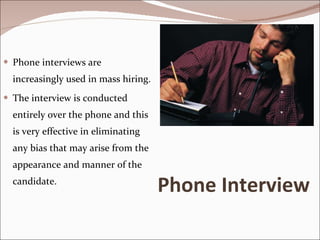
Phone Interview Phoneinterviews are increasingly used in mass hiring. The interview is conducted entirely over the phone and this is very effective in eliminating any bias that may arise from the appearance and manner of the candidate.
15.
Why the phoneinterview? Phone interview is used to narrow a field of candidates. That is why candidates should treat this interview with the same seriousness as a phone interview. The candidate should focus on the conversation and listen to the questions carefully before answering. In this interview, voice is also a key.
Why group interviews?Group interview is also the best way to discover any leadership potential among the candidates. The leading candidates who are selected from the group interview are then taken for an informal one to one interview.
18.
Stress Interview Thistype of interview is rare in the present job scenario. It was a very common interview method when selecting for sales position.
19.
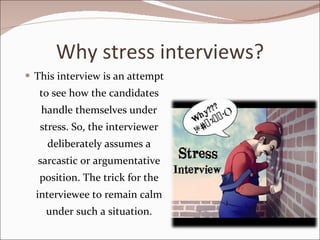
Why stress interviews?This interview is an attempt to see how the candidates handle themselves under stress. So, the interviewer deliberately assumes a sarcastic or argumentative position. The trick for the interviewee to remain calm under such a situation.
20.
Stress interview means-Being asked more than one questions at a time; Being asked further questions without being allowed adequate time to respond; Being questioned in an interrogatory tone and voice; Being asked an unrelated bunch of questions; Having his feelings provoked.
Tips on how-to-interviewWork as a reporter can be demanding because of time constraints and the challenges of interviews. Interview methods can differ depending on the interviewee, and it's important to alter your method as needed. Stay calm and ask follow-up questions whenever you do not understand something in an interview.
23.
Preparation The mostimportant aspect of the interview is conducting background research. You can't understand the full story without background knowledge. Research can also help you come up with productive questions. Showing that you know about the subject may also make your source respond more positively to you and your questions. Prepare questions to ask and bring pen, paper and a tape recorder with you to the interview. Make an appointment and arrive on time.
24.
Guiding the InterviewIntroduce yourself and explain what you are doing and for whom. Ask the source's name and title and make sure you have the correct spelling. Misspelling a name is an offense worthy of firing at some publications, and may earn you a failing grade if you are a student.
25.
Don’t forget! Maintaineye contact, be friendly and avoid yes-or-no questions. Also, to keep from influencing a source's answer, avoid asking biased questions. Take notes and try to get complete quotes on important subjects. If you did not hear something, politely ask the source to repeat it. Also consider the surroundings of the interview and the source's behavior, as these details can make your writing more interesting.