SOFT SKILLS FOR 
EFFECTIVE 
INTERPERSONAL 
COMMUNICATION
INTRODUCTION TO 
COMMUNICATION 
• Communication is derived from Latin word 
ā€˜commuicare’ 
• Communication is the exchange of ideas from 
one person to another 
• Communication is not used in organization but 
also in day to day life. 
• E.g:- new born communicates with its mother 
even stones, plants communicate etc.
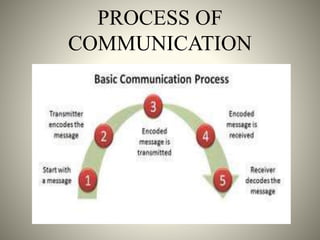
PROCESS OF 
COMMUNICATION
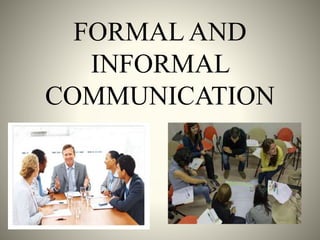
FORMAL AND 
INFORMAL 
COMMUNICATION
FORMAL COMMUNICATION 
• Formal communication refers to official 
communication in the organization. 
• Formal communication is done in all levels in 
an organization. 
• For e.g:- an employee may first communicate 
with its superior and then the superior with the 
higher authorities.
TYPES OF FORMAL 
COMMUNICATION 
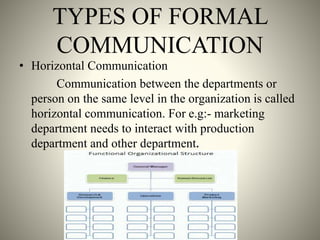
• Horizontal Communication 
Communication between the departments or 
person on the same level in the organization is called 
horizontal communication. For e.g:- marketing 
department needs to interact with production 
department and other department.
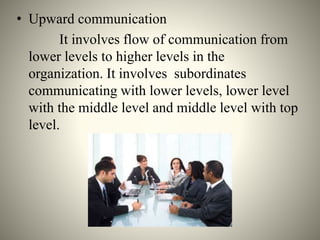
• Upward communication 
It involves flow of communication from 
lower levels to higher levels in the 
organization. It involves subordinates 
communicating with lower levels, lower level 
with the middle level and middle level with top 
level.
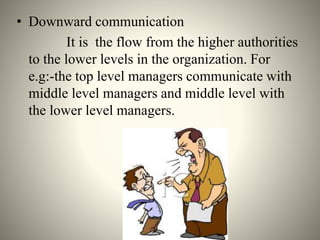
• Downward communication 
It is the flow from the higher authorities 
to the lower levels in the organization. For 
e.g:-the top level managers communicate with 
middle level managers and middle level with 
the lower level managers.
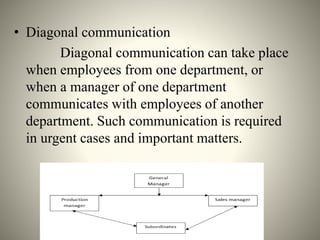
• Diagonal communication 
Diagonal communication can take place 
when employees from one department, or 
when a manager of one department 
communicates with employees of another 
department. Such communication is required 
in urgent cases and important matters.
ADVANTAGES OF FORMAL 
COMMUNICATION 
• Feedback 
• Suggestions from employees 
• Clarification 
• Management labour relationship 
• Plans and policies 
• Decision making 
• Responsibility 
• Directions 
• Control 
• Training and motivation
INFORMAL 
COMMUNICATION 
• Along with formal communication in an 
organization, there exists a secondary network of 
communication, which is referred as informal 
communication 
• It is also known as grapevine. 
• The grapevine may grow or move in any direction 
with the support of tendrils, in the same way 
informal communication can move in any 
direction with the support of informal groups.
TYPES OF INFORMAL 
COMMUNICATION 
• Single Strand Chain:- 
In this, the information passes from 
one person to another person and then to 
another person and so on. 
• Gossip chain:- 
In this chain, one person obtains 
information and then transmits to others in the 
organization.
• Probability chain:- 
In this, the information is passed on 
random or selective basis. 
• Cluster Chain:- 
In this chain, one person informs to a 
few selected persons, who in turn may pass on 
the information to other selected persons.
ADVANTAGES OF INFORMAL 
COMMUNICATION 
• Quick transmission 
• Feedback 
• Supplement to formal channels 
• Promotes team spirit 
• Informal relations
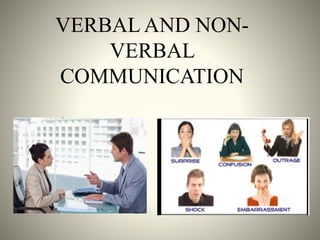
VERBAL AND NON-VERBAL 
COMMUNICATION
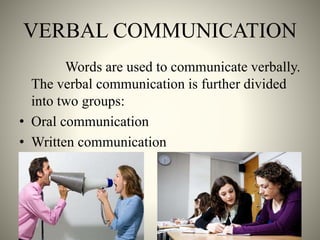
VERBAL COMMUNICATION 
Words are used to communicate verbally. 
The verbal communication is further divided 
into two groups: 
• Oral communication 
• Written communication
ORAL COMMUNICATION 
• It takes place in the form of listening and 
speaking. In organization spend more time (80 to 
85%) on listening and speaking rather than on 
writing and reading(about 15 to 20%) 
• oral communication takes place in variety of 
forms such as: gossip, meaningful discussion, 
phone conservation, formal and informal 
meetings, presentations, oral complains etc.
ADVANTAGES OF ORAL 
COMMUNICATION 
• Save time 
• Less expensive 
• Direct and informal 
• Instant feedback 
• Persuasive in nature 
• Develops relations 
• Motivates the speakers 
• Generates ideas 
• Confidential and secret information
DISADVANTAGES OF ORAL 
COMMUNICATION 
• Problems of retention 
• Lack of legal validity 
• Lack accountability 
• Chances of misunderstanding 
• Problem of distance 
• Not suitable for lengthy official messages 
• Lacks planning 
• Diversion of subject matter
WRITTEN COMMUNICATION 
• Written communication is a form of verbal 
communication. The common forms of written 
communication are letters, memos, reports and 
proposals. 
• Written communication is necessary in cases 
like permanent record required for future, 
information required for legal point of view etc
ADVANTAGES OF WRITTEN 
COMMUNICATION 
• Legal evidence 
• Permanent record 
• Accurate and precise 
• Wide circulation 
• Fixing of responsibility 
• Less chances of misunderstanding 
• Corporate images 
• Suitable for long messages
DISAVDANTAGES OF WRITTEN 
COMMUNICATION 
• Time consuming 
• Expensive 
• Problem of feedback 
• Problem of instant clarification 
• Problems of writers 
• Problem of communicating secret information
NON-VERBAL 
COMMUNICATION 
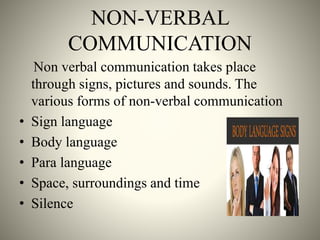
Non verbal communication takes place 
through signs, pictures and sounds. The 
various forms of non-verbal communication 
• Sign language 
• Body language 
• Para language 
• Space, surroundings and time 
• Silence
SIGN LANGUAGE 
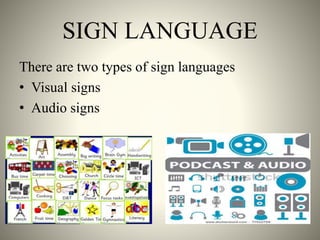
There are two types of sign languages 
• Visual signs 
• Audio signs
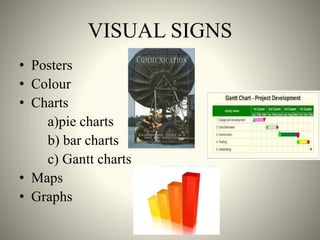
VISUAL SIGNS 
• Posters 
• Colour 
• Charts 
a)pie charts 
b) bar charts 
c) Gantt charts 
• Maps 
• Graphs
AUDIO SIGNAL 
• The audio sounds can be used to communicate 
messages in the organizations. 
• For instance, the factory siren indicates the 
time for workers of a particular shift,i.e., either 
the start or the completion of a particular shift. 
• A push button bell or an electricity bell can be 
used to call the attention of office assistant.
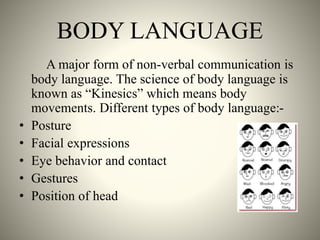
BODY LANGUAGE 
A major form of non-verbal communication is 
body language. The science of body language is 
known as ā€œKinesicsā€ which means body 
movements. Different types of body language:- 
• Posture 
• Facial expressions 
• Eye behavior and contact 
• Gestures 
• Position of head
PARA LANGUAGE 
Paralanguage means ā€œlike languageā€. 
Paralanguage does not involve words, but it involves 
the way in which the speaker speaks or the way in 
which the speaker modulates his speech. Following are 
different aspects of paralanguage 
• Voice 
a)pitch variation 
b) speed of speaking 
c) pause 
d) volume variation 
e) non-fluencies
• Word stress 
the speaker may adopt proper stress on 
certain word, which is of crucial importance. 
By placing stress on certain word, the speaker 
can change the meaning of the sentence.
SILENCE 
• People communicate but only through words, 
signs and signals but also through silence. 
• Silence can effectively communicate a number 
of responses. the responses can be positive and 
negative such as sorrow, disapproval, anger 
etc. 
• As far as oral talk is concerned, the speaker 
can make effective use of silence by giving a 
pause before an important point during a 
speech which creates curiosity.
SPACE,SURROUNDINGS AND 
TIME 
• SPACE 
Space and proximity plays an important part in the communication 
process. The influence that space and proximity has on our 
communication is called as Proxemics. The four zone of space given 
by Edward Hall 
1) The intimate space :- In this it is mostly family members., friends 
etc. Maintaining a intimate distance within space of 18 inches. 
2) The personal space:- It is that were a person communicates to a 
couple of person in this area and the space involves 18inches to 4feet. 
3) The social space:- In this the communicators are mostly formal in 
nature and most business decision is taken within this area and the 
distance involves between 4 feet to 12 feet. 
4) the public space:- In this communication may take place between 
parties to communication in company meetings, conferences etc. and 
distance is beyond 12 feet.
• SURROUNDINGS 
The surrounding or the physical environment in 
which people communicate also affects the 
communication process. As far as surroundings are 
concerned, the layout of the room, sitting arrangement 
in the room etc. 
As far as possible, the organization should use 
proper colour combination in the office room for proper 
communication process. Proper layout makes the 
visitors, subordinates and other comfortable in the 
office room 
Hence, surroundings area influences a lot in the 
communication process. So proper care should be taken 
while thinking about the surroundings.
• TIME LANGUAGE 
Successful people value time. Some 
communication experts consider time as non-verbal 
language. Business people value time and consider it 
as one of the important resources. Those who do 
proper time management are often successful in their 
business activities. 
The Japanese, the North Americans and the 
Western European people give lot of importance to 
time. They follow the concept of ā€œjust in timeā€ 
Those who do not value time, often reach late 
for appointments and meetings and they are also 
prone to give some excuses or other. Such people 
often get limited success in their business and other 
official activities
DISADVANTAGES OF NON-VERBAL 
COMMUNICATION 
• Problem of misunderstanding 
• Problem of fake body language 
• Problem of perception 
• Irritation 
• Problem of quality communication
AVDANTAGES OF NON-VERBAL 
COMMUNICATION 
• Attracts attention 
• Better recall 
• Creates impact 
• Develops relations 
• Educational value 
• Feelings and emotions 
• Facilitates interactions 
• Generates ideas
BARRIERS TO EFFECTIVE 
COMMUNICATION 
One of the main problems in business 
organization is the problems or barriers to 
communication. The barriers or problems may 
arise anytime during communication process. 
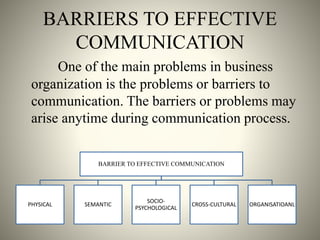
BARRIER TO EFFECTIVE COMMUNICATION 
PHYSICAL SEMANTIC 
SOCIO-PSYCHOLOGICAL 
CROSS-CULTURAL ORGANISATIOANL
PHYSICAL OR ENVIRONMENT 
BARRIERS 
• Noise 
• Defects in communication system 
• Time and distance 
• Wrong selection of medium 
• Temperature and humidity
SEMANTIC OR LANGUAGE 
BARRIERS 
• Misinterpretation of words 
• Difference in language 
• Use of jargon 
• By-passed instructions
PERSONAL OR SOCIO-PSYCHOLOGICAL 
BARRIER 
• Different perceptions 
• Closed mind 
• Poor retention 
• The halo and horn effect 
• Emotions 
• Slanting 
• Filtering 
• Wrong assumptions 
• Impatience 
• Rambling 
• Unsolicited communication
CROSS-CULTURAL 
BARRIERS 
• Colors 
• Body language 
• Proxemics 
• Time 
• Other cultural barriers
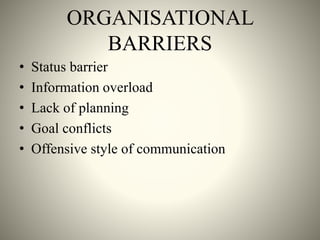
ORGANISATIONAL 
BARRIERS 
• Status barrier 
• Information overload 
• Lack of planning 
• Goal conflicts 
• Offensive style of communication
EFFECTIVE LISTENING 
• Listening is the art of hearing and understanding 
what someone is saying. 
• Listening requires the presence of ears(hearing) 
and the mind(understanding). 
• Listening is a conscious, positive act requiring 
will power.
IMPORTANCE OF LISTENING 
• Helps to obtain information 
• Helps to solve problems 
• Develops better relations 
• Helps to know the organization 
• Helps in framing plans and policies 
• helps to share experience 
• Helps in decision making 
• Provides encouragement 
• Listening can pacify dissatisfied listener 
• Increases confident of the listener
FEATURES OF LISTENING 
• Process 
• Types of listening 
1) appreciative listening 
2) content listening 
3) empathetic listening 
4) evaluative listening 
• Obstacles of listening 
• Benefits of listening 
• Listening is different from hearing 
• Degree of listening 
• Listening and retention 
• Listening skills can be improved
IMPORTANCE OF BODY 
LANGUAGE 
Body language is as important as the words 
that ones uses in communication. If your body 
language is expressing something contrary to 
what your words are saying, your audience will 
not believe hat you are saying. Importance of 
body language are:- 
• Develops trust 
• Importance of dress 
• Importance of eye contact 
• Importance of facial expressions 
• Importance of gestures 
• Importance of posture
SELF AWARENESS 
• Self awareness is the process of understanding 
one’s personality traits, value system, beliefs, 
natural inclinations and tendencies. It is the self-reflection 
to gain better insight into oneself. There 
are thee specific capabilities:- 
1. Emotional self-awareness is the recognition of 
one’s feelings or how emotions and how they 
affect one’s performance and better 
understanding of one’s feelings and emotions, 
and make changes, if so required.
2. Accurate self- awareness makes a person 
aware of his or her abilities and limitations. 
Accurate self-assessment may help to correct 
weaknesses or limitations and improve 
strength and abilities. Accurate self awareness 
is key to success of every ā€œstar performerā€ 
3. Self-confidence enables to have realistic 
perception of one’s abilities. It includes 
attributes like assertiveness, pride, optimism, 
affection independence, trust and ability to 
handle criticism and emotional maturity.
IMPORTANCE OF SELF-AWARNESS 
• Empathy 
• Analysis of strengths and weakness 
• Tolerance 
• Humility 
• Likeability 
• Skills development 
• Developing intuitive decision-making skills 
• Reduces stress 
• motivation
PUBLIC SPEAKING AND 
PRESTENATION SKILLS 
Public speaking is the process of speaking 
to a group of people in a structured manner. 
The purpose is to inform, or to influence the 
listeners. It is closely related to ā€˜presentation’. 
One major difference between public speaking 
and presentation is that public speaking may 
be non-commercial and addressed to a larger 
audience.
GUIDELINES TO IMPROVE PUBLIC 
SPEAKING AND PRESENTATION SKILLS 
• Structure the talk 
• Time management 
• Analyse the audience 
• Research 
• Seek volunteers 
• Gestures 
• Incorporate humor 
• Voice 
• Enthusiasm 
• Facial expression 
• Act and speak ethically 
• Complement words with visuals 
• Eye contact 
• Seek feedback
THANK YOU