SPEECH
COMMUNICATION
      A PowerPoint Presentation by:

            Rimando, Rey
          Saboco, Pierre Jay
            Narvaez, Carla


  Bachelor of Science in Civil Engineering
 Partido State University – Goa, Cam. Sur
“You can speak well if your tongue can
deliver the message of your heart.”


                           Introduction

                                  The process by which
                                       meanings are
                                  exchanged b/w people
                                    through the use of
                                 common set of symbols
                                         is called
                                   COMMUNICATION.
What is Speech
       Communication?
(from Latin "communis", meaning to share)
       is defined as a process by which we assign and convey
meaning in an attempt to create shared understanding. This
process requires a vast repertoire of skills in intrapersonal
and interpersonal processing, listening, observing, speaking,
questioning, analyzing, and evaluating.
      Use of these processes is developmental and transfers
to all areas of life: home, school, community, work, and
beyond. It is through communication that collaboration and
cooperation occur.
Communication
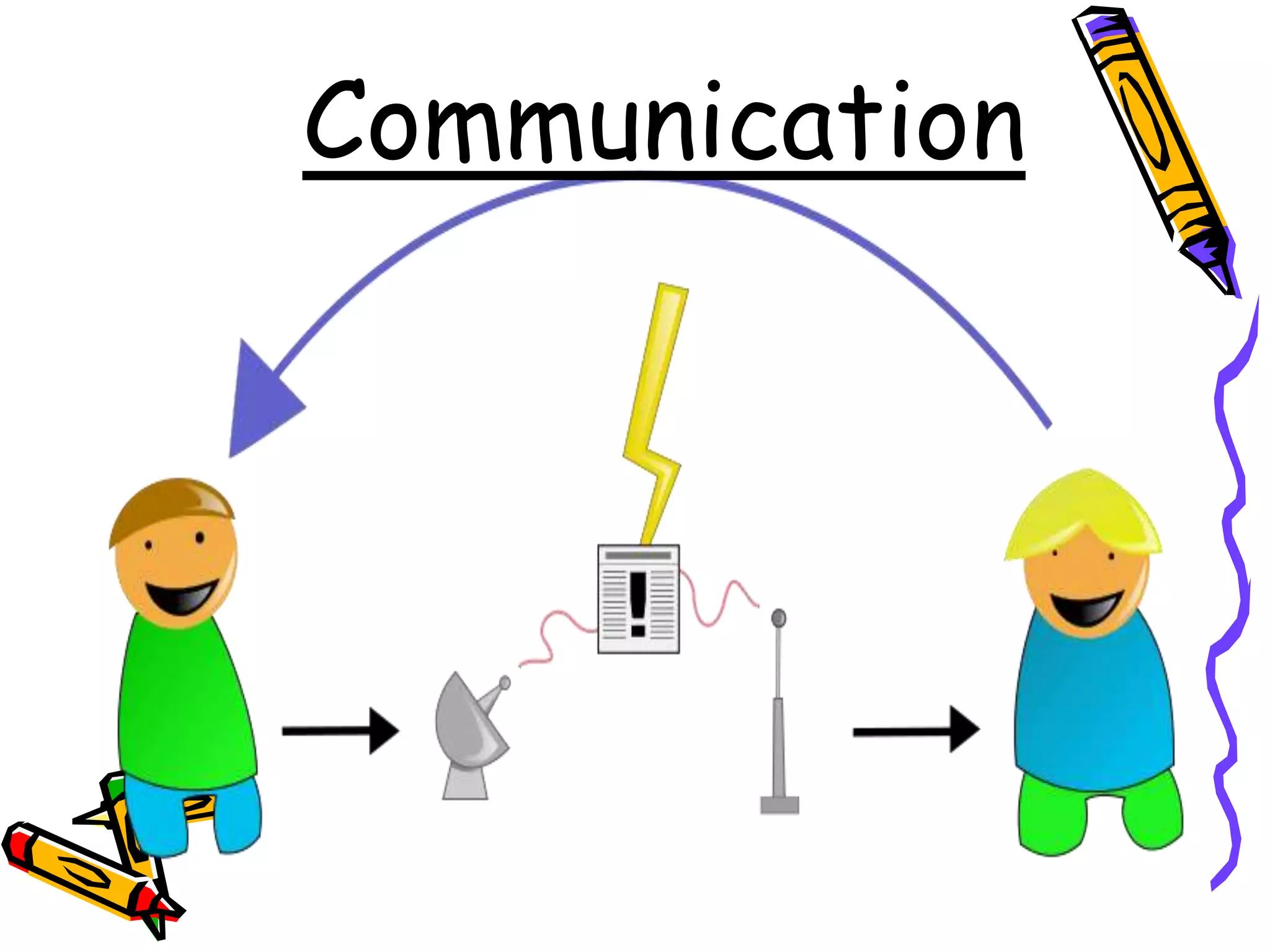
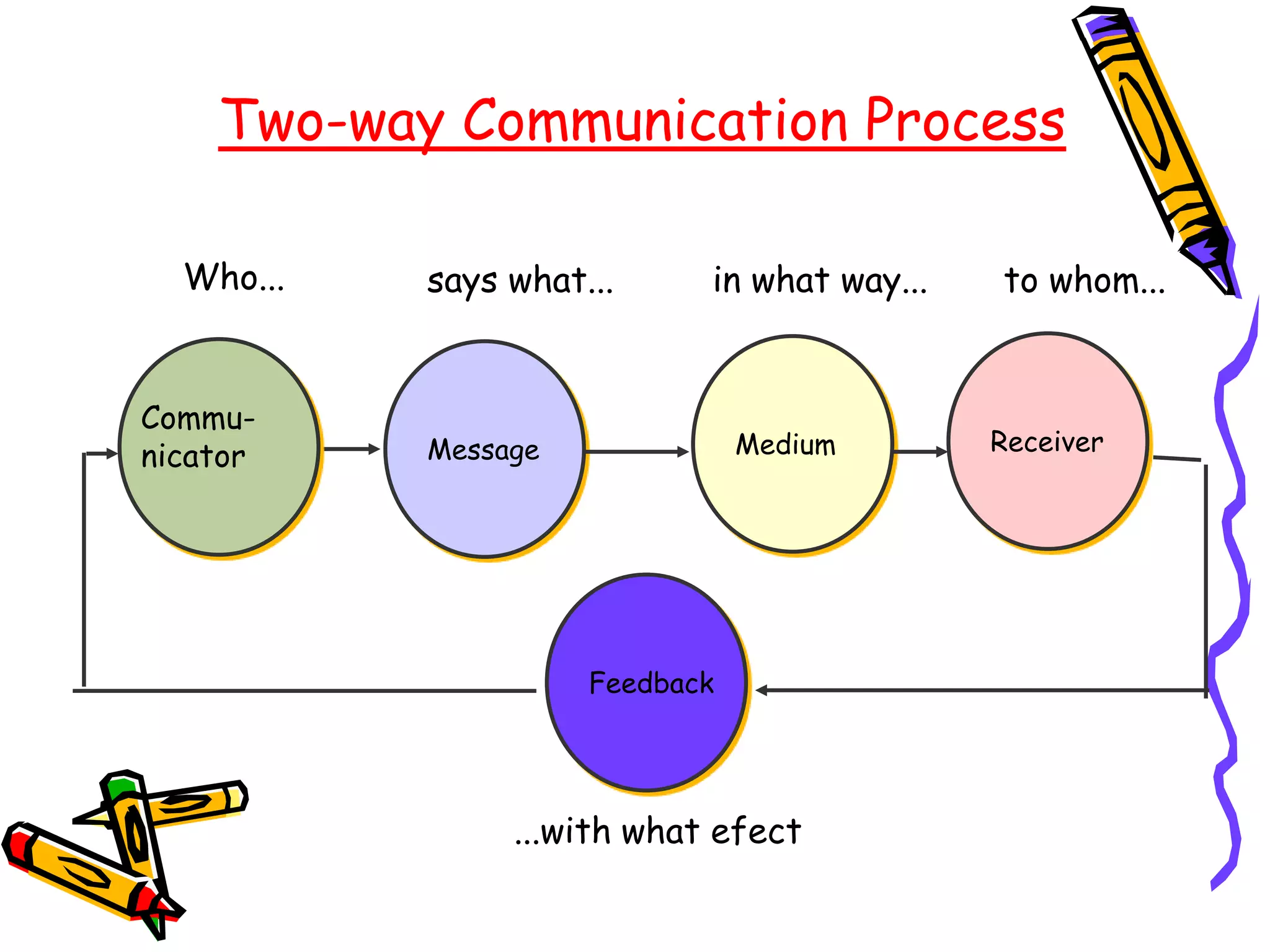
Two-way Communication Process

  Who...   says what...     in what way...   to whom...


Commu-
           Message              Medium       Receiver
nicator


                     Feedback


                ...with what efect
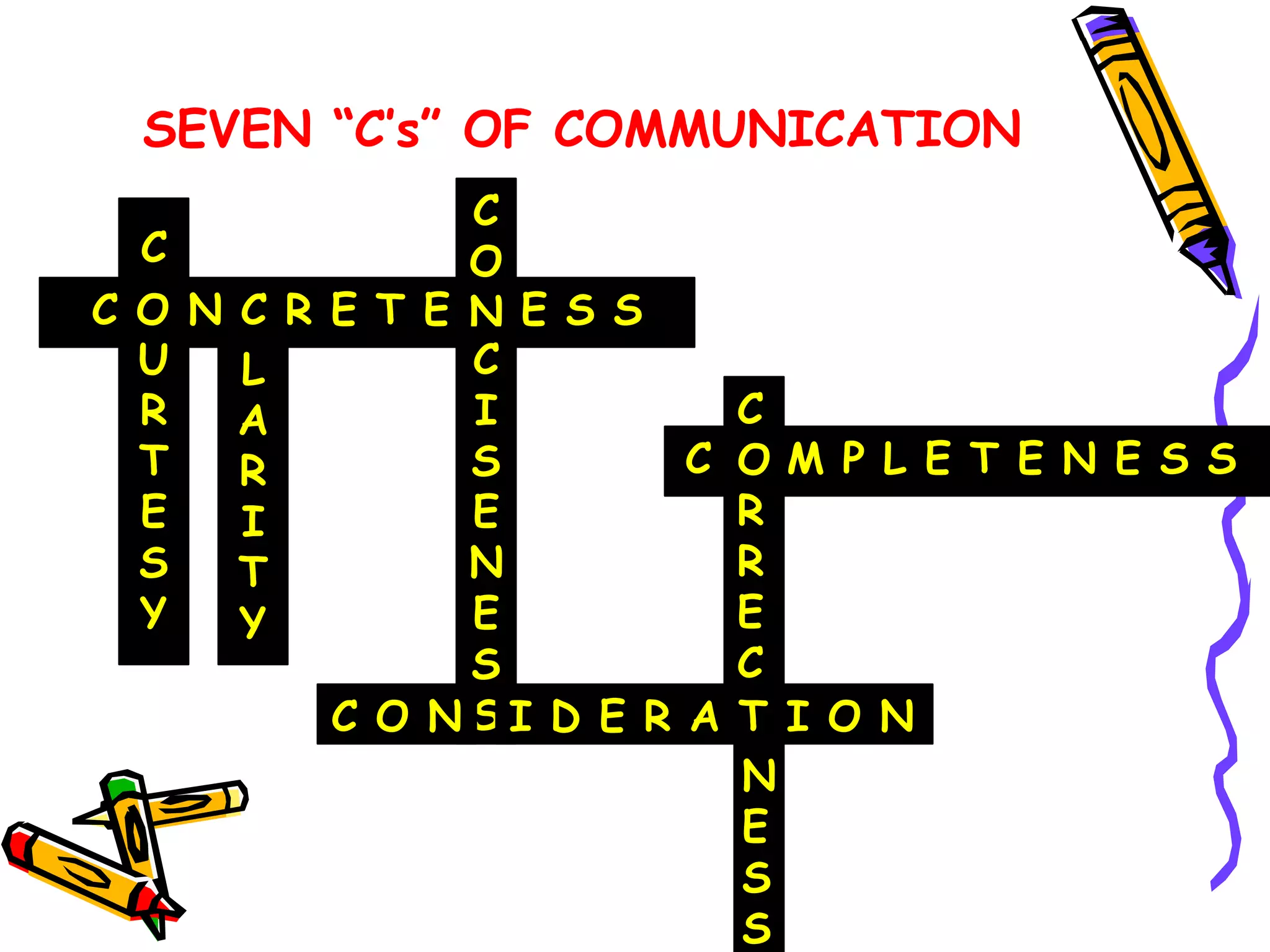
SEVEN “C’s” OF COMMUNICATION
                C
  C             O
C O N C R E T E N E S S
  U   L         C
  R   A         I         C
  T   R         S       C OM P L E T E N E S S
  E   I         E         R
  S   T         N         R
  Y   Y         E         E
                S         C
          C O NSI D E R A T I O N
                          N
                          E
                          S
                          S
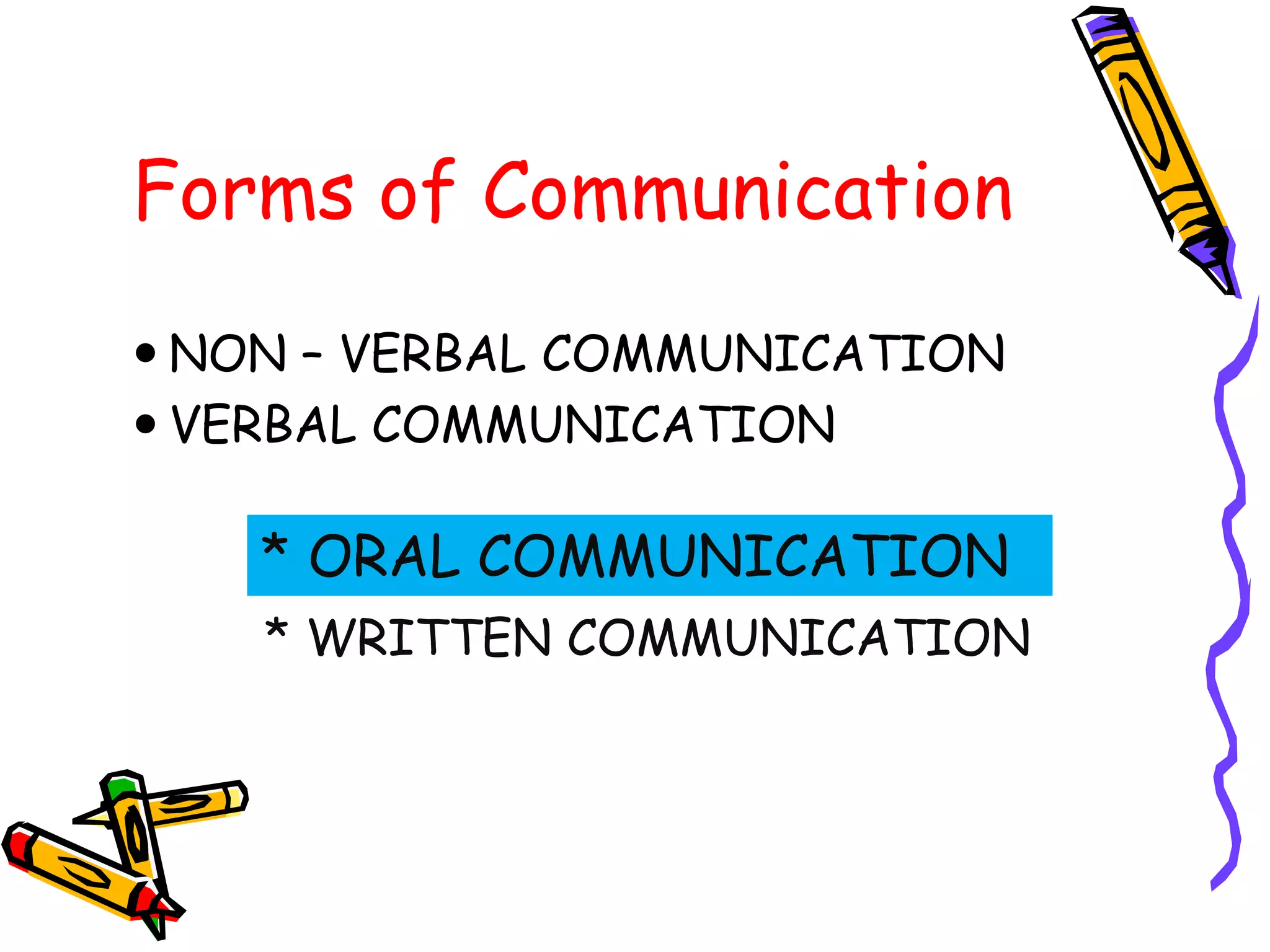
Forms of Communication
 NON – VERBAL COMMUNICATION
 VERBAL COMMUNICATION

    * ORAL COMMUNICATION
    * WRITTEN COMMUNICATION
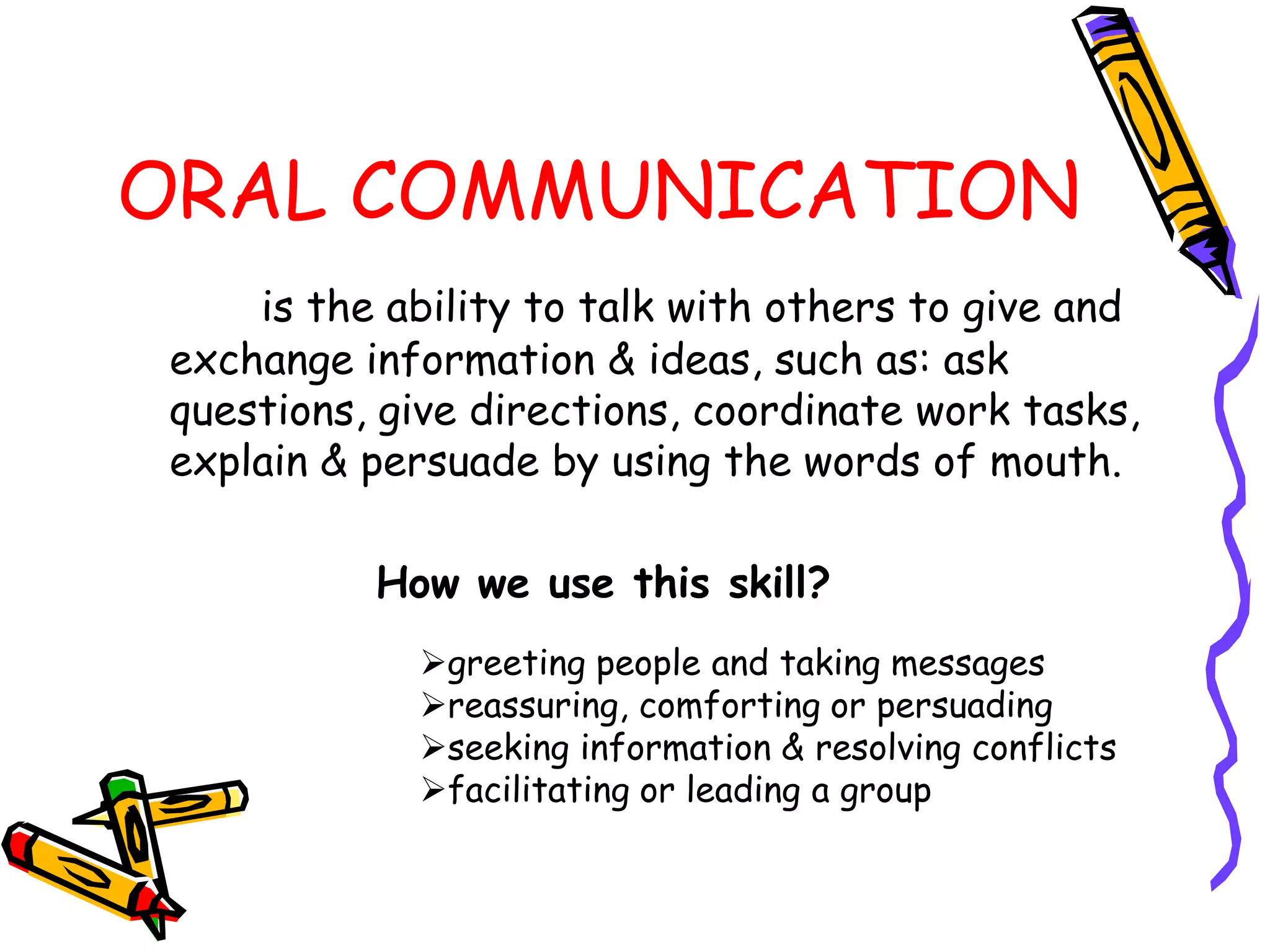
ORAL COMMUNICATION
    is the ability to talk with others to give and
exchange information & ideas, such as: ask
questions, give directions, coordinate work tasks,
explain & persuade by using the words of mouth.

          How we use this skill?
            greeting people and taking messages
            reassuring, comforting or persuading
            seeking information & resolving conflicts
            facilitating or leading a group
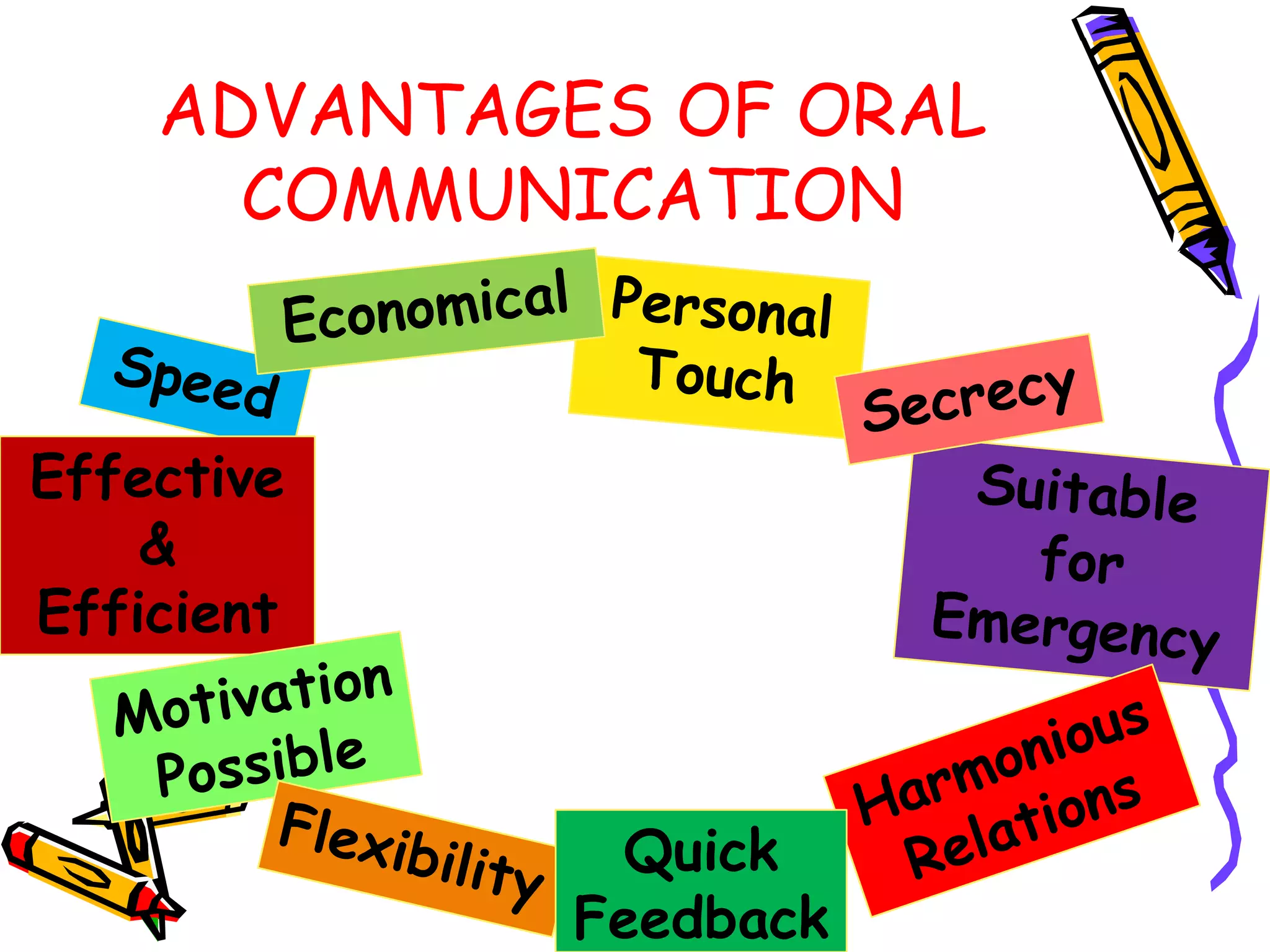
ADVANTAGES OF ORAL
      COMMUNICATION


Effective
    &
Efficient


               Quick
             Feedback
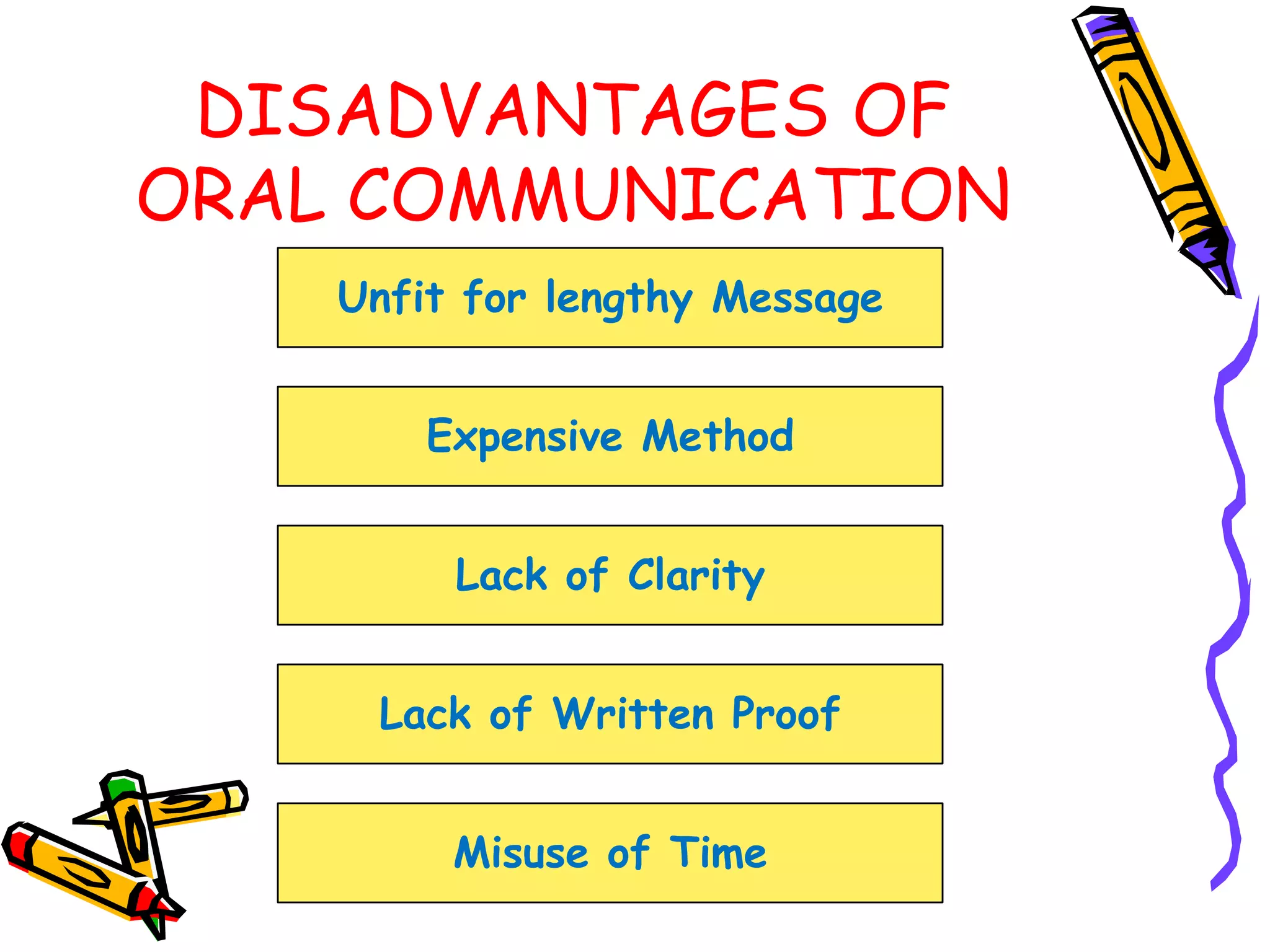
DISADVANTAGES OF
ORAL COMMUNICATION
    Unfit for lengthy Message


        Expensive Method


         Lack of Clarity


     Lack of Written Proof


         Misuse of Time
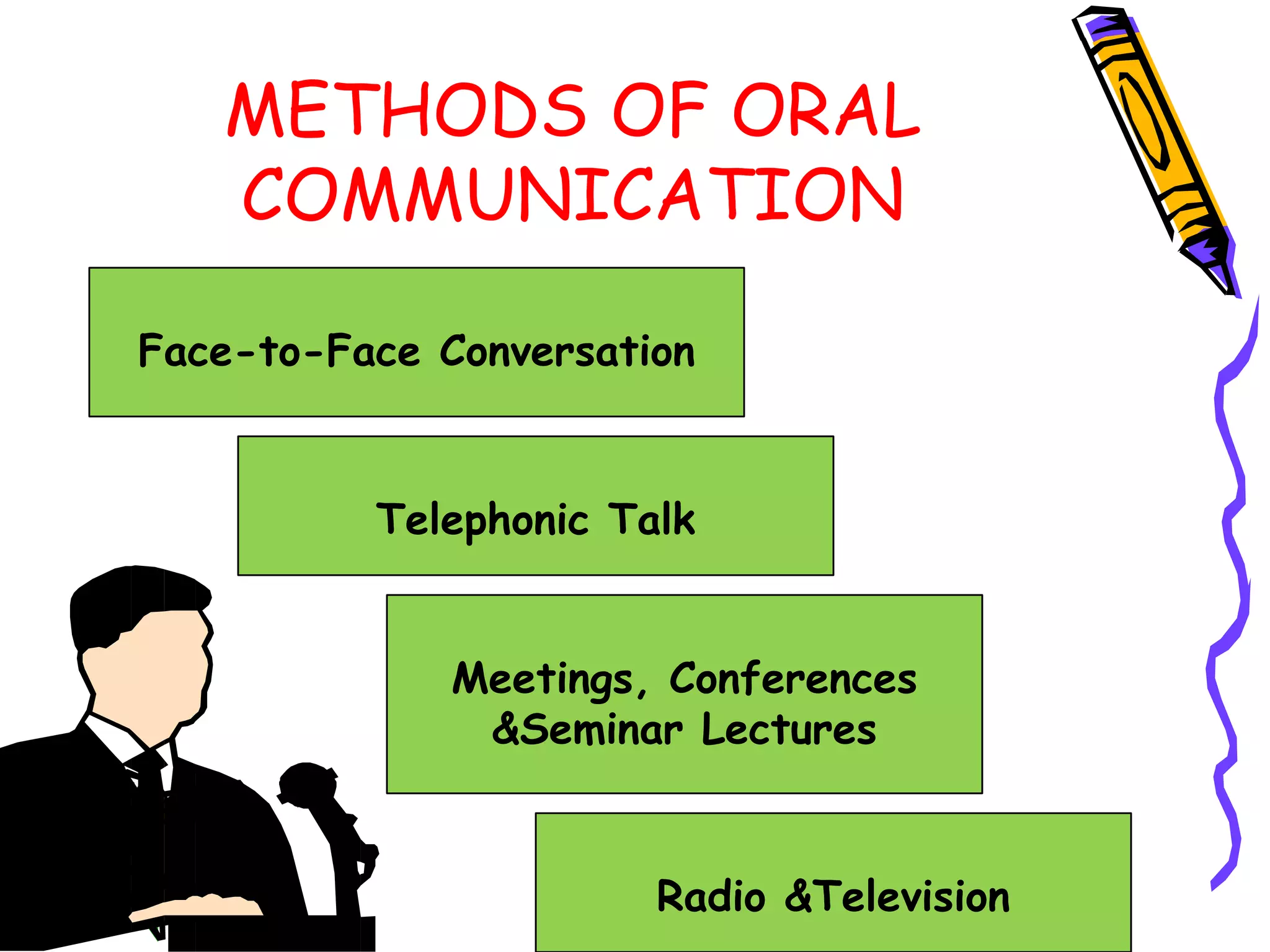
METHODS OF ORAL
   COMMUNICATION

Face-to-Face Conversation


          Telephonic Talk


              Meetings, Conferences
               &Seminar Lectures


                       Radio &Television
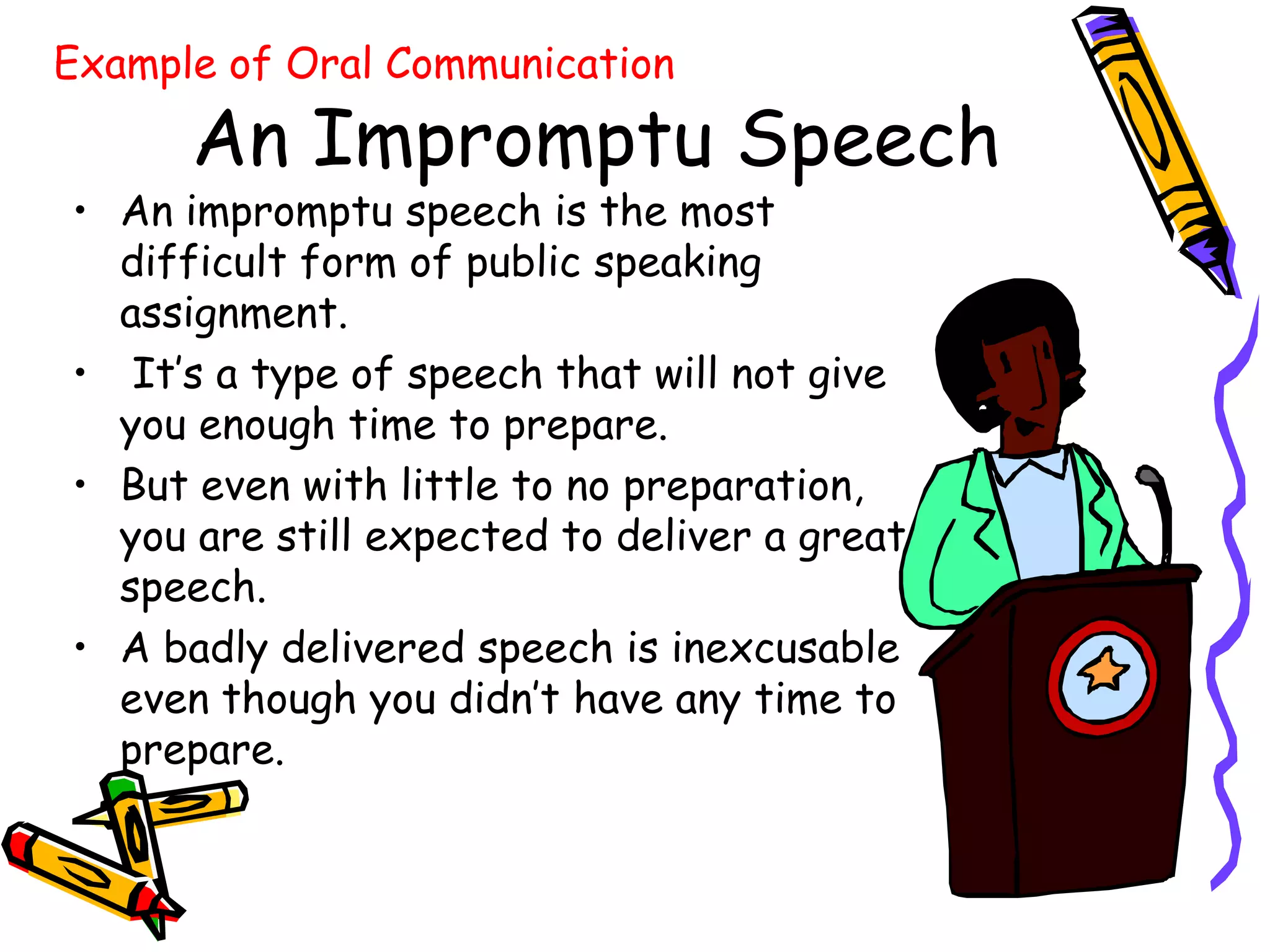
Example of Oral Communication

      An Impromptu Speech
• An impromptu speech is the most
  difficult form of public speaking
  assignment.
• It’s a type of speech that will not give
  you enough time to prepare.
• But even with little to no preparation,
  you are still expected to deliver a great
  speech.
• A badly delivered speech is inexcusable
  even though you didn’t have any time to
  prepare.
Functions of Communication
     • Gives information

     • Knowledge management

     • Decision making

     • Coordinating work activities

     • Creates control

     • Express feeling / emotion
Types of Speech
       Communication
• Informative – This speech serves to provide
  interesting and useful information to your
  audience. Some examples of informative
  speeches:


  –   A teacher telling students about earthquakes
  –   A student talking about her research
  –   A travelogue about the Tower of London
  –   A computer programmer speaking about new
      software
Types of Speech
     Communication
•Demonstrative – This has many similarities with
an informative speech. A demonstrative speech also
teaches you something. The main difference lies in
including a demonstration of how to do the thing
you’re teaching. Some examples of demonstrative
speeches:

      *     How to start your own blog
      *     How to bake a cake
      *     How to write a speech
      *     How to… just about anything
Types of Speech
        Communication
•Persuasive – A persuasive speech works to
convince people to change in some way: they think,
the way they do something, or to start doing
something that they are not currently doing. Some
examples of persuasive speeches:

   •   Become an organ donor
   •   Improve your health through better eating
   •   Television violence is negatively influencing
             our children
   •   Become a volunteer and change the world
Types of Speech
     Communication
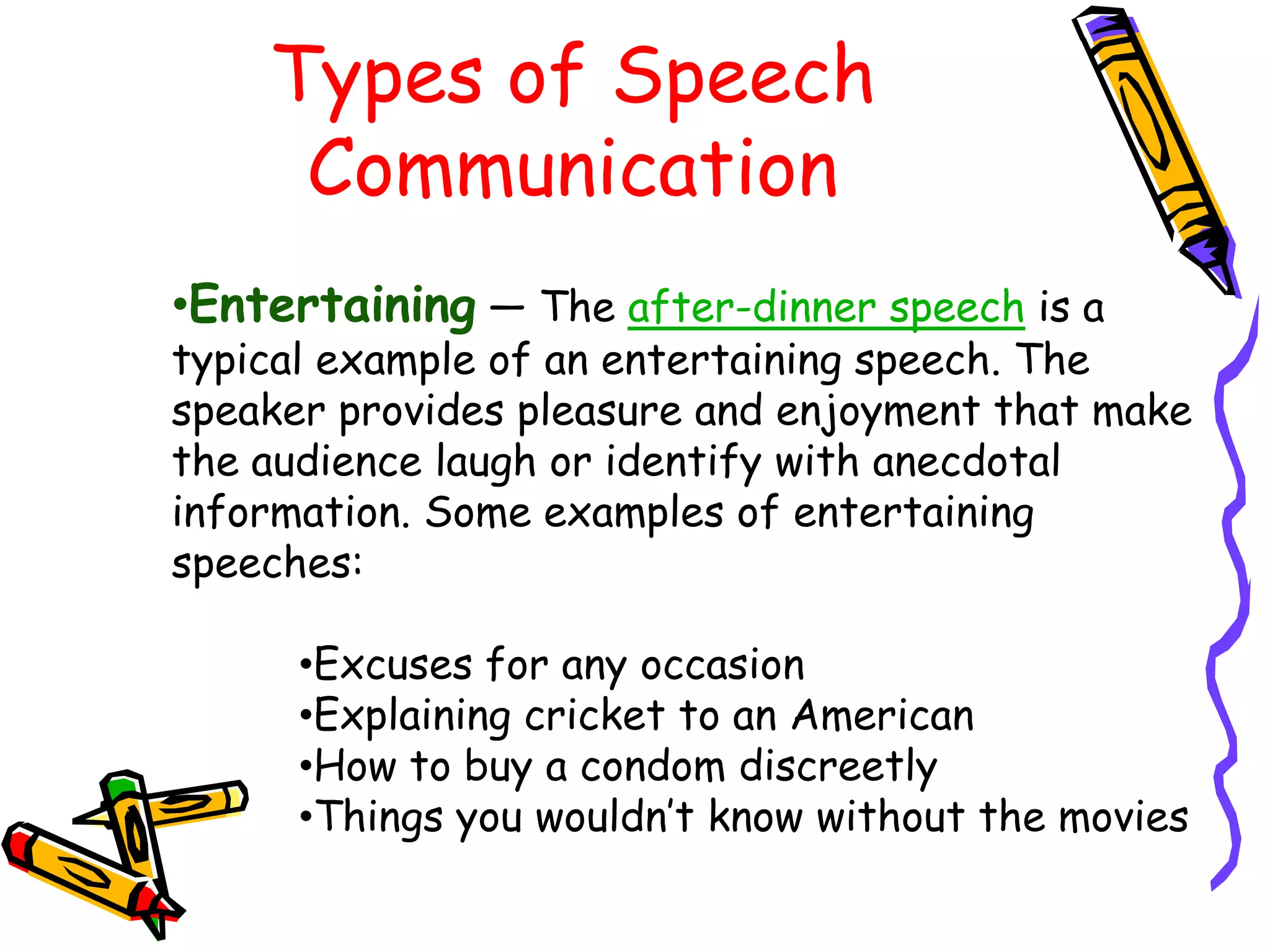
•Entertaining — The after-dinner speech is a
typical example of an entertaining speech. The
speaker provides pleasure and enjoyment that make
the audience laugh or identify with anecdotal
information. Some examples of entertaining
speeches:

      •Excuses for any occasion
      •Explaining cricket to an American
      •How to buy a condom discreetly
      •Things you wouldn’t know without the movies
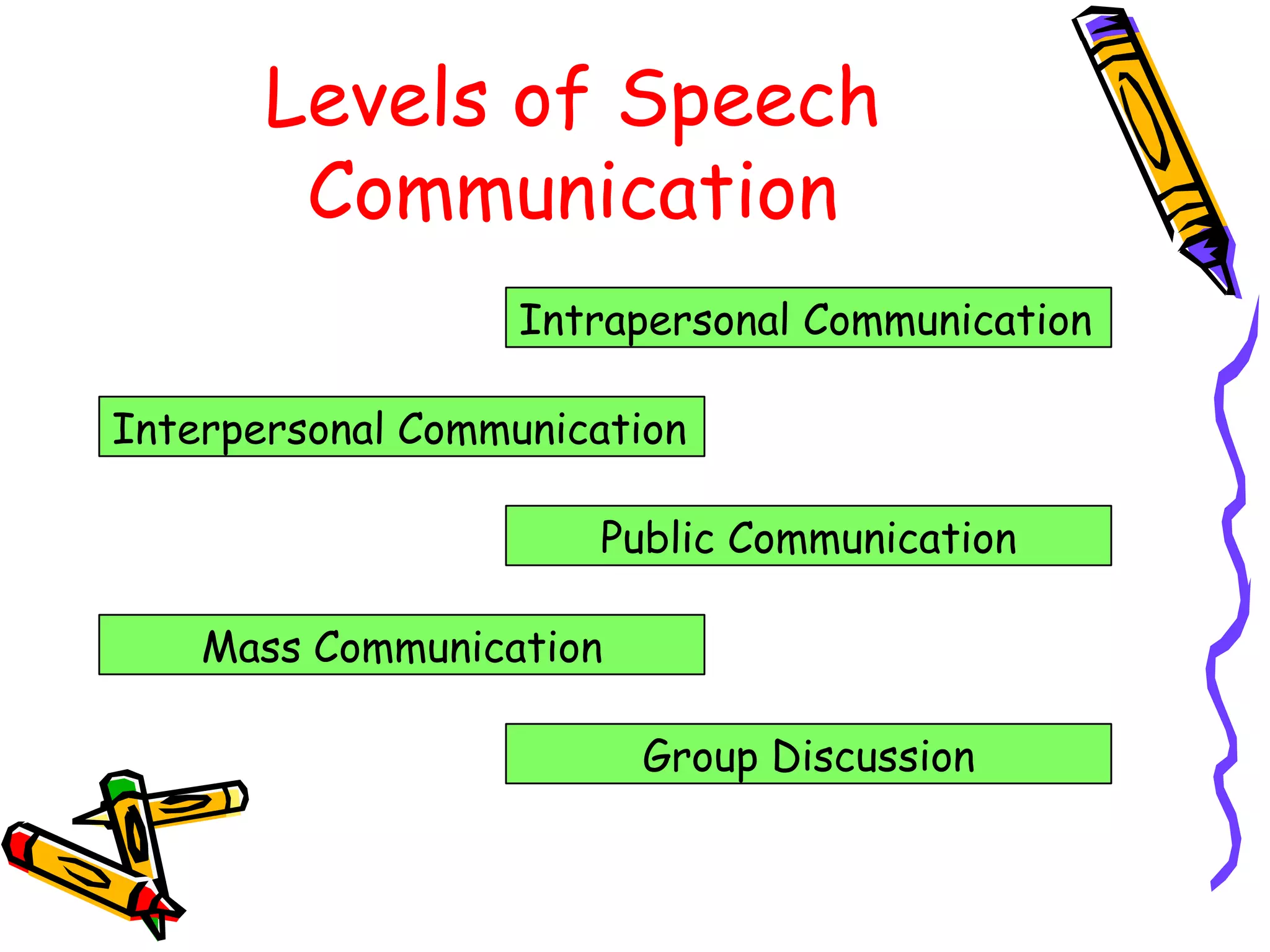
Levels of Speech
        Communication
                   Intrapersonal Communication

Interpersonal Communication

                      Public Communication

    Mass Communication

                         Group Discussion
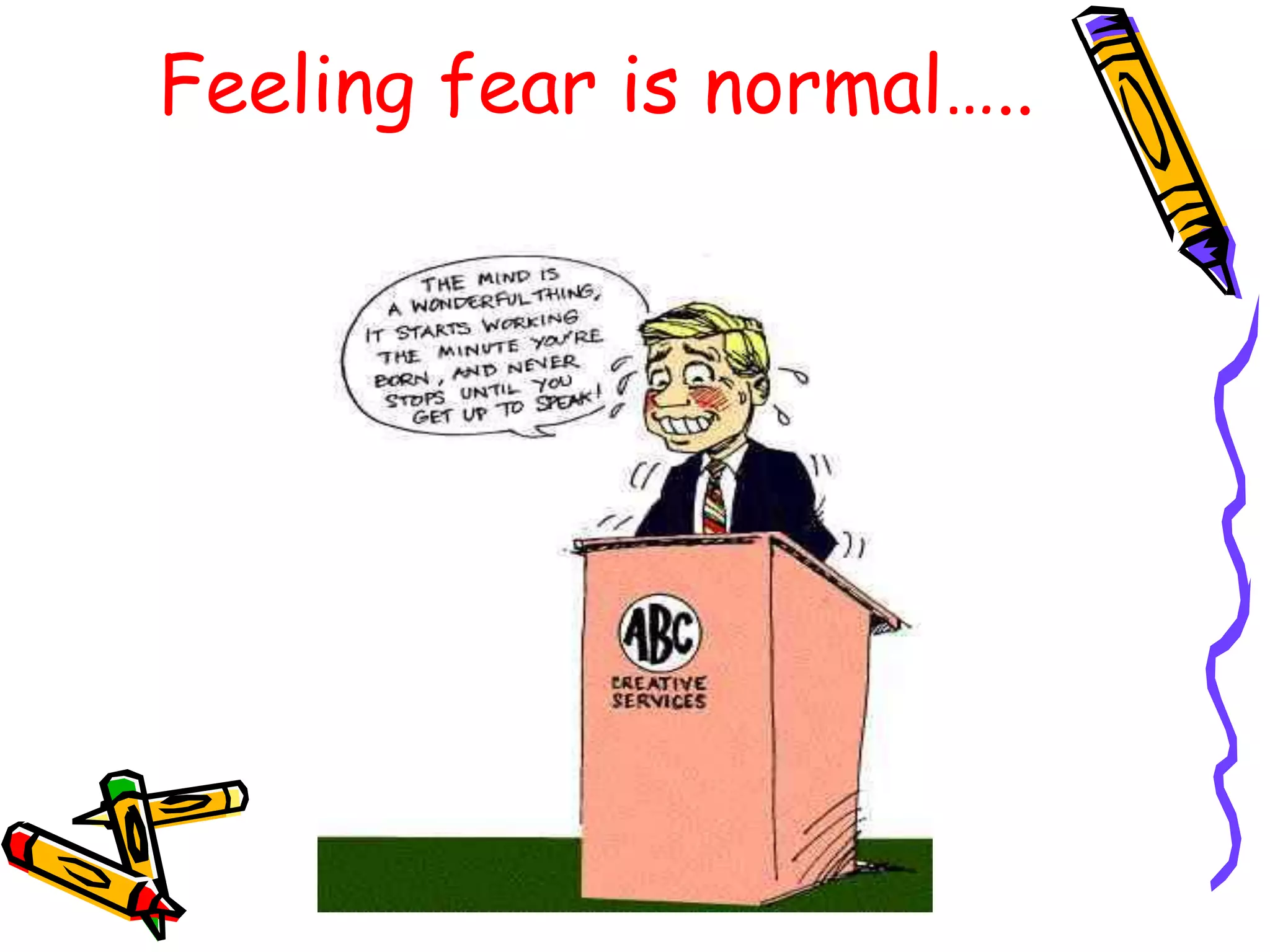
Feeling fear is normal…..
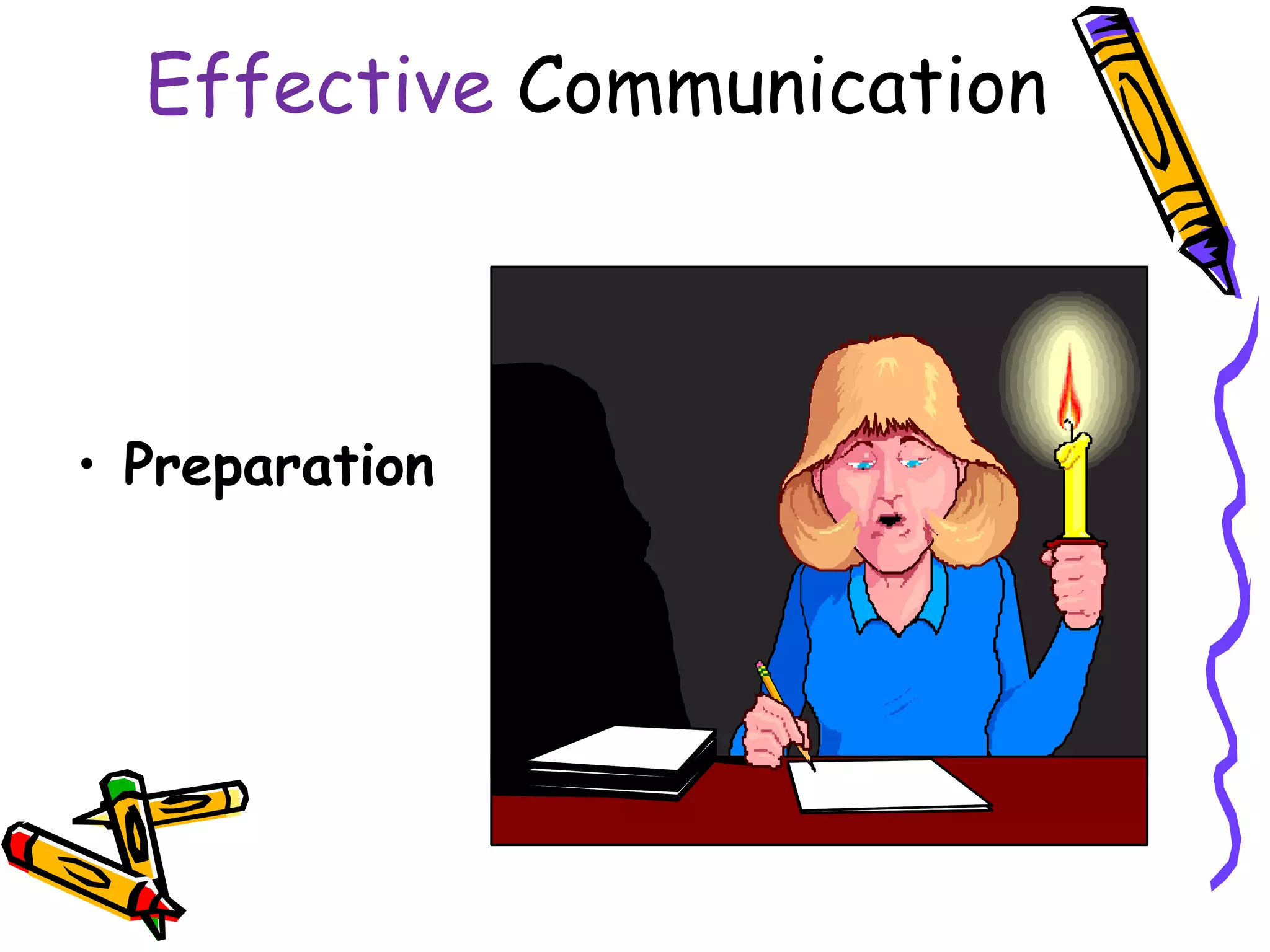
Effective Communication


• Preparation
Effective Communication

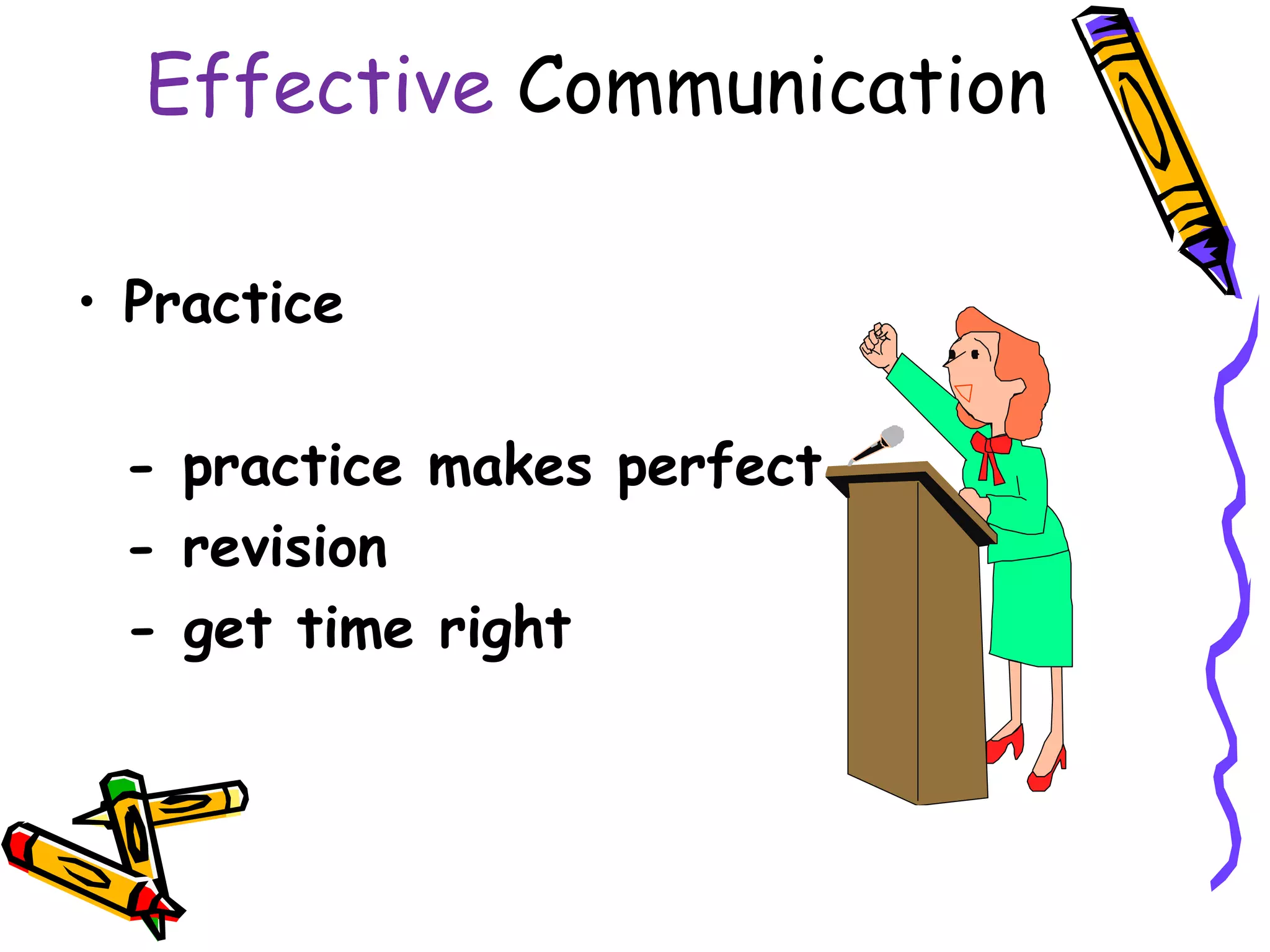
• Practice

 - practice makes perfect
 - revision
 - get time right
Effective Communication

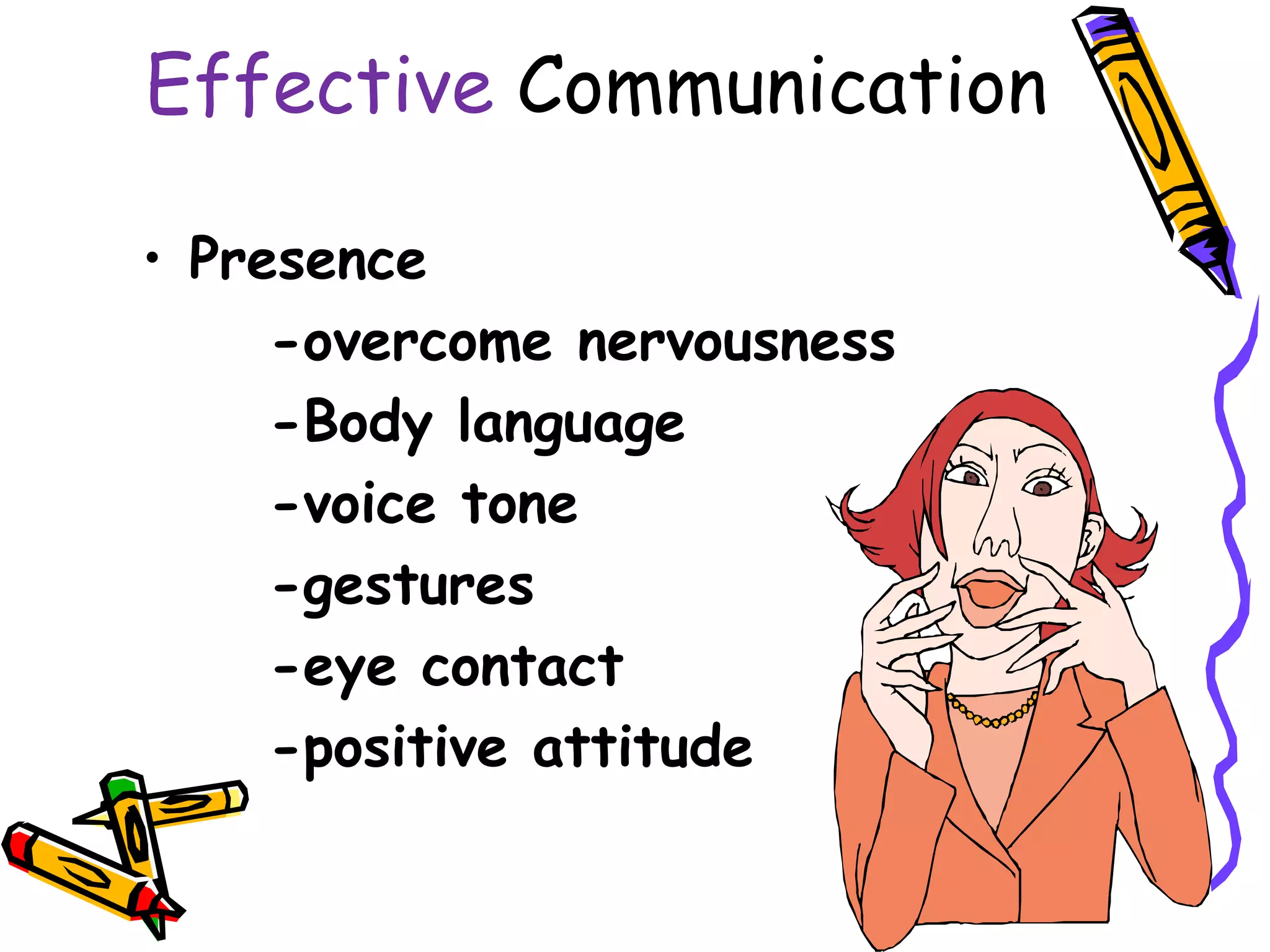
• Presence
     -overcome nervousness
     -Body language
     -voice tone
     -gestures
     -eye contact
     -positive attitude
What makes a GOOD host?

    • Attitude
    • Personality
    • Voice


    BE YOURSELF.
BARRIERS TO
COMMUNICATION
COMMON BARRIERS TO
     COMMUNICATION


1. SEMANTICS
 Definition of words

 Choice of words
COMMON BARRIERS TO
          COMMUNICATION
2. POOR CHOICE, USE OF CHANNELS
   When to use certain channel

  Oral alone:
    • Simple reprimand
    • Settle simple dispute
  Written alone:
    • Don’t need immediate feedback
    • Need record
COMMON BARRIERS TO
      COMMUNICATION

2. USE OF CHANNELS
 Both channels:
   • Commendation
   • Serious reprimand
   • Important policy change
 Nonverbal
   • Be aware of it.
COMMON BARRIERS TO
      COMMUNICATION

3. PHYSICAL DISTRACTIONS
4. NOISE, PHYSICAL,
   PSYCHOLOGICAL
5. STATUS DIFFERENCE
6. EFFECTS OF EMOTIONS
COMMON BARRIERS TO
     COMMUNICATION

7. PERCEPTIONS
 Stereotypes
 Halo effects
 Selective perception
   • See and hear what we expect
   • Ignore if conflicts with “what we know.”

 Projection
COMMON BARRIERS TO
       COMMUNICATION

8. FILTERING, SCREENING
   NEGATIVE INFORMTAION
9. EVALUATING THE SOURCE
10.ABSENCE OF FEEDBACK,
    POOR FEEDBACK
COMMON BARRIERS TO
       COMMUNICATION


11. INFORMATION, DATA
     OVERLOAD

12. POOR LISTENING
 LISTEN TO RESPOND
 LISTEN TO UNDERSTAND
TO OVERCOME BARRIERS:
Learn to use feedback well.
Be sensitive to receiver’s point of view.
Listen to UNDERSTAND!
Use direct, simple language, or at least
 use language appropriate to the receiver.
Use proper channel(s). Learn to use
 channels well.
Learn to use supportive
 communication, not defensive
 communication.
STRATEGIES TO
     REDUCE FEAR
•   Know your Environment
•   Know your Audience
•   Know your Speech
•   Learn to Relax
•   Visualize a Successful Speech
•   Evaluate Yourself
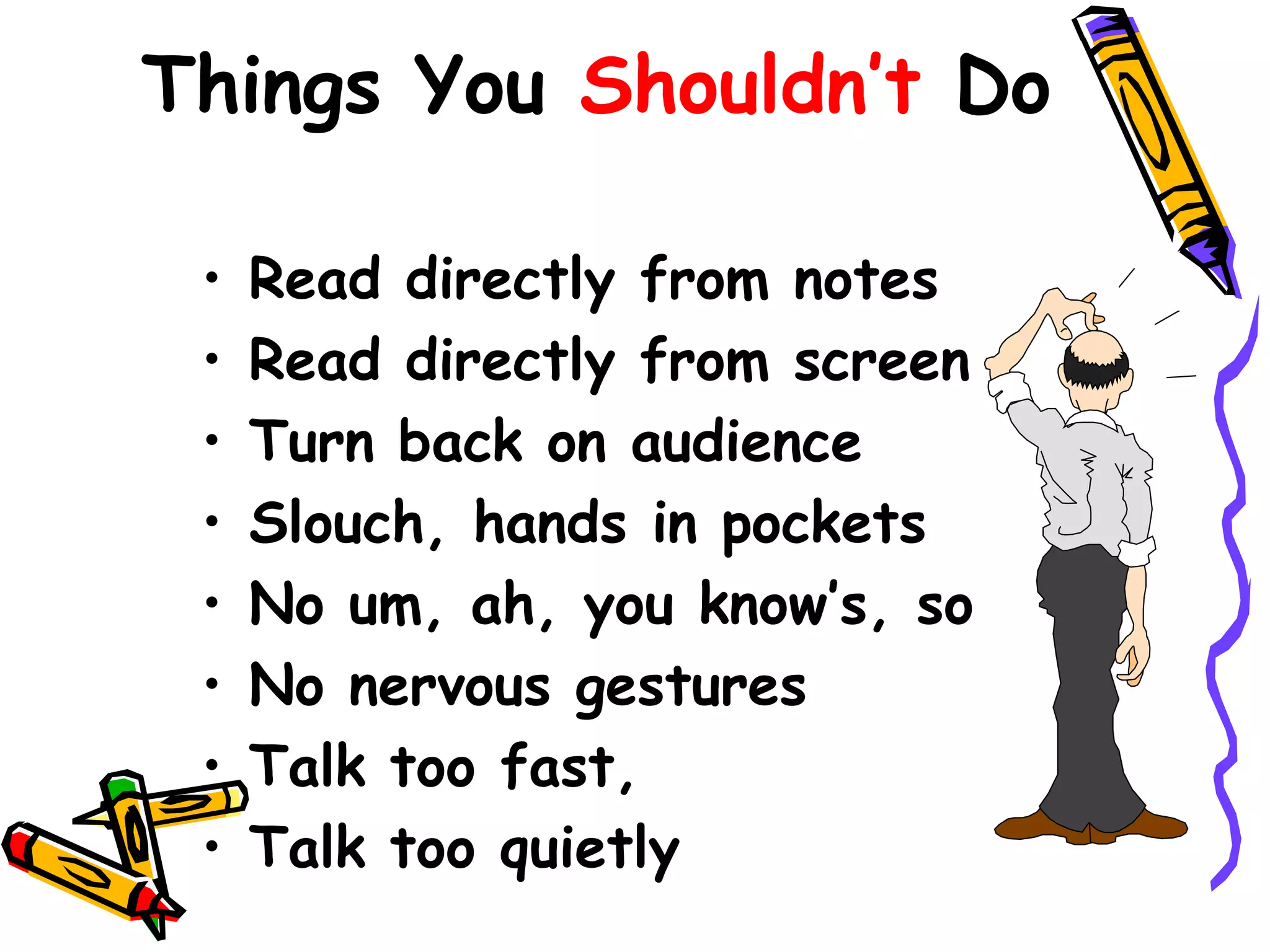
Things You Shouldn’t Do

 •   Read directly from notes
 •   Read directly from screen
 •   Turn back on audience
 •   Slouch, hands in pockets
 •   No um, ah, you know’s, so
 •   No nervous gestures
 •   Talk too fast,
 •   Talk too quietly
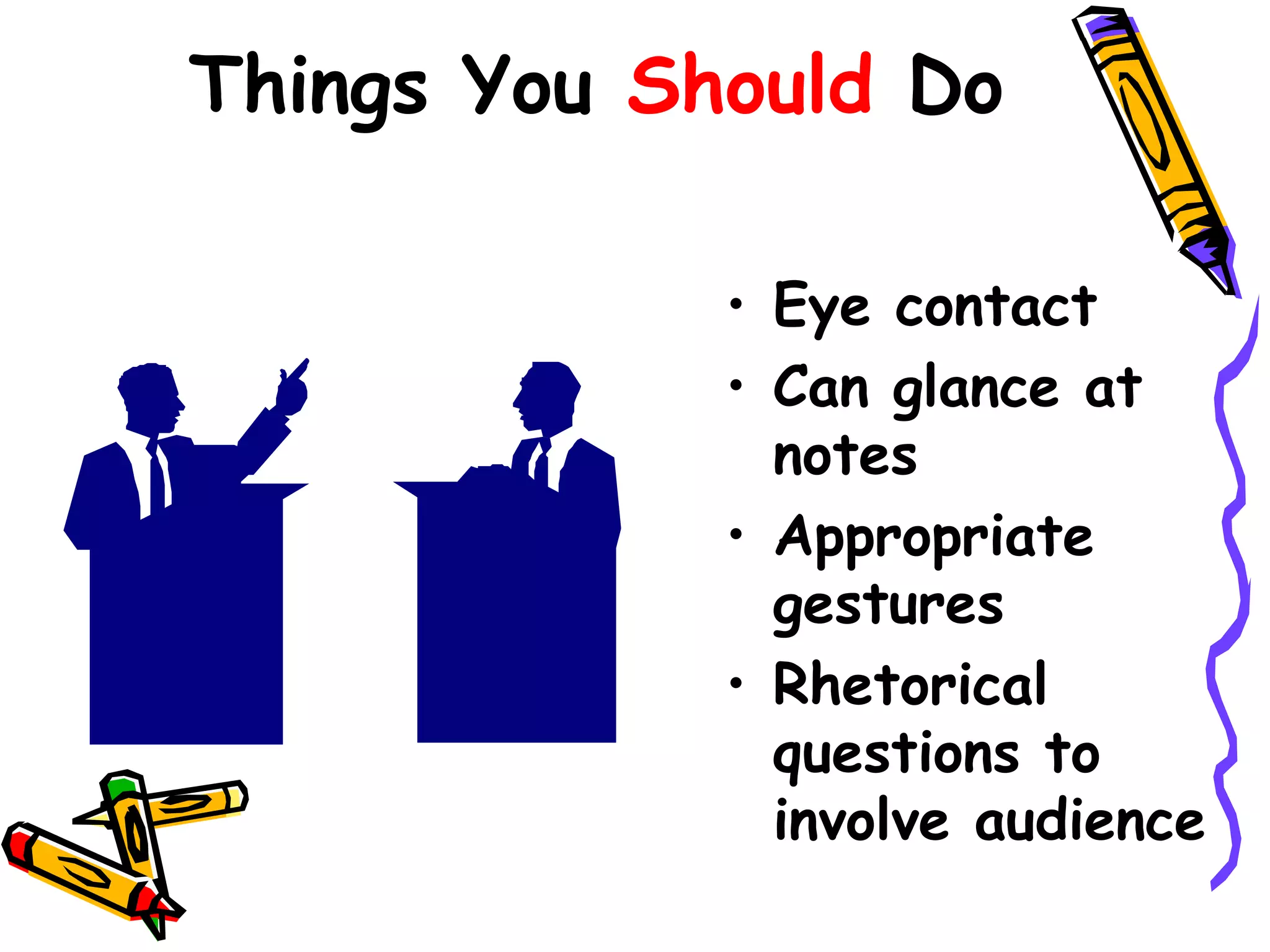
Things You Should Do

             • Eye contact
             • Can glance at
               notes
             • Appropriate
               gestures
             • Rhetorical
               questions to
               involve audience
Ten Successful Tips
        Control the ―Butterflies‖

• Know the room- become familiar with the
  place of presentation
• Know the audience- greet or chat with the
  audience before hand. It’s easier to speak
  to friends than to strangers
• Know your material-increased nervousness
  is due to un-preparedness
Control the ―Butterflies‖

• Relaxation- relax entire body by stretching
  and breathing so as to ease the tension

• Visualize giving your speech-Visualize
  yourself giving your speech from start to
  finish. By visualizing yourself successful,
  you will be successful
Control the ―Butterflies‖

• People want you to succeed-the audience is
  there to see you succeed not to fail

• Don’t apologize-by mentioning your
  nervousness or apologizing, you’ll only be
  calling the audience’s attention to mistakes
Control the ―Butterflies‖

• Concentrate on your message-not the
  medium. Focus on the message you are
  trying to convey and not on your anxieties

• Turn nervousness into positive energy-
  nervousness increases adrenaline, transform
  it into vitality and enthusiasm
Control the ―Butterflies‖

• Gain experience-experience builds
  confidence, which is key to effective public
  speaking
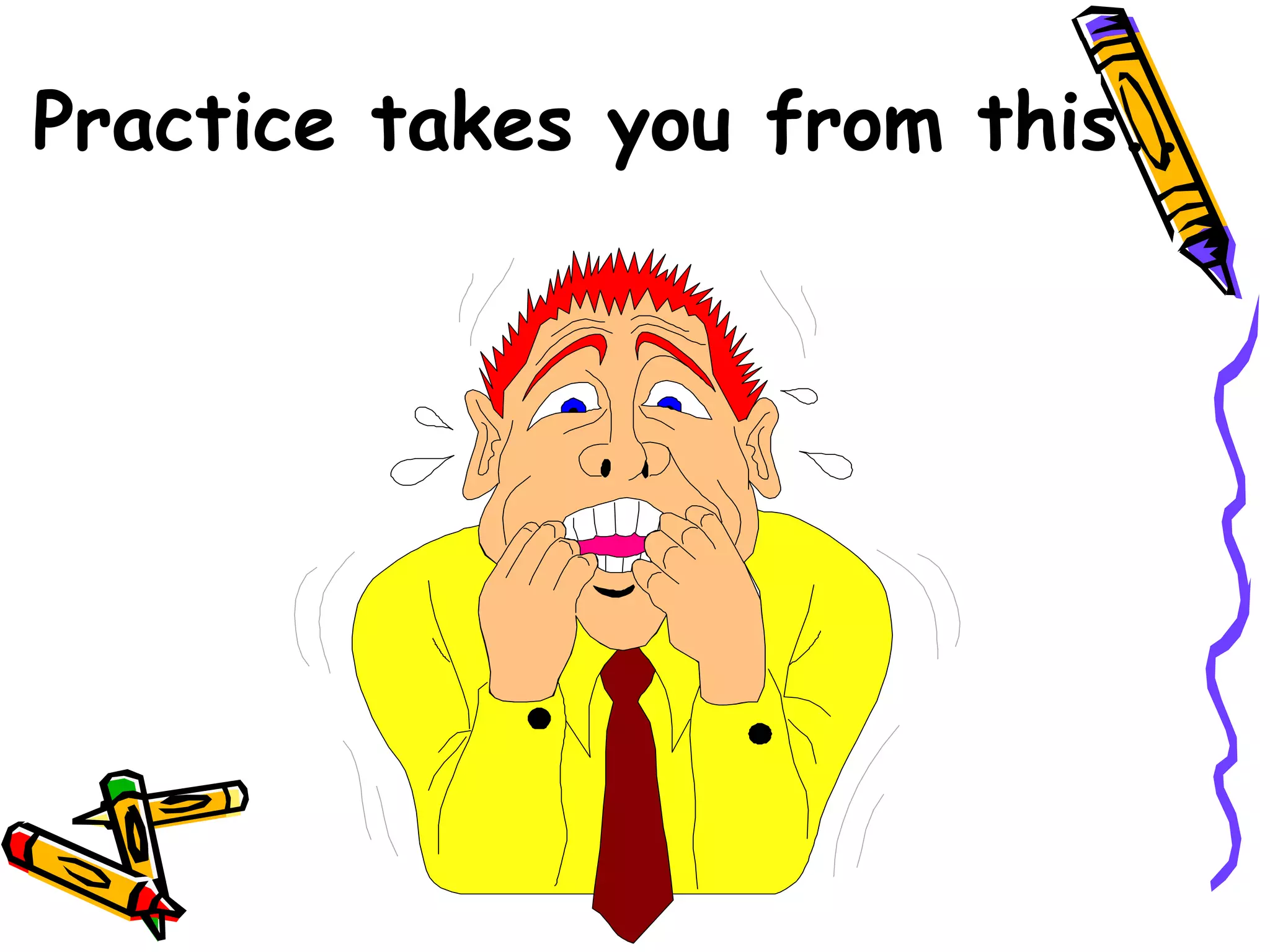
Practice takes you from this..
To this….
Speech communication

Speech communication

  • 1.
    SPEECH COMMUNICATION A PowerPoint Presentation by: Rimando, Rey Saboco, Pierre Jay Narvaez, Carla Bachelor of Science in Civil Engineering Partido State University – Goa, Cam. Sur
  • 2.
    “You can speakwell if your tongue can deliver the message of your heart.” Introduction The process by which meanings are exchanged b/w people through the use of common set of symbols is called COMMUNICATION.
  • 3.
    What is Speech Communication? (from Latin "communis", meaning to share) is defined as a process by which we assign and convey meaning in an attempt to create shared understanding. This process requires a vast repertoire of skills in intrapersonal and interpersonal processing, listening, observing, speaking, questioning, analyzing, and evaluating. Use of these processes is developmental and transfers to all areas of life: home, school, community, work, and beyond. It is through communication that collaboration and cooperation occur.
  • 4.
  • 5.
    Two-way Communication Process Who... says what... in what way... to whom... Commu- Message Medium Receiver nicator Feedback ...with what efect
  • 6.
    SEVEN “C’s” OFCOMMUNICATION C C O C O N C R E T E N E S S U L C R A I C T R S C OM P L E T E N E S S E I E R S T N R Y Y E E S C C O NSI D E R A T I O N N E S S
  • 7.
    Forms of Communication NON – VERBAL COMMUNICATION  VERBAL COMMUNICATION * ORAL COMMUNICATION * WRITTEN COMMUNICATION
  • 8.
    ORAL COMMUNICATION is the ability to talk with others to give and exchange information & ideas, such as: ask questions, give directions, coordinate work tasks, explain & persuade by using the words of mouth. How we use this skill? greeting people and taking messages reassuring, comforting or persuading seeking information & resolving conflicts facilitating or leading a group
  • 9.
    ADVANTAGES OF ORAL COMMUNICATION Effective & Efficient Quick Feedback
  • 10.
    DISADVANTAGES OF ORAL COMMUNICATION Unfit for lengthy Message Expensive Method Lack of Clarity Lack of Written Proof Misuse of Time
  • 11.
    METHODS OF ORAL COMMUNICATION Face-to-Face Conversation Telephonic Talk Meetings, Conferences &Seminar Lectures Radio &Television
  • 12.
    Example of OralCommunication An Impromptu Speech • An impromptu speech is the most difficult form of public speaking assignment. • It’s a type of speech that will not give you enough time to prepare. • But even with little to no preparation, you are still expected to deliver a great speech. • A badly delivered speech is inexcusable even though you didn’t have any time to prepare.
  • 13.
    Functions of Communication • Gives information • Knowledge management • Decision making • Coordinating work activities • Creates control • Express feeling / emotion
  • 14.
    Types of Speech Communication • Informative – This speech serves to provide interesting and useful information to your audience. Some examples of informative speeches: – A teacher telling students about earthquakes – A student talking about her research – A travelogue about the Tower of London – A computer programmer speaking about new software
  • 15.
    Types of Speech Communication •Demonstrative – This has many similarities with an informative speech. A demonstrative speech also teaches you something. The main difference lies in including a demonstration of how to do the thing you’re teaching. Some examples of demonstrative speeches: * How to start your own blog * How to bake a cake * How to write a speech * How to… just about anything
  • 16.
    Types of Speech Communication •Persuasive – A persuasive speech works to convince people to change in some way: they think, the way they do something, or to start doing something that they are not currently doing. Some examples of persuasive speeches: • Become an organ donor • Improve your health through better eating • Television violence is negatively influencing our children • Become a volunteer and change the world
  • 17.
    Types of Speech Communication •Entertaining — The after-dinner speech is a typical example of an entertaining speech. The speaker provides pleasure and enjoyment that make the audience laugh or identify with anecdotal information. Some examples of entertaining speeches: •Excuses for any occasion •Explaining cricket to an American •How to buy a condom discreetly •Things you wouldn’t know without the movies
  • 18.
    Levels of Speech Communication Intrapersonal Communication Interpersonal Communication Public Communication Mass Communication Group Discussion
  • 19.
    Feeling fear isnormal…..
  • 20.
  • 21.
    Effective Communication • Practice - practice makes perfect - revision - get time right
  • 22.
    Effective Communication • Presence -overcome nervousness -Body language -voice tone -gestures -eye contact -positive attitude
  • 23.
    What makes aGOOD host? • Attitude • Personality • Voice BE YOURSELF.
  • 24.
  • 25.
    COMMON BARRIERS TO COMMUNICATION 1. SEMANTICS Definition of words Choice of words
  • 26.
    COMMON BARRIERS TO COMMUNICATION 2. POOR CHOICE, USE OF CHANNELS  When to use certain channel Oral alone: • Simple reprimand • Settle simple dispute Written alone: • Don’t need immediate feedback • Need record
  • 27.
    COMMON BARRIERS TO COMMUNICATION 2. USE OF CHANNELS Both channels: • Commendation • Serious reprimand • Important policy change Nonverbal • Be aware of it.
  • 28.
    COMMON BARRIERS TO COMMUNICATION 3. PHYSICAL DISTRACTIONS 4. NOISE, PHYSICAL, PSYCHOLOGICAL 5. STATUS DIFFERENCE 6. EFFECTS OF EMOTIONS
  • 29.
    COMMON BARRIERS TO COMMUNICATION 7. PERCEPTIONS Stereotypes Halo effects Selective perception • See and hear what we expect • Ignore if conflicts with “what we know.” Projection
  • 30.
    COMMON BARRIERS TO COMMUNICATION 8. FILTERING, SCREENING NEGATIVE INFORMTAION 9. EVALUATING THE SOURCE 10.ABSENCE OF FEEDBACK, POOR FEEDBACK
  • 31.
    COMMON BARRIERS TO COMMUNICATION 11. INFORMATION, DATA OVERLOAD 12. POOR LISTENING LISTEN TO RESPOND LISTEN TO UNDERSTAND
  • 32.
    TO OVERCOME BARRIERS: Learnto use feedback well. Be sensitive to receiver’s point of view. Listen to UNDERSTAND! Use direct, simple language, or at least use language appropriate to the receiver. Use proper channel(s). Learn to use channels well. Learn to use supportive communication, not defensive communication.
  • 33.
    STRATEGIES TO REDUCE FEAR • Know your Environment • Know your Audience • Know your Speech • Learn to Relax • Visualize a Successful Speech • Evaluate Yourself
  • 34.
    Things You Shouldn’tDo • Read directly from notes • Read directly from screen • Turn back on audience • Slouch, hands in pockets • No um, ah, you know’s, so • No nervous gestures • Talk too fast, • Talk too quietly
  • 35.
    Things You ShouldDo • Eye contact • Can glance at notes • Appropriate gestures • Rhetorical questions to involve audience
  • 36.
    Ten Successful Tips Control the ―Butterflies‖ • Know the room- become familiar with the place of presentation • Know the audience- greet or chat with the audience before hand. It’s easier to speak to friends than to strangers • Know your material-increased nervousness is due to un-preparedness
  • 37.
    Control the ―Butterflies‖ •Relaxation- relax entire body by stretching and breathing so as to ease the tension • Visualize giving your speech-Visualize yourself giving your speech from start to finish. By visualizing yourself successful, you will be successful
  • 38.
    Control the ―Butterflies‖ •People want you to succeed-the audience is there to see you succeed not to fail • Don’t apologize-by mentioning your nervousness or apologizing, you’ll only be calling the audience’s attention to mistakes
  • 39.
    Control the ―Butterflies‖ •Concentrate on your message-not the medium. Focus on the message you are trying to convey and not on your anxieties • Turn nervousness into positive energy- nervousness increases adrenaline, transform it into vitality and enthusiasm
  • 40.
    Control the ―Butterflies‖ •Gain experience-experience builds confidence, which is key to effective public speaking
  • 41.
    Practice takes youfrom this..
  • 42.