TYPES OF SPEECHES
   MR. ANTONIO V. MILLER
THE INFORMATIVE SPEECH


The purpose of the informative speech is to provide interesting,
useful, and unique information to your audience.
In general, you will use four major types of informative
speeches. While you can classify informative speeches many
ways, the speech you deliver will fit into one of four major
categories.
In this guide, we focus on informative speeches about:
  Objects
  Processes
  Events
  Concepts
INFORMATIVE SPEECH ABOUT
        OBJECTS

Speeches about objects focus on things existing in the world.
Objects include, among other things, people, places, animals, or
products.
limit your speech to a focused discussion of some aspect of your
topic.
Some example topics for speeches about objects include: the
Central Intelligence Agency, tombstones, surgical lasers, Franklin
Delano Roosevelt, the pituitary gland, and lemmings.
To focus these topics, you could give a speech about Franklin
Delano Roosevelt and efforts to conceal how he suffered from
polio while he was in office. Or, a speech about tombstones
could focus on the creation and original designs of grave
markers.
SPEECHES ABOUT PROCESS


Speeches about processes focus on patterns of action.
One type of speech about processes, the demonstration
speech, teaches people "how-to" perform a process. More
frequently, however, you will use process speeches to
explain a process in broader terms. This way, the audience
is more likely to understand the importance or the context
of the process.
A speech about how milk is pasteurized would not teach
the audience how to milk cows. Rather, this speech could
help audience members understand the process by making
explicit connections between patterns of action (the
pasteurization process) and outcomes (a safe milk supply).
OTHER EXAMPLES ABOUT PROCESS


 Other examples of speeches about processes include:
 how the Internet works (not "how to work the
 Internet"), how to construct a good informative
 speech, and how to research the job market.
 As with any speech, be sure to limit your discussion to
 information you can explain clearly and completely
 within time constraints.
SPEECHES ABOUT EVENTS


Speeches about events focus on things that happened, are
happening, or will happen.
When speaking about an event, remember to relate the
topic to your audience. A speech chronicling history is
informative, but you should adapt the information to your
audience and provide them with some way to use the
information.
As always, limit your focus to those aspects of an event
that can be adequately discussed within the time
limitations of your assignment.
EXAMPLES OF SPEECHES OF EVENTS


  Examples of speeches about events include:
    The 1963 Civil Rights March on Washington,
    Groundhog's Day, the Battle of the Bulge, the World
    Series, and the 2000 Presidential Elections.
SPEECHES OF CONCEPTS


Speeches about concepts focus on beliefs, ideas, and theories.
While speeches about objects, processes, and events are fairly
concrete, speeches about concepts are more abstract.
Take care to be clear and understandable when creating and
presenting a speech about a concept. When selecting a concept,
remember you are crafting an informative speech.
Focus your efforts toward providing unbiased information and
refrain from making arguments.
 Because concepts can be vague and involved, limit your speech
to aspects that can be readily explained and understood within
the time limits.
EXAMPLES OF CONCEPT SPEECHES


 Some examples of topics for concept speeches
 include: democracy, Taoism, principles of feminism,
 the philosophy of non-violent protest, and the Big
 Bang theory.
   TAOISM- It’s a Chinese movement. It’s not a doctrine,
   neither a system of belief, but it’s something closely
   related to a personal experience. It’s a style of living
   and a way in which the world is seen.
DEMONSTRATIVE SPEECHES


In a nutshell, a good demonstration speech teaches.
The goal is to successfully teach a process or skill.
It's a variation of the informative speech with in-built visual
aids.
The audience, through listening, watching or participating,
learns something new.
As their guide, you will take them through a process of
'show and tell' covering each step from set-up to finish.
Think of it as a 'how-to' speech.
if my demonstration speech is on 'how to tie a tie', then the
desired result is an audience capable of tying their own ties
or at least inspired to try.
You will have an introduction in which you tell the audience
what it is they're going to learn, why they'll benefit from
learning it and why you chose the topic.
Next you have the body of the speech. This is the
demonstration itself.
Lastly, you'll have a conclusion summarizing what it is
that's been learned and reinforcing its benefits.
SOME EXAMPLES OF
  DEMONSTRATIVE SPEECHES


Examples of topics easily fitting its requirements are:
  How to wax a surfboard
  How to make a pumpkin pie
  How to fix a puncture in your bike tire
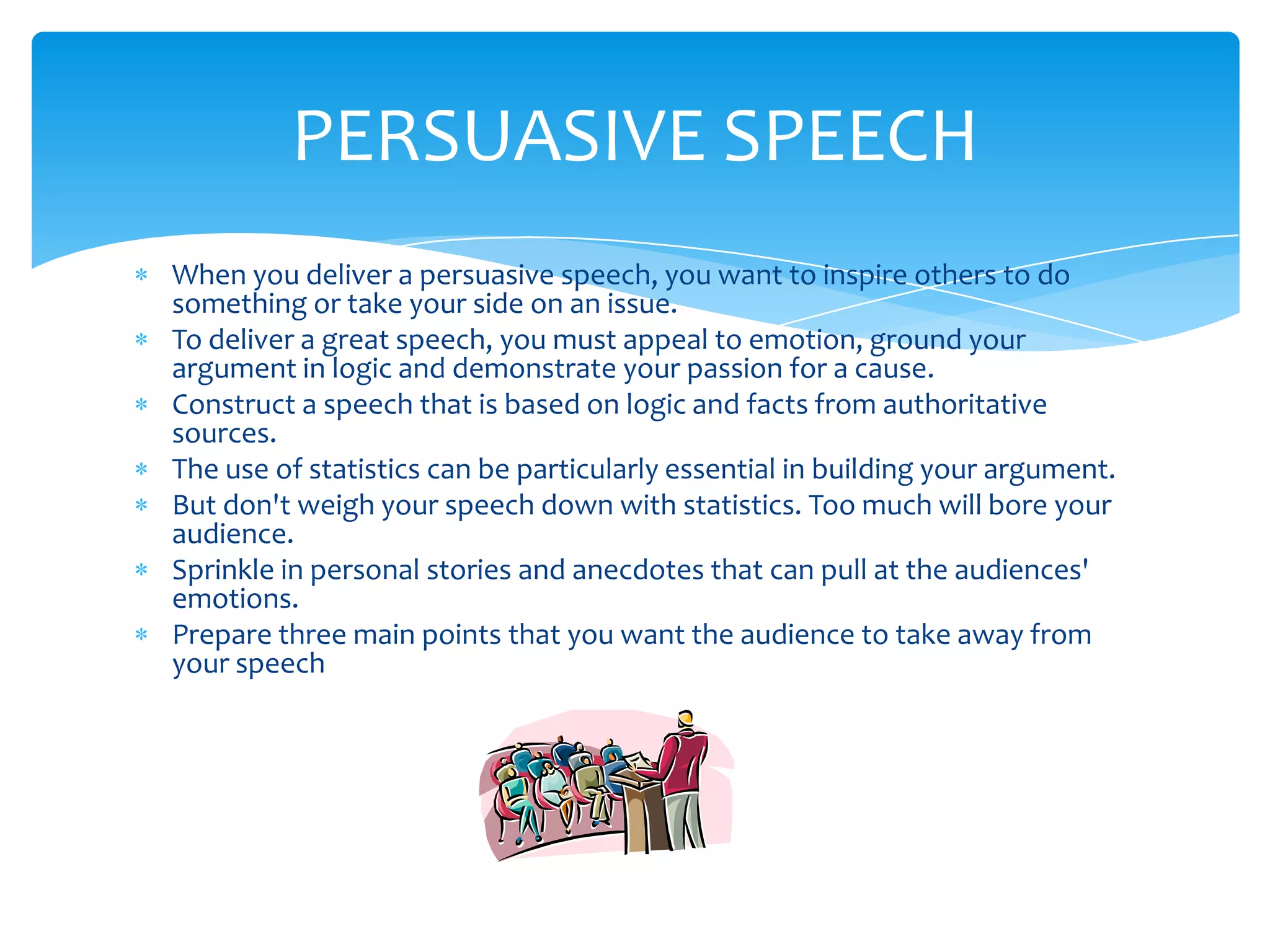
PERSUASIVE SPEECH
When you deliver a persuasive speech, you want to inspire others to do
something or take your side on an issue.
To deliver a great speech, you must appeal to emotion, ground your
argument in logic and demonstrate your passion for a cause.
Construct a speech that is based on logic and facts from authoritative
sources.
The use of statistics can be particularly essential in building your argument.
But don't weigh your speech down with statistics. Too much will bore your
audience.
Sprinkle in personal stories and anecdotes that can pull at the audiences'
emotions.
Prepare three main points that you want the audience to take away from
your speech
THE SPEECH TO ENTERTAIN


The after-dinner speech is a good example of a
speech to entertain.
The speaker provides pleasure and enjoyment that
will make the audience laugh or identify themselves
with anecdotal information.
THE AUDIENCE RESEARCH


Every communication must be in the form and style
that suits the audience.
To analyze the audience, there are some important
factors to be considered:
1.   Age factor
2.   Socio-culture
3.   Educational background
4.   Economic background
5.   Expectation of audience
PARTS OF A SPEECH


A speech has three fundamental parts
      Introduction
      Main body
      Conclusion
In fact, composition of the main body determines the
nature of the introduction, as well as the conclusion.
LANGUAGE AND STYLE


The style of oral communication is different from the
style of written communication, in any language .
The following tips should be considered by the speaker :
      Avoid difficult words that can create confusion
      Avoid using technical terms .
      Avoid using socially unpleasant words
      Avoid repeating phrases like; you see, you know...
Types of speeches

Types of speeches

  • 1.
    TYPES OF SPEECHES MR. ANTONIO V. MILLER
  • 2.
    THE INFORMATIVE SPEECH Thepurpose of the informative speech is to provide interesting, useful, and unique information to your audience. In general, you will use four major types of informative speeches. While you can classify informative speeches many ways, the speech you deliver will fit into one of four major categories. In this guide, we focus on informative speeches about: Objects Processes Events Concepts
  • 3.
    INFORMATIVE SPEECH ABOUT OBJECTS Speeches about objects focus on things existing in the world. Objects include, among other things, people, places, animals, or products. limit your speech to a focused discussion of some aspect of your topic. Some example topics for speeches about objects include: the Central Intelligence Agency, tombstones, surgical lasers, Franklin Delano Roosevelt, the pituitary gland, and lemmings. To focus these topics, you could give a speech about Franklin Delano Roosevelt and efforts to conceal how he suffered from polio while he was in office. Or, a speech about tombstones could focus on the creation and original designs of grave markers.
  • 4.
    SPEECHES ABOUT PROCESS Speechesabout processes focus on patterns of action. One type of speech about processes, the demonstration speech, teaches people "how-to" perform a process. More frequently, however, you will use process speeches to explain a process in broader terms. This way, the audience is more likely to understand the importance or the context of the process. A speech about how milk is pasteurized would not teach the audience how to milk cows. Rather, this speech could help audience members understand the process by making explicit connections between patterns of action (the pasteurization process) and outcomes (a safe milk supply).
  • 5.
    OTHER EXAMPLES ABOUTPROCESS Other examples of speeches about processes include: how the Internet works (not "how to work the Internet"), how to construct a good informative speech, and how to research the job market. As with any speech, be sure to limit your discussion to information you can explain clearly and completely within time constraints.
  • 6.
    SPEECHES ABOUT EVENTS Speechesabout events focus on things that happened, are happening, or will happen. When speaking about an event, remember to relate the topic to your audience. A speech chronicling history is informative, but you should adapt the information to your audience and provide them with some way to use the information. As always, limit your focus to those aspects of an event that can be adequately discussed within the time limitations of your assignment.
  • 7.
    EXAMPLES OF SPEECHESOF EVENTS Examples of speeches about events include: The 1963 Civil Rights March on Washington, Groundhog's Day, the Battle of the Bulge, the World Series, and the 2000 Presidential Elections.
  • 8.
    SPEECHES OF CONCEPTS Speechesabout concepts focus on beliefs, ideas, and theories. While speeches about objects, processes, and events are fairly concrete, speeches about concepts are more abstract. Take care to be clear and understandable when creating and presenting a speech about a concept. When selecting a concept, remember you are crafting an informative speech. Focus your efforts toward providing unbiased information and refrain from making arguments. Because concepts can be vague and involved, limit your speech to aspects that can be readily explained and understood within the time limits.
  • 9.
    EXAMPLES OF CONCEPTSPEECHES Some examples of topics for concept speeches include: democracy, Taoism, principles of feminism, the philosophy of non-violent protest, and the Big Bang theory. TAOISM- It’s a Chinese movement. It’s not a doctrine, neither a system of belief, but it’s something closely related to a personal experience. It’s a style of living and a way in which the world is seen.
  • 10.
    DEMONSTRATIVE SPEECHES In anutshell, a good demonstration speech teaches. The goal is to successfully teach a process or skill. It's a variation of the informative speech with in-built visual aids. The audience, through listening, watching or participating, learns something new. As their guide, you will take them through a process of 'show and tell' covering each step from set-up to finish. Think of it as a 'how-to' speech.
  • 11.
    if my demonstrationspeech is on 'how to tie a tie', then the desired result is an audience capable of tying their own ties or at least inspired to try. You will have an introduction in which you tell the audience what it is they're going to learn, why they'll benefit from learning it and why you chose the topic. Next you have the body of the speech. This is the demonstration itself. Lastly, you'll have a conclusion summarizing what it is that's been learned and reinforcing its benefits.
  • 12.
    SOME EXAMPLES OF DEMONSTRATIVE SPEECHES Examples of topics easily fitting its requirements are: How to wax a surfboard How to make a pumpkin pie How to fix a puncture in your bike tire
  • 13.
    PERSUASIVE SPEECH When youdeliver a persuasive speech, you want to inspire others to do something or take your side on an issue. To deliver a great speech, you must appeal to emotion, ground your argument in logic and demonstrate your passion for a cause. Construct a speech that is based on logic and facts from authoritative sources. The use of statistics can be particularly essential in building your argument. But don't weigh your speech down with statistics. Too much will bore your audience. Sprinkle in personal stories and anecdotes that can pull at the audiences' emotions. Prepare three main points that you want the audience to take away from your speech
  • 14.
    THE SPEECH TOENTERTAIN The after-dinner speech is a good example of a speech to entertain. The speaker provides pleasure and enjoyment that will make the audience laugh or identify themselves with anecdotal information.
  • 15.
    THE AUDIENCE RESEARCH Everycommunication must be in the form and style that suits the audience. To analyze the audience, there are some important factors to be considered: 1. Age factor 2. Socio-culture 3. Educational background 4. Economic background 5. Expectation of audience
  • 16.
    PARTS OF ASPEECH A speech has three fundamental parts Introduction Main body Conclusion In fact, composition of the main body determines the nature of the introduction, as well as the conclusion.
  • 17.
    LANGUAGE AND STYLE Thestyle of oral communication is different from the style of written communication, in any language . The following tips should be considered by the speaker : Avoid difficult words that can create confusion Avoid using technical terms . Avoid using socially unpleasant words Avoid repeating phrases like; you see, you know...