


Wasim Hasan
           Lecturer in English
                      
       MS Applied Linguistics
M.A. English (Linguistics & Literature)
      PGD in Computer Sciences
         PGD in Linguistics
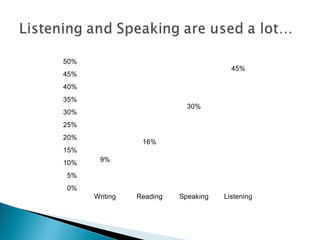
50%
                                       45%
45%
40%
35%
                            30%
30%
25%
20%
                 16%
15%
10%    9%

5%
0%
      Writing   Reading   Speaking   Listening
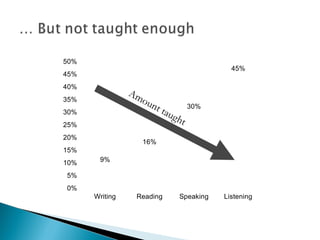
50%
                                              45%
45%
40%
                Am
35%               oun
                        t ta          30%
30%                         ugh
25%                               t
20%
                  16%
15%
10%    9%

5%
0%
      Writing    Reading      Speaking      Listening
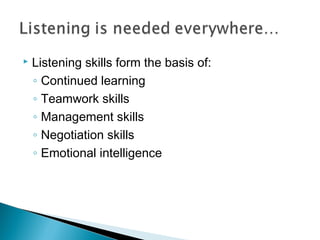
   Listening skills form the basis of:
    ◦ Continued learning
    ◦ Teamwork skills
    ◦ Management skills
    ◦ Negotiation skills
    ◦ Emotional intelligence
70% of all communication is
 ◦ Misunderstood
 ◦ Misinterpreted
 ◦ Rejected
 ◦ Distorted
 ◦ Not heard
Difference between Listening and Hearing
 ◦ Hearing is a natural ability to detect sounds
 ◦ Listening is a skill, which is developed to
   understand, interpret the message accurately.

   It does not require much of an effort to hear,
   whereas Listening to be effective, takes much of
   an effort and time on the part of a listener.
Listening ability varies according to
  ◦ Interest in the topic
 ◦ Importance of the information
 ◦ Length of the message
 ◦ Complexity of the message
 ◦ The delivery of the message
 ◦ Personal problems
 ◦ External distractions
   Speaker              Listener
    ◦   Language          ◦ Perceptions
    ◦   Wordiness         ◦ Preconceived
    ◦   Semantics           notions/expectations
    ◦   Emotions          ◦ Physical hearing
    ◦   Inflections         problem
                          ◦ Speed of thought
                          ◦ Personal interests
                          ◦ Emotions
                          ◦ Attention span
                          ◦ No active listening!
Steps involved in Effective Listening :
◦Hearing
◦Focusing on the message
◦Comprehending and interpreting
◦Analyzing and evaluating
◦Responding
◦Remembering
Concepts Related to Listening Ability
 ◦ Concentration
 ◦ Questioning
 ◦ Objectivity
 ◦ Note Taking
 ◦ Feedback
1.Concentration
  I. Motivation and Demotivation
  II. Anticipate what the speaker will say next
  III. Focus on the message
  Iv. Avoid interruption, let the speaker finish first.

  2.Questioning
  Use of questioning is an effective listening strategy. It serves
   two purposes:
   I. message gets clarified
   II. Speaker gets a positive feedback that a listener is involved.
3. Objectivity
i. Minimize the impact of emotion-laden words
ii. Judge content, not delivery
iii. React fairly and sensibly
iv. Overcome distraction; internal as well as external
 4. Note Taking
  The usefulness of note taking depends on the situation.
5. Feedback
  Feed is important in the listening process to that a
  speaker knows that his/her message is understood.
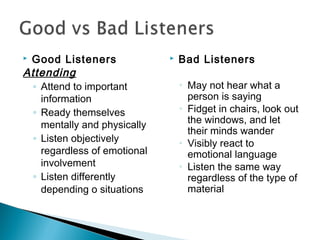
Good Listeners                  Bad Listeners
Attending
  ◦ Attend to important           ◦   May not hear what a
    information                       person is saying
  ◦ Ready themselves              ◦   Fidget in chairs, look out
    mentally and physically           the windows, and let
                                      their minds wander
  ◦ Listen objectively            ◦   Visibly react to
    regardless of emotional           emotional language
    involvement                   ◦   Listen the same way
  ◦ Listen differently                regardless of the type of
    depending o situations            material
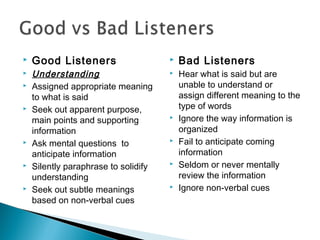
   Good Listeners                       Bad Listeners
   Understanding                        Hear what is said but are
   Assigned appropriate meaning          unable to understand or
    to what is said                       assign different meaning to the
   Seek out apparent purpose,            type of words
    main points and supporting           Ignore the way information is
    information                           organized
   Ask mental questions to              Fail to anticipate coming
    anticipate information                information
   Silently paraphrase to solidify      Seldom or never mentally
    understanding                         review the information
   Seek out subtle meanings             Ignore non-verbal cues
    based on non-verbal cues
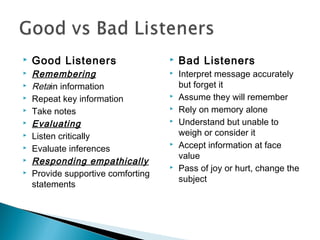
   Good Listeners                     Bad Listeners
   Remembering                        Interpret message accurately
   Retain information                  but forget it
   Repeat key information             Assume they will remember
   Take notes                         Rely on memory alone
   Evaluating                         Understand but unable to
   Listen critically                   weigh or consider it
   Evaluate inferences
                                       Accept information at face
                                        value
   Responding empathically
                                       Pass of joy or hurt, change the
   Provide supportive comforting
                                        subject
    statements
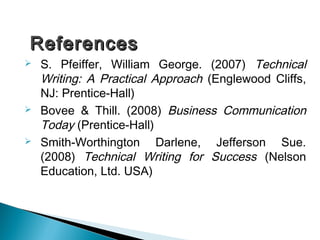
References
   S. Pfeiffer, William George. (2007) Technical
    Writing: A Practical Approach (Englewood Cliffs,
    NJ: Prentice-Hall)
   Bovee & Thill. (2008) Business Communication
    Today (Prentice-Hall)
   Smith-Worthington Darlene, Jefferson Sue.
    (2008) Technical Writing for Success (Nelson
    Education, Ltd. USA)
6. listening skills in communication

6. listening skills in communication

  • 2.
    Wasim Hasan Lecturer in English   MS Applied Linguistics M.A. English (Linguistics & Literature) PGD in Computer Sciences PGD in Linguistics
  • 3.
    50% 45% 45% 40% 35% 30% 30% 25% 20% 16% 15% 10% 9% 5% 0% Writing Reading Speaking Listening
  • 4.
    50% 45% 45% 40% Am 35% oun t ta 30% 30% ugh 25% t 20% 16% 15% 10% 9% 5% 0% Writing Reading Speaking Listening
  • 5.
    Listening skills form the basis of: ◦ Continued learning ◦ Teamwork skills ◦ Management skills ◦ Negotiation skills ◦ Emotional intelligence
  • 6.
    70% of allcommunication is ◦ Misunderstood ◦ Misinterpreted ◦ Rejected ◦ Distorted ◦ Not heard
  • 7.
    Difference between Listeningand Hearing ◦ Hearing is a natural ability to detect sounds ◦ Listening is a skill, which is developed to understand, interpret the message accurately. It does not require much of an effort to hear, whereas Listening to be effective, takes much of an effort and time on the part of a listener.
  • 8.
    Listening ability variesaccording to ◦ Interest in the topic ◦ Importance of the information ◦ Length of the message ◦ Complexity of the message ◦ The delivery of the message ◦ Personal problems ◦ External distractions
  • 9.
    Speaker  Listener ◦ Language ◦ Perceptions ◦ Wordiness ◦ Preconceived ◦ Semantics notions/expectations ◦ Emotions ◦ Physical hearing ◦ Inflections problem ◦ Speed of thought ◦ Personal interests ◦ Emotions ◦ Attention span ◦ No active listening!
  • 10.
    Steps involved inEffective Listening : ◦Hearing ◦Focusing on the message ◦Comprehending and interpreting ◦Analyzing and evaluating ◦Responding ◦Remembering
  • 11.
    Concepts Related toListening Ability ◦ Concentration ◦ Questioning ◦ Objectivity ◦ Note Taking ◦ Feedback
  • 12.
    1.Concentration I.Motivation and Demotivation II. Anticipate what the speaker will say next III. Focus on the message Iv. Avoid interruption, let the speaker finish first. 2.Questioning Use of questioning is an effective listening strategy. It serves two purposes: I. message gets clarified II. Speaker gets a positive feedback that a listener is involved.
  • 13.
    3. Objectivity i. Minimizethe impact of emotion-laden words ii. Judge content, not delivery iii. React fairly and sensibly iv. Overcome distraction; internal as well as external 4. Note Taking The usefulness of note taking depends on the situation. 5. Feedback Feed is important in the listening process to that a speaker knows that his/her message is understood.
  • 14.
    Good Listeners  Bad Listeners Attending ◦ Attend to important ◦ May not hear what a information person is saying ◦ Ready themselves ◦ Fidget in chairs, look out mentally and physically the windows, and let their minds wander ◦ Listen objectively ◦ Visibly react to regardless of emotional emotional language involvement ◦ Listen the same way ◦ Listen differently regardless of the type of depending o situations material
  • 15.
    Good Listeners  Bad Listeners  Understanding  Hear what is said but are  Assigned appropriate meaning unable to understand or to what is said assign different meaning to the  Seek out apparent purpose, type of words main points and supporting  Ignore the way information is information organized  Ask mental questions to  Fail to anticipate coming anticipate information information  Silently paraphrase to solidify  Seldom or never mentally understanding review the information  Seek out subtle meanings  Ignore non-verbal cues based on non-verbal cues
  • 16.
    Good Listeners  Bad Listeners  Remembering  Interpret message accurately  Retain information but forget it  Repeat key information  Assume they will remember  Take notes  Rely on memory alone  Evaluating  Understand but unable to  Listen critically weigh or consider it  Evaluate inferences  Accept information at face value  Responding empathically  Pass of joy or hurt, change the  Provide supportive comforting subject statements
  • 17.
    References  S. Pfeiffer, William George. (2007) Technical Writing: A Practical Approach (Englewood Cliffs, NJ: Prentice-Hall)  Bovee & Thill. (2008) Business Communication Today (Prentice-Hall)  Smith-Worthington Darlene, Jefferson Sue. (2008) Technical Writing for Success (Nelson Education, Ltd. USA)