Features of Effective
Communication
Completeness
•Includes everything that the
receive needs to hear for
him/her to respond, react or
evaluate properly.
Conciseness
•Does not mean keeping the message
short, but making it direct or straight
to the point. Insignificant or
redundant information should be
eliminated.
Consideration
•Consider relevant information about
his/her receiver such as mood,
background, race, preference,
education, status and needs.
Concreteness
•Supported by facts, figures and
real-life examples and situations;
in this case, the receiver is more
connected.
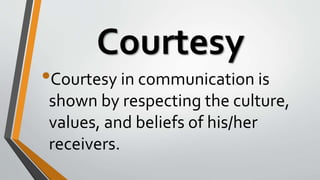
Courtesy
•Courtesy in communication is
shown by respecting the culture,
values, and beliefs of his/her
receivers.
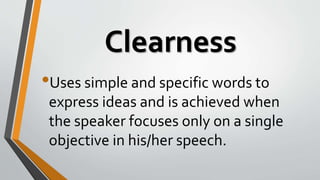
Clearness
•Uses simple and specific words to
express ideas and is achieved when
the speaker focuses only on a single
objective in his/her speech.
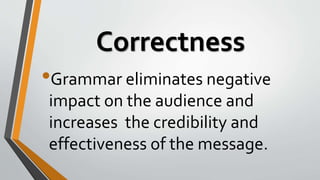
Correctness
•Grammar eliminates negative
impact on the audience and
increases the credibility and
effectiveness of the message.
• 1.
• 2.
• 3,
• 4.
• 1. 6.
• 2. 7.
• 3.
• 4.
• 5.
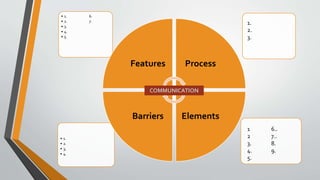
Features Process
Elements
Barriers
1.
2.
3.
1 6..
2 7..
3. 8.
4. 9.
5.
COMMUNICATION
Verbal and
Non-verbal
Communication
Verbal Communication
•refers to an interaction in
which words are used to relay
a message.
Characteristics of aVerbal
Communication
•a. appropriateness- language
used should be appropriate to the
environment or occassion
(formal/informal)
•b. brevity - uses simple yet
prcise and powerful words are
found to be more credible.
Brevity is achieved by being
more direct to your words.
•. clarity- words, feelings or
ideas may be interpreted
differently by a listener, hence
it is essential to clearly state
your message and express
ideas and feelings.
•d. ethics- words should be carefully
chosen in consideration of the
gender, roles, ethnicity, preferences
and status.
•e.vividness- words that vividly or
creatively describe things or feelings
usually add color and spice to
communication.
Non-verbal
Communication
•refers to an interaction where behavior is
used to convey and represent meanings.
Examples are smile,stares,tone of
voice,movements,manners of walking,
appearance, style of attire and many more.
•It enhances and emphasizes the message of
your speech, making it more meaningful,
truthful and relevant.
•It can communicate feelings, attitudes and
perceptions without you, saying a word.
•It can sustain the attention of listeners and keep
them angaged in a specific.
•It serves as channel to release tension and
nervousness.
Charades
INTERCULTURAL
COMMUNICATION
Intercultural
Communication
•refers to the effective
communication between
people/clients/workers of
different cultural background.
Examples of Cultural
Differences
•Arabic language is written from
right to left and almost all other
languages are written from left
ro right
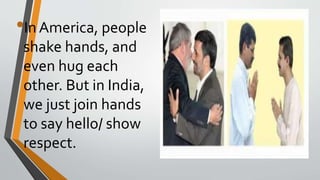
•In America, people
shake hands, and
even hug each
other. But in India,
we just join hands
to say hello/ show
respect.
Need for Intercultural
Communication
•succes of any International business
•allows worker from different culture to
work together as a group
•worldwide marketing campaign
•an increase in international business
TwoTrends of International
Communication
•Globalization
•MulticulturalWorkforce
Globalization
•refers to the reduction and removal
of barriers between national
borders in order to facilitate the
flow of goods, capital, services and
labour
Multicultural Workforce
•The phrase “multicultural
workforce” refers to the changing
of age, gender, ethnicity, physical
ability, and race of employees
across all types and places of work.
Activity
Individually, prepare a two-minute
speech about understanding cultural
differences which will tackle the
essence of cross-cultural
communication.
Speech Context and
Style
Types of Speech Context
•Intrapersonal- this refers to
communication that centers on one person
where the speaker acts both as the sender
and the receiver of message.The message
is made up of your thoughts and feelings
and the channel is your brain.
•Examples:You spent the night
thinking and analyzing why a
student from other class talked to
you on the way home and you
decided it probably meant nothing.
•You felt happy while thinking about
how your teacher appreciated you
for submitting your project before
the due date and you reflected on
why this was so.
Types of Speech Context
•Interpersonal- refers to
communication between and
among people and establishes
personal relationship between
and among them.
Types of Interpersonal Context
•Dyad Communication- communication
occurs between two people.
ex. You offered feedback on the speech
performance of your classmate.
•Small Group- refers to communication that
involves at least three but not more than
twelve people engaging in a face-to-face
interaction to achieve a desired goal.
•ex.You are participating in an
organizational meeting which aims to
address the concerns of fellow students.
•Public- this refers to communication that
requires you to deliver or send the message
before or in front of a group.The message
can be driven by informational or
persuasive purposes.
ex.You deliver a graduation speech to your
batch.
•Mass Communication- refers to
communication that takes place through
television, radio, newspapers, magazine,
books, billboards, internet and other types of
media.
ex.You are a student journalist articulating your
stand on current issues through the school’s
newspaper.

Features of communication.pptx

  • 1.
  • 2.
    Completeness •Includes everything thatthe receive needs to hear for him/her to respond, react or evaluate properly.
  • 3.
    Conciseness •Does not meankeeping the message short, but making it direct or straight to the point. Insignificant or redundant information should be eliminated.
  • 4.
    Consideration •Consider relevant informationabout his/her receiver such as mood, background, race, preference, education, status and needs.
  • 5.
    Concreteness •Supported by facts,figures and real-life examples and situations; in this case, the receiver is more connected.
  • 6.
    Courtesy •Courtesy in communicationis shown by respecting the culture, values, and beliefs of his/her receivers.
  • 7.
    Clearness •Uses simple andspecific words to express ideas and is achieved when the speaker focuses only on a single objective in his/her speech.
  • 8.
    Correctness •Grammar eliminates negative impacton the audience and increases the credibility and effectiveness of the message.
  • 9.
    • 1. • 2. •3, • 4. • 1. 6. • 2. 7. • 3. • 4. • 5. Features Process Elements Barriers 1. 2. 3. 1 6.. 2 7.. 3. 8. 4. 9. 5. COMMUNICATION
  • 10.
  • 11.
    Verbal Communication •refers toan interaction in which words are used to relay a message.
  • 12.
    Characteristics of aVerbal Communication •a.appropriateness- language used should be appropriate to the environment or occassion (formal/informal)
  • 13.
    •b. brevity -uses simple yet prcise and powerful words are found to be more credible. Brevity is achieved by being more direct to your words.
  • 14.
    •. clarity- words,feelings or ideas may be interpreted differently by a listener, hence it is essential to clearly state your message and express ideas and feelings.
  • 15.
    •d. ethics- wordsshould be carefully chosen in consideration of the gender, roles, ethnicity, preferences and status. •e.vividness- words that vividly or creatively describe things or feelings usually add color and spice to communication.
  • 16.
    Non-verbal Communication •refers to aninteraction where behavior is used to convey and represent meanings. Examples are smile,stares,tone of voice,movements,manners of walking, appearance, style of attire and many more.
  • 17.
    •It enhances andemphasizes the message of your speech, making it more meaningful, truthful and relevant. •It can communicate feelings, attitudes and perceptions without you, saying a word. •It can sustain the attention of listeners and keep them angaged in a specific. •It serves as channel to release tension and nervousness.
  • 18.
  • 19.
  • 20.
    Intercultural Communication •refers to theeffective communication between people/clients/workers of different cultural background.
  • 21.
    Examples of Cultural Differences •Arabiclanguage is written from right to left and almost all other languages are written from left ro right
  • 22.
    •In America, people shakehands, and even hug each other. But in India, we just join hands to say hello/ show respect.
  • 23.
    Need for Intercultural Communication •succesof any International business •allows worker from different culture to work together as a group •worldwide marketing campaign •an increase in international business
  • 24.
  • 25.
    Globalization •refers to thereduction and removal of barriers between national borders in order to facilitate the flow of goods, capital, services and labour
  • 26.
    Multicultural Workforce •The phrase“multicultural workforce” refers to the changing of age, gender, ethnicity, physical ability, and race of employees across all types and places of work.
  • 27.
    Activity Individually, prepare atwo-minute speech about understanding cultural differences which will tackle the essence of cross-cultural communication.
  • 28.
  • 29.
    Types of SpeechContext •Intrapersonal- this refers to communication that centers on one person where the speaker acts both as the sender and the receiver of message.The message is made up of your thoughts and feelings and the channel is your brain.
  • 30.
    •Examples:You spent thenight thinking and analyzing why a student from other class talked to you on the way home and you decided it probably meant nothing.
  • 31.
    •You felt happywhile thinking about how your teacher appreciated you for submitting your project before the due date and you reflected on why this was so.
  • 32.
    Types of SpeechContext •Interpersonal- refers to communication between and among people and establishes personal relationship between and among them.
  • 33.
    Types of InterpersonalContext •Dyad Communication- communication occurs between two people. ex. You offered feedback on the speech performance of your classmate.
  • 34.
    •Small Group- refersto communication that involves at least three but not more than twelve people engaging in a face-to-face interaction to achieve a desired goal. •ex.You are participating in an organizational meeting which aims to address the concerns of fellow students.
  • 35.
    •Public- this refersto communication that requires you to deliver or send the message before or in front of a group.The message can be driven by informational or persuasive purposes. ex.You deliver a graduation speech to your batch.
  • 36.
    •Mass Communication- refersto communication that takes place through television, radio, newspapers, magazine, books, billboards, internet and other types of media. ex.You are a student journalist articulating your stand on current issues through the school’s newspaper.