Janet Allen
Purpose and Goals 
 Effective presentation skills are critical to leadership. The 
employee who can deliver a convincing, well thought-out, cogent 
presentation is one who will earn the respect of his or her 
colleagues, superiors, and customers. This skill is key for those 
seeking to bring their careers to the next level. Those who speak 
well influence others, and that is the essence of leadership. 
Organizations need leaders who can make their point with clarity 
and brevity. 
 Goals include: overcoming nervousness and anxiety, being a 
great presenter, projecting your desired image, analyzing and 
focusing on your audience, planning strategy, building your 
message, honing your skills, the power of persuasion, captivating 
your audience, managing the audience, how to manage a 
meeting successfully, presenting as a team, and using multimedia 
visuals successfully.
Goals 
 Confidently prepare and give a 
presentation or briefing 
 Efficiently manage an effective meeting 
 Successfully deliver a formal 
presentation with a cohesive team
Norms for Behavior 
 Be present and focused. 
 Respect airtime (three before me). 
 Focus on what we can do. 
 Everyone contributes.
Introductions 
 Name 
 Position 
 Why are you here? 
 Hobby
1.2
A.W.A.R.E. 
 Action 
 Work It! 
 Acknowledge and Accept 
 Relax 
 End
Action – Be prepared. 
 Know your content, your strategy, and your 
resources. 
 Test your technology in advance. 
 Practice in front of the mirror, a camera, or 
a friend. 
 Anticipate potential problems and 
questions. 
 Use visualization to imagine the entire 
presentation from start to finish.
Work It! – Embrace the Speaker Role 
You have done the hard work of preparation; you 
deserve to do well.
Work It! – Don’t hide. 
Use confident body language, project your voice, 
and look at your audience. Smile and step out 
from behind the desk or podium.
Acknowledge and Accept 
It’s normal to be nervous!
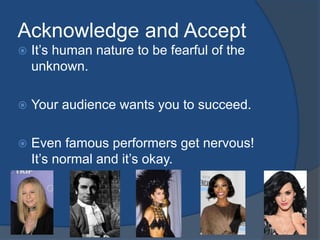
Acknowledge and Accept 
 It’s human nature to be fearful of the 
unknown. 
 Your audience wants you to succeed. 
 Even famous performers get nervous! 
It’s normal and it’s okay.
Relax – Release adrenaline. 
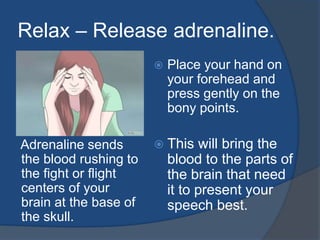
Adrenaline sends 
the blood rushing to 
the fight or flight 
centers of your 
brain at the base of 
the skull. 
 Place your hand on 
your forehead and 
press gently on the 
bony points. 
 This will bring the 
blood to the parts of 
the brain that need 
it to present your 
speech best.
Relax – The art of letting go. 
 Breathe deeply. 
Breathing Exercise 
 Stretch. 
Stretching Exercise
Relax – Yul Brynner’s Wall Push 
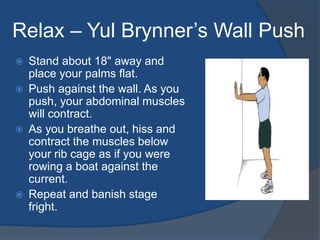
 Stand about 18" away and 
place your palms flat. 
 Push against the wall. As you 
push, your abdominal muscles 
will contract. 
 As you breathe out, hiss and 
contract the muscles below 
your rib cage as if you were 
rowing a boat against the 
current. 
 Repeat and banish stage 
fright.
End 
 Your nervousness 
WILL end! 
 Don’t forget to 
remind yourself 
that this feeling 
will go away 
eventually. 
 Make sure to let 
your audience 
know when your 
speech is over 
and have a call to 
action.
1.3
Five Things Every Presenter 
Needs to Know About People 
by Susan Weinschenk 
Link
The Secret Structure of 
Great Talks 
by Nancy Duarte 
Link
Reflect and Journal 
1. How can you relate this to the presentations 
or briefings you are expected to give? 
2. What techniques from Weinschenk resonate 
the most with you? 
3. What techniques from Duarte resonate the 
most with you? 
4. What are three to five specific techniques 
from the morning session that you can 
reasonably incorporate into your next 
briefing? 
5. Which ones are you most excited about?
1.4
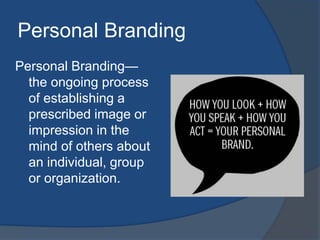
Personal Branding 
Personal Branding— 
the ongoing process 
of establishing a 
prescribed image or 
impression in the 
mind of others about 
an individual, group 
or organization.
1.5
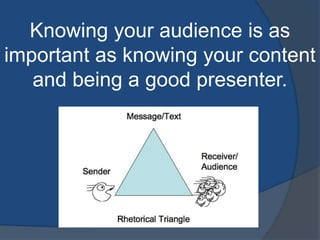
Knowing your audience is as 
important as knowing your content 
and being a good presenter.
Why is it important to know your 
audience? 
 Create the best content 
 Pinpoint an effective approach and strategy 
 Craft appropriate language 
 Identify focus areas 
 Find balance between logic and emotion 
 Determine the degree of audience interaction 
 Plan for situations that may prevent you from 
reaching your presentation objectives
What should you find out about 
your audience? 
 Group size 
 Prior knowledge 
and experience 
 Opinions, feelings, 
and attitudes 
toward your topic 
 Needs, wants, and 
expectations 
 Priorities and Pain 
Points 
 Decision makers 
 Position levels and 
professions 
 Audience makeup – 
gender, education, 
age, class, ethnic 
background, political 
leanings 
 Potential problems 
from the audience 
 Mood and condition 
of the group
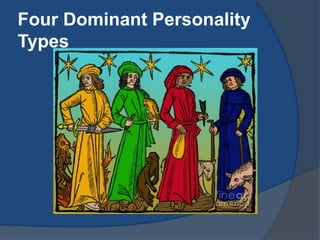
Four Dominant Personality 
Types
Director (Choleric) 
 Focuses on goals, results, action, and achievement 
 Highly competitive 
 Forceful, authoritative, commanding 
 Demanding and impatient 
 Decisive, direct and blunt 
 Exerts control – of self and others 
 Seeks power, status, prestige 
 Big (often fragile) ego 
 Independent and self-sustaining – takes quick 
initiative 
 Does not show weakness 
 A smart risk-taker and methodical innovator
How to present to Directors: 
 Show self-assurance 
and 
confidence. 
 Make your 
presentation direct 
and accurate. 
 Be professional and 
relaxed. 
 Don’t ramble or be 
vague in your 
answers. 
 Don’t be emotional, 
cute, or clever. 
 Don’t leave loose 
ends in your 
presentation.
Energizer (Sanguine) 
 Imaginative, innovative, intuitive, and risk-taker 
 Dreamer, visionary, idealist who loves big ideas 
 Impulsive, intuitive, spontaneous, and emotional 
 Great at synthesizing ideas and concepts 
 Unconventional and unorthodox in solutions 
 Mercurial—enjoys exciting, meaningful change 
 Thrives on admiration and recognition 
 Dislikes rules, regulations, or tradition 
 Easily distracted and bored—changes direction 
and focus frequently 
 Excellent communicator who takes pride in 
influencing people and events
How to present to 
Energizers: 
 Show your interest 
and/or passion for 
your subject 
 Use lots of relevant 
visuals that illustrate 
your points. 
 Ask for feedback and 
participation. 
 Don’t be too 
impersonal, formal, or 
detached. 
 Don’t act like a close-minded 
know-it-all. 
 Don’t be dismissive of 
their ideas and 
feedback.
Affable (Melancholic) 
 Hates and avoids conflict, controversy, or debate 
 Highly sensitive to their own feelings and those of 
others 
 Can’t say no 
 Supportive team players 
 Indecisive, tentative, and afraid to commit 
(especially quickly) 
 Needs approval, validation, and lots of genuine 
affection 
 Dependable, loyal, easygoing, and sincere 
 Dislikes dealing with details and cold, hard, facts 
 Can appear weak and wishy-washy, especially in 
demanding situations
How to present to Affables: 
 Show sincere, 
personal interest in 
the audience. 
 Be solution-focused 
and positive. 
 Show step-by-step 
plans that will guide 
the audience toward 
the goals. 
 Don’t be assertive or 
intimidating. 
 Don’t become 
impatient or rush 
them to make 
decisions. 
 Don’t ignore the 
human side of the 
audience.
Thinker (Phlegmatic) 
 Objective, rational, methodical, and orderly 
 Cautious, skeptical, prove-it-to-me cynic 
 Slow and methodical in decision making— 
meticulous researcher and fact-checker 
 Serious, stoical, reserved, conservative—hides 
reactions and feelings (but can suddenly erupt with 
wacky or goofy humor or behavior when unguarded) 
 Craves solving complex, challenging problems 
 Can be inflexible and sees issues as black or white 
 Follows rules, procedures, and protocols with little to 
no deviation 
 Prefers incremental changes to radical innovations
How to present to Thinkers: 
 Be prepared and 
detailed. 
 Use examples, valid 
evidence, and facts. 
 Be prepared to 
answer questions 
with detailed and 
concrete answers. 
 Don’t exaggerate or 
estimate. 
 Don’t use personal 
or emotional 
appeals. 
 Don’t challenge their 
expertise.
Presenting to a mixed 
group: 
Use a combination of techniques to appeal 
to everyone in your audience. 
 Be prepared and knowledgeable. 
 Research your audience. 
 Have a strategy and outline. 
 Be relaxed and professional. 
 Use facts, figures, visuals, and 
examples. 
 Make sure there is a call to action.
Presenting to a mixed 
group: 
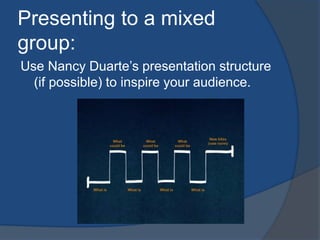
Use Nancy Duarte’s presentation structure 
(if possible) to inspire your audience.
Above all… 
Find a balance of techniques, methods, 
and strategies that makes you feel 
confident and comfortable while giving 
your presentation or briefing.
Call to Action 
 Elevator Pitch: What do you do? 
 2 minutes 
 No notes 
 Use what you learned today. 
 The purpose of this exercise is to put into 
practice everything you’ve learned today. 
 Get over your nervousness. 
 Use the qualities of a great presenter. 
 Project your desired image. 
 Use what you know about your audience to be effective. 
 Link
Peer Feedback 
 What techniques, 
methods, and 
strategies from 
today’s sessions did 
you notice the 
speaker using? 
 What did you learn 
from this speaker 
about presenting? 
 Respectfully, what 
should the speaker 
focus on doing or 
not doing as he or 
she goes forward? 
 Final thoughts.
Reflect and Quick Write 
 What went well today? 
 What methods, techniques, and 
strategies do you want to focus on as 
you move forward with briefings and 
presentations? 
 What questions do you still have?
Day Two: Meeting Management 
1. Review Elevator Pitch 
2. Honing Your Skills and Rehearsing 
 Voice 
 Body Language 
3. Persuasion 
4. Captivating Your Audience 
5. Managing the Audience 
6. Meeting Management Experience 
(Fishbowl)

Effective Briefing Techniques

  • 1.
  • 2.
    Purpose and Goals  Effective presentation skills are critical to leadership. The employee who can deliver a convincing, well thought-out, cogent presentation is one who will earn the respect of his or her colleagues, superiors, and customers. This skill is key for those seeking to bring their careers to the next level. Those who speak well influence others, and that is the essence of leadership. Organizations need leaders who can make their point with clarity and brevity.  Goals include: overcoming nervousness and anxiety, being a great presenter, projecting your desired image, analyzing and focusing on your audience, planning strategy, building your message, honing your skills, the power of persuasion, captivating your audience, managing the audience, how to manage a meeting successfully, presenting as a team, and using multimedia visuals successfully.
  • 4.
    Goals  Confidentlyprepare and give a presentation or briefing  Efficiently manage an effective meeting  Successfully deliver a formal presentation with a cohesive team
  • 5.
    Norms for Behavior  Be present and focused.  Respect airtime (three before me).  Focus on what we can do.  Everyone contributes.
  • 6.
    Introductions  Name  Position  Why are you here?  Hobby
  • 7.
  • 8.
    A.W.A.R.E.  Action  Work It!  Acknowledge and Accept  Relax  End
  • 9.
    Action – Beprepared.  Know your content, your strategy, and your resources.  Test your technology in advance.  Practice in front of the mirror, a camera, or a friend.  Anticipate potential problems and questions.  Use visualization to imagine the entire presentation from start to finish.
  • 11.
    Work It! –Embrace the Speaker Role You have done the hard work of preparation; you deserve to do well.
  • 12.
    Work It! –Don’t hide. Use confident body language, project your voice, and look at your audience. Smile and step out from behind the desk or podium.
  • 13.
    Acknowledge and Accept It’s normal to be nervous!
  • 14.
    Acknowledge and Accept  It’s human nature to be fearful of the unknown.  Your audience wants you to succeed.  Even famous performers get nervous! It’s normal and it’s okay.
  • 15.
    Relax – Releaseadrenaline. Adrenaline sends the blood rushing to the fight or flight centers of your brain at the base of the skull.  Place your hand on your forehead and press gently on the bony points.  This will bring the blood to the parts of the brain that need it to present your speech best.
  • 16.
    Relax – Theart of letting go.  Breathe deeply. Breathing Exercise  Stretch. Stretching Exercise
  • 17.
    Relax – YulBrynner’s Wall Push  Stand about 18" away and place your palms flat.  Push against the wall. As you push, your abdominal muscles will contract.  As you breathe out, hiss and contract the muscles below your rib cage as if you were rowing a boat against the current.  Repeat and banish stage fright.
  • 18.
    End  Yournervousness WILL end!  Don’t forget to remind yourself that this feeling will go away eventually.  Make sure to let your audience know when your speech is over and have a call to action.
  • 19.
  • 20.
    Five Things EveryPresenter Needs to Know About People by Susan Weinschenk Link
  • 21.
    The Secret Structureof Great Talks by Nancy Duarte Link
  • 22.
    Reflect and Journal 1. How can you relate this to the presentations or briefings you are expected to give? 2. What techniques from Weinschenk resonate the most with you? 3. What techniques from Duarte resonate the most with you? 4. What are three to five specific techniques from the morning session that you can reasonably incorporate into your next briefing? 5. Which ones are you most excited about?
  • 23.
  • 24.
    Personal Branding PersonalBranding— the ongoing process of establishing a prescribed image or impression in the mind of others about an individual, group or organization.
  • 25.
  • 26.
    Knowing your audienceis as important as knowing your content and being a good presenter.
  • 27.
    Why is itimportant to know your audience?  Create the best content  Pinpoint an effective approach and strategy  Craft appropriate language  Identify focus areas  Find balance between logic and emotion  Determine the degree of audience interaction  Plan for situations that may prevent you from reaching your presentation objectives
  • 28.
    What should youfind out about your audience?  Group size  Prior knowledge and experience  Opinions, feelings, and attitudes toward your topic  Needs, wants, and expectations  Priorities and Pain Points  Decision makers  Position levels and professions  Audience makeup – gender, education, age, class, ethnic background, political leanings  Potential problems from the audience  Mood and condition of the group
  • 29.
  • 30.
    Director (Choleric) Focuses on goals, results, action, and achievement  Highly competitive  Forceful, authoritative, commanding  Demanding and impatient  Decisive, direct and blunt  Exerts control – of self and others  Seeks power, status, prestige  Big (often fragile) ego  Independent and self-sustaining – takes quick initiative  Does not show weakness  A smart risk-taker and methodical innovator
  • 31.
    How to presentto Directors:  Show self-assurance and confidence.  Make your presentation direct and accurate.  Be professional and relaxed.  Don’t ramble or be vague in your answers.  Don’t be emotional, cute, or clever.  Don’t leave loose ends in your presentation.
  • 32.
    Energizer (Sanguine) Imaginative, innovative, intuitive, and risk-taker  Dreamer, visionary, idealist who loves big ideas  Impulsive, intuitive, spontaneous, and emotional  Great at synthesizing ideas and concepts  Unconventional and unorthodox in solutions  Mercurial—enjoys exciting, meaningful change  Thrives on admiration and recognition  Dislikes rules, regulations, or tradition  Easily distracted and bored—changes direction and focus frequently  Excellent communicator who takes pride in influencing people and events
  • 33.
    How to presentto Energizers:  Show your interest and/or passion for your subject  Use lots of relevant visuals that illustrate your points.  Ask for feedback and participation.  Don’t be too impersonal, formal, or detached.  Don’t act like a close-minded know-it-all.  Don’t be dismissive of their ideas and feedback.
  • 34.
    Affable (Melancholic) Hates and avoids conflict, controversy, or debate  Highly sensitive to their own feelings and those of others  Can’t say no  Supportive team players  Indecisive, tentative, and afraid to commit (especially quickly)  Needs approval, validation, and lots of genuine affection  Dependable, loyal, easygoing, and sincere  Dislikes dealing with details and cold, hard, facts  Can appear weak and wishy-washy, especially in demanding situations
  • 35.
    How to presentto Affables:  Show sincere, personal interest in the audience.  Be solution-focused and positive.  Show step-by-step plans that will guide the audience toward the goals.  Don’t be assertive or intimidating.  Don’t become impatient or rush them to make decisions.  Don’t ignore the human side of the audience.
  • 36.
    Thinker (Phlegmatic) Objective, rational, methodical, and orderly  Cautious, skeptical, prove-it-to-me cynic  Slow and methodical in decision making— meticulous researcher and fact-checker  Serious, stoical, reserved, conservative—hides reactions and feelings (but can suddenly erupt with wacky or goofy humor or behavior when unguarded)  Craves solving complex, challenging problems  Can be inflexible and sees issues as black or white  Follows rules, procedures, and protocols with little to no deviation  Prefers incremental changes to radical innovations
  • 37.
    How to presentto Thinkers:  Be prepared and detailed.  Use examples, valid evidence, and facts.  Be prepared to answer questions with detailed and concrete answers.  Don’t exaggerate or estimate.  Don’t use personal or emotional appeals.  Don’t challenge their expertise.
  • 38.
    Presenting to amixed group: Use a combination of techniques to appeal to everyone in your audience.  Be prepared and knowledgeable.  Research your audience.  Have a strategy and outline.  Be relaxed and professional.  Use facts, figures, visuals, and examples.  Make sure there is a call to action.
  • 39.
    Presenting to amixed group: Use Nancy Duarte’s presentation structure (if possible) to inspire your audience.
  • 40.
    Above all… Finda balance of techniques, methods, and strategies that makes you feel confident and comfortable while giving your presentation or briefing.
  • 41.
    Call to Action  Elevator Pitch: What do you do?  2 minutes  No notes  Use what you learned today.  The purpose of this exercise is to put into practice everything you’ve learned today.  Get over your nervousness.  Use the qualities of a great presenter.  Project your desired image.  Use what you know about your audience to be effective.  Link
  • 42.
    Peer Feedback What techniques, methods, and strategies from today’s sessions did you notice the speaker using?  What did you learn from this speaker about presenting?  Respectfully, what should the speaker focus on doing or not doing as he or she goes forward?  Final thoughts.
  • 43.
    Reflect and QuickWrite  What went well today?  What methods, techniques, and strategies do you want to focus on as you move forward with briefings and presentations?  What questions do you still have?
  • 44.
    Day Two: MeetingManagement 1. Review Elevator Pitch 2. Honing Your Skills and Rehearsing  Voice  Body Language 3. Persuasion 4. Captivating Your Audience 5. Managing the Audience 6. Meeting Management Experience (Fishbowl)

Editor's Notes

  • #20 1. Think of a great presentation or briefing you’ve witnessed. Write down 3-5 specific things that the presenter did that made him or her great. Share your list with a partner and see if you can add to your own.   2. Share out with the whole group: What do you notice about these traits and strategies of fearful speakers? What effects do they have?   Answers: They have strategies, visual aids, they are prepared and professional, they seem like experts, they can be funny, and they are relaxed. The effects are that the audience focuses on the content of the speech and they learn, are inspired, and motivated.   3. Now we’re going to learn from some experts in the field. The first video is short and very informative. Please take brief notes on the front of your handout. Watch the Five Things Every Presenter Needs to Know About People by Susan Weinschenk:
  • #21 Pass out handout before playing video.
  • #23 Make sure everyone has paper to write on.
  • #24 This is the point where we take what you learned from overcoming nervousness and add it to what you learned about the qualities of a great presenter.
  • #25 Your focus, language, content, and presentation style help shape the image you want to convey. When you project this image, it doesn’t mean pretending to be something you’re not; it involves emphasizing your expertise, strengths, and unique promise of value. 2. In this next activity, you will complete a worksheet to determine what your personal brand and desired image is.   3. I recommend that when you complete 1-6, you go over question 7 with a partner so you can brainstorm together what you can do to project this desired image. Use what you have learned today as well as prior knowledge to write down your ideas.   4. If there is time, share out with the group. If not, time for LUNCH.  
  • #26 When they come back from lunch, give them the temperament test. 2. A successful presenter ALWAYS considers the audience. If you don’t know anything about your audience it will be impossible to give them what they need. Your briefing or presentation should be all about your audience. 3. Giving a canned, one-size-fits-all presentation to various and diverse groups leads to sub-par results, and at times, total failure.  
  • #27 Knowing your audience is as important as knowing your content and being a good presenter. The model of the Rhetorical Triangle is equilateral and was used by Aristotle to demonstrate that each entity is equally important. If you’re a great speaker or presenter, people might remember you and how funny you were, but not your content. If the message is emphasized over the speaker and the audience, then your audience might be bored, resistant, or confused (if it’s not at their level). If the you don’t understand your audience, then the message might not reach them because you haven’t tailored your presentation to their needs. The might not care or they might not understand. All three are equally important when giving a briefing or presentation.
  • #28 How can you find out about your audience? Research!!
  • #30 Four temperaments is a psychological theory that suggests that there are four fundamental personality types, sanguine (pleasure-seeking and sociable), choleric (ambitious and leader-like), melancholic (analytical and quiet), and phlegmatic (relaxed and peaceful). Most formulations include the possibility of mixtures of the types. The Greek physician Hippocrates (460–370 BC) incorporated the four temperaments into his medical theories as part of the ancient medical concept of humorism, that four bodily fluids affect human personality traits and behaviors. Later discoveries in biochemistry have led modern medicine and science to reject the theory of the four temperaments, although some personality type systems that are accepted by modern science continue to use these categories. Which one are you? (Have them raise hands for each one – write down how many of each.)
  • #31 Are there are lot of these types of personalities when you present? What are some things to consider when presenting to directors? (Get ideas from the students to see if they’re on the right track.) If you are a director, what do you consider to be a good presentation?
  • #33 Are there are lot of these types of personalities when you present? What are some things to consider when presenting to energizers? (Get ideas from the students to see if they’re on the right track.) If you are an energizer, what do you consider to be a good presentation?
  • #35 Are there are lot of these types of personalities when you present? What are some things to consider when presenting to affables? (Get ideas from the students to see if they’re on the right track.) If you are an affable, what do you like in a presentation?
  • #37 Are there are lot of these types of personalities when you present? What are some things to consider when presenting to thinkers? (Get ideas from the students to see if they’re on the right track.) If you’re a thinker, what do you like to see in a presentation?
  • #42 You will be preparing a two-minute “Elevator Pitch” that answers the question: What do you do? You will not be able to use notes and you will be expected to use all that you have learned today in order to appear confidant and knowledgeable.   The purpose of this exercise is to help you put into practice everything you’ve learned today. Get over your nervousness, use qualities of a great presenter, project your desired image, and use what you know about your audience to be effective.   Watch this video about how to properly answer the question, “What do you do?”: