Optimizing Seal Design for Improved
HPLC & UHPLC Pump Performance
Sarah Smith, Global Market Manager
Bal Seal Engineering, Inc.
Slide 2
Major Liquid Chromatography Types
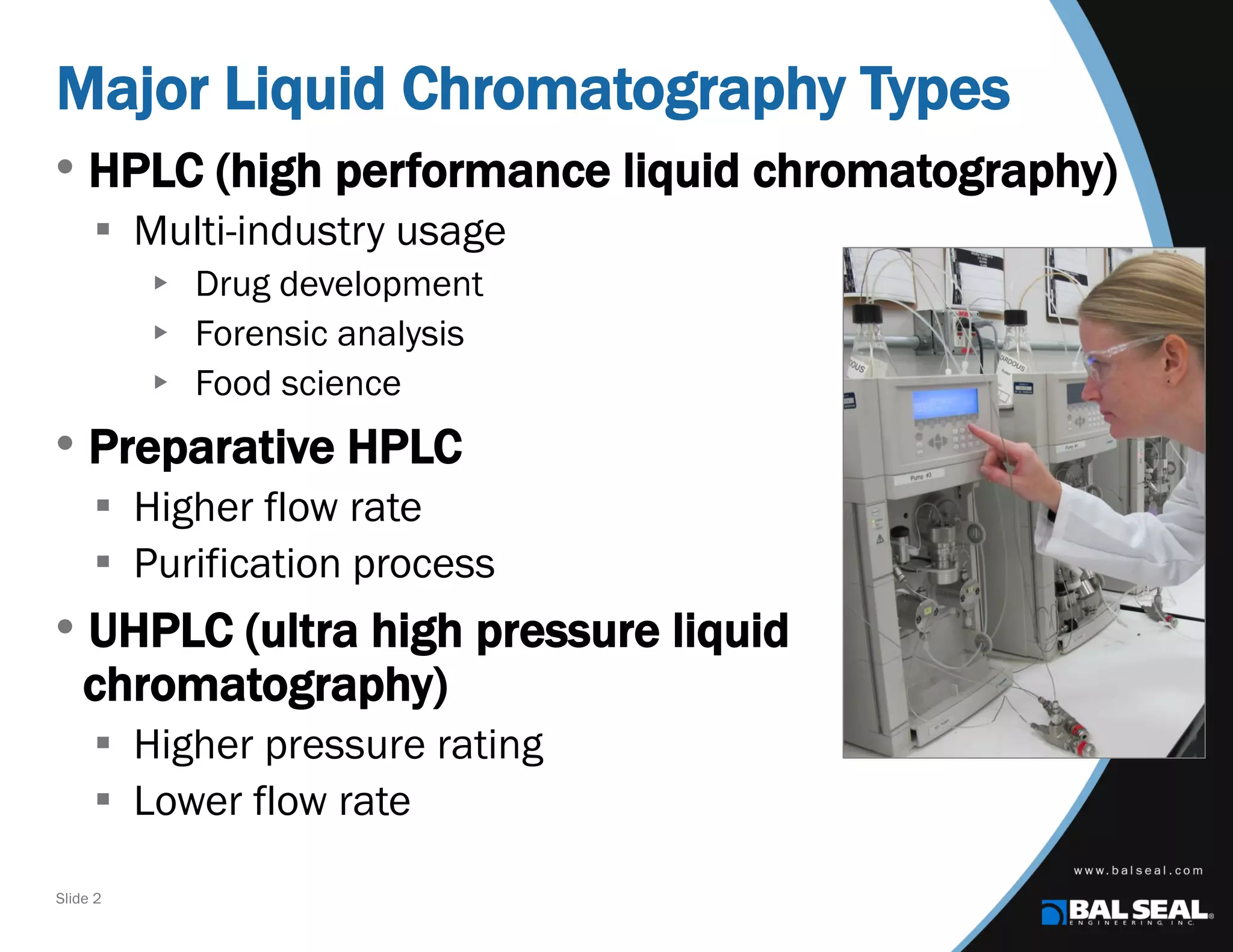
• HPLC (high performance liquid chromatography)
 Multi-industry usage
 Drug development
 Forensic analysis
 Food science
• Preparative HPLC
 Higher flow rate
 Purification process
• UHPLC (ultra high pressure liquid
chromatography)
 Higher pressure rating
 Lower flow rate
Slide 3
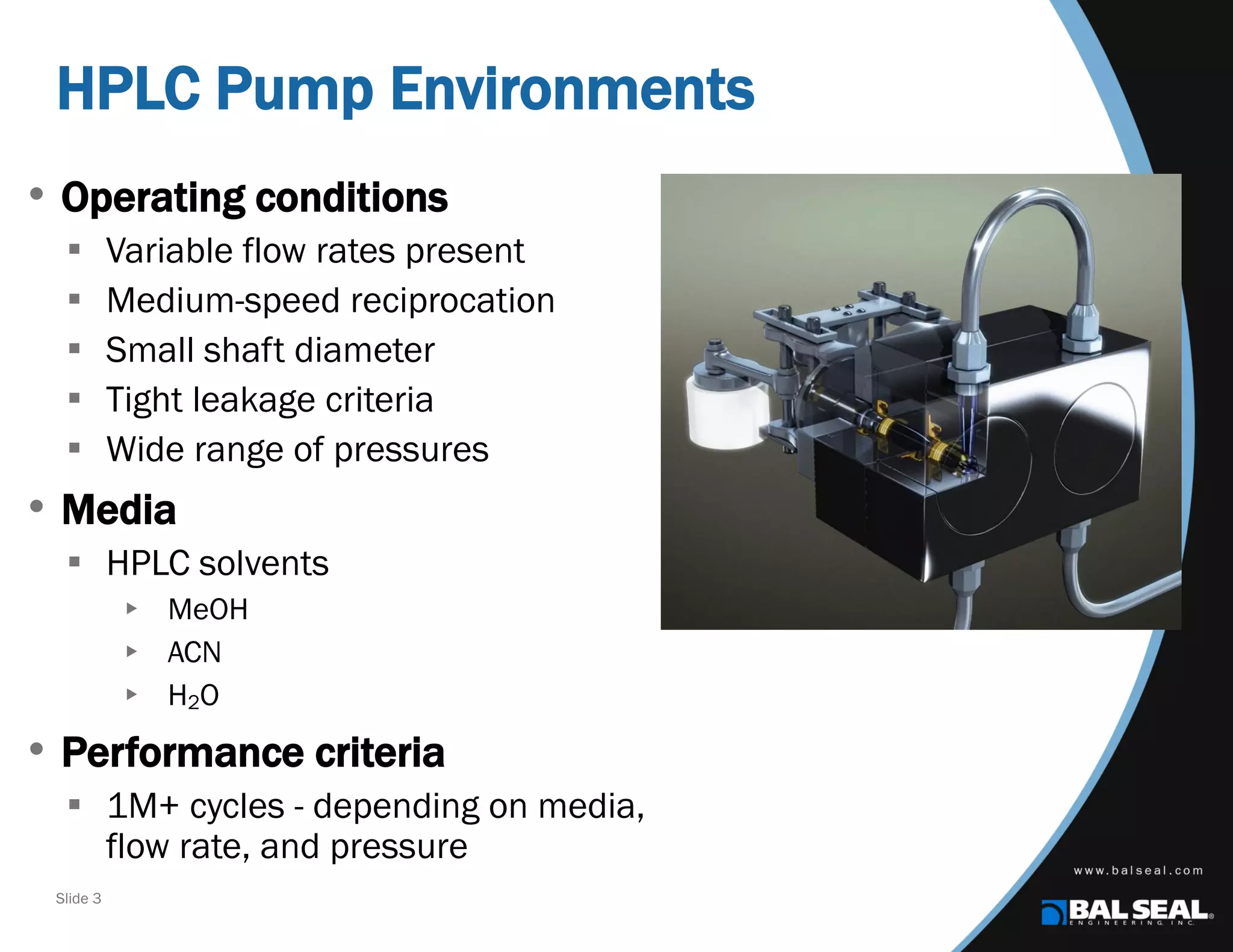
HPLC Pump Environments
• Operating conditions
 Variable flow rates present
 Medium-speed reciprocation
 Small shaft diameter
 Tight leakage criteria
 Wide range of pressures
• Media
 HPLC solvents
 MeOH
 ACN
 H2O
• Performance criteria
 1M+ cycles - depending on media,
flow rate, and pressure
Slide 4
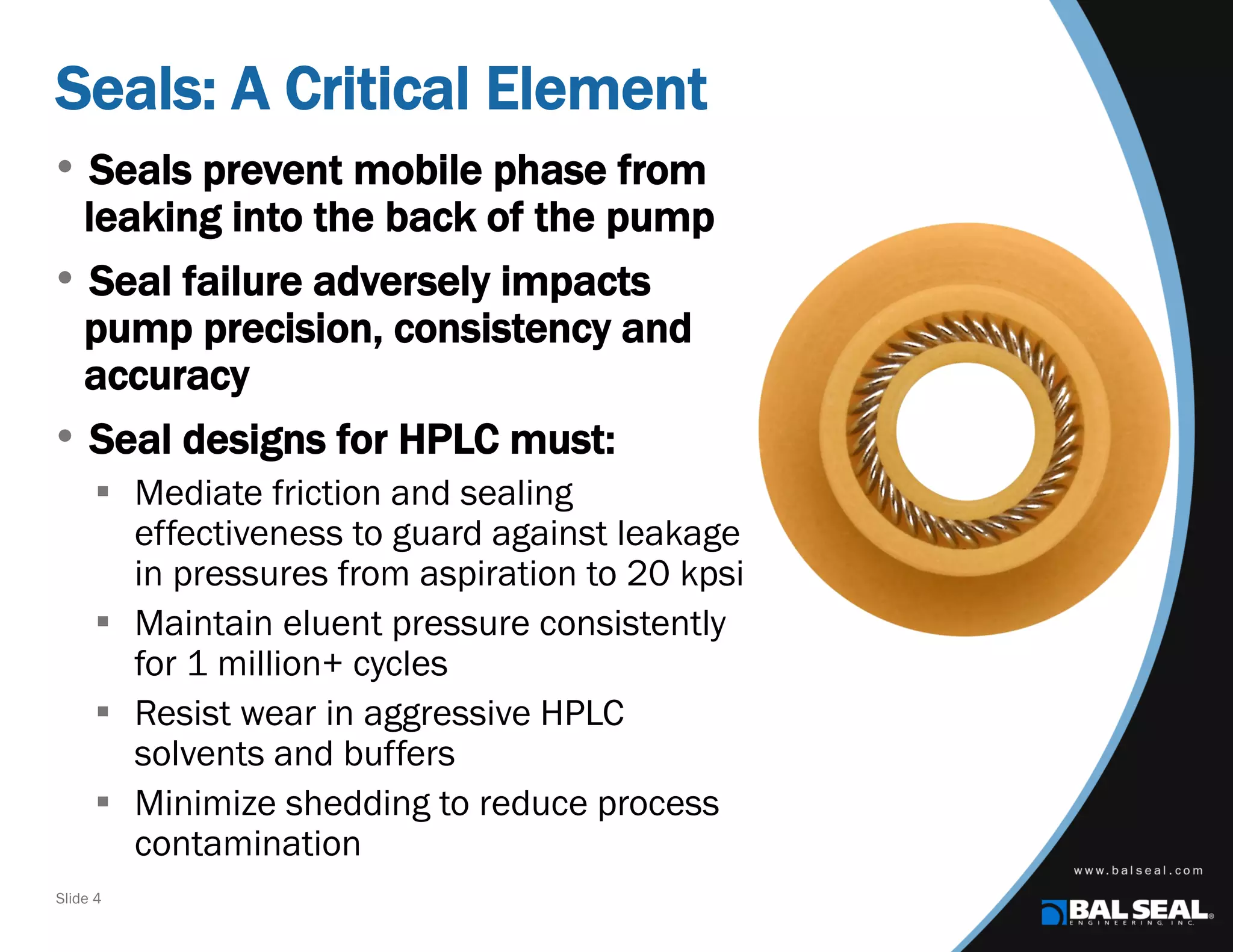
Seals: A Critical Element
• Seals prevent mobile phase from
leaking into the back of the pump
• Seal failure adversely impacts
pump precision, consistency and
accuracy
• Seal designs for HPLC must:
 Mediate friction and sealing
effectiveness to guard against leakage
in pressures from aspiration to 20 kpsi
 Maintain eluent pressure consistently
for 1 million+ cycles
 Resist wear in aggressive HPLC
solvents and buffers
 Minimize shedding to reduce process
contamination
Slide 5
Sealing Performance Factors
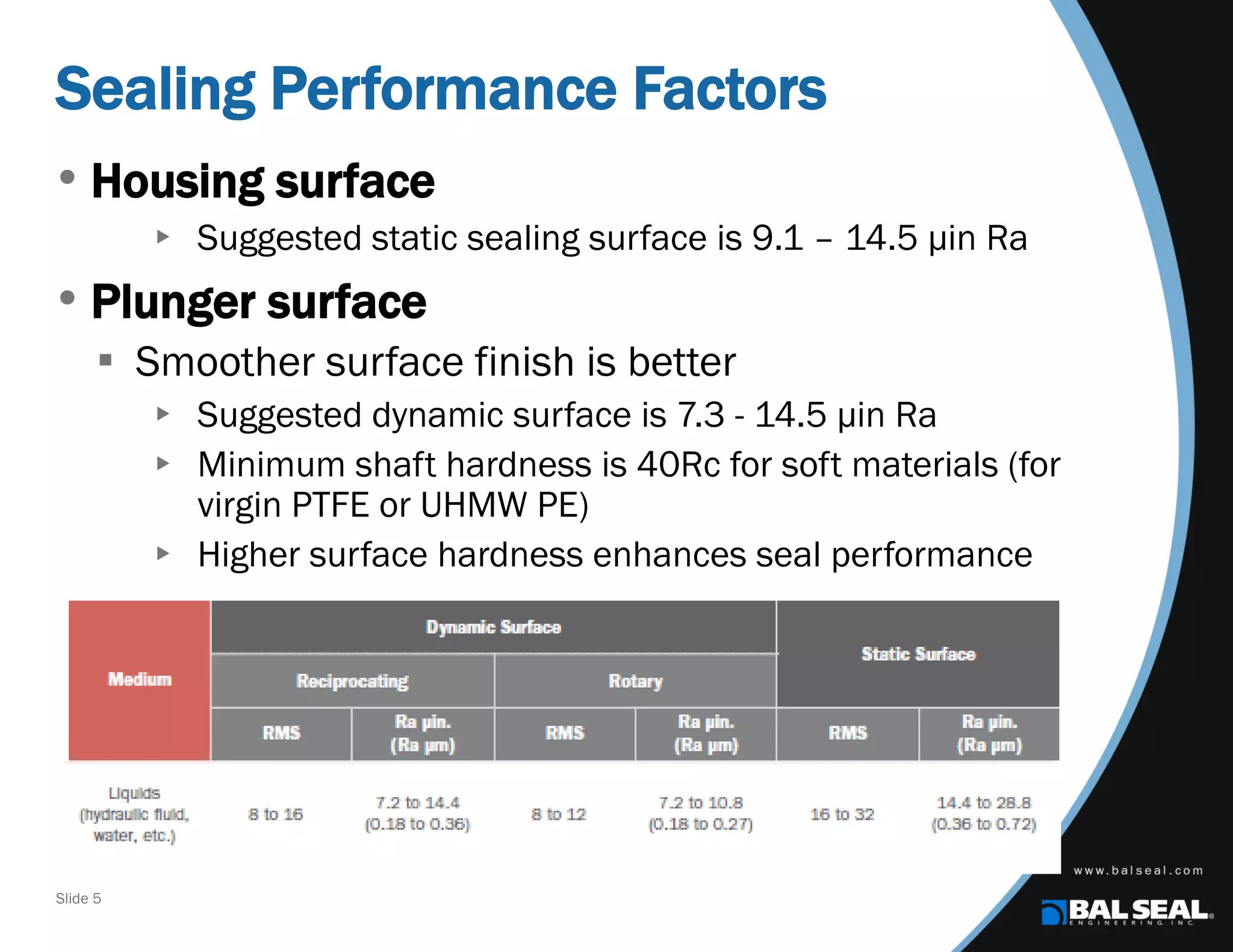
• Housing surface
 Suggested static sealing surface is 9.1 – 14.5 µin Ra
• Plunger surface
 Smoother surface finish is better
 Suggested dynamic surface is 7.3 - 14.5 µin Ra
 Minimum shaft hardness is 40Rc for soft materials (for
virgin PTFE or UHMW PE)
 Higher surface hardness enhances seal performance
Slide 6
Sealing Performance Factors
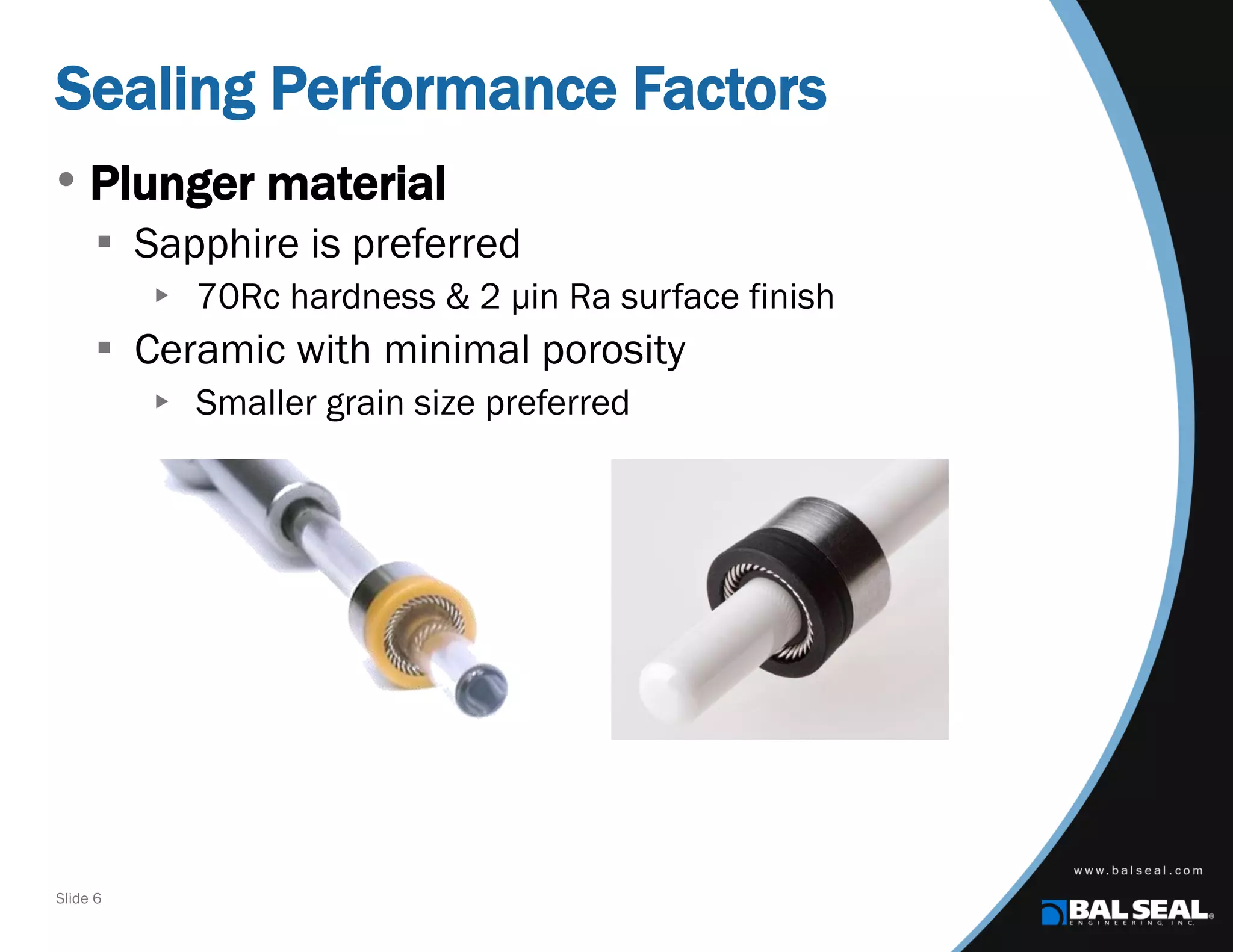
• Plunger material
 Sapphire is preferred
 70Rc hardness & 2 µin Ra surface finish
 Ceramic with minimal porosity
 Smaller grain size preferred
Slide 7
Sealing Performance Factors
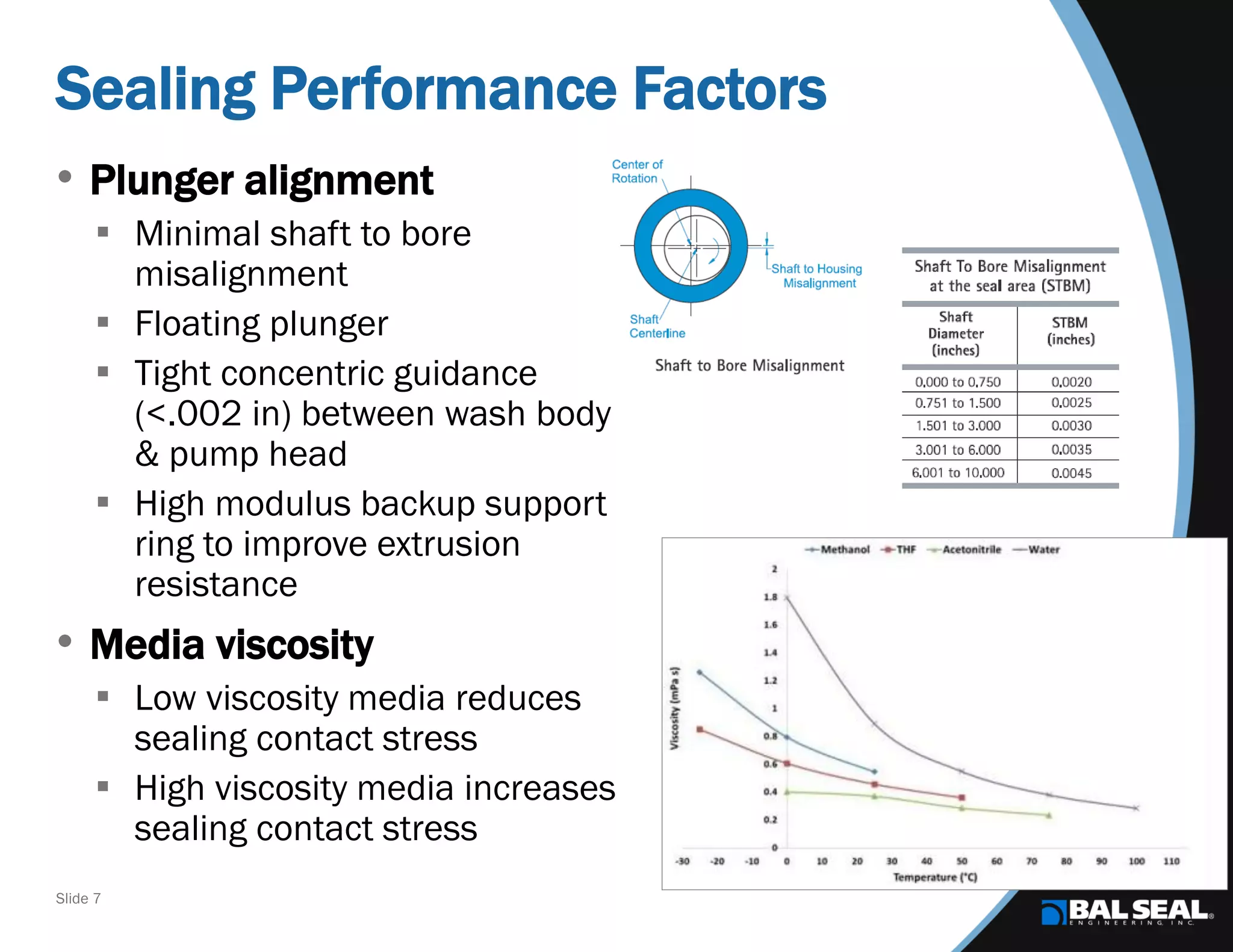
• Plunger alignment
 Minimal shaft to bore
misalignment
 Floating plunger
 Tight concentric guidance
(<.002 in) between wash body
& pump head
 High modulus backup support
ring to improve extrusion
resistance
• Media viscosity
 Low viscosity media reduces
sealing contact stress
 High viscosity media increases
sealing contact stress
Slide 8
Design Insight
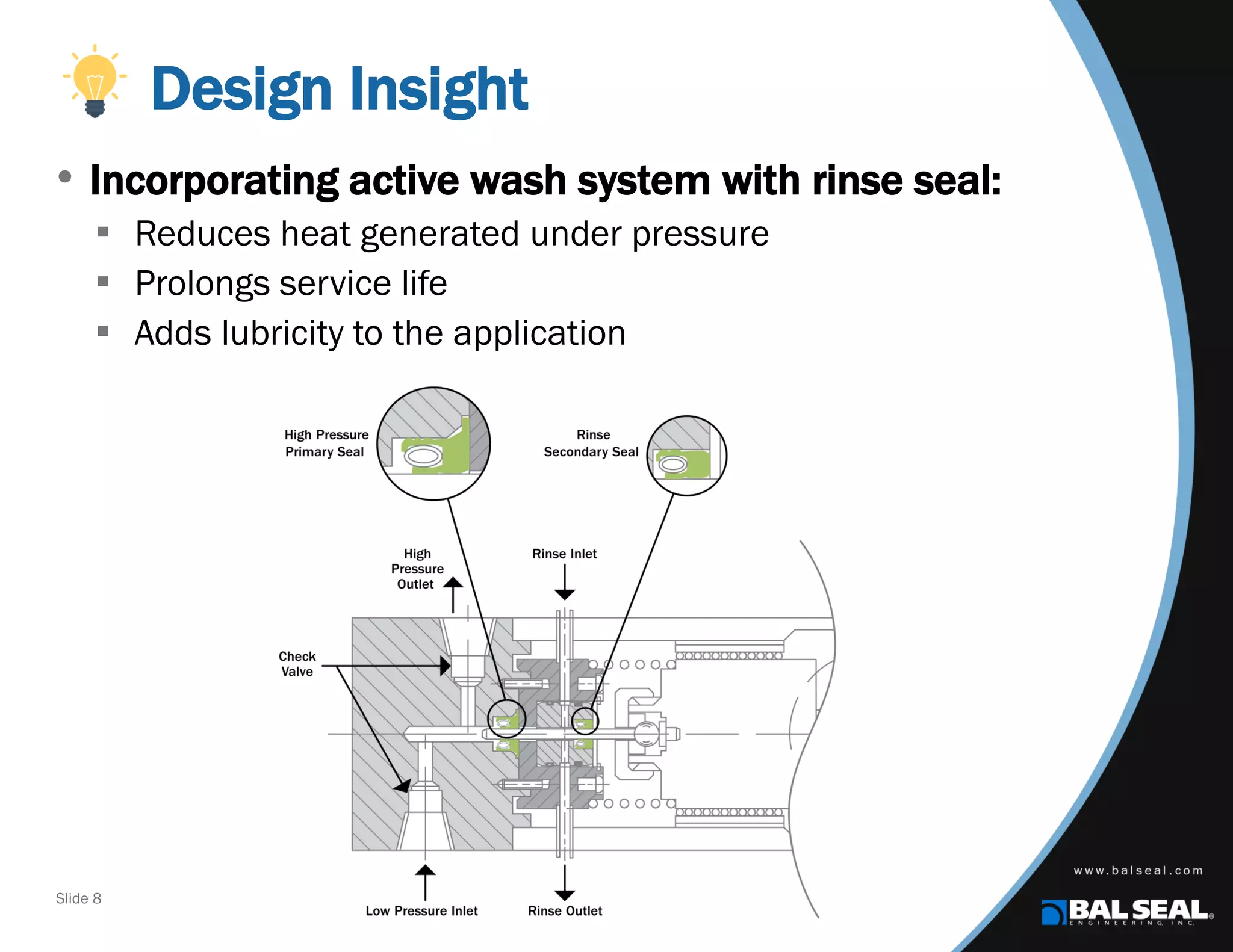
• Incorporating active wash system with rinse seal:
 Reduces heat generated under pressure
 Prolongs service life
 Adds lubricity to the application
Slide 9
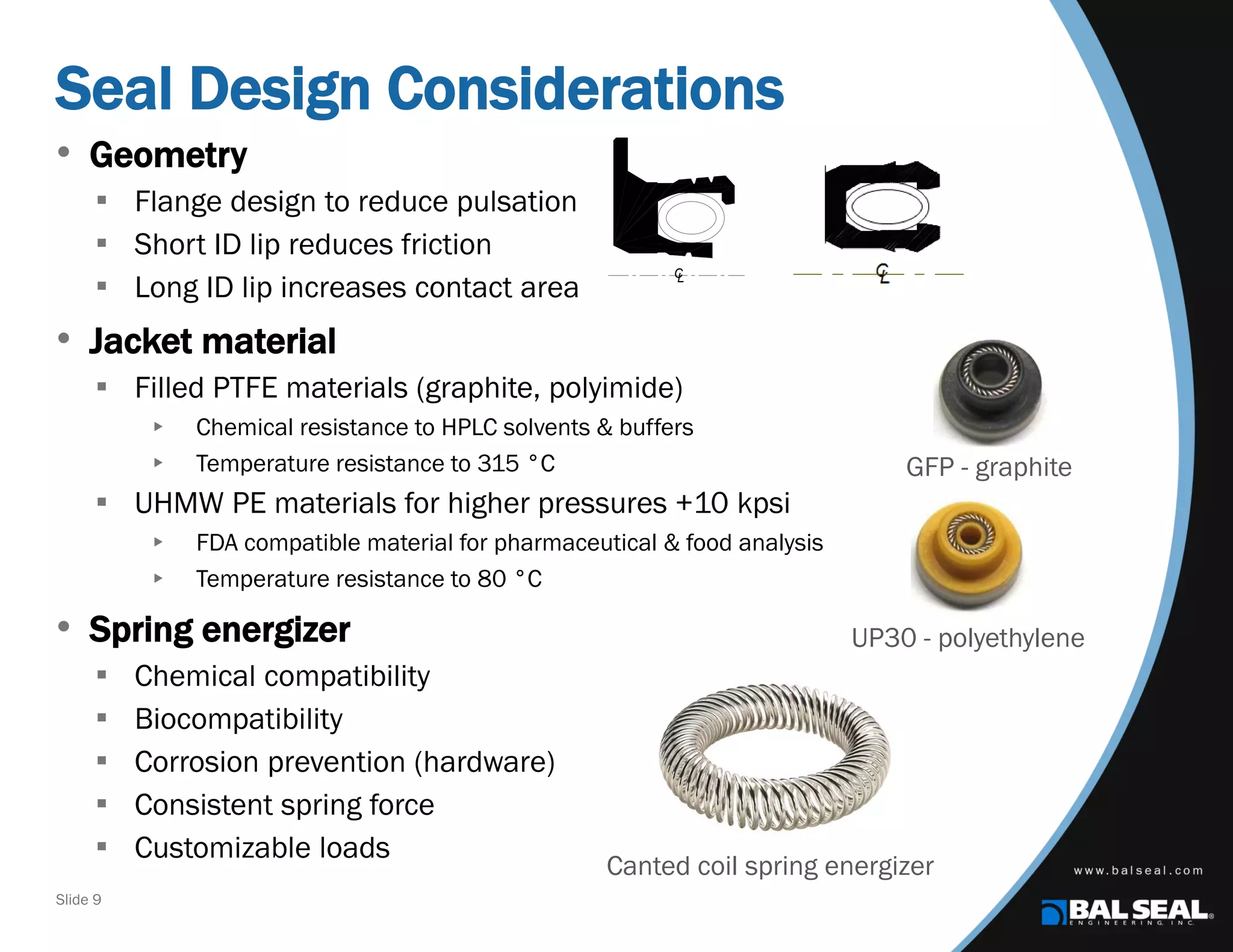
• Geometry
 Flange design to reduce pulsation
 Short ID lip reduces friction
 Long ID lip increases contact area
• Jacket material
 Filled PTFE materials (graphite, polyimide)
 Chemical resistance to HPLC solvents & buffers
 Temperature resistance to 315 °C
 UHMW PE materials for higher pressures +10 kpsi
 FDA compatible material for pharmaceutical & food analysis
 Temperature resistance to 80 °C
• Spring energizer
 Chemical compatibility
 Biocompatibility
 Corrosion prevention (hardware)
 Consistent spring force
 Customizable loads
Seal Design Considerations
LC
GFP - graphite
UP30 - polyethylene
Canted coil spring energizer
Slide 10
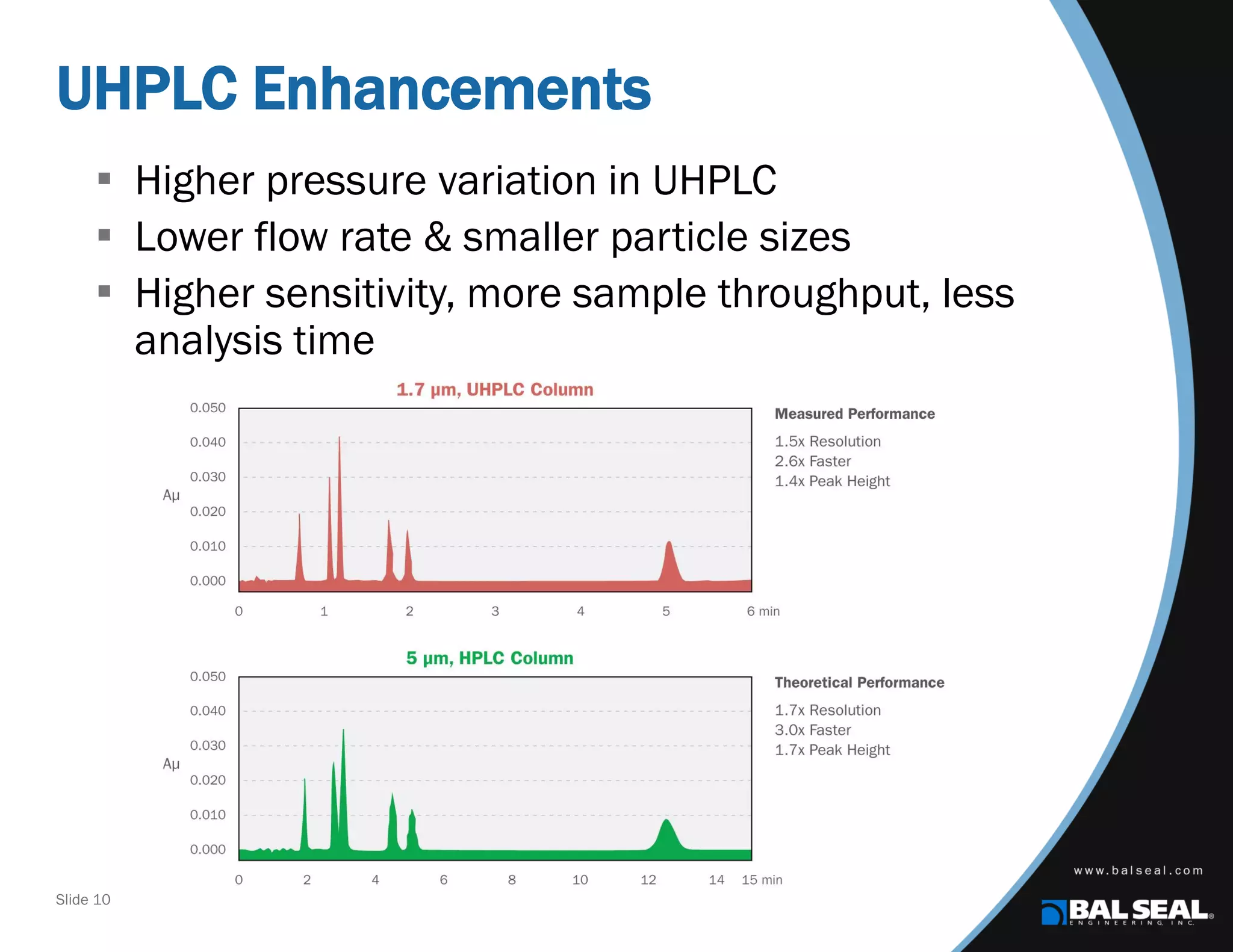
UHPLC Enhancements
 Higher pressure variation in UHPLC
 Lower flow rate & smaller particle sizes
 Higher sensitivity, more sample throughput, less
analysis time
Slide 11
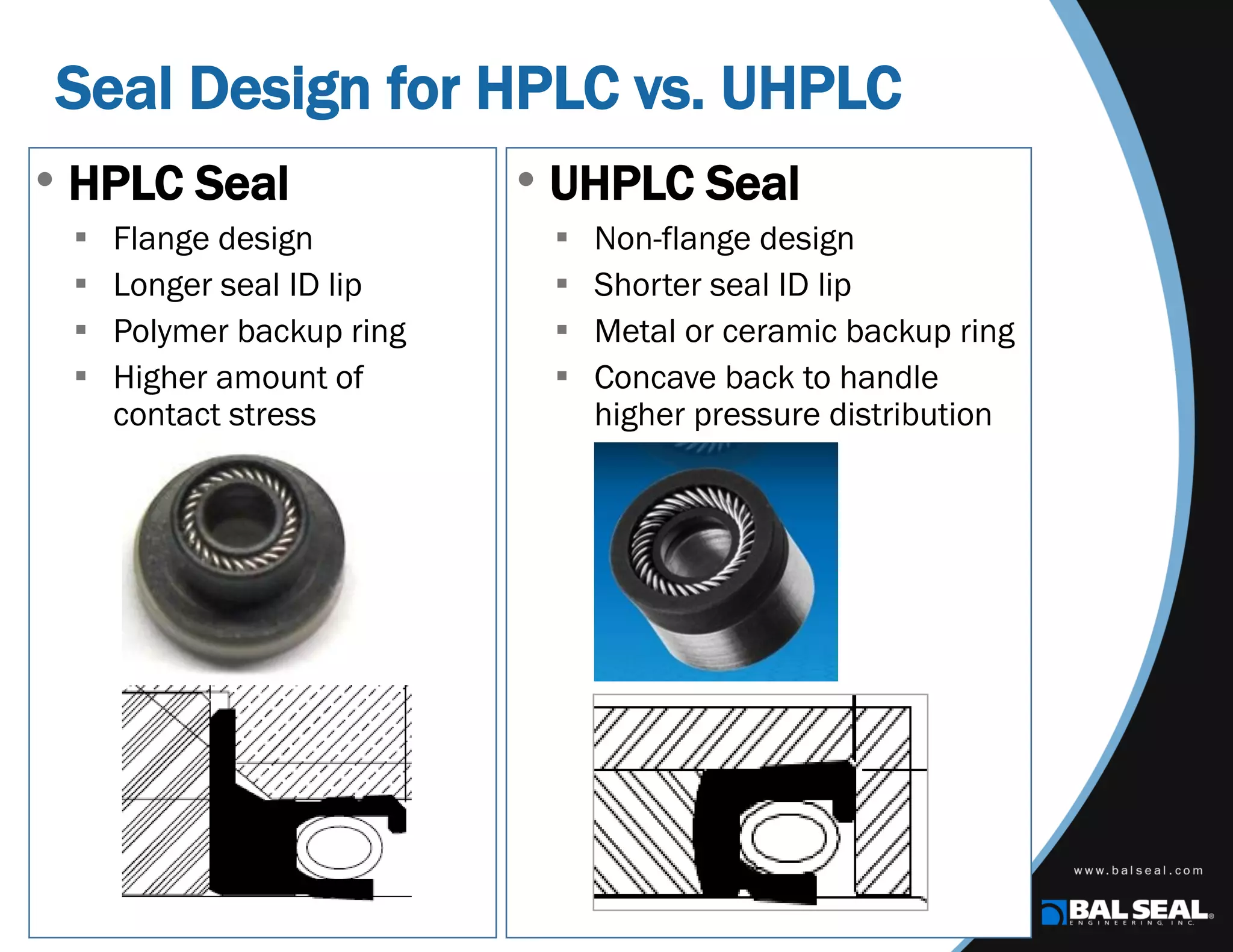
Seal Design for HPLC vs. UHPLC
• HPLC Seal
 Flange design
 Longer seal ID lip
 Polymer backup ring
 Higher amount of
contact stress
• UHPLC Seal
 Non-flange design
 Shorter seal ID lip
 Metal or ceramic backup ring
 Concave back to handle
higher pressure distribution
Slide 12
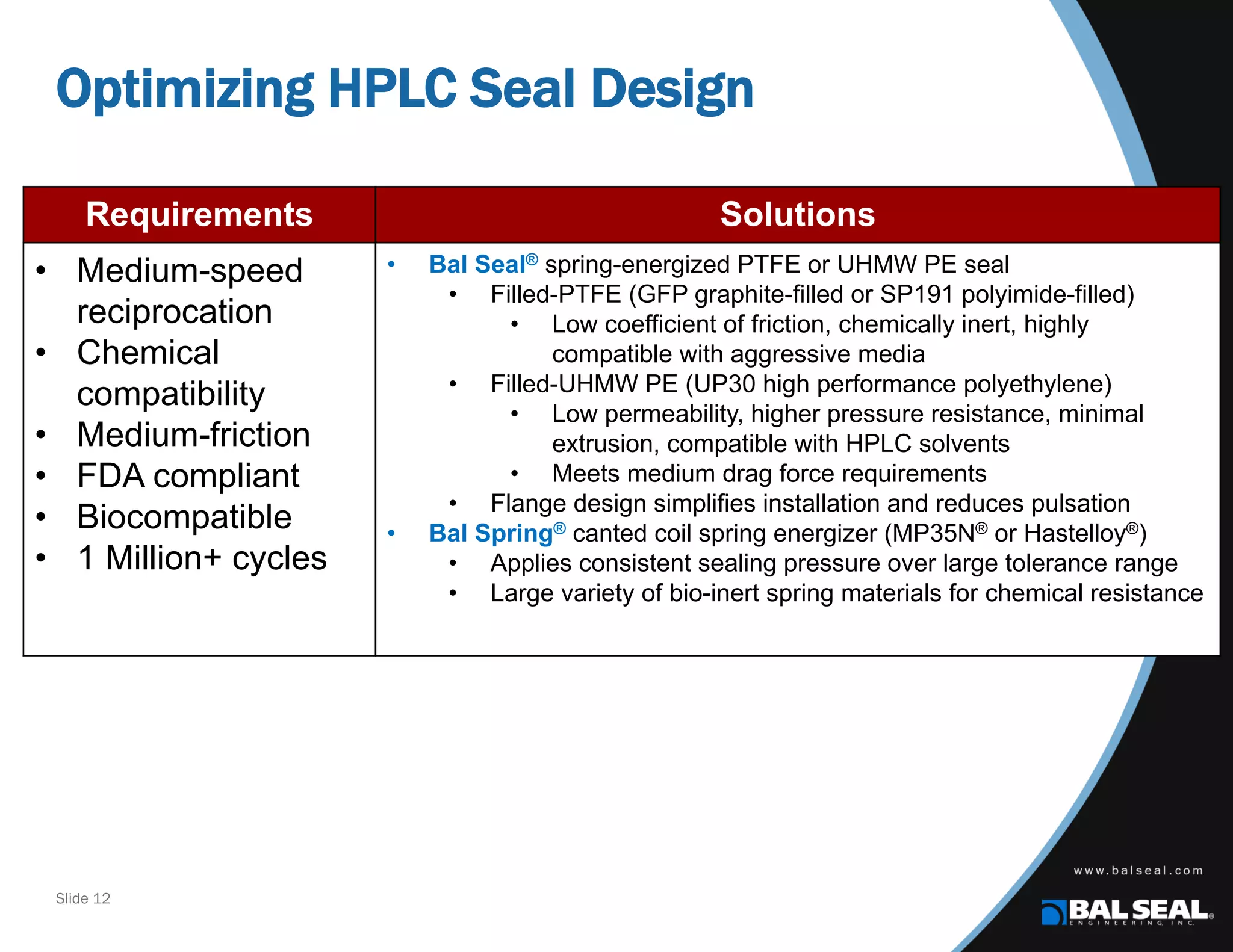
Optimizing HPLC Seal Design
Requirements Solutions
• Medium-speed
reciprocation
• Chemical
compatibility
• Medium-friction
• FDA compliant
• Biocompatible
• 1 Million+ cycles
• Bal Seal® spring-energized PTFE or UHMW PE seal
• Filled-PTFE (GFP graphite-filled or SP191 polyimide-filled)
• Low coefficient of friction, chemically inert, highly
compatible with aggressive media
• Filled-UHMW PE (UP30 high performance polyethylene)
• Low permeability, higher pressure resistance, minimal
extrusion, compatible with HPLC solvents
• Meets medium drag force requirements
• Flange design simplifies installation and reduces pulsation
• Bal Spring® canted coil spring energizer (MP35N® or Hastelloy®)
• Applies consistent sealing pressure over large tolerance range
• Large variety of bio-inert spring materials for chemical resistance
Slide 13
Summary & Recommendations
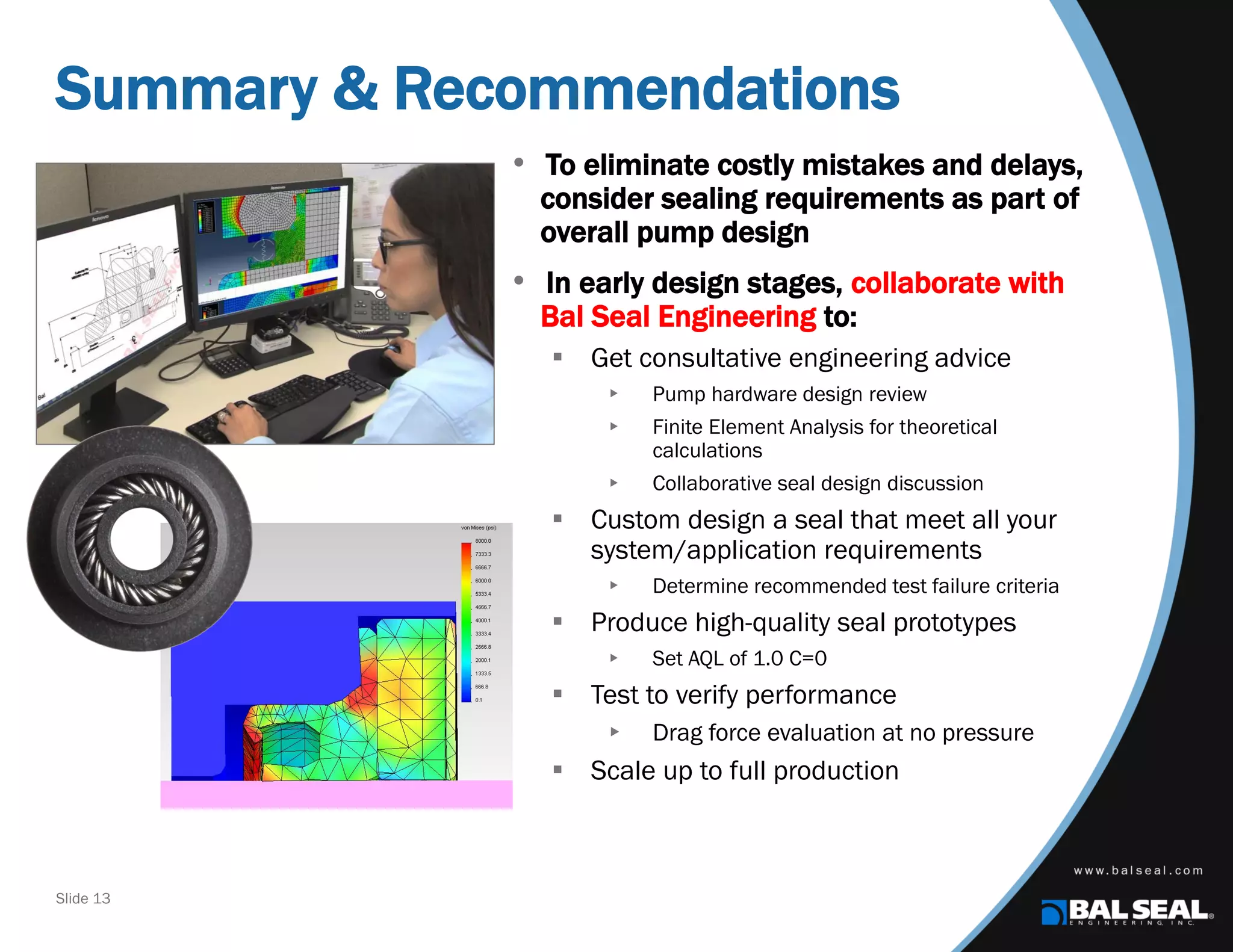
• To eliminate costly mistakes and delays,
consider sealing requirements as part of
overall pump design
• In early design stages, collaborate with
Bal Seal Engineering to:
 Get consultative engineering advice
 Pump hardware design review
 Finite Element Analysis for theoretical
calculations
 Collaborative seal design discussion
 Custom design a seal that meet all your
system/application requirements
 Determine recommended test failure criteria
 Produce high-quality seal prototypes
 Set AQL of 1.0 C=0
 Test to verify performance
 Drag force evaluation at no pressure
 Scale up to full production
Slide 14
Resources & Contact Information
Sarah Smith
Global Market Manager, Analytical
Bal Seal Engineering, Inc.
ssmith@balseal.com
+1 949.460.2226
marketing@balseal.com www.balseal.com +1 949.460.2100 Design request form
Custom components that drive
tomorrow’s technologies®
©Bal Seal Engineering, Inc. This document contains and/or refers to information that is PROPRIETARY to Bal Seal Engineering, Inc. Products referenced herein are the
subject of issued or pending United States and foreign patents. Bal Seal Engineering, Inc. products and designs are PROPRIETARY and products may not be manufactured,
or caused to be manufactured, by any other party.

Optimizing Seal Design for Improved HPLC & UHPLC Pump Performance

  • 1.
    Optimizing Seal Designfor Improved HPLC & UHPLC Pump Performance Sarah Smith, Global Market Manager Bal Seal Engineering, Inc.
  • 2.
    Slide 2 Major LiquidChromatography Types • HPLC (high performance liquid chromatography)  Multi-industry usage  Drug development  Forensic analysis  Food science • Preparative HPLC  Higher flow rate  Purification process • UHPLC (ultra high pressure liquid chromatography)  Higher pressure rating  Lower flow rate
  • 3.
    Slide 3 HPLC PumpEnvironments • Operating conditions  Variable flow rates present  Medium-speed reciprocation  Small shaft diameter  Tight leakage criteria  Wide range of pressures • Media  HPLC solvents  MeOH  ACN  H2O • Performance criteria  1M+ cycles - depending on media, flow rate, and pressure
  • 4.
    Slide 4 Seals: ACritical Element • Seals prevent mobile phase from leaking into the back of the pump • Seal failure adversely impacts pump precision, consistency and accuracy • Seal designs for HPLC must:  Mediate friction and sealing effectiveness to guard against leakage in pressures from aspiration to 20 kpsi  Maintain eluent pressure consistently for 1 million+ cycles  Resist wear in aggressive HPLC solvents and buffers  Minimize shedding to reduce process contamination
  • 5.
    Slide 5 Sealing PerformanceFactors • Housing surface  Suggested static sealing surface is 9.1 – 14.5 µin Ra • Plunger surface  Smoother surface finish is better  Suggested dynamic surface is 7.3 - 14.5 µin Ra  Minimum shaft hardness is 40Rc for soft materials (for virgin PTFE or UHMW PE)  Higher surface hardness enhances seal performance
  • 6.
    Slide 6 Sealing PerformanceFactors • Plunger material  Sapphire is preferred  70Rc hardness & 2 µin Ra surface finish  Ceramic with minimal porosity  Smaller grain size preferred
  • 7.
    Slide 7 Sealing PerformanceFactors • Plunger alignment  Minimal shaft to bore misalignment  Floating plunger  Tight concentric guidance (<.002 in) between wash body & pump head  High modulus backup support ring to improve extrusion resistance • Media viscosity  Low viscosity media reduces sealing contact stress  High viscosity media increases sealing contact stress
  • 8.
    Slide 8 Design Insight •Incorporating active wash system with rinse seal:  Reduces heat generated under pressure  Prolongs service life  Adds lubricity to the application
  • 9.
    Slide 9 • Geometry Flange design to reduce pulsation  Short ID lip reduces friction  Long ID lip increases contact area • Jacket material  Filled PTFE materials (graphite, polyimide)  Chemical resistance to HPLC solvents & buffers  Temperature resistance to 315 °C  UHMW PE materials for higher pressures +10 kpsi  FDA compatible material for pharmaceutical & food analysis  Temperature resistance to 80 °C • Spring energizer  Chemical compatibility  Biocompatibility  Corrosion prevention (hardware)  Consistent spring force  Customizable loads Seal Design Considerations LC GFP - graphite UP30 - polyethylene Canted coil spring energizer
  • 10.
    Slide 10 UHPLC Enhancements Higher pressure variation in UHPLC  Lower flow rate & smaller particle sizes  Higher sensitivity, more sample throughput, less analysis time
  • 11.
    Slide 11 Seal Designfor HPLC vs. UHPLC • HPLC Seal  Flange design  Longer seal ID lip  Polymer backup ring  Higher amount of contact stress • UHPLC Seal  Non-flange design  Shorter seal ID lip  Metal or ceramic backup ring  Concave back to handle higher pressure distribution
  • 12.
    Slide 12 Optimizing HPLCSeal Design Requirements Solutions • Medium-speed reciprocation • Chemical compatibility • Medium-friction • FDA compliant • Biocompatible • 1 Million+ cycles • Bal Seal® spring-energized PTFE or UHMW PE seal • Filled-PTFE (GFP graphite-filled or SP191 polyimide-filled) • Low coefficient of friction, chemically inert, highly compatible with aggressive media • Filled-UHMW PE (UP30 high performance polyethylene) • Low permeability, higher pressure resistance, minimal extrusion, compatible with HPLC solvents • Meets medium drag force requirements • Flange design simplifies installation and reduces pulsation • Bal Spring® canted coil spring energizer (MP35N® or Hastelloy®) • Applies consistent sealing pressure over large tolerance range • Large variety of bio-inert spring materials for chemical resistance
  • 13.
    Slide 13 Summary &Recommendations • To eliminate costly mistakes and delays, consider sealing requirements as part of overall pump design • In early design stages, collaborate with Bal Seal Engineering to:  Get consultative engineering advice  Pump hardware design review  Finite Element Analysis for theoretical calculations  Collaborative seal design discussion  Custom design a seal that meet all your system/application requirements  Determine recommended test failure criteria  Produce high-quality seal prototypes  Set AQL of 1.0 C=0  Test to verify performance  Drag force evaluation at no pressure  Scale up to full production
  • 14.
    Slide 14 Resources &Contact Information Sarah Smith Global Market Manager, Analytical Bal Seal Engineering, Inc. ssmith@balseal.com +1 949.460.2226 marketing@balseal.com www.balseal.com +1 949.460.2100 Design request form
  • 15.
    Custom components thatdrive tomorrow’s technologies® ©Bal Seal Engineering, Inc. This document contains and/or refers to information that is PROPRIETARY to Bal Seal Engineering, Inc. Products referenced herein are the subject of issued or pending United States and foreign patents. Bal Seal Engineering, Inc. products and designs are PROPRIETARY and products may not be manufactured, or caused to be manufactured, by any other party.