Photocalorimetry: Validation Methods Andy Morris, Medway Sciences, University of Greenwich at Medway
Outline of Talk Background to Photocalorimetry Project Instrument Design Validation Techniques & Actinometry 2-NB Ferrioxalate Spectroradiometry Conclusions & Future Work Applications to solids
Photocalorimetry A new area of interest - small amount of previous work (virtually nothing written about the solid state) Many benefits: Rapid analysis - conventional storage testing takes many weeks, calorimetric technique can be done in hours Conventional testing is costly Sensitive analysis - heat changes in the µW range detected Apparatus enables testing in both the solid and solution phases Can apply data to calorimetric equations for analysis Simple experimental setup...
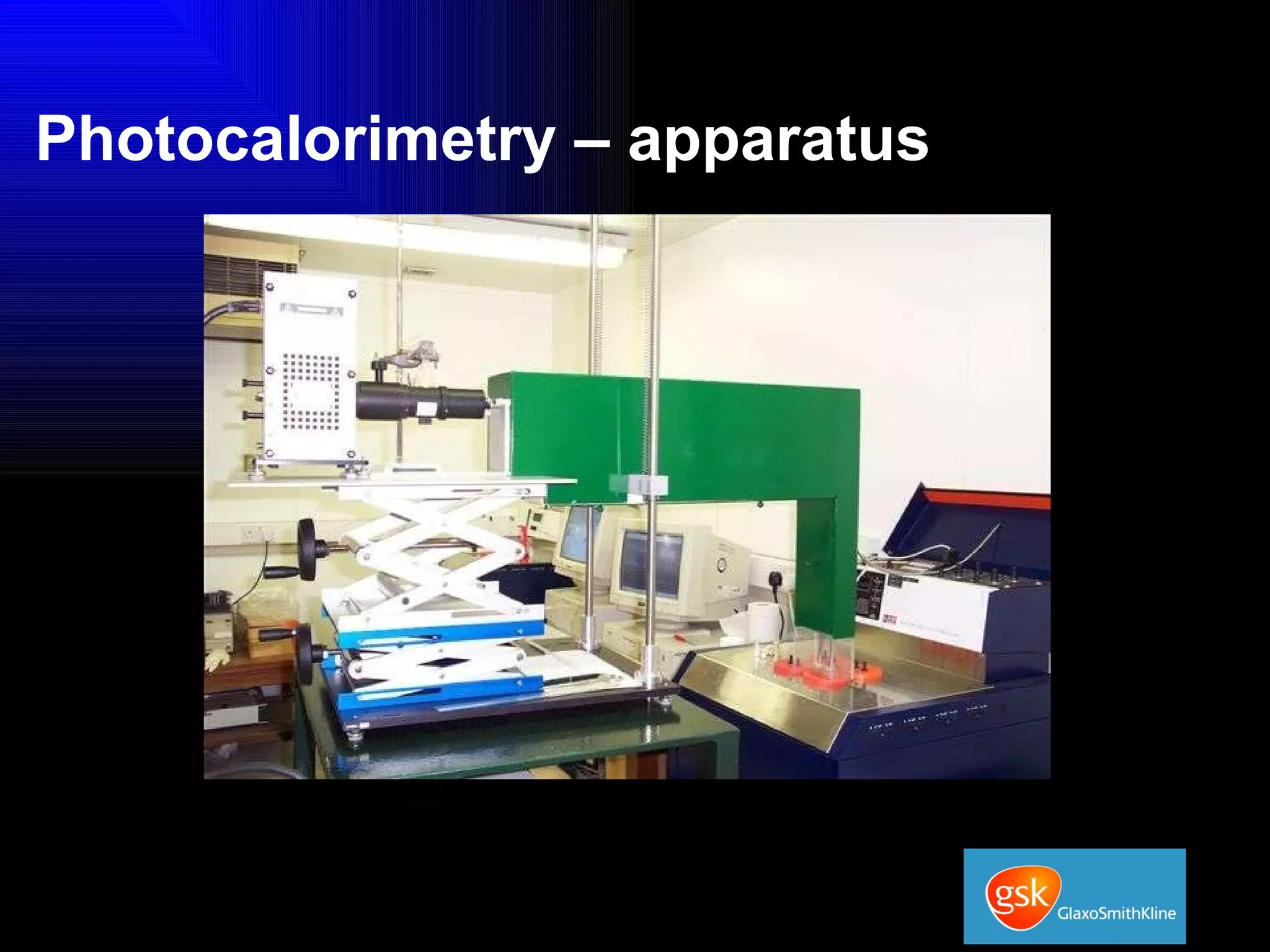
Photocalorimetry – apparatus
Photocalorimetry - Validation Apparatus has been developed previously (Lehto  et al .) First need to establish a validation method ( cf  triacetin reaction) i.e.  a system that can be used as a chemical actinometer Systems well-known in the literature Solids :  nifedipine Solutions:  ferrioxalate (conventional)   2-nitrobenzaldehyde (2-NB) (novel) Initial work in solution phase - simpler systems, in principle More complex validation systems will come later (e.g. solids)
Photocalorimetry - Actinometry Chemical Actinometers A solution containing a chemical compound that undergoes a specific chemical reaction as a result of photon absorption Reaction Rate related to the rate at which photons are absorbed by the actinometer The actinometer solution is illuminated under the same conditions as the drug samples The reaction is followed as a function of illumination time    Photon Flux    Photon Flux (Wm -2 ) Allows results to be compared quantitatively if a value of H is known….
Photocalorimetry - Actinometry 3 Systems to Compare: 2-nitrobenzaldehyde - novel Potassium Ferrioxalate - established Spectroradiometry (absolute method)
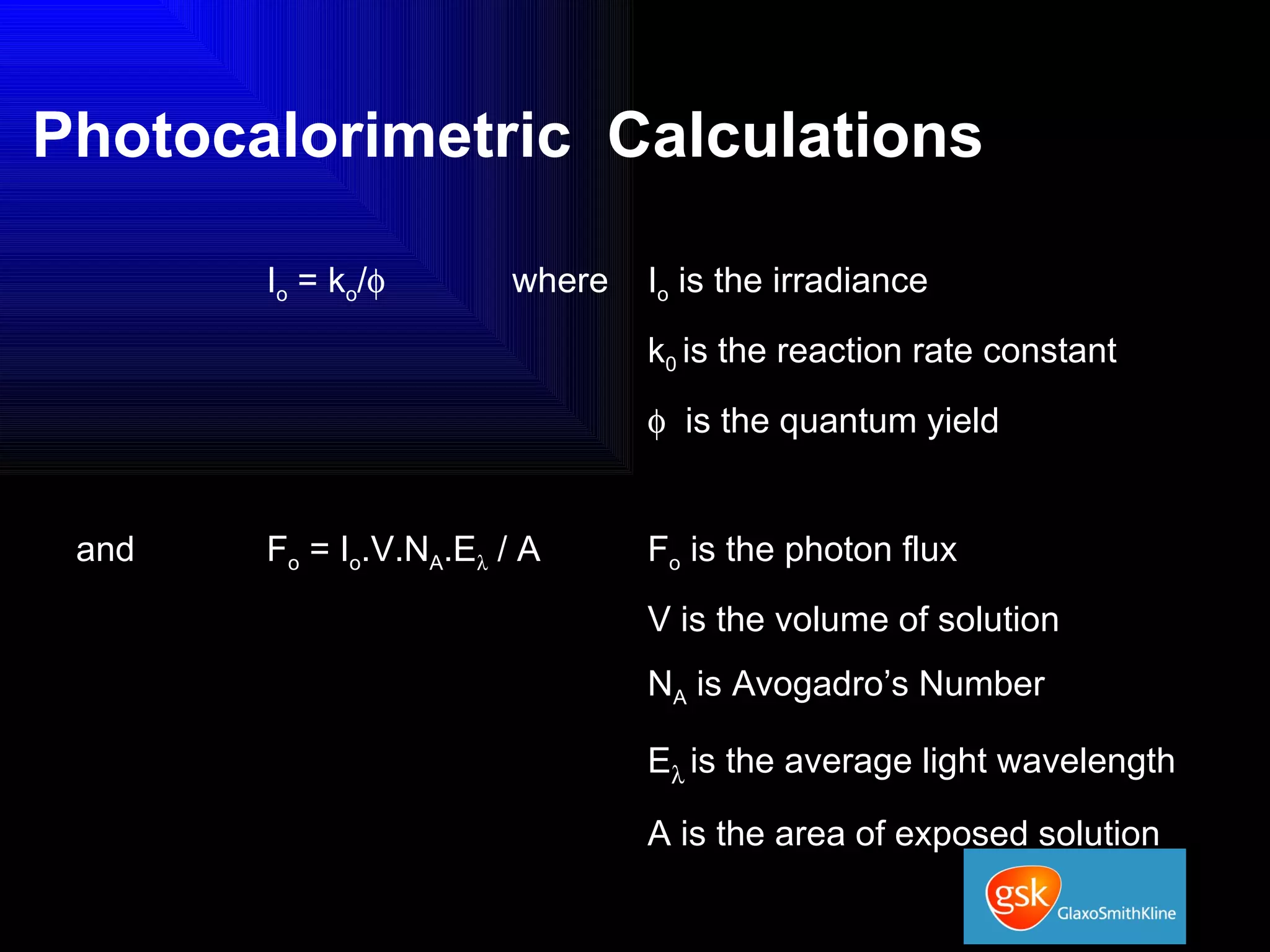
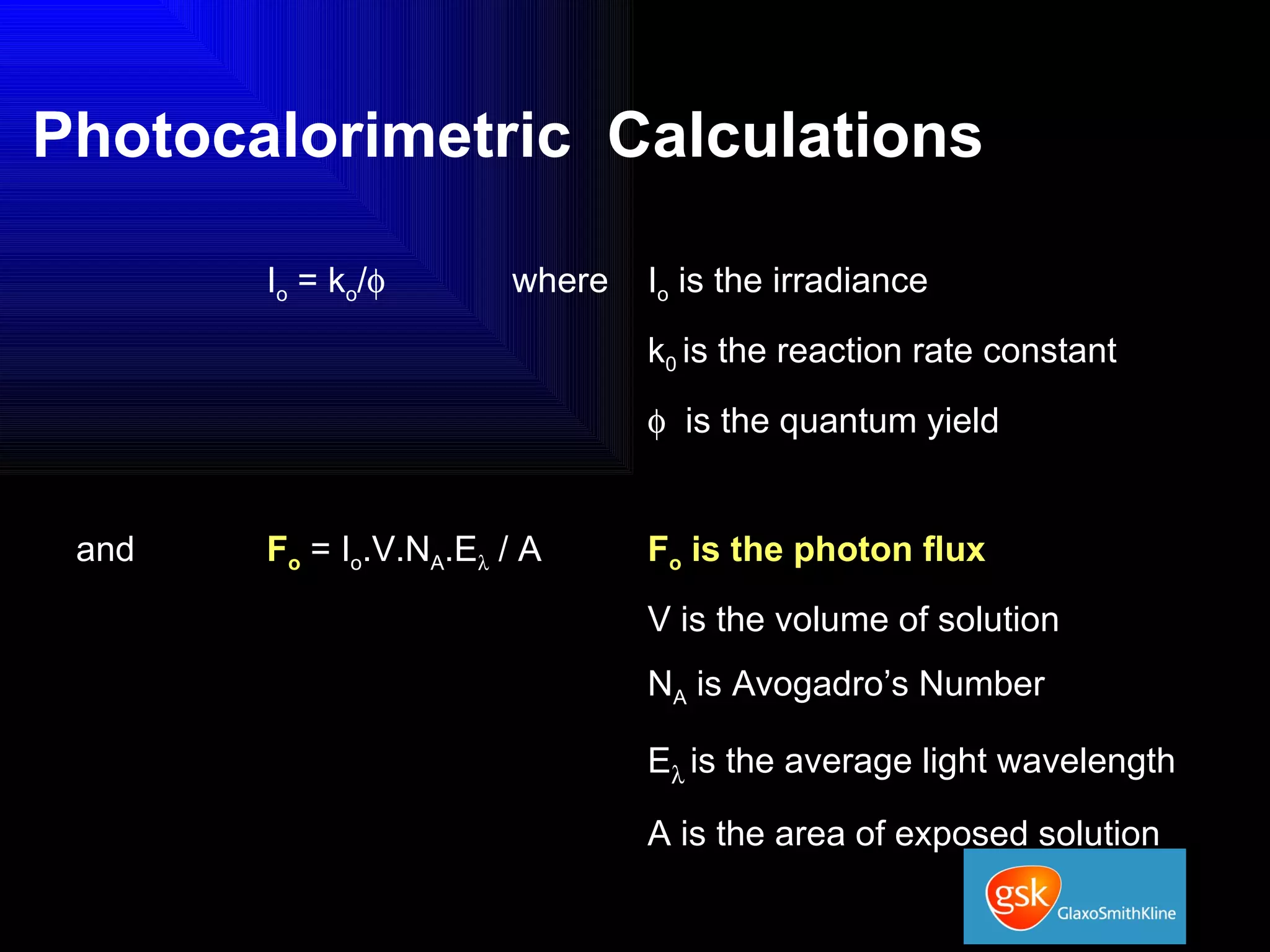
Photocalorimetric  Calculations I o  = k o /    where  I o  is the irradiance k 0  is the reaction rate constant    is the quantum yield and  F o  = I o .V.N A .E   / A F o  is the photon flux V is the volume of solution N A  is Avogadro’s Number E    is the average light wavelength A is the area of exposed solution
Photocalorimetric  Calculations I o  = k o /    where  I o  is the irradiance k 0  is the reaction rate constant    is the quantum yield and  F o   = I o .V.N A .E   / A F o  is the photon flux V is the volume of solution N A  is Avogadro’s Number E    is the average light wavelength A is the area of exposed solution
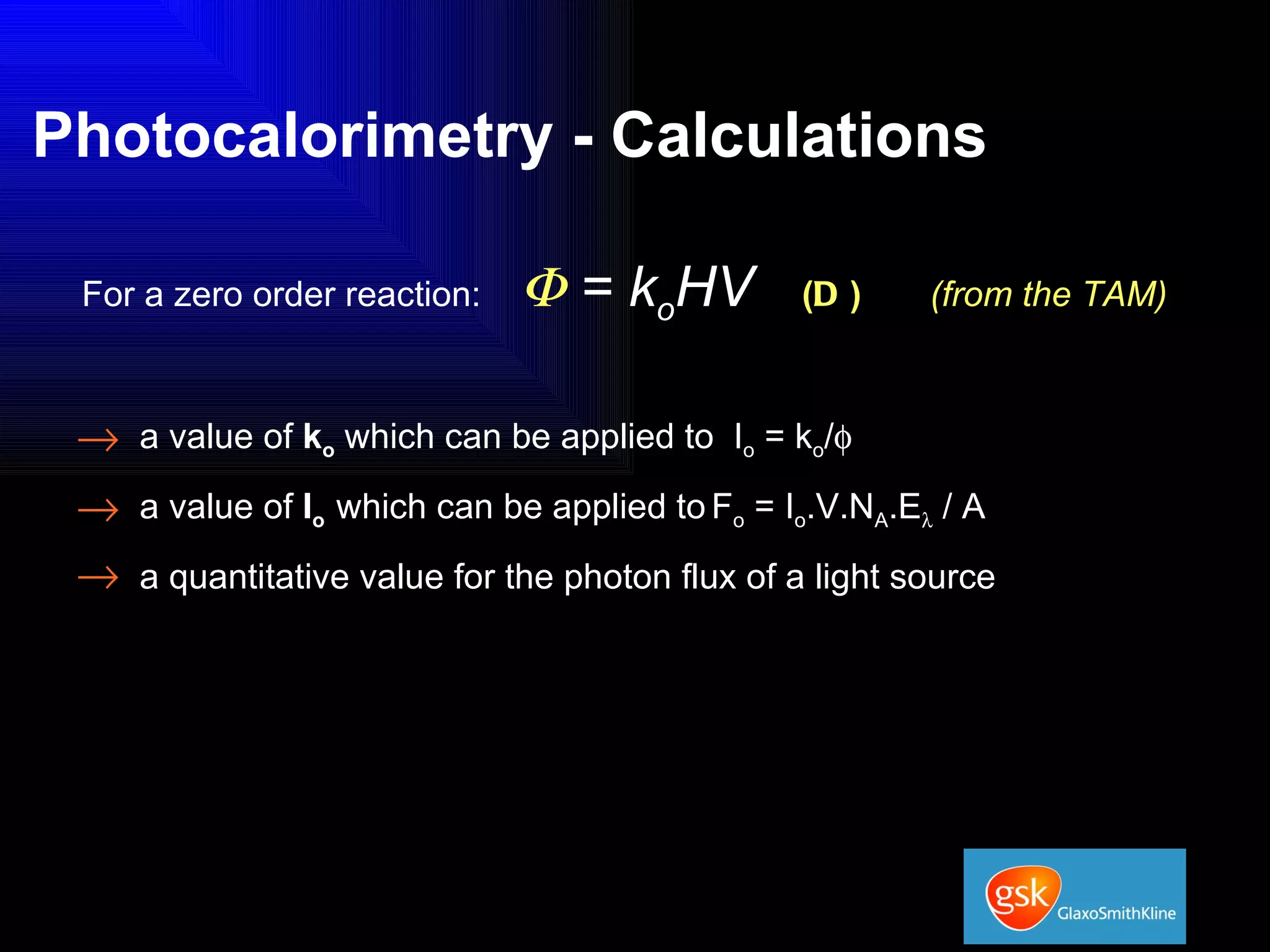
Photocalorimetry - Calculations For a zero order reaction:   = k o HV   a value of  k o  which can be applied to  I o  = k o /  a value of  I o   which can be applied to   F o  = I o .V.N A .E   / A a quantitative value (in W / m 2 ) for the photon flux of a light source
Photocalorimetry - Calculations For a zero order reaction:   = k o HV   ( D )  (from the TAM) a value of  k o  which can be applied to  I o  = k o /  a value of  I o   which can be applied to   F o  = I o .V.N A .E   / A a quantitative value for the photon flux of a light source
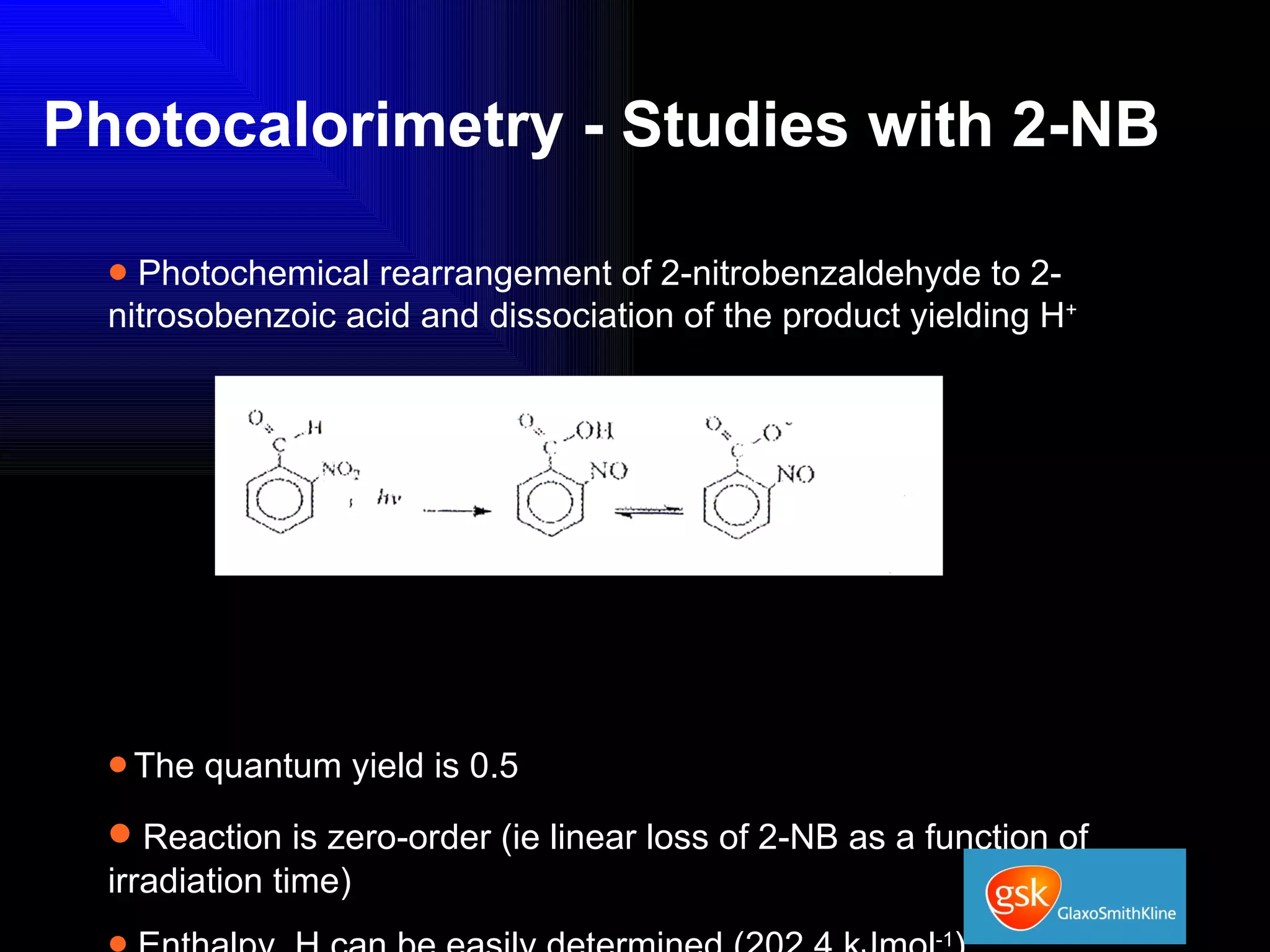
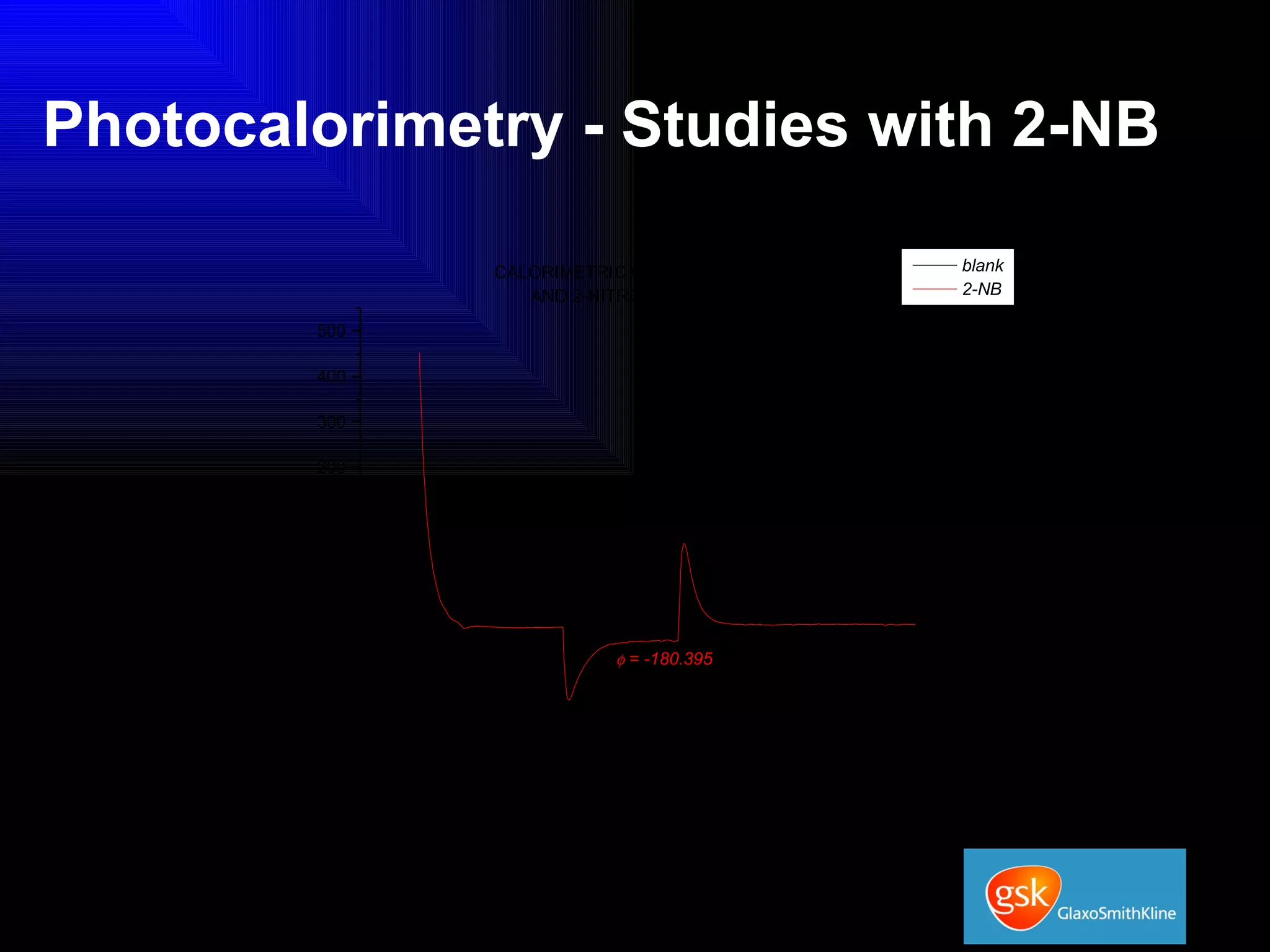
Photocalorimetry - Studies with 2-NB Photochemical rearrangement of 2-nitrobenzaldehyde to 2-nitrosobenzoic acid and dissociation of the product yielding H +  The quantum yield is 0.5 Reaction is zero-order (ie linear loss of 2-NB as a function of irradiation time) Enthalpy, H can be easily determined (202.4 kJmol -1 ) Can be followed in real-time in the TAM...
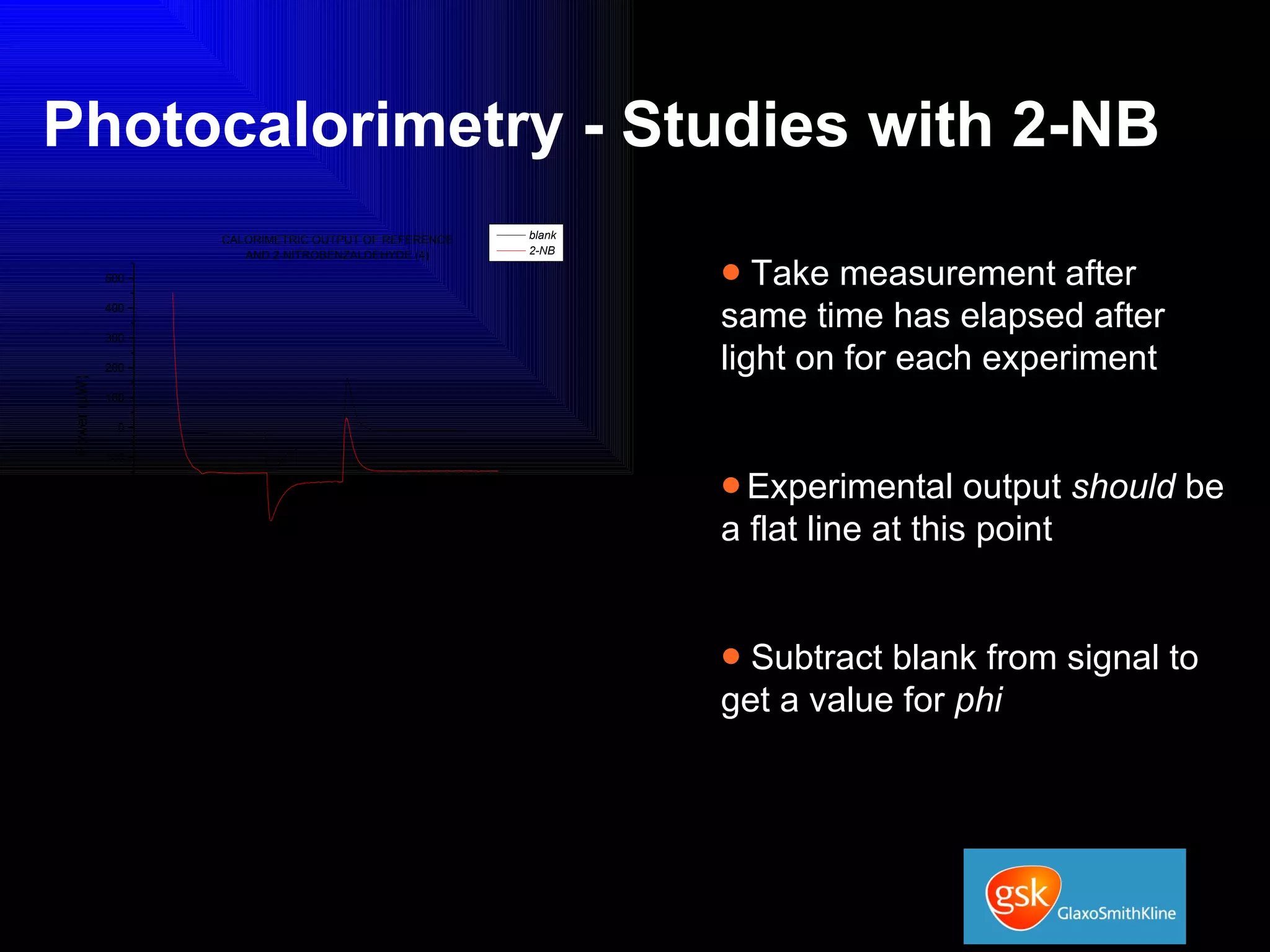
Photocalorimetry - Studies with 2-NB Take measurement after same time has elapsed after light on for each experiment Experimental output  should  be a flat line at this point Subtract blank from signal to get a value for  phi
Photocalorimetry - Studies with 2-NB
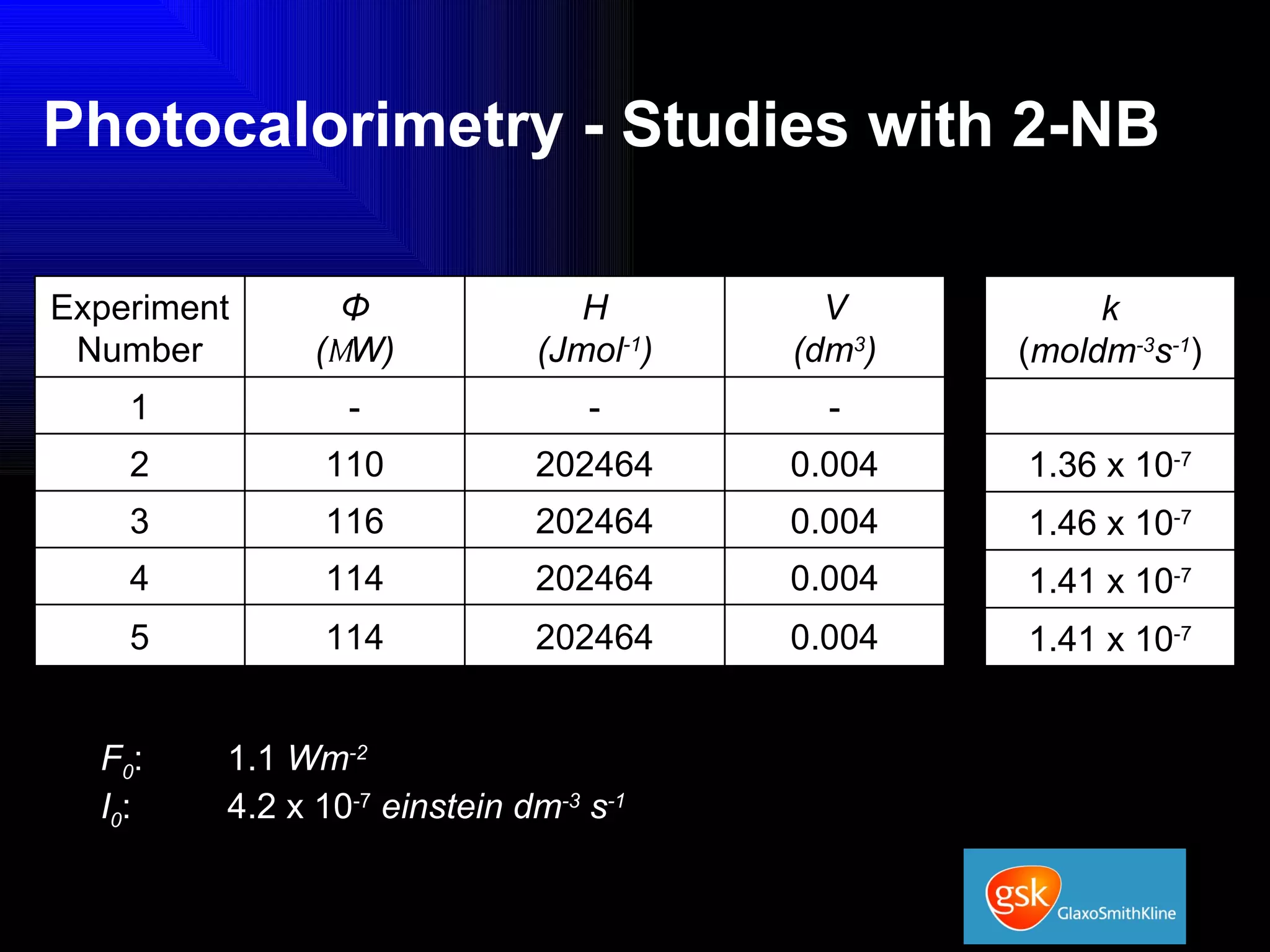
Photocalorimetry - Studies with 2-NB F 0 : 1.1  Wm -2 I 0 : 4.2 x 10 -7   einstein dm -3  s -1 Experiment Number Φ ( m W) H (Jmol -1 ) V (dm 3 ) 1 - - - 2 110 202464 0.004 3 116 202464 0.004 4 114 202464 0.004 5 114 202464 0.004 k ( moldm -3 s -1 ) 1.36 x 10 -7 1.46 x 10 -7 1.41 x 10 -7 1.41 x 10 -7
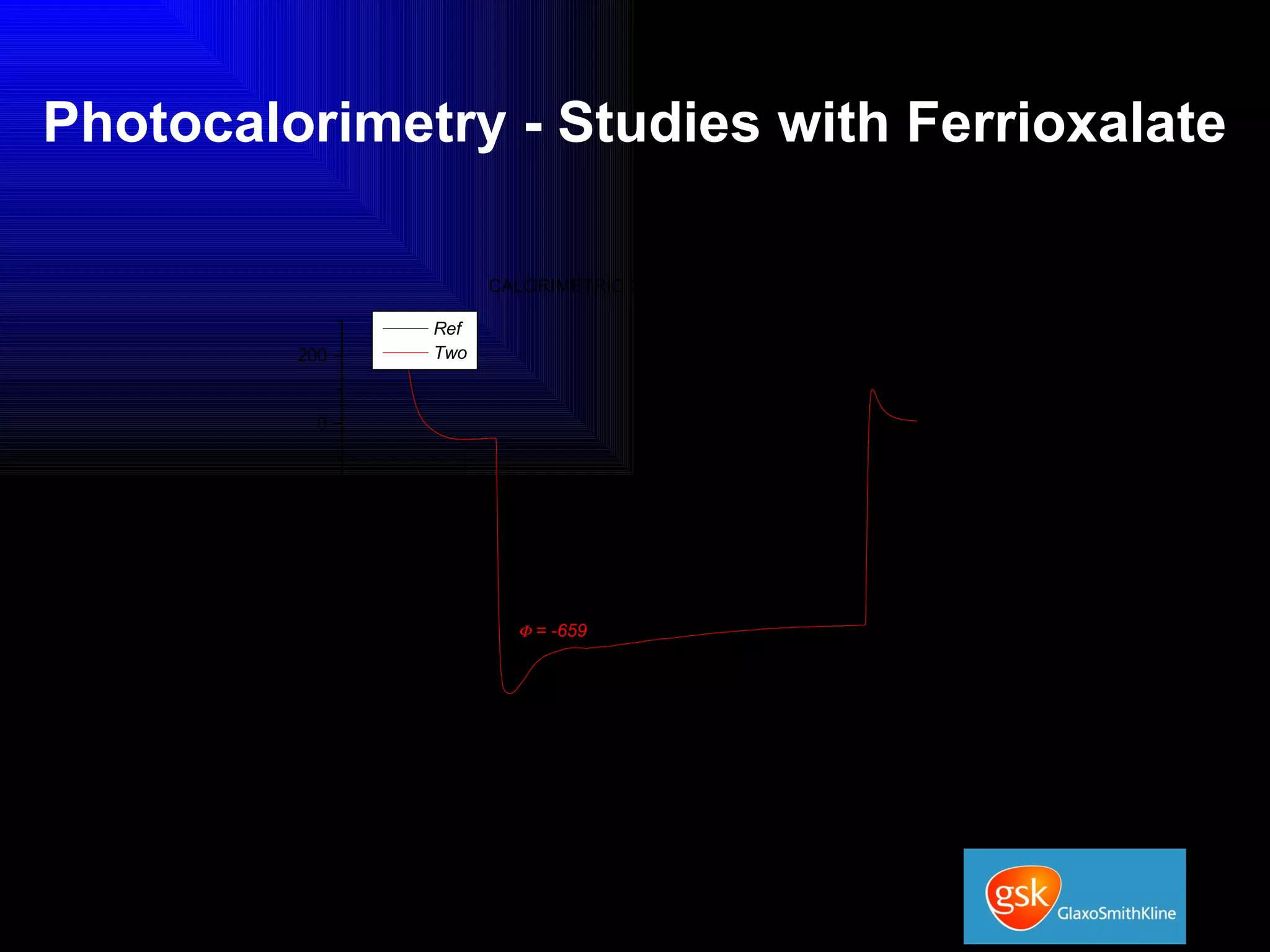
Photocalorimetry - Studies with Ferrioxalate Traditional chemical actinometer 2[Fe(C 2 O 4 ) 3 ] 3-      2Fe(C 2 O 4 ) 2-  + 2CO 2 Many advantages over 2-NB: 1. Sensitivity 2. Wavelength Coverage 3. Photolyte stability and Photolysis Products 4. Simplicity of operation 5. Has a known enthalpy Highly regarded and widely used Adopt the same principles for calculation as before….
Photocalorimetry - Studies with Ferrioxalate
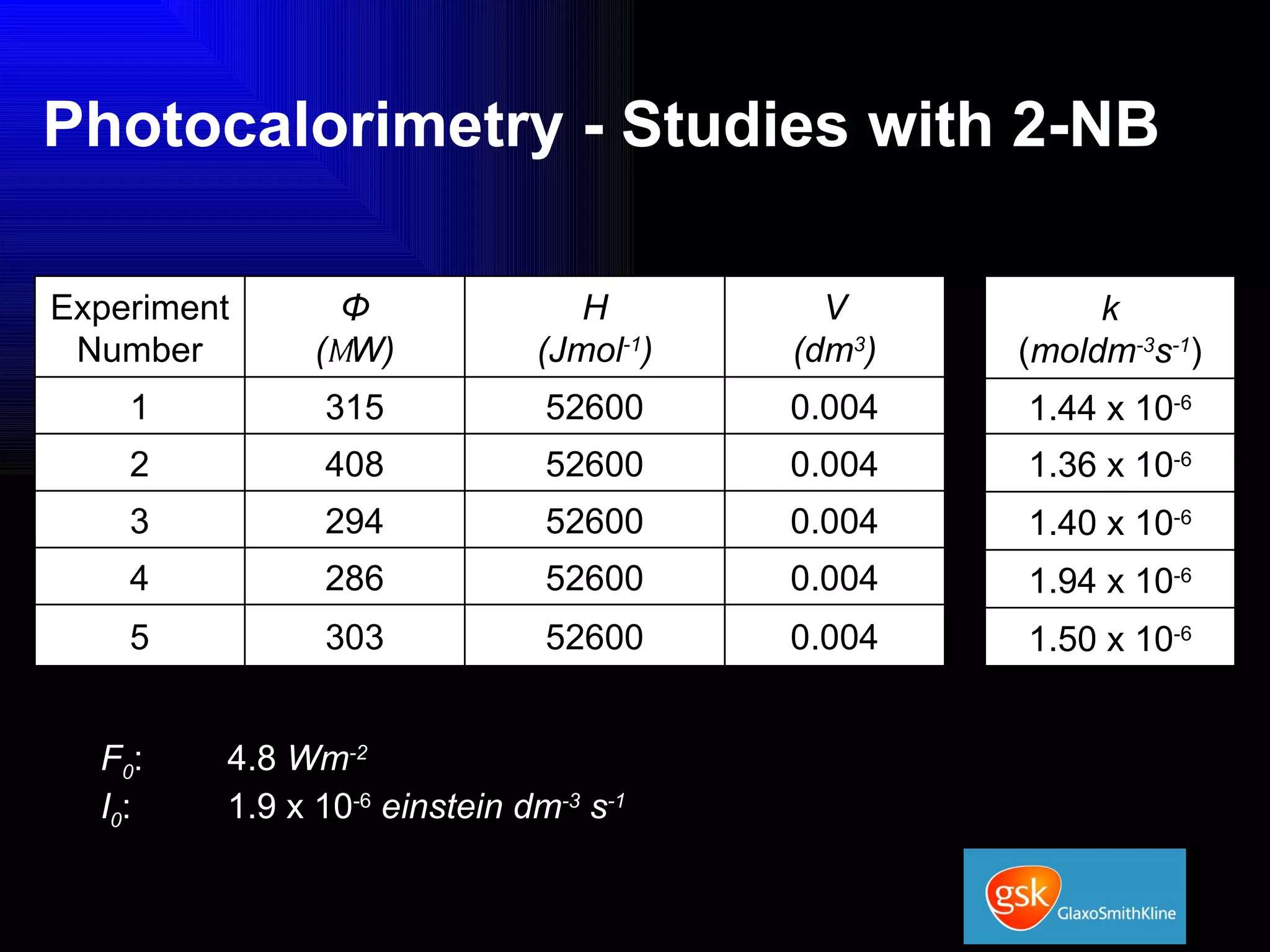
Photocalorimetry - Studies with 2-NB F 0 : 4.8  Wm -2 I 0 : 1.9 x 10 -6   einstein dm -3  s -1 Experiment Number Φ ( m W) H (Jmol -1 ) V (dm 3 ) 1 315 52600 0.004 2 408 52600 0.004 3 294 52600 0.004 4 286 52600 0.004 5 303 52600 0.004 k ( moldm -3 s -1 ) 1.44 x  10 -6 1.36 x 10 -6 1.40 x 10 -6 1.94 x 10 -6 1.50 x 10 -6
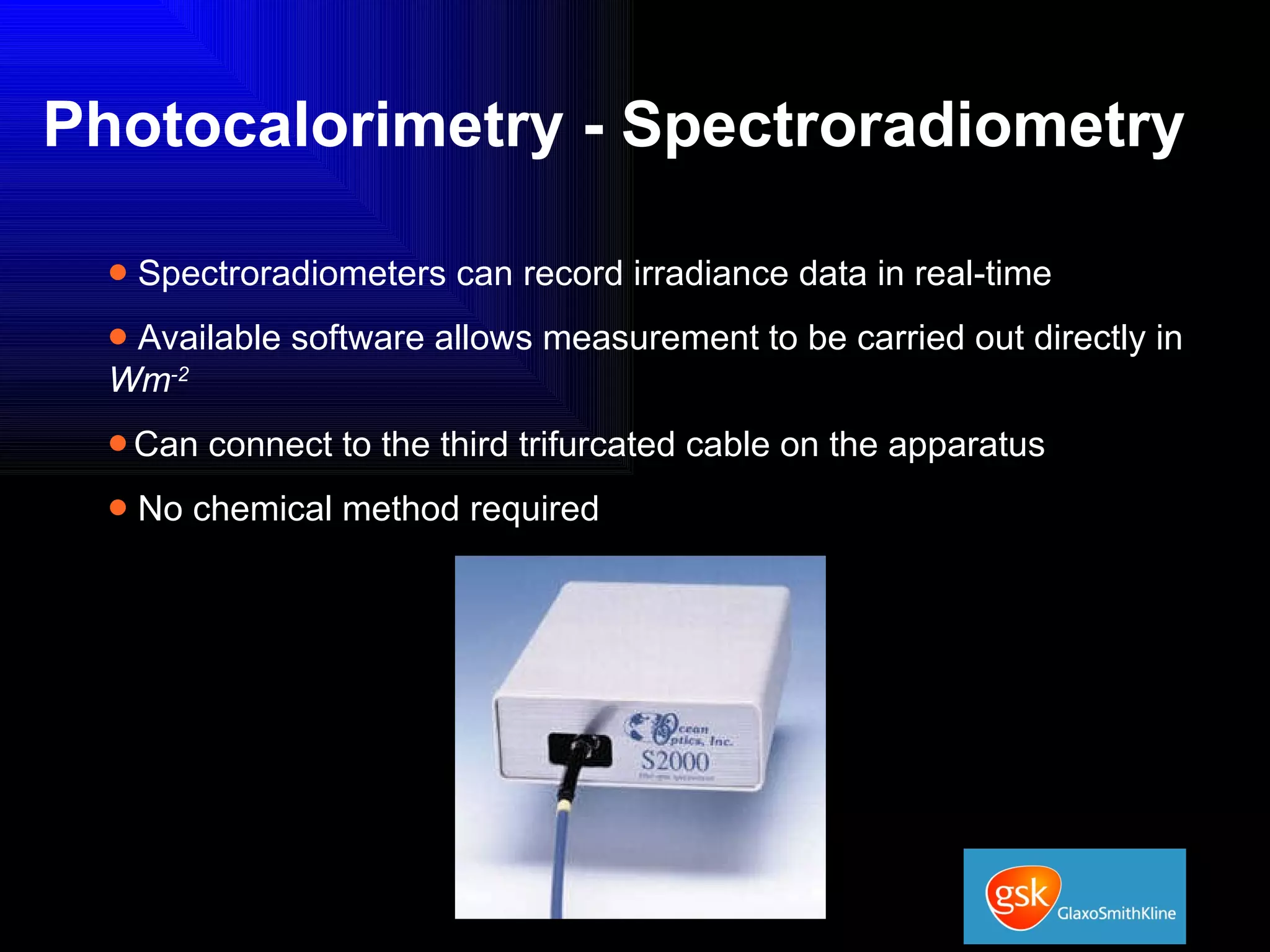
Photocalorimetry - Spectroradiometry Spectroradiometers can record irradiance data in real-time Available software allows measurement to be carried out directly in  Wm -2  Can connect to the third trifurcated cable on the apparatus No chemical method required
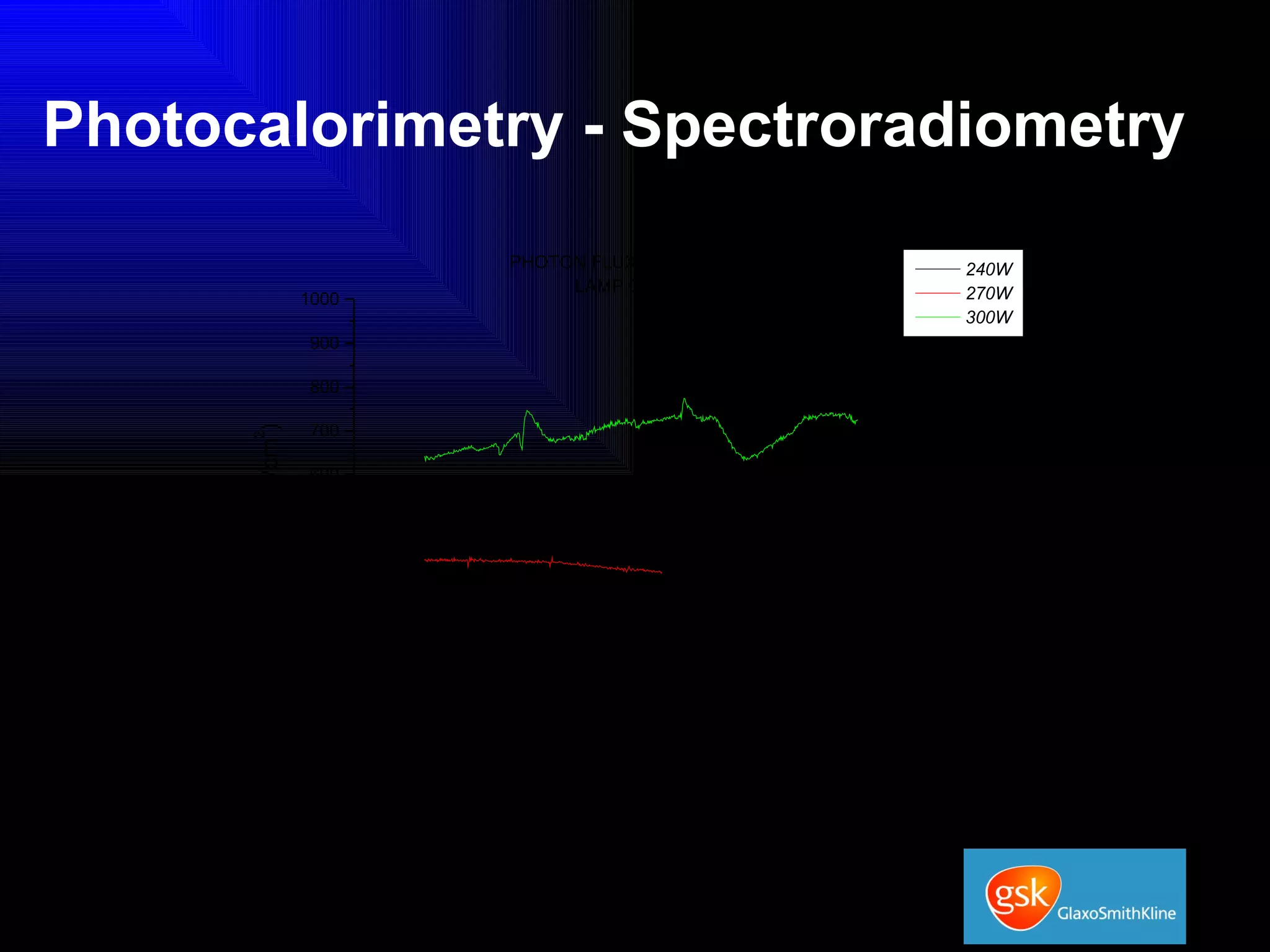
Photocalorimetry - Spectroradiometry
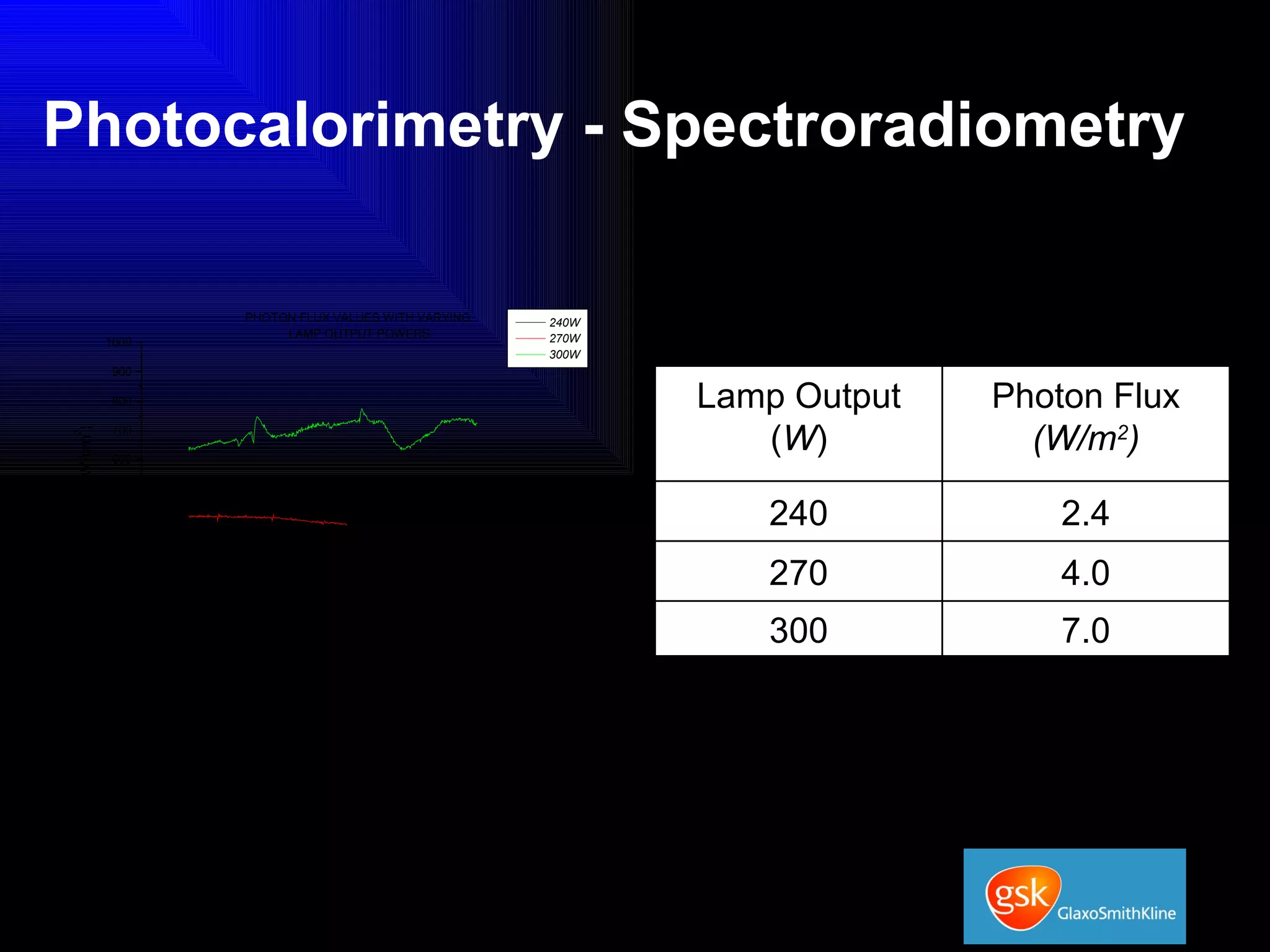
Photocalorimetry - Spectroradiometry Lamp Output ( W ) Photon Flux (W/m 2 ) 240 2.4 270 4.0 300 7.0
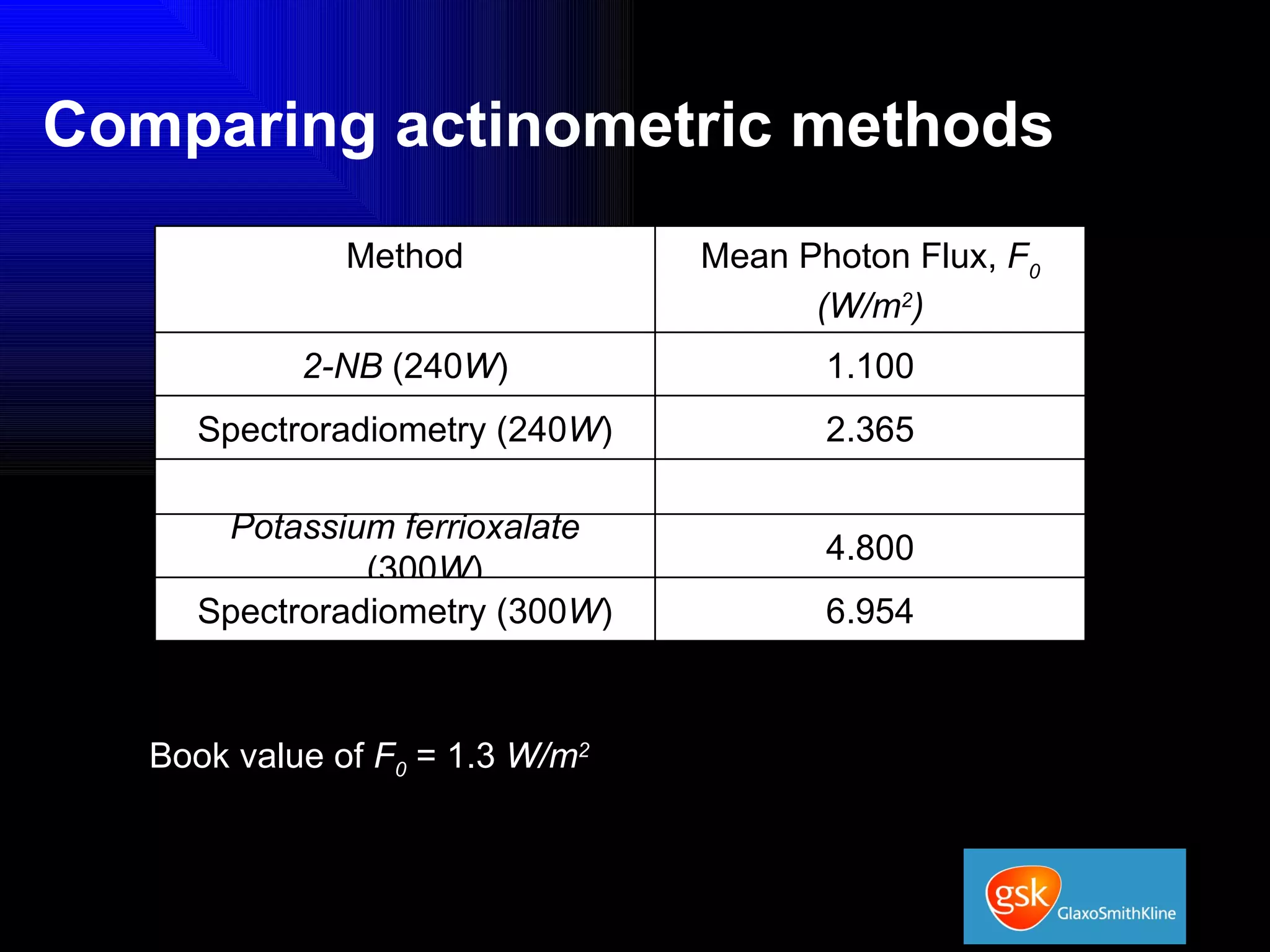
Comparing actinometric methods Book value of  F 0  = 1.3  W/m 2 Method Mean Photon Flux,  F 0 (W/m 2 ) 2-NB  (240 W ) 1.100 Spectroradiometry (240 W ) 2.365 Potassium ferrioxalate  (300 W ) 4.800 Spectroradiometry (300 W ) 6.954
Comparing actinometric methods The values obtained by the two chemical methods compare more favorably than the spectroradiometric method 2-NB  is more favorable than  potassium ferrioxalate Steadier calorimetric output (i.e. flat line produced) Easier to prepare and has a longer shelf life Interesting that  potassium ferrioxalate  is the IUPAC recommended method Investigations into why spectroradiometry is inaccurate need to be carried out
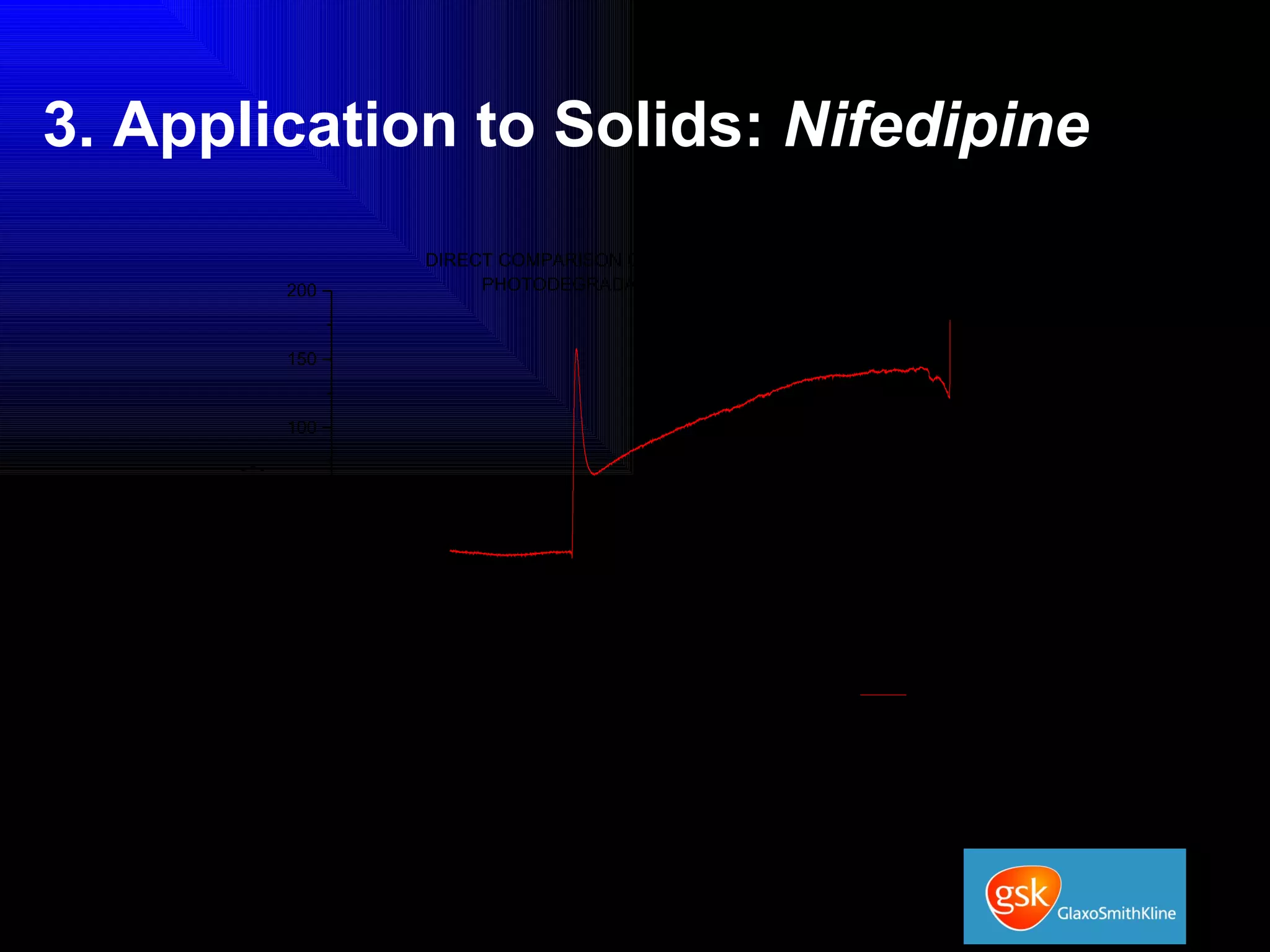
3. Application to Solids Nifedipine  under white light No quantitative data recorded for solid state photocalorimetric experiments Use  nifedipine  since it is well-known in the literature Apparent first-order kinetics - should be easy to spot experimentally Acts as a good “test” reaction before moving onto studies involving individual wavelengths of light Apply the same rules of analysis as used for  2-NB  and  Potassium Ferrioxalate Talc is used as the reference material
3. Application to Solids:  Nifedipine
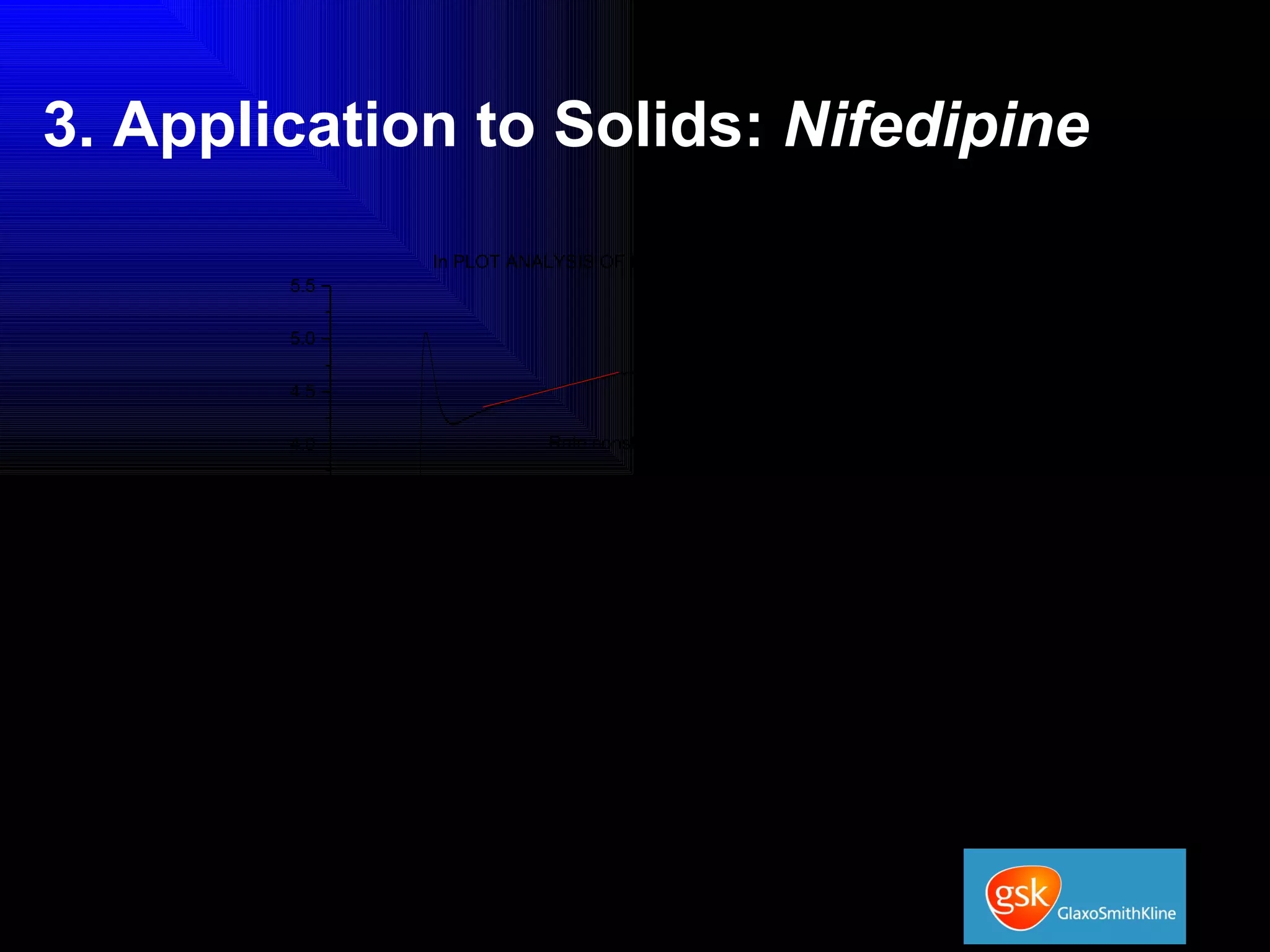
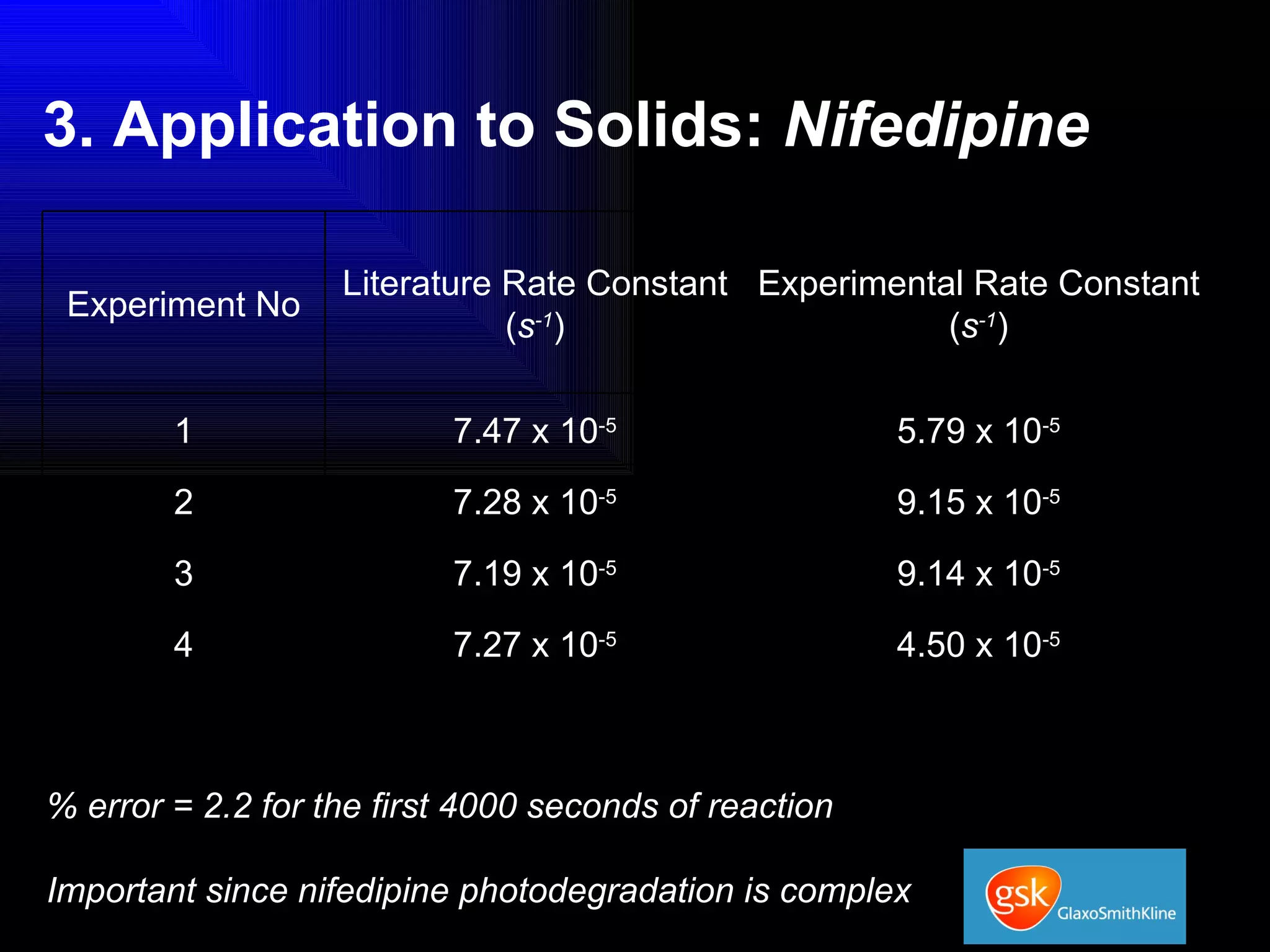
3. Application to Solids:  Nifedipine % error = 2.2 for the first 4000 seconds of reaction Important since nifedipine photodegradation is complex Experiment No Literature Rate Constant ( s -1 ) Experimental Rate Constant ( s -1 ) 1 7.47 x 10 -5 5.79 x 10 -5 2 7.28 x 10 -5 9.15 x 10 -5 3 7.19 x 10 -5 9.14 x 10 -5 4 7.27 x 10 -5 4.50 x 10 -5
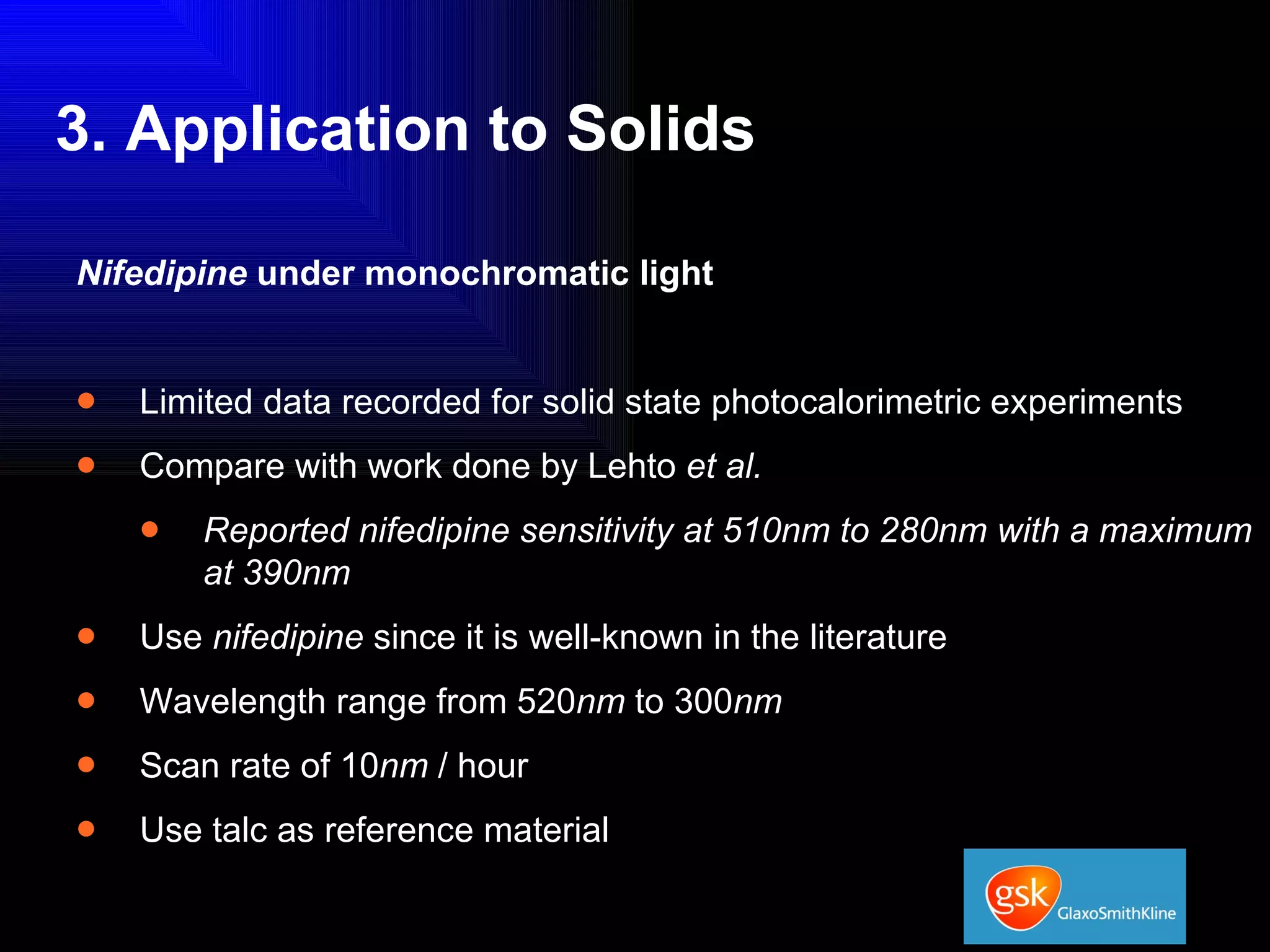
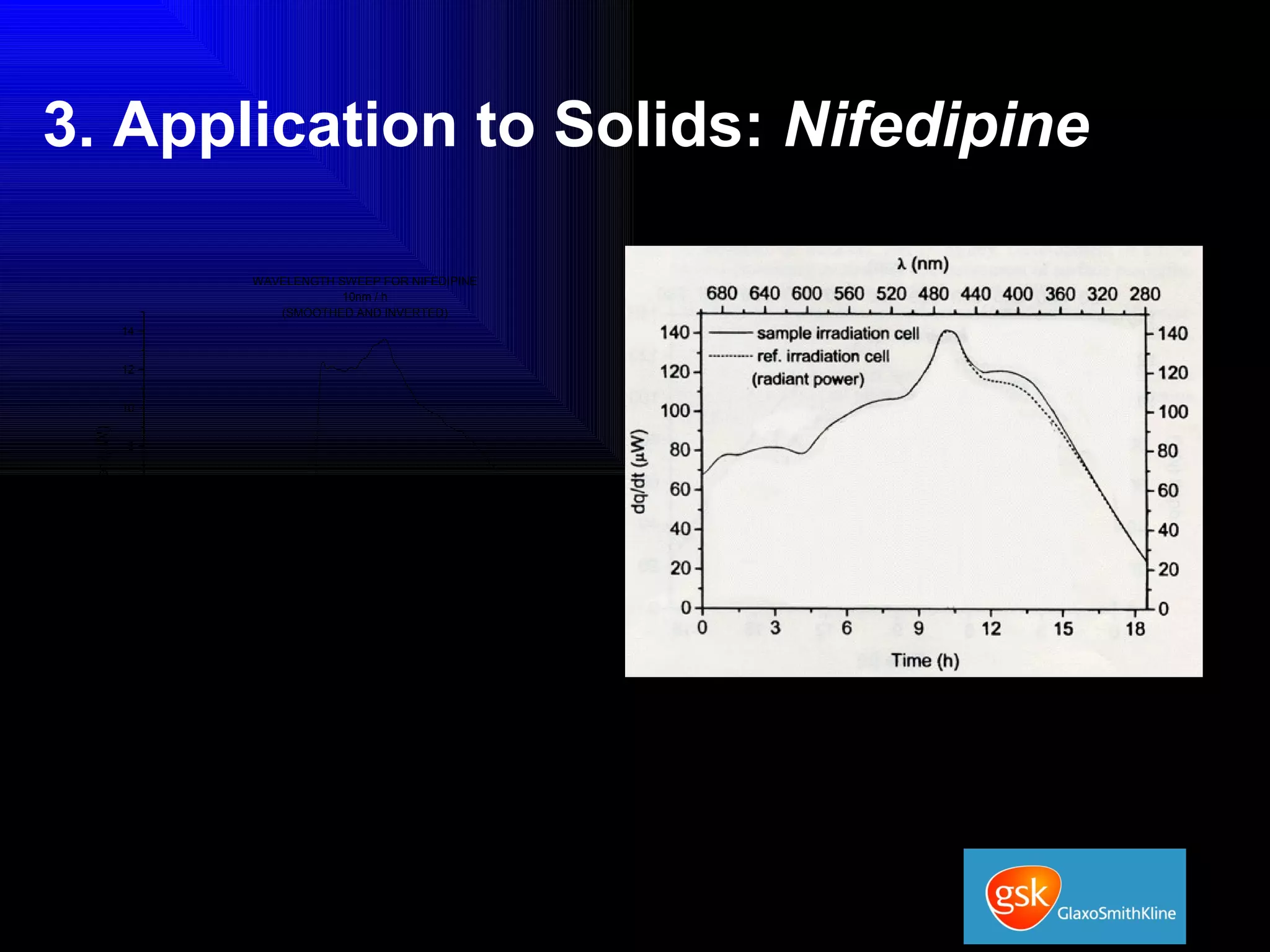
3. Application to Solids Nifedipine  under monochromatic light Limited data recorded for solid state photocalorimetric experiments Compare with work done by Lehto  et al. Reported nifedipine sensitivity at 510nm to 280nm with a maximum at 390nm Use  nifedipine  since it is well-known in the literature Wavelength range from 520 nm  to 300 nm Scan rate of 10 nm  / hour Use talc as reference material
3. Application to Solids:  Nifedipine
Conclusions and Future Work Photocalorimeter designed and built successfully 2 main options exist for actinometer selection in solution phase 2-NB  v  Potassium Ferrioxalate 2-NB is more stable; easier to prepare and has a simple calorimetric output Nifedipine  is a suitable validation material - first quantitative measurements presented here Complexity is a problem after 4000 s - Use of Chemometrics Investigations into effect of wavelength on nifedipine were successful. Further work will investigate the effect of moisture, temperature etc on calorimetric output at different wavelengths
Acknowledgements Professor Anthony Beezer Professor Joseph Connor David Clapham, GSK Medway Sciences colleagues

Tac 2004

  • 1.
  • 2.
    Photocalorimetry: Validation MethodsAndy Morris, Medway Sciences, University of Greenwich at Medway
  • 3.
    Outline of TalkBackground to Photocalorimetry Project Instrument Design Validation Techniques & Actinometry 2-NB Ferrioxalate Spectroradiometry Conclusions & Future Work Applications to solids
  • 4.
    Photocalorimetry A newarea of interest - small amount of previous work (virtually nothing written about the solid state) Many benefits: Rapid analysis - conventional storage testing takes many weeks, calorimetric technique can be done in hours Conventional testing is costly Sensitive analysis - heat changes in the µW range detected Apparatus enables testing in both the solid and solution phases Can apply data to calorimetric equations for analysis Simple experimental setup...
  • 5.
  • 6.
    Photocalorimetry - ValidationApparatus has been developed previously (Lehto et al .) First need to establish a validation method ( cf triacetin reaction) i.e. a system that can be used as a chemical actinometer Systems well-known in the literature Solids : nifedipine Solutions: ferrioxalate (conventional) 2-nitrobenzaldehyde (2-NB) (novel) Initial work in solution phase - simpler systems, in principle More complex validation systems will come later (e.g. solids)
  • 7.
    Photocalorimetry - ActinometryChemical Actinometers A solution containing a chemical compound that undergoes a specific chemical reaction as a result of photon absorption Reaction Rate related to the rate at which photons are absorbed by the actinometer The actinometer solution is illuminated under the same conditions as the drug samples The reaction is followed as a function of illumination time  Photon Flux  Photon Flux (Wm -2 ) Allows results to be compared quantitatively if a value of H is known….
  • 8.
    Photocalorimetry - Actinometry3 Systems to Compare: 2-nitrobenzaldehyde - novel Potassium Ferrioxalate - established Spectroradiometry (absolute method)
  • 9.
    Photocalorimetric CalculationsI o = k o /  where I o is the irradiance k 0 is the reaction rate constant  is the quantum yield and F o = I o .V.N A .E  / A F o is the photon flux V is the volume of solution N A is Avogadro’s Number E  is the average light wavelength A is the area of exposed solution
  • 10.
    Photocalorimetric CalculationsI o = k o /  where I o is the irradiance k 0 is the reaction rate constant  is the quantum yield and F o = I o .V.N A .E  / A F o is the photon flux V is the volume of solution N A is Avogadro’s Number E  is the average light wavelength A is the area of exposed solution
  • 11.
    Photocalorimetry - CalculationsFor a zero order reaction:  = k o HV a value of k o which can be applied to I o = k o /  a value of I o which can be applied to F o = I o .V.N A .E  / A a quantitative value (in W / m 2 ) for the photon flux of a light source
  • 12.
    Photocalorimetry - CalculationsFor a zero order reaction:  = k o HV ( D ) (from the TAM) a value of k o which can be applied to I o = k o /  a value of I o which can be applied to F o = I o .V.N A .E  / A a quantitative value for the photon flux of a light source
  • 13.
    Photocalorimetry - Studieswith 2-NB Photochemical rearrangement of 2-nitrobenzaldehyde to 2-nitrosobenzoic acid and dissociation of the product yielding H + The quantum yield is 0.5 Reaction is zero-order (ie linear loss of 2-NB as a function of irradiation time) Enthalpy, H can be easily determined (202.4 kJmol -1 ) Can be followed in real-time in the TAM...
  • 14.
    Photocalorimetry - Studieswith 2-NB Take measurement after same time has elapsed after light on for each experiment Experimental output should be a flat line at this point Subtract blank from signal to get a value for phi
  • 15.
  • 16.
    Photocalorimetry - Studieswith 2-NB F 0 : 1.1 Wm -2 I 0 : 4.2 x 10 -7 einstein dm -3 s -1 Experiment Number Φ ( m W) H (Jmol -1 ) V (dm 3 ) 1 - - - 2 110 202464 0.004 3 116 202464 0.004 4 114 202464 0.004 5 114 202464 0.004 k ( moldm -3 s -1 ) 1.36 x 10 -7 1.46 x 10 -7 1.41 x 10 -7 1.41 x 10 -7
  • 17.
    Photocalorimetry - Studieswith Ferrioxalate Traditional chemical actinometer 2[Fe(C 2 O 4 ) 3 ] 3-  2Fe(C 2 O 4 ) 2- + 2CO 2 Many advantages over 2-NB: 1. Sensitivity 2. Wavelength Coverage 3. Photolyte stability and Photolysis Products 4. Simplicity of operation 5. Has a known enthalpy Highly regarded and widely used Adopt the same principles for calculation as before….
  • 18.
    Photocalorimetry - Studieswith Ferrioxalate
  • 19.
    Photocalorimetry - Studieswith 2-NB F 0 : 4.8 Wm -2 I 0 : 1.9 x 10 -6 einstein dm -3 s -1 Experiment Number Φ ( m W) H (Jmol -1 ) V (dm 3 ) 1 315 52600 0.004 2 408 52600 0.004 3 294 52600 0.004 4 286 52600 0.004 5 303 52600 0.004 k ( moldm -3 s -1 ) 1.44 x 10 -6 1.36 x 10 -6 1.40 x 10 -6 1.94 x 10 -6 1.50 x 10 -6
  • 20.
    Photocalorimetry - SpectroradiometrySpectroradiometers can record irradiance data in real-time Available software allows measurement to be carried out directly in Wm -2 Can connect to the third trifurcated cable on the apparatus No chemical method required
  • 21.
  • 22.
    Photocalorimetry - SpectroradiometryLamp Output ( W ) Photon Flux (W/m 2 ) 240 2.4 270 4.0 300 7.0
  • 23.
    Comparing actinometric methodsBook value of F 0 = 1.3 W/m 2 Method Mean Photon Flux, F 0 (W/m 2 ) 2-NB (240 W ) 1.100 Spectroradiometry (240 W ) 2.365 Potassium ferrioxalate (300 W ) 4.800 Spectroradiometry (300 W ) 6.954
  • 24.
    Comparing actinometric methodsThe values obtained by the two chemical methods compare more favorably than the spectroradiometric method 2-NB is more favorable than potassium ferrioxalate Steadier calorimetric output (i.e. flat line produced) Easier to prepare and has a longer shelf life Interesting that potassium ferrioxalate is the IUPAC recommended method Investigations into why spectroradiometry is inaccurate need to be carried out
  • 25.
    3. Application toSolids Nifedipine under white light No quantitative data recorded for solid state photocalorimetric experiments Use nifedipine since it is well-known in the literature Apparent first-order kinetics - should be easy to spot experimentally Acts as a good “test” reaction before moving onto studies involving individual wavelengths of light Apply the same rules of analysis as used for 2-NB and Potassium Ferrioxalate Talc is used as the reference material
  • 26.
    3. Application toSolids: Nifedipine
  • 27.
    3. Application toSolids: Nifedipine
  • 28.
    3. Application toSolids: Nifedipine % error = 2.2 for the first 4000 seconds of reaction Important since nifedipine photodegradation is complex Experiment No Literature Rate Constant ( s -1 ) Experimental Rate Constant ( s -1 ) 1 7.47 x 10 -5 5.79 x 10 -5 2 7.28 x 10 -5 9.15 x 10 -5 3 7.19 x 10 -5 9.14 x 10 -5 4 7.27 x 10 -5 4.50 x 10 -5
  • 29.
    3. Application toSolids Nifedipine under monochromatic light Limited data recorded for solid state photocalorimetric experiments Compare with work done by Lehto et al. Reported nifedipine sensitivity at 510nm to 280nm with a maximum at 390nm Use nifedipine since it is well-known in the literature Wavelength range from 520 nm to 300 nm Scan rate of 10 nm / hour Use talc as reference material
  • 30.
    3. Application toSolids: Nifedipine
  • 31.
    3. Application toSolids: Nifedipine
  • 32.
    3. Application toSolids: Nifedipine
  • 33.
    Conclusions and FutureWork Photocalorimeter designed and built successfully 2 main options exist for actinometer selection in solution phase 2-NB v Potassium Ferrioxalate 2-NB is more stable; easier to prepare and has a simple calorimetric output Nifedipine is a suitable validation material - first quantitative measurements presented here Complexity is a problem after 4000 s - Use of Chemometrics Investigations into effect of wavelength on nifedipine were successful. Further work will investigate the effect of moisture, temperature etc on calorimetric output at different wavelengths
  • 34.
    Acknowledgements Professor AnthonyBeezer Professor Joseph Connor David Clapham, GSK Medway Sciences colleagues
  • 35.