David Fogel
Business Development Director
Bal Seal Engineering
www.balseal.com
Slide 2
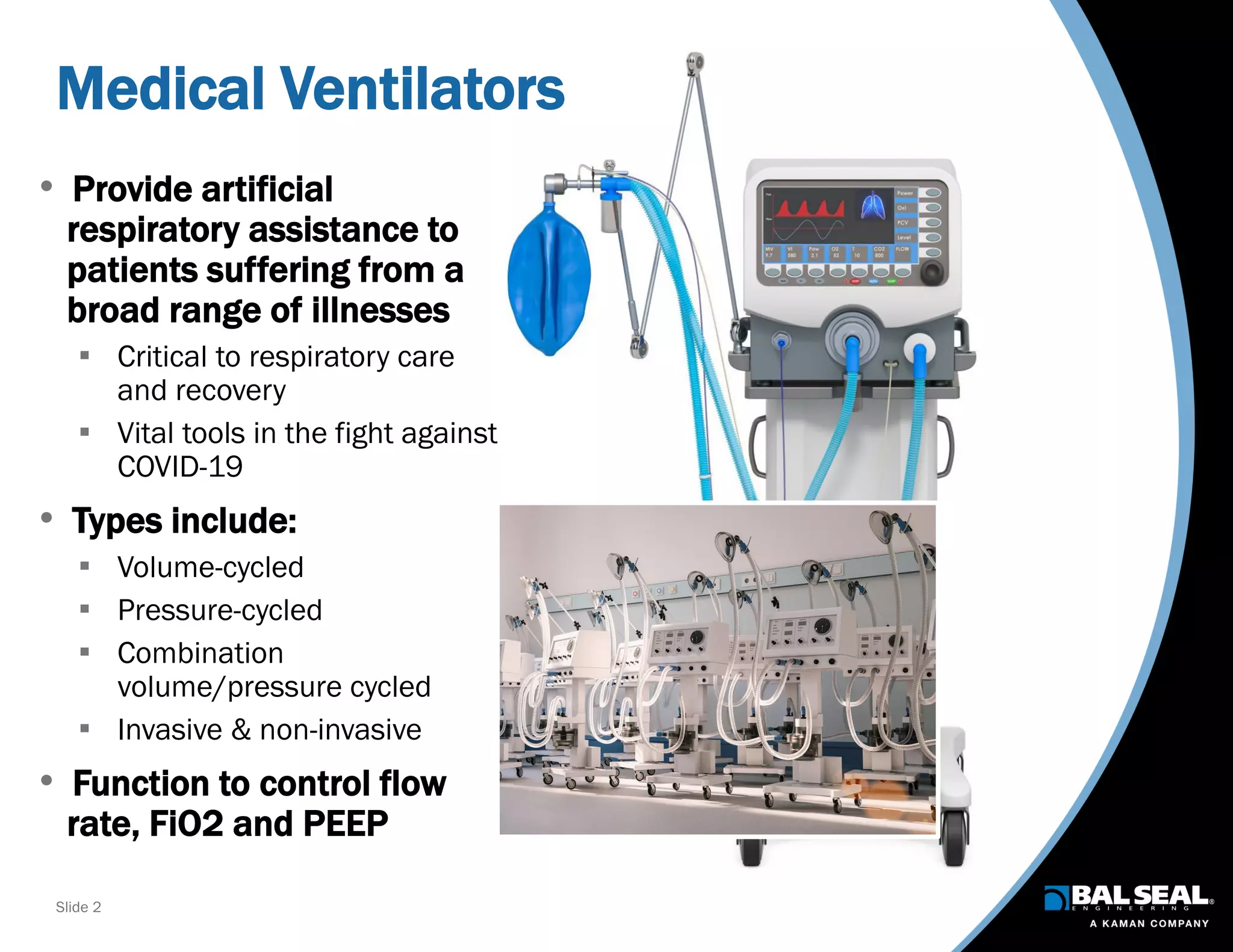
Medical Ventilators
• Provide artificial
respiratory assistance to
patients suffering from a
broad range of illnesses
 Critical to respiratory care
and recovery
 Vital tools in the fight against
COVID-19
• Types include:
 Volume-cycled
 Pressure-cycled
 Combination
volume/pressure cycled
 Invasive & non-invasive
• Function to control flow
rate, FiO2 and PEEP
Slide 3
Ventilator Equipment Profiles
• Applications
 Neonatal, child, adult, ICU, portable,
at-home, emergency transport/mass-
casualty care
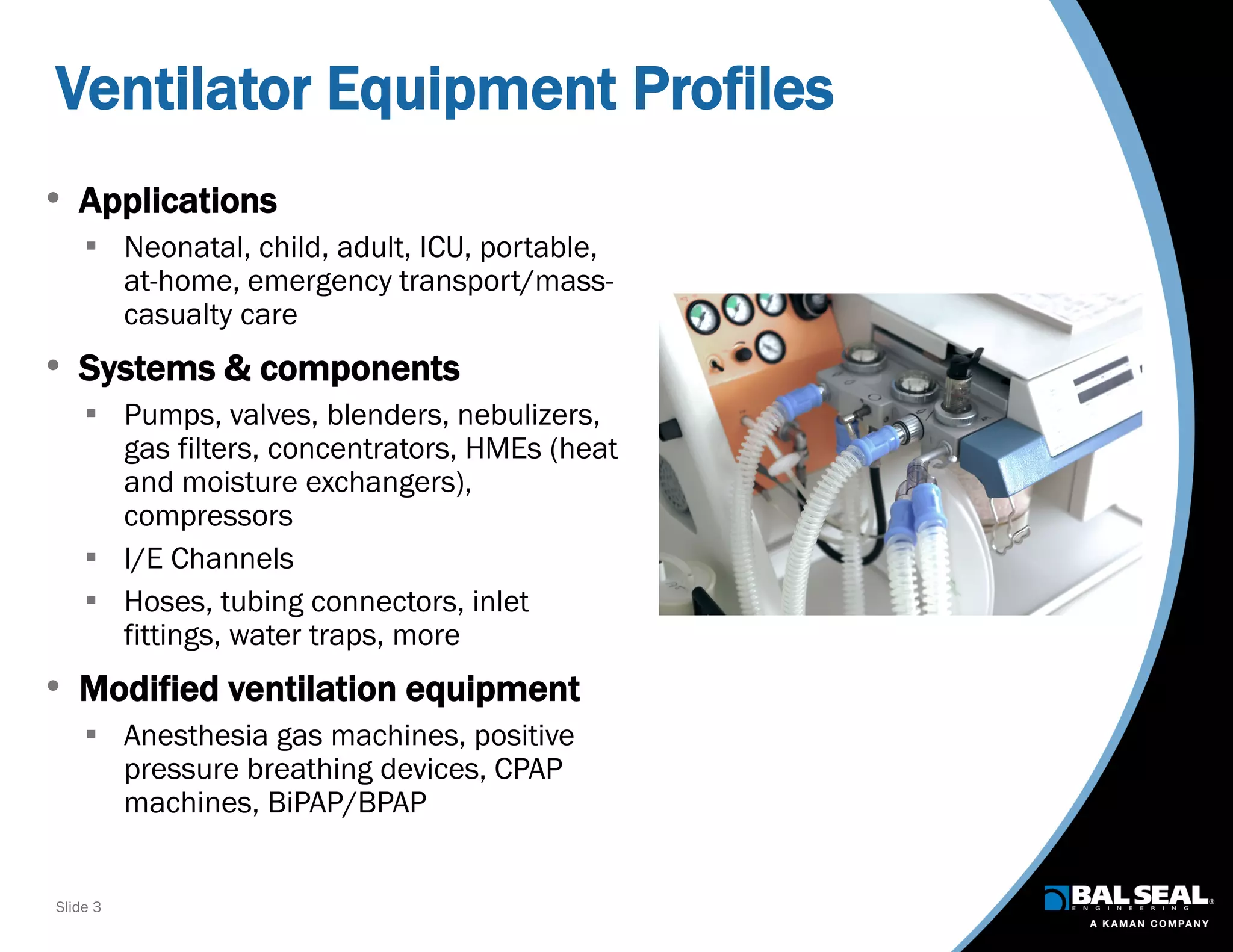
• Systems & components
 Pumps, valves, blenders, nebulizers,
gas filters, concentrators, HMEs (heat
and moisture exchangers),
compressors
 I/E Channels
 Hoses, tubing connectors, inlet
fittings, water traps, more
• Modified ventilation equipment
 Anesthesia gas machines, positive
pressure breathing devices, CPAP
machines, BiPAP/BPAP
Slide 4
Ventilator Operating Requirements
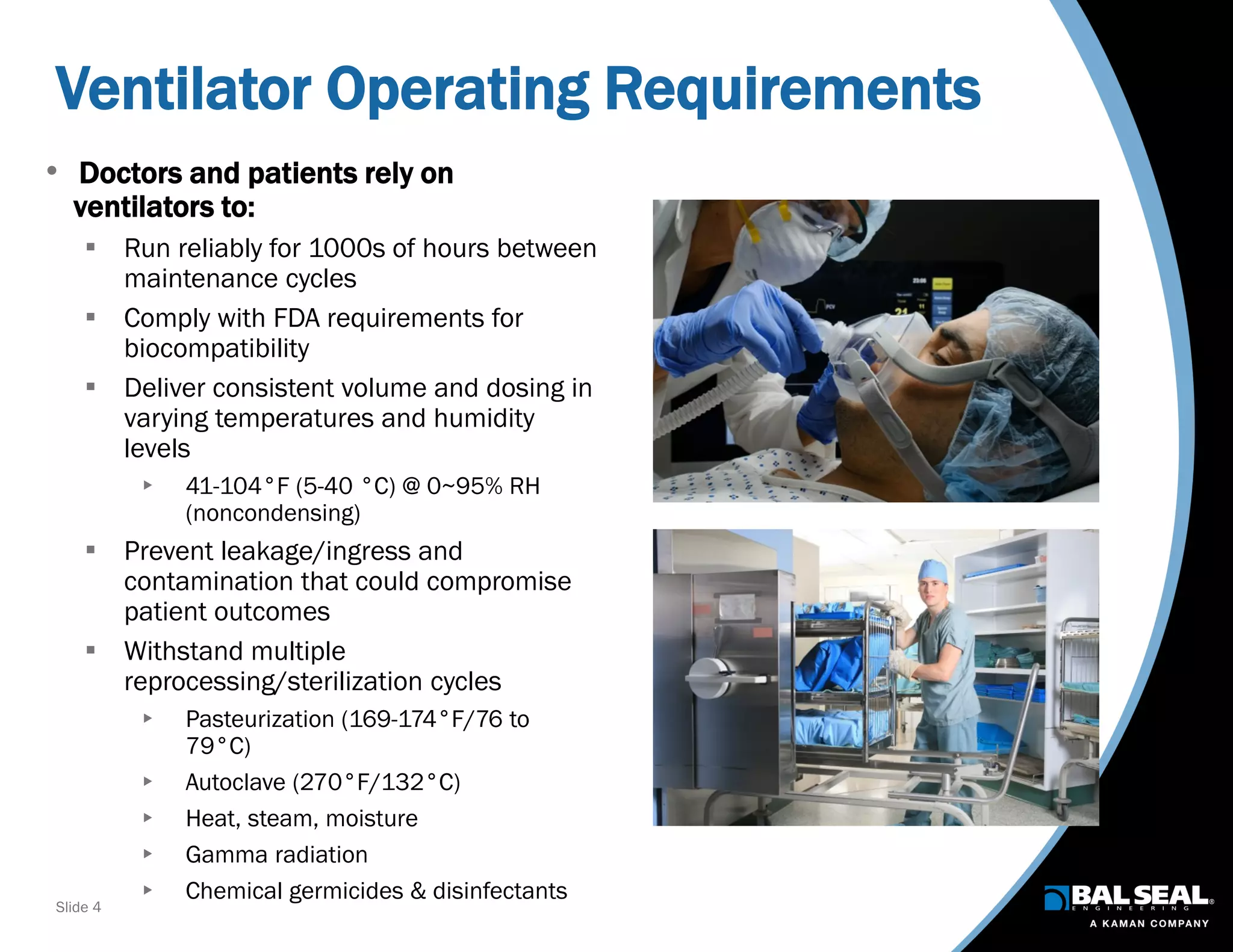
• Doctors and patients rely on
ventilators to:
 Run reliably for 1000s of hours between
maintenance cycles
 Comply with FDA requirements for
biocompatibility
 Deliver consistent volume and dosing in
varying temperatures and humidity
levels
 41-104°F (5-40 °C) @ 0~95% RH
(noncondensing)
 Prevent leakage/ingress and
contamination that could compromise
patient outcomes
 Withstand multiple
reprocessing/sterilization cycles
 Pasteurization (169-174°F/76 to
79°C)
 Autoclave (270°F/132°C)
 Heat, steam, moisture
 Gamma radiation
 Chemical germicides & disinfectants
Slide 5
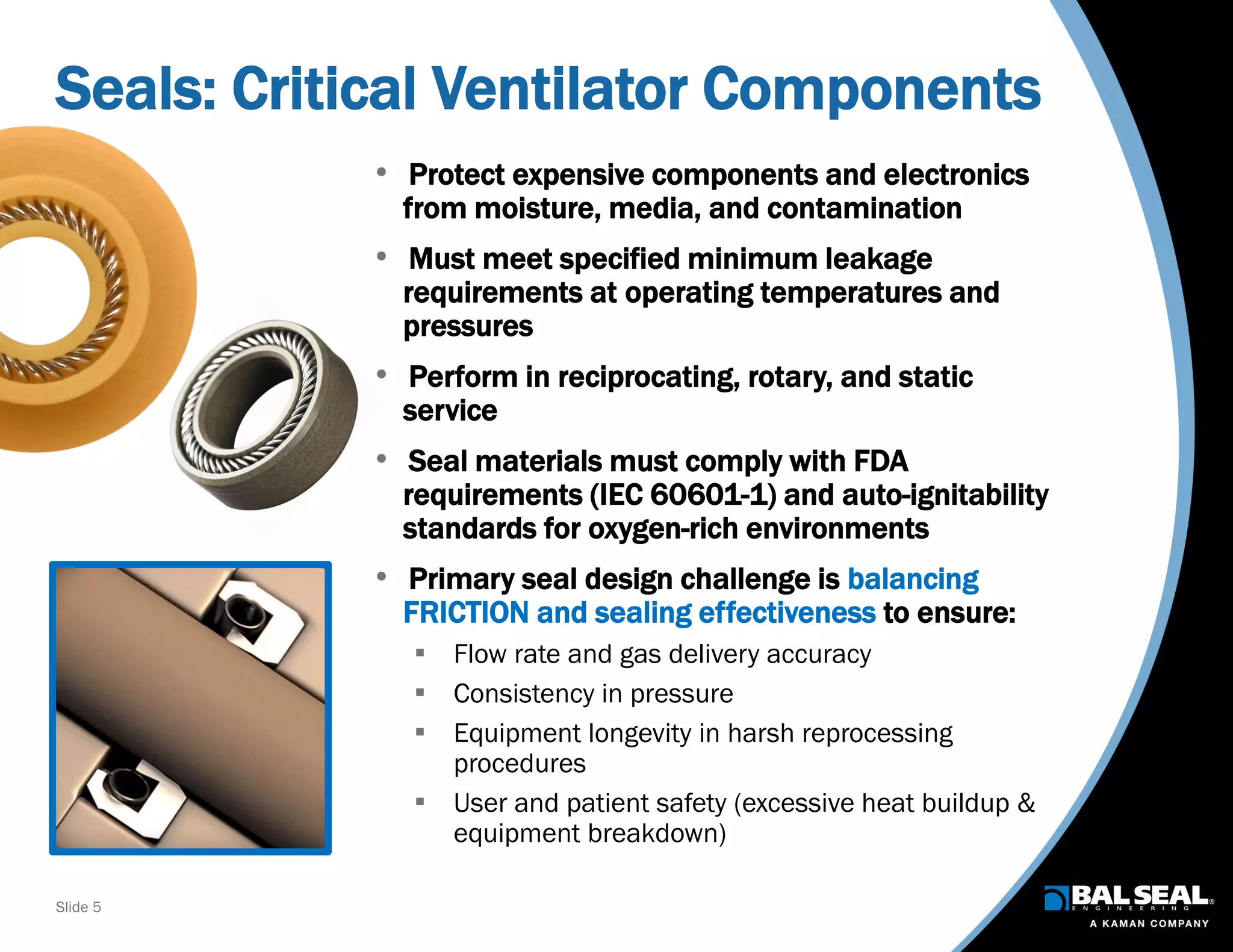
Seals: Critical Ventilator Components
• Protect expensive components and electronics
from moisture, media, and contamination
• Must meet specified minimum leakage
requirements at operating temperatures and
pressures
• Perform in reciprocating, rotary, and static
service
• Seal materials must comply with FDA
requirements (IEC 60601-1) and auto-ignitability
standards for oxygen-rich environments
• Primary seal design challenge is balancing
FRICTION and sealing effectiveness to ensure:
 Flow rate and gas delivery accuracy
 Consistency in pressure
 Equipment longevity in harsh reprocessing
procedures
 User and patient safety (excessive heat buildup &
equipment breakdown)
Slide 6
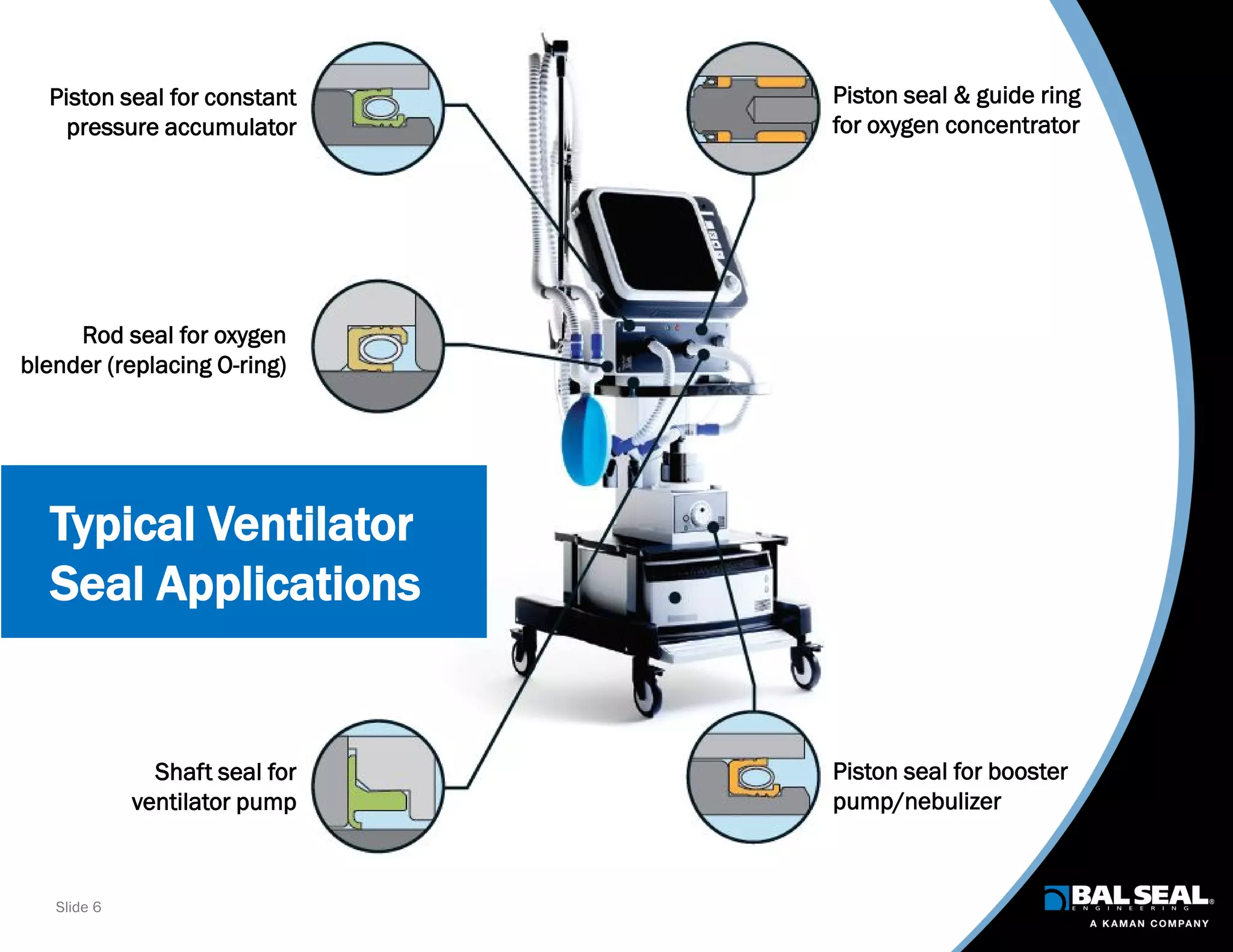
Piston seal for constant
pressure accumulator
Shaft seal for
ventilator pump
Rod seal for oxygen
blender (replacing O-ring)
Piston seal & guide ring
for oxygen concentrator
Piston seal for booster
pump/nebulizer
Typical Ventilator
Seal Applications
Slide 7
Seal Design Considerations
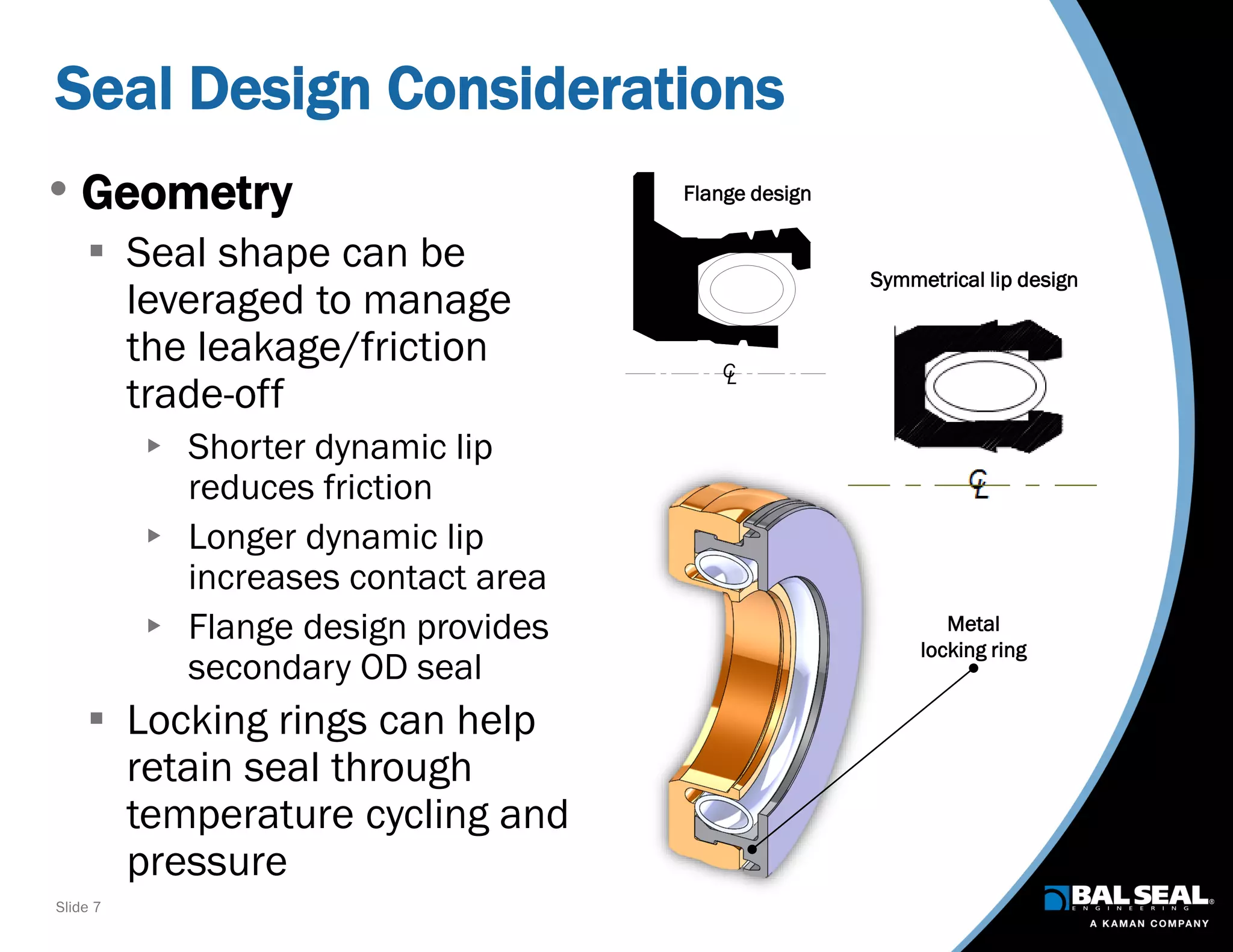
• Geometry
 Seal shape can be
leveraged to manage
the leakage/friction
trade-off
 Shorter dynamic lip
reduces friction
 Longer dynamic lip
increases contact area
 Flange design provides
secondary OD seal
 Locking rings can help
retain seal through
temperature cycling and
pressure
LC
Metal
locking ring
Flange design
Symmetrical lip design
Slide 8
Seal Design Considerations
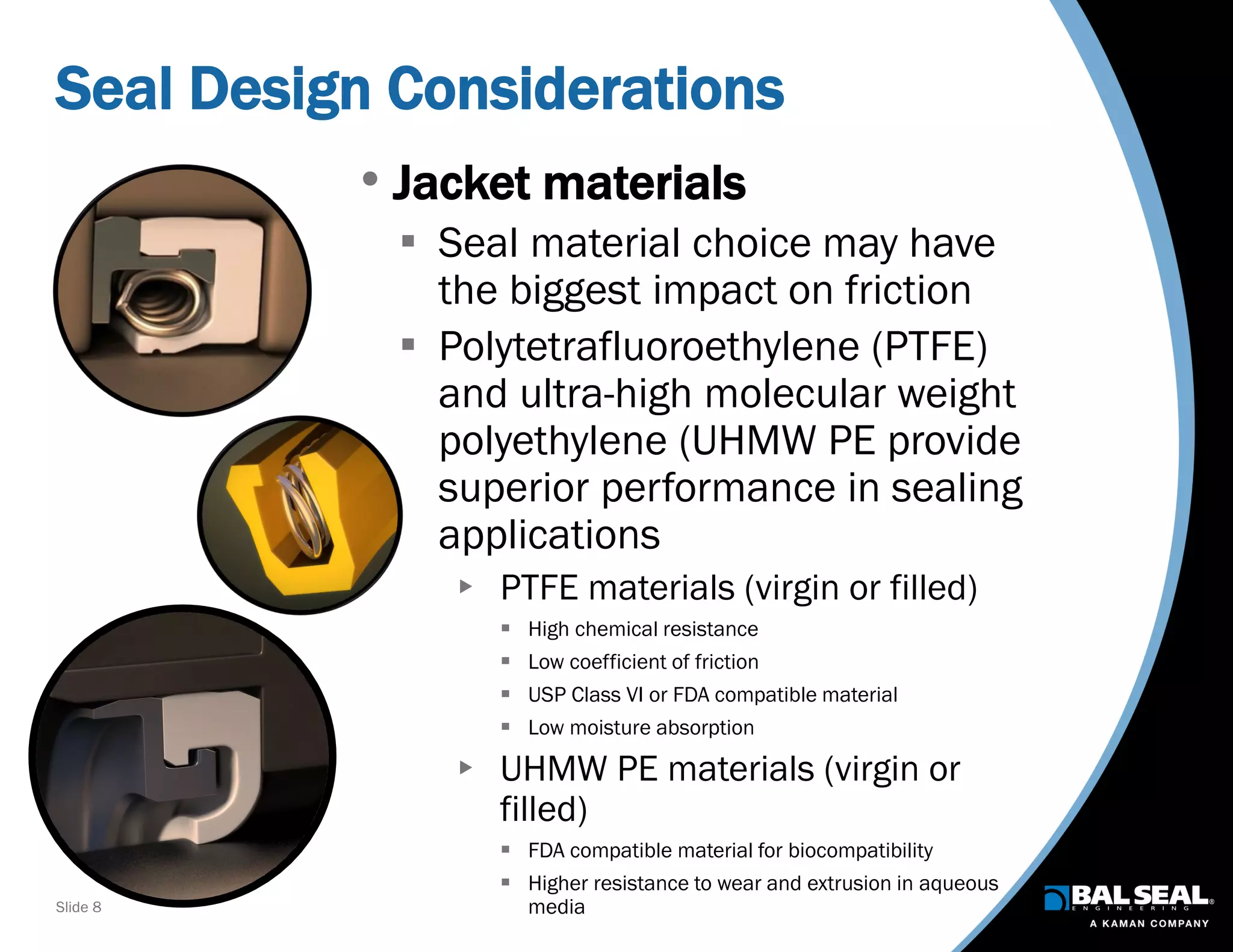
• Jacket materials
 Seal material choice may have
the biggest impact on friction
 Polytetrafluoroethylene (PTFE)
and ultra-high molecular weight
polyethylene (UHMW PE provide
superior performance in sealing
applications
 PTFE materials (virgin or filled)
 High chemical resistance
 Low coefficient of friction
 USP Class VI or FDA compatible material
 Low moisture absorption
 UHMW PE materials (virgin or
filled)
 FDA compatible material for biocompatibility
 Higher resistance to wear and extrusion in aqueous
media
Slide 9
Seal Design Considerations
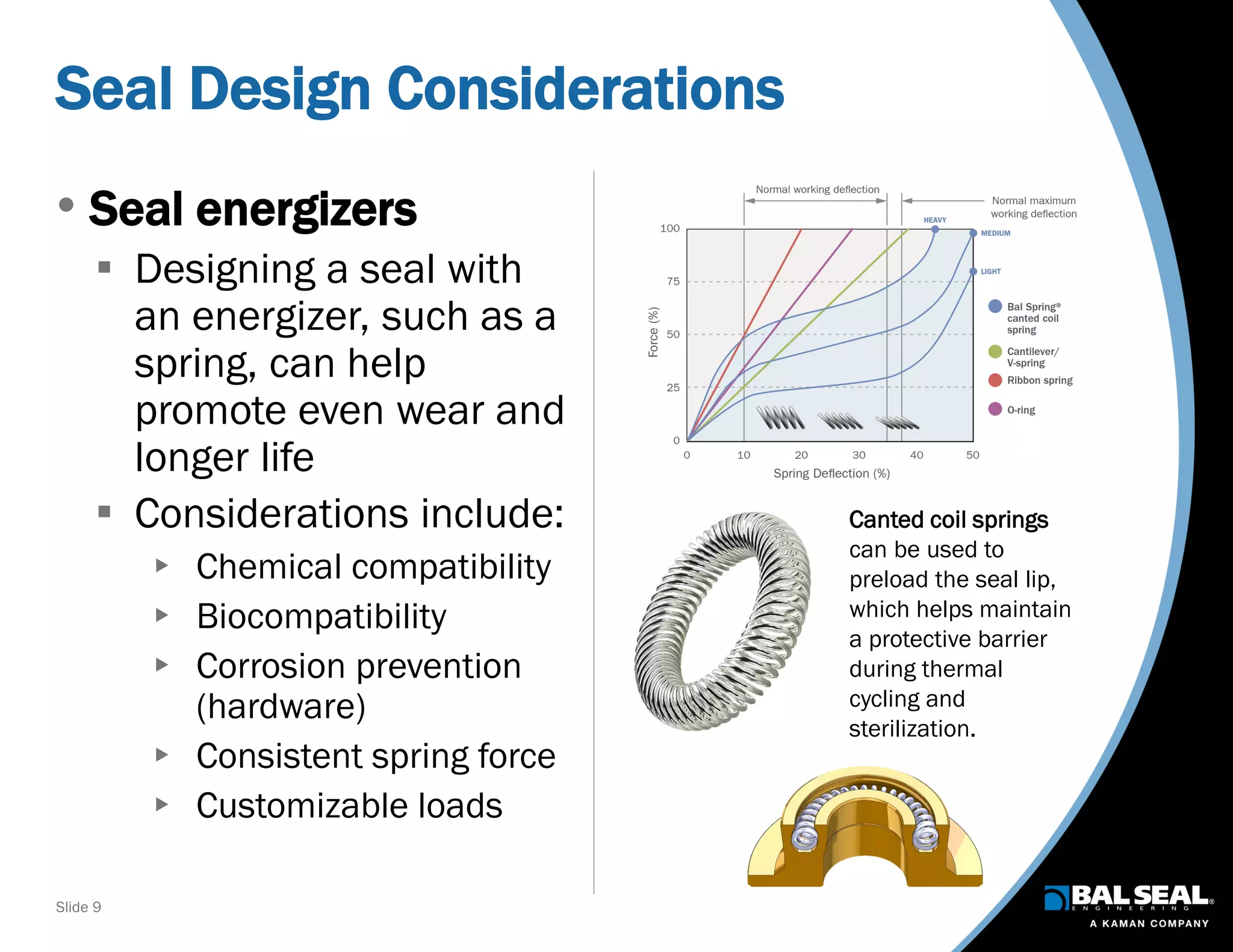
• Seal energizers
 Designing a seal with
an energizer, such as a
spring, can help
promote even wear and
longer life
 Considerations include:
 Chemical compatibility
 Biocompatibility
 Corrosion prevention
(hardware)
 Consistent spring force
 Customizable loads
Canted coil springs
can be used to
preload the seal lip,
which helps maintain
a protective barrier
during thermal
cycling and
sterilization.
Slide 10
Hardware Design Considerations
• Shaft diameter
• Material
• Surface finish
• Surface
hardness
• Tolerances
• Shaft-to-bore
misalignment
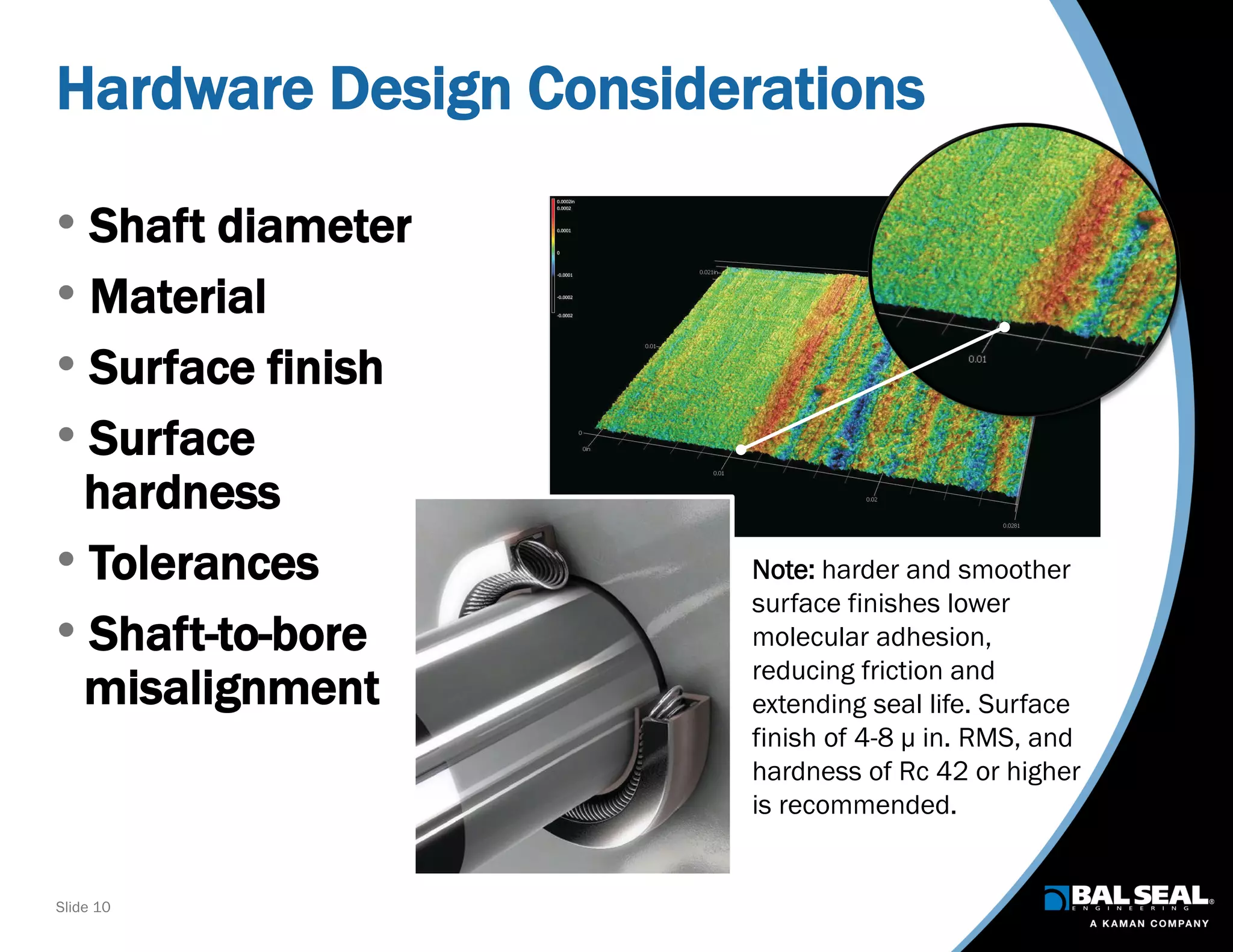
Note: harder and smoother
surface finishes lower
molecular adhesion,
reducing friction and
extending seal life. Surface
finish of 4-8 µ in. RMS, and
hardness of Rc 42 or higher
is recommended.
Slide 11
Recap: Ventilator Sealing
Success Factors
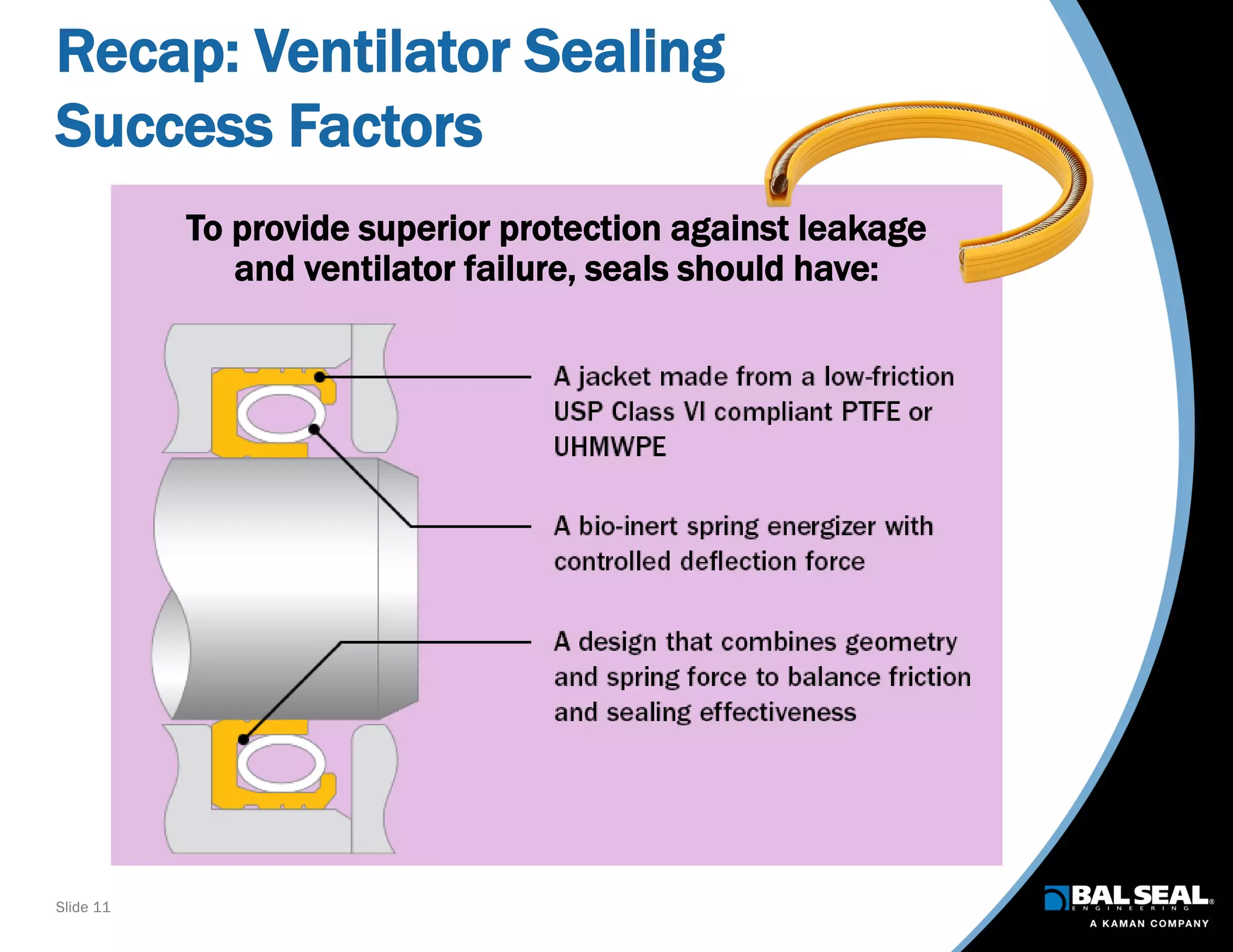
To provide superior protection against leakage
and ventilator failure, seals should have:
Slide 12
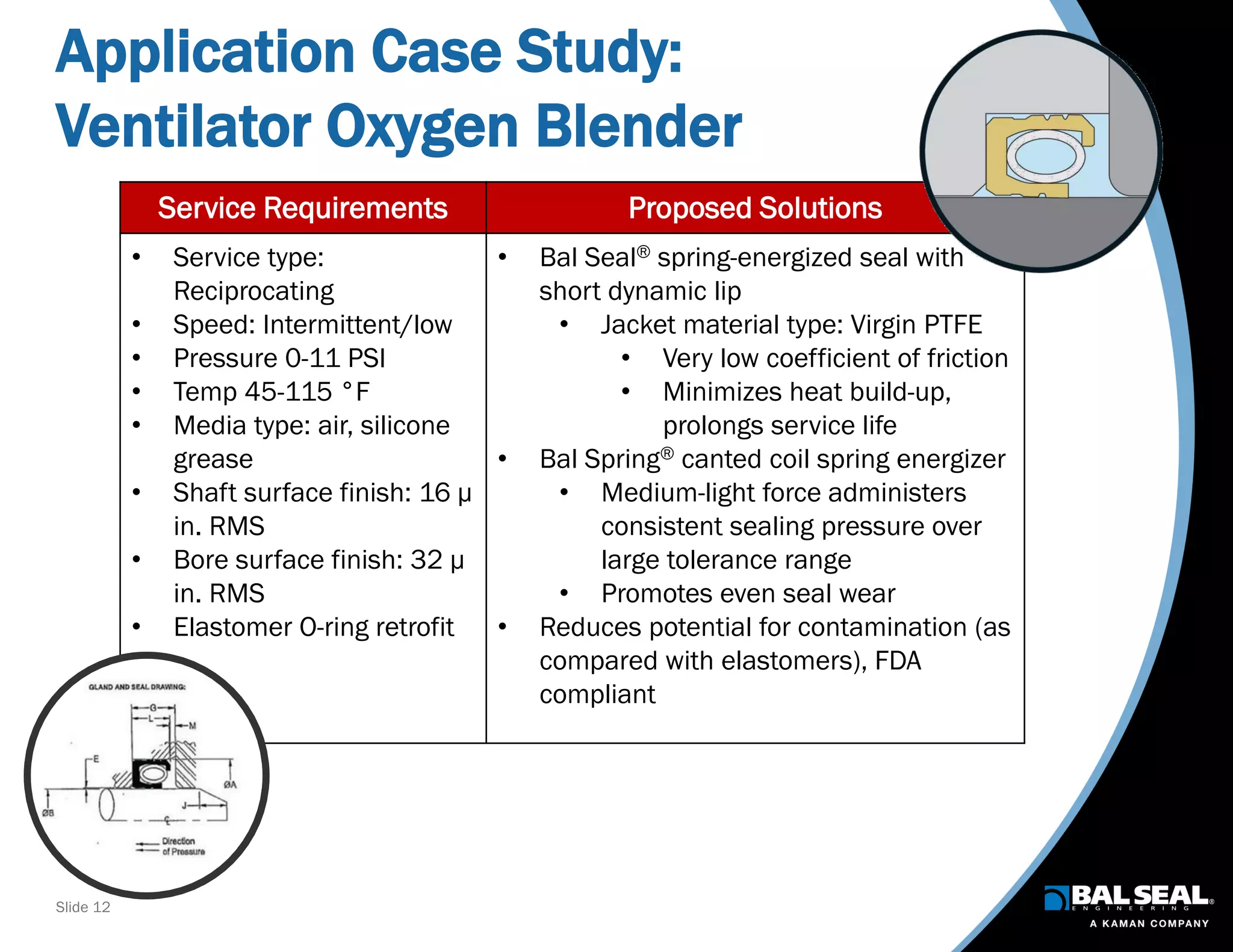
Application Case Study:
Ventilator Oxygen Blender
Service Requirements Proposed Solutions
• Service type:
Reciprocating
• Speed: Intermittent/low
• Pressure 0-11 PSI
• Temp 45-115 °F
• Media type: air, silicone
grease
• Shaft surface finish: 16 µ
in. RMS
• Bore surface finish: 32 µ
in. RMS
• Elastomer O-ring retrofit
• Bal Seal® spring-energized seal with
short dynamic lip
• Jacket material type: Virgin PTFE
• Very low coefficient of friction
• Minimizes heat build-up,
prolongs service life
• Bal Spring® canted coil spring energizer
• Medium-light force administers
consistent sealing pressure over
large tolerance range
• Promotes even seal wear
• Reduces potential for contamination (as
compared with elastomers), FDA
compliant
Slide 13
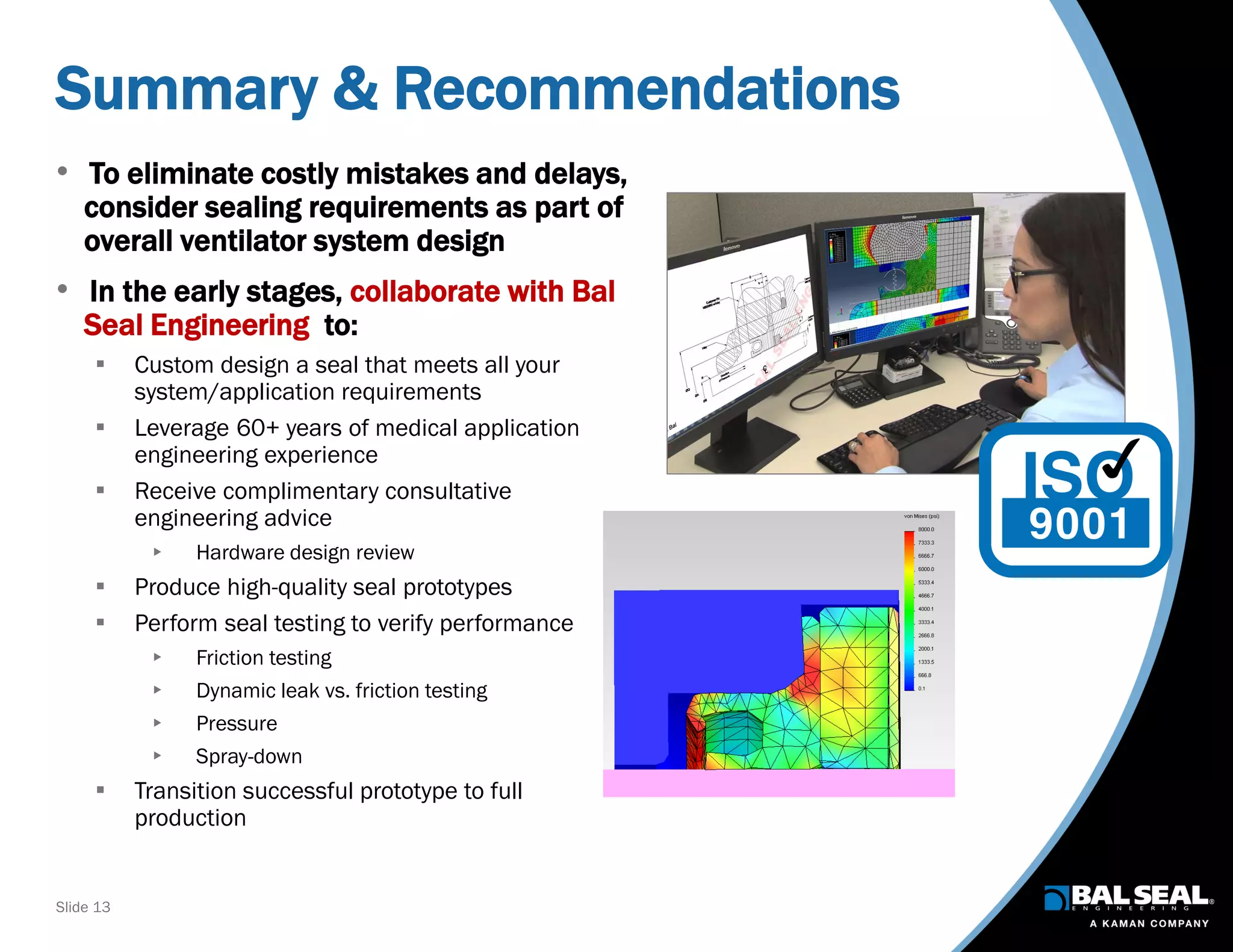
Summary & Recommendations
• To eliminate costly mistakes and delays,
consider sealing requirements as part of
overall ventilator system design
• In the early stages, collaborate with Bal
Seal Engineering to:
 Custom design a seal that meets all your
system/application requirements
 Leverage 60+ years of medical application
engineering experience
 Receive complimentary consultative
engineering advice
 Hardware design review
 Produce high-quality seal prototypes
 Perform seal testing to verify performance
 Friction testing
 Dynamic leak vs. friction testing
 Pressure
 Spray-down
 Transition successful prototype to full
production
Slide 14
More Resources & Contact Info
sales@balseal.com www.balseal.com +949 460-2100 Design request form
David Fogel
Medical Team Member/Director of Business
Development
Bal Seal Engineering
T: 949.460.2241
dfogel@balseal.com
Slide 15
September 20 © Copyright, Bal Seal Engineering, LLC. This document contains and/or refers to information that is PROPRIETARY to Bal Seal Engineering, LLC, and may not be reproduced, copied,
published, or distributed in any form or disclosed to a third party, in whole or in part, without the written authorization of an officer of Bal Seal Engineering, LLC. Products are the subject of issued or pending
United States and foreign patents. Products of Bal Seal Engineering, LLC and this document are PROPRIETARY and products may not be manufactured, or caused to be manufactured, by any other party.

Optimizing Seal Design for Improved Medical Ventilator Life & Performance

  • 1.
    David Fogel Business DevelopmentDirector Bal Seal Engineering www.balseal.com
  • 2.
    Slide 2 Medical Ventilators •Provide artificial respiratory assistance to patients suffering from a broad range of illnesses  Critical to respiratory care and recovery  Vital tools in the fight against COVID-19 • Types include:  Volume-cycled  Pressure-cycled  Combination volume/pressure cycled  Invasive & non-invasive • Function to control flow rate, FiO2 and PEEP
  • 3.
    Slide 3 Ventilator EquipmentProfiles • Applications  Neonatal, child, adult, ICU, portable, at-home, emergency transport/mass- casualty care • Systems & components  Pumps, valves, blenders, nebulizers, gas filters, concentrators, HMEs (heat and moisture exchangers), compressors  I/E Channels  Hoses, tubing connectors, inlet fittings, water traps, more • Modified ventilation equipment  Anesthesia gas machines, positive pressure breathing devices, CPAP machines, BiPAP/BPAP
  • 4.
    Slide 4 Ventilator OperatingRequirements • Doctors and patients rely on ventilators to:  Run reliably for 1000s of hours between maintenance cycles  Comply with FDA requirements for biocompatibility  Deliver consistent volume and dosing in varying temperatures and humidity levels  41-104°F (5-40 °C) @ 0~95% RH (noncondensing)  Prevent leakage/ingress and contamination that could compromise patient outcomes  Withstand multiple reprocessing/sterilization cycles  Pasteurization (169-174°F/76 to 79°C)  Autoclave (270°F/132°C)  Heat, steam, moisture  Gamma radiation  Chemical germicides & disinfectants
  • 5.
    Slide 5 Seals: CriticalVentilator Components • Protect expensive components and electronics from moisture, media, and contamination • Must meet specified minimum leakage requirements at operating temperatures and pressures • Perform in reciprocating, rotary, and static service • Seal materials must comply with FDA requirements (IEC 60601-1) and auto-ignitability standards for oxygen-rich environments • Primary seal design challenge is balancing FRICTION and sealing effectiveness to ensure:  Flow rate and gas delivery accuracy  Consistency in pressure  Equipment longevity in harsh reprocessing procedures  User and patient safety (excessive heat buildup & equipment breakdown)
  • 6.
    Slide 6 Piston sealfor constant pressure accumulator Shaft seal for ventilator pump Rod seal for oxygen blender (replacing O-ring) Piston seal & guide ring for oxygen concentrator Piston seal for booster pump/nebulizer Typical Ventilator Seal Applications
  • 7.
    Slide 7 Seal DesignConsiderations • Geometry  Seal shape can be leveraged to manage the leakage/friction trade-off  Shorter dynamic lip reduces friction  Longer dynamic lip increases contact area  Flange design provides secondary OD seal  Locking rings can help retain seal through temperature cycling and pressure LC Metal locking ring Flange design Symmetrical lip design
  • 8.
    Slide 8 Seal DesignConsiderations • Jacket materials  Seal material choice may have the biggest impact on friction  Polytetrafluoroethylene (PTFE) and ultra-high molecular weight polyethylene (UHMW PE provide superior performance in sealing applications  PTFE materials (virgin or filled)  High chemical resistance  Low coefficient of friction  USP Class VI or FDA compatible material  Low moisture absorption  UHMW PE materials (virgin or filled)  FDA compatible material for biocompatibility  Higher resistance to wear and extrusion in aqueous media
  • 9.
    Slide 9 Seal DesignConsiderations • Seal energizers  Designing a seal with an energizer, such as a spring, can help promote even wear and longer life  Considerations include:  Chemical compatibility  Biocompatibility  Corrosion prevention (hardware)  Consistent spring force  Customizable loads Canted coil springs can be used to preload the seal lip, which helps maintain a protective barrier during thermal cycling and sterilization.
  • 10.
    Slide 10 Hardware DesignConsiderations • Shaft diameter • Material • Surface finish • Surface hardness • Tolerances • Shaft-to-bore misalignment Note: harder and smoother surface finishes lower molecular adhesion, reducing friction and extending seal life. Surface finish of 4-8 µ in. RMS, and hardness of Rc 42 or higher is recommended.
  • 11.
    Slide 11 Recap: VentilatorSealing Success Factors To provide superior protection against leakage and ventilator failure, seals should have:
  • 12.
    Slide 12 Application CaseStudy: Ventilator Oxygen Blender Service Requirements Proposed Solutions • Service type: Reciprocating • Speed: Intermittent/low • Pressure 0-11 PSI • Temp 45-115 °F • Media type: air, silicone grease • Shaft surface finish: 16 µ in. RMS • Bore surface finish: 32 µ in. RMS • Elastomer O-ring retrofit • Bal Seal® spring-energized seal with short dynamic lip • Jacket material type: Virgin PTFE • Very low coefficient of friction • Minimizes heat build-up, prolongs service life • Bal Spring® canted coil spring energizer • Medium-light force administers consistent sealing pressure over large tolerance range • Promotes even seal wear • Reduces potential for contamination (as compared with elastomers), FDA compliant
  • 13.
    Slide 13 Summary &Recommendations • To eliminate costly mistakes and delays, consider sealing requirements as part of overall ventilator system design • In the early stages, collaborate with Bal Seal Engineering to:  Custom design a seal that meets all your system/application requirements  Leverage 60+ years of medical application engineering experience  Receive complimentary consultative engineering advice  Hardware design review  Produce high-quality seal prototypes  Perform seal testing to verify performance  Friction testing  Dynamic leak vs. friction testing  Pressure  Spray-down  Transition successful prototype to full production
  • 14.
    Slide 14 More Resources& Contact Info sales@balseal.com www.balseal.com +949 460-2100 Design request form David Fogel Medical Team Member/Director of Business Development Bal Seal Engineering T: 949.460.2241 dfogel@balseal.com
  • 15.
    Slide 15 September 20© Copyright, Bal Seal Engineering, LLC. This document contains and/or refers to information that is PROPRIETARY to Bal Seal Engineering, LLC, and may not be reproduced, copied, published, or distributed in any form or disclosed to a third party, in whole or in part, without the written authorization of an officer of Bal Seal Engineering, LLC. Products are the subject of issued or pending United States and foreign patents. Products of Bal Seal Engineering, LLC and this document are PROPRIETARY and products may not be manufactured, or caused to be manufactured, by any other party.